
| REPORT ATTRIBUTE | DETAILS |
|---|---|
| Historical Period | 2019-2022 |
| Base Year | 2023 |
| Forecast Period | 2024-2032 |
| Acrylic Acid Market Size 2023 | USD 11,548.5 Million |
| Acrylic Acid Market, CAGR | 3.80% |
| Acrylic Acid Market Size 2032 | USD 16,154.80 Million |
Market Insights
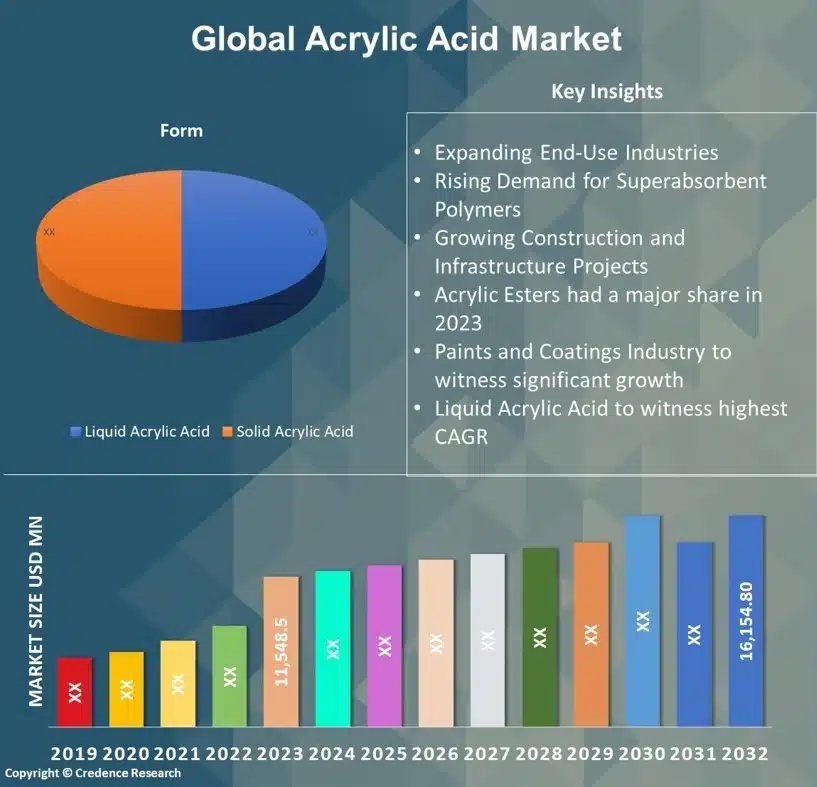
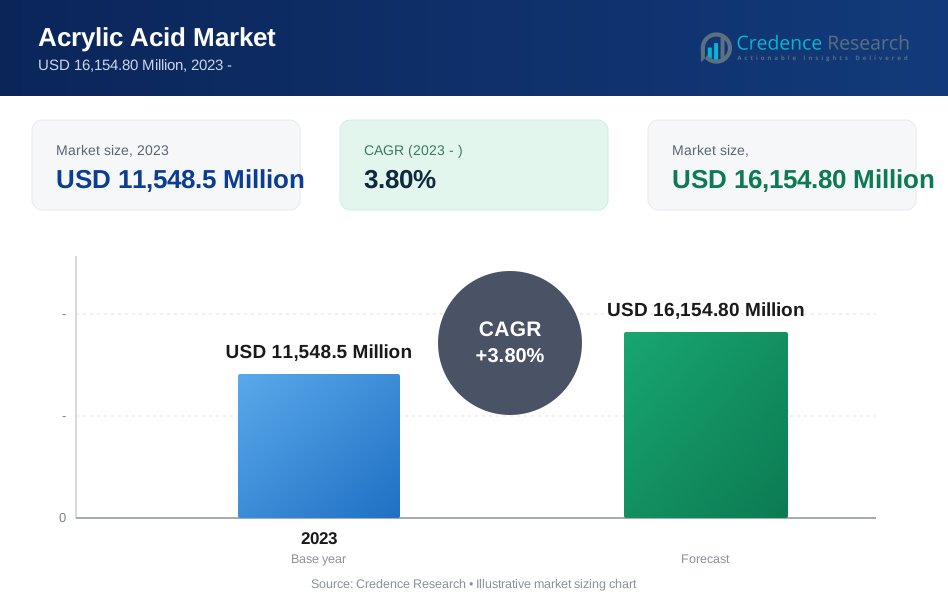
- The global demand for Acrylic Acids was valued at USD 11,548.5 Million in 2023 and is expected to reach USD 16,154.80 Million in 2032, growing at a CAGR of 3.80% between 2024 and 2032.
- The Acrylic Esters sector is the market leader by derivative type, accounting for more than 31% of total value in 2023, while the Superabsorbent Polymers segment is expected to grow rapidly throughout the forecast period.
- The Paints and Coatings industry dominates the global need for Acrylic Acids, accounting for more than 25% in 2023 and Textiles Industry is predicted to expand at a high CAGR.
- The Solid Acrylic Acid sector is predicted to grow fastest over the projection period, while the Liquid Acrylic Acid segment will have a market share of more than 50% in 2023.
- Over the projection period, the Esterification category is expected to expand at the highest rate, while the Direct Synthesis category will dominate the market in 2023 with a 30% share.
- The Oxidation of Acrolein category is expected to expand quickly over the forecast period, while the Oxidation of Propylene segment will have the greatest market share in 2023.
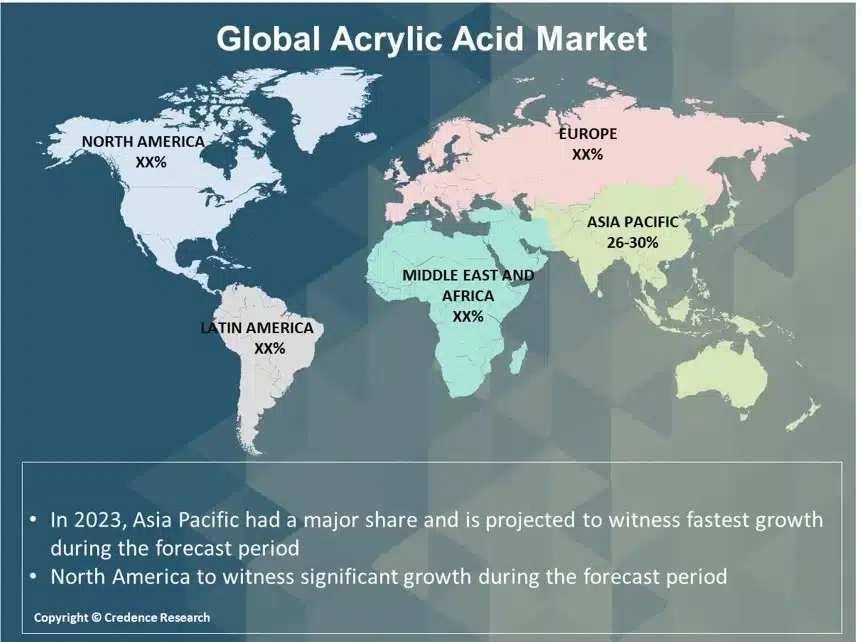
- Asia Pacific is fueling the growth of the Acrylic Acid industry with over one-third share in 2023, while North America and Europe collectively account for just under 55% share in 2023. Europe held over 30% share in 2023.
- Due to the growth in end-use industries such as adhesives, superabsorbent polymers, surface coatings, and textiles, which are major contributors to the increasing demand for acrylic acid.
- The market's primary possibilities include the significant growth potential in Asia Pacific, increased construction and infrastructure projects in the region.
Executive Summary
Market Definition
Acrylic acid is an organic compound with the chemical formula CH2=CHCOOH. It is a clear, colorless liquid characterized by a sharp, pungent odor. Acrylic acid is a versatile monomer and a key building block in the production of various polymers and resins. Its chemical structure contains a carbon-carbon double bond (C=C) and a carboxylic acid group (–COOH). Acrylic acid is widely used in the manufacturing of polymers, particularly in the production of acrylic polymers and superabsorbent polymers. These polymers find applications in a range of industries, including adhesives, sealants, coatings, textiles, and personal care products. Due to its reactivity and ability to polymerize, acrylic acid serves as a crucial ingredient in the synthesis of materials with diverse properties, such as flexibility, adhesion, and water absorption.
Market Overview
The global Acrylic Acid market has witnessed steady growth in recent years and is expected to grow at a CAGR of 3.80% between 2024 and 2032. The market was valued at USD 11,548.5 million in 2023 and is expected to reach USD 16,154.80 million in 2032.
The key driver boosting the growth rate of the Acrylic Acid market is the rising demand for things such as diapers and adult incontinence products, where acrylic acid plays a key role in making superabsorbent polymers. These special polymers soak up liquids, making products more effective and comfortable. Another important factor pushing the acrylic acid market is the construction and infrastructure boom happening globally. From building houses to massive projects, acrylic acid is in demand for making strong adhesives, sealants, and coatings that keep things together and protected.
Moreover, the shift towards eco-friendly products is making water-based adhesives popular, and acrylic acid is right in the mix. Companies and consumers alike are choosing water-based adhesives as they are better for the environment. This is all part of a larger trend where people are becoming more aware of environmental issues.
Segmentation by Derivative Type
- Acrylic Esters (Butyl Acrylate, Ethyl Acrylate, Methyl Acrylate, etc.) is the leading segment by derivative type and held over 31% share in value in 2023, attributable to the increased awareness of personal hygiene and health, driving the demand for acrylic acid in products like sanitary napkins and personal care items.
- The Superabsorbent Polymers (SAP) segment will likely exhibit a significant CAGR during the forecast period. Using the various end-use industries such as adhesives, superabsorbent polymers, surface coatings, and textiles, which are major contributors to the increasing demand for acrylic acid.
- Acrylic Polymers (Polyacrylic Acid), and Others are another segments but contributes very little to the global Acrylic Acid market compared to the Acrylic Esters, and Superabsorbent Polymers segments.
Segmentation by End-User Industries
- The Paints and Coatings Industry segment governs the demand for Acrylic Acids in the world, holding a massive share of over 25% in 2023, and Textiles Industry is expected to grow at a rapid CAGR due to the rising demand for acrylic acid in applications like adhesives, sealants, and coatings.
- The Personal Care and Hygiene Industry segment contributes to the demand for Acrylic Acids.
Segmentation by Form
- The Solid Acrylic Acid segment is expected to post the highest CAGR during the forecast period. This is primarily due to technological advancements in surface coating formulations, where acrylic acid is often used for its durability and protective properties.
- The Liquid Acrylic Acid segment is leading the market share with over 50% share in 2023.
Segmentation by Application Methods
- The Direct Synthesis segment is anticipated to register the highest CAGR during the projection period.
- With a market share of nearly 30% in 2023, the Esterification category is currently in the lead.
Segmentation by Production Process
- The Oxidation of Propylene dominate the global need for Acrylic Acids, accounting for more than 50% in 2023 and are predicted to expand at a high CAGR.
- The rest of the demand for Acrylic Acids comes from the Oxidation of Acrolein, and others segment.
Segmentation by Region
- Asia Pacific is fueling the growth of the Acrylic Acid industry with over one-third share in 2023 due to the region's expanding automotive and consumer electronics industries and increased disposable income.
- North America and Europe collectively account for just under 55% share in 2023, with Europe holding over 30% share in the same year.
- The rest of the world, including Latin America, the Middle East, and Africa, supplies the remaining demand for Acrylic Acid.
The market for Acrylic Acids is driven by rising smartphone usage and greater adoption of Acrylic Acid connectivity due to growth in end-use industries such as adhesives, superabsorbent polymers, surface coatings, and textiles, which are major contributors to the increasing demand for acrylic acid.
The Asia Pacific region is a significant player in the acrylic acid market, experiencing robust growth driven by expanding industries and increasing infrastructure projects. Countries like China, India, and Japan are witnessing a surge in demand for acrylic acid due to booming construction activities, particularly in residential and commercial sectors. The automotive industry in this region is also contributing to the market growth, with acrylic acid being utilized in coatings and adhesives. Additionally, the rise in disposable income and awareness of personal hygiene products, such as diapers, is fueling the demand for superabsorbent polymers, a key application of acrylic acid. The dynamic economic landscape, coupled with a growing population, positions the Asia Pacific as a pivotal region for the continued expansion of the acrylic acid market. As per the Ministry of Economy, Trade, and Industry in Japan, the production volume of synthetic resin paints in the country reached approximately 1.01 million metric tons in 2021, contributing significantly to the overall paint production volume, which rose to nearly 1.53 million metric tons. This marked an increase from the 1.50 million metric tons recorded in 2020. The robust production figures indicate the substantial role of the paints industry in Japan, particularly in the synthetic resin paints segment.
The Europe is expected to be the fastest-growing region over the forecast period. Key factors for the market growth includes a well-established industrial base, technological advancements, and a focus on sustainable practices. The construction and automotive industries play a vital role in these regions, utilizing acrylic acid in coatings, sealants, and adhesives for diverse applications. Moreover, the demand for eco-friendly products and water-based adhesives is gaining traction in response to stringent environmental regulations. The mature markets in North America and Europe also witness a steady demand for acrylic acid in the production of specialty polymers and textiles. As consumers in these regions increasingly prioritize sustainable and high-performance materials, the acrylic acid market is expected to continue its growth trajectory, with innovation and environmental considerations shaping the industry landscape.
The primary factor driving the Acrylic Acid market's growth rate is the growth in the automotive sector, where acrylic acid is used in adhesives, sealants, and coatings for applications ranging from interior components to exterior finishes.
Furthermore, the growth in end-use industries such as adhesives, superabsorbent polymers, surface coatings, and textiles, which are major contributors to the increasing demand for acrylic acid.
Key Highlights of the Report
The global Acrylic Acid market is segmented by derivative type, end user industry, form, application methods, production process, and region. Acrylic Esters (Butyl Acrylate, Ethyl Acrylate, Methyl Acrylate, etc.)-based Acrylic Acids are the most popular, while Superabsorbent Polymers (SAP) are the primary segments. In addition, paints and coatings industry and textiles industry are the most common industry. However, liquid acrylic acid and direct synthesis dominate the market, with North America leading the market growth.
One of the main factors propelling the global market for Acrylic Acids is the surge in demand for superabsorbent polymers in products like diapers and adult incontinence products, where acrylic acid is a key component. Furthermore, the growth in global construction and infrastructure development on the demand for acrylic acid in applications such as adhesives, sealants, and coatings.
Nonetheless, North America is anticipated to have the greatest share of the global Acrylic Acid market due to the technological advancements in surface coating formulations, where acrylic acid is often used for its durability and protective properties. Furthermore, the market is anticipated to expand at the highest rate in the North America region due to the shift towards environmentally friendly and water-based adhesives, where acrylic acid-based polymers play a crucial role, driven by regulatory trends and sustainability goals. In the United States, data from the American Coatings Association (Coatings Tech) reveals that the paints and coatings industry generated USD 25.21 billion in 2020, with expectations to reach USD 28.06 billion by 2022. Similarly, in terms of volume, the industry measured 1,337 million gallons in 2020, projected to increase to 1,416 million gallons by 2022. This growth trend indicates a rising demand for acrylic acid from the paints and coatings sector in the United States, reflecting the industry's expansion and the increasing use of acrylic-based products in the country.
What Are The Main Drivers Of The Global Acrylic Acid Market?
The primary drivers of the global acrylic acid market include the increasing demand for superabsorbent polymers, particularly in products like diapers and adult incontinence items. Acrylic acid is a key component in these polymers, driving growth as awareness of personal hygiene rises worldwide. Additionally, the booming construction and infrastructure projects globally contribute significantly to the demand for acrylic acid, used in adhesives, sealants, and coatings. The shift towards water-based adhesives, driven by environmental concerns and sustainability, is another key driver. As industries seek eco-friendly solutions, acrylic acid's role in these adhesives aligns with the growing demand for greener alternatives.
What Are The Major Challenges Faced By The Global Acrylic Acid Market?
The global acrylic acid market faces several challenges, including fluctuations in raw material prices. The cost and availability of raw materials directly impact production costs, affecting the profit margins of manufacturers. Another challenge is the competitive landscape, with multiple players vying for market share. Adherence to stringent environmental regulations and the need for sustainable practices pose challenges, requiring industry players to adapt and innovate. The market must also contend with technological advancements, as continuous improvements may necessitate upgrades to production processes. Additionally, economic uncertainties and global geopolitical factors can influence market dynamics, posing challenges for the acrylic acid industry.
What Are The Growth Opportunities In The Global Acrylic Acid Market?
The global acrylic acid market presents growth opportunities, particularly with the rising demand for eco-friendly products. Water-based adhesives, driven by environmental considerations, offer a significant growth avenue. The expansion of end-use industries, such as automotive and textiles, presents opportunities for increased applications of acrylic acid. Innovations in product formulations and processes, including biotechnological advancements, can contribute to improved efficiency and sustainability, opening new avenues for market growth. The global push for sustainable practices and green technologies positions acrylic acid as a key player in providing solutions that cater to both industry needs and environmental concerns.
Market Drivers
The global Acrylic Acid market is driven by several factors. The following are the key drivers of the global Acrylic Acid market:
Increasing Demand for Superabsorbent Polymers
The escalating demand for superabsorbent polymers, particularly in personal hygiene products like diapers and adult incontinence items, serves as a major driver propelling the growth of the global acrylic acid market. Acrylic acid plays a crucial role in the production of these polymers, meeting the rising global awareness of personal hygiene and contributing significantly to market expansion. As per the International Finance Corporation, the global water sector is anticipated to witness a slowdown in investments due to the impact of the COVID-19 crisis. A survey by the Global Water Leaders Group indicates that the outbreak is likely to result in a approximately 27% reduction in industrial water demand. Consequently, the demand for water treatment chemicals in the water sector is expected to decrease, exerting a negative influence on the acrylic acid market.
Market Restraints
The global Acrylic Acid market faces some challenges that may hinder its growth. These include the following:
Fluctuations in Raw Material Prices
Fluctuations in the prices of raw materials used in acrylic acid production pose a significant restraint for the global market. The cost and availability of these raw materials directly impact production costs, affecting profit margins for manufacturers. The acrylic acid market needs to navigate these fluctuations effectively to ensure stability and sustained growth.
Opportunities
The global Acrylic Acid market offers significant growth opportunities. These include the following:
Growing Demand for Water-Based Adhesives
The increasing demand for eco-friendly products provides a notable opportunity for the global acrylic acid market. As environmental concerns drive industries towards sustainable practices, the adoption of water-based adhesives, in which acrylic acid plays a pivotal role, presents a promising growth avenue. This shift aligns with the global trend towards greener alternatives, creating opportunities for market players to meet the demand for environmentally friendly solutions.
Competitive Landscape
Key Players
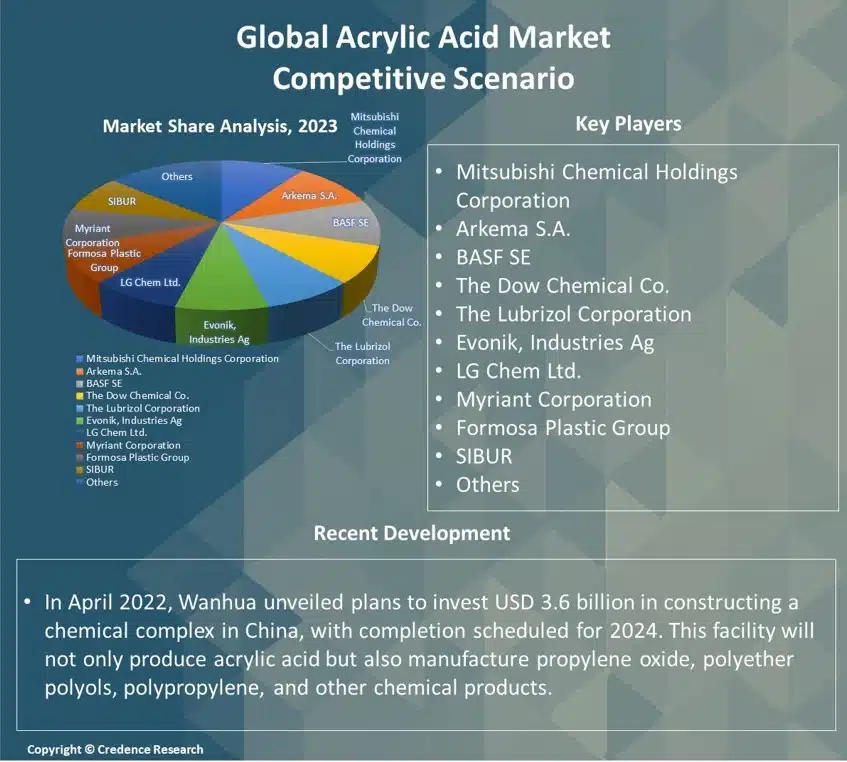
The global Acrylic Acid market is highly competitive, with several key players. Some of the major players in the market and their market share are as follows:
- Mitsubishi Chemical Holdings Corporation
- Arkema S.A.
- BASF SE
- The Dow Chemical Co.
- The Lubrizol Corporation
- Evonik, Industries Ag
- LG Chem Ltd.
- Myriant Corporation
- Formosa Plastic Group
- SIBUR
- Others
These organizations prioritize product innovation, distribution channel expansion, and mergers and acquisitions to stay competitive.
The global Acrylic Acid market's key players continually seek to stay ahead by offering new products and developments.
In April 2022, Wanhua unveiled plans to invest USD 3.6 billion in constructing a chemical complex in China, with completion scheduled for 2024. This facility will not only produce acrylic acid but also manufacture propylene oxide, polyether polyols, polypropylene, and other chemical products.
In August 2021, BASF SE and SINOPEC jointly decided to expand their Verbund site operated by BASF-YPC Co. Ltd, a 50-50 joint venture based in Nanjing, China. The expansion encompasses the increased capacity of various downstream chemical plants, including the establishment of a new tert-Butyl acrylate plant aimed at supporting the burgeoning Chinese market. This plant is an extension to the existing Verbund and utilizes acrylic acid and isobutene from the upstream processes as feedstock.
Summary of Key Findings
- The demand for interface cables is rising demand for superabsorbent polymers, particularly in personal hygiene products like diapers and adult incontinence items, serves as a major driver propelling the growth of the global acrylic acid market.
- Market segmented by derivative type, end user industry, form, application methods, production process, and region.
- Acrylic Esters-based Acrylic Acids are the most popular, with Superabsorbent Polymers (SAP), and Acrylic Polymers (Polyacrylic Acid) sectors as primary user segments.
- Paints and coatings industry, and textiles industry are most commonly used for devices.
- North America is leading market growth; the market is highly competitive with key players including Mitsubishi Chemical Holdings Corporation, Arkema S.A., BASF SE, The Dow Chemical Co., The Lubrizol Corporation, Evonik, Industries Ag, LG Chem Ltd., Myriant Corporation, Formosa Plastic Group, SIBUR, and Others.
Future Outlook
- Positive outlook for the global acrylic acid market with significant growth potential in the North American region.
- One of the main factors promoting the market's expansion is the government and business sectors' current reliance on Acrylic Acids.
- During the forecast period, rices of raw materials used in acrylic acid production pose a significant restraint for the global market.
- Key firms must focus on product innovation, growing market reach, and maintaining competitive pricing to keep ahead of the competition.
How CXOs Can Benefit from the Credence Research Acrylic Acid Market Report
The Credence Research Acrylic Acid Market Report provides CXOs with a comprehensive overview of the market, including:
- Market size and growth forecast: The report provides detailed estimates of the global Acrylic Acid market size, segmented by derivative type, end user industry, form, application methods, production process, and region. It also includes forecasts for the market through 2032, based on key trends and drivers.
- Market segmentation: The report segments the Acrylic Acid market by derivative type, end user industry, form, application methods, production process, and region. This segmentation provides CXOs with a granular understanding of the market and the opportunities in each segment.
- Competitive landscape: The report profiles the key players in the Acrylic Acid market and provides insights into their strategies, product offerings, and financial performance. This information can help CXOs to identify and assess their competition.
- Key trends and drivers: The report identifies and analyzes the key trends and drivers that are shaping the Acrylic Acid This information can help CXOs to make informed decisions about their investments and strategies.
CXOs can use the insights from the Credence Research Acrylic Acid Market Report to:
- Identify growth opportunities: The report can help CXOs to identify new growth opportunities in the Acrylic Acid For example, the report identifies the growing demand for Acrylic Acid from paints and coatings industry, and textiles industry as a key opportunity.
- Make informed investment decisions: The report can help CXOs to make informed investment decisions about Acrylic Acid. For example, the report provides insights into the key factors to consider when evaluating Acrylic Acid providers and selecting Acrylic Acid
- Develop competitive strategies: The report can help CXOs to develop competitive strategies for their Acrylic Acid For example, the report identifies the key strategies that Acrylic Acid providers are using to differentiate themselves from their competitors.
- Track market developments: The report can help CXOs to track market developments and stay ahead of the curve. For example, the report provides insights into the latest trends and innovations in the Acrylic Acid
Overall, the Credence Research Acrylic Acid Market Report is a valuable resource for CXOs who are looking to gain a deeper understanding of the market and identify opportunities for growth.
Segmentation
- By Derivative Type
- Acrylic Esters (Butyl Acrylate, Ethyl Acrylate, Methyl Acrylate, etc.)
- Superabsorbent Polymers (SAP)
- Acrylic Polymers (Polyacrylic Acid)
- Others
- By End User Industries
- Paints and Coatings Industry
- Textiles Industry
- Personal Care and Hygiene Industry
- Water Treatment Industry
- Others
- By Form
- Liquid Acrylic Acid
- Solid Acrylic Acid
- By Application Methods
- Direct Synthesis
- Esterification
- Amidation
- Others
- By Production Process
- Oxidation of Propylene
- Oxidation of Acrolein
- Others
- By Region
- North America
- The U.S.
- Canada
- Mexico
- Europe
- Germany
- France
- The U.K.
- Italy
- Spain
- Rest of Europe
- Asia Pacific
- China
- Japan
- India
- South Korea
- South-east Asia
- Rest of Asia Pacific
- Latin America
- Brazil
- Argentina
- Rest of Latin America
- Middle East & Africa
- GCC Countries
- South Africa
- Rest of Middle East and Africa
- North America
Request a Free Sample
Fill in your details and we'll send you a free sample report.
- Sample data tables & charts
- Research methodology
Need a Custom Version of This Report?
Tailor the scope, geography, or segments to your exact requirements.
- Custom geography or segment scope
- Direct access to our analyst team
Frequently Asked Questions
What is the current size of the global Acrylic Acid market?
What is the expected growth rate of the Acrylic Acid market between 2024 and 2032?
Which segment is leading the market share in terms of derivative type?
Which end user industry segment governs the demand for Acrylic Acids in the world?
Who are the major players in the global Acrylic Acid market?
Table of Content
Chapter 1. Report Introduction
- 1.1 Report Description & Purpose
- 1.1.1 Report Title & Market Definition
- 1.1.2 Unique Selling Propositions (USP) & Key Differentiators
- 1.1.3 Value Proposition for Stakeholders
- 1.2 Research Objectives
- 1.2.1 Market Sizing Objectives (Volume & Revenue)
- 1.2.2 Segmentation Objectives
- 1.2.3 Competitive Intelligence Objectives
- 1.2.4 Forecast & Scenario Objectives
- 1.3 Report Scope
- 1.3.1 Acrylic Acid Scope – Types & Subtypes Covered
- 1.3.2 Geographic Scope – Regions & Countries Covered
- 1.3.3 Historical Period, Base Year & Forecast Period (2023; forecast to the forecast period)
- 1.3.4 Inclusions & Exclusions
- 1.4 HS Code & Classification Framework
- 1.5 Currency, Units & Pricing Basis
- 1.6 Target Stakeholders
- 1.7 Limitations & Assumptions
Chapter 2. Executive Summary
- 2.1 Global Acrylic Acid Market Snapshot
- 2.1.1 Market Size – Historical (2023) & Forecast (the forecast period) (2023: USD 11,548.5 Million → forecast year: USD 16,154.80 Million)
- 2.1.2 Volume & Revenue – Global Totals
- 2.1.3 Key Market Highlights – Top Five Facts
- 2.2 Acrylic Acid Market Segmentation Snapshot
- 2.2.1 Market Split by Region – 2023 vs.
- 2.3 Competitive Snapshot
- 2.3.1 Top 10 Players by Revenue Share – 2023
- 2.3.2 Top 10 Players by Volume Share – 2023
- 2.3.3 Recent Strategic Developments (18-Month Summary)
- 2.4 Key Investment Highlights & Strategic Conclusions
Chapter 3. Acrylic Acid Market Dynamics & Industry Analysis
- 3.1 Market Overview & Context
- 3.1.1 Acrylic Acid Market Position in the Broader Automotive Value Chain
- 3.1.2 OEM vs. Replacement Market Dynamics
- 3.1.3 Market Maturity & Development Stage by Region
- 3.2 Acrylic Acid Market Drivers
- 3.3 Acrylic Acid Market Restraints & Challenges
- 3.4 Acrylic Acid Market Opportunities
- 3.5 Porter's Five Forces Analysis
- 3.5.1 Threat of New Entrants
- 3.5.2 Bargaining Power of Suppliers
- 3.5.3 Bargaining Power of Buyers
- 3.5.4 Threat of Substitutes
- 3.5.5 Competitive Rivalry – Intensity Assessment
- 3.6 Acrylic Acid Value Chain Analysis
- 3.6.1 Upstream – Raw Material/Input Suppliers
- 3.6.1.1 Raw Material/Input 1
- 3.6.1.2 Raw Material/Input 2
- 3.6.1.3 Raw Material/Input 3
- 3.6.2 Midstream – Production/Manufacturing/Service Delivery
- 3.6.2.1 Production/Process Overview
- 3.6.2.2 Key Facility Locations & Capacity by Manufacturer
- 3.6.3 Downstream – Distribution & End Consumer
- 3.6.3.1 Primary Channel – B2B/OEM
- 3.6.3.2 Secondary Channels – Dealer, Retail, Online, Direct
- 3.6.4 Value Chain Profitability Analysis
- 3.6.1 Upstream – Raw Material/Input Suppliers
- 3.7 PESTEL Analysis
- 3.7.1 Political Factors
- 3.7.2 Economic Factors
- 3.7.3 Social Factors
- 3.7.4 Technological Factors
- 3.7.5 Environmental Factors
- 3.7.6 Legal Factors
- 3.8 Acrylic Acid Supply Chain Analysis
- 3.8.1 Raw Material/Input Supply Risk Assessment
- 3.8.2 Manufacturing Concentration Risk (Geographic Exposure)
- 3.8.3 Trade Disruption Impact Analysis
- 3.9 Regulatory & Policy Landscape
Note: The regulatory and policy landscape section covers regulations based on their applicability to the market, Acrylic Acid category, geography, and scope of the study. Only regulatory frameworks with a material impact on operations, compliance, trade, sustainability, or market access are analyzed in detail.
Chapter 4. Key Investment Pockets & Opportunity Analysis
- 4.1 Acrylic Acid Market Attractiveness Analysis
- 4.1.1 By Region – Investment Attractiveness Matrix (Volume × CAGR)
- 4.2 Absolute Revenue Growth Opportunity
- 4.2.1 By Region – Absolute USD Growth Through the forecast period
- 4.3 Incremental Volume Opportunity
- 4.3.1 By Region – Incremental Volume Through the forecast period
- 4.3.2 Segment – Incremental Volume
- 4.4 Emerging Submarket Opportunity Deep Dive (Subject to Applicability)
- 4.5 Emerging Market Opportunity Scorecards
- 4.5.1 United States
- 4.5.2 Europe
- 4.5.3 Asia
- 4.5.4 Middle East & Africa
Note: Emerging Market Opportunity Scorecards will be included based on relevance and strategic importance. Regions listed are indicative and may vary depending on data availability and market dynamics.
Chapter 5. Acrylic Acid Import-Export Analysis & Trade Flows
- 5.1 Global Trade Overview
- 5.1.1 Global Export Value by Country (2023)
- 5.1.2 Global Export Volume by Country (2023)
- 5.1.3 Global Import Value by Country (2023)
- 5.1.4 Global Import Volume by Country (2023)
- 5.1.5 Net Trade Balance by Country (2023)
- 5.2 Export Analysis – Segment
- 5.2.1 Type 1 (HS Code)
- 5.2.2 Type 2 (HS Code)
- 5.2.3 Type 3 (HS Code)
- 5.2.4 Type 4 (HS Code)
- 5.2.5 Type 5 (HS Code)
- 5.3 Import Analysis – Segment
- 5.3.1 Type 1 (HS Code)
- 5.3.2 Type 2 (HS Code)
- 5.3.3 Type 3 (HS Code)
- 5.3.4 Type 4 (HS Code)
- 5.3.5 Type 5 (HS Code)
- 5.4 Average Unit Trade Prices
- 5.4.1 Average Export Price – Segment & Country
- 5.4.2 Average Import Price – Segment & Source Country
- 5.4.3 Price Trends (2023)
- 5.5 Key Trade Route Analysis
- 5.5.1 Trade Route 1
- 5.5.2 Trade Route 2
- 5.5.3 Trade Route 3
- 5.5.4 Trade Route 4
- 5.5.5 Trade Route 5
- 5.6 Trade Policy Impact Assessment
- 5.6.1 US Anti-Dumping & Section 301 Tariffs
- 5.6.2 EU Customs Union Impact
- 5.6.3 Major Free Trade Agreements
- 5.6.4 USMCA Rules of Origin
Note: Trade policy analysis will be included only where relevant to the Acrylic Acid market.
Chapter 6. Competitive Landscape & Company Benchmarking
- 6.1 Acrylic Acid Market Concentration & Structure
- 6.1.1 Herfindahl-Hirschman Index (HHI) – vs. 2023
- 6.1.2 Tier 1, Tier 2 & Tier 3 Market Structure
- 6.1.3 Global, Regional & Local Player Dynamics
- 6.2 Acrylic Acid Market Share Analysis – 2023
- 6.2.1 Global Revenue Share by Company
- 6.2.2 Global Volume Share by Company
- 6.2.3 Regional Revenue Share
- 6.2.4 Market Share Evolution ( vs. 2023)
- 6.2.5 OEM Segment Share by Company
- 6.2.6 Replacement Segment Share by Company
- 6.3 Production/Delivery Capacity & Facility Analysis
- 6.3.1 Global Installed Capacity
- 6.3.2 Capacity Utilization Rates
- 6.3.3 Production/Output Volume
- 6.3.4 Facility Locations & Capacity Map
- 6.3.5 Planned Capacity Additions
- 6.4 Acrylic Acid Competitive Benchmarking Matrix
- 6.4.1 Revenue, Volume, CAGR & Profitability Comparison
- 6.4.2 Channel Revenue Mix
- 6.4.3 Geographic Revenue Exposure
- 6.4.4 R&D Intensity
- 6.4.5 Sustainability Maturity
- 6.5 Strategic Developments in Acrylic Acid (Last 24 Months)
- 6.5.1 Mergers, Acquisitions & Divestments
- 6.5.2 New Acrylic Acid Launches
- 6.5.3 Facility Expansions
- 6.5.4 Strategic Alliances, Joint Ventures & Partnerships
- 6.5.5 Distribution Expansion & Market Entry
- 6.5.6 Sustainability & ESG Initiatives
- 6.6 Competitive Strategy Mapping
- 6.6.1 Leader, Challenger, Follower & Niche Classification
- 6.6.2 Pricing Strategy Comparison
- 6.6.3 Channel Strategy Matrix
Note: Strategic developments are included based on their materiality and the availability of reliable information.
Chapter 7. Global Acrylic Acid Market – By Distribution Channel
- 7.1 Segment Overview
- 7.1.1 Volume & Revenue Split by Channel (2023 & )
- 7.1.2 Channel Mix Evolution (the forecast period)
Chapter 8. Regional Market Analysis – Global Overview
- 8.1 Global Regional Overview
- 8.1.1 Regional Volume Share
- 8.1.2 Regional Revenue Share
- 8.1.3 Regional Volume by Region
- 8.1.4 Regional Revenue by Region
- 8.1.5 Regional Forecast Through the forecast period
- 8.2 Cross-Regional Segment Analysis
- 8.2.1 By Distribution Channel
- 8.2.2 By Brand/Price Tier
Chapter 9. North America Acrylic Acid Market
- 9.1 United States
- 9.2 Canada
- 9.3 Mexico
Chapter 10. Europe Acrylic Acid Market
- 10.1 Germany
- 10.2 France
- 10.3 Italy
- 10.4 United Kingdom
- 10.5 Spain
- 10.6 Poland
- 10.7 Russia
- 10.8 Netherlands
- 10.9 Belgium
- 10.10 Sweden
- 10.11 Denmark
- 10.12 Norway
- 10.13 Rest of Europe
Chapter 11. Asia Pacific Acrylic Acid Market
- 11.1 China
- 11.2 India
- 11.3 Japan
- 11.4 South Korea
- 11.5 Thailand
- 11.6 Indonesia
- 11.7 Vietnam
- 11.8 Malaysia
- 11.9 Australia
- 11.10 Rest of Asia Pacific
Chapter 12. Latin America Acrylic Acid Market
- 12.1 Brazil
- 12.2 Argentina
- 12.3 Colombia
- 12.4 Chile
- 12.5 Rest of Latin America
Chapter 13. Middle East Acrylic Acid Market
- 13.1 Saudi Arabia
- 13.2 United Arab Emirates
- 13.3 Turkey
- 13.4 Israel
- 13.5 Iran
- 13.6 Rest of the Middle East
Chapter 14. Africa Acrylic Acid Market
- 14.1 South Africa
- 14.2 Egypt
- 14.3 Nigeria
- 14.4 Morocco
- 14.5 Rest of Africa
Chapter 15. Acrylic Acid Company Profiles
- 15.1 [Company 01]
- 15.1.1 Company Overview
- 15.1.2 Key Management Personnel
- 15.1.3 Products & Services Portfolio
- 15.1.4 Financial Performance
- 15.1.5 Key Market Focus & Geographic Presence
- 15.1.6 Recent Developments & Strategic Initiatives
Note: The company profile list is preliminary and may change based on research findings, market developments, data availability, and client requirements.
Chapter 16. Appendices
- Appendix A – List of Abbreviations & Acronyms
- Appendix B – Industry Classification Code Reference – Full Series
- Appendix C – Production & Capacity Data Tables
- Appendix D – End-Use & Demand Base Tables
- Appendix E – Consumption & Replacement Rate Assumptions
- Appendix F – ASP Reference Tables
- Appendix G – Manufacturing & Facility Database
- Appendix H – Import-Export Data Tables
- Appendix I – Regulatory Summary Tables
- Appendix J – Primary Research Participant List (Anonymized)
- Appendix K – Primary Research Questionnaire Framework
- Appendix L – Data Sources & Bibliography
- Appendix M – Market Size Divergence & Source Comparison
Chapter 17. Research Methodology
- 17.1 Research Framework & Philosophy
- 17.2 Secondary Research – Sources, Hierarchy & Data Extraction
- 17.3 Data Modeling – Bottom-Up & Top-Down Market Sizing
- 17.4 Primary Research – Stakeholder Framework, LOI & Sample Sizes
- 17.5 Forecast Methodology – Regression, Scenario & Sensitivity Analysis
- 17.6 Quality Control – Four-Layer Validation Framework
- 17.7 Limitations & Standard Assumptions
- 17.8 Disclaimer
