
| REPORT ATTRIBUTE | DETAILS |
|---|---|
| Historical Period | 2019-2022 |
| Base Year | 2023 |
| Forecast Period | 2024-2032 |
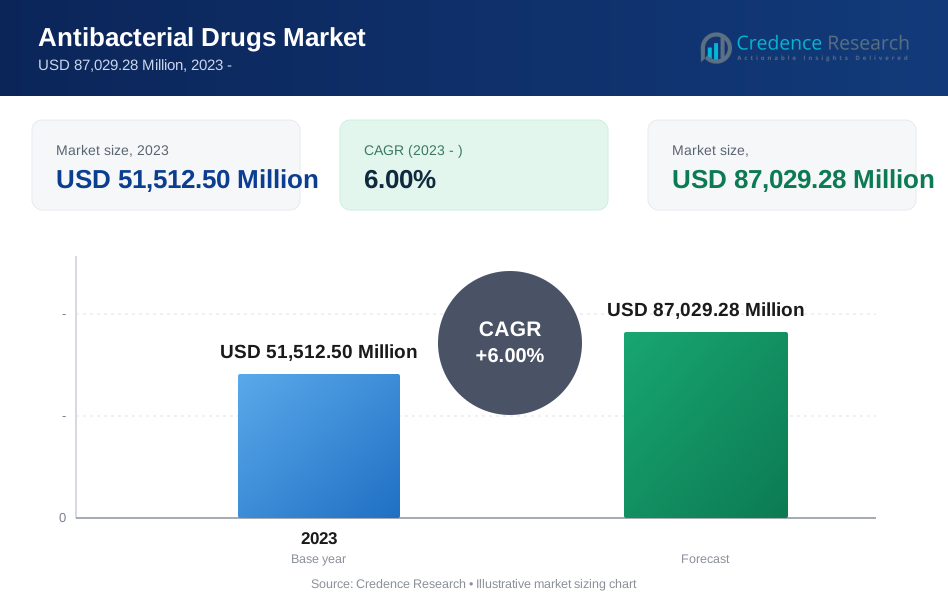
| Antibacterial Drugs Market Size 2023 | USD 51,512.50 Million |
| Antibacterial Drugs Market, CAGR | 6.00% |
| Antibacterial Drugs Market Size 2032 | USD 87,029.28 Million |
Market Insights
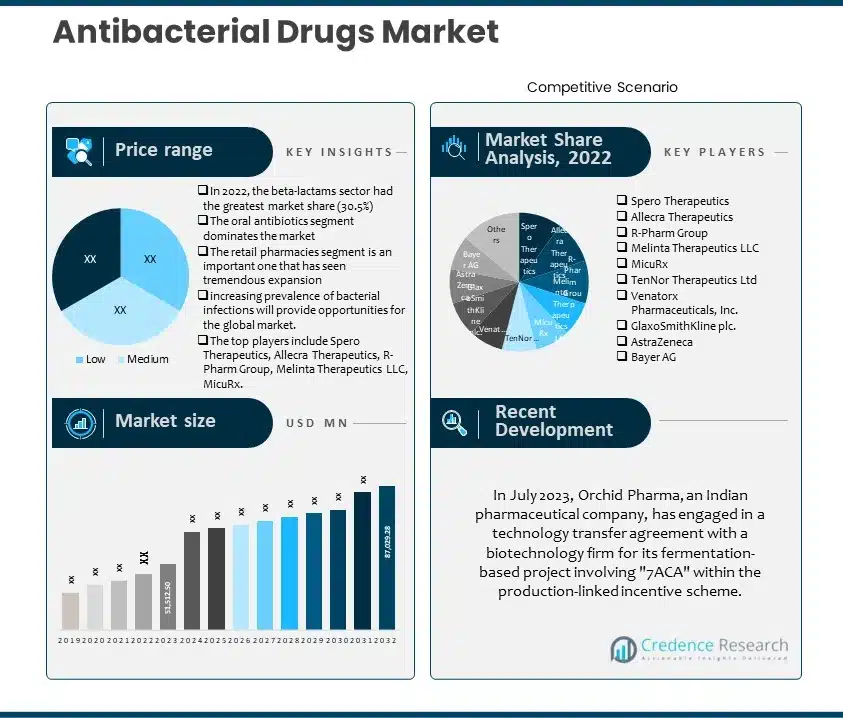
- The global demand for Antibacterial Drugs was valued at USD 51,512.50 Million in 2023 and is expected to reach USD 87,029.28 Million in 2032, growing at a CAGR of 6.00% between 2024 and 2032.
- The beta-lactams sector is the market leader by drug class, accounting for more than 31% of total value in 2023, while the penicillins segment is expected to grow rapidly throughout the forecast period.
- The oral antibiotics industry dominates the global need for Antibacterial Drugs, accounting for more than 55% in 2023 and is predicted to expand at a high CAGR.
- The retail pharmacies sector is predicted to grow fastest over the projection period, while the Hospital Pharmacies segment will have a market share of more than 40% in 2023.
- Over the projection period, the Urinary Tract Infections category is expected to expand at the highest rate, while the Respiratory Tract Infections category will dominate the market in 2023 with a 25% share.
- The pediatrics category is expected to expand quickly over the forecast period, while the adults segment will have the greatest market share in 2023.
- North America is fueling the growth of the Antibacterial Drugs industry with over one-third share in 2023, while Asia Pacific and Europe collectively account for just under 55% share in 2023. Europe held over 20% share in 2023.
- Due to the increasing prevalence of bacterial infections, the market for Antibacterial Drugs is driven by increased healthcare spending, particularly in developing economies which supports the growth of the antibacterial drugs market.
- The market's primary possibilities include the significant growth potential in North America, government initiatives to combat infectious diseases.
Executive Summary
Market Definition
Antibacterial drugs are medicines used to treat infections caused by bacteria. They work by either killing the bacteria or stopping them from multiplying, which helps the body's immune system to fight off the infection. These drugs are commonly prescribed by doctors to treat a wide range of bacterial infections, such as urinary tract infections, pneumonia, skin infections, and bacterial meningitis. Antibacterial drugs are available in various forms, including pills, liquids, and injections, and they play a crucial role in helping people recover from bacterial illnesses and preventing the spread of bacterial infections to others.
Market Overview
The global Antibacterial Drugs market has witnessed steady growth in recent years and is expected to grow at a CAGR of 6.00% between 2024 and 2032. The market was valued at USD 51,512.50 million in 2023 and is expected to reach USD 87,029.28 million in 2032.
The growth of the Antibacterial Drugs market is propelled by several key factors such as the increasing prevalence of bacterial infections worldwide is driving the demand for effective antibacterial treatments. With bacteria evolving and becoming resistant to existing drugs, there is a continual need for new and more potent antibacterial medications to combat these infections.
Additionally, heightened awareness among the public and healthcare professionals about the importance of infection prevention and treatment is fostering greater demand for antibacterial drugs. This is further augmented by government initiatives and healthcare policies aimed at curbing the spread of infectious diseases, thus creating a conducive environment for market growth.
Furthermore, technological advancements in drug discovery and formulation, along with strategic collaborations between pharmaceutical companies and research institutions, are facilitating the development and accessibility of innovative antibacterial drugs, further boosting market expansion.
Segmentation by Drug Class
- Beta-Lactams is the leading segment by drug class and held over 31% share in value in 2023, attributable to the bacterial infections continue to pose a significant health challenge globally, the demand for effective antibacterial drugs rises.
- The penicillins segment will likely exhibit a significant CAGR during the forecast period. The growing threat of antimicrobial resistance fuels the demand for new and more potent antibacterial drugs, driving market growth.
- Cephalosporins, carbapenems, quinolones, macrolides, tetracyclines, aminoglycosides, sulfonamides, and others is another segment but contributes significantly to the global Antibacterial Drugs market compared to the beta-lactams and penicillins segments.
Segmentation by Route of Administration
- The oral antibiotics segment governs the demand for Antibacterial Drugs in the world, holding a massive share of over 55% in 2023, and is also expected to grow at a rapid CAGR due to the increased healthcare spending, particularly in developing economies, supports the growth of the antibacterial drugs market as more resources are allocated to combat infectious diseases.
- The injectable antibiotics sectors segment contributes to the demand for antibacterial drugs.
Segmentation by Distribution Channel
- The retail pharmacies segment is expected to post the highest CAGR during the forecast period. This is primarily due to the government-led initiatives, such as vaccination programs and antimicrobial stewardship campaigns, contribute to market growth by promoting the use of antibacterial drugs.
- The hospital pharmacies segment is leading the market share with over 40% share in 2023.
Segmentation by Indication
- The urinary tract infections segment is anticipated to register the highest CAGR during the projection period.
- With a market share of nearly 25% in 2023, the respiratory tract infections category is currently in the lead.
- The category of indication includes skin infections, ear infections, sexually transmitted infections (STIS), gastrointestinal infections, and others.
Segmentation by Patient Age Group
- The adults dominate the global need for antibacterial drugs, accounting for more than 50% in 2023 due to the increasing incidence of HAIs necessitates the use of antibacterial drugs in healthcare settings, boosting market demand.
- Pediatrics is predicted to expand at a high CAGR during the forecast timeframe.
Segmentation by Region
- North America is fueling the growth of the Antibacterial Drugs industry with over one-third share in 2023 due to the region's collaborations between pharmaceutical companies, research institutions, and government organizations.
- Asia Pacific and Europe collectively account for just under 55% share in 2023, with Europe holding over 20% share in the same year.
- The rest of the world, including Latin America, the Middle East, and Africa, supplies the remaining demand for Antibacterial Drugs.
The market for Antibacterial Drugs is driven by the growing emphasis on preventive measures, including vaccination and infection control practices, supports the demand for antibacterial drugs for prophylactic use.
North America is a leader in embracing new technologies and a hub for technical innovation. The market in North America is being pushed by countries such as the United States and Canada have advanced healthcare systems and high levels of healthcare spending. Additionally, there's a significant presence of pharmaceutical companies conducting research and development in this region, leading to a wide availability of antibacterial drugs. Moreover, robust regulatory frameworks ensure the safety and efficacy of these medications, further consolidating North America's position as a key market for antibacterial drugs.
The Asia Pacific is expected to be the fastest-growing region over the forecast period. Countries in this region, such as China, India, and Japan, are experiencing rapid economic growth, leading to improvements in healthcare infrastructure and increased healthcare expenditure. Moreover, the high burden of infectious diseases in densely populated countries drives the demand for antibacterial drugs. Furthermore, growing awareness about the importance of infection prevention and treatment, coupled with rising government initiatives to address antimicrobial resistance, further propel market growth in the Asia Pacific region.
The primary factor driving the antibacterial drugs market's growth rate is the growing prevalence of bacterial infections via Antibacterial Drugs due to the increased healthcare spending, particularly in developing economies, supports the growth of the antibacterial drugs market as more resources are allocated to combat infectious diseases.
Key Highlights of the Report
The global Antibacterial Drugs market is segmented by drug class, route of administration, distribution channel, indication, patient age group, and region. Beta-Lactams-based Antibacterial Drugs are the most popular, while oral antibiotics are the primary segments. In addition, hospital pharmacies, and respiratory tract infections are the most commonly used categories. However, adults dominate the market, with North America leading the market growth.
One of the main factors propelling the global market for Antibacterial Drugs is increasing prevalence of bacterial infections. The growing threat of antimicrobial resistance fuels the demand for new and more potent antibacterial drugs. Advances in drug discovery, formulation, and delivery systems enhance the effectiveness and efficiency of antibacterial drugs, further driving market growth.
Nonetheless, North America is anticipated to have the greatest share of the worldwide Antibacterial Drugs market because of the investments in healthcare infrastructure development, particularly in emerging markets, create opportunities for the growth of the antibacterial drugs market. Furthermore, the market is anticipated to expand at the highest rate in the Asia-Pacific (APAC) region due to the rising public awareness about the importance of infection prevention and treatment stimulates demand for antibacterial drugs.
What Are The Main Drivers Of The Global Antibacterial Drugs Market?
The main drivers of the global antibacterial drugs market include increasing prevalence of bacterial infections, emergence of drug-resistant bacteria, rising healthcare expenditure, growing geriatric population, technological advancements, and government initiatives to combat infectious diseases.
What Are The Major Challenges Faced By The Global Antibacterial Drugs Market?
The major challenges faced by the global antibacterial drugs market include antimicrobial resistance, high costs associated with drug development, regulatory hurdles, competition from alternative therapies, and lack of novel antibacterial agents in the pipeline.
What Are The Growth Opportunities In The Global Antibacterial Drugs Market?
The growth opportunities in the global antibacterial drugs market lie in expanding indications for existing drugs, strategic collaborations and partnerships, investment in research and development for novel antibacterial agents, focus on preventive healthcare measures, and tapping into emerging markets with unmet medical needs.
Market Drivers
The global Antibacterial Drugs market is driven by several factors. The following are the key drivers of the global Antibacterial Drugs market:
Increasing Prevalence Of Infectious Diseases
The global antimicrobial drugs market growing due to the increasing prevalence of infectious diseases worldwide. As infectious diseases continue to pose a substantial health burden globally, there is a growing demand for effective antimicrobial drugs to treat bacterial, viral, fungal, and parasitic infections. This driver stimulates the development and adoption of antimicrobial drugs, thereby fueling market growth. As per the World Health Organization (WHO) data from October 2021, Tuberculosis claimed the lives of 1.5 million individuals in 2020, including 214,000 individuals with HIV. Globally, TB ranks as the 13th primary cause of mortality and stands as the second most prevalent infectious disease following COVID-19, surpassing HIV/AIDS.
Furthermore, in an article published by The Journal of Antimicrobial Chemotherapy in August 2020, it was revealed that approximately 15% of COVID-19 patients in Wuhan, China, underwent antifungal treatment. Moreover, about 71% of these patients received antibiotic treatment, with 25% being fully treated using a single antibiotic and 45% undergoing combination antibiotic therapy. The antibiotics administered included tigecycline (targeting methicillin-resistant Staphylococcus aureus (MRSA)), quinolones, cephalosporin, carbapenems, and linezolid.
Market Restraints
The global Antibacterial Drugs market faces some challenges that may hinder its growth. These include the following:
Rise Of Antimicrobial Resistance (AMR)
A major restraint facing the global antimicrobial drugs market is the rise of antimicrobial resistance (AMR). AMR occurs when microorganisms, such as bacteria, viruses, fungi, and parasites, evolve and become resistant to the drugs used to treat them. This phenomenon undermines the effectiveness of antimicrobial therapies, leading to treatment failures and increased morbidity and mortality rates. Addressing antimicrobial resistance requires significant efforts in drug development, stewardship programs, and infection control measures, posing a challenge to the growth of the antimicrobial drugs market.
Opportunities
The global Antibacterial Drugs market offers significant growth opportunities. These include the following:
Development Of Novel Therapeutic Approaches
An opportunity in the global antimicrobial drugs market lies in the development of novel therapeutic approaches and innovative drug formulations. Advancements in biotechnology, genomics, and drug delivery systems offer opportunities to overcome antimicrobial resistance and enhance the efficacy of antimicrobial drugs. Additionally, there is potential for the repurposing of existing drugs or the discovery of new antimicrobial agents through research and development initiatives. By capitalizing on these opportunities, stakeholders in the antimicrobial drugs market can address unmet medical needs and drive growth in the industry. For instance, in March 2021, Melinta Therapeutics LLC, a biopharmaceutical company headquartered in the United States, disclosed that it had obtained approval from the U.S. Food and Drug Administration (FDA) for its latest drug, KIMYRSA (oritavancin). This medication, classified as a lipoglycopeptide antibiotic, is designated for the treatment of adult patients afflicted with acute bacterial skin and skin structure infections (ABSSSI).
Competitive Landscape
Key Players
The global Antibacterial Drugs market is highly competitive, with several key players. Some of the major players in the market and their market share are as follows:
- Spero Therapeutics
- Allecra Therapeutics
- R-Pharm Group
- Melinta Therapeutics LLC
- MicuRx
- TenNor Therapeutics Ltd
- Venatorx Pharmaceuticals, Inc.
- GlaxoSmithKline plc.
- AstraZeneca
- Bayer AG
- Johnson & Johnson
- Bristol-Myers Squibb Company
- Merck & Co., Inc.
- Eli Lilly and Company
- AbbVie Inc.
- Novartis AG
- Pfizer Inc.
- Sanofi
- Others
These organizations prioritize product innovation, distribution channel expansion, and mergers and acquisitions to stay competitive.
The global Antibacterial Drugs market's key players continually seek to stay ahead by offering new products and developments.
In January 2023, The approval granted by the U.S. Food and Drug Administration (FDA) for Fesoterodine Fumarate Extended-Release tablets, available in both 4 mg and 8 mg variants, to Alembic Pharmaceuticals has significantly bolstered market demand for the product. This approval signifies recognition of the drug's efficacy and safety in treating relevant medical conditions, thereby instilling confidence among healthcare professionals and patients alike. As a result, Alembic Pharmaceuticals stands to benefit from an expanded market share and increased revenue streams, while patients gain access to a reliable and FDA-approved treatment option for their medical needs.
In July 2023, Orchid Pharma, an Indian pharmaceutical company, has engaged in a technology transfer agreement with a biotechnology firm for its fermentation-based project involving "7ACA" within the production-linked incentive scheme. This collaboration enables Orchid Pharma to leverage the expertise and resources of the biotechnology company to advance its fermentation processes related to the "7ACA" project.
Summary of Key Findings
- The demand for antimicrobial drugs is rising due to the increased healthcare spending, particularly in developing economies, which is boosting the growth of the antibacterial drugs market.
- Market segmented by drug class, route of administration, distribution channel, indication, patient age group, and region.
- Beta-Lactams-based Antibacterial Drugs are the most popular, while oral antibiotics are the primary segments.
- Hospital pharmacies, and respiratory tract infections are the most commonly used categories. However, adults dominate the market.
- North America is leading market growth; the market is highly competitive with key players including Spero Therapeutics, Allecra Therapeutics, R-Pharm Group, Melinta Therapeutics LLC, MicuRx, TenNor Therapeutics Ltd, Venatorx Pharmaceuticals, Inc., GlaxoSmithKline plc., AstraZeneca , Bayer AG , Johnson & Johnson, Bristol-Myers Squibb Company, Merck & Co., Inc., Eli Lilly and Company, AbbVie Inc., Novartis AG, Pfizer Inc., Sanofi, and Others.
Future Outlook
- Positive outlook for the global Antibacterial Drugs market with significant growth potential in the North American region
- One of the main factors promoting the market's expansion is the government and business sectors' current reliance on Antibacterial Drugs.
- During the forecast period, high costs associated with drug development is a significant factor projected to restrain the growth of the Antibacterial Drugs market.
- Key firms must focus on product innovation, growing market reach, and maintaining competitive pricing to keep ahead of the competition.
How CXOs Can Benefit from the Credence Research Antibacterial Drugs Market Report
The Credence Research Antibacterial Drugs Market Report provides CXOs with a comprehensive overview of the market, including:
- Market size and growth forecast: The report provides detailed estimates of the global Antibacterial Drugs market size, segmented by drug class, route of administration, distribution channel, indication, patient age group, and region. It also includes forecasts for the market through 2032, based on key trends and drivers.
- Market segmentation: The report segments the Antibacterial Drugs market by drug class, route of administration, distribution channel, indication, patient age group, and region. This segmentation provides CXOs with a granular understanding of the market and the opportunities in each segment.
- Competitive landscape: The report profiles the key players in the Antibacterial Drugs market and provides insights into their strategies, product offerings, and financial performance. This information can help CXOs to identify and assess their competition.
- Key trends and drivers: The report identifies and analyzes the key trends and drivers that are shaping the Antibacterial Drugs This information can help CXOs to make informed decisions about their investments and strategies.
CXOs can use the insights from the Credence Research Antibacterial Drugs Market Report to:
- Identify growth opportunities: The report can help CXOs to identify new growth opportunities in the Antibacterial Drugs For example, the report identifies the growing demand for Antibacterial Drugs from hospital pharmacies, and pharmaceutical companies as a key opportunity.
- Make informed investment decisions: The report can help CXOs to make informed investment decisions about Antibacterial Drugs. For example, the report provides insights into the key factors to consider when evaluating Antibacterial Drugs providers and selecting Antibacterial Drugs
- Develop competitive strategies: The report can help CXOs to develop competitive strategies for their Antibacterial Drugs For example, the report identifies the key strategies that Antibacterial Drugs providers are using to differentiate themselves from their competitors.
- Track market developments: The report can help CXOs to track market developments and stay ahead of the curve. For example, the report provides insights into the latest trends and innovations in the Antibacterial Drugs
Overall, the Credence Research Antibacterial Drugs Market Report is a valuable resource for CXOs who are looking to gain a deeper understanding of the market and identify opportunities for growth.
Segmentation
- By Drug Class
- Beta-Lactams
- Penicillins
- Cephalosporins
- Carbapenems
- Quinolones
- Macrolides
- Tetracyclines
- Aminoglycosides
- Sulfonamides
- Others
- By Route of Administration
- Oral Antibiotics
- Injectable Antibiotics
- By Distribution Channel
- Hospital Pharmacies
- Retail Pharmacies
- Online Pharmacies
- By Indication
- Respiratory Tract Infections
- Urinary Tract Infections
- Skin Infections
- Ear Infections
- Sexually Transmitted Infections (STIs)
- Gastrointestinal Infections
- Others
- By Patient Age Group
- Adults
- Pediatrics
- By Region
- North America
- The U.S.
- Canada
- Mexico
- Europe
- Germany
- France
- The U.K.
- Italy
- Spain
- Rest of Europe
- Asia Pacific
- China
- Japan
- India
- South Korea
- South-east Asia
- Rest of Asia Pacific
- Latin America
- Brazil
- Argentina
- Rest of Latin America
- Middle East & Africa
- GCC Countries
- South Africa
- Rest of Middle East and Africa
- North America
Request a Free Sample
Fill in your details and we'll send you a free sample report.
- Sample data tables & charts
- Research methodology
Need a Custom Version of This Report?
Tailor the scope, geography, or segments to your exact requirements.
- Custom geography or segment scope
- Direct access to our analyst team
Frequently Asked Questions
What is the current size of the global Antibacterial Drugs market?
What is the expected growth rate of the Antibacterial Drugs market between 2024 and 2032?
Which segment is leading the market share in terms of drug class?
Which route of administration segment governs the demand for Antibacterial Drugs in the world?
Who are the major players in the global Antibacterial Drugs market?
Table of Content
Chapter 1. Report Introduction
- 1.1 Report Description & Purpose
- 1.1.1 Report Title & Market Definition
- 1.1.2 Unique Selling Propositions (USP) & Key Differentiators
- 1.1.3 Value Proposition for Stakeholders
- 1.2 Research Objectives
- 1.2.1 Market Sizing Objectives (Volume & Revenue)
- 1.2.2 Segmentation Objectives
- 1.2.3 Competitive Intelligence Objectives
- 1.2.4 Forecast & Scenario Objectives
- 1.3 Report Scope
- 1.3.1 Antibacterial Drugs Scope – Types & Subtypes Covered
- 1.3.2 Geographic Scope – Regions & Countries Covered
- 1.3.3 Historical Period, Base Year & Forecast Period (2023; forecast to the forecast period)
- 1.3.4 Inclusions & Exclusions
- 1.4 HS Code & Classification Framework
- 1.5 Currency, Units & Pricing Basis
- 1.6 Target Stakeholders
- 1.7 Limitations & Assumptions
Chapter 2. Executive Summary
- 2.1 Global Antibacterial Drugs Market Snapshot
- 2.1.1 Market Size – Historical (2023) & Forecast (the forecast period) (2023: USD 51,512.50 Million → forecast year: USD 87,029.28 Million)
- 2.1.2 Volume & Revenue – Global Totals
- 2.1.3 Key Market Highlights – Top Five Facts
- 2.2 Antibacterial Drugs Market Segmentation Snapshot
- 2.2.1 Market Split by Region – 2023 vs.
- 2.3 Competitive Snapshot
- 2.3.1 Top 10 Players by Revenue Share – 2023
- 2.3.2 Top 10 Players by Volume Share – 2023
- 2.3.3 Recent Strategic Developments (18-Month Summary)
- 2.4 Key Investment Highlights & Strategic Conclusions
Chapter 3. Antibacterial Drugs Market Dynamics & Industry Analysis
- 3.1 Market Overview & Context
- 3.1.1 Antibacterial Drugs Market Position in the Broader Automotive Value Chain
- 3.1.2 OEM vs. Replacement Market Dynamics
- 3.1.3 Market Maturity & Development Stage by Region
- 3.2 Antibacterial Drugs Market Drivers
- 3.3 Antibacterial Drugs Market Restraints & Challenges
- 3.4 Antibacterial Drugs Market Opportunities
- 3.5 Porter's Five Forces Analysis
- 3.5.1 Threat of New Entrants
- 3.5.2 Bargaining Power of Suppliers
- 3.5.3 Bargaining Power of Buyers
- 3.5.4 Threat of Substitutes
- 3.5.5 Competitive Rivalry – Intensity Assessment
- 3.6 Antibacterial Drugs Value Chain Analysis
- 3.6.1 Upstream – Raw Material/Input Suppliers
- 3.6.1.1 Raw Material/Input 1
- 3.6.1.2 Raw Material/Input 2
- 3.6.1.3 Raw Material/Input 3
- 3.6.2 Midstream – Production/Manufacturing/Service Delivery
- 3.6.2.1 Production/Process Overview
- 3.6.2.2 Key Facility Locations & Capacity by Manufacturer
- 3.6.3 Downstream – Distribution & End Consumer
- 3.6.3.1 Primary Channel – B2B/OEM
- 3.6.3.2 Secondary Channels – Dealer, Retail, Online, Direct
- 3.6.4 Value Chain Profitability Analysis
- 3.6.1 Upstream – Raw Material/Input Suppliers
- 3.7 PESTEL Analysis
- 3.7.1 Political Factors
- 3.7.2 Economic Factors
- 3.7.3 Social Factors
- 3.7.4 Technological Factors
- 3.7.5 Environmental Factors
- 3.7.6 Legal Factors
- 3.8 Antibacterial Drugs Supply Chain Analysis
- 3.8.1 Raw Material/Input Supply Risk Assessment
- 3.8.2 Manufacturing Concentration Risk (Geographic Exposure)
- 3.8.3 Trade Disruption Impact Analysis
- 3.9 Regulatory & Policy Landscape
Note: The regulatory and policy landscape section covers regulations based on their applicability to the market, Antibacterial Drugs category, geography, and scope of the study. Only regulatory frameworks with a material impact on operations, compliance, trade, sustainability, or market access are analyzed in detail.
Chapter 4. Key Investment Pockets & Opportunity Analysis
- 4.1 Antibacterial Drugs Market Attractiveness Analysis
- 4.1.1 By Region – Investment Attractiveness Matrix (Volume × CAGR)
- 4.2 Absolute Revenue Growth Opportunity
- 4.2.1 By Region – Absolute USD Growth Through the forecast period
- 4.3 Incremental Volume Opportunity
- 4.3.1 By Region – Incremental Volume Through the forecast period
- 4.3.2 Segment – Incremental Volume
- 4.4 Emerging Submarket Opportunity Deep Dive (Subject to Applicability)
- 4.5 Emerging Market Opportunity Scorecards
- 4.5.1 United States
- 4.5.2 Europe
- 4.5.3 Asia
- 4.5.4 Middle East & Africa
Note: Emerging Market Opportunity Scorecards will be included based on relevance and strategic importance. Regions listed are indicative and may vary depending on data availability and market dynamics.
Chapter 5. Antibacterial Drugs Import-Export Analysis & Trade Flows
- 5.1 Global Trade Overview
- 5.1.1 Global Export Value by Country (2023)
- 5.1.2 Global Export Volume by Country (2023)
- 5.1.3 Global Import Value by Country (2023)
- 5.1.4 Global Import Volume by Country (2023)
- 5.1.5 Net Trade Balance by Country (2023)
- 5.2 Export Analysis – Segment
- 5.2.1 Type 1 (HS Code)
- 5.2.2 Type 2 (HS Code)
- 5.2.3 Type 3 (HS Code)
- 5.2.4 Type 4 (HS Code)
- 5.2.5 Type 5 (HS Code)
- 5.3 Import Analysis – Segment
- 5.3.1 Type 1 (HS Code)
- 5.3.2 Type 2 (HS Code)
- 5.3.3 Type 3 (HS Code)
- 5.3.4 Type 4 (HS Code)
- 5.3.5 Type 5 (HS Code)
- 5.4 Average Unit Trade Prices
- 5.4.1 Average Export Price – Segment & Country
- 5.4.2 Average Import Price – Segment & Source Country
- 5.4.3 Price Trends (2023)
- 5.5 Key Trade Route Analysis
- 5.5.1 Trade Route 1
- 5.5.2 Trade Route 2
- 5.5.3 Trade Route 3
- 5.5.4 Trade Route 4
- 5.5.5 Trade Route 5
- 5.6 Trade Policy Impact Assessment
- 5.6.1 US Anti-Dumping & Section 301 Tariffs
- 5.6.2 EU Customs Union Impact
- 5.6.3 Major Free Trade Agreements
- 5.6.4 USMCA Rules of Origin
Note: Trade policy analysis will be included only where relevant to the Antibacterial Drugs market.
Chapter 6. Competitive Landscape & Company Benchmarking
- 6.1 Antibacterial Drugs Market Concentration & Structure
- 6.1.1 Herfindahl-Hirschman Index (HHI) – vs. 2023
- 6.1.2 Tier 1, Tier 2 & Tier 3 Market Structure
- 6.1.3 Global, Regional & Local Player Dynamics
- 6.2 Antibacterial Drugs Market Share Analysis – 2023
- 6.2.1 Global Revenue Share by Company
- 6.2.2 Global Volume Share by Company
- 6.2.3 Regional Revenue Share
- 6.2.4 Market Share Evolution ( vs. 2023)
- 6.2.5 OEM Segment Share by Company
- 6.2.6 Replacement Segment Share by Company
- 6.3 Production/Delivery Capacity & Facility Analysis
- 6.3.1 Global Installed Capacity
- 6.3.2 Capacity Utilization Rates
- 6.3.3 Production/Output Volume
- 6.3.4 Facility Locations & Capacity Map
- 6.3.5 Planned Capacity Additions
- 6.4 Antibacterial Drugs Competitive Benchmarking Matrix
- 6.4.1 Revenue, Volume, CAGR & Profitability Comparison
- 6.4.2 Channel Revenue Mix
- 6.4.3 Geographic Revenue Exposure
- 6.4.4 R&D Intensity
- 6.4.5 Sustainability Maturity
- 6.5 Strategic Developments in Antibacterial Drugs (Last 24 Months)
- 6.5.1 Mergers, Acquisitions & Divestments
- 6.5.2 New Antibacterial Drugs Launches
- 6.5.3 Facility Expansions
- 6.5.4 Strategic Alliances, Joint Ventures & Partnerships
- 6.5.5 Distribution Expansion & Market Entry
- 6.5.6 Sustainability & ESG Initiatives
- 6.6 Competitive Strategy Mapping
- 6.6.1 Leader, Challenger, Follower & Niche Classification
- 6.6.2 Pricing Strategy Comparison
- 6.6.3 Channel Strategy Matrix
Note: Strategic developments are included based on their materiality and the availability of reliable information.
Chapter 7. Global Antibacterial Drugs Market – By Distribution Channel
- 7.1 Segment Overview
- 7.1.1 Volume & Revenue Split by Channel (2023 & )
- 7.1.2 Channel Mix Evolution (the forecast period)
Chapter 8. Regional Market Analysis – Global Overview
- 8.1 Global Regional Overview
- 8.1.1 Regional Volume Share
- 8.1.2 Regional Revenue Share
- 8.1.3 Regional Volume by Region
- 8.1.4 Regional Revenue by Region
- 8.1.5 Regional Forecast Through the forecast period
- 8.2 Cross-Regional Segment Analysis
- 8.2.1 By Distribution Channel
- 8.2.2 By Brand/Price Tier
Chapter 9. North America Antibacterial Drugs Market
- 9.1 United States
- 9.2 Canada
- 9.3 Mexico
Chapter 10. Europe Antibacterial Drugs Market
- 10.1 Germany
- 10.2 France
- 10.3 Italy
- 10.4 United Kingdom
- 10.5 Spain
- 10.6 Poland
- 10.7 Russia
- 10.8 Netherlands
- 10.9 Belgium
- 10.10 Sweden
- 10.11 Denmark
- 10.12 Norway
- 10.13 Rest of Europe
Chapter 11. Asia Pacific Antibacterial Drugs Market
- 11.1 China
- 11.2 India
- 11.3 Japan
- 11.4 South Korea
- 11.5 Thailand
- 11.6 Indonesia
- 11.7 Vietnam
- 11.8 Malaysia
- 11.9 Australia
- 11.10 Rest of Asia Pacific
Chapter 12. Latin America Antibacterial Drugs Market
- 12.1 Brazil
- 12.2 Argentina
- 12.3 Colombia
- 12.4 Chile
- 12.5 Rest of Latin America
Chapter 13. Middle East Antibacterial Drugs Market
- 13.1 Saudi Arabia
- 13.2 United Arab Emirates
- 13.3 Turkey
- 13.4 Israel
- 13.5 Iran
- 13.6 Rest of the Middle East
Chapter 14. Africa Antibacterial Drugs Market
- 14.1 South Africa
- 14.2 Egypt
- 14.3 Nigeria
- 14.4 Morocco
- 14.5 Rest of Africa
Chapter 15. Antibacterial Drugs Company Profiles
- 15.1 [Company 01]
- 15.1.1 Company Overview
- 15.1.2 Key Management Personnel
- 15.1.3 Products & Services Portfolio
- 15.1.4 Financial Performance
- 15.1.5 Key Market Focus & Geographic Presence
- 15.1.6 Recent Developments & Strategic Initiatives
Note: The company profile list is preliminary and may change based on research findings, market developments, data availability, and client requirements.
Chapter 16. Appendices
- Appendix A – List of Abbreviations & Acronyms
- Appendix B – Industry Classification Code Reference – Full Series
- Appendix C – Production & Capacity Data Tables
- Appendix D – End-Use & Demand Base Tables
- Appendix E – Consumption & Replacement Rate Assumptions
- Appendix F – ASP Reference Tables
- Appendix G – Manufacturing & Facility Database
- Appendix H – Import-Export Data Tables
- Appendix I – Regulatory Summary Tables
- Appendix J – Primary Research Participant List (Anonymized)
- Appendix K – Primary Research Questionnaire Framework
- Appendix L – Data Sources & Bibliography
- Appendix M – Market Size Divergence & Source Comparison
Chapter 17. Research Methodology
- 17.1 Research Framework & Philosophy
- 17.2 Secondary Research – Sources, Hierarchy & Data Extraction
- 17.3 Data Modeling – Bottom-Up & Top-Down Market Sizing
- 17.4 Primary Research – Stakeholder Framework, LOI & Sample Sizes
- 17.5 Forecast Methodology – Regression, Scenario & Sensitivity Analysis
- 17.6 Quality Control – Four-Layer Validation Framework
- 17.7 Limitations & Standard Assumptions
- 17.8 Disclaimer
