
Market Overview:
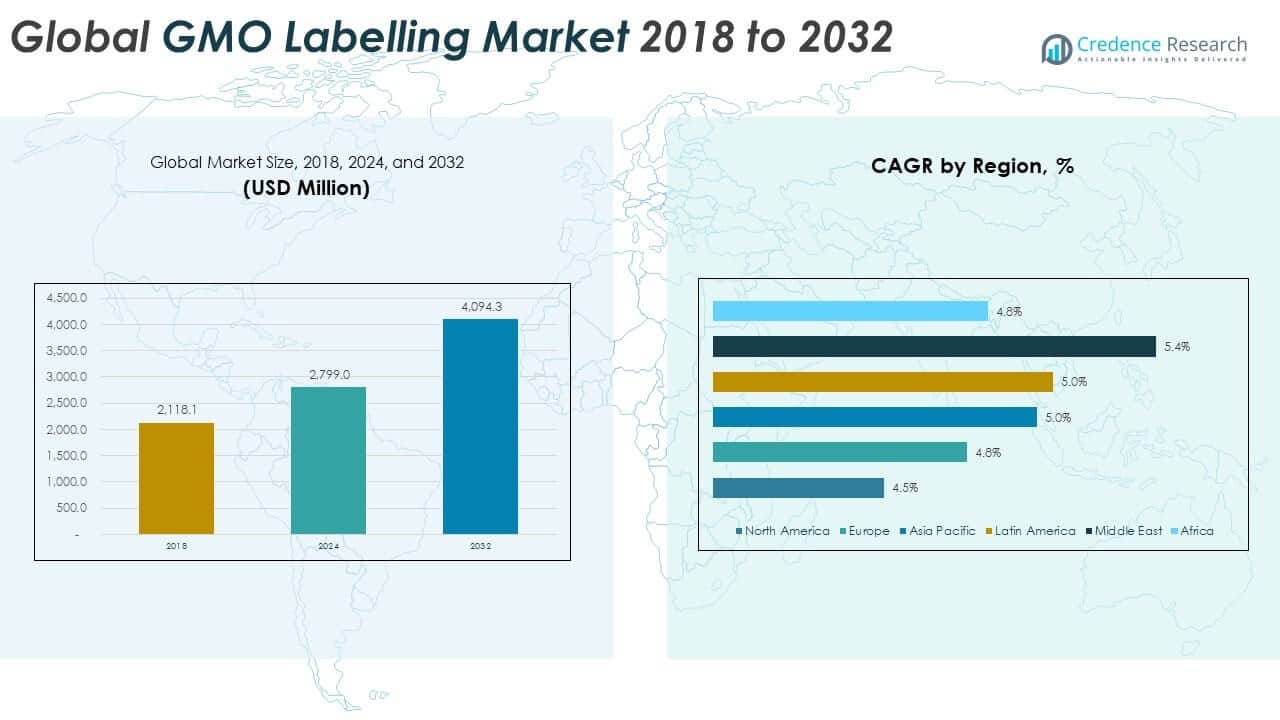
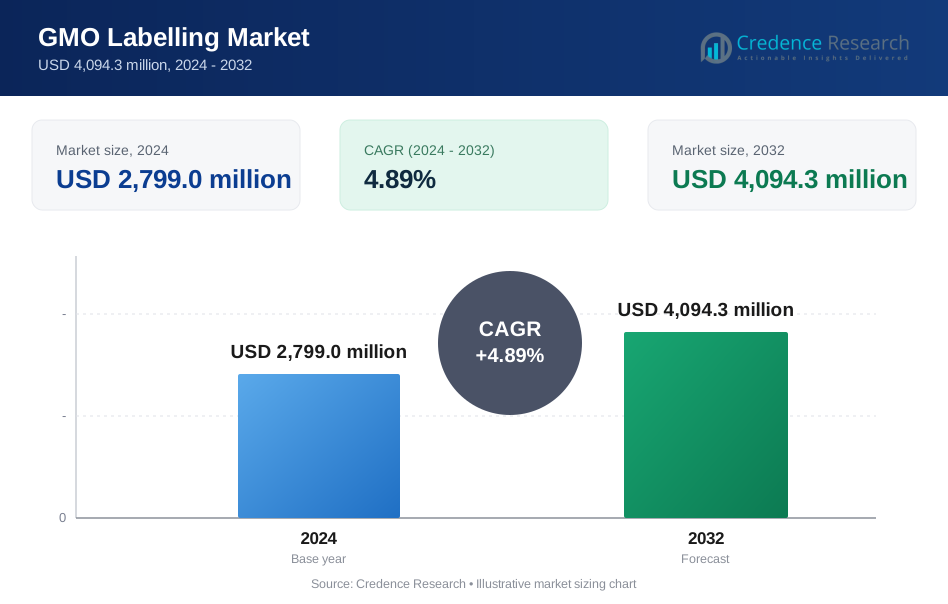
The Global GMO Labelling Market size was valued at USD 2,118.1 million in 2018 to USD 2,799.0 million in 2024 and is anticipated to reach USD 4,094.3 million by 2032, at a CAGR of 4.89% during the forecast period.
| REPORT ATTRIBUTE | DETAILS |
|---|---|
| Historical Period | 2020-2023 |
| Base Year | 2024 |
| Forecast Period | 2025-2032 |
| GMO Labelling Market Size 2024 | USD 2,799.0 million |
| GMO Labelling Market, CAGR | 4.89% |
| GMO Labelling Market Size 2032 | USD 4,094.3 million |
The market grows due to rising consumer demand for food transparency and mandatory disclosure laws across key economies. Governments in North America, Europe, and Asia Pacific have strengthened label mandates on genetically modified ingredients. This pushes food manufacturers and retailers to adopt advanced label printing technologies and traceability systems. Increased consumption of processed and packaged foods expands the need for standardized labeling. Regulatory clarity and pressure from advocacy groups reinforce compliance investment. QR-based and multilingual label formats support cross-border compliance. Voluntary non-GMO labels gain popularity among health-conscious buyers. The shift toward clean-label retail categories continues to drive adoption.
Asia Pacific leads the Global GMO Labelling Market due to strict implementation in Japan, China, and South Korea and growing packaged food production. North America follows, supported by established compliance frameworks in the U.S. and Canada. Europe holds a strong share driven by traceability enforcement and consumer preference for non-GMO products. Latin America shows growth led by Brazil and Argentina’s regulatory enforcement. The Middle East expands steadily, supported by import-based GMO controls and halal alignment. Africa remains an emerging market, with South Africa enforcing label mandates and others preparing regulatory rollout.
Market Insights:
- The Global GMO Labelling Market was valued at USD 2,118.1 million in 2018, reached USD 2,799.0 million in 2024, and is projected to hit USD 4,094.3 million by 2032, expanding at a CAGR of 4.89%, reflecting sustained regulatory‑driven demand growth.
- Asia Pacific led the market in 2024 with about 8% share, driven by large packaged food volumes and strict enforcement in Japan, China, and South Korea, followed by Europe at 24.0% due to stringent GMO traceability laws, and North America at 18.5% supported by mandatory bioengineered food disclosure rules.
- The Middle East emerged as the fastest‑growing region, holding nearly 0% share in 2024, supported by a 5.4% CAGR, rising food imports, and alignment of labeling rules with international and halal standards.
- By label type, mandatory GMO labels accounted for the dominant share at roughly 65% in 2024, reflecting strong enforcement across developed and export‑driven markets.
- Voluntary GMO labels represented about 35% share in 2024, driven by clean‑label positioning, retailer pressure, and consumer preference for transparency in premium and health‑focused food categories.
Market Drivers
Rising Demand for Transparency and Consumer Right-to-Know Labeling Standards
Consumers increasingly demand visibility into food content and production methods. The Global GMO Labelling Market benefits from this shift, with packaged food companies adjusting labels to meet expectations. Clear labeling builds trust and brand loyalty, especially in competitive retail environments. Regulators back this shift by enforcing right-to-know policies. Consumer advocacy groups continue pressing for mandatory disclosures across jurisdictions. Retailers and e-commerce platforms align with transparent labeling frameworks. Health and nutrition trends also push buyers to review ingredient sourcing. These factors collectively strengthen regulatory compliance and labeling infrastructure investment.
Government Regulations and Mandatory Labeling Laws Across Key Economies
Governments are enacting firm labeling mandates that directly impact the market. In the United States, the USDA’s bioengineered disclosure rule reshaped the labeling process for large food brands. In the EU, laws require strict tracking of genetically modified content, even for processed ingredients. Such frameworks push food supply chains to adopt traceable data systems. Label updates, digital disclosures, and packaging changes are now key operational priorities. This regulatory evolution reinforces the adoption of barcode tracking and QR code scans. Exporters also align labels to match destination rules. It drives cross-border labeling harmonization and regional compliance hubs.
- For instance, Kellogg Company updated label formats across its U.S. product lines to comply with USDA bioengineered disclosure rules, including approved text, symbol, or QR code disclosures for products containing regulated ingredients.
Growth in Packaged Food and Processed Ingredients Driving Labeling Needs
The surge in ready-to-eat and processed food consumption creates new pressure on label management. Manufacturers must provide clear GMO disclosures for composite and multi-ingredient products. The Global GMO Labelling Market expands as ingredient traceability becomes a key compliance and consumer requirement. Large-scale food processors digitize their product data and labeling workflows. They seek cloud-based label generation tools with compliance flagging. This trend spreads across frozen foods, snacks, condiments, and beverages. Global supply chain complexity fuels the need for precise GMO source documentation. This increases demand for automated labeling and product lifecycle tools.
- For instance, General Mills has participated in industry traceability initiatives and publicly reported investments in digital systems to improve supply chain transparency and support compliance with bioengineered food disclosure requirements.
Advances in Digital Disclosure Methods Supporting Cost-Efficient Compliance
Companies are adopting digital disclosure formats to manage labeling complexity and cost. The Global GMO Labelling Market shifts toward QR codes, smart labels, and app-based scans. These tools allow brands to provide layered information without redesigning packaging. Governments now recognize digital labels as valid disclosures. Smaller manufacturers benefit from flexible, scalable formats that require minimal packaging changes. Multilingual support in mobile formats also helps address global markets. Retailers integrate these technologies into loyalty and engagement systems. These advances align label compliance with broader digital transformation in food distribution.
Market Trends
Integration of Blockchain and Smart Traceability in Labeling Systems
Traceability technology continues transforming how food manufacturers meet GMO labeling requirements. Blockchain is emerging as a trusted tool to track genetic sourcing across the supply chain. It helps validate label claims through immutable and verifiable records. Major food exporters use it to simplify cross-border inspections and audits. Smart contracts also automate GMO disclosure protocols. The Global GMO Labelling Market incorporates these tools to offer real-time label integrity assurance. Producers embed traceability data into QR codes for easy consumer access. This trend enhances label reliability and operational transparency across regions.
- For instance, Walmart used IBM Food Trust blockchain to trace mangoes, reducing traceability time from days to 2.2 seconds, enhancing supply chain validation for label claims like origin and quality.
Adoption of Personalized Labeling Based on Consumer Health Preferences
Food companies are increasingly personalizing GMO labels for targeted health-conscious buyers. Digital platforms enable labels that adapt to dietary filters or allergen profiles. The Global GMO Labelling Market benefits from tech-enabled food platforms that allow consumers to scan and view tailored information. Retailers promote such smart labels through health apps and online grocery tools. These adaptive labels boost engagement among niche consumer groups. Health claims, dietary certifications, and GMO content now appear in unified digital formats. This personalization trend reshapes how consumers evaluate food options in-store and online.
- For instance, Campbell Soup Company updated its product packaging to comply with the USDA’s National Bioengineered Food Disclosure Standard, adopting approved text, symbol, or digital disclosures on products containing bioengineered ingredients. Public disclosures confirm the company’s commitment to label transparency under federal requirements.
Use of AI-Powered Label Management Systems to Support Compliance Scaling
Labeling systems are adopting AI to handle changing regulations and dynamic ingredient data. The Global GMO Labelling Market integrates AI tools to generate compliant labels across thousands of SKUs. These systems analyze label formats, match them with region-specific rules, and alert teams to inconsistencies. Automation reduces manual updates and mitigates error risks in mass labeling. Large food conglomerates use AI to streamline global compliance. AI-driven platforms enable faster regulatory adaptation across multilingual packaging. They also support cloud storage for historic label tracking and audit readiness.
Expansion of Eco-Labeling and GMO-Free Certification in Brand Positioning
Brands increasingly use GMO-free certification as a sustainability and clean-label strategy. The Global GMO Labelling Market sees strong demand for third-party eco-labels that indicate non-GMO sourcing. Certifications such as “Non-GMO Project Verified” gain visibility in global retail chains. This trend links GMO status with broader ESG narratives in branding. Organic food producers integrate GMO-free claims into their ethical sourcing messages. Consumers view GMO-free status as a proxy for health and environmental responsibility. Retailers dedicate shelf space for such verified products to meet evolving preferences.
Market Challenges Analysis
Complexity in Harmonizing International GMO Labeling Regulations Across Trade Channels
The Global GMO Labelling Market faces significant challenges due to inconsistent global regulations. Each country applies different thresholds, disclosure formats, and definitions of genetic modification. This variation creates compliance burdens for exporters managing multi-market shipments. Companies often redesign labels per destination or maintain multiple stock-keeping units. Lack of standardization increases packaging costs and slows product release cycles. Trade disputes also arise over labeling misalignments between regions. Even within trade blocs, GMO policies shift rapidly. Firms must invest in real-time regulatory tracking and label revalidation tools to stay compliant.
Resistance from Food Manufacturers and Retail Chains Due to Cost and Reputational Risks
Manufacturers hesitate to adopt full disclosure due to concerns over consumer backlash. Labeling genetically modified content may affect brand image in regions with strong anti-GMO sentiment. The Global GMO Labelling Market also contends with packaging redesign expenses and system upgrades. Smaller firms lack the capital to overhaul labeling lines or add QR-based disclosures. Retailers worry about inconsistent label visibility across brands and formats. Delays in government-issued label templates add further confusion. Some lobby groups challenge mandatory rules, slowing enforcement or diluting standards in key markets.
Market Opportunities
Growth in Clean-Label Retail Categories Creating Demand for Transparent GMO Disclosures
Rising demand for organic, non-GMO, and allergen-free foods drives label innovation. The Global GMO Labelling Market benefits as clean-label trends expand across health-conscious buyer segments. Retailers actively promote GMO-free certifications in premium product categories. Food startups gain visibility by including simple, verifiable label elements. This creates an opportunity to embed GMO status into broader health narratives. Digital-first platforms also integrate label transparency into purchase decisions.
Emerging Economies Advancing Labeling Infrastructure Through Policy and Retail Digitization
Governments in Asia, Latin America, and parts of Africa are building labeling ecosystems. The Global GMO Labelling Market sees opportunity as these regions align with international food safety norms. Investments in food processing and e-commerce drive packaging innovation. National food authorities roll out phased GMO label rules in line with global trade demands. These shifts support new vendor ecosystems for smart packaging and traceability.
Market Segmentation Analysis:
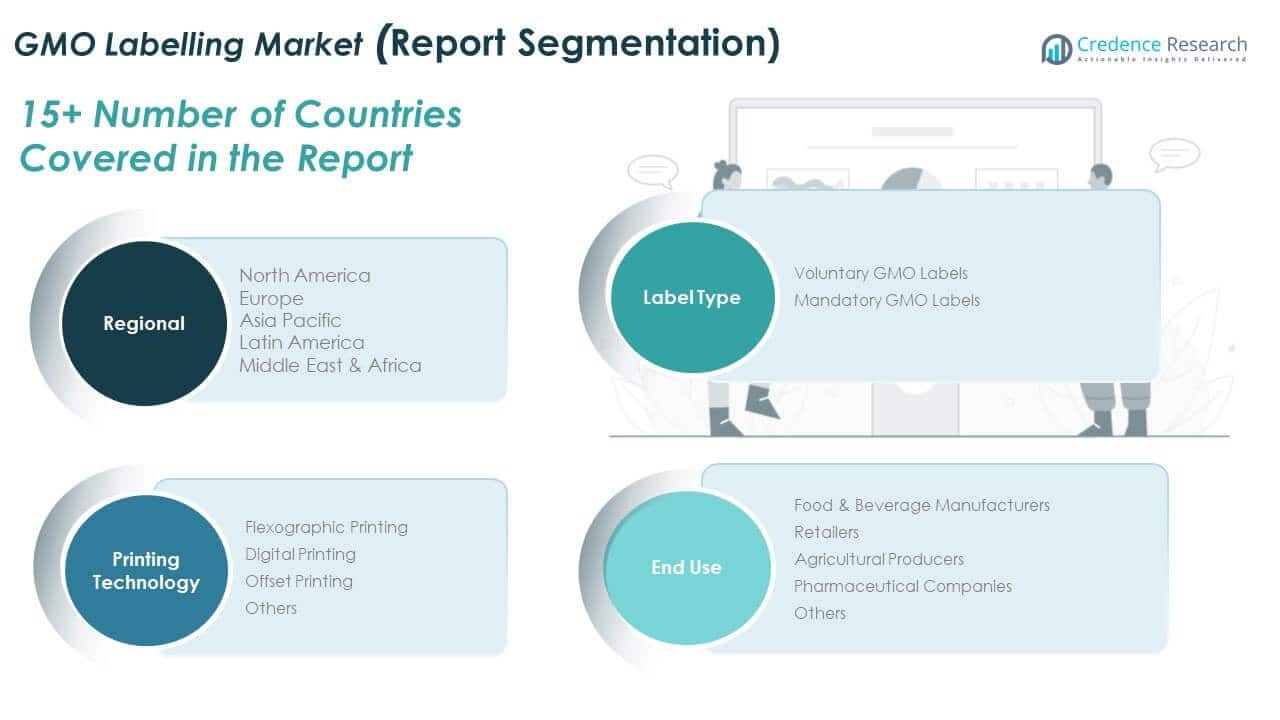
By label type, mandatory GMO labels dominate due to regulatory pressure in regions such as North America and Europe. Governments require clear disclosure of genetically modified content, prompting widespread label updates across packaged food sectors. Voluntary GMO labels grow in regions where mandatory frameworks are still evolving, especially among brands targeting health-conscious consumers or exporting to regulated markets. It helps companies differentiate through transparency and build consumer trust.
- For instance, Kind Snacks earned Non-GMO Project verification for all 40+ bar varieties by 2015, displaying seals on 100% of U.S. packaging per Non-GMO Project records.
By printing technology, flexographic printing holds a major share due to its high-volume efficiency and widespread use in packaging production. Digital printing is growing fast, supported by rising demand for short runs, variable data printing, and regulatory adaptability. It enables rapid label updates and reduces cost for small batches. Offset printing remains relevant for premium packaging needs with high print quality, though it sees slower adoption. The others category includes emerging technologies such as inkjet and hybrid systems, gaining traction in niche applications.
- For instance, HP Indigo digital presses have been used by leading food brands to meet NBFDS compliance through high-speed variable data printing, supporting rapid label changes for bioengineered disclosures across U.S. cereal and snack packaging. HP highlights its capability to produce short runs with unique QR codes and regulatory symbols to enable compliance with evolving labeling laws.
By end use, food and beverage manufacturers lead demand, driven by the scale of processed food production and strict GMO disclosure requirements. Retailers follow closely, as private-label products and shelf labeling require compliant and informative packaging. Agricultural producers adopt GMO labels for seed bags, grain shipments, and direct-to-consumer offerings in regulated markets. Pharmaceutical companies use labels to disclose genetically modified ingredients in biologics and drug formulations. The others segment includes institutional suppliers and health supplement firms addressing niche compliance and export needs. The Global GMO Labelling Market adapts across all these segments through innovation, traceability, and evolving compliance strategies.
Segmentation:
By Label Type
- Voluntary GMO Labels
- Mandatory GMO Labels
By Printing Technology
- Flexographic Printing
- Digital Printing
- Offset Printing
- Others
By End Use
- Food & Beverage Manufacturers
- Retailers
- Agricultural Producers
- Pharmaceutical Companies
- Others
By Region
- North America
- U.S.
- Canada
- Mexico
- Europe
- Germany
- France
- U.K.
- Italy
- Spain
- Rest of Europe
- Asia Pacific
- China
- Japan
- India
- South Korea
- South-east Asia
- Rest of Asia Pacific
- Latin America
- Brazil
- Argentina
- Rest of Latin AmericaMiddle East & Africa
- GCC Countries
- South Africa
- Rest of the Middle East and Africa
Regional Analysis:
North America
The North America Global GMO Labelling Market size was valued at USD 400.32 million in 2018 to USD 518.46 million in 2024 and is anticipated to reach USD 737.79 million by 2032, at a CAGR of 4.5% during the forecast period. North America accounted for approximately 18.5% of the global market share in 2024. The region leads in regulatory implementation through USDA's National Bioengineered Food Disclosure Standard. The U.S. sets clear compliance guidelines for packaged food and beverages, which drive high adoption among manufacturers. QR code-based disclosure is gaining ground due to packaging space constraints. Canada promotes similar frameworks, focusing on consumer education and food transparency. Mexico's evolving labeling ecosystem supports regional trade alignment under USMCA. It benefits from cross-border harmonization of GMO disclosure. Retailers actively promote compliance-ready products to build consumer confidence and reduce risk.
Europe
The Europe Global GMO Labelling Market size was valued at USD 510.88 million in 2018 to USD 671.05 million in 2024 and is anticipated to reach USD 973.62 million by 2032, at a CAGR of 4.8% during the forecast period. Europe represented nearly 24% of the global market share in 2024. The EU enforces one of the world’s strictest GMO labeling regulations, mandating full disclosure for food containing over 0.9% genetically modified content. Major economies like Germany, France, and Italy have high enforcement and traceability standards. Retailers require detailed labeling and audit trails from suppliers. Public sentiment in Europe favors GMO-free products, driving demand for voluntary labels even when exemptions apply. It enables growth in both mandatory and clean-label segments. Stringent compliance norms support digital labeling and traceability innovation across the bloc.
Asia Pacific
The Asia Pacific Global GMO Labelling Market size was valued at USD 795.34 million in 2018 to USD 1,057.64 million in 2024 and is anticipated to reach USD 1,559.92 million by 2032, at a CAGR of 5.0% during the forecast period. Asia Pacific accounted for nearly 37.8% of the global market share in 2024, making it the dominant region. Japan and South Korea lead with structured GMO label mandates and consumer education programs. China’s evolving standards reflect broader food safety reforms. India enforces GMO disclosures on packaged imports and monitors seed-based GMO declarations. Australia and Southeast Asian countries align labeling norms with key export destinations. Rapid urbanization and rising packaged food consumption accelerate label deployment. Governments in the region invest in infrastructure to track GMO content across domestic and imported goods. It opens space for voluntary and tech-enabled labeling systems.
Latin America
The Latin America Global GMO Labelling Market size was valued at USD 228.33 million in 2018 to USD 304.50 million in 2024 and is anticipated to reach USD 450.78 million by 2032, at a CAGR of 5.0% during the forecast period. Latin America held approximately 10.9% of the global market share in 2024. Brazil leads with mandatory GMO labels on both food and seeds, enforced by clear visual symbols. Argentina implements similar standards across its food supply chain. These nations maintain strong agricultural exports, pushing for GMO disclosure alignment with trading partners. Governments promote traceability and digital label systems to improve food visibility. Local producers use GMO-free labels to target health-aware urban buyers. It enables product differentiation in retail shelves. Retail chains incorporate GMO label compliance into sourcing policies and in-store labeling.
Middle East
The Middle East Global GMO Labelling Market size was valued at USD 143.61 million in 2018 to USD 195.17 million in 2024 and is anticipated to reach USD 296.02 million by 2032, at a CAGR of 5.4% during the forecast period. The region contributed around 7% of global market share in 2024. GCC countries enforce GMO labelling through food safety authorities, primarily targeting imported packaged products. Saudi Arabia and the UAE implement GMO restrictions in line with halal and food traceability standards. Regional food importers align labels with European and U.S. compliance formats to ease customs clearance. Governments promote clear declarations on GM soy, corn, and derivative ingredients. Food distributors integrate QR codes and bilingual labeling to meet regulatory needs. It supports market expansion among health-driven urban consumers. New labeling laws under review in other countries will further shape the market.
Africa
The Africa Global GMO Labelling Market size was valued at USD 39.61 million in 2018 to USD 52.22 million in 2024 and is anticipated to reach USD 76.15 million by 2032, at a CAGR of 4.8% during the forecast period. Africa captured around 2.2% of the global market share in 2024. South Africa leads with a mandatory GMO labeling system under the Consumer Protection Act. It requires labeling for genetically modified content exceeding 5%, covering both local and imported food items. Kenya and Egypt are strengthening food labelling policies through national food safety agencies. Countries prioritize import compliance to support agricultural trade and local transparency. Public awareness campaigns and regulatory outreach improve GMO content understanding. Urban retailers promote verified GMO-free products among health-aware consumers. It supports emerging demand for traceable and standardized packaging across food categories.
Key Player Analysis:
- Campbell Soup
- Danone
- Kellogg Company
- ConAgra Foods Inc.
- General Mills
- Chipotle
- Kerry Ingredients
- Organic Valley
- Ingredion Incorporated
- Other Key Players
Competitive Analysis:
The Global GMO Labelling Market features a mix of multinational food manufacturers, ingredient suppliers, and labeling technology providers. Key players include Campbell Soup, Danone, Kellogg Company, ConAgra Foods, and General Mills, which lead in label adoption due to regulatory exposure across major markets. Firms such as Chipotle and Organic Valley use GMO-free claims as part of brand positioning. Ingredion and Kerry Ingredients support back-end compliance through certified supply chains and traceability. Label printing vendors invest in digital solutions to meet dynamic disclosure needs. Companies compete on label accuracy, compliance efficiency, and consumer engagement tools. It fosters growth in QR-based labeling, multilingual packaging, and blockchain traceability systems. Strategic moves include regional expansion, product innovation, and supply chain certification. Mergers and partnerships help scale labeling infrastructure across geographies. Vendors with flexible, tech-enabled platforms hold a competitive edge in navigating regulatory updates and complex global trade flows.
Recent Developments:
- In January 2026, the German Association Food without Genetic Engineering (VLOG)implemented updated minimum analysis requirements for raw materials and animal feed. As of January 1, 2026, manufacturing companies and laboratories certified to the VLOG standard must comply with new, more stringent requirements for soy and rapeseed, specifically mandating the detection of new genetically modified events such as DAS-44406-6 and MON88302.
Report Coverage:
The research report offers an in-depth analysis based on Label Type, Printing Technology, End Use, and Region. It details leading market players, providing an overview of their business, product offerings, investments, revenue streams, and key applications. Additionally, the report includes insights into the competitive environment, SWOT analysis, current market trends, as well as the primary drivers and constraints. Furthermore, it discusses various factors that have driven market expansion in recent years. The report also explores market dynamics, regulatory scenarios, and technological advancements that are shaping the industry. It assesses the impact of external factors and global economic changes on market growth. Lastly, it provides strategic recommendations for new entrants and established companies to navigate the complexities of the market.
Future Outlook:
- Regulatory bodies across major economies will continue tightening GMO disclosure norms, driving mandatory label adoption.
- Food manufacturers will invest in digital labeling technologies to meet multilingual and multi-regional compliance standards.
- Growth in online grocery and DTC platforms will increase demand for QR-based and app-integrated GMO label formats.
- Consumer push for clean-label transparency will strengthen the role of voluntary GMO labels across developed markets.
- Smart packaging innovations will integrate blockchain and traceability tools to validate GMO status across supply chains.
- Asia Pacific will expand rapidly as emerging economies formalize GMO label regulations and digitize food logistics.
- Export-driven agricultural producers will adopt certified GMO labeling practices to access regulated foreign markets.
- Private-label and retailer-driven compliance programs will influence labeling choices across private and store-brand lines.
- Pharmaceutical and nutraceutical industries will integrate GMO disclosures in clinical packaging and regulatory filings.
- Strategic partnerships between food manufacturers and tech providers will streamline label lifecycle management.
Request a Free Sample
Fill in your details and we'll send you a free sample report.
- Sample data tables & charts
- Research methodology
Need a Custom Version of This Report?
Tailor the scope, geography, or segments to your exact requirements.
- Custom geography or segment scope
- Direct access to our analyst team
Frequently Asked Questions
What is the current market size for Global GMO Labelling Market, and what is its projected size in 2032?
At what Compound Annual Growth Rate is the Global GMO Labelling Market projected to grow between 2024 and 2032?
Which Global GMO Labelling Market segment held the largest share in 2024?
What are the primary factors fueling the growth of the Global GMO Labelling Market?
Who are the leading companies in the Global GMO Labelling Market?
Which region commanded the largest share of the Global GMO Labelling Market in 2024?
Table of Content
Chapter 1. Report Introduction
- 1.1 Report Description & Purpose
- 1.1.1 Report Title & Market Definition
- 1.1.2 Unique Selling Propositions (USP) & Key Differentiators
- 1.1.3 Value Proposition for Stakeholders
- 1.2 Research Objectives
- 1.2.1 Market Sizing Objectives (Volume & Revenue)
- 1.2.2 Segmentation Objectives
- 1.2.3 Competitive Intelligence Objectives
- 1.2.4 Forecast & Scenario Objectives
- 1.3 Report Scope
- 1.3.1 GMO Labelling Scope – Types & Subtypes Covered
- 1.3.2 Geographic Scope – Regions & Countries Covered
- 1.3.3 Historical Period, Base Year & Forecast Period (2024; forecast to 2032)
- 1.3.4 Inclusions & Exclusions
- 1.4 HS Code & Classification Framework
- 1.5 Currency, Units & Pricing Basis
- 1.6 Target Stakeholders
- 1.7 Limitations & Assumptions
Chapter 2. Executive Summary
- 2.1 Global GMO Labelling Market Snapshot
- 2.1.1 Market Size – Historical (2024) & Forecast (2024-2032) (2024: USD 2,799.0 million → 2032: USD 4,094.3 million)
- 2.1.2 Volume & Revenue – Global Totals
- 2.1.3 Key Market Highlights – Top Five Facts
- 2.2 GMO Labelling Market Segmentation Snapshot
- 2.2.1 Market Split by Region – 2024 vs. 2032
- 2.3 Competitive Snapshot
- 2.3.1 Top 10 Players by Revenue Share – 2024
- 2.3.2 Top 10 Players by Volume Share – 2024
- 2.3.3 Recent Strategic Developments (18-Month Summary)
- 2.4 Key Investment Highlights & Strategic Conclusions
Chapter 3. GMO Labelling Market Dynamics & Industry Analysis
- 3.1 Market Overview & Context
- 3.1.1 GMO Labelling Market Position in the Broader Automotive Value Chain
- 3.1.2 OEM vs. Replacement Market Dynamics
- 3.1.3 Market Maturity & Development Stage by Region
- 3.2 GMO Labelling Market Drivers
- 3.3 GMO Labelling Market Restraints & Challenges
- 3.4 GMO Labelling Market Opportunities
- 3.5 Porter's Five Forces Analysis
- 3.5.1 Threat of New Entrants
- 3.5.2 Bargaining Power of Suppliers
- 3.5.3 Bargaining Power of Buyers
- 3.5.4 Threat of Substitutes
- 3.5.5 Competitive Rivalry – Intensity Assessment
- 3.6 GMO Labelling Value Chain Analysis
- 3.6.1 Upstream – Raw Material/Input Suppliers
- 3.6.1.1 Raw Material/Input 1
- 3.6.1.2 Raw Material/Input 2
- 3.6.1.3 Raw Material/Input 3
- 3.6.2 Midstream – Production/Manufacturing/Service Delivery
- 3.6.2.1 Production/Process Overview
- 3.6.2.2 Key Facility Locations & Capacity by Manufacturer
- 3.6.3 Downstream – Distribution & End Consumer
- 3.6.3.1 Primary Channel – B2B/OEM
- 3.6.3.2 Secondary Channels – Dealer, Retail, Online, Direct
- 3.6.4 Value Chain Profitability Analysis
- 3.6.1 Upstream – Raw Material/Input Suppliers
- 3.7 PESTEL Analysis
- 3.7.1 Political Factors
- 3.7.2 Economic Factors
- 3.7.3 Social Factors
- 3.7.4 Technological Factors
- 3.7.5 Environmental Factors
- 3.7.6 Legal Factors
- 3.8 GMO Labelling Supply Chain Analysis
- 3.8.1 Raw Material/Input Supply Risk Assessment
- 3.8.2 Manufacturing Concentration Risk (Geographic Exposure)
- 3.8.3 Trade Disruption Impact Analysis
- 3.9 Regulatory & Policy Landscape
Note: The regulatory and policy landscape section covers regulations based on their applicability to the market, GMO Labelling category, geography, and scope of the study. Only regulatory frameworks with a material impact on operations, compliance, trade, sustainability, or market access are analyzed in detail.
Chapter 4. Key Investment Pockets & Opportunity Analysis
- 4.1 GMO Labelling Market Attractiveness Analysis
- 4.1.1 By Region – Investment Attractiveness Matrix (Volume × CAGR)
- 4.2 Absolute Revenue Growth Opportunity
- 4.2.1 By Region – Absolute USD Growth Through 2032
- 4.3 Incremental Volume Opportunity
- 4.3.1 By Region – Incremental Volume Through 2032
- 4.3.2 Segment – Incremental Volume
- 4.4 Emerging Submarket Opportunity Deep Dive (Subject to Applicability)
- 4.5 Emerging Market Opportunity Scorecards
- 4.5.1 United States
- 4.5.2 Europe
- 4.5.3 Asia
- 4.5.4 Middle East & Africa
Note: Emerging Market Opportunity Scorecards will be included based on relevance and strategic importance. Regions listed are indicative and may vary depending on data availability and market dynamics.
Chapter 5. GMO Labelling Import-Export Analysis & Trade Flows
- 5.1 Global Trade Overview
- 5.1.1 Global Export Value by Country (2024)
- 5.1.2 Global Export Volume by Country (2024)
- 5.1.3 Global Import Value by Country (2024)
- 5.1.4 Global Import Volume by Country (2024)
- 5.1.5 Net Trade Balance by Country (2024)
- 5.2 Export Analysis – Segment
- 5.2.1 Type 1 (HS Code)
- 5.2.2 Type 2 (HS Code)
- 5.2.3 Type 3 (HS Code)
- 5.2.4 Type 4 (HS Code)
- 5.2.5 Type 5 (HS Code)
- 5.3 Import Analysis – Segment
- 5.3.1 Type 1 (HS Code)
- 5.3.2 Type 2 (HS Code)
- 5.3.3 Type 3 (HS Code)
- 5.3.4 Type 4 (HS Code)
- 5.3.5 Type 5 (HS Code)
- 5.4 Average Unit Trade Prices
- 5.4.1 Average Export Price – Segment & Country
- 5.4.2 Average Import Price – Segment & Source Country
- 5.4.3 Price Trends (2024)
- 5.5 Key Trade Route Analysis
- 5.5.1 Trade Route 1
- 5.5.2 Trade Route 2
- 5.5.3 Trade Route 3
- 5.5.4 Trade Route 4
- 5.5.5 Trade Route 5
- 5.6 Trade Policy Impact Assessment
- 5.6.1 US Anti-Dumping & Section 301 Tariffs
- 5.6.2 EU Customs Union Impact
- 5.6.3 Major Free Trade Agreements
- 5.6.4 USMCA Rules of Origin
Note: Trade policy analysis will be included only where relevant to the GMO Labelling market.
Chapter 6. Competitive Landscape & Company Benchmarking
- 6.1 GMO Labelling Market Concentration & Structure
- 6.1.1 Herfindahl-Hirschman Index (HHI) – vs. 2024
- 6.1.2 Tier 1, Tier 2 & Tier 3 Market Structure
- 6.1.3 Global, Regional & Local Player Dynamics
- 6.2 GMO Labelling Market Share Analysis – 2024
- 6.2.1 Global Revenue Share by Company
- 6.2.2 Global Volume Share by Company
- 6.2.3 Regional Revenue Share
- 6.2.4 Market Share Evolution ( vs. 2024)
- 6.2.5 OEM Segment Share by Company
- 6.2.6 Replacement Segment Share by Company
- 6.3 Production/Delivery Capacity & Facility Analysis
- 6.3.1 Global Installed Capacity
- 6.3.2 Capacity Utilization Rates
- 6.3.3 Production/Output Volume
- 6.3.4 Facility Locations & Capacity Map
- 6.3.5 Planned Capacity Additions
- 6.4 GMO Labelling Competitive Benchmarking Matrix
- 6.4.1 Revenue, Volume, CAGR & Profitability Comparison
- 6.4.2 Channel Revenue Mix
- 6.4.3 Geographic Revenue Exposure
- 6.4.4 R&D Intensity
- 6.4.5 Sustainability Maturity
- 6.5 Strategic Developments in GMO Labelling (Last 24 Months)
- 6.5.1 Mergers, Acquisitions & Divestments
- 6.5.2 New GMO Labelling Launches
- 6.5.3 Facility Expansions
- 6.5.4 Strategic Alliances, Joint Ventures & Partnerships
- 6.5.5 Distribution Expansion & Market Entry
- 6.5.6 Sustainability & ESG Initiatives
- 6.6 Competitive Strategy Mapping
- 6.6.1 Leader, Challenger, Follower & Niche Classification
- 6.6.2 Pricing Strategy Comparison
- 6.6.3 Channel Strategy Matrix
Note: Strategic developments are included based on their materiality and the availability of reliable information.
Chapter 7. Global GMO Labelling Market – By Distribution Channel
- 7.1 Segment Overview
- 7.1.1 Volume & Revenue Split by Channel (2024 & 2032)
- 7.1.2 Channel Mix Evolution (2024-2032)
Chapter 8. Regional Market Analysis – Global Overview
- 8.1 Global Regional Overview
- 8.1.1 Regional Volume Share
- 8.1.2 Regional Revenue Share
- 8.1.3 Regional Volume by Region
- 8.1.4 Regional Revenue by Region
- 8.1.5 Regional Forecast Through 2032
- 8.2 Cross-Regional Segment Analysis
- 8.2.1 By Distribution Channel
- 8.2.2 By Brand/Price Tier
Chapter 9. North America GMO Labelling Market
- 9.1 United States
- 9.2 Canada
- 9.3 Mexico
Chapter 10. Europe GMO Labelling Market
- 10.1 Germany
- 10.2 France
- 10.3 Italy
- 10.4 United Kingdom
- 10.5 Spain
- 10.6 Poland
- 10.7 Russia
- 10.8 Netherlands
- 10.9 Belgium
- 10.10 Sweden
- 10.11 Denmark
- 10.12 Norway
- 10.13 Rest of Europe
Chapter 11. Asia Pacific GMO Labelling Market
- 11.1 China
- 11.2 India
- 11.3 Japan
- 11.4 South Korea
- 11.5 Thailand
- 11.6 Indonesia
- 11.7 Vietnam
- 11.8 Malaysia
- 11.9 Australia
- 11.10 Rest of Asia Pacific
Chapter 12. Latin America GMO Labelling Market
- 12.1 Brazil
- 12.2 Argentina
- 12.3 Colombia
- 12.4 Chile
- 12.5 Rest of Latin America
Chapter 13. Middle East GMO Labelling Market
- 13.1 Saudi Arabia
- 13.2 United Arab Emirates
- 13.3 Turkey
- 13.4 Israel
- 13.5 Iran
- 13.6 Rest of the Middle East
Chapter 14. Africa GMO Labelling Market
- 14.1 South Africa
- 14.2 Egypt
- 14.3 Nigeria
- 14.4 Morocco
- 14.5 Rest of Africa
Chapter 15. GMO Labelling Company Profiles
- 15.1 [Company 01]
- 15.1.1 Company Overview
- 15.1.2 Key Management Personnel
- 15.1.3 Products & Services Portfolio
- 15.1.4 Financial Performance
- 15.1.5 Key Market Focus & Geographic Presence
- 15.1.6 Recent Developments & Strategic Initiatives
Note: The company profile list is preliminary and may change based on research findings, market developments, data availability, and client requirements.
Chapter 16. Appendices
- Appendix A – List of Abbreviations & Acronyms
- Appendix B – Industry Classification Code Reference – Full Series
- Appendix C – Production & Capacity Data Tables
- Appendix D – End-Use & Demand Base Tables
- Appendix E – Consumption & Replacement Rate Assumptions
- Appendix F – ASP Reference Tables
- Appendix G – Manufacturing & Facility Database
- Appendix H – Import-Export Data Tables
- Appendix I – Regulatory Summary Tables
- Appendix J – Primary Research Participant List (Anonymized)
- Appendix K – Primary Research Questionnaire Framework
- Appendix L – Data Sources & Bibliography
- Appendix M – Market Size Divergence & Source Comparison
Chapter 17. Research Methodology
- 17.1 Research Framework & Philosophy
- 17.2 Secondary Research – Sources, Hierarchy & Data Extraction
- 17.3 Data Modeling – Bottom-Up & Top-Down Market Sizing
- 17.4 Primary Research – Stakeholder Framework, LOI & Sample Sizes
- 17.5 Forecast Methodology – Regression, Scenario & Sensitivity Analysis
- 17.6 Quality Control – Four-Layer Validation Framework
- 17.7 Limitations & Standard Assumptions
- 17.8 Disclaimer
