Market Overview:
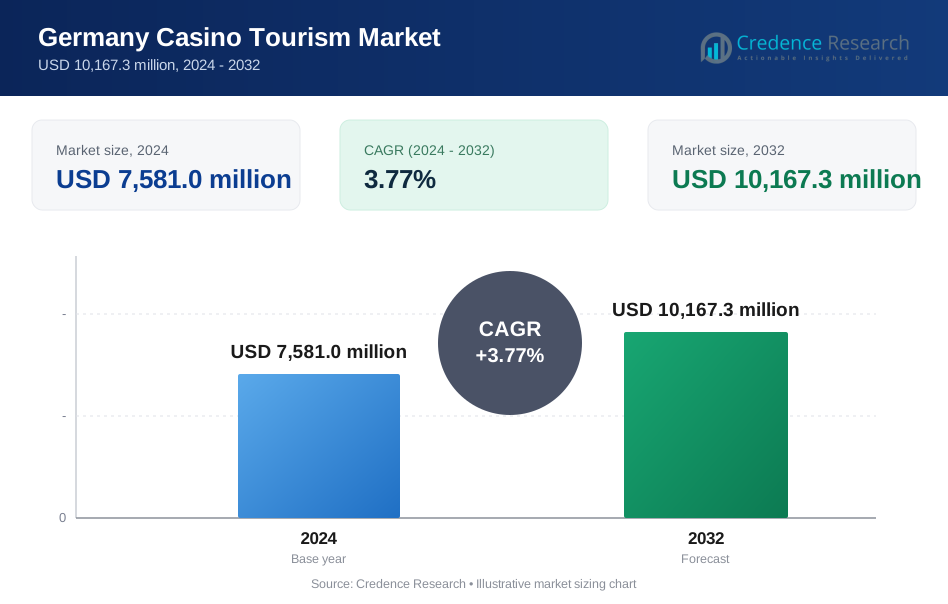
The Germany Casino Tourism Market size was valued at USD 6,263.6 million in 2018 to USD 7,581.0 million in 2024 and is anticipated to reach USD 10,167.3 million by 2032, at a CAGR of 3.77% during the forecast period.
| REPORT ATTRIBUTE | DETAILS |
|---|---|
| Historical Period | 2020-2023 |
| Base Year | 2024 |
| Forecast Period | 2025-2032 |
| Germany Casino Tourism Market Size 2024 | USD 7,581.0 million |
| Germany Casino Tourism Market CAGR | 3.77% |
| Germany Casino Tourism Market Size 2032 | USD 10,167.3 million |
Growth in Germany’s casino tourism market is supported by rising international arrivals, integration of casinos with wellness and heritage destinations, and a strong regulatory framework. Tourists from neighboring European countries prefer German gaming hubs for their premium experiences and trusted legal environment. Casinos increasingly align with broader travel packages and cultural events to attract diverse demographics. Urban centers leverage their nightlife, while spa towns offer luxury resort gaming. The market gains further momentum from digital platforms that simplify access to casino-related services and promotions.
Western and Southern Germany lead the market due to established destinations such as Baden-Baden, Munich, and Wiesbaden. These regions benefit from their proximity to France, Switzerland, and Austria, strong infrastructure, and high-end ospitality. Northern Germany follows with ports and cities like Hamburg drawing cruise and urban traffic. Eastern Germany, particularly Berlin, is emerging through cultural appeal and cross-border visitation from Poland and the Czech Republic. Regional dynamics are shaped by travel connectivity, historical tourism links, and the quality of local entertainment infrastructure.

Market Insights
- The Germany Casino Tourism Market was valued at USD 6,263.6 million in 2018, reached USD 7,581.0 million in 2024, and is projected to hit USD 10,167.3 million by 2032, growing at a CAGR of 3.77%.
- Western and Southern Germany lead with about 48% share due to premium casino hubs, luxury tourism, and cross‑border access, followed by Northern Germany at nearly 27% driven by urban nightlife and cruise traffic, while Eastern Germany holds close to 25% supported by cultural tourism and proximity to Eastern Europe.
- Eastern Germany stands out as the fastest‑growing region, holding roughly 25% share, supported by Berlin’s global appeal, younger tourist inflows, and rising cross‑border visitation from Poland and the Czech Republic.
- By tourist type, domestic visitors account for an estimated 55% share of the Germany Casino Tourism Market, supported by repeat visits, loyalty programs, and strong year‑round participation across urban and spa destinations.
- International tourists represent around 45% share, while showing faster growth momentum than domestic travel, driven by improving connectivity, premium casino experiences, and strong demand from neighboring European countries.
Market Drivers
Strong Growth in International Tourism Driving Casino Visits in Key German Cities
Germany continues to attract millions of international visitors, and casino tourism benefits from this influx. Cities like Berlin, Baden-Baden, and Hamburg have become known for their luxury gaming environments. Tourists from neighboring European nations often cross borders for regulated and high-quality gambling experiences. The legal framework ensures safety, fair play, and trust, which boosts casino participation. The Germany Casino Tourism Market gains traction from integrated entertainment offerings in major tourist hubs. Gaming blends with spa tourism, shopping, and historical sightseeing. It caters to both high-net-worth travelers and casual visitors. Strong transport connectivity supports city-to-city casino travel within the country.
- For instance, Spielbank Berlin at Potsdamer Platz operates as a state‑licensed casino offering a wide range of slot machines supplied by established international manufacturers. Its central location and regulated gaming environment support Berlin’s position as a major urban entertainment and tourism destination.
Increasing Integration of Casinos with Broader Leisure and Hospitality Experiences
Casinos across Germany are embedding themselves within wider hospitality zones. Resorts combine gaming with spas, luxury dining, and live shows. This broadens appeal and increases time spent at the property. Visitors seeking a complete experience beyond gaming drive higher occupancy rates in casino-linked hotels. The Germany Casino Tourism Market benefits from these bundled services that increase per-visitor spend. This model appeals to tourists looking for high-end weekend getaways. Large resorts in Baden-Württemberg and Bavaria follow this integration trend. Urban casinos in Berlin and Düsseldorf are expanding amenities to match. This hybrid format boosts overall revenue per square meter.
- For instance, Casino Baden‑Baden at Kurhaus integrates gaming tables with adjacent spa facilities in a historic tourism venue.
Regulatory Clarity Supporting Responsible Gaming and Casino Expansion
Germany’s state-level gaming regulation provides a stable framework for operators and investors. Licensing procedures and operational standards remain transparent. This attracts both domestic and international investments in the casino space. Responsible gaming initiatives also enhance public perception and build trust. The Germany Casino Tourism Market thrives under these clear rules that prioritize compliance and safety. Casinos must comply with advertising and player protection laws, ensuring long-term sustainability. New operators benefit from streamlined application processes. The environment supports expansion of both traditional and modern casino formats. Legal stability reinforces Germany’s position in the regional casino tourism segment.
Rising Affinity for Casino Experiences Among Domestic and Cross-Border Visitors
A growing number of tourists view casino visits as part of their travel itinerary. Visitors from France, Switzerland, Poland, and the Netherlands frequent German gaming cities. These travelers enjoy premium services without crossing into high-cost jurisdictions. The Germany Casino Tourism Market benefits from this growing interest in casual and luxury gaming alike. Younger tourists are attracted by modern interiors, themed slots, and live gaming events. Casinos also host seasonal festivals, food expos, and cultural evenings that increase their draw. These diversified offerings turn casinos into event destinations. The market capitalizes on visitor demand for memorable experiences.
Market Trends
Growth in Digital Booking Platforms and Online Presence of Land-Based Casinos
Casinos in Germany are investing in online platforms to attract and manage visitors. Websites allow advanced table reservations, loyalty program access, and package booking. These tools simplify the tourist’s decision-making process. The Germany Casino Tourism Market gains visibility through online marketing campaigns, SEO, and affiliate listings. Operators now use apps to update visitors on events, shows, and jackpots. This trend increases engagement and improves conversion from interest to footfall. Casinos also provide virtual tours to familiarize travelers before arrival. These platforms help enhance service quality while tracking visitor behavior. Digital tools strengthen loyalty and streamline operations.
Themed Casino Events and Festival Alignment Enhancing Seasonal Visitor Inflows
Operators align gaming events with local festivals and tourism seasons. Oktoberfest, Christmas markets, and summer carnivals are synced with special casino promotions. The Germany Casino Tourism Market responds well to these event-based experiences that appeal to both locals and tourists. Casinos offer themed décor, entertainment, and seasonal menus to match the festivities. Special poker nights, slot tournaments, and prize draws attract regional traffic. This drives occupancy rates in connected hotels and restaurants. Event-based scheduling helps reduce off-season slumps. Tourism authorities collaborate with casinos to promote regional travel. These efforts create recurring demand cycles throughout the year.
- For instance, Spielbank Hohensyburg hosts regular poker tournaments and cash games, positioning it as one of Germany’s most active live poker venues under state licensing.
Luxury and Heritage-Based Positioning of German Casinos to Attract High-Spenders
Many casinos in Germany are located in historically rich buildings or spa towns. Properties like Casino Baden-Baden blend heritage architecture with luxury service. This unique setting positions casinos as high-value destinations. The Germany Casino Tourism Market draws luxury travelers who seek exclusivity and ambience. Casinos emphasize dress codes, gourmet dining, and curated concierge services. These factors appeal to travelers from the Middle East, China, and Western Europe. Operators invest in interiors, art collections, and curated entertainment. The overall experience mimics luxury hospitality standards. This niche strategy enhances Germany’s competitive position in Europe’s casino map.
- For instance, Casino Baden-Baden at Kurhaus features formal dress codes and gaming tables in a 19th-century historic venue.
Eco-Friendly and Sustainable Practices Shaping Casino Infrastructure Development
Sustainability is becoming a focus in casino renovation and new project planning. Operators use energy-efficient lighting, renewable power, and water-saving systems. LEED and BREEAM certifications now feature in project briefs. The Germany Casino Tourism Market aligns with national goals for carbon-neutral tourism. Green building features enhance brand reputation and appeal to conscious travelers. Waste recycling, EV charging, and low-emission shuttles are also being introduced. Casinos use digital signage and QR menus to reduce paper waste. These steps create a modern, future-proof brand image. Sustainability supports both operational savings and long-term tourist loyalty.

Market Challenges Analysis
Stringent Licensing Rules and Operational Limitations Slowing Expansion of Casino Venues
Germany’s fragmented federal regulatory structure leads to regional variation in casino licensing. Each state defines its own licensing terms, tax regimes, and caps on slot machines. This complexity delays entry of new operators and slows expansion of established players. The Germany Casino Tourism Market faces hurdles in scaling up within high-demand zones. Municipal opposition to new venues is also common, especially in historic areas. Licensing fees and profit-sharing requirements impact margins. Strict hours of operation and advertising limitations reduce revenue generation flexibility. Regulatory burdens affect both private and public-sector operators. These constraints challenge long-term scalability.
Rising Competition from Online Gambling Platforms and Cross-Border Destinations
Online casinos and mobile gambling apps continue to gain ground among younger users. Digital platforms offer convenience, lower stakes, and high accessibility. The Germany Casino Tourism Market competes with these channels for entertainment time and spend. Many tourists prefer virtual slots and live-dealer games accessible via smartphones. Neighboring countries with looser regulations, like the Czech Republic, attract price-sensitive travelers. Cross-border casino packages sometimes offer better value and fewer restrictions. This erodes Germany’s appeal to casual tourists. It must now innovate to differentiate land-based gaming experiences from their online counterparts.
Market Opportunities
Development of Integrated Casino Resorts in Underutilized Tourism Regions
Germany holds potential to develop casino resorts in lesser-known tourist regions. Areas like Saxony, Thuringia, or parts of northern Bavaria can host integrated facilities. The Germany Casino Tourism Market can expand through public-private partnerships in such zones. Targeted investments in gaming, lodging, wellness, and entertainment would boost local economies. These resorts could also support year-round tourism and job creation.
Strategic Alliances Between Casino Operators and National Tourism Boards
Partnerships with national and state tourism bodies can enhance global visibility. The Germany Casino Tourism Market can benefit from co-branded campaigns, travel expo presence, and cultural event tie-ins. Collaborative storytelling around luxury gaming and German heritage can attract long-haul travelers. These alliances help promote Germany not just as a cultural hub but also as a refined gaming destination.
Market Segmentation Analysis
By Game Type
The Germany Casino Tourism Market features high engagement in blackjack, roulette, and poker variants. Blackjack leads the segment due to its simplicity and popularity among both seasoned and casual players. American roulette attracts international tourists familiar with U.S.-style gaming formats. 3 card poker and casino stud poker cater to strategy-oriented gamblers, often integrated into poker-focused events. Dice games and punto banco maintain moderate presence, appealing to niche groups. The “Others” category includes electronic slots and video poker, which show consistent growth in urban casinos and I-gaming platforms.
- For instance, Spielbank Berlin offers multiple blackjack tables alongside roulette wheels under state licensing.
By Casino Type
Commercial casinos dominate the Germany Casino Tourism Market, hosting the majority of gaming activity and attracting both domestic and international tourists. I-gaming holds a growing share, driven by regulatory clarity and younger consumer preferences. Limited stakes casinos operate under strict regional controls and cater to local communities. Tribal casinos remain limited due to Germany’s legal structure, representing a small segment. The “Others” category includes seasonal or temporary gaming events operated under special permits.
- For instance, Casino Baden-Baden operates as a commercial venue in Baden-Württemberg with full table games under regional licensing
By Tourist Type
International tourists lead the revenue generation in the Germany Casino Tourism Market. Visitors from France, Switzerland, the Netherlands, and Eastern Europe contribute significantly to footfall in key gaming cities. Domestic tourists drive steady year-round traffic, especially in spa towns and urban gaming hubs. Repeat visits and loyalty programs support retention among local travelers. Both groups respond well to integrated offerings and event-driven promotions.
By End User
Gambling enthusiasts represent the core of the Germany Casino Tourism Market, accounting for extended stays and high average spend. Social exuberants engage in gaming as part of broader leisure activities, showing strong participation in live events. Dabblers play casually during holidays or cultural trips. Lottery loyalists often cross over to casinos for new experiences. The “Others” category includes business travelers and event attendees seeking entertainment during stays.
Segmentation
By Game Type
- 3 Card Poker
- American Roulette
- Blackjack
- Casino Stud Poker
- Dice
- Punto Banco
- Others
By Casino Type
- Commercial
- Tribal
- Limited Stakes
- I-gaming
- Others
By Tourist Type
- Domestic
- International
By End User
- Gambling Enthusiasts
- Social Exuberants
- Dabblers
- Lottery Loyalists
- Others

Regional Analysis
Western and Southern Germany as the Core Casino Tourism Hubs
Western and Southern Germany account for nearly 48% of the Germany Casino Tourism Market. Baden-Württemberg and Bavaria lead due to iconic destinations such as Baden-Baden and Munich. These regions benefit from strong luxury tourism, spa towns, and proximity to France, Switzerland, and Austria. High-income international visitors prefer these destinations for premium gaming environments. Strong rail and road connectivity supports short-stay casino travel. Established hospitality infrastructure sustains higher visitor spending. These factors keep this subregion dominant.
Northern Germany Supported by Urban Tourism and Cruise Traffic
Northern Germany holds around 27% share of the Germany Casino Tourism Market. Cities such as Hamburg and Bremen attract casino tourists through nightlife, port activity, and cruise tourism. International visitors from Scandinavia and the UK contribute to steady casino footfall. Urban casinos in this region focus on entertainment-led gaming formats. Event tourism and business travel further support demand. Strong airport connectivity enhances accessibility. The region maintains stable growth through diversified tourist inflows.
Eastern Germany Emerging Through Cross-Border and City Tourism
Eastern Germany represents approximately 25% of the Germany Casino Tourism Market. Berlin leads this subregion due to its global tourism appeal and vibrant nightlife. Cross-border visitors from Poland and the Czech Republic support casino traffic. Casinos in this region target younger tourists and casual players. Competitive pricing and modern venues increase appeal. Cultural tourism blends well with gaming visits. These drivers position Eastern Germany as a fast-emerging subregion.
Key Player Analysis
- Tripadvisor
- TourRadar
- Thomascook
- DER Touristik Central Europe GmbH
- Agate Travel
- Other Key Players
Competitive Analysis
The Germany Casino Tourism Market reflects a mix of state-owned casino operators, private hospitality groups, and travel intermediaries. Casino operators compete through location advantage, gaming variety, and service quality. Premium destinations focus on luxury positioning, curated events, and exclusive table offerings. Urban casinos emphasize accessibility, entertainment programming, and high slot density. Competition also extends to experience design, including dining, shows, and themed gaming floors. Tourism platforms such as TripAdvisor, TourRadar, and DER Touristik influence visitor choice through reviews, bundled travel products, and itinerary planning. These players shape demand by promoting casino-linked destinations rather than operating gaming assets. Thomas Cook and Agate Travel support inbound traffic through customized tour packages. Strategic partnerships between casinos and travel agencies enhance visibility among international tourists. Digital presence has become a competitive lever. Operators invest in online reservations, loyalty systems, and targeted promotions. I-gaming platforms create indirect competition by diverting casual players, pushing land-based casinos to focus on experiential differentiation. Regional regulations limit aggressive expansion, which intensifies competition within licensed zones. Brand reputation, compliance strength, and tourist trust define long-term competitiveness.
Recent Developments
- In July 2025, DoubleDown Interactive Co., Ltd. entered into a Share Purchase and Transfer Agreement with Azerion Tech Holding B.V. to acquire WHOW Games GmbH, a Hamburg-based social casino developer with a strong presence in Germany's social casino market.
Report Coverage
The research report offers an in-depth analysis based on Game Type, Casino Type, Tourist Type, and End User. It details leading market players, providing an overview of their business, product offerings, investments, revenue streams, and key applications. Additionally, the report includes insights into the competitive environment, SWOT analysis, current market trends, as well as the primary drivers and constraints. Furthermore, it discusses various factors that have driven market expansion in recent years. The report also explores market dynamics, regulatory scenarios, and technological advancements that are shaping the industry. It assesses the impact of external factors and global economic changes on market growth. Lastly, it provides strategic recommendations for new entrants and established companies to navigate the complexities of the market.
Future Outlook
- Casino tourism in Germany will expand through integrated resort models offering luxury, wellness, and gaming.
- I-gaming platforms will complement land-based casinos, attracting younger tech-savvy tourists to physical venues.
- Digitalization of casino services such as pre-booking, loyalty apps, and live event updates will increase visitor engagement.
- Demand for themed gaming experiences tied to festivals and city events will drive seasonal traffic across regions.
- Heritage properties and spa towns will gain popularity among high-net-worth tourists seeking exclusive casino settings.
- Northern and Eastern regions will capture emerging demand through cruise port growth and cross-border traffic.
- Enhanced transport links and tourism promotion campaigns will raise international footfall in mid-sized cities.
- Responsible gaming initiatives and transparency in regulations will strengthen Germany’s global brand appeal.
- Collaboration between casino operators and travel aggregators will streamline tourist flows to gaming hotspots.
- Eco-conscious infrastructure upgrades in casinos will align with Germany’s broader sustainable tourism goals.
Request a Free Sample
Fill in your details and we'll send you a free sample report.
- Sample data tables & charts
- Research methodology
Need a Custom Version of This Report?
Tailor the scope, geography, or segments to your exact requirements.
- Custom geography or segment scope
- Direct access to our analyst team
Frequently Asked Questions
What is the current market size for Germany Casino Tourism Market, and what is its projected size in 2032?
At what Compound Annual Growth Rate is the Germany Casino Tourism Market projected to grow between 2024 and 2032?
Which Germany Casino Tourism Market segment held the largest share in 2024?
What are the primary factors fueling the growth of the Germany Casino Tourism Market?
Who are the leading companies in the Germany Casino Tourism Market?
Which region commanded the largest share of the Germany Casino Tourism Market in 2024?
Table of Content
Chapter 1 Market Segmentation
- 1.1 Segmentation Framework
- 1.1.1 Product and Service Classification
- 1.1.2 Application and End-Use Classification
- 1.1.3 Technology and Solution Classification
- 1.1.4 Customer and Distribution Channel Classification
- 1.1.5 Geographic Segmentation
- 1.1.6 Market Segment Definitions and Boundaries
Chapter 2 Introduction
- 2.1 Report Objectives and Scope
- 2.2 Product Definition and Industry Terminology
- 2.3 Market Inclusions and Exclusions
- 2.4 Research Process
- 2.4.1 Primary Research and Expert Interviews
- 2.4.2 Secondary Research and Source Review
- 2.4.3 Top-Down and Bottom-Up Estimation
- 2.4.4 Data Triangulation and Verification
- 2.5 Market Size Measurement Basis
- 2.5.1 2024: USD 7,581.0 million → 2032: USD 10,167.3 million
- 2.6 Historical and Forecast Reference Periods
- 2.6.1 Base Year: 2024
- 2.6.2 Forecast Period: 2024-2032
- 2.7 Research Assumptions and Limitations
Chapter 3 Executive Summary
- 3.1 Market Snapshot and Key Findings
- 3.2 Base-Year Market Size, 2024
- 3.3 Forecast Market Size, 2032
- 3.4 Revenue and Volume Growth Outlook
- 3.5 Key Demand and Supply Indicators
- 3.6 Leading Market Segments
- 3.7 Fastest-Growing Market Opportunities
- 3.8 Regional Performance Highlights
- 3.9 Technology and Industry Transformation
- 3.10 Competitive Landscape Summary
- 3.11 Analyst View and Strategic Implications
Chapter 4 Germany Casino Tourism Market Trends and Developments
- 4.1 Historical Industry Development
- 4.2 Recent Market Trends and Developments
- 4.3 Demand and Customer Behavior Trends
- 4.4 Technology and Product Innovation
- 4.5 Artificial Intelligence, Automation and Digitalization
- 4.6 Local Manufacturing and Supply Chain Realignment
- 4.7 Industry Partnerships, Mergers and Acquisitions
- 4.8 Sustainability and Circular Economy Developments
- 4.9 Government and Private Sector Investment Trends
- 4.10 Emerging Business Models and Commercialization
- 4.11 Industry Developments and Announcements
Chapter 5 Germany Casino Tourism Market Supply and Demand Analysis
- 5.1 Demand Trend and Consumption Analysis
- 5.2 Demand Forecast, 2024-2032
- 5.3 Supply Chain Structure and Procurement Trends
- 5.4 Supply-Demand Gap and Bottlenecks
- 5.5 Import Dependence and Sourcing Structure
- 5.6 Regional Supply and Demand Concentration
Chapter 6 Germany Casino Tourism Market Pricing Analysis
- 6.1 Pricing Structure and Measurement
- 6.2 Historical Pricing Trends
- 6.3 Pricing Outlook, 2024-2032
- 6.4 Pricing by Product and Market Segment
- 6.5 Geographic Pricing Differences
- 6.6 Key Input, Energy, Labor and Logistics Costs
- 6.7 Contract Pricing and Purchasing Models
- 6.8 Pricing Sensitivity and Competitive Positioning
- 6.9 Price, Margin and Profitability Implications
Chapter 7 Germany Casino Tourism Market Dynamics
- 7.1 Market Growth Drivers
- 7.1.1 Demand-Side Drivers
- 7.1.2 Technology and Innovation Drivers
- 7.1.3 Infrastructure and Investment Drivers
- 7.1.4 Regulatory and Policy Drivers
- 7.2 Market Restraints
- 7.2.1 Cost and Affordability Constraints
- 7.2.2 Technology and Adoption Barriers
- 7.2.3 Supply Chain and Operational Constraints
- 7.3 Market Challenges
- 7.3.1 Competitive Pressure and Margin Erosion
- 7.3.2 Skills, Infrastructure and Implementation Gaps
- 7.4 Emerging Market Opportunities
- 7.5 Market Dynamics Impact and Time-Horizon Assessment
Chapter 8 Germany Casino Tourism Value Chain Analysis
- 8.1 Industry Value Chain Overview
- 8.2 Upstream Suppliers and Critical Inputs
- 8.3 Technology and Component Providers
- 8.4 Manufacturing or Service Delivery
- 8.5 Distribution, Channel Partners and Integrators
- 8.6 Downstream Applications and End Users
- 8.7 Value Addition and Profit Pools
- 8.8 Vertical Integration and Outsourcing
- 8.9 Supplier Concentration and Risk
- 8.10 Supply Chain Localization and Resilience
Chapter 9 Germany Casino Tourism Market Regulations and Policies
- 9.1 Relevant Laws, Standards and Compliance Frameworks
- 9.2 Product, Service, Safety and Quality Requirements
- 9.3 Government Policies, Incentives and Subsidies
- 9.4 Imports, Exports and Trade Barriers
- 9.5 Public Procurement and Local Content Requirements
- 9.6 Data Protection, AI and Cybersecurity Compliance
- 9.7 Upcoming Policy Changes and Market Implications
Chapter 10 Germany Casino Tourism Market Hotspots and Opportunities
- 10.1 Market Opportunity Mapping and Growth Hotspots
- 10.2 High-Growth Applications and Customer Groups
- 10.3 Underserved Markets and White-Space Opportunities
- 10.4 Emerging Technology and Product Opportunities
- 10.5 New Capacity and Investment Hotspots
- 10.6 Market Entry and Expansion Opportunities
- 10.7 Distribution and Partnership Opportunities
- 10.8 Near-Term and Long-Term Commercial Potential
- 10.9 Opportunity Attractiveness and Execution Risks
Chapter 11 Germany Casino Tourism Market Outlook, 2024-2032
- 11.1 Market Size and Analysis
- 11.1.1 Revenue (Market Measurement: 2024: USD 7,581.0 million → 2032: USD 10,167.3 million)
- 11.1.2 Historical Market Size
- 11.1.3 Base-Year Market Size, 2024
- 11.2 Market Forecast, 2024-2032
- 11.2.1 Revenue Forecast to 2032
- 11.2.2 CAGR and Year-on-Year Growth
- 11.2.3 Incremental Revenue Opportunity
- 11.3 Forecast Assumptions and Scenario Analysis
- 11.3.1 Base-Case Forecast
- 11.3.2 Optimistic and Conservative Scenarios
- 11.3.3 Technology, Pricing and Policy Sensitivities
- 11.4 Market Attractiveness and Growth Outlook
Chapter 12 Germany Casino Tourism Market Segmentation and Outlook
- 12.1 Segmentation Summary and Market Shares, 2024
- 12.2 Largest and Fastest-Growing Segments
- 12.3 Segment Growth Comparison
- 12.4 Segment Attractiveness and Priority Matrix
Chapter 13 Germany Casino Tourism Geographic Market Outlook, 2024-2032
- 13.1 Regional Market Size and Country-Level Shares, 2024
- 13.2 Country Market Size Comparison, 2024
- 13.3 Country Market Forecasts, 2024-2032
- 13.4 Subregional Industrial and Demand Clusters
- 13.5 Intra-Regional Pricing and Cost Differences
- 13.6 Cross-Border Trade and Supply Networks
- 13.7 Regional Supply and Demand Balances
- 13.8 Country Opportunity Comparison and Prioritization
Note: Every listed country is covered on the structure shown under the first country.
Chapter 14 Germany Casino Tourism Technology, Innovation and Sustainability Outlook
- 14.1 Technology Landscape and Maturity
- 14.2 Product, Process and Service Innovation
- 14.3 AI, Automation and Digital Tools in the Industry
- 14.4 Technology Adoption and Performance Benchmarking
- 14.5 Innovation Pipeline and R&D Investment
- 14.6 Energy Efficiency and Resource Management
- 14.7 Sustainability, Recycling and Circularity
- 14.8 Technology Roadmap, 2024-2032
- 14.9 Risks of Obsolescence and Technology Substitution
Chapter 15 Germany Casino Tourism Market Key Strategic Imperatives
- 15.1 Growth and Market Entry Priorities
- 15.2 High-Return Products and Segments
- 15.3 Pricing, Profitability and Cost Optimization
- 15.4 Technology Investment and Product Differentiation
- 15.5 Supply Chain Localization and Resilience
- 15.6 Distribution and Customer Acquisition
- 15.7 Partnership, Acquisition and Capacity Strategy
- 15.8 Regional Expansion Priorities
- 15.9 Short-, Medium- and Long-Term Actions
Chapter 16 Competition Outlook
- 16.1 Industry Competition Characteristics
- 16.2 Market Structure and Concentration
- 16.3 Market Share and Competitive Positioning, 2024
- 16.4 Company-Wise Revenue and Product Benchmarking
- 16.5 Production and Service Capacity Benchmarking
- 16.6 Technology, Pricing and Differentiation
- 16.7 Regional Footprint and Distribution Strength
- 16.8 Mergers, Acquisitions and Strategic Alliances
- 16.9 New Entrants and Competitive Threats
- 16.10 Porter's Five Forces and Industry Attractiveness
- 16.11 Competitive Outlook, 2024-2032
Chapter 17 Company Profiles
- 17.1 Company Coverage and Selection Criteria
- 17.2 Leading Market Participants – Standard Profile Structure
- 17.2.1 Business Description
- 17.2.2 Company Ownership and Geographic Presence
- 17.2.3 Product and Service Portfolio
- 17.2.4 Manufacturing and Operating Footprint
- 17.2.5 Financial Performance and Investment
- 17.2.6 Market Share and Competitive Position
- 17.2.7 Technology and Innovation Capabilities
- 17.2.8 Strategic Alliances or Partnerships
- 17.2.9 Recent Developments
- 17.2.10 Growth Strategy and Outlook
- 17.3 Other Relevant Market Participants
Note: Every listed company is profiled on the structure shown under the first company. The company list is preliminary and may change based on research findings, market developments, data availability and client requirements.
Chapter 18 Disclaimer
- 18.1 Research and Forecast Disclaimer
- 18.2 Data Source and Estimation Limitations
Note: The depth of individual sections depends on data availability for this market. Volume, capacity, trade and other unit-based metrics are included where applicable.