Market Overview:
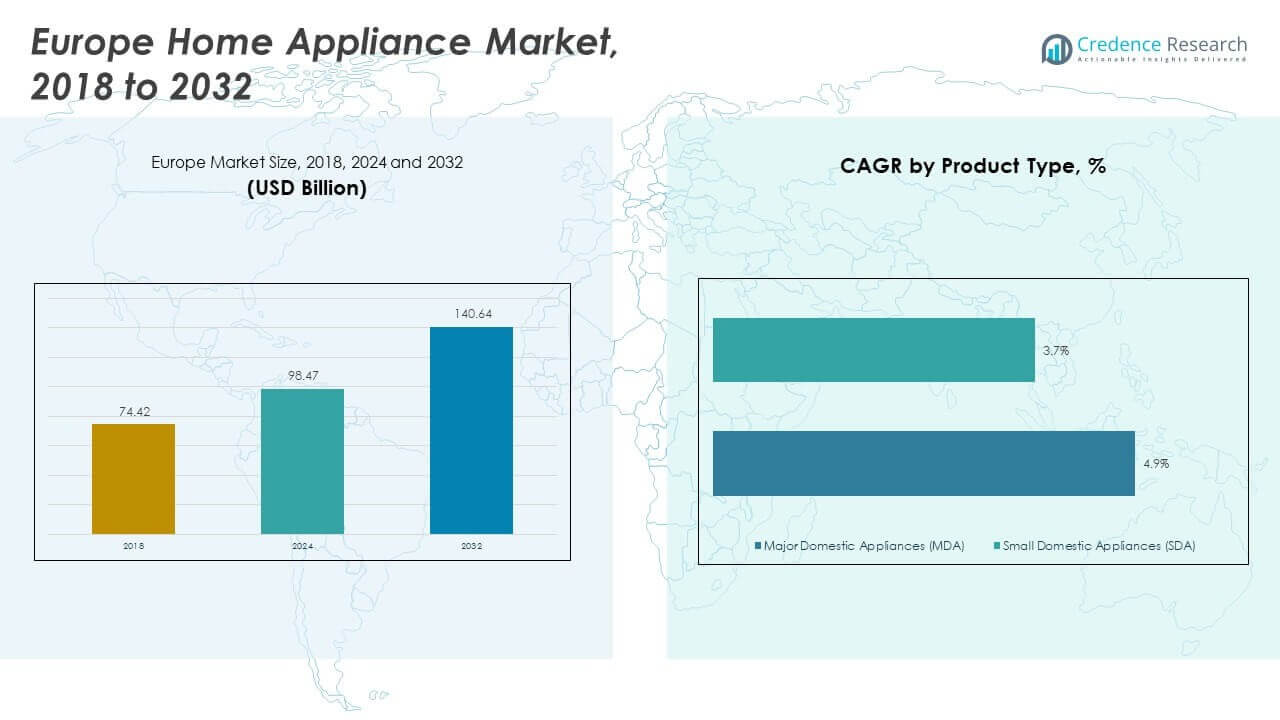
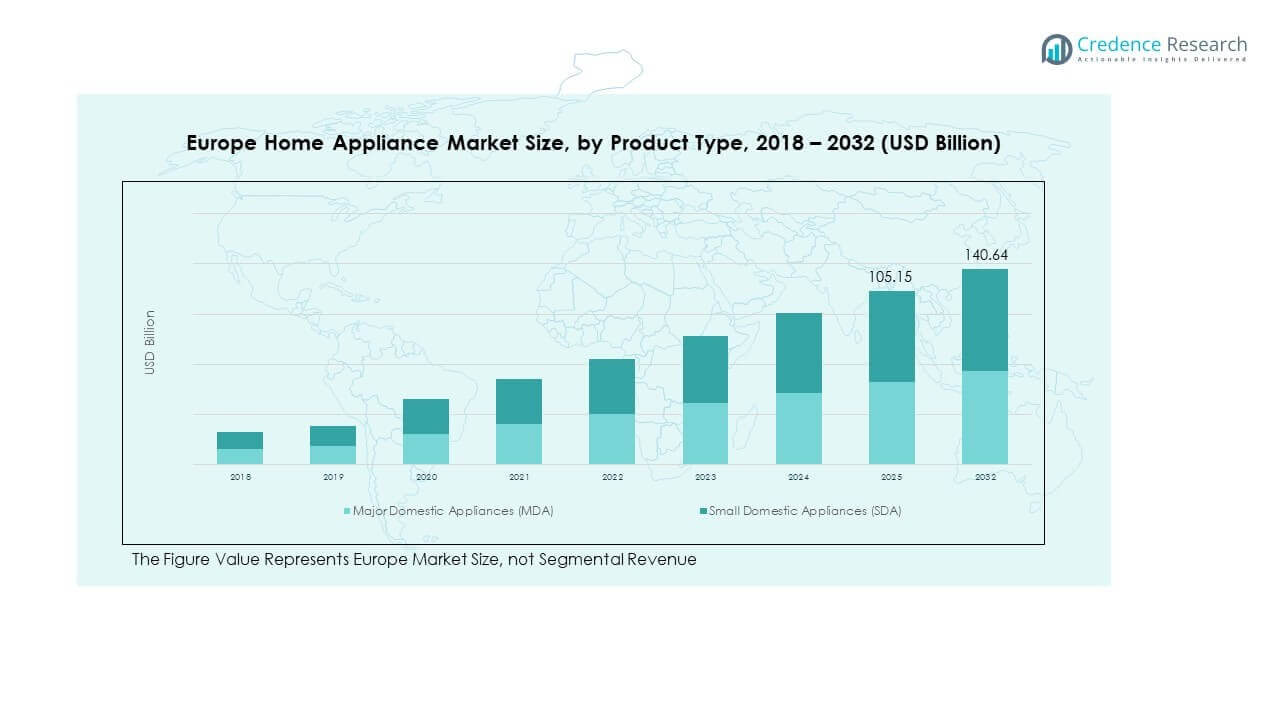
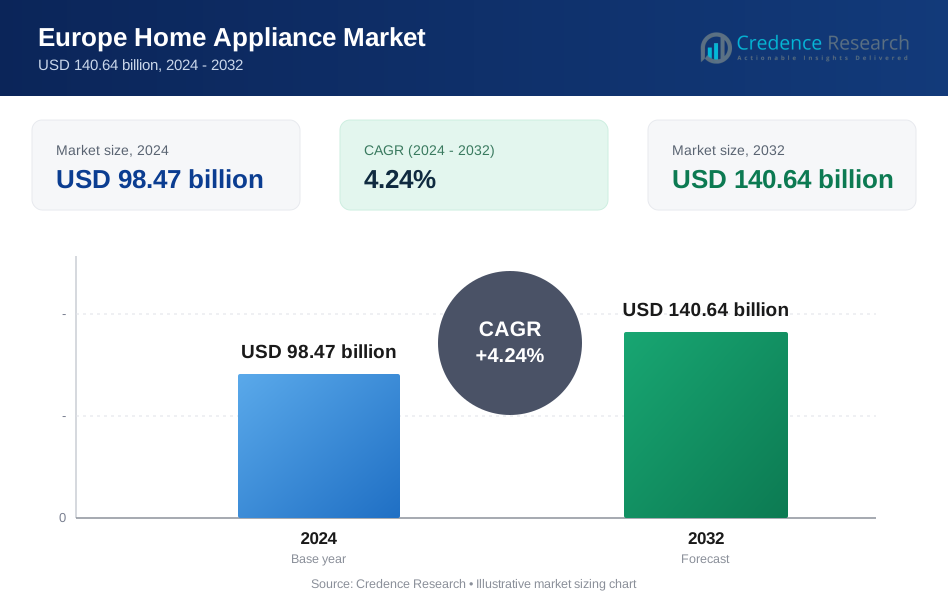
The Europe Home Appliance Market size was valued at USD 74.42 billion in 2018 to USD 98.47 billion in 2024 and is anticipated to reach USD 140.64 billion by 2032, at a CAGR of 4.24% during the forecast period.
| REPORT ATTRIBUTE | DETAILS |
|---|---|
| Historical Period | 2020-2023 |
| Base Year | 2024 |
| Forecast Period | 2025-2032 |
| Europe Home Appliance Market Size 2024 | USD 98.47 Billion |
| Europe Home Appliance Market, CAGR | 4.24% |
| Europe Home Appliance Market Size 2032 | USD 140.64 Billion |
The Europe Home Appliance Market grows due to urban living and lifestyle upgrades. Consumers prefer energy-efficient and smart appliances for daily use. Replacement demand stays strong due to aging appliance bases. Rising disposable income supports premium product adoption. Sustainability rules push manufacturers toward low-energy designs. Smart homes increase demand for connected appliances. E-commerce improves product access and price comparison. Built-in kitchens support integrated appliance sales. Brand innovation drives frequent model refresh cycles. After-sales networks improve buyer confidence.
Germany, France, and the United Kingdom lead demand due to high spending power. These markets show strong adoption of premium appliances. Italy and Spain follow with steady replacement demand. Southern Europe benefits from housing renovations. Central and Eastern Europe are emerging markets. Rising urbanization supports appliance penetration there. Local manufacturing improves supply efficiency. Government energy policies shape product preferences. Retail expansion boosts regional reach.
Market Insights:
- The Europe Home Appliance Market was valued at USD 74.42 billion in 2018, reached USD 98.47 billion in 2024, and is projected to hit USD 140.64 billion by 2032, growing at a CAGR of 4.24%.
- Western Europe holds about 55% share, led by Germany, France, and the UK due to high income levels, premium adoption, and strong retail networks; Southern Europe follows with 25% share driven by renovation demand in Italy and Spain; Northern and Eastern Europe together account for nearly 20% due to rising efficiency-focused purchases.
- Eastern Europe stands as the fastest-growing region with an estimated 12% share, supported by urbanization, rising disposable incomes, and expanding modern retail infrastructure.
- Major Domestic Appliances dominate the market with roughly 65% share, supported by strong replacement cycles in refrigerators, washing machines, and cooking appliances.
- Small Domestic Appliances account for about 35% share, driven by convenience, affordability, and growing demand for compact products in urban households.
Market Drivers:
Rising Urban Housing Development and Appliance Replacement Cycles
The Europe Home Appliance Market benefits from steady urban housing growth across major cities. New apartment construction increases demand for core household appliances. Replacement cycles stay active due to aging installed bases. Consumers prefer newer models with improved performance and durability. Urban lifestyles raise dependence on time-saving appliances. Compact housing supports demand for space-efficient designs. Retail financing options ease purchase decisions. Manufacturers align launches with residential project timelines. Developers increasingly include appliances in turnkey housing projects. Rental housing growth sustains entry-level appliance demand. Urban migration keeps baseline replacement demand stable.
- For instance, BSH Hausgeräte reported that over 60% of its European washing machine sales come from replacement demand, supported by average appliance lifespans of 10–12 years across urban households.
Energy Efficiency Regulations and Sustainability Policy Enforcement
The Europe Home Appliance Market responds strongly to strict energy efficiency rules. Governments promote low-energy and water-efficient appliances through clear standards. Consumers show high awareness of utility cost savings. Energy labels influence buying behavior across income groups. Manufacturers invest in compliant product redesign. Long-term operating savings support premium adoption. Public incentives strengthen certified product demand. Policy stability supports long-term production planning. Carbon reduction targets guide product roadmaps. Compliance improves brand credibility among buyers. Efficiency benchmarks influence retailer product assortments.
- For instance, the Electrolux Group disclosed in 2025 that while approximately 85% of its total climate impact occurs during the product use phase, its "most resource-efficient products" accounted for 24% of total units sold and 33% of gross profit globally in 2024.
Rising Disposable Income and Premium Product Adoption Trends
The Europe Home Appliance Market gains from stable disposable income levels. Households upgrade appliances for comfort and design value. Premium kitchens support built-in appliance demand. Brand trust shapes purchase decisions. Extended warranties increase confidence in high-value products. Lifestyle upgrades favor multifunction appliances. Showrooms enable hands-on evaluation. Marketing highlights design and ease of use. Premium appliances signal lifestyle status. Custom finishes support personalization preferences. Financing plans improve affordability of high-end models.
Expansion of Organized Retail and Digital Sales Channels
The Europe Home Appliance Market benefits from strong retail and e-commerce networks. Large stores improve product comparison. Online platforms simplify research and pricing checks. Omnichannel models increase buying flexibility. Fast delivery meets urban demand. Installation services enhance customer experience. Retail partnerships expand regional reach. Data-led promotions raise conversion rates. Click-and-collect options gain traction. Digital reviews influence purchase confidence. Retail analytics refine inventory planning.
Market Trends:
Growth of Smart and Connected Appliance Ecosystems
The Europe Home Appliance Market shows rising adoption of smart appliances. Consumers prefer connected devices for control and convenience. Appliances integrate with home automation systems. Mobile apps support remote monitoring. Voice assistants improve usability. Manufacturers focus on software features. Data security gains attention. Interoperability becomes a key differentiator. Firmware updates extend product relevance. Predictive maintenance improves appliance uptime. Smart features support energy optimization.
- For instance, Samsung Electronics disclosed in 2023 that the SmartThings platform supported over 100 million connected appliances globally, with Europe identified as a core region for active connected home adoption and energy-focused smart home deployments.
Design-Led Innovation and Aesthetic Customization Demand
The Europe Home Appliance Market reflects strong design focus. Consumers value appliances that match modern interiors. Color options and finishes support personalization. Minimalist styles attract urban buyers. Built-in formats enable seamless kitchens. Design partnerships boost brand appeal. Visual impact drives showroom sales. Premium design supports higher pricing. Handle-less designs gain popularity. Matte finishes replace traditional gloss. Design awards influence brand perception.
- For instance, Beko Europe, formed following the Arçelik–Whirlpool EMEA integration, has positioned built-in kitchen appliances as a core growth focus across Europe, leveraging Whirlpool, Hotpoint, and Indesit portfolios alongside Beko and Grundig to support demand for integrated, design-aligned, and smart-connected kitchens.
Shift Toward Compact and Multifunction Appliance Formats
The Europe Home Appliance Market adapts to smaller living spaces. Compact appliances gain demand in cities. Multifunction models save space and energy. Combination ovens and washer-dryers see wider use. Flexible capacity suits varied households. Versatility improves value perception. Brands optimize output within smaller footprints. Retailers promote space-saving solutions. Urban apartments favor slim-width products. Multifunction devices reduce appliance count. Space efficiency supports first-time buyers.
Focus On After-Sales Service and Customer Experience
The Europe Home Appliance Market emphasizes service quality. Buyers expect reliable installation support. Extended service plans build loyalty. Fast spare part access reduces downtime. Digital booking simplifies service access. Customer feedback shapes product updates. Service transparency improves trust. Strong networks drive repeat purchases. Service speed influences brand choice. Preventive maintenance reduces failures. Customer support quality supports retention.
Market Challenges Analysis:
Cost Pressure from Raw Materials and Manufacturing Compliance
The Europe Home Appliance Market faces rising input costs. Metal and electronic components affect margins. Energy rules increase production complexity. Certification updates raise compliance expenses. Pricing flexibility stays limited. Smaller brands face scale issues. Supply disruptions affect planning. Cost control remains critical. Long supplier contracts gain importance. Local sourcing reduces exposure to volatility.
Market Saturation and Intense Brand Competition Risks
The Europe Home Appliance Market operates within a mature landscape. High penetration limits volume growth. Price competition impacts profitability. Brand differentiation becomes difficult. Private labels increase pressure. Frequent discounts weaken margins. Consumer switching rises. Innovation speed defines survival. Marketing spend continues to rise. Service quality influences brand retention.
Market Opportunities:
Expansion of Energy-Efficient and Eco-Labeled Product Portfolios
The Europe Home Appliance Market offers strong sustainability-driven opportunities. Eco-labeled products attract conscious buyers. Energy savings support long-term value. Premium efficiency enables margin protection. Incentives support adoption. Brands strengthen green positioning. Retailers highlight efficiency benefits. Sustainability supports corporate goals. Product labeling improves purchase transparency. Lifecycle efficiency gains buyer trust. Green portfolios align with EU climate targets.
Growth Potential Across Emerging Eastern European Economies
The Europe Home Appliance Market shows opportunity in Eastern Europe. Appliance ownership rates continue to rise. Urban migration drives new households. Income growth improves affordability. Modern retail expands access. Local production improves supply reliability. Early entry builds brand loyalty. Demand growth supports long-term expansion. Infrastructure development supports appliance adoption. Distribution networks continue to strengthen. Consumer awareness of efficiency improves.
Market Segmentation Analysis:
By Product Type
The Europe Home Appliance Market is primarily driven by Major Domestic Appliances. Refrigerators, washing machines, and dishwashers form the core demand base due to essential household use. Replacement cycles remain strong for these categories across mature markets. Cookers, ovens, and hoods benefit from kitchen renovation trends. Dryers and freezers see steady demand in urban and cold-climate regions. Small Domestic Appliances complement this demand through convenience-led adoption. Vacuum cleaners, coffee machines, and air fryers gain traction due to lifestyle changes. Personal care appliances support frequent upgrade behavior.
- For instance, LG Electronics has announced cumulative global production exceeding 100 million Inverter Direct Drive motors, a core technology used in its premium front-loading washing machines across Europe to improve durability, noise reduction, and energy efficiency. The company remains a leading player in the European front-load segment, with multiple models certified at the highest EU energy efficiency classes.
By Price Tier
The Europe Home Appliance Market shows balanced demand across price tiers. Entry-level products serve cost-conscious buyers and rental housing. Mid-range appliances attract mass households seeking durability and efficiency. Premium products gain share through design, smart features, and energy performance. Luxury appliances cater to high-income households and bespoke kitchens. Brand reputation strongly influences premium and luxury purchases. Financing options improve access to higher tiers. Price segmentation supports broad market coverage.
- For instance, Miele states that its appliances are tested for up to 20 years of household use, supporting strong premium demand across Germany, Switzerland, and Nordic countries.
By Purchase Channel
The Europe Home Appliance Market relies heavily on specialist retail stores. These outlets support product comparison and professional guidance. Online marketplaces grow due to convenience and pricing transparency. Brand stores strengthen direct customer engagement and loyalty. Hypermarkets support volume sales for entry and mid-range products. Omnichannel strategies enhance reach and flexibility. Delivery and installation services influence channel choice.
By Consumer Profile
The Europe Home Appliance Market demand varies by household income and size. Higher-income households favor premium and luxury appliances. Larger households prioritize capacity and durability. Younger consumers prefer smart and compact appliances. Urban buyers focus on space-efficient designs. Rural consumers value robustness and service access. Demographic diversity shapes product positioning.
Segmentation:
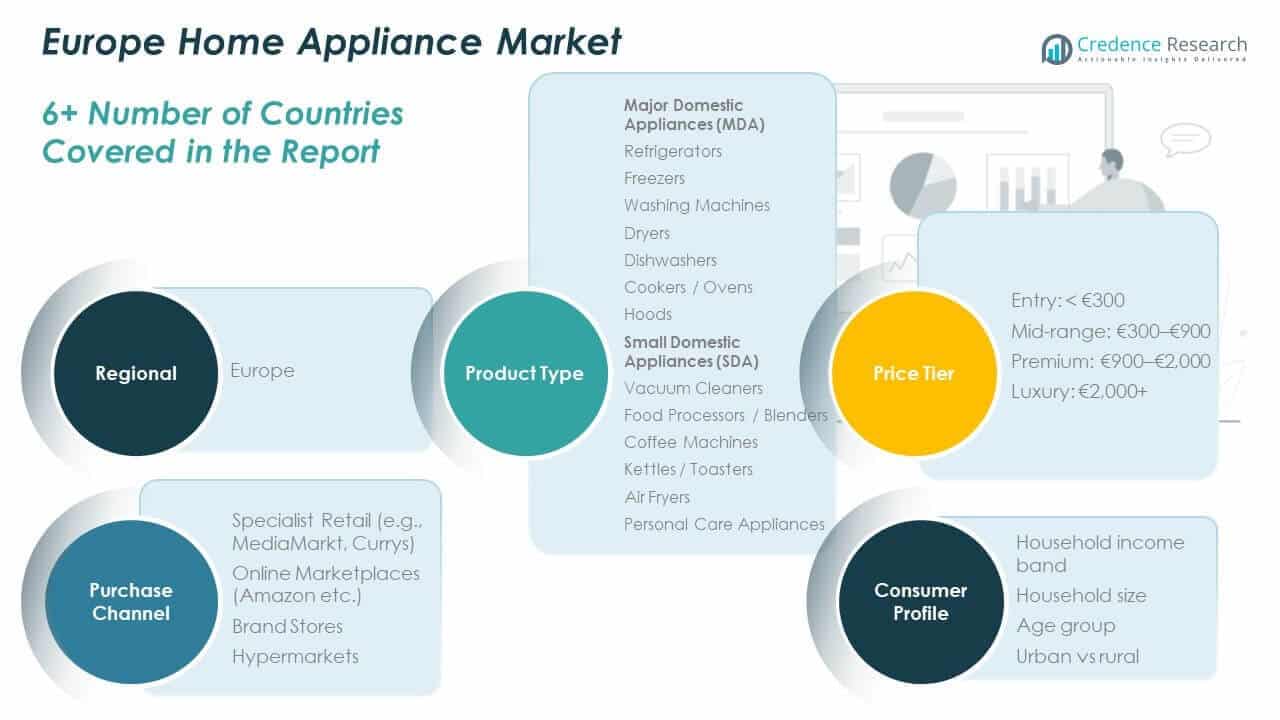
By Product Type
- Major Domestic Appliances (MDA)
- Refrigerators
- Freezers
- Washing Machines
- Dryers
- Dishwashers
- Cookers / Ovens
- Hoods
- Small Domestic Appliances (SDA)
- Vacuum Cleaners
- Food Processors / Blenders
- Coffee Machines
- Kettles / Toasters
- Air Fryers
- Personal Care Appliances
By Price Tier
- Entry: < €300
- Mid-range: €300 – €900
- Premium: €900 – €2,000
- Luxury: €2,000+
By Purchase Channel
- Specialist Retail (e.g., MediaMarkt, Currys)
- Online Marketplaces (e.g., Amazon)
- Brand Stores
- Hypermarkets
By Consumer Profile
- Household income band
- Household size
- Age group
- Urban vs rural
Regional Analysis:
Western Europe Dominance Driven By Premium Adoption
The Europe Home Appliance Market remains led by Western Europe, holding nearly 55% market share. Germany, France, and the United Kingdom anchor this dominance through high appliance penetration. Consumers favor premium and energy-efficient products across households. Replacement demand stays strong due to mature installed bases. Strong retail infrastructure supports consistent sales volumes. Brand loyalty influences repeat purchases. Innovation and sustainability shape buying behavior across this region.
Southern Europe Supported By Renovation And Design Preferences
The Europe Home Appliance Market sees Southern Europe account for around 25% market share. Italy and Spain drive demand through housing renovation activity. Consumers emphasize design, built-in formats, and compact appliances. Tourism supports steady commercial appliance demand. Price sensitivity remains moderate across households. Energy efficiency awareness continues to improve. Retail expansion strengthens regional distribution coverage.
Northern And Eastern Europe As Emerging Growth Centers
The Europe Home Appliance Market assigns close to 20% market share to Northern and Eastern Europe combined. Nordic countries show demand for high-efficiency and durable appliances. Eastern Europe benefits from urbanization and rising household incomes. Appliance ownership rates continue to increase in these markets. Modern retail formats improve product access. Local manufacturing supports supply efficiency. Long-term growth potential remains strong across this region.
Key Player Analysis:
- BSH Hausgeräte (Bosch & Siemens)
- Electrolux Group (including AEG & Zanussi)
- Whirlpool Corporation
- Haier Europe (including Candy & Hoover)
- Midea Group (including Toshiba & Midea brands)
- Samsung Electronics
- LG Electronics
- Panasonic Corporation
- Arçelik (including Beko brands)
- Hisense Group
Competitive Analysis:
The Europe Home Appliance Market shows strong competition among global and regional brands. Leading players focus on brand strength, energy efficiency, and product design. It features high market penetration across core appliance categories. Companies compete through premium positioning and wide product portfolios. Retail reach and after-sales service influence brand preference. Innovation cycles remain frequent across large appliances. Strategic pricing helps defend market share. Private labels increase pressure in mass segments. Competitive intensity stays high in mature Western Europe.
Recent Developments:
- In January 2026, Electrolux Professional Group completed the acquisition of assets from Royal Range, enhancing its professional appliance offerings. This move supports expansion in specialized kitchen equipment for the European market.
- In October 2025, Haier Europe partnered with Witt Denmark A/S, appointing it as the official distributor for Haier and Candy brands across the Nordic region starting November 2025. This strategic alliance aims to accelerate growth and innovation in Scandinavia.
- In September 2025, BSH Home Appliances Group entered into a global strategic partnership with ECOVACS ROBOTICS to develop innovative floor cleaning solutions. The first product from this collaboration is the world's first built-in vacuum and mopping robot under the Bosch brand, set for availability in European stores from spring 2026.
- In March 2025, Panasonic Corporation formed a capital and business alliance with tado° GmbH through a €30 million equity investment to advance energy-efficient heat pump solutions. The partnership targets up to 30% energy reduction via updated software for Aquarea Heat Pumps, rolling out in Europe by September 2025.
Report Coverage:
The research report offers an in-depth analysis based on product type, price tier, purchase channel, and consumer profile. It details leading market players, providing an overview of their business, product offerings, investments, revenue streams, and key applications. Additionally, the report includes insights into the competitive environment, SWOT analysis, current market trends, as well as the primary drivers and constraints. Furthermore, it discusses various factors that have driven market expansion in recent years. The report also explores market dynamics, regulatory scenarios, and technological advancements that are shaping the industry. It assesses the impact of external factors and global economic changes on market growth. Lastly, it provides strategic recommendations for new entrants and established companies to navigate the complexities of the market.
Future Outlook:
- Smart appliance adoption will expand across urban households, driven by rising comfort with connected home ecosystems and mobile-based control features that improve daily convenience.
- Energy efficiency will shape future product development priorities, with manufacturers focusing on lower power consumption, water savings, and compliance with evolving EU standards.
- Premium appliances will gain share in Western Europe, supported by high disposable income levels, strong renovation activity, and preference for durable, design-oriented products.
- Eastern Europe will see faster volume growth, fueled by urbanization, rising household formation, and improving access to modern retail and financing options.
- Online channels will strengthen omnichannel strategies, allowing brands to integrate digital discovery with physical store support for installation and after-sales service.
- Design-led appliances will support premium pricing, as consumers increasingly value aesthetics, built-in formats, and alignment with modern kitchen interiors.
- Compact appliances will suit smaller living spaces, especially in dense cities where space efficiency and multifunctionality influence purchase decisions.
- Service quality will influence repeat purchases, with fast installation, spare part availability, and transparent service processes shaping brand loyalty.
- Sustainability goals will guide manufacturing decisions, encouraging the use of recyclable materials, efficient production methods, and longer product lifecycles.
- Innovation speed will define competitive positioning, as brands compete on smart features, product upgrades, and rapid response to changing consumer preferences.
Request a Free Sample
Fill in your details and we'll send you a free sample report.
- Sample data tables & charts
- Research methodology
Need a Custom Version of This Report?
Tailor the scope, geography, or segments to your exact requirements.
- Custom geography or segment scope
- Direct access to our analyst team
Frequently Asked Questions
What is the current market size for Europe Home Appliance Market, and what is its projected size in 2032?
At what Compound Annual Growth Rate is the Europe Home Appliance Market projected to grow between 2024 and 2032?
Which Europe Home Appliance Market segment held the largest share in 2024?
What are the primary factors fueling the growth of the Europe Home Appliance Market?
Who are the leading companies in the Europe Home Appliance Market?
Which region commanded the largest share of the Europe Home Appliance Market in 2024?
Table of Content
Chapter 1 Market Segmentation
- 1.1 Segmentation Framework
- 1.1.1 Product and Service Classification
- 1.1.2 Application and End-Use Classification
- 1.1.3 Technology and Solution Classification
- 1.1.4 Customer and Distribution Channel Classification
- 1.1.5 Geographic Segmentation
- 1.1.6 Market Segment Definitions and Boundaries
Chapter 2 Introduction
- 2.1 Report Objectives and Scope
- 2.2 Product Definition and Industry Terminology
- 2.3 Market Inclusions and Exclusions
- 2.4 Research Process
- 2.4.1 Primary Research and Expert Interviews
- 2.4.2 Secondary Research and Source Review
- 2.4.3 Top-Down and Bottom-Up Estimation
- 2.4.4 Data Triangulation and Verification
- 2.5 Market Size Measurement Basis
- 2.5.1 2024: USD 98.47 billion → 2032: USD 140.64 billion
- 2.6 Historical and Forecast Reference Periods
- 2.6.1 Base Year: 2024
- 2.6.2 Forecast Period: 2024-2032
- 2.7 Research Assumptions and Limitations
Chapter 3 Executive Summary
- 3.1 Market Snapshot and Key Findings
- 3.2 Base-Year Market Size, 2024
- 3.3 Forecast Market Size, 2032
- 3.4 Revenue and Volume Growth Outlook
- 3.5 Key Demand and Supply Indicators
- 3.6 Leading Market Segments
- 3.7 Fastest-Growing Market Opportunities
- 3.8 Regional Performance Highlights
- 3.9 Technology and Industry Transformation
- 3.10 Competitive Landscape Summary
- 3.11 Analyst View and Strategic Implications
Chapter 4 Europe Home Appliance Market Trends and Developments
- 4.1 Historical Industry Development
- 4.2 Recent Market Trends and Developments
- 4.3 Demand and Customer Behavior Trends
- 4.4 Technology and Product Innovation
- 4.5 Artificial Intelligence, Automation and Digitalization
- 4.6 Local Manufacturing and Supply Chain Realignment
- 4.7 Industry Partnerships, Mergers and Acquisitions
- 4.8 Sustainability and Circular Economy Developments
- 4.9 Government and Private Sector Investment Trends
- 4.10 Emerging Business Models and Commercialization
- 4.11 Industry Developments and Announcements
Chapter 5 Europe Home Appliance Market Production, Supply and Demand Analysis
- 5.1 Demand Trend and Consumption Analysis
- 5.2 Demand Forecast, 2024-2032
- 5.3 Production and Output Trend
- 5.4 Production and Output Forecast, 2024-2032
- 5.5 Installed Capacity and Capacity Utilization
- 5.6 Company-Wise Production Plants and Statistics
- 5.6.1 Installed Production Capacity
- 5.6.2 Actual Production
- 5.6.3 Planned Capacity and Expansion Targets
- 5.7 Supply Chain Structure and Procurement Trends
- 5.8 Supply-Demand Gap and Bottlenecks
- 5.9 Import Dependence and Sourcing Structure
- 5.10 Contract Manufacturing and Outsourcing
- 5.11 Regional Supply and Demand Concentration
Chapter 6 Europe Home Appliance Market Pricing Analysis
- 6.1 Pricing Structure and Measurement
- 6.2 Historical Pricing Trends
- 6.3 Pricing Outlook, 2024-2032
- 6.4 Average Selling Price and Unit Economics
- 6.5 Pricing by Product and Market Segment
- 6.6 Geographic Pricing Differences
- 6.7 Key Input, Energy, Labor and Logistics Costs
- 6.8 Contract Pricing and Purchasing Models
- 6.9 Pricing Sensitivity and Competitive Positioning
- 6.10 Price, Margin and Profitability Implications
Chapter 7 Europe Home Appliance Market Dynamics
- 7.1 Market Growth Drivers
- 7.1.1 Demand-Side Drivers
- 7.1.2 Technology and Innovation Drivers
- 7.1.3 Infrastructure and Investment Drivers
- 7.1.4 Regulatory and Policy Drivers
- 7.2 Market Restraints
- 7.2.1 Cost and Affordability Constraints
- 7.2.2 Technology and Adoption Barriers
- 7.2.3 Supply Chain and Operational Constraints
- 7.3 Market Challenges
- 7.3.1 Competitive Pressure and Margin Erosion
- 7.3.2 Skills, Infrastructure and Implementation Gaps
- 7.4 Emerging Market Opportunities
- 7.5 Market Dynamics Impact and Time-Horizon Assessment
Chapter 8 Europe Home Appliance Value Chain Analysis
- 8.1 Industry Value Chain Overview
- 8.2 Upstream Suppliers and Critical Inputs
- 8.3 Technology and Component Providers
- 8.4 Manufacturing or Service Delivery
- 8.5 Distribution, Channel Partners and Integrators
- 8.6 Downstream Applications and End Users
- 8.7 Value Addition and Profit Pools
- 8.8 Vertical Integration and Outsourcing
- 8.9 Supplier Concentration and Risk
- 8.10 Supply Chain Localization and Resilience
Chapter 9 Europe Home Appliance Market Regulations and Policies
- 9.1 Relevant Laws, Standards and Compliance Frameworks
- 9.2 Product, Service, Safety and Quality Requirements
- 9.3 Government Policies, Incentives and Subsidies
- 9.4 Imports, Exports and Trade Barriers
- 9.5 Public Procurement and Local Content Requirements
- 9.6 Environmental and Sustainability Compliance
- 9.7 Upcoming Policy Changes and Market Implications
Chapter 10 Europe Home Appliance Market Hotspots and Opportunities
- 10.1 Market Opportunity Mapping and Growth Hotspots
- 10.2 High-Growth Applications and Customer Groups
- 10.3 Underserved Markets and White-Space Opportunities
- 10.4 Emerging Technology and Product Opportunities
- 10.5 New Capacity and Investment Hotspots
- 10.6 Market Entry and Expansion Opportunities
- 10.7 Distribution and Partnership Opportunities
- 10.8 Near-Term and Long-Term Commercial Potential
- 10.9 Opportunity Attractiveness and Execution Risks
Chapter 11 Europe Home Appliance Market Outlook, 2024-2032
- 11.1 Market Size and Analysis
- 11.1.1 Revenue (Market Measurement: 2024: USD 98.47 billion → 2032: USD 140.64 billion)
- 11.1.2 Market Volume and Quantity Sold
- 11.1.3 Historical Market Size
- 11.1.4 Base-Year Market Size, 2024
- 11.2 Market Forecast, 2024-2032
- 11.2.1 Revenue Forecast to 2032
- 11.2.2 Volume Forecast to 2032
- 11.2.3 CAGR and Year-on-Year Growth
- 11.2.4 Incremental Revenue Opportunity
- 11.3 Forecast Assumptions and Scenario Analysis
- 11.3.1 Base-Case Forecast
- 11.3.2 Optimistic and Conservative Scenarios
- 11.3.3 Technology, Pricing and Policy Sensitivities
- 11.4 Market Attractiveness and Growth Outlook
Chapter 12 Europe Home Appliance Market Segmentation and Outlook
- 12.1 Segmentation Summary and Market Shares, 2024
- 12.2 Largest and Fastest-Growing Segments
- 12.3 Segment Growth Comparison
- 12.4 Segment Attractiveness and Priority Matrix
Chapter 13 Europe Home Appliance Geographic Market Outlook, 2024-2032
- 13.1 Regional Market Size and Country-Level Shares, 2024
- 13.2 Country Market Size Comparison, 2024
- 13.3 Country Market Forecasts, 2024-2032
- 13.4 Subregional Industrial and Demand Clusters
- 13.5 Intra-Regional Pricing and Cost Differences
- 13.6 Cross-Border Trade and Supply Networks
- 13.7 Regional Supply and Demand Balances
- 13.8 Country Opportunity Comparison and Prioritization
Note: Every listed country is covered on the structure shown under the first country.
Chapter 14 Europe Home Appliance Technology, Innovation and Sustainability Outlook
- 14.1 Technology Landscape and Maturity
- 14.2 Product, Process and Service Innovation
- 14.3 AI, Automation and Digital Tools in the Industry
- 14.4 Technology Adoption and Performance Benchmarking
- 14.5 Innovation Pipeline and R&D Investment
- 14.6 Patent and Intellectual Property Trends
- 14.7 Energy Efficiency and Resource Management
- 14.8 Sustainability, Recycling and Circularity
- 14.9 Technology Roadmap, 2024-2032
- 14.10 Risks of Obsolescence and Technology Substitution
Chapter 15 Europe Home Appliance Market Key Strategic Imperatives
- 15.1 Growth and Market Entry Priorities
- 15.2 High-Return Products and Segments
- 15.3 Pricing, Profitability and Cost Optimization
- 15.4 Technology Investment and Product Differentiation
- 15.5 Supply Chain Localization and Resilience
- 15.6 Distribution and Customer Acquisition
- 15.7 Partnership, Acquisition and Capacity Strategy
- 15.8 Regional Expansion Priorities
- 15.9 Short-, Medium- and Long-Term Actions
Chapter 16 Competition Outlook
- 16.1 Industry Competition Characteristics
- 16.2 Market Structure and Concentration
- 16.3 Market Share and Competitive Positioning, 2024
- 16.4 Company-Wise Revenue and Product Benchmarking
- 16.5 Production and Service Capacity Benchmarking
- 16.6 Technology, Pricing and Differentiation
- 16.7 Regional Footprint and Distribution Strength
- 16.8 Mergers, Acquisitions and Strategic Alliances
- 16.9 New Entrants and Competitive Threats
- 16.10 Porter's Five Forces and Industry Attractiveness
- 16.11 Competitive Outlook, 2024-2032
Chapter 17 Company Profiles
- 17.1 Company Coverage and Selection Criteria
- 17.2 Leading Market Participants – Standard Profile Structure
- 17.2.1 Business Description
- 17.2.2 Company Ownership and Geographic Presence
- 17.2.3 Product and Service Portfolio
- 17.2.4 Manufacturing and Operating Footprint
- 17.2.5 Production Capacity and Expansion Plans
- 17.2.6 Financial Performance and Investment
- 17.2.7 Market Share and Competitive Position
- 17.2.8 Technology and Innovation Capabilities
- 17.2.9 Strategic Alliances or Partnerships
- 17.2.10 Recent Developments
- 17.2.11 Growth Strategy and Outlook
- 17.3 Other Relevant Market Participants
Note: Every listed company is profiled on the structure shown under the first company. The company list is preliminary and may change based on research findings, market developments, data availability and client requirements.
Chapter 18 Disclaimer
- 18.1 Research and Forecast Disclaimer
- 18.2 Data Source and Estimation Limitations
Note: The depth of individual sections depends on data availability for this market. Volume, capacity, trade and other unit-based metrics are included where applicable.