
Market Overview:
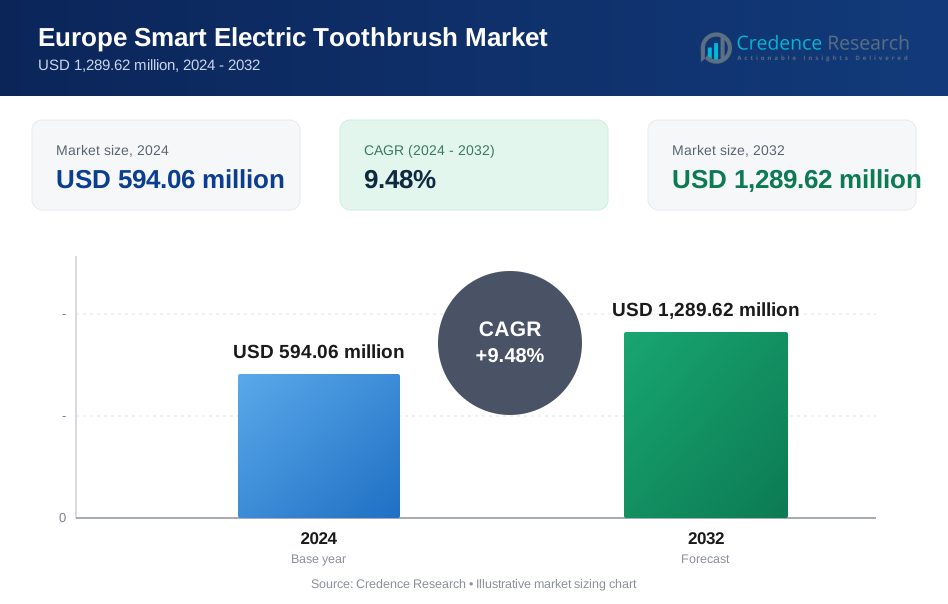
The Europe Smart Electric Toothbrush Market size was valued at USD 272.89 million in 2018 to USD 594.06 million in 2024 and is anticipated to reach USD 1,289.62 million by 2032, at a CAGR of 9.48% during the forecast period.
| REPORT ATTRIBUTE | DETAILS |
|---|---|
| Historical Period | 2020-2023 |
| Base Year | 2024 |
| Forecast Period | 2025-2032 |
| Europe Smart Electric Toothbrush Market Size 2024 | USD 594.06 million |
| Europe Smart Electric Toothbrush Market, CAGR | 9.48% |
| Europe Smart Electric Toothbrush Market Size 2032 | USD 1,289.62 million |
Rising oral health awareness, the demand for personalized hygiene solutions, and the integration of smart features are driving adoption across Europe. Consumers prefer electric toothbrushes with app-based guidance, real-time feedback, and pressure sensors to improve brushing habits. Dental professionals recommend these products for improved compliance, while growing smartphone penetration supports wider use. Brands leverage digital platforms and wellness programs to educate users and boost product visibility. Smart brushes with AI capabilities now cater to specific needs such as sensitivity, orthodontic care, and preventive dental routines.
Western Europe leads the market, with Germany, the UK, and France showing high adoption due to advanced retail networks and strong dental health awareness. Northern Europe follows with demand driven by sustainability preferences and premium device penetration. Southern Europe sees growing interest supported by pharmacy-driven retail and mid-range offerings. Eastern Europe remains an emerging region, with rising urbanization, expanding digital access, and entry-level product launches strengthening future growth. Regional dynamics reflect diverse purchasing behaviors, infrastructure readiness, and consumer education levels across the continent.

Market Insights
- The Europe Smart Electric Toothbrush Market was valued at USD 272.89 million in 2018, reached USD 594.06 million in 2024, and is projected to hit USD 1,289.62 million by 2032, growing at a CAGR of 9.48%.
- Western Europe accounted for 42% of the market in 2024, followed by Northern Europe at 23% and Southern Europe at 18%, driven by strong dental awareness, digital engagement, and established retail networks.
- Eastern Europe, with a 17% share, is the fastest-growing region due to urbanization, expanding e-commerce, and rising access to mid-range and entry-level devices.
- In 2024, rechargeable electric toothbrushes held the largest product-type share at 35%, followed by smart connected brushes at 29%, supported by high user engagement and connectivity features.
- By 2032, AI-enabled smart electric toothbrushes are projected to gain 25% share, driven by growing demand for personalized oral care and dentist-recommended precision tools.
Market Drivers
Rising Consumer Focus on Preventive Dental Care and Personalized Oral Hygiene Tools
Growing consumer attention toward preventive health is reshaping oral hygiene habits across Europe. People now prefer devices that track, coach, and enhance brushing routines. Dentists support smart toothbrushes that monitor coverage and brushing pressure. Personalized oral care reports help users identify patterns and improve outcomes. Features like timers, zone guidance, and Bluetooth syncing increase awareness and compliance. Health-focused households drive purchases through wellness-driven spending. The Europe Smart Electric Toothbrush Market benefits from this shift in care models. It sees strong demand from tech-savvy families and young adults. This personalized wellness push is now central to product design.
- For instance, Oral-B’s iO Series 10 features 16-zone AI-powered tracking and pressure sensors, helping users achieve up to 100% more plaque removal than manual brushes, according to clinical tests.
Integration of Connectivity Features with Real-Time Feedback and Usage Analytics
Digital integration is a strong growth lever across smart health tools in Europe. Smart toothbrushes with app-based tracking and AI feedback raise user engagement. Cloud storage of brushing data helps users maintain dental discipline. Parents monitor children's oral routines through synced dashboards. Devices now offer pressure sensors, position tracking, and habit analysis. Users share brushing reports with dental professionals to improve care alignment. This data-driven model strengthens trust in premium brush segments. The Europe Smart Electric Toothbrush Market gains from the rise of connected ecosystems. It attracts buyers seeking smart wellness integrations for everyday hygiene.
- For instance, Philips Sonicare Prestige 9900 uses SenseIQ technology and app sync, delivering up to 15x more plaque removal and 7x healthier gums within 2 weeks, based on third-party lab studies.
Strong Retail Penetration of Smart Oral Care Through Online Platforms and Pharmacies
Retail formats across Europe provide easy access to digital oral care products. E-commerce platforms feature curated categories for smart brushes with customer reviews. Pharmacies and health stores offer bundled oral care subscriptions. Retailers run seasonal promotions that raise trial and repeat purchases. Subscription models provide replacement heads and battery units regularly. Online platforms drive price comparison and tech specification awareness. Visibility across multiple retail channels enhances brand recall. The Europe Smart Electric Toothbrush Market benefits from omnichannel strategies. It sees volume growth from both first-time and returning customers.
Influence of Public Awareness Campaigns by Dental Associations and Brands
Dental health associations across Europe promote better brushing techniques through public campaigns. Smart toothbrush brands align with these efforts to demonstrate product value. Schools and clinics integrate oral hygiene education supported by digital tools. Governments also fund awareness drives around gum disease and dental decay. Smart toothbrushes become tools of behavior change through tech-based nudges. Partnerships with dental networks encourage trial usage during checkups. Brands offer limited-period demos in retail stores and exhibitions. The Europe Smart Electric Toothbrush Market benefits from these advocacy-based marketing efforts. It strengthens brand trust and adoption across income groups.
Market Trends
Adoption of AI-Powered Brushing Intelligence in Premium Segment Devices
Manufacturers now embed artificial intelligence to guide users through customized brushing routines. AI models detect motion patterns, apply zone-specific suggestions, and warn users of incorrect techniques. Voice-based feedback or app alerts drive better brushing alignment. AI platforms use historical data to recommend settings per individual. Users feel empowered through quantified oral care. AI also helps reduce wear on gums by adjusting brush intensity. These features raise device value perception among users. The Europe Smart Electric Toothbrush Market sees strong uptake in premium models with AI coaching. It creates new benchmarks for digital oral care engagement.
Focus on Sustainable Designs, Rechargeable Formats, and Recyclable Packaging
Sustainability in consumer devices has reached the oral care space in Europe. Smart electric toothbrushes now come in recyclable packaging and modular formats. Several brands adopt bio-based plastics or recycled resin housings. Rechargeable units cut down on disposable battery usage. Consumers show preference for low-waste oral care systems. Replacement heads use minimal materials without performance compromise. Companies align sustainability with performance through innovation. The Europe Smart Electric Toothbrush Market benefits from eco-conscious customer preferences. It becomes a testbed for green-certified consumer device offerings.
Rise of Subscription-Based Oral Health Ecosystems for Long-Term Engagement
Subscription models extend customer retention and simplify maintenance. Users receive scheduled shipments of brush heads, mouthwash, and dental floss. Platforms send usage insights and reminders through apps. Loyalty-based incentives promote consistent product use. Subscription plans improve affordability for high-cost models. Brands track customer satisfaction and upgrade paths through digital feedback. Customer lifetime value increases in these models. The Europe Smart Electric Toothbrush Market adopts recurring revenue approaches. It allows brands to stabilize revenue while enhancing user convenience.
- For instance, Quip’s Smart Electric Toothbrush offers a 3-monthly refill subscription and app-based tracking, with internal reports showing higher brushing consistency among smart brush users compared to manual-only subscribers.
Increasing Influence of Social Media, Influencer Marketing, and Gamification
Social media platforms drive awareness of smart toothbrush features through visual content. Influencers highlight brushing challenges, app scores, and family routines. Gamified brushing apps create engagement among children and parents. Challenges like streaks or leaderboards encourage healthy competition. Visual dashboards drive sharing among peer groups. Limited edition designs linked to influencers boost trial intent. Branded content raises trust in new features or models. The Europe Smart Electric Toothbrush Market gains visibility through these digital marketing shifts. It engages younger demographics through personalized digital experiences.
- For instance, Colgate HUM’s app includes gamified features like streaks and rewards, which the company reports have significantly increased brushing session completion rates since its EU rollout, engaging over a million users in daily challenges.

Market Challenges Analysis
Affordability Gaps Between Smart Toothbrushes and Traditional Oral Care Tools
The Europe Smart Electric Toothbrush Market faces pricing barriers across price-sensitive segments. Many buyers still perceive manual brushes or basic electric models as sufficient. Entry-level smart toothbrushes often exceed the average oral care spend of lower-income users. The high upfront cost, combined with subscription add-ons, discourages trial. Insurance schemes rarely cover tech-driven consumer hygiene products. While urban regions adapt faster, rural buyers remain cautious. Mass-market brands must balance innovation with affordability. Lack of price parity across regions limits uniform adoption. It affects scale for mid-tier product lines and deters long-tail customer retention.
Technical Compatibility and App Fatigue Reduce Usage Continuity Among Users
Some users face pairing issues or syncing delays between smart brushes and mobile apps. Inconsistent app updates and device firmware bugs hinder real-time tracking. Long-term usage falls when engagement dashboards fail to show meaningful insights. Device batteries, head wear-out rates, and app performance affect satisfaction. Users juggling multiple health apps may lose interest in daily logging. Concerns about data privacy and tracking also emerge. Technical friction lowers enthusiasm for continued use. The Europe Smart Electric Toothbrush Market faces churn when engagement drops post-purchase. It must overcome these usability hurdles to maintain product stickiness.
Market Opportunities
Growing Demand for AI-Enhanced Oral Care Across Healthcare and Institutional Channels
Hospitals, dental clinics, and wellness programs explore smart toothbrushes for preventive care. Dentists recommend AI-based tools for early gum disease detection and habit correction. Employers include digital oral care kits in wellness initiatives. Schools test gamified brushing kits in public health campaigns. The Europe Smart Electric Toothbrush Market can tap these institutional channels for volume growth. It enables broader awareness and trial across user segments.
Localization and Product Personalization for Specific Age, Language, and Medical Needs
Localized app interfaces, age-specific coaching, and sensitive-mode brushes offer tailored value. Kids' models feature colors, characters, and parental monitoring tools. Seniors prefer ergonomic, easy-grip designs with minimal tech complexity. Language localization improves retention in multilingual markets. The Europe Smart Electric Toothbrush Market benefits from hyper-personalization strategies. It helps brands stand out across demographic clusters.
Market Segmentation Analysis
By Product Type
The Europe Smart Electric Toothbrush Market includes battery-powered, rechargeable, smart connected, and AI-enabled models. Rechargeable electric toothbrushes hold strong appeal due to convenience and lower long-term cost. Smart connected variants gain traction among digital health users who value performance tracking. AI-enabled models are emerging in premium categories, offering brushing guidance and real-time feedback. Battery-powered models continue to serve price-sensitive users seeking entry-level digital functionality.
By Brushing Technology
Brushing technologies in the market span oscillating–rotating, sonic, ultrasonic, and hybrid formats. Oscillating–rotating systems remain widely used due to effective plaque removal and affordability. Sonic technology delivers gentle yet powerful vibrations, appealing to sensitive gum users. Ultrasonic and hybrid models address advanced oral care needs, combining vibration patterns with cleaning precision. The market sees innovation across all modes as brands target varied oral profiles.
By End User
End users include household consumers, dental professionals, and institutional programs. Adults form the largest user group, while smart brushes for children include gamified features and parental controls. Dental clinics deploy AI-enabled units for patient demonstration and preventive care. Institutional buyers, such as schools and wellness programs, adopt these devices for hygiene education and outreach. The market caters to diverse users across personal and professional channels.
- For instance, the Philips Sonicare For Kids app guides brushing across multiple zones and rewards full session completion with streak badges and interactive character-based incentives, supporting better coverage and engagement in children.
By Technology Layer
Core technologies driving the Europe Smart Electric Toothbrush Market include MCUs, sensors, battery systems, connectivity modules, and embedded firmware. Sensors such as motion, pressure, and orientation support accurate brushing. Bluetooth and Wi-Fi modules ensure seamless syncing with apps. Power management ICs and embedded software enhance device efficiency and user control. Integration of these components drives product differentiation and feature depth.
By Price Tier
The market spans entry-level to ultra-premium tiers. Entry-level products cater to users shifting from manual brushes. Mid-range models balance features with cost efficiency. Premium and ultra-premium variants integrate AI, app control, and sustainability-led design. Consumers in urban centers show high acceptance for mid to premium categories. Price segmentation supports varied affordability levels across Europe.
- For instance, Quip’s electric toothbrush features a 2-minute timer with 30-second pulses and offers a 3-month battery life on a single AAA cell, while its mid-range models provide app connectivity and better feature balance for cost-conscious users.
By Application
Smart toothbrushes support multiple applications including daily hygiene, preventive dental care, orthodontic support, and gum sensitivity management. Devices with soft bristles and mode customization target users with braces or gum issues. Preventive features appeal to users seeking early intervention against oral problems. This broad scope of functionality helps the market grow across demographics and dental conditions.
By Distribution Channel
Sales channels include online platforms, brand-owned stores, pharmacies, supermarkets, and dental clinics. Online platforms lead in terms of product variety, price transparency, and access. Pharmacies and clinics offer professional recommendations and bundled dental care products. Supermarkets expand reach in mainstream retail. Brand-owned e-commerce strengthens customer loyalty and post-purchase engagement. The market leverages omni-channel strategies to improve coverage and visibility.
Segmentation
By Product Type
- Battery-powered electric toothbrushes
- Rechargeable electric toothbrushes
- Smart connected electric toothbrushes
- AI-enabled smart electric toothbrushes
By Brushing Technology
- Oscillating–rotating technology
- Sonic technology
- Ultrasonic technology
- Hybrid brushing technology
By End User
- Household / individual consumers
- Adults
- Children
- Dental clinics & professionals
- Institutional & preventive oral care programs
By Technology Layer
- Microcontrollers (MCUs)
- Sensors
- Motion sensors
- Pressure sensors
- Position/orientation sensors
- Motors & drive systems
- Battery systems
- Power management ICs
- Connectivity modules
- Bluetooth Low Energy (BLE)
- Wi-Fi
- NFC
- Embedded firmware
- Mobile applications & software platforms
By Price Tier
- Entry-level
- Mid-range
- Premium
- Ultra-premium
By Application
- Daily oral hygiene
- Preventive dental care
- Orthodontic care support
- Gum care & sensitivity management
By Distribution Channel
- Online retail platforms
- Brand-owned e-commerce channels
- Pharmacies & drug stores
- Supermarkets & hypermarkets
- Dental clinics & specialty stores

Regional Analysis
Western Europe accounts for the largest share of the Europe Smart Electric Toothbrush Market, holding nearly 42% of the total market. Countries such as Germany, the UK, and France lead adoption, supported by strong dental awareness, high disposable income, and dense urban populations. Dental professionals in these markets endorse smart devices, pushing uptake among middle to high-income users. Brand penetration remains highest in this subregion due to structured retail networks and active health campaigns. Western Europe also sees rapid growth in AI-enabled brushes and app-based oral care subscriptions. It sets the pace for innovation and consumer education.
Northern Europe contributes around 23% of the market, with strong growth in Sweden, Norway, Finland, and Denmark. This subregion favors premium and sustainable toothbrush designs due to strong environmental awareness and a digitally connected population. Consumers prefer devices with recyclable components and long battery life. Health tech adoption remains high across all age groups, supporting fast traction for smart oral care tools. Public dental programs and school-led hygiene awareness initiatives also promote long-term demand. The Europe Smart Electric Toothbrush Market benefits from Northern Europe’s early-adopter profile and eco-conscious consumer base.
Southern and Eastern Europe collectively represent about 35% of the market. Southern countries like Spain and Italy show improving adoption through pharmacy-led sales and promotional bundling. Eastern Europe, led by Poland, Czech Republic, and Hungary, remains an emerging subregion. Rising urbanization, expanding e-commerce access, and healthcare infrastructure improvements push market growth. Mid-range and entry-level devices see stronger traction in these price-sensitive areas. The Europe Smart Electric Toothbrush Market sees long-term opportunity here through localization, pricing strategies, and targeted education efforts.
Key Player Analysis
- Philips
- Procter & Gamble
- Colgate-Palmolive
- Panasonic
- Church & Dwight
- FOREO
- SEYSSO
- Trisa
- Beurer
- Oral-B
Competitive Analysis
The Europe Smart Electric Toothbrush Market includes both global oral care giants and emerging health-tech innovators. Leading companies such as Philips, Oral-B (P&G), and Colgate-Palmolive hold significant market share through strong brand presence and diverse product lines. These players dominate premium and mid-range segments by offering AI-enabled, app-synced, and dentist-endorsed devices. Their scale allows bundled offerings across both online and offline channels. New entrants and regional startups compete through differentiation in sustainability, design, and subscription models. Companies like FOREO and Oclean focus on sleek, battery-efficient brushes tailored for younger consumers. Players also collaborate with dental clinics to promote clinical-grade usage. Most competitors rely on omnichannel distribution and offer regular product upgrades. The Europe Smart Electric Toothbrush Market sees rising consolidation, with large players acquiring niche brands to expand reach and portfolio. Competitive intensity continues to rise across pricing tiers and user groups.
Recent Developments
- In October 2025, Philips (NL) launched its latest electric toothbrush model incorporating AI-driven features to analyze brushing habits in the Europe Smart Electric Toothbrush Market.
- In January 2025, Philips launched its most advanced Sonicare models-the 5000–7000 Series-with adaptive brushing technology that adjusts to tooth positioning and includes optical pressure sensing.
- In January 2025, Oral-B (Procter & Gamble) launched the Oral-B iO Series 2 (iO2) electric toothbrushes in Berlin featuring advanced iO technology.
Report Coverage
The research report offers an in-depth analysis based on Product Type, Brushing Technology, End User, Technology Layer, Price Tier, Application and Distribution Channel. It details leading market players, providing an overview of their business, product offerings, investments, revenue streams, and key applications. Additionally, the report includes insights into the competitive environment, SWOT analysis, current market trends, as well as the primary drivers and constraints. Furthermore, it discusses various factors that have driven market expansion in recent years. The report also explores market dynamics, regulatory scenarios, and technological advancements that are shaping the industry. It assesses the impact of external factors and global economic changes on market growth. Lastly, it provides strategic recommendations for new entrants and established companies to navigate the complexities of the market.
Future Outlook
- AI-enabled toothbrushes will move from premium to mainstream segments as production scales and unit costs decline.
- Integration with tele-dentistry platforms will allow users to share brushing data with professionals for real-time assessment.
- Gamified features targeting children and seniors will expand usage in household and institutional settings.
- Eco-friendly models using recycled materials and long-life batteries will shape future product designs.
- Voice-enabled guidance systems and in-app health dashboards will strengthen user engagement across demographics.
- Localized language interfaces and culturally tailored app content will support market penetration in Eastern and Southern Europe.
- Brands will invest in diagnostics-driven models that detect early gum disease or dental erosion.
- Distribution through dental clinics and pharmacy chains will grow, with bundled kits and dentist referrals driving trial.
- Subscription models offering consumables, app features, and device insurance will boost customer lifetime value.
- Consolidation will continue as global oral care leaders acquire innovative startups to expand their smart product portfolios.
Request a Free Sample
Fill in your details and we'll send you a free sample report.
- Sample data tables & charts
- Research methodology
Need a Custom Version of This Report?
Tailor the scope, geography, or segments to your exact requirements.
- Custom geography or segment scope
- Direct access to our analyst team
Frequently Asked Questions
What is the current market size for Europe Smart Electric Toothbrush Market, and what is its projected size in 2032?
At what Compound Annual Growth Rate is the Europe Smart Electric Toothbrush Market projected to grow between 2024 and 2032?
Which Europe Smart Electric Toothbrush Market segment held the largest share in 2024?
What are the primary factors fueling the growth of the Europe Smart Electric Toothbrush Market?
Who are the leading companies in the Europe Smart Electric Toothbrush Market?
Which region commanded the largest share of the Europe Smart Electric Toothbrush Market in 2024?
Table of Content
Chapter 1 Market Segmentation
- 1.1 Segmentation Framework
- 1.1.1 Product and Service Classification
- 1.1.2 Application and End-Use Classification
- 1.1.3 Technology and Solution Classification
- 1.1.4 Customer and Distribution Channel Classification
- 1.1.5 Geographic Segmentation
- 1.1.6 Market Segment Definitions and Boundaries
Chapter 2 Introduction
- 2.1 Report Objectives and Scope
- 2.2 Product Definition and Industry Terminology
- 2.3 Market Inclusions and Exclusions
- 2.4 Research Process
- 2.4.1 Primary Research and Expert Interviews
- 2.4.2 Secondary Research and Source Review
- 2.4.3 Top-Down and Bottom-Up Estimation
- 2.4.4 Data Triangulation and Verification
- 2.5 Market Size Measurement Basis
- 2.5.1 2024: USD 594.06 million → 2032: USD 1,289.62 million
- 2.6 Historical and Forecast Reference Periods
- 2.6.1 Base Year: 2024
- 2.6.2 Forecast Period: 2024-2032
- 2.7 Research Assumptions and Limitations
Chapter 3 Executive Summary
- 3.1 Market Snapshot and Key Findings
- 3.2 Base-Year Market Size, 2024
- 3.3 Forecast Market Size, 2032
- 3.4 Revenue and Volume Growth Outlook
- 3.5 Key Demand and Supply Indicators
- 3.6 Leading Market Segments
- 3.7 Fastest-Growing Market Opportunities
- 3.8 Regional Performance Highlights
- 3.9 Technology and Industry Transformation
- 3.10 Competitive Landscape Summary
- 3.11 Analyst View and Strategic Implications
Chapter 4 Europe Smart Electric Toothbrush Market Trends and Developments
- 4.1 Historical Industry Development
- 4.2 Recent Market Trends and Developments
- 4.3 Demand and Customer Behavior Trends
- 4.4 Technology and Product Innovation
- 4.5 Artificial Intelligence, Automation and Digitalization
- 4.6 Local Manufacturing and Supply Chain Realignment
- 4.7 Industry Partnerships, Mergers and Acquisitions
- 4.8 Sustainability and Circular Economy Developments
- 4.9 Government and Private Sector Investment Trends
- 4.10 Emerging Business Models and Commercialization
- 4.11 Industry Developments and Announcements
Chapter 5 Europe Smart Electric Toothbrush Market Production, Supply and Demand Analysis
- 5.1 Demand Trend and Consumption Analysis
- 5.2 Demand Forecast, 2024-2032
- 5.3 Production and Output Trend
- 5.4 Production and Output Forecast, 2024-2032
- 5.5 Installed Capacity and Capacity Utilization
- 5.6 Company-Wise Production Plants and Statistics
- 5.6.1 Installed Production Capacity
- 5.6.2 Actual Production
- 5.6.3 Planned Capacity and Expansion Targets
- 5.7 Supply Chain Structure and Procurement Trends
- 5.8 Supply-Demand Gap and Bottlenecks
- 5.9 Import Dependence and Sourcing Structure
- 5.10 Contract Manufacturing and Outsourcing
- 5.11 Regional Supply and Demand Concentration
Chapter 6 Europe Smart Electric Toothbrush Market Pricing Analysis
- 6.1 Pricing Structure and Measurement
- 6.2 Historical Pricing Trends
- 6.3 Pricing Outlook, 2024-2032
- 6.4 Average Selling Price and Unit Economics
- 6.5 Pricing by Product and Market Segment
- 6.6 Geographic Pricing Differences
- 6.7 Key Input, Energy, Labor and Logistics Costs
- 6.8 Contract Pricing and Purchasing Models
- 6.9 Pricing Sensitivity and Competitive Positioning
- 6.10 Price, Margin and Profitability Implications
Chapter 7 Europe Smart Electric Toothbrush Market Dynamics
- 7.1 Market Growth Drivers
- 7.1.1 Demand-Side Drivers
- 7.1.2 Technology and Innovation Drivers
- 7.1.3 Infrastructure and Investment Drivers
- 7.1.4 Regulatory and Policy Drivers
- 7.2 Market Restraints
- 7.2.1 Cost and Affordability Constraints
- 7.2.2 Technology and Adoption Barriers
- 7.2.3 Supply Chain and Operational Constraints
- 7.3 Market Challenges
- 7.3.1 Competitive Pressure and Margin Erosion
- 7.3.2 Skills, Infrastructure and Implementation Gaps
- 7.4 Emerging Market Opportunities
- 7.5 Market Dynamics Impact and Time-Horizon Assessment
Chapter 8 Europe Smart Electric Toothbrush Value Chain Analysis
- 8.1 Industry Value Chain Overview
- 8.2 Upstream Suppliers and Critical Inputs
- 8.3 Technology and Component Providers
- 8.4 Manufacturing or Service Delivery
- 8.5 Distribution, Channel Partners and Integrators
- 8.6 Downstream Applications and End Users
- 8.7 Value Addition and Profit Pools
- 8.8 Vertical Integration and Outsourcing
- 8.9 Supplier Concentration and Risk
- 8.10 Supply Chain Localization and Resilience
Chapter 9 Europe Smart Electric Toothbrush Market Regulations and Policies
- 9.1 Relevant Laws, Standards and Compliance Frameworks
- 9.2 Product, Service, Safety and Quality Requirements
- 9.3 Government Policies, Incentives and Subsidies
- 9.4 Imports, Exports and Trade Barriers
- 9.5 Public Procurement and Local Content Requirements
- 9.6 Environmental and Sustainability Compliance
- 9.7 Upcoming Policy Changes and Market Implications
Chapter 10 Europe Smart Electric Toothbrush Market Hotspots and Opportunities
- 10.1 Market Opportunity Mapping and Growth Hotspots
- 10.2 High-Growth Applications and Customer Groups
- 10.3 Underserved Markets and White-Space Opportunities
- 10.4 Emerging Technology and Product Opportunities
- 10.5 New Capacity and Investment Hotspots
- 10.6 Market Entry and Expansion Opportunities
- 10.7 Distribution and Partnership Opportunities
- 10.8 Near-Term and Long-Term Commercial Potential
- 10.9 Opportunity Attractiveness and Execution Risks
Chapter 11 Europe Smart Electric Toothbrush Market Outlook, 2024-2032
- 11.1 Market Size and Analysis
- 11.1.1 Revenue (Market Measurement: 2024: USD 594.06 million → 2032: USD 1,289.62 million)
- 11.1.2 Market Volume and Quantity Sold
- 11.1.3 Historical Market Size
- 11.1.4 Base-Year Market Size, 2024
- 11.2 Market Forecast, 2024-2032
- 11.2.1 Revenue Forecast to 2032
- 11.2.2 Volume Forecast to 2032
- 11.2.3 CAGR and Year-on-Year Growth
- 11.2.4 Incremental Revenue Opportunity
- 11.3 Forecast Assumptions and Scenario Analysis
- 11.3.1 Base-Case Forecast
- 11.3.2 Optimistic and Conservative Scenarios
- 11.3.3 Technology, Pricing and Policy Sensitivities
- 11.4 Market Attractiveness and Growth Outlook
Chapter 12 Europe Smart Electric Toothbrush Market Segmentation and Outlook
- 12.1 Segmentation Summary and Market Shares, 2024
- 12.2 Largest and Fastest-Growing Segments
- 12.3 Segment Growth Comparison
- 12.4 Segment Attractiveness and Priority Matrix
Chapter 13 Europe Smart Electric Toothbrush Geographic Market Outlook, 2024-2032
- 13.1 Regional Market Size and Country-Level Shares, 2024
- 13.2 Country Market Size Comparison, 2024
- 13.3 Country Market Forecasts, 2024-2032
- 13.4 Subregional Industrial and Demand Clusters
- 13.5 Intra-Regional Pricing and Cost Differences
- 13.6 Cross-Border Trade and Supply Networks
- 13.7 Regional Supply and Demand Balances
- 13.8 Country Opportunity Comparison and Prioritization
Note: Every listed country is covered on the structure shown under the first country.
Chapter 14 Europe Smart Electric Toothbrush Technology, Innovation and Sustainability Outlook
- 14.1 Technology Landscape and Maturity
- 14.2 Product, Process and Service Innovation
- 14.3 AI, Automation and Digital Tools in the Industry
- 14.4 Technology Adoption and Performance Benchmarking
- 14.5 Innovation Pipeline and R&D Investment
- 14.6 Patent and Intellectual Property Trends
- 14.7 Energy Efficiency and Resource Management
- 14.8 Sustainability, Recycling and Circularity
- 14.9 Technology Roadmap, 2024-2032
- 14.10 Risks of Obsolescence and Technology Substitution
Chapter 15 Europe Smart Electric Toothbrush Market Key Strategic Imperatives
- 15.1 Growth and Market Entry Priorities
- 15.2 High-Return Products and Segments
- 15.3 Pricing, Profitability and Cost Optimization
- 15.4 Technology Investment and Product Differentiation
- 15.5 Supply Chain Localization and Resilience
- 15.6 Distribution and Customer Acquisition
- 15.7 Partnership, Acquisition and Capacity Strategy
- 15.8 Regional Expansion Priorities
- 15.9 Short-, Medium- and Long-Term Actions
Chapter 16 Competition Outlook
- 16.1 Industry Competition Characteristics
- 16.2 Market Structure and Concentration
- 16.3 Market Share and Competitive Positioning, 2024
- 16.4 Company-Wise Revenue and Product Benchmarking
- 16.5 Production and Service Capacity Benchmarking
- 16.6 Technology, Pricing and Differentiation
- 16.7 Regional Footprint and Distribution Strength
- 16.8 Mergers, Acquisitions and Strategic Alliances
- 16.9 New Entrants and Competitive Threats
- 16.10 Porter's Five Forces and Industry Attractiveness
- 16.11 Competitive Outlook, 2024-2032
Chapter 17 Company Profiles
- 17.1 Company Coverage and Selection Criteria
- 17.2 Leading Market Participants – Standard Profile Structure
- 17.2.1 Business Description
- 17.2.2 Company Ownership and Geographic Presence
- 17.2.3 Product and Service Portfolio
- 17.2.4 Manufacturing and Operating Footprint
- 17.2.5 Production Capacity and Expansion Plans
- 17.2.6 Financial Performance and Investment
- 17.2.7 Market Share and Competitive Position
- 17.2.8 Technology and Innovation Capabilities
- 17.2.9 Strategic Alliances or Partnerships
- 17.2.10 Recent Developments
- 17.2.11 Growth Strategy and Outlook
- 17.3 Other Relevant Market Participants
Note: Every listed company is profiled on the structure shown under the first company. The company list is preliminary and may change based on research findings, market developments, data availability and client requirements.
Chapter 18 Disclaimer
- 18.1 Research and Forecast Disclaimer
- 18.2 Data Source and Estimation Limitations
Note: The depth of individual sections depends on data availability for this market. Volume, capacity, trade and other unit-based metrics are included where applicable.

