
Market Overview:
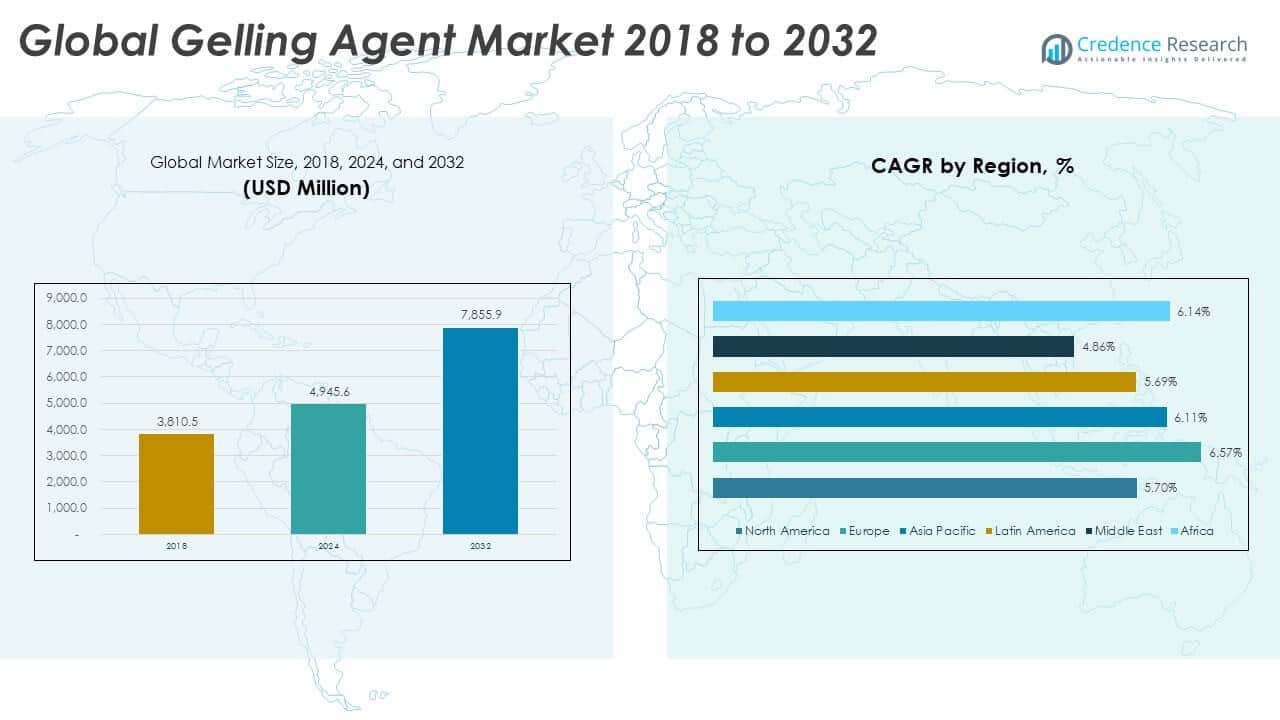
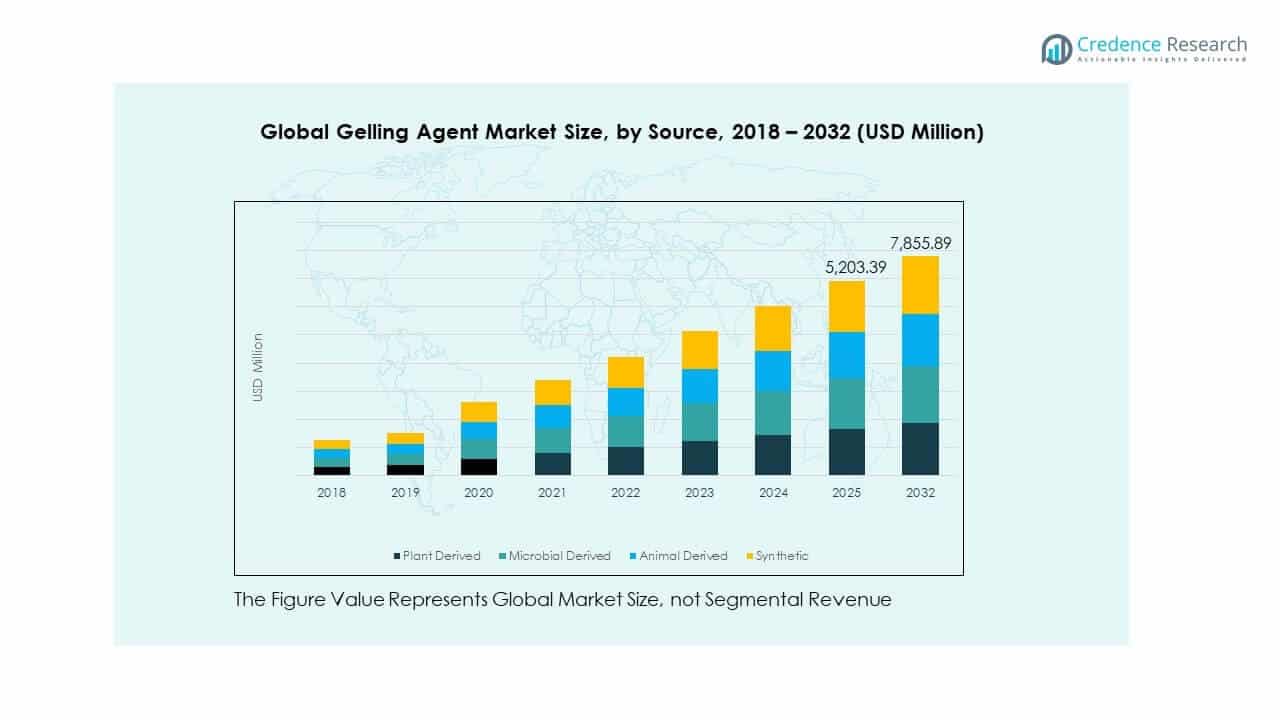
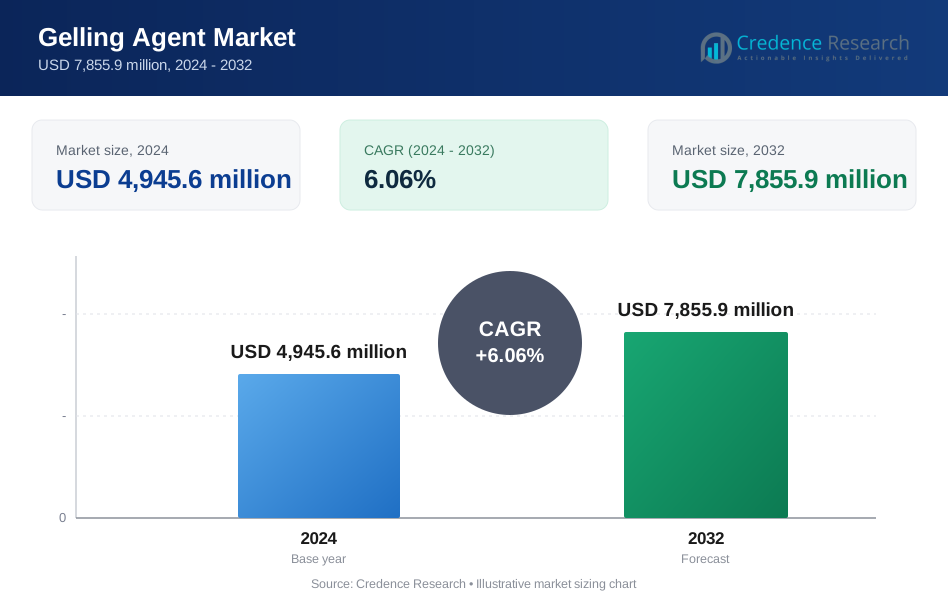
The Global Gelling Agent Market size was valued at USD 3,810.5 million in 2018 to USD 4,945.6 million in 2024 and is anticipated to reach USD 7,855.9 million by 2032, at a CAGR of 6.06% during the forecast period.
| REPORT ATTRIBUTE | DETAILS |
|---|---|
| Historical Period | 2020-2023 |
| Base Year | 2024 |
| Forecast Period | 2025-2032 |
| Gelling Agent Market Size 2024 | USD 4,945.6 million |
| Gelling Agent Market, CAGR | 6.06% |
| Gelling Agent Market Size 2032 | USD 7,855.9 million |
The market is gaining momentum due to rising demand from the food, pharmaceutical, and personal care industries. Consumers increasingly seek clean-label and plant-based products, pushing manufacturers to replace synthetic additives with natural gelling agents. These ingredients play a vital role in texture, stability, and shelf-life enhancement across a broad range of applications. Their usage in gel-based drug delivery, skin care formulations, and low-fat food alternatives continues to expand. Innovations in multi-functional gelling systems are also supporting diverse formulation needs across global product categories.
Asia Pacific dominates the market due to its large-scale food production, industrial base, and rising consumption across China, India, and Southeast Asia. North America and Europe follow with strong demand from processed foods and healthcare. Latin America is emerging through regional manufacturing and demand in beverages and confectionery. The Middle East and Africa show steady uptake, supported by urbanization and expanding food industries, though the market remains import-dependent in several nations. Each region presents unique demand patterns shaped by dietary habits, regulation, and industry maturity.
Market Insights:
- The Global Gelling Agent Market was valued at USD 3,810.5 million in 2018, rose to USD 4,945.6 million in 2024, and is expected to reach USD 7,855.9 million by 2032, growing at a CAGR of 6.06%.
- The top three regions by 2024 market share are Asia Pacific (34.87%), Europe (27.82%), and North America (23.63%), driven by strong food processing, pharmaceutical, and clean-label ingredient demand.
- Africa is the fastest-growing region with a CAGR of 6.14%, supported by urbanization, expanding food industries, and rising demand for affordable gelling solutions.
- In 2024, plant-derived gelling agents hold the largest segment share at approximately 38%, due to natural origin, regulatory acceptance, and broad food and personal care usage.
- Microbial-derived gelling agents follow closely with nearly 30% share in 2024, driven by xanthan and gellan gum use in advanced food, pharmaceutical, and cosmetic formulations.
Market Drivers
Rising Demand for Natural Ingredients in Food Processing and Beverage Applications
Consumer shift toward clean-label products supports strong growth in gelling agent adoption. Manufacturers are replacing synthetic additives with natural gelling alternatives like agar, pectin, and carrageenan. These ingredients improve mouthfeel, stability, and shelf-life in jams, dairy desserts, juices, and confectionery. The Global Gelling Agent Market gains traction due to rising demand from vegan, vegetarian, and organic segments. It enables food companies to meet regulatory and nutritional labeling demands without compromising texture. Strong penetration of plant-based foods continues to drive large-scale reformulation efforts. Growth in health-conscious and allergen-aware consumers also boosts demand for low-fat or gelatin-free products. This trend positions gelling agents as key enablers of natural formulation strategies.
- For instance, Cargill introduced its UniPECTINE® LMCPlus pectin range, designed for low‑sugar and reduced‑sugar jams and fruit preparations. The solution delivers improved gel strength and texture stability compared with conventional low‑methoxyl pectins, supporting cleaner labels and consistent fruit distribution in jam formulations.
Pharmaceutical and Healthcare Applications Driving Formulation Innovation and Gel-Based Dosage Forms
In pharmaceuticals, gelling agents support product stability, controlled release, and ease of consumption. Gel-based drug formulations are preferred for oral, topical, and transdermal delivery systems. These agents improve viscosity, bioavailability, and patient compliance, especially in pediatric and geriatric segments. The Global Gelling Agent Market benefits from increased demand for non-solid drug forms across developing and developed economies. It helps optimize formulations for hydration gels, wound dressings, and dental care products. Rising R&D investments from drugmakers support the search for multi-functional excipients. Regulatory approvals for new delivery formats support wider adoption of natural or synthetic gel bases. This demand strengthens cross-industry integration with pharmaceutical excipient producers.
- For instance, Gelita reports that its pharmaceutical-grade gelatin capsules enable faster dissolution times in oral dosage forms, supporting improved absorption in liquid and semi-solid medicines.
Personal Care and Cosmetic Formulations Requiring Stabilizers and Texture Enhancers in Gel-Based Products
The personal care industry increasingly adopts gelling agents for formulation of gels, creams, lotions, and styling products. They improve product stability, spreadability, and consumer sensory experience across skincare, haircare, and cosmetic lines. The Global Gelling Agent Market benefits from growing preference for plant-derived thickeners and rheology modifiers. It supports formulations that are transparent, non-greasy, and easy to absorb, especially in premium product lines. Consumer demand for sulfate-free and paraben-free formats has increased the use of safe, bio-based gelling options. These ingredients also provide emulsion stability in high-water-content products. Brands use them to meet sustainability claims while enhancing texture performance. Innovation in gel cosmetics continues to expand product formats in the beauty segment.
Processed Food Growth and Shelf-Life Extension Supporting Industrial Adoption Across Multiple Regions
Industrial food production relies on gelling agents for moisture retention, emulsification, and preservation. Processed food exports, ready-to-eat meals, and bakery items require texture consistency across storage cycles. The Global Gelling Agent Market supports quality assurance by reducing spoilage and improving freeze-thaw stability. It plays a key role in high-output food manufacturing and packaging operations. Demand rises in emerging economies due to rapid urbanization and packaged food penetration. These agents help manufacturers manage shelf-life without relying on synthetic preservatives. Investment in cold chain logistics strengthens regional processing industries, increasing gelling agent usage. The ability to standardize product consistency across global supply chains further enhances market value.
Market Trends
Development of Functional Gelling Agents with Dual Roles in Nutrition and Texture Improvement
Manufacturers are investing in gelling agents that also provide dietary benefits, including fiber content and mineral enhancement. This trend addresses demand for multi-functional ingredients that align with wellness product development. The Global Gelling Agent Market supports innovation in value-added foods targeting digestive health and sugar reduction. It enables brands to reduce reliance on added fats or sugars by delivering desired mouthfeel through fiber-based gels. Ingredient developers formulate gelling blends with prebiotics or protein carriers to boost nutritional appeal. Demand from diabetic and weight-conscious populations drives this convergence of texture and nutrition. Companies use proprietary blends to differentiate from basic hydrocolloids. Product launches focus on holistic value rather than single-function gelling behavior.
- For instance, Ingredion states that its citrus fiber-based gelling systems enable sugar reduction of up to 30% in fruit preparations while maintaining target texture and viscosity.
Emergence of Bio-Based Gelling Solutions to Align with Circular Economy and Clean Production Goals
Sustainability goals are pushing manufacturers to shift toward biodegradable, non-GMO, and low-emission gelling agents. Bio-derived materials from algae, seaweed, or citrus waste see increased demand. The Global Gelling Agent Market reflects this transition through rising share of natural gums and cellulose-based agents. It supports clean-label claims without compromising on performance in food and cosmetic applications. Companies invest in green extraction and fermentation technologies to reduce environmental impact. Certification programs for sustainable sourcing are becoming standard procurement requirements. Innovation pipelines prioritize materials with low water, land, and energy footprints. Partnerships between ingredient firms and agri-waste processors fuel further growth in circular gelling inputs.
Customization of Gel Strength, pH Stability, and Processing Parameters to Suit Niche Industrial Needs
Buyers across food, pharma, and personal care sectors now demand gelling agents tailored for specific product conditions. These include desired viscosity under heat, salt resistance, or shear stress resilience during processing. The Global Gelling Agent Market supports advanced customization of gelling profiles to suit niche formulations. It enables seamless integration into continuous manufacturing setups and high-speed filling lines. Developers design agents that adapt across different product pH ranges or interact with active pharmaceutical ingredients. Texture engineers work closely with clients to adjust bloom strength, hydration time, or particle size. This customization creates new value chains around high-performance gelling technologies. Differentiated offerings drive higher margins in competitive markets.
Expansion of Gel Applications in Industrial and Technical Use Cases Beyond Core Consumer Sectors
Gelling agents are gaining traction in industrial fields such as paints, adhesives, batteries, and construction. These applications require thickening, water retention, or film-forming properties that gelling agents provide. The Global Gelling Agent Market benefits from crossover into these non-food domains, especially in Asia and Europe. It supports emerging uses such as ceramic binders, fire-retardant gels, and cement additives. Chemical manufacturers adopt gelling solutions to stabilize slurries or control flow in complex reactions. In electronics, gels support insulation and thermal transfer in battery casings. These industrial expansions diversify demand sources and reduce reliance on seasonal food or cosmetic cycles. The shift enhances long-term market resilience and investment interest.
- For instance, J.M. Huber Corporation reports that its specialty cellulose gelling solutions improve water retention and workability in construction materials used across large-scale infrastructure projects.
Market Challenges Analysis
Volatility in Raw Material Prices and Supply Chain Constraints Impacting Cost Efficiency and Delivery
Raw material costs for gelling agents depend heavily on crops like seaweed, guar, or citrus, which face supply fluctuations. Poor harvests, weather disruptions, and regional restrictions create sharp input price swings. The Global Gelling Agent Market faces cost pressure when buyers must absorb high raw material volatility. It increases procurement risk, especially for small-scale processors lacking supplier leverage. Shipping delays and logistic constraints further strain timely delivery and stock management. These disruptions reduce flexibility in bulk orders and force overstocking or last-minute sourcing. Import tariffs or export bans in key regions create sourcing gaps across global supply chains. This instability hampers pricing predictability and long-term contract planning.
Strict Food Safety Regulations and Functional Limitations of Some Natural Gelling Agents
Regulatory authorities enforce strict guidelines on gelling agents’ purity, origin, and application levels. Some natural agents show limited pH stability or incompatibility with specific product systems. The Global Gelling Agent Market must address these technical limitations to expand adoption. Compliance testing and documentation add cost and time to market entry. Shelf-life performance and clarity under storage conditions also vary by gelling type. Food processors require precise control over texture and shelf stability, which limits use of inconsistent ingredients. Functional gaps in natural gels compared to synthetic counterparts require process adjustments or blending. These challenges create resistance to reformulation among conservative product manufacturers.
Market Opportunities
Expansion of Plant-Based and Vegan Product Categories Unlocking New Application Areas
The growing popularity of vegan diets and plant-based foods increases demand for animal-free gelling agents. Manufacturers are replacing gelatin with agar, pectin, or starch-based systems in desserts, gummies, and dairy alternatives. The Global Gelling Agent Market can expand its scope by addressing formulation gaps in these fast-growing categories. It offers value in mimicking dairy-like textures or jelly consistencies using natural, non-animal ingredients. Startups and private labels prefer flexible, clean-label agents that fit within sustainability branding. The expansion into flexitarian and functional snack formats will continue to drive innovation in vegan-compatible gelling options.
Rising Investment in Functional Foods, Pharmaceuticals, and Cosmeceuticals in Emerging Economies
Emerging markets are investing in fortified foods, topical formulations, and wellness-oriented beverages. These applications often require stable, clear gels that retain bioactive ingredients. The Global Gelling Agent Market has room to grow by supplying formulation bases for nutraceutical capsules, rehydration gels, and active skin serums. R&D spending in India, China, and Southeast Asia opens new partnerships for ingredient developers. Local production capacity for gelling agents can also improve cost competitiveness and product reach across domestic brands.
Market Segmentation Analysis:
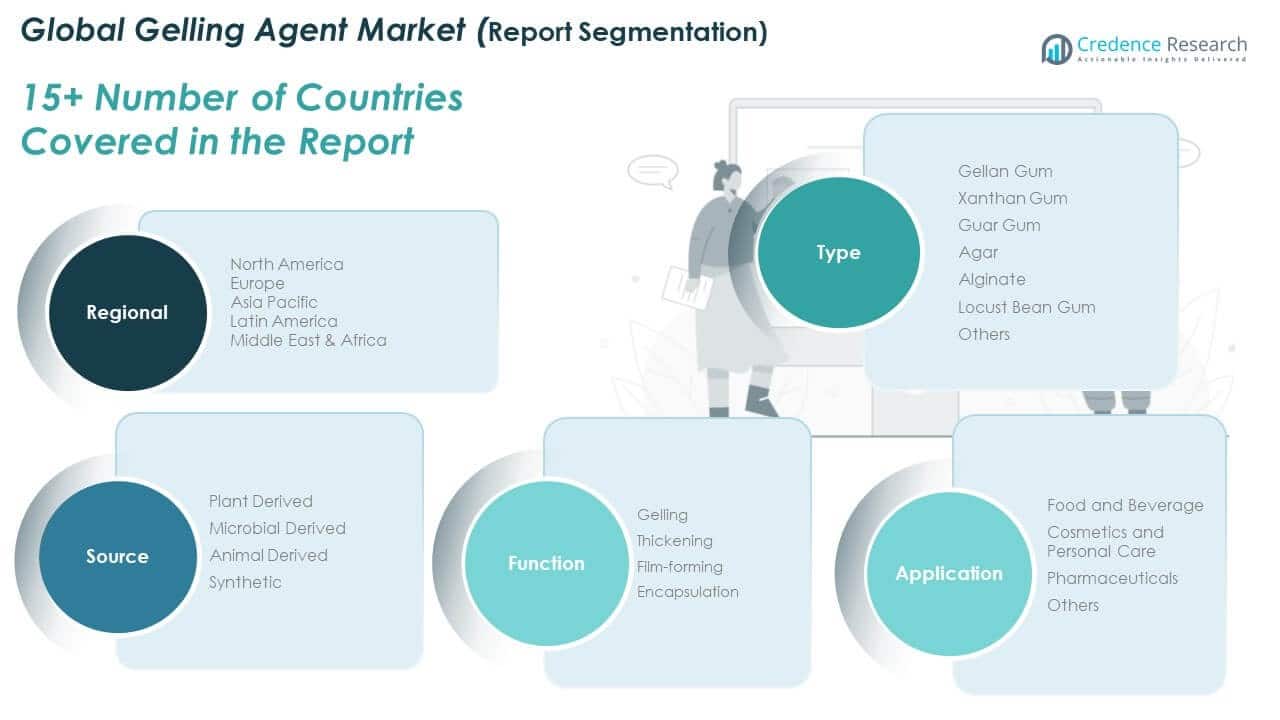
By type, xanthan gum holds a dominant share due to its versatility in food, beverage, and cosmetic applications. Agar and gellan gum gain traction in vegan and clean-label product lines, while guar gum maintains strong demand in bakery and dairy processing. Alginate is widely used in pharmaceutical and food encapsulation, whereas locust bean gum finds relevance in texture enhancement. The "Others" category includes niche agents addressing regional or product-specific formulations.
- For instance, CP Kelco’s Kelcogel® gellan gum performs effectively at very low inclusion rates, often under 0.05%, to produce clear beverages that maintain suspended fruit pieces or beads, demonstrating strong gel clarity and texture control compared with many other hydrocolloids.
By source, plant-derived gelling agents lead due to their natural profile and broad functional compatibility. Microbial-derived options like xanthan and gellan gums offer stability under varying pH and temperature conditions, supporting their role in advanced formulations. Animal-derived agents, primarily gelatin, serve legacy products but face declining demand amid rising plant-based preferences. Synthetic variants continue to play a role in industrial or regulated pharmaceutical applications where precision and consistency are critical.
By application, the food and beverage segment dominates the Global Gelling Agent Market, driven by processed foods, desserts, sauces, and beverages. It supports product stability, mouthfeel, and shelf-life extension across formats. Cosmetics and personal care products increasingly incorporate natural thickeners and gel bases for lotions, creams, and gels. Pharmaceuticals leverage gelling agents in drug delivery systems, oral gels, and capsule suspensions. Other applications include industrial coatings, adhesives, and veterinary products.
- For instance, xanthan gum is widely used in food, cosmetic, and pharmaceutical formulations, providing stabilization in sauces, dairy drinks, lotions, and topical gels due to its ability to control flow and prevent phase separation even at typical usage levels between 0.1% and 0.5%.
By function, gelling accounts for the largest share, followed by thickening, film-forming, and encapsulation. It enables viscosity control, suspension, and structure in various formulations. Demand for encapsulation rises in nutraceutical and pharmaceutical segments to improve stability and active delivery.
Segmentation:
By Type
- Gellan Gum
- Xanthan Gum
- Guar Gum
- Agar
- Alginate
- Locust Bean Gum
- Others
By Source
- Plant Derived
- Microbial Derived
- Animal Derived
- Synthetic
By Application
- Food and Beverage
- Cosmetics and Personal Care
- Pharmaceuticals
- Others
By Function
- Gelling
- Thickening
- Film-forming
- Encapsulation
By Region
- North America (U.S., Canada, Mexico)
- Europe (UK, France, Germany, Italy, Spain, Russia, Rest of Europe)
- Asia Pacific (China, Japan, South Korea, India, Australia, Southeast Asia, Rest of APAC)
- Latin America (Brazil, Argentina, Rest of Latin America)
- Middle East (GCC, Israel, Turkey, Rest of Middle East)
- Africa (South Africa, Egypt, Rest of Africa)
Regional Analysis:
North America
The North America Global Gelling Agent Market size was valued at USD 918.71 million in 2018 to USD 1,168.86 million in 2024 and is anticipated to reach USD 1,806.85 million by 2032, at a CAGR of 5.70% during the forecast period. North America holds a 23.63% market share in 2024. The market benefits from well-established food processing and pharmaceutical industries. Gelling agents support large-scale production of baked goods, dairy, beverages, and convenience foods. Rising consumer preference for clean-label and vegan products drives the demand for agar, xanthan, and guar gum. In pharmaceuticals, gel-based formulations for topical and oral applications continue to expand. Leading cosmetic brands incorporate gelling agents in skincare and haircare products. It supports innovation in gel textures, natural product claims, and texture performance. Regulatory clarity and innovation funding enable steady market expansion.
Europe
The Europe Global Gelling Agent Market size was valued at USD 1,028.83 million in 2018 to USD 1,375.58 million in 2024 and is anticipated to reach USD 2,270.35 million by 2032, at a CAGR of 6.57% during the forecast period. Europe accounts for 27.82% of the market share in 2024. Strong demand for organic and natural food ingredients fuels growth in plant-based gelling agents. Regulatory emphasis on food safety and ingredient traceability supports product reformulation. Processed dairy, vegan desserts, and bakery items are key application areas. Pharmaceuticals use advanced gelling systems in slow-release formulations and medical gels. Leading countries like Germany, France, and the UK show high penetration across personal care and food sectors. It benefits from research collaboration and government-backed sustainability programs. Market players introduce bio-based solutions to meet EU packaging and food labeling standards.
Asia Pacific
The Asia Pacific Global Gelling Agent Market size was valued at USD 1,325.29 million in 2018 to USD 1,724.74 million in 2024 and is anticipated to reach USD 2,749.56 million by 2032, at a CAGR of 6.11% during the forecast period. Asia Pacific leads with a 34.87% market share in 2024. Rapid urbanization, rising income levels, and demand for processed foods drive consumption. Countries like China, India, and Japan contribute heavily to growth. The market supports widespread applications in food processing, personal care, and pharmaceuticals. Locally sourced agar, alginate, and guar gum offer cost advantages. Regional players focus on affordability and volume-based strategies. It sees strong uptake in plant-based nutrition and fortified foods. Export demand for processed food also boosts industrial use of gelling agents.
Latin America
The Latin America Global Gelling Agent Market size was valued at USD 283.88 million in 2018 to USD 361.03 million in 2024 and is anticipated to reach USD 557.77 million by 2032, at a CAGR of 5.69% during the forecast period. Latin America represents 7.30% of the 2024 market share. Growth is supported by the expansion of domestic food and beverage industries. Gelling agents are widely used in sauces, dairy, jams, and frozen desserts. Brazil and Argentina lead regional adoption, supported by growing urban food consumption. Consumer awareness around clean ingredients is increasing, driving demand for plant-based gels. It sees expanding use in cosmetics and topical pharmaceutical products. Regulatory improvements and private investments enhance market access. Opportunities exist in export-oriented production of hydrocolloid-rich crops.
Middle East
The Middle East Global Gelling Agent Market size was valued at USD 182.14 million in 2018 to USD 221.99 million in 2024 and is anticipated to reach USD 322.09 million by 2032, at a CAGR of 4.86% during the forecast period. The region holds a 4.49% market share in 2024. It relies heavily on imports for high-grade food ingredients, including gelling agents. Demand rises in processed dairy, meat products, and halal-certified goods. The market benefits from rising investments in food manufacturing hubs in the UAE and Saudi Arabia. Pharmaceutical and cosmetic sectors adopt gelling agents in gels, syrups, and creams. Government programs support local production and diversification of food supply chains. It remains in a growth phase with increasing consumer focus on premium and clean-label products.
Africa
The Africa Global Gelling Agent Market size was valued at USD 71.64 million in 2018 to USD 93.40 million in 2024 and is anticipated to reach USD 149.26 million by 2032, at a CAGR of 6.14% during the forecast period. Africa accounts for 1.89% of the 2024 market share. It shows rising demand from small-scale food processors and cosmetics producers. Gelling agents are applied in jams, jellies, sauces, and fortified nutrition blends. Nigeria, Egypt, and South Africa are key contributors with expanding FMCG industries. The pharmaceutical sector uses gelling agents in OTC and pediatric products. Limited domestic manufacturing leads to high import dependence. It sees strong potential in food security, dietary supplementation, and local value addition. Investment in regional processing capacity could unlock sustained market growth.
Key Player Analysis:
- Cargill Incorporated
- Tate & Lyle
- Archer Daniels Midland Company (ADM)
- Ingredion Incorporated
- Kerry Group
- Agro Gums
- Gelita AG
- FMC Corporation
- Marine Biopolymers Ltd.
- M. Huber Corporation
- Other Key Players
Competitive Analysis:
The Global Gelling Agent Market shows a moderately consolidated competitive structure with a mix of multinational ingredient suppliers and regional specialists. Large players focus on broad product portfolios that cover plant-based, microbial, and animal-derived gelling agents. They leverage strong sourcing networks, technical expertise, and long-term contracts with food, pharmaceutical, and personal care manufacturers. It supports competition through continuous product improvement, application-specific customization, and quality consistency. Mid-sized and regional firms compete on cost efficiency, local raw material access, and faster delivery timelines. Strategic priorities include expansion of natural and clean-label offerings, investment in processing technologies, and capacity upgrades in high-growth regions. Companies also emphasize regulatory compliance and certification to strengthen customer trust. Partnerships with food processors and pharmaceutical formulators help secure recurring demand and protect market positioning.
Recent Developments:
- In March 2025, Cargill showcased innovative functional blends tailored for snacks, bakery, confectionery, dairy, and ice cream at AAHAR 2025 marking a fresh push into targeted gelling and texturizing solutions for the Indian market.
- In November 2024, Tate & Lyle completed the acquisition of CP Kelco for USD 1.8 billion enhancing capabilities in pectin and specialty gums.
- In September 2024, Jungbunzlauer invested USD 200 million to establish Canada's first xanthan gum manufacturing facility in Port Colborne, Ontario.
Report Coverage:
The research report offers an in-depth analysis based on Type, Source, Application, Function, and Region. It details leading market players, providing an overview of their business, product offerings, investments, revenue streams, and key applications. Additionally, the report includes insights into the competitive environment, SWOT analysis, current market trends, as well as the primary drivers and constraints. Furthermore, it discusses various factors that have driven market expansion in recent years. The report also explores market dynamics, regulatory scenarios, and technological advancements that are shaping the industry. It assesses the impact of external factors and global economic changes on market growth. Lastly, it provides strategic recommendations for new entrants and established companies to navigate the complexities of the market.
Future Outlook:
- Demand for plant-based gelling agents will accelerate due to clean-label trends and vegan food adoption.
- Innovation in functional blends combining gelling, thickening, and nutritional roles will grow.
- Asia Pacific will remain the top regional driver, supported by rising food exports and industrial use.
- Bio-based and biodegradable gelling materials will gain share amid growing environmental regulations.
- Gelling agents in pharma will expand through controlled-release and pediatric-friendly formats.
- Cosmeceutical applications will adopt novel textures using natural and hybrid gel systems.
- Synthetic gelling agents will see selective demand where high-performance or stability is critical.
- Automation and continuous processing in food plants will require highly customizable gel systems.
- Supply chain localization strategies will open new production hubs across emerging economies.
- Strategic partnerships between ingredient firms and FMCG brands will shape long-term growth models.
Request a Free Sample
Fill in your details and we'll send you a free sample report.
- Sample data tables & charts
- Research methodology
Need a Custom Version of This Report?
Tailor the scope, geography, or segments to your exact requirements.
- Custom geography or segment scope
- Direct access to our analyst team
Frequently Asked Questions
What is the current market size for Global Gelling Agent Market, and what is its projected size in 2032?
At what Compound Annual Growth Rate is the Global Gelling Agent Market projected to grow between 2024 and 2032?
Which Global Gelling Agent Market segment held the largest share in 2024?
What are the primary factors fueling the growth of the Global Gelling Agent Market?
Who are the leading companies in the Global Gelling Agent Market?
Which region commanded the largest share of the Global Gelling Agent Market in 2024?
Table of Content
Chapter 1. Report Introduction
- 1.1 Report Description & Purpose
- 1.1.1 Report Title & Market Definition
- 1.1.2 Unique Selling Propositions (USP) & Key Differentiators
- 1.1.3 Value Proposition for Stakeholders
- 1.2 Research Objectives
- 1.2.1 Market Sizing Objectives (Volume & Revenue)
- 1.2.2 Segmentation Objectives
- 1.2.3 Competitive Intelligence Objectives
- 1.2.4 Forecast & Scenario Objectives
- 1.3 Report Scope
- 1.3.1 Gelling Agent Scope – Types & Subtypes Covered
- 1.3.2 Geographic Scope – Regions & Countries Covered
- 1.3.3 Historical Period, Base Year & Forecast Period (2024; forecast to 2032)
- 1.3.4 Inclusions & Exclusions
- 1.4 HS Code & Classification Framework
- 1.5 Currency, Units & Pricing Basis
- 1.6 Target Stakeholders
- 1.7 Limitations & Assumptions
Chapter 2. Executive Summary
- 2.1 Global Gelling Agent Market Snapshot
- 2.1.1 Market Size – Historical (2024) & Forecast (2024-2032) (2024: USD 4,945.6 million → 2032: USD 7,855.9 million)
- 2.1.2 Volume & Revenue – Global Totals
- 2.1.3 Key Market Highlights – Top Five Facts
- 2.2 Gelling Agent Market Segmentation Snapshot
- 2.2.1 Market Split by Region – 2024 vs. 2032
- 2.3 Competitive Snapshot
- 2.3.1 Top 10 Players by Revenue Share – 2024
- 2.3.2 Top 10 Players by Volume Share – 2024
- 2.3.3 Recent Strategic Developments (18-Month Summary)
- 2.4 Key Investment Highlights & Strategic Conclusions
Chapter 3. Gelling Agent Market Dynamics & Industry Analysis
- 3.1 Market Overview & Context
- 3.1.1 Gelling Agent Market Position in the Broader Automotive Value Chain
- 3.1.2 OEM vs. Replacement Market Dynamics
- 3.1.3 Market Maturity & Development Stage by Region
- 3.2 Gelling Agent Market Drivers
- 3.3 Gelling Agent Market Restraints & Challenges
- 3.4 Gelling Agent Market Opportunities
- 3.5 Porter's Five Forces Analysis
- 3.5.1 Threat of New Entrants
- 3.5.2 Bargaining Power of Suppliers
- 3.5.3 Bargaining Power of Buyers
- 3.5.4 Threat of Substitutes
- 3.5.5 Competitive Rivalry – Intensity Assessment
- 3.6 Gelling Agent Value Chain Analysis
- 3.6.1 Upstream – Raw Material/Input Suppliers
- 3.6.1.1 Raw Material/Input 1
- 3.6.1.2 Raw Material/Input 2
- 3.6.1.3 Raw Material/Input 3
- 3.6.2 Midstream – Production/Manufacturing/Service Delivery
- 3.6.2.1 Production/Process Overview
- 3.6.2.2 Key Facility Locations & Capacity by Manufacturer
- 3.6.3 Downstream – Distribution & End Consumer
- 3.6.3.1 Primary Channel – B2B/OEM
- 3.6.3.2 Secondary Channels – Dealer, Retail, Online, Direct
- 3.6.4 Value Chain Profitability Analysis
- 3.6.1 Upstream – Raw Material/Input Suppliers
- 3.7 PESTEL Analysis
- 3.7.1 Political Factors
- 3.7.2 Economic Factors
- 3.7.3 Social Factors
- 3.7.4 Technological Factors
- 3.7.5 Environmental Factors
- 3.7.6 Legal Factors
- 3.8 Gelling Agent Supply Chain Analysis
- 3.8.1 Raw Material/Input Supply Risk Assessment
- 3.8.2 Manufacturing Concentration Risk (Geographic Exposure)
- 3.8.3 Trade Disruption Impact Analysis
- 3.9 Regulatory & Policy Landscape
Note: The regulatory and policy landscape section covers regulations based on their applicability to the market, Gelling Agent category, geography, and scope of the study. Only regulatory frameworks with a material impact on operations, compliance, trade, sustainability, or market access are analyzed in detail.
Chapter 4. Key Investment Pockets & Opportunity Analysis
- 4.1 Gelling Agent Market Attractiveness Analysis
- 4.1.1 By Region – Investment Attractiveness Matrix (Volume × CAGR)
- 4.2 Absolute Revenue Growth Opportunity
- 4.2.1 By Region – Absolute USD Growth Through 2032
- 4.3 Incremental Volume Opportunity
- 4.3.1 By Region – Incremental Volume Through 2032
- 4.3.2 Segment – Incremental Volume
- 4.4 Emerging Submarket Opportunity Deep Dive (Subject to Applicability)
- 4.5 Emerging Market Opportunity Scorecards
- 4.5.1 United States
- 4.5.2 Europe
- 4.5.3 Asia
- 4.5.4 Middle East & Africa
Note: Emerging Market Opportunity Scorecards will be included based on relevance and strategic importance. Regions listed are indicative and may vary depending on data availability and market dynamics.
Chapter 5. Gelling Agent Import-Export Analysis & Trade Flows
- 5.1 Global Trade Overview
- 5.1.1 Global Export Value by Country (2024)
- 5.1.2 Global Export Volume by Country (2024)
- 5.1.3 Global Import Value by Country (2024)
- 5.1.4 Global Import Volume by Country (2024)
- 5.1.5 Net Trade Balance by Country (2024)
- 5.2 Export Analysis – Segment
- 5.2.1 Type 1 (HS Code)
- 5.2.2 Type 2 (HS Code)
- 5.2.3 Type 3 (HS Code)
- 5.2.4 Type 4 (HS Code)
- 5.2.5 Type 5 (HS Code)
- 5.3 Import Analysis – Segment
- 5.3.1 Type 1 (HS Code)
- 5.3.2 Type 2 (HS Code)
- 5.3.3 Type 3 (HS Code)
- 5.3.4 Type 4 (HS Code)
- 5.3.5 Type 5 (HS Code)
- 5.4 Average Unit Trade Prices
- 5.4.1 Average Export Price – Segment & Country
- 5.4.2 Average Import Price – Segment & Source Country
- 5.4.3 Price Trends (2024)
- 5.5 Key Trade Route Analysis
- 5.5.1 Trade Route 1
- 5.5.2 Trade Route 2
- 5.5.3 Trade Route 3
- 5.5.4 Trade Route 4
- 5.5.5 Trade Route 5
- 5.6 Trade Policy Impact Assessment
- 5.6.1 US Anti-Dumping & Section 301 Tariffs
- 5.6.2 EU Customs Union Impact
- 5.6.3 Major Free Trade Agreements
- 5.6.4 USMCA Rules of Origin
Note: Trade policy analysis will be included only where relevant to the Gelling Agent market.
Chapter 6. Competitive Landscape & Company Benchmarking
- 6.1 Gelling Agent Market Concentration & Structure
- 6.1.1 Herfindahl-Hirschman Index (HHI) – vs. 2024
- 6.1.2 Tier 1, Tier 2 & Tier 3 Market Structure
- 6.1.3 Global, Regional & Local Player Dynamics
- 6.2 Gelling Agent Market Share Analysis – 2024
- 6.2.1 Global Revenue Share by Company
- 6.2.2 Global Volume Share by Company
- 6.2.3 Regional Revenue Share
- 6.2.4 Market Share Evolution ( vs. 2024)
- 6.2.5 OEM Segment Share by Company
- 6.2.6 Replacement Segment Share by Company
- 6.3 Production/Delivery Capacity & Facility Analysis
- 6.3.1 Global Installed Capacity
- 6.3.2 Capacity Utilization Rates
- 6.3.3 Production/Output Volume
- 6.3.4 Facility Locations & Capacity Map
- 6.3.5 Planned Capacity Additions
- 6.4 Gelling Agent Competitive Benchmarking Matrix
- 6.4.1 Revenue, Volume, CAGR & Profitability Comparison
- 6.4.2 Channel Revenue Mix
- 6.4.3 Geographic Revenue Exposure
- 6.4.4 R&D Intensity
- 6.4.5 Sustainability Maturity
- 6.5 Strategic Developments in Gelling Agent (Last 24 Months)
- 6.5.1 Mergers, Acquisitions & Divestments
- 6.5.2 New Gelling Agent Launches
- 6.5.3 Facility Expansions
- 6.5.4 Strategic Alliances, Joint Ventures & Partnerships
- 6.5.5 Distribution Expansion & Market Entry
- 6.5.6 Sustainability & ESG Initiatives
- 6.6 Competitive Strategy Mapping
- 6.6.1 Leader, Challenger, Follower & Niche Classification
- 6.6.2 Pricing Strategy Comparison
- 6.6.3 Channel Strategy Matrix
Note: Strategic developments are included based on their materiality and the availability of reliable information.
Chapter 7. Global Gelling Agent Market – By Distribution Channel
- 7.1 Segment Overview
- 7.1.1 Volume & Revenue Split by Channel (2024 & 2032)
- 7.1.2 Channel Mix Evolution (2024-2032)
Chapter 8. Regional Market Analysis – Global Overview
- 8.1 Global Regional Overview
- 8.1.1 Regional Volume Share
- 8.1.2 Regional Revenue Share
- 8.1.3 Regional Volume by Region
- 8.1.4 Regional Revenue by Region
- 8.1.5 Regional Forecast Through 2032
- 8.2 Cross-Regional Segment Analysis
- 8.2.1 By Distribution Channel
- 8.2.2 By Brand/Price Tier
Chapter 9. North America Gelling Agent Market
- 9.1 United States
- 9.2 Canada
- 9.3 Mexico
Chapter 10. Europe Gelling Agent Market
- 10.1 Germany
- 10.2 France
- 10.3 Italy
- 10.4 United Kingdom
- 10.5 Spain
- 10.6 Poland
- 10.7 Russia
- 10.8 Netherlands
- 10.9 Belgium
- 10.10 Sweden
- 10.11 Denmark
- 10.12 Norway
- 10.13 Rest of Europe
Chapter 11. Asia Pacific Gelling Agent Market
- 11.1 China
- 11.2 India
- 11.3 Japan
- 11.4 South Korea
- 11.5 Thailand
- 11.6 Indonesia
- 11.7 Vietnam
- 11.8 Malaysia
- 11.9 Australia
- 11.10 Rest of Asia Pacific
Chapter 12. Latin America Gelling Agent Market
- 12.1 Brazil
- 12.2 Argentina
- 12.3 Colombia
- 12.4 Chile
- 12.5 Rest of Latin America
Chapter 13. Middle East Gelling Agent Market
- 13.1 Saudi Arabia
- 13.2 United Arab Emirates
- 13.3 Turkey
- 13.4 Israel
- 13.5 Iran
- 13.6 Rest of the Middle East
Chapter 14. Africa Gelling Agent Market
- 14.1 South Africa
- 14.2 Egypt
- 14.3 Nigeria
- 14.4 Morocco
- 14.5 Rest of Africa
Chapter 15. Gelling Agent Company Profiles
- 15.1 [Company 01]
- 15.1.1 Company Overview
- 15.1.2 Key Management Personnel
- 15.1.3 Products & Services Portfolio
- 15.1.4 Financial Performance
- 15.1.5 Key Market Focus & Geographic Presence
- 15.1.6 Recent Developments & Strategic Initiatives
Note: The company profile list is preliminary and may change based on research findings, market developments, data availability, and client requirements.
Chapter 16. Appendices
- Appendix A – List of Abbreviations & Acronyms
- Appendix B – Industry Classification Code Reference – Full Series
- Appendix C – Production & Capacity Data Tables
- Appendix D – End-Use & Demand Base Tables
- Appendix E – Consumption & Replacement Rate Assumptions
- Appendix F – ASP Reference Tables
- Appendix G – Manufacturing & Facility Database
- Appendix H – Import-Export Data Tables
- Appendix I – Regulatory Summary Tables
- Appendix J – Primary Research Participant List (Anonymized)
- Appendix K – Primary Research Questionnaire Framework
- Appendix L – Data Sources & Bibliography
- Appendix M – Market Size Divergence & Source Comparison
Chapter 17. Research Methodology
- 17.1 Research Framework & Philosophy
- 17.2 Secondary Research – Sources, Hierarchy & Data Extraction
- 17.3 Data Modeling – Bottom-Up & Top-Down Market Sizing
- 17.4 Primary Research – Stakeholder Framework, LOI & Sample Sizes
- 17.5 Forecast Methodology – Regression, Scenario & Sensitivity Analysis
- 17.6 Quality Control – Four-Layer Validation Framework
- 17.7 Limitations & Standard Assumptions
- 17.8 Disclaimer
