
Camphor Tablets Market Overview:
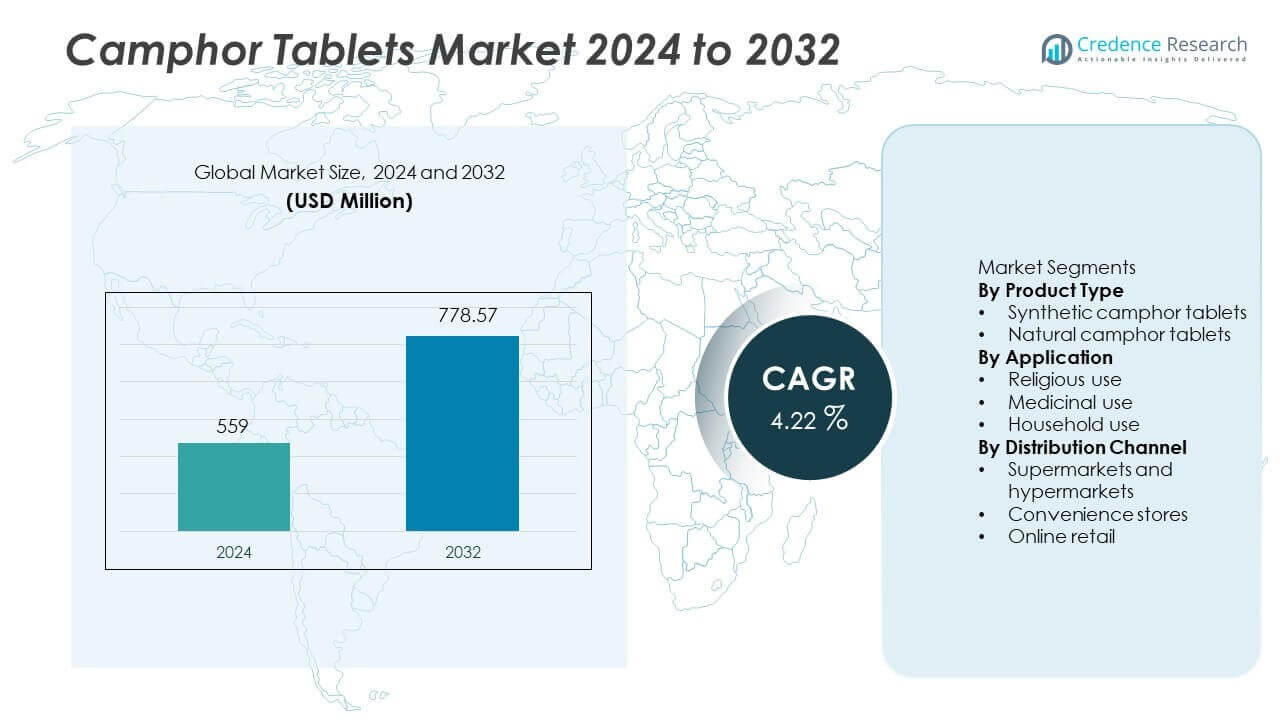
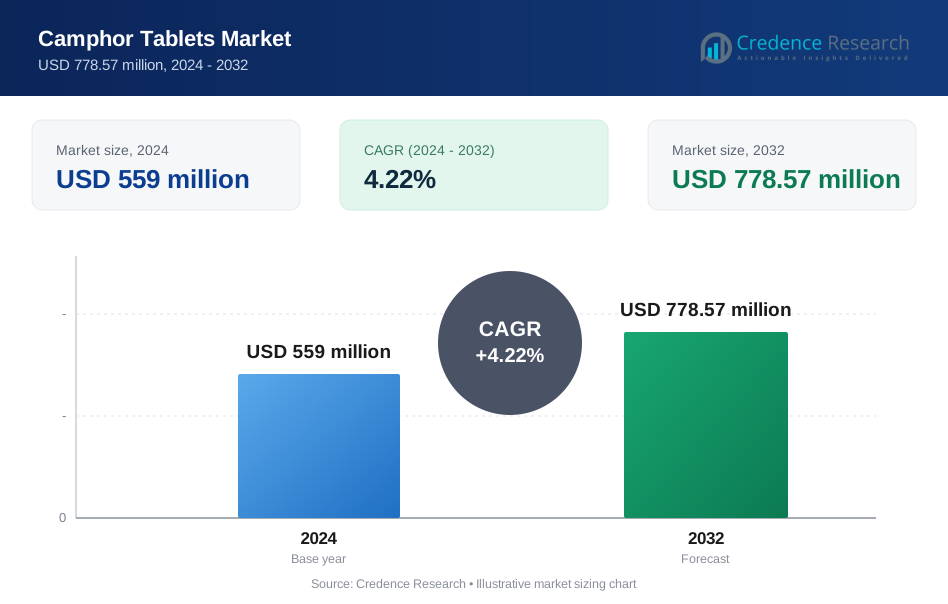
The camphor tablets market was valued at USD 559 million in 2024 and is expected to reach USD 778.57 million by 2032, growing at a CAGR of 4.22% during the forecast period.
| REPORT ATTRIBUTE | DETAILS |
|---|---|
| Historical Period | 2020-2023 |
| Base Year | 2024 |
| Forecast Period | 2025-2032 |
| Camphor Tablets Market Size 2024 | USD 559 million |
| Camphor Tablets Market, CAGR | 4.22% |
| Camphor Tablets Market Size 2032 | USD 778.57 million |
Leading players in the camphor tablets market include Mangalam Organics Limited, Saptagir Camphor Limited, Kanchi Karpooram Ltd., Privi Organics Limited, Vinayak Ingredients (INDIA) Pvt. Ltd., Himani Industries Limited, Aromatic Camphor Industries, Sharp Mint Limited, Oriental Aromatics Limited, and Taiwan Tekho Camphor Co., Ltd. These companies compete through product purity, cost efficiency, and strong regional distribution networks. Asia Pacific leads the market with a 58% share, driven by widespread religious usage and large consumer base. North America follows with a 15% share, supported by ethnic communities and household applications. Europe holds a 14% share, backed by organized retail and niche demand, while the Rest of the World accounts for 13% due to steady consumption across emerging regions.
Camphor Tablets Market Insights
- The camphor tablets market was valued at USD 559 million in 2024 and is projected to grow at a CAGR of 4.22% during the forecast period.
- Strong demand from religious practices drives market growth, with religious use leading the application segment at a 52% share due to daily rituals and temple consumption.
- Market trends show rising interest in natural and herbal products, while synthetic camphor tablets dominate the product type segment with a 64% share due to cost efficiency and consistent quality.
- Competitive intensity remains moderate as key players focus on purity standards, branded packaging, and wider retail reach to strengthen market presence.
- Asia Pacific leads with a 58% market share, followed by North America at 15% and Europe at 14%, while steady consumption across developing regions supports the remaining market share.
Camphor Tablets Market Segmentation Analysis:
By Product Type
The product type segment in the camphor tablets market shows clear preference between synthetic and natural variants. Synthetic camphor tablets dominate this segment with a market share of 64%. Synthetic products benefit from consistent quality, stable fragrance strength, and lower production costs. Large-scale manufacturers prefer synthetic camphor due to easier availability of raw materials and controlled formulation. These tablets also offer longer shelf life, supporting bulk distribution. Natural camphor tablets maintain demand in premium and religious applications. However, limited raw material supply and higher prices restrict volume growth. Strong cost efficiency and wide acceptance continue to drive synthetic camphor tablet dominance.
- For instance, Saptagir Camphor expanded its production capacity for synthetic camphor and specialty aroma chemicals using state-of-the-art technology and equipment.
By Application
Application-based segmentation highlights strong demand from traditional and daily-use practices. Religious use leads the segment with a market share of 52%. Camphor tablets play a key role in rituals, prayers, and spiritual ceremonies across temples and households. Daily worship practices sustain consistent consumption volumes. Medicinal use follows due to camphor’s decongestant and topical relief properties. Household use supports demand for pest control and air purification. Rising urban populations maintain steady religious consumption. Cultural traditions and regular ritual usage remain the primary drivers supporting the dominant position of religious applications in the camphor tablets market.
- For instance, Mangalam Organics markets camphor tablets under the brand Mangalam for pious purposes through its extensive network of distributors, wholesalers, and retail channels.
By Distribution Channel
Distribution channel segmentation reflects strong reliance on physical retail formats. Supermarkets and hypermarkets dominate with a market share of 46%. These outlets offer wide product visibility and bulk purchasing options. Consumers prefer organized retail for assured quality and branded products. Convenience stores hold steady demand due to proximity and frequent purchases. Online retail continues to grow, supported by home delivery and product variety. However, traditional buying habits favor offline channels. High footfall in supermarkets and consistent shelf availability remain key drivers supporting the leading position of organized retail channels in the camphor tablets market.
Key Growth Driver
Strong Demand from Religious and Cultural Practices
Religious and cultural traditions strongly drive camphor tablet consumption. Daily prayer rituals, temple offerings, and festive ceremonies create steady demand. Camphor tablets are widely used for their symbolic and aromatic properties. Regular household worship supports repeat purchases throughout the year. Expansion of religious tourism further strengthens demand. Urban households continue traditional practices despite lifestyle changes. Bulk consumption by temples ensures volume stability. Cultural continuity across generations sustains long-term growth. This strong religious linkage remains a key foundation for market expansion across regions.
- For instance, Kanchi Karpooram Limited operates camphor tablet manufacturing lines with a total installed capacity significantly lower than the previously mentioned figure, and the company has pursued expansion plans to increase its capacity, as documented in environmental clearance applications.
Expanding Use in Household and Medicinal Applications
Camphor tablets see growing use beyond religious practices. Households use camphor for air freshening and insect repellent purposes. Medicinal applications support demand due to camphor’s decongestant and topical relief properties. Rising awareness of traditional remedies strengthens usage. Consumers prefer familiar and multipurpose products. Increased focus on wellness supports adoption in daily routines. Easy availability enhances consumption frequency. This diversification of applications reduces dependency on seasonal religious demand. Household and medicinal uses contribute to consistent market growth.
- For instance, Sharp Mint Limited produces pharmaceutical-grade menthol crystals using advanced technology and multi-step processes including distillation and crystallization.
Affordable Pricing and Wide Availability
Affordable pricing plays a critical role in camphor tablet adoption. Synthetic variants offer cost-effective options for mass consumption. Wide availability across retail outlets ensures easy access. Small packaging sizes encourage frequent purchases. Strong distribution networks support both urban and rural markets. Local manufacturers improve market penetration. Competitive pricing supports steady demand across income groups. Cost efficiency makes camphor tablets a preferred daily-use product. This accessibility-driven demand remains a key growth factor.
Key Trend & Opportunity
Rising Preference for Natural and Herbal Products
Consumer preference increasingly shifts toward natural and herbal products. Natural camphor tablets gain traction among health-conscious buyers. Demand grows for products perceived as pure and chemical-free. Premium positioning creates opportunities for higher margins. Religious consumers show strong interest in natural offerings. Manufacturers introduce certified and branded natural variants. Packaging innovation supports product differentiation. This trend creates growth opportunities in niche and premium segments. Natural product demand strengthens brand value.
- For instance, natural camphor is sourced from Cinnamomum camphora trees using steam distillation units, while companies such as Ramco Camphor Industries typically manufacture synthetic camphor through chemical processing of derivatives from turpentine oil.
Growth of Online and Organized Retail Channels
Organized retail and online platforms reshape distribution patterns. Consumers seek convenience and product variety through digital channels. Online platforms improve access to branded products. Subscription models support repeat purchases. Organized retail enhances product visibility and trust. Urban consumers drive channel diversification. Manufacturers expand digital presence to capture new buyers. This shift creates opportunities for wider geographic reach. Retail modernization supports long-term market expansion.
- For instance, Kanchi Karpooram Limited utilizes an order management process to support its distribution to a variety of customers, including industrial clients, general consumers, and international traders.
Key Challenge
Volatility in Raw Material Availability
Raw material availability poses a major challenge for manufacturers. Natural camphor sourcing depends on limited plant resources. Seasonal fluctuations impact supply consistency. Price instability affects production planning. Synthetic camphor relies on chemical inputs with fluctuating costs. Supply disruptions affect smaller producers more severely. Quality consistency becomes harder to maintain. Raw material volatility increases operational risk. Manufacturers must manage sourcing strategies carefully to maintain stability.
Regulatory and Quality Compliance Pressure
Regulatory compliance presents growing challenges for the market. Authorities enforce strict standards on purity and labeling. Medicinal usage requires additional quality certifications. Non-compliance risks product recalls and penalties. Smaller players face cost burdens to meet standards. Quality testing increases operational expenses. Packaging regulations also evolve across regions. Compliance pressure affects product pricing and margins. Maintaining consistent quality remains a critical challenge for market participants.
Regional Analysis
Asia Pacific
Asia Pacific holds a market share of 58% in the camphor tablets market, driven by strong cultural and religious practices. Countries such as India, China, and Indonesia show high daily consumption. Regular temple rituals and household worship sustain consistent demand. Large population size supports volume growth. Availability of local manufacturing strengthens supply chains. Synthetic camphor tablets see high adoption due to affordability. Natural variants retain demand in premium religious use. Expanding urban households continue traditional practices. Strong distribution through local retail stores supports steady market performance across the region.
North America
North America accounts for a market share of 15%, supported by demand from ethnic communities and household applications. Immigrant populations maintain religious usage patterns. Camphor tablets also see use in home care and wellness practices. Organized retail and online platforms support product availability. Consumers prefer branded and well-packaged products. Medicinal use remains limited but stable. Synthetic camphor dominates due to regulatory compliance. Rising interest in traditional remedies supports niche growth. Stable purchasing power and structured distribution networks sustain market demand in the region.
Europe
Europe holds a market share of 14%, driven by religious usage among specific cultural groups. Household applications support steady consumption across urban areas. Demand concentrates in countries with strong immigrant populations. Organized retail plays a key role in product sales. Online platforms improve accessibility for niche buyers. Natural camphor tablets attract health-conscious consumers. Regulatory standards influence product formulation and labeling. Synthetic variants dominate due to consistency requirements. Stable demand and controlled distribution define the European market landscape.
Rest of the World
The Rest of the World region holds a market share of 13%, led by Latin America, the Middle East, and Africa. Religious and traditional practices support consumption. Household usage drives regular purchases in urban centers. Local retail stores remain key distribution points. Price-sensitive consumers prefer synthetic camphor tablets. Natural variants maintain limited but stable demand. Growing urbanization supports gradual market expansion. Distribution remains fragmented across countries. Cultural continuity and expanding retail access sustain steady demand across these developing regions.
Camphor Tablets Market Segmentations:
By Product Type
- Synthetic camphor tablets
- Natural camphor tablets
By Application
- Religious use
- Medicinal use
- Household use
By Distribution Channel
- Supermarkets and hypermarkets
- Convenience stores
- Online retail
By Geography
- North America
- U.S.
- Canada
- Mexico
- Europe
- Germany
- France
- U.K.
- Italy
- Spain
- Rest of Europe
- Asia Pacific
- China
- Japan
- India
- South Korea
- South-east Asia
- Rest of Asia Pacific
- Latin America
- Brazil
- Argentina
- Rest of Latin America
- Middle East & Africa
- GCC Countries
- South Africa
- Rest of the Middle East and Africa
Competitive Landscape
Competitive landscape analysis highlights active competition among Mangalam Organics Limited, Saptagir Camphor Limited, Kanchi Karpooram Ltd., Privi Organics Limited, Vinayak Ingredients (INDIA) Pvt. Ltd., Himani Industries Limited, Aromatic Camphor Industries, Sharp Mint Limited, Oriental Aromatics Limited, and Taiwan Tekho Camphor Co., Ltd. Market participants focus on capacity expansion, product purity, and distribution reach to strengthen positioning. Synthetic camphor producers benefit from stable supply chains and cost efficiency. Companies invest in branded packaging to build consumer trust. Natural camphor suppliers target premium religious and wellness segments. Regional players maintain strong presence through local retail networks. Compliance with quality and safety standards remains a key competitive factor. Pricing strategies influence market share in price-sensitive regions. Entry barriers remain moderate due to regulatory and sourcing challenges.
Key Player Analysis
- Mangalam Organics Limited
- Saptagir Camphor Limited
- Kanchi Karpooram Ltd.
- Privi Organics Limited
- Vinayak Ingredients (INDIA) Pvt. Ltd.
- Himani Industries Limited
- Aromatic Camphor Industries
- Sharp Mint Limited
- Oriental Aromatics Limited
- Taiwan Tekho Camphor Co., Ltd.
Recent Developments
- In 2025, Mangalam Organics Limited (MOL) did maintain a strong e-commerce presence for its camphor tablets, including popular 500g options, which was part of a broader strategy to shift from B2B to B2C operations and expand retail penetration.
- In November 2024, Saptagir Camphor Private Limited exhibited and co-sponsored the 9th International Agarbatti & Perfume Expo in Hyderabad and received the “Star Raw Material Supplier to the Camphor Industry” award for its synthetic camphor and aromatic terpene supply role.
Report Coverage
The research report offers an in-depth analysis based on Product Type, Application, Distribution Channel and Geography. It details leading market players, providing an overview of their business, product offerings, investments, revenue streams, and key applications. Additionally, the report includes insights into the competitive environment, SWOT analysis, current market trends, as well as the primary drivers and constraints. Furthermore, it discusses various factors that have driven market expansion in recent years. The report also explores market dynamics, regulatory scenarios, and technological advancements that are shaping the industry. It assesses the impact of external factors and global economic changes on market growth. Lastly, it provides strategic recommendations for new entrants and established companies to navigate the complexities of the market.
Future Outlook
- Demand will remain steady due to continuous religious and cultural practices.
- Household usage will support regular consumption across urban and rural areas.
- Medicinal applications will maintain stable demand through traditional remedies.
- Synthetic camphor tablets will retain dominance due to cost efficiency.
- Natural camphor products will gain traction in premium consumer segments.
- Organized retail will strengthen product visibility and brand preference.
- Online channels will support wider geographic reach and convenience.
- Quality and purity standards will influence purchasing decisions.
- Regional manufacturers will expand distribution to improve market access.
- Product packaging innovation will enhance consumer trust and differentiation.
Request a Free Sample
Fill in your details and we'll send you a free sample report.
- Sample data tables & charts
- Research methodology
Need a Custom Version of This Report?
Tailor the scope, geography, or segments to your exact requirements.
- Custom geography or segment scope
- Direct access to our analyst team
Frequently Asked Questions
What is the current market size for the Camphor Tablets market, and what is its projected size in 2032?
At what Compound Annual Growth Rate is the Camphor Tablets market projected to grow between 2024 and 2032?
Which Camphor Tablets market segment held the largest share in 2024?
What are the primary factors fueling the growth of the Camphor Tablets market?
Who are the leading companies in the Camphor Tablets market?
Which region commanded the largest share of the Camphor Tablets market in 2024?
Table of Content
Chapter 1. Report Introduction
- 1.1 Report Description & Purpose
- 1.1.1 Report Title & Market Definition
- 1.1.2 Unique Selling Propositions (USP) & Key Differentiators
- 1.1.3 Value Proposition for Stakeholders
- 1.2 Research Objectives
- 1.2.1 Market Sizing Objectives (Volume & Revenue)
- 1.2.2 Segmentation Objectives
- 1.2.3 Competitive Intelligence Objectives
- 1.2.4 Forecast & Scenario Objectives
- 1.3 Report Scope
- 1.3.1 Camphor Tablets Scope – Types & Subtypes Covered
- 1.3.2 Geographic Scope – Regions & Countries Covered
- 1.3.3 Historical Period, Base Year & Forecast Period (2024; forecast to 2032)
- 1.3.4 Inclusions & Exclusions
- 1.4 HS Code & Classification Framework
- 1.5 Currency, Units & Pricing Basis
- 1.6 Target Stakeholders
- 1.7 Limitations & Assumptions
Chapter 2. Executive Summary
- 2.1 Global Camphor Tablets Market Snapshot
- 2.1.1 Market Size – Historical (2024) & Forecast (2024-2032) (2024: USD 559 million → 2032: USD 778.57 million)
- 2.1.2 Volume & Revenue – Global Totals
- 2.1.3 Key Market Highlights – Top Five Facts
- 2.2 Camphor Tablets Market Segmentation Snapshot
- 2.2.1 Market Split by Region – 2024 vs. 2032
- 2.3 Competitive Snapshot
- 2.3.1 Top 10 Players by Revenue Share – 2024
- 2.3.2 Top 10 Players by Volume Share – 2024
- 2.3.3 Recent Strategic Developments (18-Month Summary)
- 2.4 Key Investment Highlights & Strategic Conclusions
Chapter 3. Camphor Tablets Market Dynamics & Industry Analysis
- 3.1 Market Overview & Context
- 3.1.1 Camphor Tablets Market Position in the Broader Automotive Value Chain
- 3.1.2 OEM vs. Replacement Market Dynamics
- 3.1.3 Market Maturity & Development Stage by Region
- 3.2 Camphor Tablets Market Drivers
- 3.3 Camphor Tablets Market Restraints & Challenges
- 3.4 Camphor Tablets Market Opportunities
- 3.5 Porter's Five Forces Analysis
- 3.5.1 Threat of New Entrants
- 3.5.2 Bargaining Power of Suppliers
- 3.5.3 Bargaining Power of Buyers
- 3.5.4 Threat of Substitutes
- 3.5.5 Competitive Rivalry – Intensity Assessment
- 3.6 Camphor Tablets Value Chain Analysis
- 3.6.1 Upstream – Raw Material/Input Suppliers
- 3.6.1.1 Raw Material/Input 1
- 3.6.1.2 Raw Material/Input 2
- 3.6.1.3 Raw Material/Input 3
- 3.6.2 Midstream – Production/Manufacturing/Service Delivery
- 3.6.2.1 Production/Process Overview
- 3.6.2.2 Key Facility Locations & Capacity by Manufacturer
- 3.6.3 Downstream – Distribution & End Consumer
- 3.6.3.1 Primary Channel – B2B/OEM
- 3.6.3.2 Secondary Channels – Dealer, Retail, Online, Direct
- 3.6.4 Value Chain Profitability Analysis
- 3.6.1 Upstream – Raw Material/Input Suppliers
- 3.7 PESTEL Analysis
- 3.7.1 Political Factors
- 3.7.2 Economic Factors
- 3.7.3 Social Factors
- 3.7.4 Technological Factors
- 3.7.5 Environmental Factors
- 3.7.6 Legal Factors
- 3.8 Camphor Tablets Supply Chain Analysis
- 3.8.1 Raw Material/Input Supply Risk Assessment
- 3.8.2 Manufacturing Concentration Risk (Geographic Exposure)
- 3.8.3 Trade Disruption Impact Analysis
- 3.9 Regulatory & Policy Landscape
Note: The regulatory and policy landscape section covers regulations based on their applicability to the market, Camphor Tablets category, geography, and scope of the study. Only regulatory frameworks with a material impact on operations, compliance, trade, sustainability, or market access are analyzed in detail.
Chapter 4. Key Investment Pockets & Opportunity Analysis
- 4.1 Camphor Tablets Market Attractiveness Analysis
- 4.1.1 By Region – Investment Attractiveness Matrix (Volume × CAGR)
- 4.2 Absolute Revenue Growth Opportunity
- 4.2.1 By Region – Absolute USD Growth Through 2032
- 4.3 Incremental Volume Opportunity
- 4.3.1 By Region – Incremental Volume Through 2032
- 4.3.2 Segment – Incremental Volume
- 4.4 Emerging Submarket Opportunity Deep Dive (Subject to Applicability)
- 4.5 Emerging Market Opportunity Scorecards
- 4.5.1 United States
- 4.5.2 Europe
- 4.5.3 Asia
- 4.5.4 Middle East & Africa
Note: Emerging Market Opportunity Scorecards will be included based on relevance and strategic importance. Regions listed are indicative and may vary depending on data availability and market dynamics.
Chapter 5. Camphor Tablets Import-Export Analysis & Trade Flows
- 5.1 Global Trade Overview
- 5.1.1 Global Export Value by Country (2024)
- 5.1.2 Global Export Volume by Country (2024)
- 5.1.3 Global Import Value by Country (2024)
- 5.1.4 Global Import Volume by Country (2024)
- 5.1.5 Net Trade Balance by Country (2024)
- 5.2 Export Analysis – Segment
- 5.2.1 Type 1 (HS Code)
- 5.2.2 Type 2 (HS Code)
- 5.2.3 Type 3 (HS Code)
- 5.2.4 Type 4 (HS Code)
- 5.2.5 Type 5 (HS Code)
- 5.3 Import Analysis – Segment
- 5.3.1 Type 1 (HS Code)
- 5.3.2 Type 2 (HS Code)
- 5.3.3 Type 3 (HS Code)
- 5.3.4 Type 4 (HS Code)
- 5.3.5 Type 5 (HS Code)
- 5.4 Average Unit Trade Prices
- 5.4.1 Average Export Price – Segment & Country
- 5.4.2 Average Import Price – Segment & Source Country
- 5.4.3 Price Trends (2024)
- 5.5 Key Trade Route Analysis
- 5.5.1 Trade Route 1
- 5.5.2 Trade Route 2
- 5.5.3 Trade Route 3
- 5.5.4 Trade Route 4
- 5.5.5 Trade Route 5
- 5.6 Trade Policy Impact Assessment
- 5.6.1 US Anti-Dumping & Section 301 Tariffs
- 5.6.2 EU Customs Union Impact
- 5.6.3 Major Free Trade Agreements
- 5.6.4 USMCA Rules of Origin
Note: Trade policy analysis will be included only where relevant to the Camphor Tablets market.
Chapter 6. Competitive Landscape & Company Benchmarking
- 6.1 Camphor Tablets Market Concentration & Structure
- 6.1.1 Herfindahl-Hirschman Index (HHI) – vs. 2024
- 6.1.2 Tier 1, Tier 2 & Tier 3 Market Structure
- 6.1.3 Global, Regional & Local Player Dynamics
- 6.2 Camphor Tablets Market Share Analysis – 2024
- 6.2.1 Global Revenue Share by Company
- 6.2.2 Global Volume Share by Company
- 6.2.3 Regional Revenue Share
- 6.2.4 Market Share Evolution ( vs. 2024)
- 6.2.5 OEM Segment Share by Company
- 6.2.6 Replacement Segment Share by Company
- 6.3 Production/Delivery Capacity & Facility Analysis
- 6.3.1 Global Installed Capacity
- 6.3.2 Capacity Utilization Rates
- 6.3.3 Production/Output Volume
- 6.3.4 Facility Locations & Capacity Map
- 6.3.5 Planned Capacity Additions
- 6.4 Camphor Tablets Competitive Benchmarking Matrix
- 6.4.1 Revenue, Volume, CAGR & Profitability Comparison
- 6.4.2 Channel Revenue Mix
- 6.4.3 Geographic Revenue Exposure
- 6.4.4 R&D Intensity
- 6.4.5 Sustainability Maturity
- 6.5 Strategic Developments in Camphor Tablets (Last 24 Months)
- 6.5.1 Mergers, Acquisitions & Divestments
- 6.5.2 New Camphor Tablets Launches
- 6.5.3 Facility Expansions
- 6.5.4 Strategic Alliances, Joint Ventures & Partnerships
- 6.5.5 Distribution Expansion & Market Entry
- 6.5.6 Sustainability & ESG Initiatives
- 6.6 Competitive Strategy Mapping
- 6.6.1 Leader, Challenger, Follower & Niche Classification
- 6.6.2 Pricing Strategy Comparison
- 6.6.3 Channel Strategy Matrix
Note: Strategic developments are included based on their materiality and the availability of reliable information.
Chapter 7. Global Camphor Tablets Market – By Distribution Channel
- 7.1 Segment Overview
- 7.1.1 Volume & Revenue Split by Channel (2024 & 2032)
- 7.1.2 Channel Mix Evolution (2024-2032)
Chapter 8. Regional Market Analysis – Global Overview
- 8.1 Global Regional Overview
- 8.1.1 Regional Volume Share
- 8.1.2 Regional Revenue Share
- 8.1.3 Regional Volume by Region
- 8.1.4 Regional Revenue by Region
- 8.1.5 Regional Forecast Through 2032
- 8.2 Cross-Regional Segment Analysis
- 8.2.1 By Distribution Channel
- 8.2.2 By Brand/Price Tier
Chapter 9. North America Camphor Tablets Market
- 9.1 United States
- 9.2 Canada
- 9.3 Mexico
Chapter 10. Europe Camphor Tablets Market
- 10.1 Germany
- 10.2 France
- 10.3 Italy
- 10.4 United Kingdom
- 10.5 Spain
- 10.6 Poland
- 10.7 Russia
- 10.8 Netherlands
- 10.9 Belgium
- 10.10 Sweden
- 10.11 Denmark
- 10.12 Norway
- 10.13 Rest of Europe
Chapter 11. Asia Pacific Camphor Tablets Market
- 11.1 China
- 11.2 India
- 11.3 Japan
- 11.4 South Korea
- 11.5 Thailand
- 11.6 Indonesia
- 11.7 Vietnam
- 11.8 Malaysia
- 11.9 Australia
- 11.10 Rest of Asia Pacific
Chapter 12. Latin America Camphor Tablets Market
- 12.1 Brazil
- 12.2 Argentina
- 12.3 Colombia
- 12.4 Chile
- 12.5 Rest of Latin America
Chapter 13. Middle East Camphor Tablets Market
- 13.1 Saudi Arabia
- 13.2 United Arab Emirates
- 13.3 Turkey
- 13.4 Israel
- 13.5 Iran
- 13.6 Rest of the Middle East
Chapter 14. Africa Camphor Tablets Market
- 14.1 South Africa
- 14.2 Egypt
- 14.3 Nigeria
- 14.4 Morocco
- 14.5 Rest of Africa
Chapter 15. Camphor Tablets Company Profiles
- 15.1 [Company 01]
- 15.1.1 Company Overview
- 15.1.2 Key Management Personnel
- 15.1.3 Products & Services Portfolio
- 15.1.4 Financial Performance
- 15.1.5 Key Market Focus & Geographic Presence
- 15.1.6 Recent Developments & Strategic Initiatives
Note: The company profile list is preliminary and may change based on research findings, market developments, data availability, and client requirements.
Chapter 16. Appendices
- Appendix A – List of Abbreviations & Acronyms
- Appendix B – Industry Classification Code Reference – Full Series
- Appendix C – Production & Capacity Data Tables
- Appendix D – End-Use & Demand Base Tables
- Appendix E – Consumption & Replacement Rate Assumptions
- Appendix F – ASP Reference Tables
- Appendix G – Manufacturing & Facility Database
- Appendix H – Import-Export Data Tables
- Appendix I – Regulatory Summary Tables
- Appendix J – Primary Research Participant List (Anonymized)
- Appendix K – Primary Research Questionnaire Framework
- Appendix L – Data Sources & Bibliography
- Appendix M – Market Size Divergence & Source Comparison
Chapter 17. Research Methodology
- 17.1 Research Framework & Philosophy
- 17.2 Secondary Research – Sources, Hierarchy & Data Extraction
- 17.3 Data Modeling – Bottom-Up & Top-Down Market Sizing
- 17.4 Primary Research – Stakeholder Framework, LOI & Sample Sizes
- 17.5 Forecast Methodology – Regression, Scenario & Sensitivity Analysis
- 17.6 Quality Control – Four-Layer Validation Framework
- 17.7 Limitations & Standard Assumptions
- 17.8 Disclaimer
