
| REPORT ATTRIBUTE | DETAILS |
|---|---|
| Historical Period | 2019-2022 |
| Base Year | 2023 |
| Forecast Period | 2024-2032 |
| CBRNE (Chemical, Biological, Radiological, Nuclear And Explosives) Detection Equipment Market Size 2024 | USD 18860 Million |
| CBRNE (Chemical, Biological, Radiological, Nuclear And Explosives) Detection Equipment Market, CAGR | 5.20% |
| CBRNE (Chemical, Biological, Radiological, Nuclear And Explosives) Detection Equipment Market Size 2032 | USD 28300 Million |
Market Insights
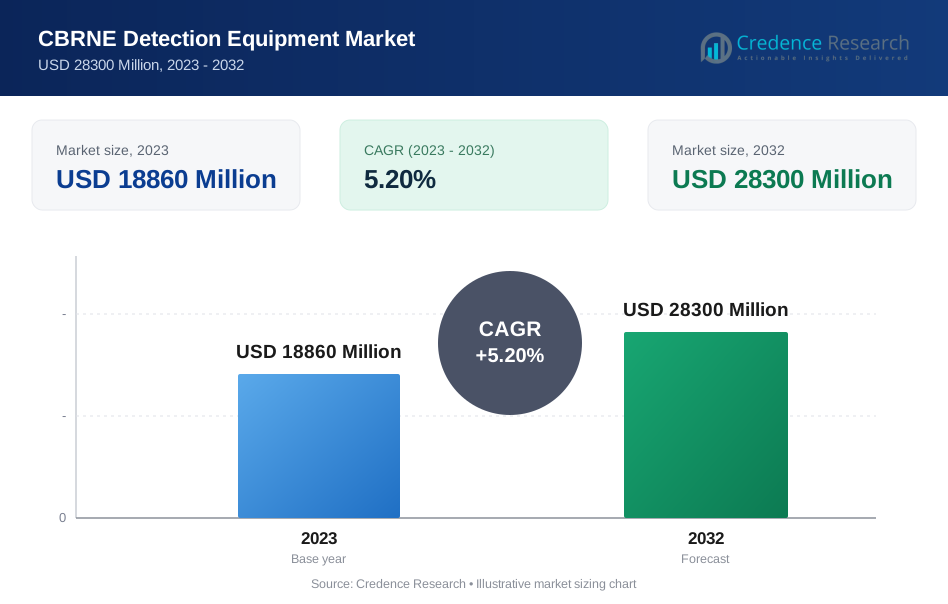
- The global demand for CBRNE detection equipment was valued at USD 18860 Million in 2024 and is expected to reach USD 28300 Million in 2032, growing at a CAGR of 5.20% between 2024 and 2032.
- Chemical detection equipment is the market's fastest expanding section, whereas explosive detection equipment is often the most prominent.
- The military and defence area is predicted to have the highest CAGR, with law enforcement ranking second.
- Mass spectrometry and polymerase chain reaction are two major segments.
- Handheld/portable detection equipment is the fastest growing segment of the CBRNE detection equipment market. Stationary detection systems are also a significant share holding category.
- Trace detection is the crucial segment of the market.
- Hazmat response is the largest portion of the CBRNE detection equipment market. Another popular component in market demand is border security.
- The largest market demand is for networked detection systems.
- Wireless communication for alerts is the fastest-growing area. Integration with command and control systems is also a vital component.
- Battery-Powered Detection Equipment has a significant part of the CBRNE detection equipment market.
- In 2023, Asia Pacific had the highest revenue share at 43%, while North America had the second-largest market share in the worldwide CBRN defensive equipment market.
- Favourable rules and international agreements fuel market expansion.
- Technological challenges in CBRN defensive equipment impedes market expansion.
Executive Summary
Market Definition
The CBRNE detection equipment market includes devices and systems that detect and identify chemical, biological, radiological, nuclear, and explosive (CBRNE) threats. These detection devices are intended to swiftly and accurately detect hazardous substances or materials that may endanger public safety, security, or the environment. They are essential in many industries, including defence, homeland security, emergency response, and industrial safety. The market for CBRNE detection equipment is being pushed by the growing demand for early warning and quick response capabilities in the event of possible CBRNE incidents.
Market Overview
The global demand for CBRNE detection equipment was valued at USD 18860 Million in 2024 and is expected to reach USD 28300 Million in 2032, growing at a CAGR of 5.20% between 2024 and 2032.The CBRNE detection equipment market is expanding rapidly as security and safety concerns spread across industries. This market encompasses a diverse variety of technologies and systems used to detect and identify chemical, biological, radiological, nuclear, and explosive threats.
Factors driving the market include an increase in the number of terrorist attacks, a growing requirement for effective emergency response capabilities, and the implementation of severe CBRNE safety rules and standards.
Segmentation by Detection Type
- Explosive detection equipment is typically the most dominant category. This is because the threat of explosives is a major worry in a variety of companies and security fields.
- The fastest growing segment is the Chemical Detection Equipment in the market.
Segmentation by End-User
- The military and defence segment is expected to have the highest CAGR during the projection period. Against the backdrop of escalating terrorist threats and political tensions, the utility of CBRN has emerged as a bioweapon capable of posing a threat to multiple countries.
- On the other hand, Law Enforcement is the second important segment.
Segmentation by Technology
- Mass spectrometry and polymerase chain reaction are two significant segments. Mass spectrometry is a powerful analytical technique capable of identifying and quantifying a wide range of compounds, making it essential for chemical detection. PCR, on the other hand, is a molecular biology technology that amplify and detects specific DNA sequences, making it useful for biological detection.
Segmentation by Deployment Type
- Handheld/portable detection equipment is the CBRNE detection equipment market's fastest growing sector. This is due to the growing demand for flexibility and mobility in detecting CBRNE threats in a variety of contexts.
- Another important share holder category is the stationary detection systems.
Segmentation by Sensitivity Range
- Trace detection is the identification of minute amounts of hazardous substances, such as explosives or chemical agents. This segment is critical in situations where the presence of trace amounts of these compounds must be determined, such as in airports, border control, or forensic investigations.
Segmentation by Application
- Hazmat Response is the largest section of the CBRNE detection equipment market. Hazmat Response is the detection and identification of hazardous materials in order to protect responders and the general public during an emergency. It is a key application requiring precise and efficient detecting equipment.
- Another popular component in market demand is border security
Segmentation by Communication System
- The highest market demand is for Networked Detection Systems. These systems enable the integration and coordination of many detection equipment, resulting in real-time monitoring and centralized control. They are especially sought after in large-scale operations and vital infrastructure, where a comprehensive and integrated detection network is required.
Segmentation by Alert and Reporting System
- Wireless Communication for Alerts is the fastest-growing segment of the CBRNE detection equipment market. This market is rapidly expanding due to rising demand for real-time communication and remote monitoring capabilities. It enables wireless delivery of quick alerts and notifications to key individuals, hence improving response time and coordination.
- Another critical component is integration with command and control systems. This allows for seamless integration of detection equipment with centralized command and control systems, increasing overall situational awareness and response effectiveness.
Segmentation by Power Source
- Battery-Powered Detection Equipment holds a substantial share of the CBRNE detection equipment market. Battery-powered equipment is portable and flexible, making it suited for a variety of applications and environments.
Segmentation by Region
- Asia Pacific had the biggest revenue share of 43% in 2023.
- North America has the second-largest market share in the global CBRN defence equipment market.
- The rest of the world, including Latin America, the Middle East, and Africa, supplies the remaining demand for CBRNE detection equipment.
Asia Pacific is predicted to dominate the CBRN Defence market from 2023 to 2032. The increase in the frequency of terror strikes in the Asia Pacific region has encouraged regional countries to strengthen their CBRN defence capabilities. Furthermore, growing defence spending in nations like as India and China, combined with the expansion of military commands in emerging economies, has resulted in increased demand for CBRN defence in the Asia Pacific area. The increased demand for CBRN defence solutions can be attributed to governments' increasing investments in the development and purchase of advanced CBRN defence measures. These efforts are specifically intended to improve the capabilities of military forces, border security, and biowarfare programs.
In addition, North America has the second-largest market share in the global CBRN defence equipment market. CBRN security systems have grown in popularity in the United States as CBRN assaults have increased, raising homeland security concerns. As a result, numerous policies and emergency responders have been developed to combat CBRN assaults and ensure homeland security.
Key Highlights of the Report
The global CBRNE detection equipment market is segmented by Detection Type, End-User, Technologys, Deployment Type, Sensitivity Range, Application, Communication System, Alert and Reporting System, Power Source and region. Explosive detection equipment is normally the most dominant category, with the military and defence market projected to have the highest CAGR. In addition, mass spectrometry and polymerase chain reaction are two key areas, and handheld/portable detection equipment is the fastest expanding sector in the CBRNE detection market. Furthermore, the largest market demand is for networked detection systems, with Asia Pcific leading the market growth.
The market's primary drivers are increasing worldwide terrorist threats, stringent government restrictions, and technological improvements. Furthermore, the high costs associated with CBRNE detection equipment, the complexity of CBRNE threats, and the challenges in integrating and interoperating are the primary limitations of the market.
Nonetheless, Asia Pacific is expected to lead the CBRN Defence market from 2023 to 2032. The increased frequency of terror attacks in the Asia Pacific area has prompted regional governments to boost their CBRN defence capabilities. Furthermore, North America has the second-largest market share in the global CBRN Defence equipment market.
What Are The Main Drivers Of The Global CBRNE detection equipmentMarket?
One of the major drivers propelling the growth of the CBRNE detection equipment market is the increasing global threats of terrorism and the pressing need for effective detection capabilities. With the rise in terrorist activities, there is a heightened focus on safeguarding against chemical, biological, radiological, nuclear, and explosive (CBRNE) threats. Additionally, stringent government regulations and standards are promoting the adoption of CBRNE detection equipment across various sectors. These regulations aim to enhance security measures and ensure the safety of individuals and infrastructure.
What Are The Major Challenges Faced By The Global CBRNE detection equipmentMarket?
Despite the growth prospects, there are certain restraints that impact the CBRNE detection equipment market. One significant restraint is the high costs associated with acquiring and maintaining CBRNE detection equipment. The advanced technologies and specialized capabilities of these devices often come with a higher price tag, limiting their affordability for some organizations. Another restraint is the complex nature of CBRNE threats, which requires specialized training and expertise for effective utilization of the equipment. The proper operation and interpretation of detection results necessitate skilled personnel who can accurately analyze and respond to potential threats.
What Are The Growth Opportunities In The Global CBRNE detection equipmentMarket?
The CBRNE detection equipment market presents several opportunities for growth and development. One such opportunity lies in the growing demand for portable and handheld CBRNE detection devices. These compact and mobile devices allow for rapid response and flexibility in various scenarios, making them invaluable for first responders and security personnel. Additionally, there is an expanding market in emerging economies, where infrastructure development and security measures are being prioritized. As these regions invest in enhancing their security capabilities, there is a significant opportunity for the adoption of CBRNE detection equipment.
Market Drivers
Favourable Regulations And International Agreements
Favourable policies and agreements are critical in moving the CBRN industry ahead. The US Department of Homeland Security's "National Strategy for Chemical, Biological, Radiological, Nuclear, and Explosives (CBRN) Standards" encourages partnership with corporate businesses and research organizations.
This collaboration seeks to improve research and development, as well as testing, of CBRN defence technologies. The plan focuses heavily on setting standards, providing training, and defining standard operating procedures for CBRN defence equipment.
Market Restraints
Saturated Market In Developed Countries
Developed countries such as the United States, Germany, and Canada have already implemented CBRN defence measures. These countries' governments have a reliable and efficient infrastructure. Large corporations have established specialty markets and services in developed countries, making it difficult for new competitors to enter the market.
Technological Challenges In CBRN Defence Equipment
Developing defence technologies for a diverse range of CBRN agents can be challenging due of their unique features. Furthermore, these defence systems must operate dependably in a variety of situations and conditions, which adds to their complexity. Personal Protective Equipment (PPE) requires modern materials such as specific filters and liquid-resistant textiles. Detection and monitoring systems employ modern sensors to detect CBRN compounds at low levels.
Strong cleaning solutions, as well as specialized tools such as steam cleaners, are required for decontamination equipment. These complex technologies enhance equipment costs, presenting a commercial challenge.
Opportunities
Emerging Markets
Emerging economies, such as Russia, Brazil, the UAE, China, and India, are investing heavily in CBRN defence systems to better prepare for possible threats. These nations have significantly boosted their military budgets in order to bolster their defence capabilities, which has resulted in the acquisition of CBRN defence systems, solutions, and services.
The significant expansion in these countries' GDPs over the last decade has provided extra motivation for increasing their defence spending.
India, China, and Russia are significant contributors to this growth, with China allocating 292.00 billion USD to defence spending in 2022, while India and Russia have invested 8.
Competitive Landscape
Key Players
The global CBRNE detection equipment market is highly competitive, with several key players. Some of the major players in the market and their market share are as follows:
- 3M Company
- Bruker Corporation
- Emergent BioSolutions
- Chemring Group
- Drägerwerk AG & Co KGaA/Dräger
- FLIR Systems
- Morphix Technologies
- Proengin
- Smiths Group Plc
- Thermo Fisher Scientific
These organizations prioritize product innovation, CBRNE detection equipment Centers expansion, and mergers and acquisitions to stay competitive.
The global CBRNE detection equipment market's key players continually seek to stay ahead by offering new products and developments.
In October 2023, Thales Group and Bertin (France) have strengthened their relationship in CBRN protection with successful biological sample and identification tests for the Piabc Pelican Project.
In October 2023, The UK Ministry of Defence (MoD) has granted Smiths Group PLC an 88-million-pound (USD 107.6 million) contract to develop and supply next-generation chemical sensors for the British Armed Forces.
Summary of Key Findings
- Saturated market in developed countries impedes market expansion.
- Market segmented by Detection Type, End-User, Technologys, Deployment Type, Sensitivity Range, Application, Communication System, Alert and Reporting System, Power Source and region.
- Chemical Detection Equipment is the market's fastest expanding section
- Mass spectrometry and polymerase chain reaction are two significant segments
- Asia Pacific is leading market growth; the market is highly competitive with key players including 3M Company, Bruker Corporation,Emergent BioSolutions, Chemring Group and Others.
Future Outlook
- Increasing demand for portable and handheld CBRNE detection devices
- Advancements in sensor technologies and data analytics
- Growing focus on integrating artificial intelligence and machine learning capabilities
- Rising investments in research and development for innovative detection solutions
- Expansion of the market in emerging economies, particularly in Asia Pacific
- Adoption of wireless communication and connectivity features in detection equipment
How CXOs Can Benefit from the Credence Research CBRNE detection equipment market Report
The Credence Research CBRNE detection equipment market Report provides CXOs with a comprehensive overview of the market, including:
- Market size and growth forecast:The report provides detailed estimates of the global CBRNE detection equipment market size, segmented by Detection Type, End-User, Technologys, Deployment Type, Sensitivity Range, Application, Communication System, Alert and Reporting System, Power Source and region. It also includes forecasts for the market through 2032, based on key trends and drivers.
- Market segmentation:The report segments the CBRNE detection equipment market by Detection Type, End-User, Technologys, Deployment Type, Sensitivity Range, Application, Communication System, Alert and Reporting System, Power Source and region. This segmentation provides CXOs with a granular understanding of the market and the opportunities in each segment.
- Competitive landscape:The report profiles the key players in the CBRNE detection equipment market and provides insights into their strategies, product offerings, and financial performance. This information can help CXOs to identify and assess their competition.
- Key trends and drivers:The report identifies and analyzes the key trends and drivers that are shaping the CBRNE detection equipment market. This information can help CXOs to make informed decisions about their investments and strategies.
CXOs can use the insights from the Credence Research CBRNE detection equipment market Report to:
- Identify growth opportunities:The report can help CXOs to identify new growth opportunities in the CBRNE detection equipment market. For example, it can provide insights into emerging technologies, market trends, and customer demands. This information can assist CXOs in making informed decisions on product development, market expansion, and strategic partnerships.
- Make informed investment decisions:The report can help CXOs to make informed investment decisions about CBRNE detection equipment. For example, it can provide valuable insights into market trends, competitive landscape, and potential growth areas.
- Develop competitive strategies:The report can help CXOs to develop competitive strategies for their CBRNE detection equipment businesses. For example, competitive landscape, including key players, their market share, and their strategies. It can also analyze customer preferences, industry trends, and emerging technologies to help CXOs identify unique selling points and differentiate their offerings.
- Track market developments:The report can help CXOs to track market developments and stay ahead of the curve. For example, the report provides insights into the latest trends and innovations in the CBRNE detection equipment market.
Overall, the Credence Research CBRNE detection equipment market Report is a valuable resource for CXOs who are looking to gain a deeper understanding of the market and identify opportunities for growth.
Segmentation
By Detection Type:
- Chemical Detection Equipment
- Biological Detection Equipment
- Radiological Detection Equipment
- Nuclear Detection Equipment
- Explosive Detection Equipment
By End-User:
- Military and Defense
- Law Enforcement
- First Responders (Fire and Emergency Services)
- Government Agencies
- Critical Infrastructure Protection (CIP)
- Commercial and Industrial Facilities
By Technology:
- Mass Spectrometry
- PCR (Polymerase Chain Reaction)
- Immunoassay
- Spectroscopy
- Radiation Detection Technologies
- Sensors and Detectors
- Others
By Deployment Type:
- Handheld/Portable Detection Equipment
- Fixed Detection Systems
- Vehicle-Mounted Detection Systems
- Wearable Detection Devices
- Others
By Sensitivity Range:
- Trace Detection
- Bulk Detection
By Application:
- Hazmat Response
- Border Security
- Crisis Management
- Environmental Monitoring
- Public Safety
- Industrial Safety
- Healthcare
- Others
By Communication System:
- Standalone Detection Equipment
- Networked Detection Systems
By Alert and Reporting System:
- Audible and Visual Alerts
- Data Logging and Reporting
- Wireless Communication for Alerts
- Integration with Command and Control Systems
By Power Source:
- Battery-Powered Detection Equipment
- Electric-Powered Detection Equipment
- Solar-Powered Detection Equipment
- Others
By Region
- North America
- US
- Canada
- Mexico
- Europe
- Germany
- France
- UK
- Italy
- Spain
- Rest of Europe
- Asia Pacific
- China
- Japan
- India
- South Korea
- South-east Asia
- Rest of Asia Pacific
- Latin America
- Brazil
- Argentina
- Rest of Latin America
- Middle East & Africa
- GCC Countries
- South Africa
- Rest of Middle East and Africa
Adjacent Markets
In the CBRNE detection equipment market, there are several adjacent markets which has high revenue growth opportunities. The key adjacent markets for CBRNE detection equipment market -
Request a Free Sample
Fill in your details and we'll send you a free sample report.
- Sample data tables & charts
- Research methodology
Need a Custom Version of This Report?
Tailor the scope, geography, or segments to your exact requirements.
- Custom geography or segment scope
- Direct access to our analyst team
Frequently Asked Questions
What is the current size of the global CBRNE detection equipment market?
What is the expected growth rate of the CBRNE detection equipment market between2024 and 2032?
Which segment is leading the market share in terms of Power Source?
Which segment governs the demand for Communication System?
Which End-User segment is expected to post the highest CAGR during the forecastperiod?
Which region is fueling the growth of the CBRNE detection equipment industry?
Who are the major players in the global CBRNE detection equipment market?
What are the major market drivers of the CBRNE detection equipment industry?
Table of Content
Chapter 1. Report Introduction
- 1.1 Report Description & Purpose
- 1.1.1 Report Title & Market Definition
- 1.1.2 Unique Selling Propositions (USP) & Key Differentiators
- 1.1.3 Value Proposition for Stakeholders
- 1.2 Research Objectives
- 1.2.1 Market Sizing Objectives (Volume & Revenue) (Volume Where Applicable)
- 1.2.2 Segmentation Objectives
- 1.2.3 Competitive Intelligence Objectives
- 1.2.4 Forecast & Scenario Objectives
- 1.3 Report Scope
- 1.3.1 CBRNE Detection Equipment Scope – Segments & Subsegments Covered
- 1.3.2 Geographic Scope – Regions & Countries Covered
- 1.3.3 Historical Period, Base Year & Forecast Period (2023; forecast to 2032)
- 1.3.4 Inclusions & Exclusions
- 1.4 Industry Classification & Applicable Codes
- 1.5 Currency, Measurement Units & Valuation Basis
- 1.6 Target Stakeholders
- 1.7 Limitations & Assumptions
Chapter 2. Executive Summary
- 2.1 Global CBRNE Detection Equipment Market Snapshot
- 2.1.1 Market Size – Historical (2023) & Forecast (2023-2032) (2023: USD 18860 Million → 2032: USD 28300 Million)
- 2.1.2 Volume & Revenue – Global Totals (Volume Where Applicable)
- 2.1.3 Key Market Highlights – Top Five Facts
- 2.2 CBRNE Detection Equipment Market Segmentation Snapshot
- 2.2.1 Market Split by Region – 2023 vs. 2032
- 2.3 Competitive Snapshot
- 2.3.1 Top 10 Players by Revenue Share – 2023
- 2.3.2 Top 10 Players by Volume Share – 2023 (Volume Where Applicable)
- 2.3.3 Recent Strategic Developments (18-Month Summary)
- 2.4 Key Investment Highlights & Strategic Conclusions
Chapter 3. CBRNE Detection Equipment Market Dynamics & Industry Analysis
- 3.1 Market Overview & Context
- 3.1.1 CBRNE Detection Equipment Market Position in the Broader Industry Value Chain
- 3.1.2 Demand Structure & Purchasing Dynamics
- 3.1.3 Market Maturity & Development Stage by Region
- 3.2 CBRNE Detection Equipment Market Drivers
- 3.3 CBRNE Detection Equipment Market Restraints & Challenges
- 3.4 CBRNE Detection Equipment Market Opportunities
- 3.5 Porter's Five Forces Analysis
- 3.5.1 Threat of New Entrants
- 3.5.2 Bargaining Power of Suppliers
- 3.5.3 Bargaining Power of Buyers
- 3.5.4 Threat of Substitutes
- 3.5.5 Competitive Rivalry – Intensity Assessment
- 3.6 CBRNE Detection Equipment Value Chain Analysis
- 3.6.1 Upstream – Key Inputs, Resources & Suppliers
- 3.6.1.1 Key Input/Resource 1
- 3.6.1.2 Key Input/Resource 2
- 3.6.1.3 Key Input/Resource 3
- 3.6.2 Midstream – Core Operations & Value Creation
- 3.6.2.1 Operating Model & Process Overview
- 3.6.2.2 Key Operating Locations & Capabilities by Company
- 3.6.3 Downstream – Market Channels & End Users
- 3.6.3.1 Direct Sales & Customer Engagement Channels
- 3.6.3.2 Indirect Sales, Intermediaries & Partner Channels
- 3.6.4 Value Chain Profitability Analysis
- 3.6.1 Upstream – Key Inputs, Resources & Suppliers
- 3.7 PESTEL Analysis
- 3.7.1 Political Factors
- 3.7.2 Economic Factors
- 3.7.3 Social Factors
- 3.7.4 Technological Factors
- 3.7.5 Environmental Factors
- 3.7.6 Legal Factors
- 3.8 CBRNE Detection Equipment Supply Chain Analysis
- 3.8.1 Critical Input & Resource Availability Risk Assessment
- 3.8.2 Supplier & Operational Concentration Risk (Geographic Exposure)
- 3.8.3 Supply & Service Disruption Impact Analysis
- 3.9 Regulatory & Policy Landscape
Note: The regulatory and policy landscape section covers regulations based on their applicability to the market, CBRNE Detection Equipment category, geography, and scope of the study. Only regulatory frameworks with a material impact on operations, compliance, trade, sustainability, or market access are analyzed in detail.
Chapter 4. Key Investment Pockets & Opportunity Analysis
- 4.1 CBRNE Detection Equipment Market Attractiveness Analysis
- 4.1.1 By Region – Investment Attractiveness Matrix (Market Size × CAGR)
- 4.2 Absolute Revenue Growth Opportunity
- 4.2.1 By Region – Absolute Revenue Growth Through 2032
- 4.3 Incremental Demand Opportunity
- 4.3.1 By Region – Incremental Demand Through 2032
- 4.3.2 Segment – Incremental Demand
- 4.4 Emerging Submarket Opportunity Deep Dive (Subject to Applicability)
- 4.5 Priority Market Opportunity Scorecards
- 4.5.1 United States
- 4.5.2 Europe
- 4.5.3 Asia
- 4.5.4 Middle East & Africa
Note: Priority market opportunity scorecards reflect the geographic scope and strategic relevance of the study. Listed markets are indicative and may be adapted to the industry.
Chapter 5. CBRNE Detection Equipment Cross-Border Trade & Market Access Analysis
- 5.1 International Trade & Cross-Border Activity Overview
- 5.1.1 Global Export Value by Country (2023)
- 5.1.2 Global Export Volume by Country (2023) (Volume Where Applicable)
- 5.1.3 Global Import Value by Country (2023)
- 5.1.4 Global Import Volume by Country (2023) (Volume Where Applicable)
- 5.1.5 Net Trade Balance by Country (2023)
- 5.2 Export Analysis – Segment
- 5.2.1 Category 1 (Applicable Classification Code)
- 5.2.2 Category 2 (Applicable Classification Code)
- 5.2.3 Category 3 (Applicable Classification Code)
- 5.2.4 Category 4 (Applicable Classification Code)
- 5.2.5 Category 5 (Applicable Classification Code)
- 5.3 Import Analysis – Segment
- 5.3.1 Category 1 (Applicable Classification Code)
- 5.3.2 Category 2 (Applicable Classification Code)
- 5.3.3 Category 3 (Applicable Classification Code)
- 5.3.4 Category 4 (Applicable Classification Code)
- 5.3.5 Category 5 (Applicable Classification Code)
- 5.4 Cross-Border Pricing & Transaction Benchmarks
- 5.4.1 Export Pricing – Segment & Country
- 5.4.2 Import Pricing – Segment & Source Country
- 5.4.3 Price Trends (2023)
- 5.5 Key Cross-Border Trade & Delivery Routes
- 5.5.1 Cross-Border Trade/Delivery Route 1
- 5.5.2 Cross-Border Trade/Delivery Route 2
- 5.5.3 Cross-Border Trade/Delivery Route 3
- 5.5.4 Cross-Border Trade/Delivery Route 4
- 5.5.5 Cross-Border Trade/Delivery Route 5
- 5.6 Trade Policy & Market Access Impact Assessment
- 5.6.1 Tariff & Non-Tariff Barriers
- 5.6.2 Regional Trade & Economic Integration Frameworks
- 5.6.3 Bilateral & Multilateral Trade Agreements
- 5.6.4 Cross-Border Operating, Licensing & Localization Requirements
Note: This chapter applies where cross-border trade or delivery is relevant to CBRNE Detection Equipment. Goods, services, and digital offerings are assessed using applicable classifications and transaction measures. Import-export volumes, trade balances, and route analyses are included only where meaningful to the market.
Chapter 6. Competitive Landscape & Company Benchmarking
- 6.1 CBRNE Detection Equipment Market Concentration & Structure
- 6.1.1 Herfindahl-Hirschman Index (HHI) – vs. 2023
- 6.1.2 Leading, Mid-Sized & Emerging Player Structure
- 6.1.3 Global, Regional & Local Player Dynamics
- 6.2 CBRNE Detection Equipment Market Share Analysis – 2023
- 6.2.1 Global Revenue Share by Company
- 6.2.2 Global Volume Share by Company (Volume Where Applicable)
- 6.2.3 Regional Revenue Share
- 6.2.4 Market Share Evolution ( vs. 2023)
- 6.2.5 Company Market Share by Key Segment
- 6.2.6 Company Market Share by Customer Group
- 6.3 Operating Scale, Capacity & Infrastructure Analysis
- 6.3.1 Global Operating Scale & Supply Capacity
- 6.3.2 Resource Utilization & Operating Efficiency
- 6.3.3 Output, Service Delivery & Activity Metrics
- 6.3.4 Operating Footprint & Infrastructure Map
- 6.3.5 Planned Operational & Capacity Expansion
- 6.4 CBRNE Detection Equipment Competitive Benchmarking Matrix
- 6.4.1 Revenue, Growth, Profitability & Operating Metric Comparison
- 6.4.2 Channel Revenue Mix
- 6.4.3 Geographic Revenue Exposure
- 6.4.4 R&D Intensity
- 6.4.5 Sustainability Maturity
- 6.5 Strategic Developments in CBRNE Detection Equipment (Last 24 Months)
- 6.5.1 Mergers, Acquisitions & Divestments
- 6.5.2 New Products, Services & Solutions in CBRNE Detection Equipment
- 6.5.3 Operational & Infrastructure Expansions
- 6.5.4 Strategic Alliances, Joint Ventures & Partnerships
- 6.5.5 Distribution Expansion & Market Entry
- 6.5.6 Sustainability & ESG Initiatives
- 6.6 Competitive Strategy Mapping
- 6.6.1 Leader, Challenger, Follower & Niche Classification
- 6.6.2 Pricing Strategy Comparison
- 6.6.3 Channel Strategy Matrix
Note: Strategic developments are included based on their materiality and the availability of reliable information.
Chapter 7. Global CBRNE Detection Equipment Market – By Sales & Delivery Channel
- 7.1 Segment Overview
- 7.1.1 Volume & Revenue Split by Channel (2023 & 2032) (Volume Where Applicable)
- 7.1.2 Channel Mix Evolution (2023-2032)
Chapter 8. Regional Market Analysis – Global Overview
- 8.1 Global Regional Overview
- 8.1.1 Regional Volume Share (Volume Where Applicable)
- 8.1.2 Regional Revenue Share
- 8.1.3 Regional Volume by Region (Volume Where Applicable)
- 8.1.4 Regional Revenue by Region
- 8.1.5 Regional Forecast Through 2032
- 8.2 Cross-Regional Segment Analysis
- 8.2.1 By Sales & Delivery Channel
- 8.2.2 By Competitive Positioning & Price Tier
Chapter 9. North America CBRNE Detection Equipment Market
- 9.1 United States
- 9.2 Canada
- 9.3 Mexico
Chapter 10. Europe CBRNE Detection Equipment Market
- 10.1 Germany
- 10.2 France
- 10.3 Italy
- 10.4 United Kingdom
- 10.5 Spain
- 10.6 Poland
- 10.7 Russia
- 10.8 Netherlands
- 10.9 Belgium
- 10.10 Sweden
- 10.11 Denmark
- 10.12 Norway
- 10.13 Rest of Europe
Chapter 11. Asia Pacific CBRNE Detection Equipment Market
- 11.1 China
- 11.2 India
- 11.3 Japan
- 11.4 South Korea
- 11.5 Thailand
- 11.6 Indonesia
- 11.7 Vietnam
- 11.8 Malaysia
- 11.9 Australia
- 11.10 Rest of Asia Pacific
Chapter 12. Latin America CBRNE Detection Equipment Market
- 12.1 Brazil
- 12.2 Argentina
- 12.3 Colombia
- 12.4 Chile
- 12.5 Rest of Latin America
Chapter 13. Middle East CBRNE Detection Equipment Market
- 13.1 Saudi Arabia
- 13.2 United Arab Emirates
- 13.3 Turkey
- 13.4 Israel
- 13.5 Iran
- 13.6 Rest of the Middle East
Chapter 14. Africa CBRNE Detection Equipment Market
- 14.1 South Africa
- 14.2 Egypt
- 14.3 Nigeria
- 14.4 Morocco
- 14.5 Rest of Africa
Chapter 15. CBRNE Detection Equipment Company Profiles
- 15.1 [Company 01]
- 15.1.1 Company Overview
- 15.1.2 Key Management Personnel
- 15.1.3 Products & Services Portfolio
- 15.1.4 Financial Performance
- 15.1.5 Key Market Focus & Geographic Presence
- 15.1.6 Recent Developments & Strategic Initiatives
Note: The company profile list is preliminary and may change based on research findings, market developments, data availability, and client requirements.
Chapter 16. Appendices
- Appendix A – List of Abbreviations & Acronyms
- Appendix B – Industry Classification Code Reference – Full Series
- Appendix C – Supply, Output & Operating Capacity Data Tables
- Appendix D – End-Use & Demand Base Tables
- Appendix E – Demand, Adoption & Usage Assumptions
- Appendix F – Pricing & Revenue Metric Reference Tables
- Appendix G – Company Operations & Infrastructure Database
- Appendix H – Cross-Border Trade & Activity Data Tables (Where Applicable)
- Appendix I – Regulatory Summary Tables
- Appendix J – Primary Research Participant List (Anonymized)
- Appendix K – Primary Research Questionnaire Framework
- Appendix L – Data Sources & Bibliography
- Appendix M – Market Size Divergence & Source Comparison
Chapter 17. Research Methodology
- 17.1 Research Framework & Philosophy
- 17.2 Secondary Research – Sources, Hierarchy & Data Extraction
- 17.3 Data Modeling – Bottom-Up & Top-Down Market Sizing
- 17.4 Primary Research – Stakeholder Framework, LOI & Sample Sizes
- 17.5 Forecast Methodology – Regression, Scenario & Sensitivity Analysis
- 17.6 Quality Control – Four-Layer Validation Framework
- 17.7 Limitations & Standard Assumptions
- 17.8 Disclaimer
