
Market Overview:
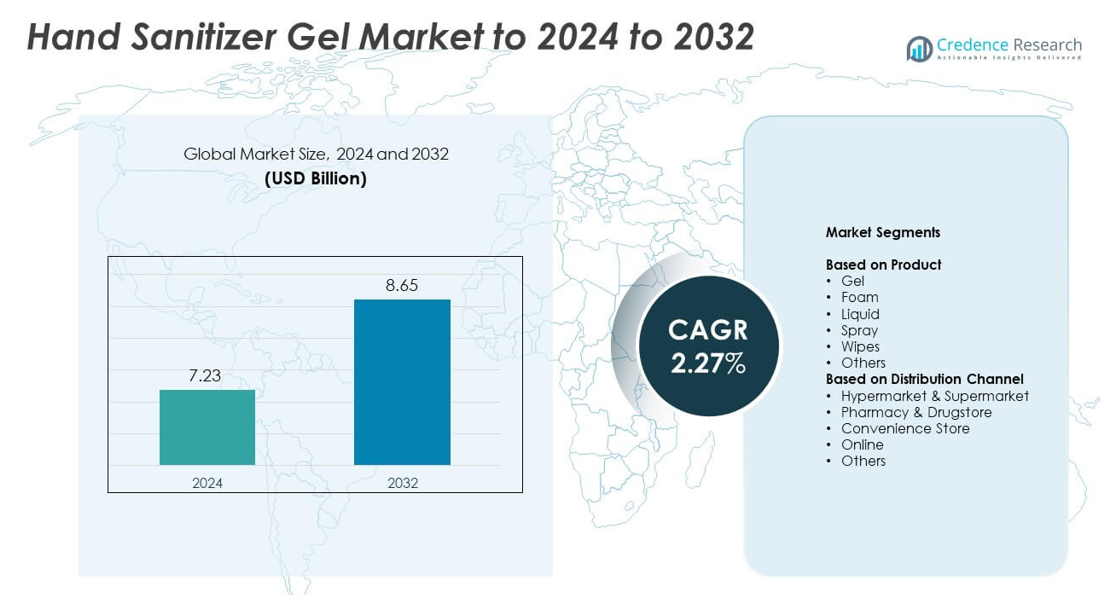
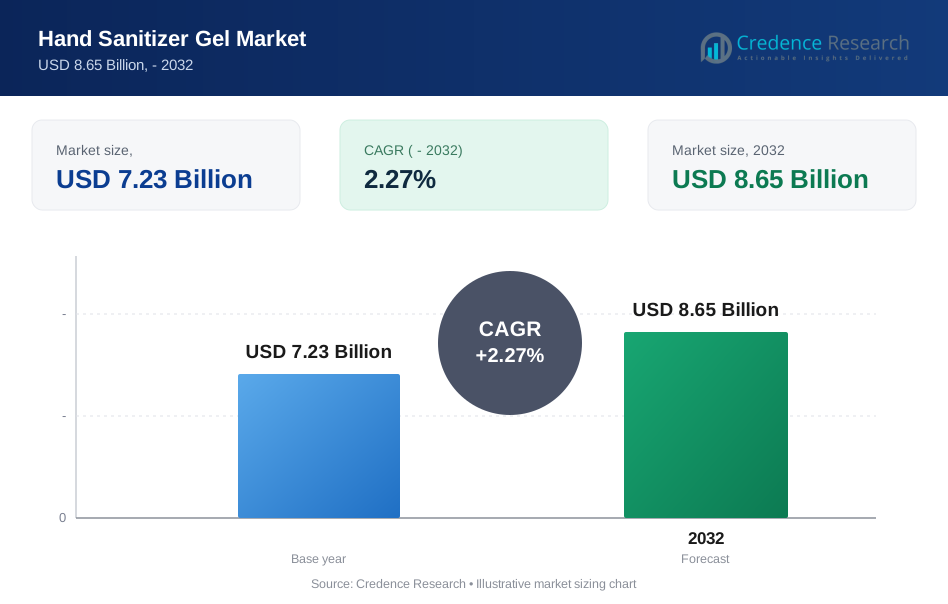
Hand Sanitizer Gel Market size was valued USD 7.23 Billion in 2024 and is anticipated to reach USD 8.65 Billion by 2032, at a CAGR of 2.27% during the forecast period.
| REPORT ATTRIBUTE | DETAILS |
|---|---|
| Historical Period | 2020-2023 |
| Base Year | 2024 |
| Forecast Period | 2025-2032 |
| Hand Sanitizer Gel Market Size 2024 | USD 7.23 Billion |
| Hand Sanitizer Gel Market, CAGR | 2.27% |
| Hand Sanitizer Gel Market Size 2032 | USD 8.65 Billion |
The Hand Sanitizer Gel Market includes major players such as Unilever, Best Sanitizers, Inc., GOJO Industries, Inc., Touchland, Chattem, Inc., Kutol, Procter and Gamble, Henkel AG and Company, Vi-Jon, The Himalaya Drug Company, and Reckitt Benckiser Group plc. These companies compete through strong product portfolios, skin-friendly formulations, and wide retail and online distribution. Innovation in moisturizing gels, premium fragrances, and portable packaging helps strengthen brand loyalty in a crowded market. North America led the market in 2024 with about 34% share, supported by high hygiene awareness, strong healthcare spending, and broad institutional usage across workplaces, schools, and public facilities.
Market Insights
- Hand Sanitizer Gel Market was valued at USD 7.23 Billion in 2024 and is projected to reach USD 8.65 Billion by 2032 at a CAGR of 2.27%.
- Market growth is driven by rising hygiene awareness, steady healthcare demand, and strong use of gel formats, which held the largest product share at about 41% in 2024.
- Key trends include rapid adoption of skin-friendly formulations, expansion of workplace and travel dispensers, and growing demand for portable packs across urban consumers.
- Competition remains intense as global and regional brands focus on innovation, premium variants, and wider online distribution, while private-label expansion increases pricing pressure.
- North America led the market with nearly 34% share in 2024, followed by Europe at around 28% and Asia Pacific at roughly 24%, supported by strong institutional use and expanding retail availability.
Market Segmentation Analysis:
By Product
Gel led the product segment in 2024 with about 41% share due to strong household and institutional use. Gel formats gained steady traction because they spread easily, dry fast, and deliver consistent alcohol concentration for quick disinfection. Foam and liquid products expanded as schools and clinics adopted touch-free dispensers, while sprays grew in travel and retail settings. Wipes held demand in childcare and personal bags, but their share remained smaller because they cost more per use. Other emerging forms saw niche uptake across gyms and offices.
- For instance, Ecolab highlights that its hand hygiene programs helped clean more than 40 billion hands in 2019"
By Distribution Channel
Hypermarket & supermarket stores dominated the distribution channel in 2024 with nearly 36% share, supported by wide product visibility, bulk-pack options, and strong placement of private-label brands. Pharmacies and drugstores remained key for medically approved formulations and higher repeat purchases. Convenience stores stayed relevant in urban areas due to on-the-go demand. Online channels grew fast as buyers preferred subscriptions, multipacks, and doorstep delivery. Other channels, including institutional suppliers, gained steady orders from schools, hotels, and corporate workplaces.
- For instance, CVS Health disclosed operating over 9,000 retail pharmacy locations in 2023, making it one of the largest physical distribution networks for sanitizer products.
Key Growth Drivers
Rising Hygiene Awareness Across Public and Private Spaces
Growing attention to personal and environmental hygiene encouraged households, public institutions, and corporate facilities to use hand sanitizer gel more frequently. Offices, schools, and transport hubs increased placement of sanitizing points to support daily safety routines. Consumers preferred quick, water-free cleaning during travel, outdoor activities, and shopping, which strengthened adoption across all income groups. Ongoing health campaigns and regular reminders during disease outbreaks helped create long-term behavioral change. This broad shift in hygiene habits supported continued demand for gel-based sanitizers throughout the year.
- For instance, Unilever confirmed that its total health and hygiene programs reached 1.3 billion people by 2020 through the end of its Sustainable Living Plan.
Expansion of Healthcare and Clinical Usage
Healthcare facilities relied heavily on gel sanitizers as part of strict infection-control protocols that require fast, repeatable hand cleaning. Hospitals, clinics, and diagnostic centers used high-alcohol gel formulations to maintain hygiene during high patient turnover and frequent treatment cycles. Increased outpatient numbers and surgical procedures created continuous demand for sanitizing stations and refill packs. Regulatory pressure to reduce hospital-acquired infections kept medical institutions committed to verified and compliant formulations. This stable clinical requirement ensured steady procurement across both public and private healthcare networks.
- For instance, 3M increased its annual production rate of N95 and medical-grade respirators to 2.5 billion units in January 2021
Growth of Retail and E-commerce Availability
Expanding retail presence made hand sanitizer gel more accessible to a wide consumer base. Hypermarkets added more brands and pack sizes, while pharmacies promoted medically aligned products that improved trust and repeat purchases. Online platforms accelerated market growth through fast delivery, bundled offers, and subscription packs that encouraged consistent use. Seasonal illness waves and emergency-driven stocking patterns also boosted short-term spikes in sales. These combined retail and digital channels helped maintain a strong supply chain and broadened long-term adoption across regions.
Key Trends & Opportunities
Shift Toward Natural and Skin-friendly Formulations
Producers increased focus on skin-friendly formulations that use moisturizing agents to reduce dryness caused by alcohol. Demand grew for aloe-based, glycerin-based, and plant-extract blends that offer gentler application without reducing disinfection strength. Dermatology-endorsed and hypoallergenic variants gained traction among sensitive-skin users. Premium brands adopted cleaner ingredient labels to attract health-conscious consumers. This shift created a growing opportunity for manufacturers to innovate with mild, safe, and high-performance gel formulations aligned with evolving consumer expectations.
- For instance, The Body Shop aims for 100% of its product formulas to be certified vegan by December 2023.
Rise of Travel, Workplace, and Institutional Dispensers
Workplaces, airports, malls, hotels, gyms, and educational buildings installed more automatic and wall-mounted gel dispensers to maintain hygiene compliance throughout the day. High-footfall areas required frequent refilling, which drove demand for bulk gel packs and long-term supply agreements. Organizations adopted standardized hygiene protocols that relied heavily on easy-access sanitizing points. This trend also encouraged producers to offer specialized dispenser-friendly formulations and packaging. Growing emphasis on shared-space safety created a sustained opportunity for suppliers serving institutional and commercial environments.
- For instance, GOJO Industries has a strong focus on smart, connected hygiene solutions and had deployed approximately 25,000 connected PURELL SMARTLINK dispensers (across all product lines) globally by early 2019, with the number having grown since then.
Product Customization and Branding Opportunity
Brands explored personalized packaging, fragrance variants, and portable pack designs to target diverse consumer needs. Corporate gifting, hospitality amenities, and travel-size products expanded the market for customized gel sanitizer solutions. Premium packaging and distinct scents helped companies differentiate in a crowded shelf space. This trend supported the rise of niche and lifestyle-focused products that appeal to young, urban buyers. Stronger design and branding strategies helped companies secure loyal customers and compete effectively with private-label offerings.
Key Challenges
Market Saturation and Intense Competition
The market saw a surge of new brands, contract manufacturers, and private-label products, which created heavy competition across all price ranges. Many companies struggled to maintain visibility as retail shelves became crowded with similar offerings. Price pressure limited margins for both established players and new entrants. Retailers prioritized private-label expansion, which challenged branded producers to justify higher prices. This saturation slowed growth in mature regions and made differentiation a critical barrier for long-term success.
Concerns Over Product Safety and Skin Irritation
Low-quality products raised concerns regarding unreliable alcohol levels, unsafe additives, and weak antimicrobial performance. Some users experienced dryness and irritation, which reduced trust in generic or unregulated brands. Authorities tightened quality standards to ensure proper formulation, packaging, and labeling, which increased compliance and testing costs for producers. Frequent recalls and public warnings highlighted the need for stricter oversight. Maintaining product consistency and safety became a major challenge, particularly for small-scale and new manufacturers attempting to compete in the market.
Regional Analysis
North America
North America held about 34% share in 2024, driven by strong adoption across households, hospitals, and corporate facilities. High hygiene awareness and strict clinical protocols supported stable demand for gel-based sanitizers. Retail chains expanded shelf space for premium and fragrance-based products, while workplaces increased the use of bulk dispensers. Growing travel activity and widespread placement of sanitizing stations in airports and malls strengthened regional consumption. The United States led usage due to large healthcare spending and steady institutional procurement. Canada and Mexico also recorded rising adoption through retail and online channels.
Europe
Europe accounted for nearly 28% share in 2024, supported by strong healthcare standards and consistent demand from public facilities. Hospitals across major countries kept gel sanitizers as a core hygiene tool due to strict infection-control guidelines. Consumer preference for natural and skin-friendly formulations expanded the premium segment. Retailers in Germany, France, and the United Kingdom promoted private-label options, which improved affordability and volume sales. Workplace hygiene measures and commuting activity supported steady adoption. Southern Europe showed rising demand in tourism zones where hotels and restaurants maintained strict sanitization requirements.
Asia Pacific
Asia Pacific held around 24% share in 2024, with rapid growth driven by rising hygiene awareness and expanding urban retail networks. Strong adoption in schools, transportation hubs, and commercial centers supported market expansion. Countries such as China, Japan, and India increased use across households due to higher concern about infection risks. E-commerce platforms played a major role in boosting gel sanitizer sales by offering bulk packs and fast delivery. Workplace safety programs across manufacturing hubs also lifted demand. Growing middle-class spending and rising travel movement strengthened long-term consumption trends.
Latin America
Latin America captured nearly 8% share in 2024, supported by growing health awareness and wider penetration of affordable product ranges. Brazil and Mexico led usage as retail stores increased availability of gel formats suited for daily use. Public campaigns on hygiene boosted consumer preference for alcohol-based sanitizers. Pharmacies remained key distribution points due to trust in medically aligned brands. Institutional demand rose in schools, public offices, and transit centers. Despite moderate economic constraints, urban areas recorded steady adoption as workplaces and households increased routine disinfection practices.
Middle East and Africa
Middle East and Africa held about 6% share in 2024, driven by rising investment in healthcare facilities and expanding retail distribution. Gulf countries showed strong adoption as malls, airports, and hospitality sites maintained strict hygiene rules. Pharmacies and supermarkets across the region expanded product assortments, improving access to gel sanitizers. Growing awareness of infection control encouraged use in households and educational institutions. South Africa, the UAE, and Saudi Arabia led regional consumption, while developing markets increased adoption through affordable brands and online channels.
Market Segmentations:
By Product
- Gel
- Foam
- Liquid
- Spray
- Wipes
- Others
By Distribution Channel
- Hypermarket & Supermarket
- Pharmacy & Drugstore
- Convenience Store
- Online
- Others
By Geography
- North America
- U.S.
- Canada
- Mexico
- Europe
- Germany
- France
- U.K.
- Italy
- Spain
- Rest of Europe
- Asia Pacific
- China
- Japan
- India
- South Korea
- South-east Asia
- Rest of Asia Pacific
- Latin America
- Brazil
- Argentina
- Rest of Latin America
- Middle East & Africa
- GCC Countries
- South Africa
- Rest of the Middle East and Africa
Competitive Landscape
The competitive landscape of the Hand Sanitizer Gel Market features leading companies such as Unilever, Best Sanitizers, Inc., GOJO Industries, Inc., Touchland, Chattem, Inc., Kutol, Procter and Gamble, Henkel AG and Company, Vi-Jon, The Himalaya Drug Company, and Reckitt Benckiser Group plc. Market competition remains intense as firms focus on product quality, skin-friendly formulations, and strong alcohol efficacy to meet rising hygiene expectations. Companies strengthen their position through broad retail presence, subscription-based online sales, and innovative packaging designed for portability and workplace use. Many players invest in dermatology-tested and moisturizing variants to differentiate in a saturated market. Brand visibility grows through targeted digital marketing and partnerships with healthcare facilities, schools, and corporate offices. Expanding production capacity and maintaining compliance with global safety standards help firms secure long-term contracts. Growing demand for premium, scented, and natural formulations also encourages ongoing innovation across the competitive landscape.
Key Player Analysis
- Unilever
- Best Sanitizers, Inc.
- GOJO Industries, Inc.
- Touchland
- Chattem, Inc.
- Kutol
- Procter and Gamble
- Henkel AG and Company
- Vi-Jon
- The Himalaya Drug Company
- Reckitt Benckiser Group plc
Recent Developments
- In 2024, Touchland launched a new "Gentle Mist Hand Sanitizer" formulated with niacinamide and Centella asiatica leaf extract for hydration while sanitizing with 70% alcohol.
- In 2023, Henkel launched a new "Ecodetergent hand sanitizer gel" formulated with plant-based alcohol and biodegradable ingredients, focusing on sustainability.
- In 2023, Reckitt launched Lysol Air Sanitizer in the US, creating a new product category (it is EPA-approved to sanitize the air, distinct from hand gel but part of the broader hygiene strategy).
Report Coverage
The research report offers an in-depth analysis based on Product, Distribution Channel and Geography. It details leading market players, providing an overview of their business, product offerings, investments, revenue streams, and key applications. Additionally, the report includes insights into the competitive environment, SWOT analysis, current market trends, as well as the primary drivers and constraints. Furthermore, it discusses various factors that have driven market expansion in recent years. The report also explores market dynamics, regulatory scenarios, and technological advancements that are shaping the industry. It assesses the impact of external factors and global economic changes on market growth. Lastly, it provides strategic recommendations for new entrants and established companies to navigate the complexities of the market.
Future Outlook
- Demand will remain steady as hygiene awareness stays strong across public spaces.
- Healthcare facilities will continue to rely on gel sanitizers for infection control.
- Retail and online expansion will support broader product accessibility.
- Premium and skin-friendly formulations will gain higher adoption among urban consumers.
- Bulk refill demand will rise as workplaces and institutions increase dispenser usage.
- Brands will focus on packaging innovation to strengthen shelf appeal and user convenience.
- Regulatory checks will tighten to ensure product safety and formulation quality.
- Private-label brands will expand, creating stronger price competition.
- Travel-size packs and portable formats will grow with rising mobility and tourism.
- Emerging markets will show faster adoption due to rising hygiene spending.
Request a Free Sample
Fill in your details and we'll send you a free sample report.
- Sample data tables & charts
- Research methodology
Need a Custom Version of This Report?
Tailor the scope, geography, or segments to your exact requirements.
- Custom geography or segment scope
- Direct access to our analyst team
Frequently Asked Questions
What is the current market size for Hand Sanitizer Gel Market, and what is its projected size in 2032?
At what Compound Annual Growth Rate is the Hand Sanitizer Gel Market projected to grow between 2025 and 2032?
What is the Forecast period considered for Middle East And Africa Hand Sanitizer Gels Market?
What are the primary factors fueling the growth of the Hand Sanitizer Gel Market?
Who are the leading companies in the Hand Sanitizer Gel Market?
Table of Content
Chapter 1. Report Introduction
- 1.1 Report Description & Purpose
- 1.1.1 Report Title & Market Definition
- 1.1.2 Unique Selling Propositions (USP) & Key Differentiators
- 1.1.3 Value Proposition for Stakeholders
- 1.2 Research Objectives
- 1.2.1 Market Sizing Objectives (Volume & Revenue)
- 1.2.2 Segmentation Objectives
- 1.2.3 Competitive Intelligence Objectives
- 1.2.4 Forecast & Scenario Objectives
- 1.3 Report Scope
- 1.3.1 Hand Sanitizer Gel Scope – Types & Subtypes Covered
- 1.3.2 Geographic Scope – Regions & Countries Covered
- 1.3.3 Historical Period, Base Year & Forecast Period (the historical period; forecast to 2032)
- 1.3.4 Inclusions & Exclusions
- 1.4 HS Code & Classification Framework
- 1.5 Currency, Units & Pricing Basis
- 1.6 Target Stakeholders
- 1.7 Limitations & Assumptions
Chapter 2. Executive Summary
- 2.1 Global Hand Sanitizer Gel Market Snapshot
- 2.1.1 Market Size – Historical (the historical period) & Forecast (2032) (base year: USD 7.23 Billion → 2032: USD 8.65 Billion)
- 2.1.2 Volume & Revenue – Global Totals
- 2.1.3 Key Market Highlights – Top Five Facts
- 2.2 Hand Sanitizer Gel Market Segmentation Snapshot
- 2.2.1 Market Split by Region – vs. 2032
- 2.3 Competitive Snapshot
- 2.3.1 Top 10 Players by Revenue Share –
- 2.3.2 Top 10 Players by Volume Share –
- 2.3.3 Recent Strategic Developments (18-Month Summary)
- 2.4 Key Investment Highlights & Strategic Conclusions
Chapter 3. Hand Sanitizer Gel Market Dynamics & Industry Analysis
- 3.1 Market Overview & Context
- 3.1.1 Hand Sanitizer Gel Market Position in the Broader Automotive Value Chain
- 3.1.2 OEM vs. Replacement Market Dynamics
- 3.1.3 Market Maturity & Development Stage by Region
- 3.2 Hand Sanitizer Gel Market Drivers
- 3.3 Hand Sanitizer Gel Market Restraints & Challenges
- 3.4 Hand Sanitizer Gel Market Opportunities
- 3.5 Porter's Five Forces Analysis
- 3.5.1 Threat of New Entrants
- 3.5.2 Bargaining Power of Suppliers
- 3.5.3 Bargaining Power of Buyers
- 3.5.4 Threat of Substitutes
- 3.5.5 Competitive Rivalry – Intensity Assessment
- 3.6 Hand Sanitizer Gel Value Chain Analysis
- 3.6.1 Upstream – Raw Material/Input Suppliers
- 3.6.1.1 Raw Material/Input 1
- 3.6.1.2 Raw Material/Input 2
- 3.6.1.3 Raw Material/Input 3
- 3.6.2 Midstream – Production/Manufacturing/Service Delivery
- 3.6.2.1 Production/Process Overview
- 3.6.2.2 Key Facility Locations & Capacity by Manufacturer
- 3.6.3 Downstream – Distribution & End Consumer
- 3.6.3.1 Primary Channel – B2B/OEM
- 3.6.3.2 Secondary Channels – Dealer, Retail, Online, Direct
- 3.6.4 Value Chain Profitability Analysis
- 3.6.1 Upstream – Raw Material/Input Suppliers
- 3.7 PESTEL Analysis
- 3.7.1 Political Factors
- 3.7.2 Economic Factors
- 3.7.3 Social Factors
- 3.7.4 Technological Factors
- 3.7.5 Environmental Factors
- 3.7.6 Legal Factors
- 3.8 Hand Sanitizer Gel Supply Chain Analysis
- 3.8.1 Raw Material/Input Supply Risk Assessment
- 3.8.2 Manufacturing Concentration Risk (Geographic Exposure)
- 3.8.3 Trade Disruption Impact Analysis
- 3.9 Regulatory & Policy Landscape
Note: The regulatory and policy landscape section covers regulations based on their applicability to the market, Hand Sanitizer Gel category, geography, and scope of the study. Only regulatory frameworks with a material impact on operations, compliance, trade, sustainability, or market access are analyzed in detail.
Chapter 4. Key Investment Pockets & Opportunity Analysis
- 4.1 Hand Sanitizer Gel Market Attractiveness Analysis
- 4.1.1 By Region – Investment Attractiveness Matrix (Volume × CAGR)
- 4.2 Absolute Revenue Growth Opportunity
- 4.2.1 By Region – Absolute USD Growth Through 2032
- 4.3 Incremental Volume Opportunity
- 4.3.1 By Region – Incremental Volume Through 2032
- 4.3.2 Segment – Incremental Volume
- 4.4 Emerging Submarket Opportunity Deep Dive (Subject to Applicability)
- 4.5 Emerging Market Opportunity Scorecards
- 4.5.1 United States
- 4.5.2 Europe
- 4.5.3 Asia
- 4.5.4 Middle East & Africa
Note: Emerging Market Opportunity Scorecards will be included based on relevance and strategic importance. Regions listed are indicative and may vary depending on data availability and market dynamics.
Chapter 5. Hand Sanitizer Gel Import-Export Analysis & Trade Flows
- 5.1 Global Trade Overview
- 5.1.1 Global Export Value by Country (the historical period)
- 5.1.2 Global Export Volume by Country (the historical period)
- 5.1.3 Global Import Value by Country (the historical period)
- 5.1.4 Global Import Volume by Country (the historical period)
- 5.1.5 Net Trade Balance by Country (the historical period)
- 5.2 Export Analysis – Segment
- 5.2.1 Type 1 (HS Code)
- 5.2.2 Type 2 (HS Code)
- 5.2.3 Type 3 (HS Code)
- 5.2.4 Type 4 (HS Code)
- 5.2.5 Type 5 (HS Code)
- 5.3 Import Analysis – Segment
- 5.3.1 Type 1 (HS Code)
- 5.3.2 Type 2 (HS Code)
- 5.3.3 Type 3 (HS Code)
- 5.3.4 Type 4 (HS Code)
- 5.3.5 Type 5 (HS Code)
- 5.4 Average Unit Trade Prices
- 5.4.1 Average Export Price – Segment & Country
- 5.4.2 Average Import Price – Segment & Source Country
- 5.4.3 Price Trends (the historical period)
- 5.5 Key Trade Route Analysis
- 5.5.1 Trade Route 1
- 5.5.2 Trade Route 2
- 5.5.3 Trade Route 3
- 5.5.4 Trade Route 4
- 5.5.5 Trade Route 5
- 5.6 Trade Policy Impact Assessment
- 5.6.1 US Anti-Dumping & Section 301 Tariffs
- 5.6.2 EU Customs Union Impact
- 5.6.3 Major Free Trade Agreements
- 5.6.4 USMCA Rules of Origin
Note: Trade policy analysis will be included only where relevant to the Hand Sanitizer Gel market.
Chapter 6. Competitive Landscape & Company Benchmarking
- 6.1 Hand Sanitizer Gel Market Concentration & Structure
- 6.1.1 Herfindahl-Hirschman Index (HHI) – vs.
- 6.1.2 Tier 1, Tier 2 & Tier 3 Market Structure
- 6.1.3 Global, Regional & Local Player Dynamics
- 6.2 Hand Sanitizer Gel Market Share Analysis –
- 6.2.1 Global Revenue Share by Company
- 6.2.2 Global Volume Share by Company
- 6.2.3 Regional Revenue Share
- 6.2.4 Market Share Evolution ( vs. )
- 6.2.5 OEM Segment Share by Company
- 6.2.6 Replacement Segment Share by Company
- 6.3 Production/Delivery Capacity & Facility Analysis
- 6.3.1 Global Installed Capacity
- 6.3.2 Capacity Utilization Rates
- 6.3.3 Production/Output Volume
- 6.3.4 Facility Locations & Capacity Map
- 6.3.5 Planned Capacity Additions
- 6.4 Hand Sanitizer Gel Competitive Benchmarking Matrix
- 6.4.1 Revenue, Volume, CAGR & Profitability Comparison
- 6.4.2 Channel Revenue Mix
- 6.4.3 Geographic Revenue Exposure
- 6.4.4 R&D Intensity
- 6.4.5 Sustainability Maturity
- 6.5 Strategic Developments in Hand Sanitizer Gel (Last 24 Months)
- 6.5.1 Mergers, Acquisitions & Divestments
- 6.5.2 New Hand Sanitizer Gel Launches
- 6.5.3 Facility Expansions
- 6.5.4 Strategic Alliances, Joint Ventures & Partnerships
- 6.5.5 Distribution Expansion & Market Entry
- 6.5.6 Sustainability & ESG Initiatives
- 6.6 Competitive Strategy Mapping
- 6.6.1 Leader, Challenger, Follower & Niche Classification
- 6.6.2 Pricing Strategy Comparison
- 6.6.3 Channel Strategy Matrix
Note: Strategic developments are included based on their materiality and the availability of reliable information.
Chapter 7. Global Hand Sanitizer Gel Market – By Distribution Channel
- 7.1 Segment Overview
- 7.1.1 Volume & Revenue Split by Channel ( & 2032)
- 7.1.2 Channel Mix Evolution (2032)
Chapter 8. Regional Market Analysis – Global Overview
- 8.1 Global Regional Overview
- 8.1.1 Regional Volume Share
- 8.1.2 Regional Revenue Share
- 8.1.3 Regional Volume by Region
- 8.1.4 Regional Revenue by Region
- 8.1.5 Regional Forecast Through 2032
- 8.2 Cross-Regional Segment Analysis
- 8.2.1 By Distribution Channel
- 8.2.2 By Brand/Price Tier
Chapter 9. North America Hand Sanitizer Gel Market
- 9.1 United States
- 9.2 Canada
- 9.3 Mexico
Chapter 10. Europe Hand Sanitizer Gel Market
- 10.1 Germany
- 10.2 France
- 10.3 Italy
- 10.4 United Kingdom
- 10.5 Spain
- 10.6 Poland
- 10.7 Russia
- 10.8 Netherlands
- 10.9 Belgium
- 10.10 Sweden
- 10.11 Denmark
- 10.12 Norway
- 10.13 Rest of Europe
Chapter 11. Asia Pacific Hand Sanitizer Gel Market
- 11.1 China
- 11.2 India
- 11.3 Japan
- 11.4 South Korea
- 11.5 Thailand
- 11.6 Indonesia
- 11.7 Vietnam
- 11.8 Malaysia
- 11.9 Australia
- 11.10 Rest of Asia Pacific
Chapter 12. Latin America Hand Sanitizer Gel Market
- 12.1 Brazil
- 12.2 Argentina
- 12.3 Colombia
- 12.4 Chile
- 12.5 Rest of Latin America
Chapter 13. Middle East Hand Sanitizer Gel Market
- 13.1 Saudi Arabia
- 13.2 United Arab Emirates
- 13.3 Turkey
- 13.4 Israel
- 13.5 Iran
- 13.6 Rest of the Middle East
Chapter 14. Africa Hand Sanitizer Gel Market
- 14.1 South Africa
- 14.2 Egypt
- 14.3 Nigeria
- 14.4 Morocco
- 14.5 Rest of Africa
Chapter 15. Hand Sanitizer Gel Company Profiles
- 15.1 [Company 01]
- 15.1.1 Company Overview
- 15.1.2 Key Management Personnel
- 15.1.3 Products & Services Portfolio
- 15.1.4 Financial Performance
- 15.1.5 Key Market Focus & Geographic Presence
- 15.1.6 Recent Developments & Strategic Initiatives
Note: The company profile list is preliminary and may change based on research findings, market developments, data availability, and client requirements.
Chapter 16. Appendices
- Appendix A – List of Abbreviations & Acronyms
- Appendix B – Industry Classification Code Reference – Full Series
- Appendix C – Production & Capacity Data Tables
- Appendix D – End-Use & Demand Base Tables
- Appendix E – Consumption & Replacement Rate Assumptions
- Appendix F – ASP Reference Tables
- Appendix G – Manufacturing & Facility Database
- Appendix H – Import-Export Data Tables
- Appendix I – Regulatory Summary Tables
- Appendix J – Primary Research Participant List (Anonymized)
- Appendix K – Primary Research Questionnaire Framework
- Appendix L – Data Sources & Bibliography
- Appendix M – Market Size Divergence & Source Comparison
Chapter 17. Research Methodology
- 17.1 Research Framework & Philosophy
- 17.2 Secondary Research – Sources, Hierarchy & Data Extraction
- 17.3 Data Modeling – Bottom-Up & Top-Down Market Sizing
- 17.4 Primary Research – Stakeholder Framework, LOI & Sample Sizes
- 17.5 Forecast Methodology – Regression, Scenario & Sensitivity Analysis
- 17.6 Quality Control – Four-Layer Validation Framework
- 17.7 Limitations & Standard Assumptions
- 17.8 Disclaimer
