
| REPORT ATTRIBUTE | DETAILS |
|---|---|
| Historical Period | 2019-2022 |
| Base Year | 2023 |
| Forecast Period | 2024-2032 |
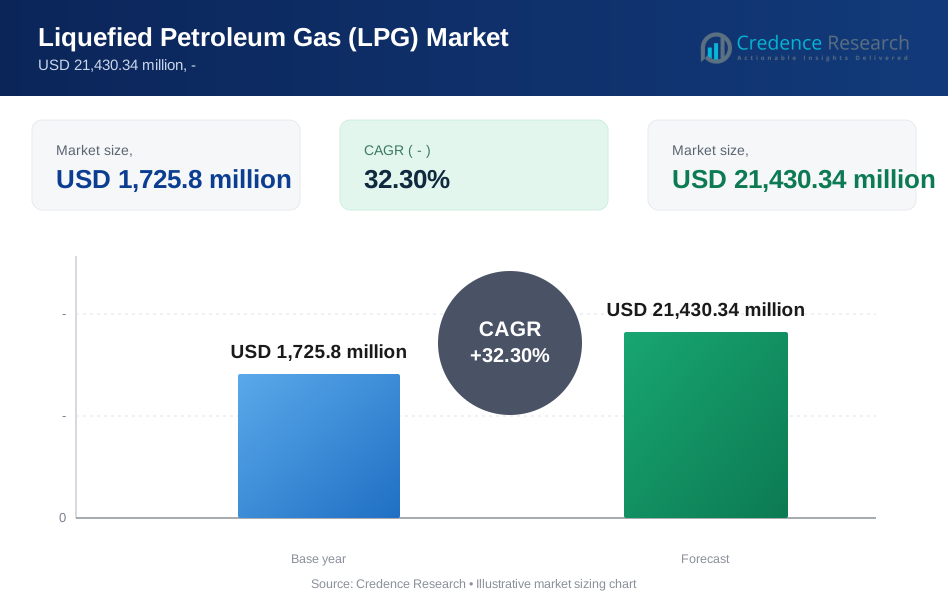
| Liquefied Petroleum Gas (LPG) Market Size 2023 | USD 1725.8 million |
| Liquefied Petroleum Gas (LPG) Market CAGR | 32.30% |
| Liquefied Petroleum Gas (LPG) Market Size 2032 | USD 21430.34 million |
Market Insights
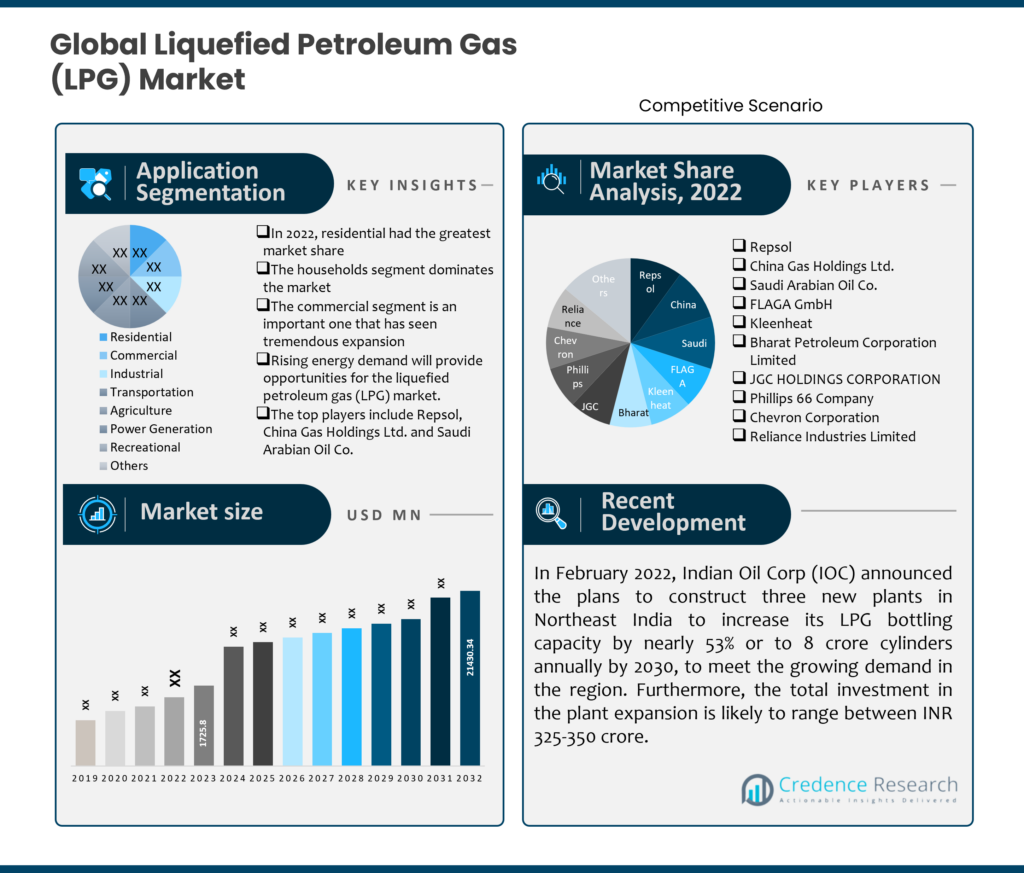
- Between 2024 and 2032, the global market for liquefied petroleum gas (LPG) is projected to rise at a compound annual growth rate (CAGR) of 32.30%, from an estimated USD 1725.8 million in 2023 to USD 21430.34 million in 2032.
- The largest category is residential. Commercial, on the other hand, is expected to grow at a strong CAGR.
- The households category will expand at a rapid rate of growth.
- The Asia Pacific region dominated the liquefied petroleum gas (LPG) market.
- Regarding the market share of liquefied petroleum gas (LPG), Europe is expected to come second.
- In the liquefied petroleum gas (LPG) market, North America is anticipated to grow fastest.
- Liquefied petroleum gas (LPG) demand is being driven by rising global energy consumption as well as the growth of industries that use LPG for a variety of processes like manufacturing and power generation.
- The development of innovative technologies for LPG production, storage, transportation, and utilization can boost market expansion by lowering costs and increasing efficiency.
Executive Summary
Market Definition
The production, distribution, and consumption of propane and butane-based fuels obtained from the processing of natural gas and the refining of crude oil are all included in the global market for liquefied petroleum gas, or LPG. Since LPG can be transferred and stored at a moderate pressure in a liquid state, it is useful for a wide range of applications. It is a flexible energy source that is widely used in the home, business, industrial, and transportation sectors for power generation, cooking, heating, and fuel for automobiles.
Market Overview
The liquefied petroleum gas (LPG) sector is predicted to continue its upward trend between 2024 and 2032, growing at a compound annual growth rate (CAGR) of 32.30%. From its projected USD 1725.8 million in 2023 to USD 21430.34 million in 2032, the market will continue to grow.
Over the past 20 years, autogas consumption worldwide has grown dramatically, reaching a record 27.1 million tonnes in 2019. Autogas consumption with other transport fuels fell significantly in 2020 as a result of the disruptions brought on by the COVID-19 pandemic. Around 27.8 million autogas-powered vehicles are currently in use worldwide, and the fleet is still expanding rapidly. The proportion of gas utilized in total vehicle fuel consumption varies significantly by region; in the US, it can be as low as 0.03%, but in Ukraine, it can reach 25%. Disparities in government incentive programs account for the majority of the autogas industry's remarkable discrepancy in performance when compared to gasoline, diesel, and other traditional automotive fuels.
The environment is the main justification for the governments of many nations' active encouragement of autogas and other alternative fuels. The majority of international studies comparing environmental performance show that autogas perform better than gasoline, diesel, and some other alternative fuels. It is projected that these factors will drive the expansion of the liquefied petroleum gas (LPG) global market.
Segmentation by Application
- The residential category is the market leader in terms of application. The residential category of the liquefied petroleum gas (LPG) market describes the use of LPG primarily for domestic purposes as a fuel source. This group covers a wide range of domestic uses, such as heating, cooking, hot water systems, and even specialized uses like heating swimming pools or grilling outside.
- The commercial category will exhibit a sizable CAGR during the projected period. Because of its clean-burning characteristics and adjustable heat, LPG is frequently used in commercial kitchens for cooking. In commercial buildings, especially in places without natural gas infrastructure, it is also utilized for space heating. LPG is an environmentally friendly energy source that can power machinery and other industrial equipment among other things.
- Other applications, including industrial, transportation, agriculture, power generation, recreational, and others, also support the need for liquefied petroleum gas (LPG).
Segmentation by End-User
- Households are regarded as the most valuable end users. Households in this category buy LPG tanks or cylinders for home usage. These cylinders are typically acquired from regional distributors or delivered by LPG providers. LPG is also used by households in areas with limited or unstable access to other energy sources, such as power appliances like clothes dryers and refrigerators, as well as heat spaces and water.
- The commercial enterprises category will likely register a significant CAGR during forecasting. LPG is used extensively in hotels, restaurants, and catering services for heating, cooking, and other operational requirements. Because of its efficiency, ease of use, and relatively clean-burning qualities, LPG is recommended in these conditions.
- Other end-users, such as industrial facilities, transportation operators, agricultural operations, power generation utilities, and recreational users, also contribute to the demand for liquefied petroleum gas (LPG).
Segmentation by Region
- Asia Pacific leads the liquefied petroleum gas (LPG) industry. The population growth, an abundance of resources, escalating energy consumption, and governmental assistance that made LPG cylinders more affordable are the main drivers of its expanding market penetration.
- Europe is estimated to rank second in liquefied petroleum gas (LPG) market size.
- The liquefied petroleum gas (LPG) industry is predicted to flourish rapidly in North America.
- The remaining need for liquefied petroleum gas (LPG) is covered by regions including Latin America, Africa, and the Middle East.
Based on projections, Asia Pacific is anticipated to control the liquefied petroleum gas (LPG) market. This is due to the fact that LPG is widely used in homes as the primary fuel for cooking and water heating in the Asia Pacific. There is plenty of LPG available, and assumptions suggest that costs will stay low for some time to come unless there is a major political disruption. With this gas serving as the primary feedstock for the synthesis of numerous chemicals and plastics, the chemical industry in the area has experienced explosive growth in recent years. In Asia Pacific, the demand for autogas (LP gas used as a transportation fuel) has grown more quickly. Governments have demonstrated a strong, sustained commitment to promoting LPG as a fuel for transportation. The market for liquefied petroleum gas is also being driven by this factor.
Europe continues to be one of the regional leaders in LPG and is the second most dominant market. However, rather than the more established markets in the northwest and south of Europe, a large portion of the growth in recent years has come from central and eastern Europe. The primary fuel for off-grid heating in Europe is LP gas. Based on data that is starting to surface, it sounds like that certain businesses, particularly in the light industrial sector, are moving toward LP gas. Distributing companies in the area are putting a lot of effort into their marketing strategies in an attempt to commercialize new applications for LP gas, particularly as boiler fuel.
Throughout the projected period, liquefied petroleum gas (LPG) sales in North America are anticipated to expand quickly. In 2018, around 234 thousand metric tonnes of LP gas from natural gas and 10,000 metric tonnes from US refineries were created in the US. According to the Energy Information Administration, the US developed 91.4 billion cubic feet, or 33.4 trillion cubic feet (Tcf) of dry natural gas on average each day in 2020. This suggests that natural gas is the main fuel used to produce LP gas. The market in the region is divided up among several industries, each of which has a reasonable portion. The main industrial and domestic segments are followed by agriculture, refinery fuel, and industrial.
Key Highlights of the Report
The global liquefied petroleum gas (LPG) market is segmented by application, end-user, and region. The residential category is the market spearhead in terms of application, and households are the top end-users. The liquefied petroleum gas (LPG) market is expanding mostly in Asia Pacific.
The movement to cleaner energy sources and concerns regarding the environment are the main drivers of the liquefied petroleum gas (LPG) industry. The migration to more environmentally friendly energy sources has been sparked by growing public awareness of environmental issues, notably those related to air quality and greenhouse gas emissions. This has increased the use of LPG because it burns cleaner than other fossil fuels like coal and oil. It is an attractive alternative for many applications since burning it emits fewer pollutants, including carbon dioxide.
Asia Pacific is expected to account for the largest liquefied petroleum gas (LPG) market globally. The use of LPG is significantly influenced by urbanization. In nations like China and India, where a growing number of people are living in cities, there is a significant rise in the demand for LPG for home heating and cooking as well as for industrial and commercial use. LPG is extensively utilized in a wide range of commercial and industrial applications, including transportation, hospitality, agriculture, and manufacturing. Due to the abundance of developing nations in the Asia-Pacific area and their developing industrial sectors, there is a considerable demand for LPG in these markets. It is also anticipated that the market will develop at the fastest rate in the North American region. LPG is in high demand in North America across a number of industries, including transportation, business, industry, and residential. LPG is extensively utilized in petrochemical manufacturing, industrial processes, car fuel, cooking, and heating.
Which Key Factors Are Driving The Global Liquefied Petroleum Gas (LPG) Market?
Expanding industry demand for liquefied petroleum gas (LPG) for activities like manufacturing and power production, as well as expanding public knowledge of LPG's advantages over alternative fuels, are the main reasons behind the growth of the LPG market.
What Are The Main Challenges Confronting The Global Liquefied Petroleum Gas (LPG) Market?
The liquefied petroleum gas (LPG) business has a number of major obstacles, such as the inadequate infrastructure for distribution and storage in some areas and fluctuations in LPG demand due to seasonal differences in cooking and heating needs.
What Market Opportunities Exist For Liquefied Petroleum Gas (LPG) Globally?
The demand for liquefied petroleum gas (LPG) is expected to rise in a number of industries, including manufacturing, agriculture, and hospitality. LPG production, storage, transportation, and utilization technologies are also expected to advance, resulting in cost savings and increased efficiency. These factors will create opportunities for the liquefied petroleum gas (LPG) market.
Market Drivers
Emerging Markets Have Rapid Economic Growth
The necessity for Liquefied Petroleum Gas (LPG) is largely triggered by emerging markets and their consistent economic development. As these economies develop, there is a corresponding rise in energy requirements for powering various sectors, from residential to industrial. Because LPG is so readily available and affordable, it is frequently utilized to meet this heightened energy demand. LPG is becoming the fuel of choice for the heating and cooking processes in households in many emerging regions, especially Asia, Africa, and Latin America. Furthermore, organizations in these regions are depending more and more on LPG for a variety of uses, such as electrical power generation and manufacturing procedures. Furthermore, because LPG is portable, it's a practical energy source for isolated and off-grid communities with limited access to conventional energy infrastructure. It is the perfect answer to address the energy needs of businesses and people in these abandoned regions because of its accessibility and relatively inexpensive installation costs, which will drive market expansion.
Market Restraints
Growing Priority Given To Biofuels, Clean Renewable Energy, And Zero Carbon Emission
The early catalyst for the development of alternative vehicle fuels came from the oil price shocks of the 1970s, when nations looked to lessen their reliance on the importation of refined products and crude oil. Since these fuels are generally less polluting, environmental concerns have surpassed energy security as the primary motivator behind government programs to promote them. Research and development of alternative automobile fuel technology has recently concentrated on hydrogen-based fuel cells, electric vehicles (EVs), biofuels made from vegetable matter (such as ethanol or biodiesel), and fuels based on natural gas and oil. Although plug-in and pure battery electric vehicles (EVs) are now readily available for purchase, their high price and short range continue to hinder their adoption rate. Although ethanol and biodiesel are now widely available, they are typically mixed with regular gasoline and diesel before being sold to final consumers. The struggle for land to grow food crops, however, is expected to limit the potential for biofuel production using traditional techniques. These factors restrain the development of the global liquefied petroleum gas (LPG) sector.
Opportunities
Growing Public Proposals and Assistance for the Adoption of LPG
Globally, the use of LP gas has increased across several industries due to the increased emphasis on reducing greenhouse gas emissions and guaranteeing sustainable energy for all. The government has shown notable support for the increased usage of LP gas through initiatives and subsidies. Through its "PAHAL" plan, which deposits subsidies directly into the bank accounts of eligible consumers, the Indian government's initiatives target subsidies more effectively. A "give it up" campaign supporting this system asks people who can afford the market price of LPG to willingly stop purchasing subsidized goods. Because of this, LP gas can start to appeal as an alternative fuel for more applications, which is expected to grow the market throughout the projection period.
Competitive Landscape
Key Players
In the highly competitive global liquefied petroleum gas (LPG) market, there are a number of significant rivals. A few of the top market players are shown below, together with their respective market shares:
- Repsol
- China Gas Holdings Ltd.
- Saudi Arabian Oil Co.
- FLAGA GmbH
- Kleenheat
- Bharat Petroleum Corporation Limited
- JGC HOLDINGS CORPORATION
- Phillips 66 Company
- Chevron Corporation
- Reliance Industries Limited
- Exxon Mobil Corporation
- Total
- Royal Dutch Shell
- Petroliam Nasional Berhad (PETRONAS)
- PetroChina Company Limited
- Petredec Pte Limited
- Qatargas Operating Company Limited
- Petrofac Limited
- Vitol
- China Petroleum & Chemical Corporation
- BP Plc.
- Others
To stay competitive, these businesses give priority to product innovation, expanding their distribution networks, and completing mergers and acquisitions.
The biggest vendors in the global liquefied petroleum gas (LPG) market consistently strive to keep one step ahead of the competition by creating cutting-edge ideas and goods.
In April 2023, The Pierce field in the UK Central North Sea was modified by Shell U.K. Ltd., a subsidiary of Shell plc, to allow gas production after it had only produced oil for many years. Consequently, field operations have now fully resumed. Pierce is a joint venture between Ithaca Energy (UK) Limited (74.48%) and Shell Companies (92.52 % operator).
In March 2023, ExxonMobil announced the successful completion of its Beaumont refinery expansion project, which will increase the capacity of one of the biggest petrochemical and refining complexes on the US Gulf Coast by 250,000 barrels per day. The business will contribute to meeting the growing need for dependable, reasonably priced energy by expanding its refinery and increasing its crude production in the Permian Basin—the largest refinery expansion in over a decade.
How are Companies Performing in the Liquefied Petroleum Gas (LPG) Market?
Several types of noteworthy factors have contributed to the liquefied petroleum gas (LPG) market's notable performance for companies. To strengthen their global presence, the companies are heavily concentrating on the exploration and production of natural gas with improved operational characteristics. BP Plc, Exxon Mobil Corporation, ConocoPhillips, and Abu Dhabi National Oil Company (ADNOC) held a substantial market share in the global market when all the scenarios were taken into account because of their more effective extraction procedures and well-established supply chains. In the upcoming years, they are anticipated to continue leading the industry.
Due to a constantly expanding fleet, mostly in Europe and Asia Pacific, the majority of companies have been focusing on enhancing their Autogas capabilities. The additional decisions made by the companies include maintaining relationships with automakers and distributors to ensure a stable supply throughout the coming decades.
Companies are collaborating with other businesses in order to expand in the liquefied petroleum gas (LPG) industry. For example, Astomos Energy Corporation and Shell International Eastern Trading Company (Shell) entered into a deal in June 2021 for the acquisition of a cargo of carbon-neutral liquefied petroleum gas that would be delivered to Japan. The first carbon-neutral LPG in the world is the large gas carrier (VLGC)-sized LPG cargo. Shell claims that certified nature-based carbon credits have been used to offset the CO2e lifetime emissions of this product. Under the terms of this agreement, lifecycle CO2e emissions produced along the value chain from production to consumption (combustion), including transportation, will be offset by credits from Shell's global portfolio of nature-based initiatives. Through its nature-based initiatives, the company preserves, modifies, or restores land, permitting nature to replenish oxygen and absorb CO2 emissions from the atmosphere.
Summary of Key Findings
- The market is growing because more people are choosing LPG-powered cars to reduce emissions and save money.
- The market is segmented by application, end-user, and region.
- The residential application category is anticipated to expand at a significant CAGR during the forecast period.
- Households are the foremost end-user category.
- Asia Pacific is leading market development; the market is highly competitive with key players including Repsol, China Gas Holdings Ltd., Saudi Arabian Oil Co., FLAGA GmbH, Kleenheat, Bharat Petroleum Corporation Limited, JGC HOLDINGS CORPORATION, Phillips 66 Company, Chevron Corporation, Reliance Industries Limited, Exxon Mobil Corporation, Total, Royal Dutch Shell, Petroliam Nasional Berhad (PETRONAS), PetroChina Company Limited, Petredec Pte Limited, Qatargas Operating Company Limited, Petrofac Limited, Vitol, China Petroleum & Chemical Corporation, BP Plc., and Others.
Future Outlook
- The liquefied petroleum gas (LPG) industry is expected to increase significantly in Asia Pacific, and its outlook is positive worldwide.
- The market's demand is being driven by rising global energy consumption.
- The expense of building the necessary infrastructure for LPG distribution, storage, and manufacturing may be impeding market expansion.
- Major organizations need to create novel offerings, reach a wider audience, and maintain competitive pricing in order to stay ahead of other businesses.
How the Credence Research Liquefied Petroleum Gas (LPG) Market Report Can Help CXOs
The Credence Research Liquefied Petroleum Gas (LPG) Market Report provides CXOs with an extensive market overview and comprises the following:
- Market size and growth forecast: The study offers comprehensive market estimations for liquefied petroleum gas (LPG) globally, broken down by application, end-user, and region. In addition, projections for the market through 2032 based on significant drivers and trends are included.
- Market segmentation: The liquefied petroleum gas (LPG) market is divided into segments by application, end-user, and region in the research report. CXOs are given a detailed grasp of the market and the potential inside each sector due to this segmentation.
- Competitive landscape: The study report provides a thorough analysis of the leading businesses in the liquefied petroleum gas (LPG) sector, together with details on their revenue streams, product lines, and business strategies. This information can help CXOs assess and identify their competitors.
- Key trends and drivers: The study report analyzes and highlights the key developments and elements driving the market for liquefied petroleum gas (LPG). CXOs can utilize this information to make well-informed choices regarding their plans and investments.
The Credence Research Liquefied Petroleum Gas (LPG) Market Report provides CXOs with insights that they may utilize to:
- Identify growth opportunities: This analysis is likely to help CXOs find fresh growth prospects in the liquefied petroleum gas (LPG) sector. For example, the research recognizes the increasing requirement for liquefied petroleum gas (LPG) from households as a crucial opportunity.
- Make informed investment decisions: The study aids CXOs in making informed decisions about liquefied petroleum gas (LPG). For example, it delivers information on the key variables to consider while picking liquefied petroleum gas (LPG) solutions and evaluating suppliers.
- Develop competitive strategies: CXOs can utilize the research report to establish competitive strategies for their liquefied petroleum gas (LPG) firms. The study paper explores the primary tactics employed by liquefied petroleum gas (LPG) providers to set themselves apart from their rivals.
- Track market developments: By tracking market advancements, this research report could assist CXOs in remaining ahead of the curve. For example, it provides information about the latest advancements and patterns in the liquefied petroleum gas (LPG) industry.
The Credence Research Liquefied Petroleum Gas (LPG) Market Report is helpful for CXOs who want to learn more about the market and identify potential opportunities.
Segmentation
-
By Application Segmentation
- Residential
- Commercial
- Industrial
- Transportation
- Agriculture
- Power Generation
- Recreational
- Others
-
By End-User Segmentation
- Households
- Commercial Enterprises
- Industrial Facilities
- Transportation Operators
- Agricultural Operations
- Power Generation Utilities
- Recreational Users
-
By Region
- North America
- U.S.
- Canada
- Mexico
- Europe
- Germany
- France
- UK.
- Italy
- Spain
- Rest of Europe
- Asia Pacific
- China
- Japan
- India
- South Korea
- South-east Asia
- Rest of Asia Pacific
- Latin America
- Brazil
- Argentina
- Rest of Latin America
- Middle East & Africa
- GCC Countries
- South Africa
- The Rest of the Middle East and Africa
- North America
Adjacent Markets
Several adjacent markets in the liquefied petroleum gas (LPG) market have high revenue growth opportunities. The key adjacent markets for the liquefied petroleum gas (LPG) market -
|
Adjacent Markets |
||
| Petrochemical Industry | Energy Storage Solutions | Oil and Gas Exploration |
| Energy Distribution and Retail | Energy Services Companies (ESCOs) | Automotive Industry |
| Power Generation Market | Environmental Services | Transportation Industry |
Request a Free Sample
Fill in your details and we'll send you a free sample report.
- Sample data tables & charts
- Research methodology
Need a Custom Version of This Report?
Tailor the scope, geography, or segments to your exact requirements.
- Custom geography or segment scope
- Direct access to our analyst team
Frequently Asked Questions
How much does the global market currently hold for liquefied petroleum gas (LPG)?
What is the liquefied petroleum gas (LPG) market's projected growth rate between 2024 and 2032?
What is the most significant market segment in terms of application?
Regarding the end-user, which market category is in the lead?
Which application is anticipated to grow at the fastest rate throughout the projected period?
In which region is the market for liquefied petroleum gas (LPG) expanding?
Who are the main players in the global liquefied petroleum gas (LPG) industry?
Which market factors are the primary drivers of the liquefied petroleum gas (LPG) industry?
What main market challenges prevent the growth of the liquefied petroleum gas (LPG) sector?
What are the main market opportunities for the liquefied petroleum gas (LPG) sector?
Table of Content
Chapter 1. Report Introduction
- 1.1 Report Description & Purpose
- 1.1.1 Report Title & Market Definition
- 1.1.2 Unique Selling Propositions (USP) & Key Differentiators
- 1.1.3 Value Proposition for Stakeholders
- 1.2 Research Objectives
- 1.2.1 Market Sizing Objectives (Volume & Revenue)
- 1.2.2 Segmentation Objectives
- 1.2.3 Competitive Intelligence Objectives
- 1.2.4 Forecast & Scenario Objectives
- 1.3 Report Scope
- 1.3.1 Liquefied Petroleum Gas (LPG) Scope – Types & Subtypes Covered
- 1.3.2 Geographic Scope – Regions & Countries Covered
- 1.3.3 Historical Period, Base Year & Forecast Period (the historical period; forecast to the forecast period)
- 1.3.4 Inclusions & Exclusions
- 1.4 HS Code & Classification Framework
- 1.5 Currency, Units & Pricing Basis
- 1.6 Target Stakeholders
- 1.7 Limitations & Assumptions
Chapter 2. Executive Summary
- 2.1 Global Liquefied Petroleum Gas (LPG) Market Snapshot
- 2.1.1 Market Size – Historical (the historical period) & Forecast (the forecast period) (base year: USD 1,725.8 million → forecast year: USD 21,430.34 million)
- 2.1.2 Volume & Revenue – Global Totals
- 2.1.3 Key Market Highlights – Top Five Facts
- 2.2 Liquefied Petroleum Gas (LPG) Market Segmentation Snapshot
- 2.2.1 Market Split by Region – vs.
- 2.3 Competitive Snapshot
- 2.3.1 Top 10 Players by Revenue Share –
- 2.3.2 Top 10 Players by Volume Share –
- 2.3.3 Recent Strategic Developments (18-Month Summary)
- 2.4 Key Investment Highlights & Strategic Conclusions
Chapter 3. Liquefied Petroleum Gas (LPG) Market Dynamics & Industry Analysis
- 3.1 Market Overview & Context
- 3.1.1 Liquefied Petroleum Gas (LPG) Market Position in the Broader Automotive Value Chain
- 3.1.2 OEM vs. Replacement Market Dynamics
- 3.1.3 Market Maturity & Development Stage by Region
- 3.2 Liquefied Petroleum Gas (LPG) Market Drivers
- 3.3 Liquefied Petroleum Gas (LPG) Market Restraints & Challenges
- 3.4 Liquefied Petroleum Gas (LPG) Market Opportunities
- 3.5 Porter's Five Forces Analysis
- 3.5.1 Threat of New Entrants
- 3.5.2 Bargaining Power of Suppliers
- 3.5.3 Bargaining Power of Buyers
- 3.5.4 Threat of Substitutes
- 3.5.5 Competitive Rivalry – Intensity Assessment
- 3.6 Liquefied Petroleum Gas (LPG) Value Chain Analysis
- 3.6.1 Upstream – Raw Material/Input Suppliers
- 3.6.1.1 Raw Material/Input 1
- 3.6.1.2 Raw Material/Input 2
- 3.6.1.3 Raw Material/Input 3
- 3.6.2 Midstream – Production/Manufacturing/Service Delivery
- 3.6.2.1 Production/Process Overview
- 3.6.2.2 Key Facility Locations & Capacity by Manufacturer
- 3.6.3 Downstream – Distribution & End Consumer
- 3.6.3.1 Primary Channel – B2B/OEM
- 3.6.3.2 Secondary Channels – Dealer, Retail, Online, Direct
- 3.6.4 Value Chain Profitability Analysis
- 3.6.1 Upstream – Raw Material/Input Suppliers
- 3.7 PESTEL Analysis
- 3.7.1 Political Factors
- 3.7.2 Economic Factors
- 3.7.3 Social Factors
- 3.7.4 Technological Factors
- 3.7.5 Environmental Factors
- 3.7.6 Legal Factors
- 3.8 Liquefied Petroleum Gas (LPG) Supply Chain Analysis
- 3.8.1 Raw Material/Input Supply Risk Assessment
- 3.8.2 Manufacturing Concentration Risk (Geographic Exposure)
- 3.8.3 Trade Disruption Impact Analysis
- 3.9 Regulatory & Policy Landscape
Note: The regulatory and policy landscape section covers regulations based on their applicability to the market, Liquefied Petroleum Gas (LPG) category, geography, and scope of the study. Only regulatory frameworks with a material impact on operations, compliance, trade, sustainability, or market access are analyzed in detail.
Chapter 4. Key Investment Pockets & Opportunity Analysis
- 4.1 Liquefied Petroleum Gas (LPG) Market Attractiveness Analysis
- 4.1.1 By Region – Investment Attractiveness Matrix (Volume × CAGR)
- 4.2 Absolute Revenue Growth Opportunity
- 4.2.1 By Region – Absolute USD Growth Through the forecast period
- 4.3 Incremental Volume Opportunity
- 4.3.1 By Region – Incremental Volume Through the forecast period
- 4.3.2 Segment – Incremental Volume
- 4.4 Emerging Submarket Opportunity Deep Dive (Subject to Applicability)
- 4.5 Emerging Market Opportunity Scorecards
- 4.5.1 United States
- 4.5.2 Europe
- 4.5.3 Asia
- 4.5.4 Middle East & Africa
Note: Emerging Market Opportunity Scorecards will be included based on relevance and strategic importance. Regions listed are indicative and may vary depending on data availability and market dynamics.
Chapter 5. Liquefied Petroleum Gas (LPG) Import-Export Analysis & Trade Flows
- 5.1 Global Trade Overview
- 5.1.1 Global Export Value by Country (the historical period)
- 5.1.2 Global Export Volume by Country (the historical period)
- 5.1.3 Global Import Value by Country (the historical period)
- 5.1.4 Global Import Volume by Country (the historical period)
- 5.1.5 Net Trade Balance by Country (the historical period)
- 5.2 Export Analysis – Segment
- 5.2.1 Type 1 (HS Code)
- 5.2.2 Type 2 (HS Code)
- 5.2.3 Type 3 (HS Code)
- 5.2.4 Type 4 (HS Code)
- 5.2.5 Type 5 (HS Code)
- 5.3 Import Analysis – Segment
- 5.3.1 Type 1 (HS Code)
- 5.3.2 Type 2 (HS Code)
- 5.3.3 Type 3 (HS Code)
- 5.3.4 Type 4 (HS Code)
- 5.3.5 Type 5 (HS Code)
- 5.4 Average Unit Trade Prices
- 5.4.1 Average Export Price – Segment & Country
- 5.4.2 Average Import Price – Segment & Source Country
- 5.4.3 Price Trends (the historical period)
- 5.5 Key Trade Route Analysis
- 5.5.1 Trade Route 1
- 5.5.2 Trade Route 2
- 5.5.3 Trade Route 3
- 5.5.4 Trade Route 4
- 5.5.5 Trade Route 5
- 5.6 Trade Policy Impact Assessment
- 5.6.1 US Anti-Dumping & Section 301 Tariffs
- 5.6.2 EU Customs Union Impact
- 5.6.3 Major Free Trade Agreements
- 5.6.4 USMCA Rules of Origin
Note: Trade policy analysis will be included only where relevant to the Liquefied Petroleum Gas (LPG) market.
Chapter 6. Competitive Landscape & Company Benchmarking
- 6.1 Liquefied Petroleum Gas (LPG) Market Concentration & Structure
- 6.1.1 Herfindahl-Hirschman Index (HHI) – vs.
- 6.1.2 Tier 1, Tier 2 & Tier 3 Market Structure
- 6.1.3 Global, Regional & Local Player Dynamics
- 6.2 Liquefied Petroleum Gas (LPG) Market Share Analysis –
- 6.2.1 Global Revenue Share by Company
- 6.2.2 Global Volume Share by Company
- 6.2.3 Regional Revenue Share
- 6.2.4 Market Share Evolution ( vs. )
- 6.2.5 OEM Segment Share by Company
- 6.2.6 Replacement Segment Share by Company
- 6.3 Production/Delivery Capacity & Facility Analysis
- 6.3.1 Global Installed Capacity
- 6.3.2 Capacity Utilization Rates
- 6.3.3 Production/Output Volume
- 6.3.4 Facility Locations & Capacity Map
- 6.3.5 Planned Capacity Additions
- 6.4 Liquefied Petroleum Gas (LPG) Competitive Benchmarking Matrix
- 6.4.1 Revenue, Volume, CAGR & Profitability Comparison
- 6.4.2 Channel Revenue Mix
- 6.4.3 Geographic Revenue Exposure
- 6.4.4 R&D Intensity
- 6.4.5 Sustainability Maturity
- 6.5 Strategic Developments in Liquefied Petroleum Gas (LPG) (Last 24 Months)
- 6.5.1 Mergers, Acquisitions & Divestments
- 6.5.2 New Liquefied Petroleum Gas (LPG) Launches
- 6.5.3 Facility Expansions
- 6.5.4 Strategic Alliances, Joint Ventures & Partnerships
- 6.5.5 Distribution Expansion & Market Entry
- 6.5.6 Sustainability & ESG Initiatives
- 6.6 Competitive Strategy Mapping
- 6.6.1 Leader, Challenger, Follower & Niche Classification
- 6.6.2 Pricing Strategy Comparison
- 6.6.3 Channel Strategy Matrix
Note: Strategic developments are included based on their materiality and the availability of reliable information.
Chapter 7. Global Liquefied Petroleum Gas (LPG) Market – By Distribution Channel
- 7.1 Segment Overview
- 7.1.1 Volume & Revenue Split by Channel ( & )
- 7.1.2 Channel Mix Evolution (the forecast period)
Chapter 8. Regional Market Analysis – Global Overview
- 8.1 Global Regional Overview
- 8.1.1 Regional Volume Share
- 8.1.2 Regional Revenue Share
- 8.1.3 Regional Volume by Region
- 8.1.4 Regional Revenue by Region
- 8.1.5 Regional Forecast Through the forecast period
- 8.2 Cross-Regional Segment Analysis
- 8.2.1 By Distribution Channel
- 8.2.2 By Brand/Price Tier
Chapter 9. North America Liquefied Petroleum Gas (LPG) Market
- 9.1 United States
- 9.2 Canada
- 9.3 Mexico
Chapter 10. Europe Liquefied Petroleum Gas (LPG) Market
- 10.1 Germany
- 10.2 France
- 10.3 Italy
- 10.4 United Kingdom
- 10.5 Spain
- 10.6 Poland
- 10.7 Russia
- 10.8 Netherlands
- 10.9 Belgium
- 10.10 Sweden
- 10.11 Denmark
- 10.12 Norway
- 10.13 Rest of Europe
Chapter 11. Asia Pacific Liquefied Petroleum Gas (LPG) Market
- 11.1 China
- 11.2 India
- 11.3 Japan
- 11.4 South Korea
- 11.5 Thailand
- 11.6 Indonesia
- 11.7 Vietnam
- 11.8 Malaysia
- 11.9 Australia
- 11.10 Rest of Asia Pacific
Chapter 12. Latin America Liquefied Petroleum Gas (LPG) Market
- 12.1 Brazil
- 12.2 Argentina
- 12.3 Colombia
- 12.4 Chile
- 12.5 Rest of Latin America
Chapter 13. Middle East Liquefied Petroleum Gas (LPG) Market
- 13.1 Saudi Arabia
- 13.2 United Arab Emirates
- 13.3 Turkey
- 13.4 Israel
- 13.5 Iran
- 13.6 Rest of the Middle East
Chapter 14. Africa Liquefied Petroleum Gas (LPG) Market
- 14.1 South Africa
- 14.2 Egypt
- 14.3 Nigeria
- 14.4 Morocco
- 14.5 Rest of Africa
Chapter 15. Liquefied Petroleum Gas (LPG) Company Profiles
- 15.1 [Company 01]
- 15.1.1 Company Overview
- 15.1.2 Key Management Personnel
- 15.1.3 Products & Services Portfolio
- 15.1.4 Financial Performance
- 15.1.5 Key Market Focus & Geographic Presence
- 15.1.6 Recent Developments & Strategic Initiatives
Note: The company profile list is preliminary and may change based on research findings, market developments, data availability, and client requirements.
Chapter 16. Appendices
- Appendix A – List of Abbreviations & Acronyms
- Appendix B – Industry Classification Code Reference – Full Series
- Appendix C – Production & Capacity Data Tables
- Appendix D – End-Use & Demand Base Tables
- Appendix E – Consumption & Replacement Rate Assumptions
- Appendix F – ASP Reference Tables
- Appendix G – Manufacturing & Facility Database
- Appendix H – Import-Export Data Tables
- Appendix I – Regulatory Summary Tables
- Appendix J – Primary Research Participant List (Anonymized)
- Appendix K – Primary Research Questionnaire Framework
- Appendix L – Data Sources & Bibliography
- Appendix M – Market Size Divergence & Source Comparison
Chapter 17. Research Methodology
- 17.1 Research Framework & Philosophy
- 17.2 Secondary Research – Sources, Hierarchy & Data Extraction
- 17.3 Data Modeling – Bottom-Up & Top-Down Market Sizing
- 17.4 Primary Research – Stakeholder Framework, LOI & Sample Sizes
- 17.5 Forecast Methodology – Regression, Scenario & Sensitivity Analysis
- 17.6 Quality Control – Four-Layer Validation Framework
- 17.7 Limitations & Standard Assumptions
- 17.8 Disclaimer
