
Market Overview
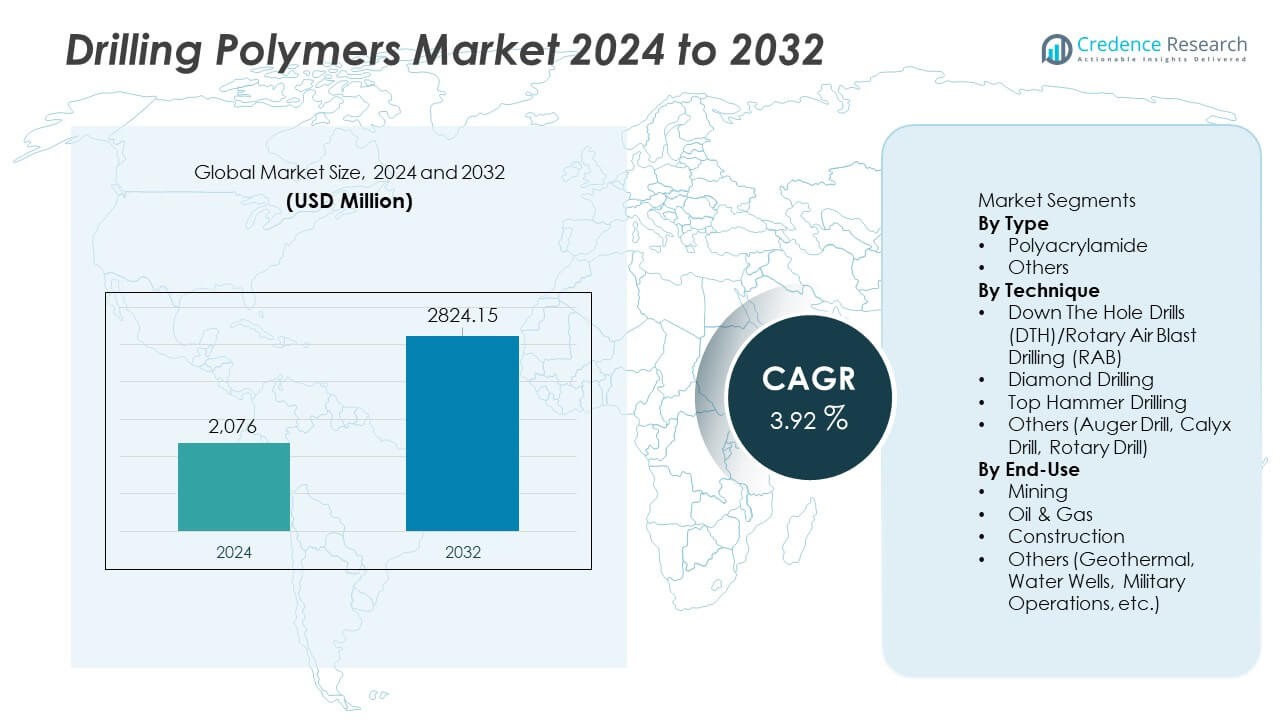
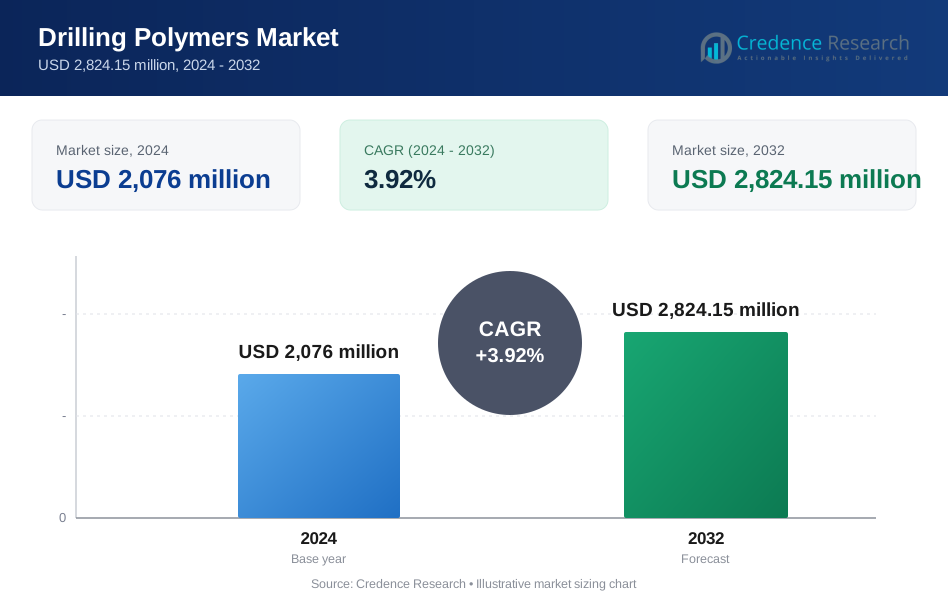
The Drilling Polymers Market was valued at USD 2,076 million in 2024 and is projected to reach USD 2,824.15 million by 2032, expanding at a CAGR of 3.92% during the forecast period.
| REPORT ATTRIBUTE | DETAILS |
|---|---|
| Historical Period | 2020-2023 |
| Base Year | 2024 |
| Forecast Period | 2025-2032 |
| Drilling Polymers Market Size 2024 | USD 2,076 Million |
| Drilling Polymers Market, CAGR | 3.92% |
| Drilling Polymers Market Size 2032 | USD 2,824.15 Million |
The Drilling Polymers market is shaped by leading players such as SNF Holding Company, BASF SE, Lubrizol Corporation, Schlumberger Limited, Halliburton Company, Kemira Oyj, Solvay S.A., Baroid Industrial Drilling Products, AMC Drilling Fluids, and Ashland Global Holdings, each focusing on advanced formulations that enhance drilling efficiency, cuttings transport, and wellbore stability. These companies strengthen competitiveness through innovation, environmental compliance, and partnerships with drilling service providers. North America leads the market with 37% share, driven by strong shale drilling and advanced exploration activities. Asia Pacific follows with 28% share, supported by growing oil, gas, and mining operations, while Europe holds 23% share, driven by offshore exploration and geothermal development.
Market Insights
- The Drilling Polymers market reached USD 2,076 million in 2024 and will grow at a CAGR of 3.92% through 2032.
- Demand rises as drilling activities expand across oil, gas, and mining sectors, with operators adopting polymers to improve viscosity, cuttings transport, and wellbore stability.
- Polyacrylamide leads the type segment with 64% share, while DTH/RAB drilling dominates the technique segment with 41% share, driven by efficiency and versatility.
- Competition intensifies as major players invest in high-performance, eco-friendly formulations and form partnerships to enhance product reach and technical support.
- North America leads with 37% share, followed by Asia Pacific at 28% and Europe at 23%, supported by active exploration and rising adoption of advanced drilling technologies.
 Market Segmentation Analysis:
By Type
Polyacrylamide dominates the segment with 64% share, driven by its strong viscosity-enhancing, fluid-loss control, and shale-stabilizing properties. Industries rely on polyacrylamide for efficient drilling mud performance, especially in deep and complex wells where consistent rheology is essential. Its compatibility with both water-based and synthetic drilling fluids strengthens adoption across mining and oilfield operations. The “Others” category grows steadily as specialty polymers support niche drilling needs such as high-temperature and high-pressure environments. The dominance of polyacrylamide continues as operators prioritize cost-effective additives that improve drilling efficiency and reduce operational risks.
- For instance, SNF Holding Company operates the largest polyacrylamide production network across its global plants, accounting for almost half of all global polyacrylamide production. The company also runs numerous manufacturing sites strategically located around the world, allowing stable supply for high-volume drilling projects and various other applications.
By Technique
Down The Hole (DTH)/Rotary Air Blast (RAB) drilling leads this segment with 41% share, supported by strong use in mining exploration and hard-rock drilling. These techniques benefit from drilling polymers that enhance cuttings transport, reduce friction, and stabilize boreholes in challenging terrains. Diamond drilling grows due to rising mineral exploration activities that require precise core extraction, while top hammer drilling expands in construction and quarrying applications. Other drilling methods gain traction for shallow or specialized operations. The leadership of DTH/RAB drilling reflects its versatility, lower operational cost, and ability to maintain efficiency in demanding geological conditions.
- For instance, Epiroc advanced DTH performance with its COP M-series hammers, which deliver drilling speeds up to 30% faster than earlier models.
By End-Use
Oil & gas dominates the end-use segment with 52% share, driven by the continuous demand for drilling polymers that support wellbore stability, lubricity improvement, and fluid-loss control in complex reservoirs. Exploration and development projects increasingly rely on high-performance polymers to enhance drilling speed and reduce non-productive time. Mining follows as the sector uses polymers for improved cuttings suspension and borehole integrity. Construction applications grow through their use in foundation drilling and tunneling projects, while geothermal and water-well drilling contribute to additional demand. The dominance of oil & gas remains strong as global drilling activities focus on safer, smoother, and more efficient well operations.
Key Growth Drivers
Rising Demand for Efficient Drilling Fluids
Growing focus on enhancing drilling performance drives strong adoption of drilling polymers across oil, gas, and mining operations. These polymers improve viscosity, cuttings transport, shale stabilization, and fluid-loss control, which reduces downtime and enhances safety. Complex drilling environments such as deepwater, horizontal, and high-pressure wells require advanced polymer-based additives to maintain consistent rheology. Operators rely on high-performance polymers to optimize drilling speed and reduce operational risks. As global drilling activities expand, the demand for reliable and efficient fluid additives continues to strengthen market growth.
- For instance, Schlumberger’s DRILPLEX HD polymer system improves hole-cleaning efficiency and cuttings transport in long horizontal wells, as demonstrated in field performance data.
Expansion of Mining and Mineral Exploration Activities
Increasing investment in mining exploration boosts the use of drilling polymers, especially for core drilling and hard-rock operations. These polymers help stabilize boreholes, suspend cuttings, and reduce equipment wear, which supports higher productivity and improved sample accuracy. Rising global demand for minerals used in energy storage, construction, and manufacturing drives continuous exploration efforts. Mining firms depend on polymer-enhanced drilling fluids to improve operational efficiency in diverse geological conditions. This expansion of exploration activities across emerging regions significantly boosts long-term market demand.
- For instance, Epiroc’s WL series core drilling tools support drilling depths exceeding 1,800 meters, which increases reliance on polymer-based stabilization systems.
Growing Adoption of Horizontal and Directional Drilling
Rising use of horizontal and directional drilling in oil and gas fields increases the need for advanced polymer-based drilling fluids. These wells require stable rheology, strong lubricity, and efficient cuttings removal, which drilling polymers provide. Operators depend on polymers to maintain borehole integrity and reduce friction in extended-reach wells. Growth in unconventional resources, including shale gas and tight oil, further strengthens demand. As more projects adopt complex drilling techniques, high-performance polymers become essential for ensuring operational efficiency and minimizing non-productive time.
Key Trends & Opportunities
Shift Toward Eco-Friendly and Biodegradable Polymers
Environmental regulations and sustainability goals drive the development of biodegradable and low-toxicity drilling polymers. Companies invest in green formulations that offer strong performance while minimizing ecological impact, especially in offshore and environmentally sensitive areas. These eco-friendly polymers support compliance with stricter waste-disposal standards and reduce environmental risks. Demand rises as operators adopt sustainable drilling practices aligned with global environmental frameworks. The shift toward greener additives creates new opportunities for manufacturers offering high-performance, regulatory-compliant polymer solutions.
- For instance, Kemira developed its Superfloc® BioMB series using a mass-balanced approach that incorporates biobased and renewable feedstocks, which are chemically identical to traditional polyacrylamide flocculants and are not inherently biodegradable according to standard criteria, but offer a reduced environmental load by decreasing the carbon footprint of production.
Technological Advancements in High-Performance Polymers
Advances in polymer science enable the creation of drilling additives that perform well under extreme temperatures, pressures, and chemically reactive formations. New formulations provide improved thermal stability, enhanced lubricity, and superior cuttings suspension, supporting complex operations in deepwater, geothermal, and ultra-deep wells. Automation and real-time monitoring systems also increase demand for polymers capable of maintaining consistent fluid behavior. These innovations create strong opportunities for companies developing specialized additives tailored to advanced drilling applications.
- For instance, Halliburton's ADAPTA filtration control agent provides secondary viscosity and is stable for use in fluid systems in challenging high-pressure, high-temperature wells. It offers reliable performance across a wide range of temperatures, including extreme downhole conditions.
Key Challenges
Volatility in Raw Material Prices
Fluctuating costs of raw materials used in polymer production create major challenges for manufacturers. Price instability affects production expenses, supply chain efficiency, and profit margins. Operators often delay procurement during periods of high cost, reducing short-term demand. Manufacturers must balance performance and cost-effectiveness to maintain competitiveness. This volatility pushes companies to diversify raw material sources and adopt more efficient production methods to ensure stability in supply and pricing.
Environmental and Regulatory Compliance Pressure
Stringent environmental regulations restrict the use of certain chemicals in drilling fluids, creating hurdles for polymer producers. Compliance requirements increase operational costs and limit formulation flexibility. Offshore drilling projects face particularly strict regulations regarding toxicity, biodegradability, and discharge control. Failure to meet environmental standards can delay approvals and restrict market access. Manufacturers must invest in research, testing, and certification processes to align products with evolving regulatory frameworks.
Regional Analysis
North America
North America leads the Drilling Polymers market with 37% share, driven by active oil and gas drilling operations, including shale exploration and unconventional resource development. The region benefits from advanced drilling technologies that require high-performance polymers for improved viscosity control, shale stabilization, and enhanced cuttings transport. Rising investments in horizontal and directional drilling further strengthen demand. Supportive regulatory frameworks and strong adoption of eco-friendly formulations encourage continuous innovation. Mining activities across the United States and Canada contribute additional consumption. The market grows steadily as operators prioritize efficiency, reduced downtime, and higher well productivity.
Europe
Europe holds 23% share, supported by sustained offshore drilling activities in the North Sea and increasing demand for efficient drilling fluids. Stringent environmental regulations encourage the use of biodegradable and low-toxicity polymers, pushing manufacturers to develop cleaner formulations. Rising geothermal exploration across Germany, Iceland, and France fuels additional demand for specialized polymers with high thermal stability. Mining operations across Eastern Europe also adopt advanced polymer-based fluids to enhance drilling accuracy and equipment performance. Strong focus on sustainable drilling practices shapes market growth, while ongoing energy transition efforts influence long-term project investment patterns.
Asia Pacific
Asia Pacific accounts for 28% share, driven by rapid expansion of oil and gas exploration in China, India, and Southeast Asian countries. Increasing mining activities in Australia and Indonesia further support strong consumption of drilling polymers. The region’s growing focus on deepwater and ultra-deepwater drilling raises the need for advanced additives with stable rheology under extreme conditions. Rising infrastructure development boosts construction-related drilling, expanding end-use demand. Investments in geothermal projects in Japan and the Philippines also contribute to market growth. Strong industrialization and large-scale resource extraction position the region as a key growth hub.
Latin America
Latin America holds 7% share, supported by expanding oil and gas drilling in Brazil, Argentina, and Mexico. The region’s deepwater exploration and shale resource development increase reliance on high-performance drilling polymers for improved stability and fluid efficiency. Mining operations across Chile and Peru generate additional demand, especially for polymers that enhance core drilling and reduce equipment wear. Economic development fuels infrastructure and construction drilling activities. Although regulatory constraints and cost pressures exist, rising exploration projects and foreign investments strengthen market prospects across the region.
Middle East & Africa
Middle East & Africa account for 5% share, driven by extensive oil and gas activities across Saudi Arabia, the UAE, Kuwait, and offshore African regions. High drilling intensity and challenging geological conditions require polymers that ensure optimal viscosity, lubrication, and borehole stability. The region’s growing focus on enhanced recovery techniques increases demand for advanced fluid additives. Mining operations in South Africa and emerging exploration in East Africa also support consumption. While environmental regulations vary by country, increasing adoption of modern drilling technologies strengthens long-term demand for high-performance drilling polymers.
Market Segmentations:
By Type
- Polyacrylamide
- Others
By Technique
- Down The Hole Drills (DTH)/Rotary Air Blast Drilling (RAB)
- Diamond Drilling
- Top Hammer Drilling
- Others (Auger Drill, Calyx Drill, Rotary Drill)
By End-Use
- Mining
- Oil & Gas
- Construction
- Others (Geothermal, Water Wells, Military Operations, etc.)
By Geography
- North America
- U.S.
- Canada
- Mexico
- Europe
- Germany
- France
- U.K.
- Italy
- Spain
- Rest of Europe
- Asia Pacific
- China
- Japan
- India
- South Korea
- South-east Asia
- Rest of Asia Pacific
- Latin America
- Brazil
- Argentina
- Rest of Latin America
- Middle East & Africa
- GCC Countries
- South Africa
- Rest of the Middle East and Africa
Competitive Landscape
The Drilling Polymers market features strong competition among key players such as SNF Holding Company, BASF SE, Lubrizol Corporation, Schlumberger Limited, Halliburton Company, Kemira Oyj, Solvay S.A., Baroid Industrial Drilling Products, AMC Drilling Fluids, and Ashland Global Holdings. Companies focus on delivering high-performance polymers that enhance viscosity control, reduce fluid loss, and improve wellbore stability in both oil and gas and mining operations. Many players invest in advanced formulations designed for extreme drilling conditions, including high-temperature and high-pressure environments. Strategic partnerships with drilling contractors and service providers help expand product reach and strengthen technical support. Firms also prioritize environmentally compliant and biodegradable polymer solutions to meet rising regulatory expectations. Continuous investment in research, testing, and application-specific customization supports differentiation, while global expansion strategies enable companies to serve emerging drilling markets. The competitive environment remains dynamic as innovation and operational efficiency become key success factors.
Key Player Analysis
- SNF Holding Company
- BASF SE
- Lubrizol Corporation
- Schlumberger Limited
- Halliburton Company
- Kemira Oyj
- Solvay S.A.
- Baroid Industrial Drilling Products
- AMC Drilling Fluids
- Ashland Global Holdings
Recent Developments
- In November 2025, BASF SE commissioned a new high-performance dispersant production line at its plant in Nanjing, China - potentially improving supply of polymer-based dispersants used across applications.
- In August 2024, SNF Holding Company signed an agreement to acquire PfP Industries and Ace Fluid Solutions - a move strengthening SNF’s water-soluble polymer and drilling-fluid additive portfolio.
Report Coverage
The research report offers an in-depth analysis based on Type, Technique, End-Use and Geography. It details leading market players, providing an overview of their business, product offerings, investments, revenue streams, and key applications. Additionally, the report includes insights into the competitive environment, SWOT analysis, current market trends, as well as the primary drivers and constraints. Furthermore, it discusses various factors that have driven market expansion in recent years. The report also explores market dynamics, regulatory scenarios, and technological advancements that are shaping the industry. It assesses the impact of external factors and global economic changes on market growth. Lastly, it provides strategic recommendations for new entrants and established companies to navigate the complexities of the market.
Future Outlook
- Demand for high-performance drilling polymers will rise as complex wells become more common.
- Polyacrylamide use will expand due to its strong efficiency in viscosity control and fluid stability.
- Eco-friendly and biodegradable polymer formulations will gain stronger market acceptance.
- Advanced polymers for high-temperature and high-pressure drilling will see increased development.
- Mining and mineral exploration growth will boost adoption of specialized drilling additives.
- Digital monitoring of drilling fluids will drive demand for polymers with stable rheological behavior.
- Offshore and deepwater projects will require more durable and thermally stable polymer solutions.
- Emerging markets will adopt drilling polymers as exploration activities expand.
- Partnerships between polymer manufacturers and drilling service companies will increase.
- Regulatory pressure will push companies to innovate cleaner, safer polymer-based drilling additives.
Request a Free Sample
Fill in your details and we'll send you a free sample report.
- Sample data tables & charts
- Research methodology
Need a Custom Version of This Report?
Tailor the scope, geography, or segments to your exact requirements.
- Custom geography or segment scope
- Direct access to our analyst team
Frequently Asked Questions
What is the current market size for the Drilling Polymers market, and what is its projected size in 2032?
At what Compound Annual Growth Rate is the Drilling Polymers market projected to grow between 2025 and 2032?
Which Drilling Polymers market segment held the largest share in 2024?
What are the primary factors fueling the growth of the Drilling Polymers market?
Who are the leading companies in the Drilling Polymers market?
Which region commanded the largest share of the Drilling Polymers market in 2024?
Table of Content
Chapter 1. Report Introduction
- 1.1 Report Description & Purpose
- 1.1.1 Report Title & Market Definition
- 1.1.2 Unique Selling Propositions (USP) & Key Differentiators
- 1.1.3 Value Proposition for Stakeholders
- 1.2 Research Objectives
- 1.2.1 Market Sizing Objectives (Volume & Revenue) (Volume Where Applicable)
- 1.2.2 Segmentation Objectives
- 1.2.3 Competitive Intelligence Objectives
- 1.2.4 Forecast & Scenario Objectives
- 1.3 Report Scope
- 1.3.1 Drilling Polymers Scope – Segments & Subsegments Covered
- 1.3.2 Geographic Scope – Regions & Countries Covered
- 1.3.3 Historical Period, Base Year & Forecast Period (2024; forecast to 2032)
- 1.3.4 Inclusions & Exclusions
- 1.4 Industry Classification & Applicable Codes
- 1.5 Currency, Measurement Units & Valuation Basis
- 1.6 Target Stakeholders
- 1.7 Limitations & Assumptions
Chapter 2. Executive Summary
- 2.1 Global Drilling Polymers Market Snapshot
- 2.1.1 Market Size – Historical (2024) & Forecast (2024-2032) (2024: USD 2,076 million → 2032: USD 2,824.15 million)
- 2.1.2 Volume & Revenue – Global Totals (Volume Where Applicable)
- 2.1.3 Key Market Highlights – Top Five Facts
- 2.2 Drilling Polymers Market Segmentation Snapshot
- 2.2.1 Market Split by Region – 2024 vs. 2032
- 2.3 Competitive Snapshot
- 2.3.1 Top 10 Players by Revenue Share – 2024
- 2.3.2 Top 10 Players by Volume Share – 2024 (Volume Where Applicable)
- 2.3.3 Recent Strategic Developments (18-Month Summary)
- 2.4 Key Investment Highlights & Strategic Conclusions
Chapter 3. Drilling Polymers Market Dynamics & Industry Analysis
- 3.1 Market Overview & Context
- 3.1.1 Drilling Polymers Market Position in the Broader Industry Value Chain
- 3.1.2 Demand Structure & Purchasing Dynamics
- 3.1.3 Market Maturity & Development Stage by Region
- 3.2 Drilling Polymers Market Drivers
- 3.3 Drilling Polymers Market Restraints & Challenges
- 3.4 Drilling Polymers Market Opportunities
- 3.5 Porter's Five Forces Analysis
- 3.5.1 Threat of New Entrants
- 3.5.2 Bargaining Power of Suppliers
- 3.5.3 Bargaining Power of Buyers
- 3.5.4 Threat of Substitutes
- 3.5.5 Competitive Rivalry – Intensity Assessment
- 3.6 Drilling Polymers Value Chain Analysis
- 3.6.1 Upstream – Key Inputs, Resources & Suppliers
- 3.6.1.1 Key Input/Resource 1
- 3.6.1.2 Key Input/Resource 2
- 3.6.1.3 Key Input/Resource 3
- 3.6.2 Midstream – Core Operations & Value Creation
- 3.6.2.1 Operating Model & Process Overview
- 3.6.2.2 Key Operating Locations & Capabilities by Company
- 3.6.3 Downstream – Market Channels & End Users
- 3.6.3.1 Direct Sales & Customer Engagement Channels
- 3.6.3.2 Indirect Sales, Intermediaries & Partner Channels
- 3.6.4 Value Chain Profitability Analysis
- 3.6.1 Upstream – Key Inputs, Resources & Suppliers
- 3.7 PESTEL Analysis
- 3.7.1 Political Factors
- 3.7.2 Economic Factors
- 3.7.3 Social Factors
- 3.7.4 Technological Factors
- 3.7.5 Environmental Factors
- 3.7.6 Legal Factors
- 3.8 Drilling Polymers Supply Chain Analysis
- 3.8.1 Critical Input & Resource Availability Risk Assessment
- 3.8.2 Supplier & Operational Concentration Risk (Geographic Exposure)
- 3.8.3 Supply & Service Disruption Impact Analysis
- 3.9 Regulatory & Policy Landscape
Note: The regulatory and policy landscape section covers regulations based on their applicability to the market, Drilling Polymers category, geography, and scope of the study. Only regulatory frameworks with a material impact on operations, compliance, trade, sustainability, or market access are analyzed in detail.
Chapter 4. Key Investment Pockets & Opportunity Analysis
- 4.1 Drilling Polymers Market Attractiveness Analysis
- 4.1.1 By Region – Investment Attractiveness Matrix (Market Size × CAGR)
- 4.2 Absolute Revenue Growth Opportunity
- 4.2.1 By Region – Absolute Revenue Growth Through 2032
- 4.3 Incremental Demand Opportunity
- 4.3.1 By Region – Incremental Demand Through 2032
- 4.3.2 Segment – Incremental Demand
- 4.4 Emerging Submarket Opportunity Deep Dive (Subject to Applicability)
- 4.5 Priority Market Opportunity Scorecards
- 4.5.1 United States
- 4.5.2 Europe
- 4.5.3 Asia
- 4.5.4 Middle East & Africa
Note: Priority market opportunity scorecards reflect the geographic scope and strategic relevance of the study. Listed markets are indicative and may be adapted to the industry.
Chapter 5. Drilling Polymers Cross-Border Trade & Market Access Analysis
- 5.1 International Trade & Cross-Border Activity Overview
- 5.1.1 Global Export Value by Country (2024)
- 5.1.2 Global Export Volume by Country (2024) (Volume Where Applicable)
- 5.1.3 Global Import Value by Country (2024)
- 5.1.4 Global Import Volume by Country (2024) (Volume Where Applicable)
- 5.1.5 Net Trade Balance by Country (2024)
- 5.2 Export Analysis – Segment
- 5.2.1 Category 1 (Applicable Classification Code)
- 5.2.2 Category 2 (Applicable Classification Code)
- 5.2.3 Category 3 (Applicable Classification Code)
- 5.2.4 Category 4 (Applicable Classification Code)
- 5.2.5 Category 5 (Applicable Classification Code)
- 5.3 Import Analysis – Segment
- 5.3.1 Category 1 (Applicable Classification Code)
- 5.3.2 Category 2 (Applicable Classification Code)
- 5.3.3 Category 3 (Applicable Classification Code)
- 5.3.4 Category 4 (Applicable Classification Code)
- 5.3.5 Category 5 (Applicable Classification Code)
- 5.4 Cross-Border Pricing & Transaction Benchmarks
- 5.4.1 Export Pricing – Segment & Country
- 5.4.2 Import Pricing – Segment & Source Country
- 5.4.3 Price Trends (2024)
- 5.5 Key Cross-Border Trade & Delivery Routes
- 5.5.1 Cross-Border Trade/Delivery Route 1
- 5.5.2 Cross-Border Trade/Delivery Route 2
- 5.5.3 Cross-Border Trade/Delivery Route 3
- 5.5.4 Cross-Border Trade/Delivery Route 4
- 5.5.5 Cross-Border Trade/Delivery Route 5
- 5.6 Trade Policy & Market Access Impact Assessment
- 5.6.1 Tariff & Non-Tariff Barriers
- 5.6.2 Regional Trade & Economic Integration Frameworks
- 5.6.3 Bilateral & Multilateral Trade Agreements
- 5.6.4 Cross-Border Operating, Licensing & Localization Requirements
Note: This chapter applies where cross-border trade or delivery is relevant to Drilling Polymers. Goods, services, and digital offerings are assessed using applicable classifications and transaction measures. Import-export volumes, trade balances, and route analyses are included only where meaningful to the market.
Chapter 6. Competitive Landscape & Company Benchmarking
- 6.1 Drilling Polymers Market Concentration & Structure
- 6.1.1 Herfindahl-Hirschman Index (HHI) – vs. 2024
- 6.1.2 Leading, Mid-Sized & Emerging Player Structure
- 6.1.3 Global, Regional & Local Player Dynamics
- 6.2 Drilling Polymers Market Share Analysis – 2024
- 6.2.1 Global Revenue Share by Company
- 6.2.2 Global Volume Share by Company (Volume Where Applicable)
- 6.2.3 Regional Revenue Share
- 6.2.4 Market Share Evolution ( vs. 2024)
- 6.2.5 Company Market Share by Key Segment
- 6.2.6 Company Market Share by Customer Group
- 6.3 Operating Scale, Capacity & Infrastructure Analysis
- 6.3.1 Global Operating Scale & Supply Capacity
- 6.3.2 Resource Utilization & Operating Efficiency
- 6.3.3 Output, Service Delivery & Activity Metrics
- 6.3.4 Operating Footprint & Infrastructure Map
- 6.3.5 Planned Operational & Capacity Expansion
- 6.4 Drilling Polymers Competitive Benchmarking Matrix
- 6.4.1 Revenue, Growth, Profitability & Operating Metric Comparison
- 6.4.2 Channel Revenue Mix
- 6.4.3 Geographic Revenue Exposure
- 6.4.4 R&D Intensity
- 6.4.5 Sustainability Maturity
- 6.5 Strategic Developments in Drilling Polymers (Last 24 Months)
- 6.5.1 Mergers, Acquisitions & Divestments
- 6.5.2 New Products, Services & Solutions in Drilling Polymers
- 6.5.3 Operational & Infrastructure Expansions
- 6.5.4 Strategic Alliances, Joint Ventures & Partnerships
- 6.5.5 Distribution Expansion & Market Entry
- 6.5.6 Sustainability & ESG Initiatives
- 6.6 Competitive Strategy Mapping
- 6.6.1 Leader, Challenger, Follower & Niche Classification
- 6.6.2 Pricing Strategy Comparison
- 6.6.3 Channel Strategy Matrix
Note: Strategic developments are included based on their materiality and the availability of reliable information.
Chapter 7. Global Drilling Polymers Market – By Sales & Delivery Channel
- 7.1 Segment Overview
- 7.1.1 Volume & Revenue Split by Channel (2024 & 2032) (Volume Where Applicable)
- 7.1.2 Channel Mix Evolution (2024-2032)
Chapter 8. Regional Market Analysis – Global Overview
- 8.1 Global Regional Overview
- 8.1.1 Regional Volume Share (Volume Where Applicable)
- 8.1.2 Regional Revenue Share
- 8.1.3 Regional Volume by Region (Volume Where Applicable)
- 8.1.4 Regional Revenue by Region
- 8.1.5 Regional Forecast Through 2032
- 8.2 Cross-Regional Segment Analysis
- 8.2.1 By Sales & Delivery Channel
- 8.2.2 By Competitive Positioning & Price Tier
Chapter 9. North America Drilling Polymers Market
- 9.1 United States
- 9.2 Canada
- 9.3 Mexico
Chapter 10. Europe Drilling Polymers Market
- 10.1 Germany
- 10.2 France
- 10.3 Italy
- 10.4 United Kingdom
- 10.5 Spain
- 10.6 Poland
- 10.7 Russia
- 10.8 Netherlands
- 10.9 Belgium
- 10.10 Sweden
- 10.11 Denmark
- 10.12 Norway
- 10.13 Rest of Europe
Chapter 11. Asia Pacific Drilling Polymers Market
- 11.1 China
- 11.2 India
- 11.3 Japan
- 11.4 South Korea
- 11.5 Thailand
- 11.6 Indonesia
- 11.7 Vietnam
- 11.8 Malaysia
- 11.9 Australia
- 11.10 Rest of Asia Pacific
Chapter 12. Latin America Drilling Polymers Market
- 12.1 Brazil
- 12.2 Argentina
- 12.3 Colombia
- 12.4 Chile
- 12.5 Rest of Latin America
Chapter 13. Middle East Drilling Polymers Market
- 13.1 Saudi Arabia
- 13.2 United Arab Emirates
- 13.3 Turkey
- 13.4 Israel
- 13.5 Iran
- 13.6 Rest of the Middle East
Chapter 14. Africa Drilling Polymers Market
- 14.1 South Africa
- 14.2 Egypt
- 14.3 Nigeria
- 14.4 Morocco
- 14.5 Rest of Africa
Chapter 15. Drilling Polymers Company Profiles
- 15.1 [Company 01]
- 15.1.1 Company Overview
- 15.1.2 Key Management Personnel
- 15.1.3 Products & Services Portfolio
- 15.1.4 Financial Performance
- 15.1.5 Key Market Focus & Geographic Presence
- 15.1.6 Recent Developments & Strategic Initiatives
Note: The company profile list is preliminary and may change based on research findings, market developments, data availability, and client requirements.
Chapter 16. Appendices
- Appendix A – List of Abbreviations & Acronyms
- Appendix B – Industry Classification Code Reference – Full Series
- Appendix C – Supply, Output & Operating Capacity Data Tables
- Appendix D – End-Use & Demand Base Tables
- Appendix E – Demand, Adoption & Usage Assumptions
- Appendix F – Pricing & Revenue Metric Reference Tables
- Appendix G – Company Operations & Infrastructure Database
- Appendix H – Cross-Border Trade & Activity Data Tables (Where Applicable)
- Appendix I – Regulatory Summary Tables
- Appendix J – Primary Research Participant List (Anonymized)
- Appendix K – Primary Research Questionnaire Framework
- Appendix L – Data Sources & Bibliography
- Appendix M – Market Size Divergence & Source Comparison
Chapter 17. Research Methodology
- 17.1 Research Framework & Philosophy
- 17.2 Secondary Research – Sources, Hierarchy & Data Extraction
- 17.3 Data Modeling – Bottom-Up & Top-Down Market Sizing
- 17.4 Primary Research – Stakeholder Framework, LOI & Sample Sizes
- 17.5 Forecast Methodology – Regression, Scenario & Sensitivity Analysis
- 17.6 Quality Control – Four-Layer Validation Framework
- 17.7 Limitations & Standard Assumptions
- 17.8 Disclaimer
