
Pharmacy Automation Market Overview:
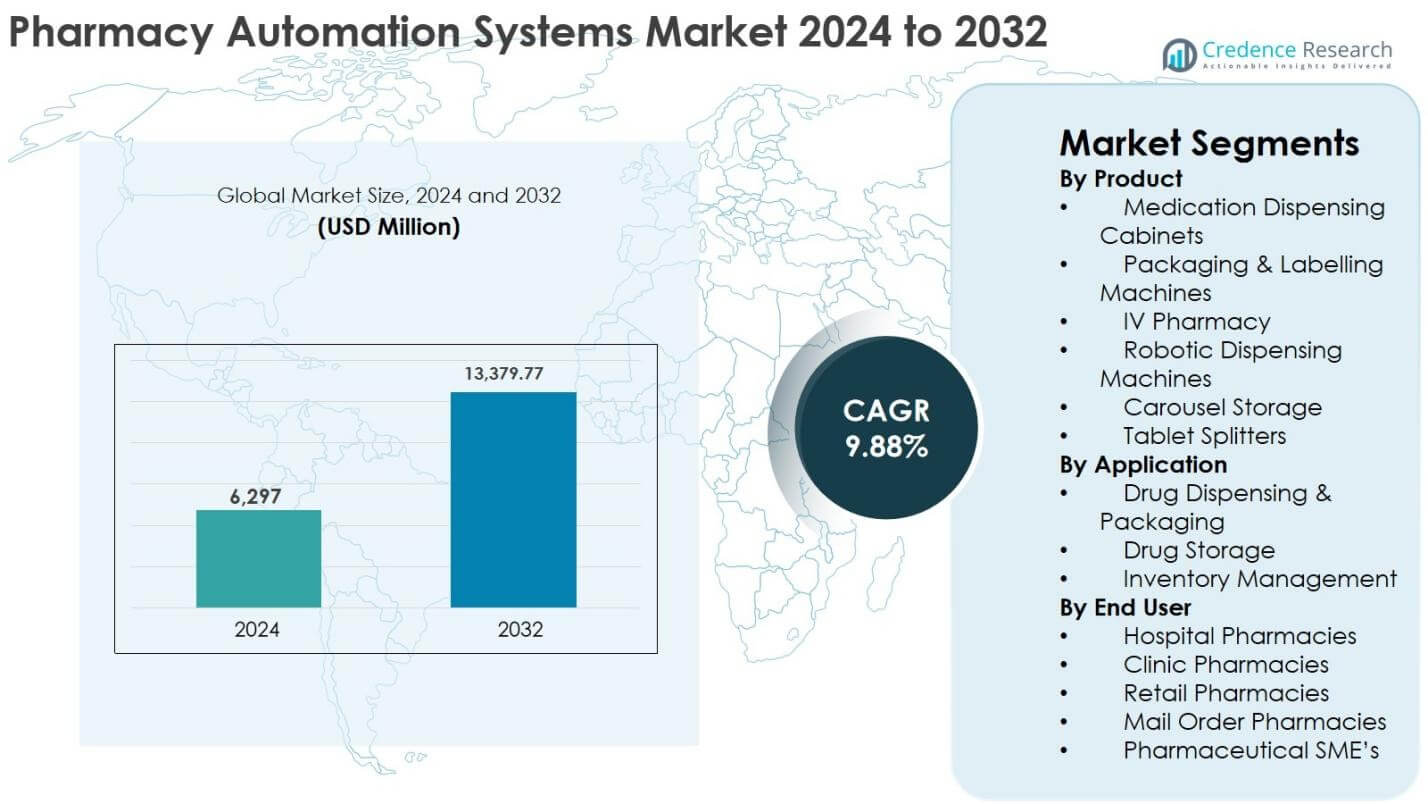
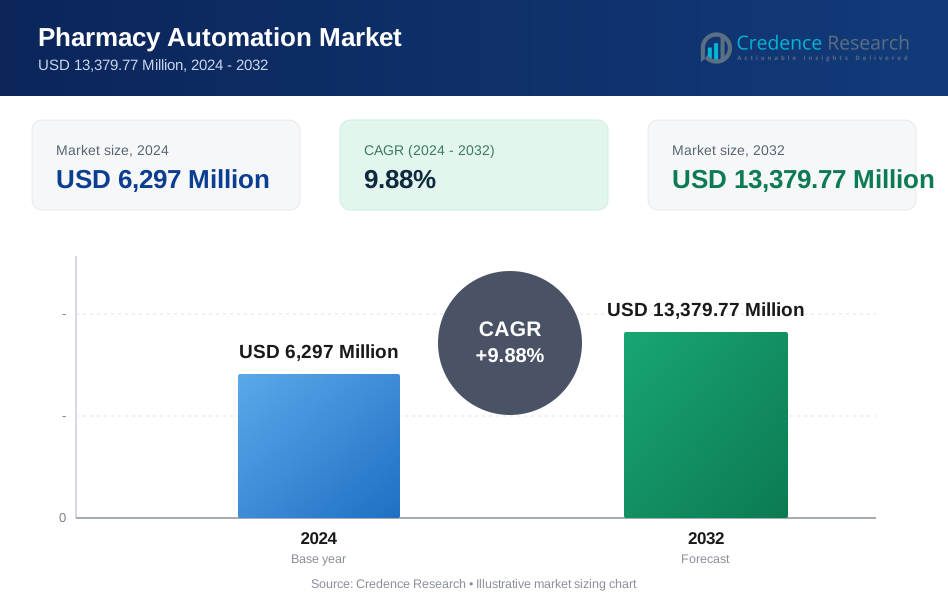
Pharmacy Automation Systems Market size was valued at USD 6,297 Million in 2024 and is anticipated to reach USD 13,379.77 Million by 2032, growing at a CAGR of 9.88% during the forecast period.
| REPORT ATTRIBUTE | DETAILS |
|---|---|
| Historical Period | 2020-2023 |
| Base Year | 2024 |
| Forecast Period | 2025-2032 |
| Pharmacy Automation Market Size 2024 | USD 6,297 million |
| Pharmacy Automation Market, CAGR | 9.88% |
| Pharmacy Automation Market Size 2032 | USD 13,379.77 million |
Pharmacy Automation Market Insights
- Market overview: Demand is increasing due to rising prescription volumes, growing focus on medication accuracy, and the shift toward digital and automated pharmacy workflows across hospitals, clinics, and retail pharmacies, supporting improved efficiency and patient safety.
- Markets driver: The dominant product segment is medication dispensing cabinets with a 32.6% share in 2024, driven by their role in reducing medication errors, enhancing workflow speed, and integrating with barcode and electronic health record systems.
- Markets trends and competitive analysis: Key players such as Omnicell, ScriptPro, Swisslog, Baxter, and McKesson are expanding AI-enabled robotic dispensing, cloud-based analytics, and modular automation platforms to strengthen scalability and interoperability across multisite healthcare networks.
- Markets restraints and regional analysis: High implementation costs and system integration challenges limit adoption in small facilities, while regionally North America leads with 36.8% share in 2024, followed by Europe at 28.4% and Asia-Pacific at 23.6%, reflecting varying levels of healthcare automation maturity.
Pharmacy Automation Market Segmentation Analysis:
By Product
The Pharmacy Automation Systems market by product is led by medication dispensing cabinets, which accounted for 32.6% share in 2024, making them the dominant sub-segment due to their role in improving accuracy, reducing medication errors, and enhancing nursing workflow efficiency. Strong adoption across hospital and clinic pharmacies is driven by growing demand for safer medication management and integration with electronic health records and barcode verification systems. Other key product categories such as robotic dispensing machines, IV pharmacy systems, packaging and labelling machines, carousel storage units, and tablet splitters are gaining traction as healthcare facilities increasingly prioritize automation to improve throughput and inventory control.
- For instance, Omnicell’s XT Automated Dispensing Cabinets are deployed in health systems such as UPMC to support closed-loop medication management and barcode verification at the point of care
By Application
Based on application, drug dispensing and packaging emerged as the dominant sub-segment with a 41.3% share in 2024, supported by rising prescription volumes, the need to minimize manual handling, and the push toward standardized, compliant dispensing processes. Pharmacy automation systems deployed in this segment help reduce turnaround time, prevent dispensing errors, and streamline high-volume medication workflows. Drug storage and inventory management applications are also expanding steadily as hospitals and retail chains adopt automated storage and real-time tracking solutions to reduce stock-outs, enhance expiry management, and optimize medication inventory costs across distributed pharmacy networks.
- For instance, CVS Health uses large-scale automated dispensing and packaging systems in its mail service and specialty pharmacies to fill and check millions of prescriptions annually with barcode verification and image-based inspection.
By End User
By end user, hospital pharmacies held the largest share at 38.9% in 2024, making them the dominant segment as large healthcare institutions increasingly invest in automation to improve patient safety, enhance medication traceability, and support centralized pharmacy operations. Strong drivers include rising inpatient medication demand, integration of automated dispensing with clinical decision-support systems, and regulatory emphasis on medication administration accuracy. Clinic pharmacies, retail pharmacies, mail-order pharmacies, and pharmaceutical SMEs are also accelerating adoption as they seek to improve workflow efficiency, reduce labour dependency, and support scalable prescription fulfilment models.
Key Growth Drivers
Rising Need for Error Reduction and Workflow Efficiency in Medication Management
The Pharmacy Automation Systems market is experiencing strong growth as healthcare providers increasingly prioritize patient safety, medication accuracy, and operational efficiency. Automation technologies significantly reduce human error in dispensing, packaging, and inventory management, which is critical as prescription volumes rise and hospital workflow complexity increases. Automated dispensing and verification systems enhance dosage accuracy, reduce adverse drug events, and support compliance with medication safety regulations. At the same time, healthcare institutions benefit from faster turnaround times, optimized staffing, and improved pharmacy productivity. Integration with electronic health records, barcode scanning, and clinical decision-support platforms further strengthens medication traceability and accountability. As hospitals and retail pharmacies move toward digitized and data-driven medication workflows, the role of automation expands from a support function to a strategic infrastructure investment, accelerating adoption across both developed and emerging healthcare markets.
- For instance, the Institute of Medicine has estimated that medication errors harm at least 1.5 million people annually in the U.S., prompting hospitals to adopt automated dispensing and verification technologies to improve safety.
Growing Demand for Centralized and Decentralized Pharmacy Operations
A major growth driver for the Pharmacy Automation Systems market is the increasing adoption of centralized and decentralized pharmacy models to improve medication distribution efficiency across healthcare networks. Centralized compounding, packaging, and inventory hubs rely on automation to manage high-volume operations, reduce labour dependency, and support standardized medication preparation. At the same time, decentralized automated dispensing units in patient care areas enable faster medication access and reduce pharmacist workload. This dual-model approach improves cost control, strengthens supply-chain transparency, and enhances medication traceability across hospitals, clinics, and retail chains. The expansion of outpatient care, specialty pharmacies, and mail-order prescription services further reinforces the need for scalable automation platforms. As healthcare systems modernize infrastructure to support multi-location operations and tele-pharmacy services, automation becomes essential for maintaining consistency, efficiency, and service quality across distributed pharmacy environments.
- For instance, CVS Health and Walgreens operate large, automated central-fill facilities that process and package high prescription volumes for multiple retail locations, helping standardize dispensing and reduce in-store workload.
Technological Advancements and Integration with Digital Health Ecosystems
Technological innovation is a key driver accelerating market expansion, as pharmacy automation solutions increasingly integrate with digital health ecosystems, analytics platforms, and cloud-based management systems. AI-enabled robotic dispensing, automated storage, and smart inventory solutions support predictive supply planning and real-time medication tracking. Advanced IV compounding systems and robotic filling technologies are improving sterility assurance and production precision in hospital pharmacies. Meanwhile, interoperability with hospital information systems, prescription management software, and e-prescribing platforms enhances workflow coordination and data accuracy. Automation vendors are also introducing modular, configurable systems to meet varied pharmacy footprints and budget levels. These advancements not only improve clinical and operational outcomes but also strengthen return on investment for healthcare providers. As digital transformation accelerates across healthcare, technology-enabled pharmacy automation is increasingly viewed as a strategic enabler of modern, data-driven medication management.
Key Trends & Opportunities
Expansion of Retail, Specialty, and Mail-Order Pharmacy Automation
A major trend shaping the Pharmacy Automation Systems market is the rapid expansion of automation adoption in retail, specialty, and mail-order pharmacy environments. Rising chronic disease prevalence, subscription-based medication programs, and home-delivery models are increasing prescription handling complexity and driving demand for high-throughput automated dispensing and packaging systems. Retail chains are investing in smart storage, automated counting, and workflow optimization tools to reduce wait times and improve service consistency. Specialty pharmacies benefit from automation-enabled traceability and cold-chain monitoring, particularly for high-value biologics and oncology medications. Mail-order facilities increasingly depend on robotic dispensing, automated labelling, and centralized inventory analytics to manage large-scale fulfillment operations. This shift creates significant opportunities for technology providers offering scalable, cloud-integrated, and regulatory-compliant automation platforms tailored to evolving pharmacy retail ecosystems.
- For instance, many U.S. community pharmacies use automated tablet counters such as the Kirby Lester line (now part of Capsa Healthcare) to improve accuracy and speed in daily dispensing while integrating with pharmacy management systems.
Adoption of Data-Driven and AI-Enabled Pharmacy Operations
Another key trend and opportunity lies in the transition toward analytics-driven and AI-enabled pharmacy automation systems that support smarter decision-making and operational optimization. Intelligent inventory forecasting, automated replenishment, and predictive maintenance tools help reduce waste, prevent stock-outs, and improve medication availability. AI-assisted verification and image-recognition technologies are enhancing quality control in dispensing and compounding processes. Cloud connectivity enables real-time performance monitoring across multi-site pharmacy networks, supporting benchmarking and centralized oversight. These capabilities create value beyond basic automation by enabling continuous process improvement and strategic resource planning. As healthcare institutions seek greater transparency, efficiency, and data integration, vendors offering AI-driven workflow intelligence, interoperability features, and automation-as-a-service business models are well-positioned to capture emerging market opportunities.
- For instance, Omnicell’s cloud-based medication management platform uses analytics to optimize cabinet stocking and refills, helping health systems reduce inventory carrying costs and out-of-stock events.
Key Challenges
High Implementation Costs and Infrastructure Complexity
Despite strong growth potential, the Pharmacy Automation Systems market faces challenges related to high capital investment requirements and infrastructure complexity, particularly for hospitals and pharmacies in cost-sensitive environments. Large-scale automation deployments require significant upfront spending on hardware, software integration, facility modifications, and staff training. Smaller clinics, independent pharmacies, and low-resource healthcare settings may struggle to justify investment without clear financial returns. Additionally, integrating automation with legacy IT systems, EHR platforms, and supply-chain software can create technical barriers and extend implementation timelines. Ongoing maintenance, calibration, and cybersecurity management further add to ownership costs. These financial and operational constraints can slow adoption, especially in emerging markets and small-to-mid-size pharmacy environments.
Workforce Adaptation, Regulatory Compliance, and Operational Risks
Another major challenge involves workforce adaptation, regulatory compliance, and operational risk management associated with automation deployment. Transitioning from manual to automated workflows requires cultural change, specialized training, and adjustments in clinical responsibility distribution between pharmacists and technicians. Any system malfunction, programming error, or improper configuration can introduce new types of operational risks, including medication delays or process bottlenecks. Strict regulatory and safety standards governing sterile compounding, medication handling, and data security also require continuous system validation and audit readiness. Pharmacies must balance automation benefits with human oversight to ensure safety, accountability, and ethical use of technology. These organizational and regulatory complexities may slow implementation maturity and require structured change-management strategies to achieve successful, sustainable automation adoption.
Regional Analysis
North America
North America held the largest share of the Pharmacy Automation Systems market in 2024, accounting for 36.8% of global revenue, driven by advanced healthcare infrastructure, strong hospital automation investments, and widespread adoption of electronic prescribing and medication safety standards. High prescription volumes, workforce shortages, and regulatory emphasis on error prevention are accelerating deployment of automated dispensing, packaging, and inventory systems across hospitals, retail chains, and mail-order pharmacies. The United States leads regional growth due to mature digital health ecosystems and strong R&D activity, while Canada is expanding adoption through modernization initiatives in public and private healthcare networks.
Europe
Europe accounted for 28.4% share of the Pharmacy Automation Systems market in 2024, supported by robust pharmaceutical regulation, strong patient safety frameworks, and increasing automation integration across hospital and community pharmacy settings. Countries such as Germany, the United Kingdom, France, and the Nordics are leading adoption through centralized medication management programs and technology-enabled hospital workflows. Growth is further reinforced by the expansion of outpatient care, aging populations, and rising demand for efficient prescription fulfillment. Investment focus remains on robotic dispensing, automated storage, and sterile compounding solutions, alongside interoperability with national healthcare information systems to enhance operational transparency.
Asia-Pacific
Asia-Pacific captured 23.6% share of the Pharmacy Automation Systems market in 2024 and represents the fastest-growing region, driven by rapid healthcare digitalization, rising hospital capacity, and expanding retail and mail-order pharmacy networks. Countries such as China, Japan, India, South Korea, and Australia are increasingly adopting automated dispensing and inventory technologies to manage high patient volumes and address medication safety challenges. Government investment in smart hospital initiatives and pharmaceutical supply-chain modernization is also accelerating demand. Growing chronic disease prevalence and urbanization are encouraging scalable, high-throughput automation deployments across both public and private healthcare settings across the region.
Latin America
Latin America accounted for 6.5% share of the Pharmacy Automation Systems market in 2024, with growth supported by gradual modernization of hospital pharmacies, rising adoption of digital prescription systems, and increasing investments from private healthcare providers. Brazil, Mexico, Chile, and Colombia are leading deployments, particularly in large urban hospitals and emerging retail pharmacy chains seeking workflow efficiency and inventory control. Although budget constraints limit large-scale implementations, pilot programs in automated dispensing, barcode verification, and storage automation are expanding steadily. Growing awareness of medication error reduction and supply-chain transparency is expected to support sustained market penetration across the region.
Middle East & Africa
The Middle East & Africa region held a 4.7% share of the Pharmacy Automation Systems market in 2024, characterized by selective but rapidly increasing adoption in technologically advanced healthcare hubs such as the UAE, Saudi Arabia, and Qatar. Investments in smart hospitals, specialty care centers, and digital health infrastructure are driving demand for automated dispensing, IV compounding, and centralized pharmacy systems. In Africa, adoption remains limited but is gradually expanding in private hospital groups and international healthcare networks. Increasing focus on patient safety, workforce optimization, and medication traceability is expected to create long-term growth opportunities across the region.
Pharmacy Automation Market Segmentations:
By Product
- Medication Dispensing Cabinets
- Packaging & Labelling Machines
- IV Pharmacy
- Robotic Dispensing Machines
- Carousel Storage
- Tablet Splitters
By Application
- Drug Dispensing & Packaging
- Drug Storage
- Inventory Management
By End User
- Hospital Pharmacies
- Clinic Pharmacies
- Retail Pharmacies
- Mail Order Pharmacies
- Pharmaceutical SME’s
By Geography
- North America
- U.S.
- Canada
- Mexico
- Europe
- Germany
- France
- U.K.
- Italy
- Spain
- Rest of Europe
- Asia Pacific
- China
- Japan
- India
- South Korea
- South-east Asia
- Rest of Asia Pacific
- Latin America
- Brazil
- Argentina
- Rest of Latin America
- Middle East & Africa
- GCC Countries
- South Africa
- Rest of the Middle East and Africa
Competitive Landscape
The Pharmacy Automation Systems market is characterized by the presence of several established global players that focus on technology innovation, workflow integration, and strategic partnerships to strengthen their competitive positioning. Companies such as Omnicell Inc., ScriptPro LLC, Swisslog Holdings AG, Baxter International Inc., Cerner Corporation, AmerisourceBergen Corporation, CareFusion Corporation, Kirby Lester LLC, Talyst LLC, and McKesson Corporation play a dominant role through extensive product portfolios spanning automated dispensing cabinets, robotic dispensing systems, packaging and labeling solutions, IV compounding technologies, and smart inventory management platforms. Market competition is driven by advancements in AI-enabled automation, interoperability with hospital information systems, and modular, scalable product architectures tailored for multisite healthcare environments. Vendors are increasingly investing in cloud-based analytics, remote monitoring, and cybersecurity capabilities to enhance system reliability and value proposition. Strategic mergers, regional expansion, and long-term hospital network contracts further support market consolidation, while emerging players compete by offering niche automation solutions and cost-effective deployment models.
Key Player Analysis
- ScriptPro LLC
- Cerner Corporation
- Omnicell Inc.
- Talyst, LLC.
- Baxter International Inc.
- Kirby Lester LLC
- Swisslog Holdings AG
- CareFusion Corporation
- AmerisourceBergen Corporation
- McKesson Corporation
Recent Developments
- In October 2025, MedPal AI plc completed the acquisition of assets from Universal Pharmacy Ltd, expanding its assets and capabilities which can support automated pharmacy services.
- In September 2025, BD (Becton, Dickinson and Company) announced a pharmacy automation partnership with Henry Ford Health to integrate the BD Rowa™ Vmax robotic automation solution into Henry Ford Health’s pharmacy operations to enhance medication storage and prescription retrieval processes.
- In April 2025, VusionGroup partnered with leading pharmacy chain Dr. Max for advanced store digitalization across Europe, enhancing pharmacy automation and digital in-store workflows.
Report Coverage
The research report offers an in-depth analysis based on Product, Application, End-User and Geography. It details leading market players, providing an overview of their business, product offerings, investments, revenue streams, and key applications. Additionally, the report includes insights into the competitive environment, SWOT analysis, current market trends, as well as the primary drivers and constraints. Furthermore, it discusses various factors that have driven market expansion in recent years. The report also explores market dynamics, regulatory scenarios, and technological advancements that are shaping the industry. It assesses the impact of external factors and global economic changes on market growth. Lastly, it provides strategic recommendations for new entrants and established companies to navigate the complexities of the market.
Future Outlook
- The market will witness increasing adoption of automation across hospital, retail, and mail-order pharmacies to improve accuracy, workflow efficiency, and medication safety.
- Vendors will integrate AI, analytics, and cloud-based platforms to enable smarter dispensing, predictive inventory planning, and real-time operational monitoring.
- Pharmacy automation will expand further into decentralized care settings, outpatient facilities, and specialty pharmacies to support high-volume and complex prescription handling.
- Robotic dispensing and IV compounding technologies will gain stronger traction as healthcare providers prioritize sterility, precision, and standardized medication preparation.
- Interoperability with electronic health records, e-prescribing systems, and digital health platforms will continue to strengthen data connectivity and traceability.
- Workforce shortages in pharmacy operations will accelerate investment in automated workflows to reduce manual dependency and optimize staffing efficiency.
- Cybersecurity, system reliability, and regulatory compliance will become critical focus areas as automation systems become more network-integrated.
- Emerging markets will increasingly adopt automation as healthcare infrastructure modernizes and digital transformation initiatives expand.
- Vendors will emphasize modular, scalable, and cost-efficient automation models to support small and mid-size healthcare facilities.
- The market will see continued consolidation through partnerships, technology collaborations, and long-term service agreements among leading industry players.
Request a Free Sample
Fill in your details and we'll send you a free sample report.
- Sample data tables & charts
- Research methodology
Need a Custom Version of This Report?
Tailor the scope, geography, or segments to your exact requirements.
- Custom geography or segment scope
- Direct access to our analyst team
Frequently Asked Questions
What is the current market size for the Pharmacy Automation Systems Market, and what is its projected size in 2032?
At what Compound Annual Growth Rate is the Pharmacy Automation Systems Market projected to grow between 2024 and 2032?
Which Pharmacy Automation Systems Market segment held the largest share in 2024?
What are the primary factors fueling the growth of the Pharmacy Automation Systems Market?
Who are the leading companies in the Pharmacy Automation Systems Market?
Which region commanded the largest share of the Pharmacy Automation Systems Market in 2024?
Table of Content
Chapter 1. Report Introduction
- 1.1 Report Description & Purpose
- 1.1.1 Report Title & Market Definition
- 1.1.2 Unique Selling Propositions (USP) & Key Differentiators
- 1.1.3 Value Proposition for Stakeholders
- 1.2 Research Objectives
- 1.2.1 Market Sizing Objectives (Volume & Revenue)
- 1.2.2 Segmentation Objectives
- 1.2.3 Competitive Intelligence Objectives
- 1.2.4 Forecast & Scenario Objectives
- 1.3 Report Scope
- 1.3.1 Pharmacy Automation Scope – Types & Subtypes Covered
- 1.3.2 Geographic Scope – Regions & Countries Covered
- 1.3.3 Historical Period, Base Year & Forecast Period (2024; forecast to 2032)
- 1.3.4 Inclusions & Exclusions
- 1.4 HS Code & Classification Framework
- 1.5 Currency, Units & Pricing Basis
- 1.6 Target Stakeholders
- 1.7 Limitations & Assumptions
Chapter 2. Executive Summary
- 2.1 Global Pharmacy Automation Market Snapshot
- 2.1.1 Market Size – Historical (2024) & Forecast (2024-2032) (2024: USD 6,297 Million → 2032: USD 13,379.77 Million)
- 2.1.2 Volume & Revenue – Global Totals
- 2.1.3 Key Market Highlights – Top Five Facts
- 2.2 Pharmacy Automation Market Segmentation Snapshot
- 2.2.1 Market Split by Region – 2024 vs. 2032
- 2.3 Competitive Snapshot
- 2.3.1 Top 10 Players by Revenue Share – 2024
- 2.3.2 Top 10 Players by Volume Share – 2024
- 2.3.3 Recent Strategic Developments (18-Month Summary)
- 2.4 Key Investment Highlights & Strategic Conclusions
Chapter 3. Pharmacy Automation Market Dynamics & Industry Analysis
- 3.1 Market Overview & Context
- 3.1.1 Pharmacy Automation Market Position in the Broader Automotive Value Chain
- 3.1.2 OEM vs. Replacement Market Dynamics
- 3.1.3 Market Maturity & Development Stage by Region
- 3.2 Pharmacy Automation Market Drivers
- 3.3 Pharmacy Automation Market Restraints & Challenges
- 3.4 Pharmacy Automation Market Opportunities
- 3.5 Porter's Five Forces Analysis
- 3.5.1 Threat of New Entrants
- 3.5.2 Bargaining Power of Suppliers
- 3.5.3 Bargaining Power of Buyers
- 3.5.4 Threat of Substitutes
- 3.5.5 Competitive Rivalry – Intensity Assessment
- 3.6 Pharmacy Automation Value Chain Analysis
- 3.6.1 Upstream – Raw Material/Input Suppliers
- 3.6.1.1 Raw Material/Input 1
- 3.6.1.2 Raw Material/Input 2
- 3.6.1.3 Raw Material/Input 3
- 3.6.2 Midstream – Production/Manufacturing/Service Delivery
- 3.6.2.1 Production/Process Overview
- 3.6.2.2 Key Facility Locations & Capacity by Manufacturer
- 3.6.3 Downstream – Distribution & End Consumer
- 3.6.3.1 Primary Channel – B2B/OEM
- 3.6.3.2 Secondary Channels – Dealer, Retail, Online, Direct
- 3.6.4 Value Chain Profitability Analysis
- 3.6.1 Upstream – Raw Material/Input Suppliers
- 3.7 PESTEL Analysis
- 3.7.1 Political Factors
- 3.7.2 Economic Factors
- 3.7.3 Social Factors
- 3.7.4 Technological Factors
- 3.7.5 Environmental Factors
- 3.7.6 Legal Factors
- 3.8 Pharmacy Automation Supply Chain Analysis
- 3.8.1 Raw Material/Input Supply Risk Assessment
- 3.8.2 Manufacturing Concentration Risk (Geographic Exposure)
- 3.8.3 Trade Disruption Impact Analysis
- 3.9 Regulatory & Policy Landscape
Note: The regulatory and policy landscape section covers regulations based on their applicability to the market, Pharmacy Automation category, geography, and scope of the study. Only regulatory frameworks with a material impact on operations, compliance, trade, sustainability, or market access are analyzed in detail.
Chapter 4. Key Investment Pockets & Opportunity Analysis
- 4.1 Pharmacy Automation Market Attractiveness Analysis
- 4.1.1 By Region – Investment Attractiveness Matrix (Volume × CAGR)
- 4.2 Absolute Revenue Growth Opportunity
- 4.2.1 By Region – Absolute USD Growth Through 2032
- 4.3 Incremental Volume Opportunity
- 4.3.1 By Region – Incremental Volume Through 2032
- 4.3.2 Segment – Incremental Volume
- 4.4 Emerging Submarket Opportunity Deep Dive (Subject to Applicability)
- 4.5 Emerging Market Opportunity Scorecards
- 4.5.1 United States
- 4.5.2 Europe
- 4.5.3 Asia
- 4.5.4 Middle East & Africa
Note: Emerging Market Opportunity Scorecards will be included based on relevance and strategic importance. Regions listed are indicative and may vary depending on data availability and market dynamics.
Chapter 5. Pharmacy Automation Import-Export Analysis & Trade Flows
- 5.1 Global Trade Overview
- 5.1.1 Global Export Value by Country (2024)
- 5.1.2 Global Export Volume by Country (2024)
- 5.1.3 Global Import Value by Country (2024)
- 5.1.4 Global Import Volume by Country (2024)
- 5.1.5 Net Trade Balance by Country (2024)
- 5.2 Export Analysis – Segment
- 5.2.1 Type 1 (HS Code)
- 5.2.2 Type 2 (HS Code)
- 5.2.3 Type 3 (HS Code)
- 5.2.4 Type 4 (HS Code)
- 5.2.5 Type 5 (HS Code)
- 5.3 Import Analysis – Segment
- 5.3.1 Type 1 (HS Code)
- 5.3.2 Type 2 (HS Code)
- 5.3.3 Type 3 (HS Code)
- 5.3.4 Type 4 (HS Code)
- 5.3.5 Type 5 (HS Code)
- 5.4 Average Unit Trade Prices
- 5.4.1 Average Export Price – Segment & Country
- 5.4.2 Average Import Price – Segment & Source Country
- 5.4.3 Price Trends (2024)
- 5.5 Key Trade Route Analysis
- 5.5.1 Trade Route 1
- 5.5.2 Trade Route 2
- 5.5.3 Trade Route 3
- 5.5.4 Trade Route 4
- 5.5.5 Trade Route 5
- 5.6 Trade Policy Impact Assessment
- 5.6.1 US Anti-Dumping & Section 301 Tariffs
- 5.6.2 EU Customs Union Impact
- 5.6.3 Major Free Trade Agreements
- 5.6.4 USMCA Rules of Origin
Note: Trade policy analysis will be included only where relevant to the Pharmacy Automation market.
Chapter 6. Competitive Landscape & Company Benchmarking
- 6.1 Pharmacy Automation Market Concentration & Structure
- 6.1.1 Herfindahl-Hirschman Index (HHI) – vs. 2024
- 6.1.2 Tier 1, Tier 2 & Tier 3 Market Structure
- 6.1.3 Global, Regional & Local Player Dynamics
- 6.2 Pharmacy Automation Market Share Analysis – 2024
- 6.2.1 Global Revenue Share by Company
- 6.2.2 Global Volume Share by Company
- 6.2.3 Regional Revenue Share
- 6.2.4 Market Share Evolution ( vs. 2024)
- 6.2.5 OEM Segment Share by Company
- 6.2.6 Replacement Segment Share by Company
- 6.3 Production/Delivery Capacity & Facility Analysis
- 6.3.1 Global Installed Capacity
- 6.3.2 Capacity Utilization Rates
- 6.3.3 Production/Output Volume
- 6.3.4 Facility Locations & Capacity Map
- 6.3.5 Planned Capacity Additions
- 6.4 Pharmacy Automation Competitive Benchmarking Matrix
- 6.4.1 Revenue, Volume, CAGR & Profitability Comparison
- 6.4.2 Channel Revenue Mix
- 6.4.3 Geographic Revenue Exposure
- 6.4.4 R&D Intensity
- 6.4.5 Sustainability Maturity
- 6.5 Strategic Developments in Pharmacy Automation (Last 24 Months)
- 6.5.1 Mergers, Acquisitions & Divestments
- 6.5.2 New Pharmacy Automation Launches
- 6.5.3 Facility Expansions
- 6.5.4 Strategic Alliances, Joint Ventures & Partnerships
- 6.5.5 Distribution Expansion & Market Entry
- 6.5.6 Sustainability & ESG Initiatives
- 6.6 Competitive Strategy Mapping
- 6.6.1 Leader, Challenger, Follower & Niche Classification
- 6.6.2 Pricing Strategy Comparison
- 6.6.3 Channel Strategy Matrix
Note: Strategic developments are included based on their materiality and the availability of reliable information.
Chapter 7. Global Pharmacy Automation Market – By Distribution Channel
- 7.1 Segment Overview
- 7.1.1 Volume & Revenue Split by Channel (2024 & 2032)
- 7.1.2 Channel Mix Evolution (2024-2032)
Chapter 8. Regional Market Analysis – Global Overview
- 8.1 Global Regional Overview
- 8.1.1 Regional Volume Share
- 8.1.2 Regional Revenue Share
- 8.1.3 Regional Volume by Region
- 8.1.4 Regional Revenue by Region
- 8.1.5 Regional Forecast Through 2032
- 8.2 Cross-Regional Segment Analysis
- 8.2.1 By Distribution Channel
- 8.2.2 By Brand/Price Tier
Chapter 9. North America Pharmacy Automation Market
- 9.1 United States
- 9.2 Canada
- 9.3 Mexico
Chapter 10. Europe Pharmacy Automation Market
- 10.1 Germany
- 10.2 France
- 10.3 Italy
- 10.4 United Kingdom
- 10.5 Spain
- 10.6 Poland
- 10.7 Russia
- 10.8 Netherlands
- 10.9 Belgium
- 10.10 Sweden
- 10.11 Denmark
- 10.12 Norway
- 10.13 Rest of Europe
Chapter 11. Asia Pacific Pharmacy Automation Market
- 11.1 China
- 11.2 India
- 11.3 Japan
- 11.4 South Korea
- 11.5 Thailand
- 11.6 Indonesia
- 11.7 Vietnam
- 11.8 Malaysia
- 11.9 Australia
- 11.10 Rest of Asia Pacific
Chapter 12. Latin America Pharmacy Automation Market
- 12.1 Brazil
- 12.2 Argentina
- 12.3 Colombia
- 12.4 Chile
- 12.5 Rest of Latin America
Chapter 13. Middle East Pharmacy Automation Market
- 13.1 Saudi Arabia
- 13.2 United Arab Emirates
- 13.3 Turkey
- 13.4 Israel
- 13.5 Iran
- 13.6 Rest of the Middle East
Chapter 14. Africa Pharmacy Automation Market
- 14.1 South Africa
- 14.2 Egypt
- 14.3 Nigeria
- 14.4 Morocco
- 14.5 Rest of Africa
Chapter 15. Pharmacy Automation Company Profiles
- 15.1 [Company 01]
- 15.1.1 Company Overview
- 15.1.2 Key Management Personnel
- 15.1.3 Products & Services Portfolio
- 15.1.4 Financial Performance
- 15.1.5 Key Market Focus & Geographic Presence
- 15.1.6 Recent Developments & Strategic Initiatives
Note: The company profile list is preliminary and may change based on research findings, market developments, data availability, and client requirements.
Chapter 16. Appendices
- Appendix A – List of Abbreviations & Acronyms
- Appendix B – Industry Classification Code Reference – Full Series
- Appendix C – Production & Capacity Data Tables
- Appendix D – End-Use & Demand Base Tables
- Appendix E – Consumption & Replacement Rate Assumptions
- Appendix F – ASP Reference Tables
- Appendix G – Manufacturing & Facility Database
- Appendix H – Import-Export Data Tables
- Appendix I – Regulatory Summary Tables
- Appendix J – Primary Research Participant List (Anonymized)
- Appendix K – Primary Research Questionnaire Framework
- Appendix L – Data Sources & Bibliography
- Appendix M – Market Size Divergence & Source Comparison
Chapter 17. Research Methodology
- 17.1 Research Framework & Philosophy
- 17.2 Secondary Research – Sources, Hierarchy & Data Extraction
- 17.3 Data Modeling – Bottom-Up & Top-Down Market Sizing
- 17.4 Primary Research – Stakeholder Framework, LOI & Sample Sizes
- 17.5 Forecast Methodology – Regression, Scenario & Sensitivity Analysis
- 17.6 Quality Control – Four-Layer Validation Framework
- 17.7 Limitations & Standard Assumptions
- 17.8 Disclaimer
