
| REPORT ATTRIBUTE | DETAILS |
|---|---|
| Historical Period | 2019-2022 |
| Base Year | 2023 |
| Forecast Period | 2024-2032 |
| Plastic Bags And Sacks Market Size 2023 | USD 1725.8 million |
| Plastic Bags And Sacks Market CAGR | 32.30% |
| Plastic Bags And Sacks Market Size 2032 | USD 21430.34 million |
Market Insights
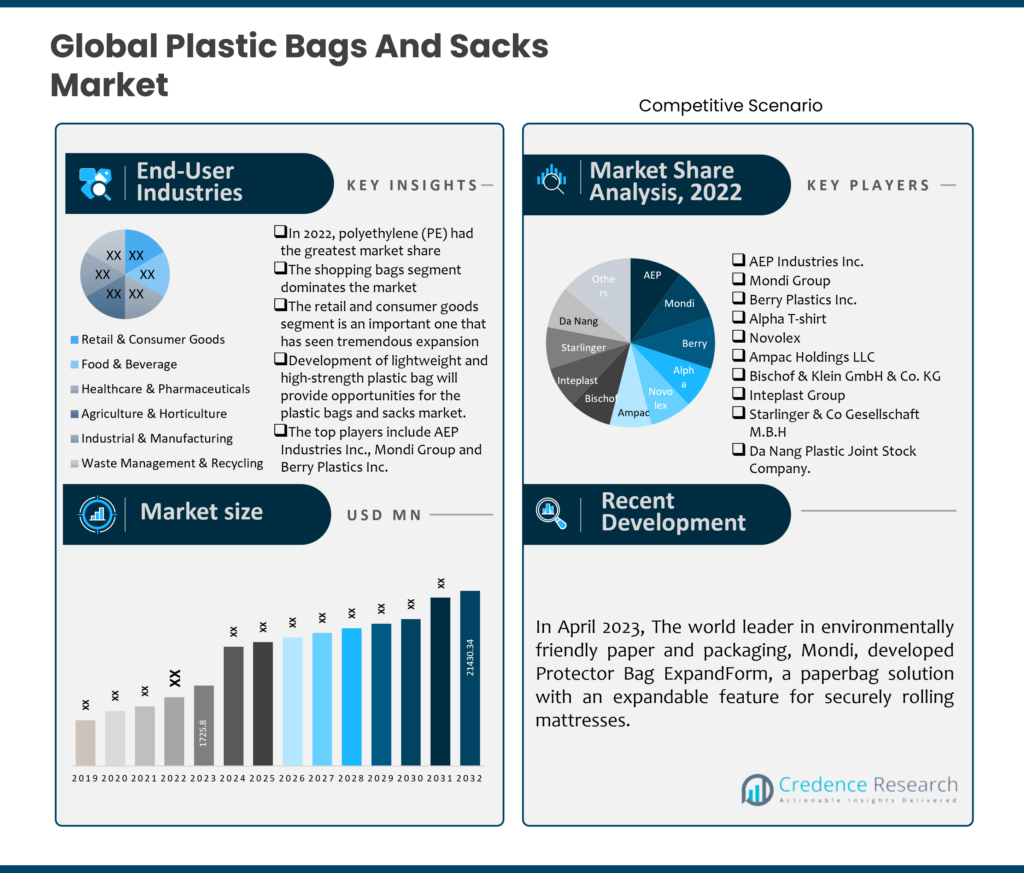
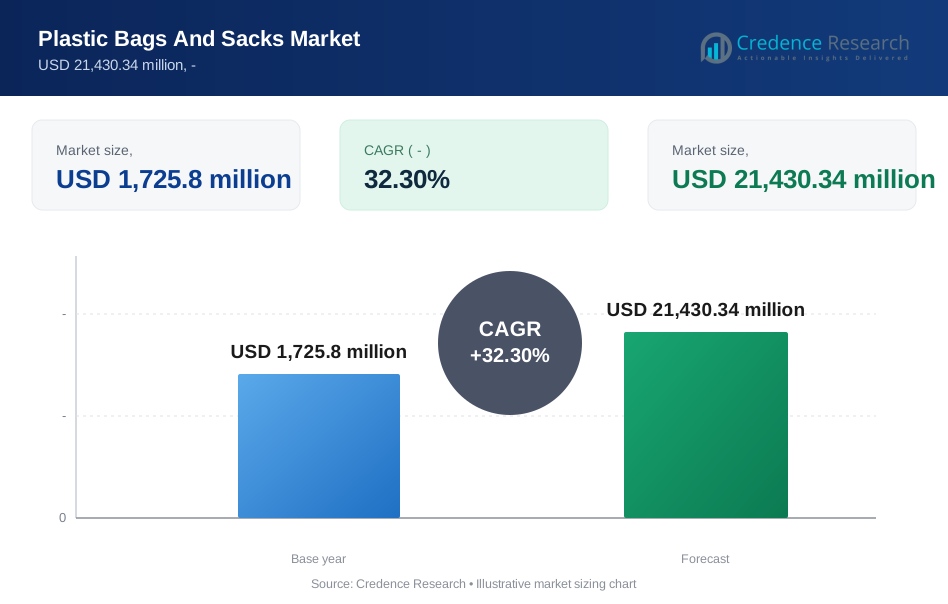
- Between 2024 and 2032, the global market for plastic bags and sacks is projected to rise at a compound annual growth rate (CAGR) of 32.30%, from an estimated USD 1725.8 million in 2023 to USD 21430.34 million in 2032.
- The largest category is polyethylene (PE). Polypropylene (PP), on the other hand, is expected to grow at a strong CAGR.
- The shopping bags category will expand at a rapid rate of growth.
- The CAGR for retail and consumer goods is expected to be the highest during the projection period.
- North America governed the market for plastic bags and sacks.
- Regarding the market share of plastic bags and sacks, Europe is expected to come second.
- In the plastic bags and sacks market, Asia Pacific is anticipated to grow fastest.
- Growth in the retail industry, particularly in emerging markets, and consumer demand for convenient, long-lasting, and lightweight packaging solutions are the main factors driving the development of the global market.
- The plastic bag and sack industry has developed due to the adoption of cutting-edge recycling technologies and the integration of smart packaging technologies, such as RFID tags and sensors, to enable tracking and authentication.
Executive Summary
Market Definition
The market for plastic bags and sacks is the area of the global economy that deals with the manufacture, sale, and distribution of plastic bags and sacks for use in packaging, carrying, and storing products, among other uses. There are many different kinds of plastic bags and sacks available in this market, such as grocery bags, trash bags, food storage bags, industrial packaging sacks, and agricultural bags. It involves players from a variety of industries, including retail, food and beverage, healthcare, agriculture, and manufacturing, as well as manufacturers, suppliers, distributors, retailers, and end users.
Market Overview
The plastic bags and sacks sector is predicted to continue its upward trend between 2024 and 2032, growing at a compound annual growth rate (CAGR) of 32.30%. From its projected USD 1725.8 million in 2023 to USD 21430.34 million in 2032, the market will continue to grow.
One major factor contributing to plastic bags' appeal is their affordability. Companies can choose to save money by using plastic bags because their manufacturing costs are lower than those of alternative materials. Manufacturers can offer more affordable packaging options due to lower production costs, which draws in a variety of businesses looking for packing solutions that are economical. The market is more competitive and continues to grow because of this cost advantage.
Innovation and technological developments also have an impact on the plastic bag and sack market. Plastic bag producers are always coming up with new formulas and techniques to improve the sustainability of their products and their performance. Growing concerns about environmental impact are being addressed by the introduction of bio-based and biodegradable plastics, which also meet the growing demand for more environmentally friendly packaging options. Technological advancements help the market become more flexible and able to adjust to changing customer demands and legal requirements.
Segmentation by Material Type
- The polyethylene (PE) category is the market leader in terms of material type. One of the polymers that is most frequently used in the market for plastic bags and sacks is polyethylene (PE). It is a thermoplastic polymer with a wide range of applications that is made of ethylene monomer units. PE is preferred because of its superior combination of qualities, which include chemical resistance, toughness, flexibility, and comparatively low production costs.
- The polypropylene (PP) category will exhibit a sizable CAGR during the projected period. Polypropylene provides plastic bags and sacks with a number of advantageous properties. It is appropriate for carrying and packing a variety of goods because it is strong, lightweight, and has a good tensile strength. Moreover, PP bags' resistance to abrasion, chemicals, and moisture increases their suitability for a variety of uses.
- Other material types, including polyethylene terephthalate (PET), biodegradable and compostable plastics, and others, also support the need for plastic bags and sacks.
Segmentation by Product Type
- Shopping bags are considered the best product type category. Shopping bags are widely used in retail settings, including convenience stores, grocery stores, supermarkets, and apparel stores. Their essential role in the retail industry is to provide customers with a convenient way to carry their purchases.
- The grocery bags category will likely register a significant CAGR during forecasting. The main purpose of grocery bags is to make grocery transportation convenient. To handle different loads of groceries, from tiny convenience store purchases to big weekly grocery hauls, they are available in a variety of sizes and strengths.
- Other product types, such as retail bags, trash bags, food bags, industrial bags, medical bags, liners and films, and specialty bags, also contribute to the demand for plastic bags and sacks.
Segmentation by End-User Industry
- The retail and consumer goods category is projected to grow faster over the projection period. The manufacturing and distribution of plastic bags and sacks, which are mostly used in the retail sector for packaging and transporting consumer goods, is the primary focus of the retail and consumer goods segment of the plastic bags and sacks market.
- Other end-user industries, including food and beverage, healthcare and pharmaceuticals, agriculture and horticulture, industrial and manufacturing, and waste management and recycling, influence the need for plastic bags and sacks.
Segmentation by Region
- North America leads the plastic bags and sacks industry. This is due to the rise in food delivery services, e-commerce, and the expansion of the building and agricultural sectors throughout the region.
- Europe is estimated to rank second in plastic bags and sacks market size.
- The plastic bags and sacks industry is predicted to flourish rapidly in Asia Pacific.
- The remaining need for plastic bags and sacks is covered by regions including Latin America, Africa, and the Middle East.
The market for plastic bags and sacks is expanding due to consumer demand for food and drink, groceries, and dairy products. Food, drinks, groceries, and dairy products frequently need to be packaged in order to keep them fresh, avoid contamination, and increase their shelf life. Because plastic bags and sacks are affordable, flexible, and long-lasting, they are frequently utilized for this purpose. Fruits, vegetables, snacks, and other grocery items are perfect for packing in plastic bags and sacks because of their portability and ease of use. Plastic bags successfully satisfy the needs of consumers for packaging that is lightweight and convenient to carry. Food products can have their shelf lives extended by using plastic packaging, which acts as a barrier against light, oxygen, and humidity. In order to reduce food intake, this is essential.
Based on projections, North America is anticipated to control the plastic bags and sacks market. Plastic bags and sacks are widely used in the United States as a result of increased consumption by a variety of end users, including commercial, industrial, and other sectors. Nearly one plastic bag per person per day, or over 100 billion bags annually, enter the hands of American consumers, according to the Earth Policy Institute. Furthermore, the nation's fast-paced way of life and the expanding retail industry penetration are contributing to the nation's plastic bag usage. Based on data from MRI Simmons, the average number of consumers using two bags per day in 2020 was 79.93 million, while in 2020, the average consumer used 92.88 million bags per day. In December 2020, Meijer also joined the Beyond the Bag Initiative. Additionally, Meijer launched Woodward Corner Market, its first small-format store, in January 2020 without using single-use plastic bags. Except for customers utilizing the company's Shop & Scan technology and self-checkouts, reusable bags have been restricted due to the coronavirus pandemic.
The market for plastic bags and sacks in Asia Pacific is anticipated to expand quickly throughout the forecast period. With some of the world's most populated countries being China, India, and Indonesia, Asia Pacific has a substantial customer base. The region's fast urbanization has resulted in a rise in the use of plastic sacks and bags for storage, transportation, and shopping. The Indian market for plastic bags and sacks is propelled by the country's increasing urbanization, organized retail expansion, and the expansion of food delivery services. Convenience, affordability, robustness, and the lightweight nature of plastic bags in comparison to alternatives are important motivators. However, some states have implemented partial or complete bans on specific types of plastic bags due to worries about plastic waste and its effects on the environment.
Key Highlights of the Report
The global plastic bags and sacks market is segmented by material type, product type, end-user industry, and region. The polyethylene (PE) category is the market spearhead in terms of material type, and shopping bags are the top product type. The retail and consumer goods category is anticipated to increase at the highest CAGR throughout the projection period. The plastic bags and sacks market is expanding mostly in North America.
Manufacturers' growing emphasis on creating creative plastic bags will support the market's expansion in the near future. For example, Interplast Group unveiled a brand-new, wide range of industrial can liners in May 2022 that are intended for companies and sectors that prioritize environmental sustainability. Available in a broad range of sizes and gauges, the product is perfect for a variety of applications and comes in two types: linear low-density polyethylene (LLDPE) and high-density polyethylene (HDPE).
North America is expected to account for the largest plastic bags and sacks market globally. For a number of reasons, North America is a leader in the plastic bag and sacks market. First of all, it has a strong manufacturing base and cutting-edge technologies that enable mass production. Furthermore, a number of significant companies and raw material suppliers in the plastics sector are based in North America. Within the industry, innovation and efficiency are facilitated by this concentration of knowledge and resources. In addition, North America has more permissive laws and policies governing the production of plastic than some other areas, which may improve the economic climate for plastic producers. It is also anticipated that the market will develop at the fastest rate in the Asia Pacific region. A sizeable amount of the plastic bags and sacks produced in the Asia Pacific region is exported to North America, Europe, and other regions of the world in addition to its domestic market. This export-focused strategy contributes to the industry's increased global prominence and growth.
Which Key Factors Are Driving The Global Plastic Bags And Sacks Market?
The manufacturing sector, the pharmaceutical industry, and the foodservice business are all expanding. There's a growing demand for plastic bags and sacks because of these factors.
What Are The Main Challenges Confronting The Global Plastic Bags And Sacks Market?
The industry's primary problems are the short lifespans of plastic sacks and bags, the rising production costs linked to meeting environmental regulations, and the possible health risks like chemical leaching that come with using plastic bags.
What Market Opportunities Exist For Plastic Bags And Sacks Globally?
The development of lightweight, high-strength plastic bag materials for better performance and cost efficiency, as well as the introduction of smart packaging solutions with interactive features like QR codes and augmented reality, are some of the factors driving the growth of the plastic bags and sacks market.
Market Drivers
Developments in Plastic Bags That are Compostable and Biodegradable
Demand for environmentally friendly alternatives to traditional plastic bags has surged as people become more aware of how damaging they are to the environment. This issue is resolved by biodegradable and compostable plastic bags, which have a smaller environmental impact due to their natural breakdown into their constituent parts. To reduce plastic pollution, governments all over the world are putting strict regulations into place. Plastic bag taxes and bans on single-use plastics are becoming more and more popular. Businesses can still provide convenient packaging options while adhering to regulations by using biodegradable and compostable plastics. Biodegradable and compostable plastics have been developed due to advancements in material science and manufacturing techniques. These materials perform similarly to conventional plastics in terms of strength, durability, and flexibility. This has increased their adoption in a number of industries and supports market expansion.
A lot of companies are aiming to attract environmentally conscious customers and improve their brand image by integrating sustainability goals into their corporate strategies. Making the switch to compostable and biodegradable packaging materials supports these initiatives and encourages the market for eco-friendly alternatives to plastic bags and sacks.
Market Restraints
Bans on Plastic Bags Being Implemented in Large Cities and Municipalities
The demand for plastic bags sharply declines when bans are implemented. The demand for plastic bags is directly impacted by the enactment of bans by large cities and municipalities, as they are significant users of these bags. Further lowering the demand for plastic bags is the shift in consumer behavior toward paper, biodegradable, and reusable bags. The plastic bags & sacks market is uncertain due to the implementation of bans. Because there's a chance that future bans will expand to other areas or that regulations will become more stringent, producers and retailers might be reluctant to invest in making or stocking plastic bags. This unpredictability may result in fewer industry investments and slower market expansion. The imposition of bans encourages creative thinking in substitute packaging options. Producers and business owners put money into creating and marketing environmentally-friendly substitutes, such as reusable bags, bags that decompose, or bags composed of sustainable materials like hemp or cotton. Plastic bags face direct competition from these substitutes, which further reduces their market share.
Opportunities
Technology Integration for Smart Packaging
Products can be tracked in real-time along the entire supply chain with smart packaging. This translates to better inventory management, fewer losses from theft or spoiling, and increased customer transparency for plastic bags & sacks manufacturers. Smart packaging incorporates sensors to keep an eye on variables like pressure, temperature, and humidity to make sure goods are transported and stored in the best possible conditions. This is especially important for perishables like food that are frequently packaged in plastic sacks and bags. Indicators of contamination or tampering can be included in smart packaging, adding an extra degree of security for both producers and consumers. This feature can be a game-changer in sectors like food and pharmaceuticals, where hygiene is crucial.
Smart technology integration can improve recycling and waste management for plastic bags and sacks. To reduce environmental impact and promote a circular economy, RFID (Radio Frequency Identification) tags, for example, can help sort and recycle plastic materials more efficiently.
Competitive Landscape
Key Players
In the highly competitive global plastic bags and sacks market, there are a number of significant rivals. A few of the top market players are shown below, together with their respective market shares:
- AEP Industries Inc.
- Mondi Group
- Berry Plastics Inc.
- Alpha T-shirt
- Novolex
- Ampac Holdings LLC
- Bischof & Klein GmbH & Co. KG
- Inteplast Group
- Starlinger & Co Gesellschaft M.B.H
- Da Nang Plastic Joint Stock Company
- Hanoi Plastic Bag JSC
- Goglio Group
- Schur Flexibles Group
- Others
To stay competitive, these businesses give priority to product innovation, expanding their distribution networks, and completing mergers and acquisitions.
The biggest vendors in the global plastic bags and sacks market consistently strive to keep one step ahead of the competition by creating cutting-edge ideas and goods.
In August 2023, Hefty brought back its exclusive line of trash bags, the Hefty Cinnamon Pumpkin Spice Ultra Strong. These festive-smelling trash bags have a Cinnamon Pumpkin Spice scent and come with features like a secure-fit closure, flex strength, odor control, and resistance to rips, tears, and leaks. The product came in different pack sizes and was sold by a few retailers, such as Walmart and Amazon.
In March 2023, Relaunched by Berry Global, the Green Sack line of garbage sacks is composed of more than 90% recycled post-consumer and agricultural plastic waste. The product line comes in an easier-to-use dispenser box designed for the cleaning, hospitality, and facilities management industries. Applications for the Green Sack range include local government, healthcare, and facilities management. Sacks come in a wide range of sizes and are produced in accordance with the CHSA Refuse Sack Standard. In addition, it is produced at Berry Global's UK facilities using waste from the UK, which helps to conserve resources and minimize landfill waste. It is also stronger, thinner, and more environmentally friendly.
In February 2023, American Electric Power reached a deal to sell its 1,365 megawatts (MW) unregulated, contracted renewables portfolio to CDPQ, Invenergy, and funds managed by Blackstone Infrastructure through a partnership called IRG Acquisition Holdings.
How are Companies Performing in the Plastic Bags and Sacks Market?
The significant performance of companies in the plastic bags and sacks market can be attributed to some noteworthy reasons. Leading companies of plastic bags are concentrating on finding innovations and improvements to remain competitive. To increase their revenue and fortify their position, they are implementing methods like partnerships, acquisitions, price reductions, and mergers. For example, ProAmpac LLC declared in February 2022 that it will acquire Belle-Pak Packaging, a Canadian-based, award-winning flexible packaging manufacturer of plastic medical and clinical bags.
Companies in the plastic bags and sacks market are putting more and more emphasis on implementing recyclable and sustainable packaging techniques. For example, the horticulture industry's first soil packaging constructed entirely of post-consumer recycled (PCR) plastic was introduced in September 2023 by Back to the Roots, an organic gardening firm, in collaboration with ProAmpac, a distributor of flexible packaging. For the 2024 gardening season, Back to the Roots will start using 100% PCR plastic certified under the Global ISCC PLUS program of the Institute of Sustainability and Carbon Certification in the packaging of its best-selling Organic Potting Mix. This year, the entire line of Organic Potting Mix products will have this innovative, sustainable packaging.
Furthermore, ClearBags introduced a new collection of home compostable, child-resistant bags for the pharmaceutical sector in March 2023. These bags are intended to break down in composting environments and are composed of a special combination of ingredients that are suitable for eating. The American Society for Testing and Materials (ASTM) has certified them, and they have a high barrier layer that keeps the contents fresh by shielding them from moisture, air and smells. To ensure safety, bags are equipped with child-resistant zippers that require adult skill to open with two hands. These eco-friendly bags combine performance, kid safety, and sustainability with an interior flap printed with composting instructions.
Summary of Key Findings
- The global market is expanding due to the development of the retail sector, especially in developing nations.
- The market is segmented by material type, product type, end-user industry, and region.
- In the market, polyethylene (PE) is the most widely used material type.
- Shopping bags are the foremost product type category.
- The retail and consumer goods category is expected to grow fastest in terms of CAGR during the forecast period.
- Asia Pacific is leading market development; the market is highly competitive with key players including AEP Industries Inc., Mondi Group, Berry Plastics Inc., Alpha T-shirt, Novolex, Ampac Holdings LLC, Bischof & Klein GmbH & Co. KG, Inteplast Group, Starlinger & Co Gesellschaft M.B.H, Da Nang Plastic Joint Stock Company, Hanoi Plastic Bag JSC, Goglio Group, Schur Flexibles Group, and Others.
Future Outlook
- The plastic bags and sacks industry is expected to increase significantly in Asia Pacific, and its outlook is positive worldwide.
- The growing acceptance of single-use plastic bags in the food delivery industry is driving the global market's expansion.
- The growing use of reusable bags and other greener substitutes may impede the expansion of the market.
- To remain competitive, major corporations must develop new products, expand their customer base, and keep their prices low.
How the Credence Research Plastic Bags And Sacks Market Report Can Help CXOs
The Credence Research Plastic Bags And Sacks Market Report provides CXOs with an extensive market overview and comprises the following:
- Market size and growth forecast: The study offers comprehensive market estimations for plastic bags and sacks globally, broken down by material type, product type, end-user industry, and region. In addition, projections for the market through 2032 based on significant drivers and trends are included.
- Market segmentation: The plastic bags and sacks market is divided into segments by material type, product type, end-user industry, and region in the research report. CXOs are given a detailed grasp of the market and the potential inside each sector due to this segmentation.
- Competitive landscape: The study report provides a thorough analysis of the leading businesses in the plastic bags and sacks sector, together with details on their revenue streams, product lines, and business strategies. This information can help CXOs assess and identify their competitors.
- Key trends and drivers: The study report analyzes and highlights the key developments and elements driving the market for plastic bags and sacks. CXOs can utilize this information to make well-informed choices regarding their plans and investments.
The Credence Research Plastic Bags And Sacks Market Report provides CXOs with insights that they may utilize to:
- Identify growth opportunities: This analysis is likely to help CXOs find fresh growth prospects in the plastic bags and sacks sector. For example, the research recognizes the increasing requirement for plastic bags and sacks from retail and consumer goods as a crucial opportunity.
- Make informed investment decisions: The study aids CXOs in making informed decisions about plastic bags and sacks. For example, it delivers information on the key variables to consider while picking solutions and evaluating suppliers.
- Develop competitive strategies: CXOs can utilize the research report to establish competitive strategies for their plastic bags and sacks firms. The study paper explores the primary tactics employed by plastic bag and sack providers to set themselves apart from their rivals.
- Track market developments: By tracking market advancements, this research report could assist CXOs in remaining ahead of the curve. For example, it provides information about the latest advancements and patterns in the plastic bags and sacks industry.
The Credence Research Plastic Bags And Sacks Market Report is helpful for CXOs who want to learn more about the market and identify potential opportunities.
Segmentation
By Material Type
- Polyethylene (PE)
- High-Density Polyethylene (HDPE)
- Low-Density Polyethylene (LDPE)
- Linear Low-Density Polyethylene (LLDPE)
- Polypropylene (PP)
- Polyethylene Terephthalate (PET)
- Biodegradable and Compostable Plastics
- Others
By Product Type
- Shopping Bags
- Grocery Bags
- Retail Bags
- Trash Bags
- Food Bags
- Produce Bags
- Freezer Bags
- Snack Bags
- Industrial Bags
- Medical Bags
- Liners and Films
- Specialty Bags
By End-User Industry
- Retail and Consumer Goods
- Food and Beverage
- Healthcare and Pharmaceuticals
- Agriculture and Horticulture
- Industrial and Manufacturing
- Waste Management and Recycling
By Region
-
- North America
- The U.S.
- Canada
- Mexico
- Europe
- Germany
- France
- UK.
- Italy
- Spain
- Rest of Europe
- Asia Pacific
- China
- Japan
- India
- South Korea
- South-east Asia
- Rest of Asia Pacific
- Latin America
- Brazil
- Argentina
- Rest of Latin America
- Middle East & Africa
- GCC Countries
- South Africa
- The Rest of the Middle East and Africa
- North America
Adjacent Markets
Several adjacent markets in the plastic bags and sacks market have high revenue growth opportunities. The key adjacent markets for the plastic bags and sacks market -
|
Adjacent Markets |
||
| Flexible Packaging Market | Plastic Packaging Market | Sustainable Packaging Market |
| Packaging Films Market | Biodegradable Packaging Market | Food Packaging Market |
| Packaging Machinery Market | Paper Packaging Market | Retail Packaging Market |
Request a Free Sample
Fill in your details and we'll send you a free sample report.
- Sample data tables & charts
- Research methodology
Need a Custom Version of This Report?
Tailor the scope, geography, or segments to your exact requirements.
- Custom geography or segment scope
- Direct access to our analyst team
Frequently Asked Questions
How much does the global market currently hold for plastic bags and sacks?
What is the plastic bags and sacks market's projected growth rate between 2024 and 2032?
What is the most significant market segment in terms of material type?
Regarding the product type, which market category is in the lead?
Which end-user industry is anticipated to grow at the fastest rate throughout the projected period?
In which region is the market for plastic bags and sacks expanding?
Who are the main players in the plastic bags and sacks industry globally?
Which market factors are the primary drivers of the plastic bags and sacks industry?
What main market challenges prevent the growth of the plastic bags and sacks sector?
What are the main market opportunities for the plastic bags and sacks sector?
Table of Content
Chapter 1. Report Introduction
- 1.1 Report Description & Purpose
- 1.1.1 Report Title & Market Definition
- 1.1.2 Unique Selling Propositions (USP) & Key Differentiators
- 1.1.3 Value Proposition for Stakeholders
- 1.2 Research Objectives
- 1.2.1 Market Sizing Objectives (Volume & Revenue)
- 1.2.2 Segmentation Objectives
- 1.2.3 Competitive Intelligence Objectives
- 1.2.4 Forecast & Scenario Objectives
- 1.3 Report Scope
- 1.3.1 Plastic Bags And Sacks Scope – Types & Subtypes Covered
- 1.3.2 Geographic Scope – Regions & Countries Covered
- 1.3.3 Historical Period, Base Year & Forecast Period (the historical period; forecast to the forecast period)
- 1.3.4 Inclusions & Exclusions
- 1.4 HS Code & Classification Framework
- 1.5 Currency, Units & Pricing Basis
- 1.6 Target Stakeholders
- 1.7 Limitations & Assumptions
Chapter 2. Executive Summary
- 2.1 Global Plastic Bags And Sacks Market Snapshot
- 2.1.1 Market Size – Historical (the historical period) & Forecast (the forecast period) (base year: USD 1,725.8 million → forecast year: USD 21,430.34 million)
- 2.1.2 Volume & Revenue – Global Totals
- 2.1.3 Key Market Highlights – Top Five Facts
- 2.2 Plastic Bags And Sacks Market Segmentation Snapshot
- 2.2.1 Market Split by Region – vs.
- 2.3 Competitive Snapshot
- 2.3.1 Top 10 Players by Revenue Share –
- 2.3.2 Top 10 Players by Volume Share –
- 2.3.3 Recent Strategic Developments (18-Month Summary)
- 2.4 Key Investment Highlights & Strategic Conclusions
Chapter 3. Plastic Bags And Sacks Market Dynamics & Industry Analysis
- 3.1 Market Overview & Context
- 3.1.1 Plastic Bags And Sacks Market Position in the Broader Automotive Value Chain
- 3.1.2 OEM vs. Replacement Market Dynamics
- 3.1.3 Market Maturity & Development Stage by Region
- 3.2 Plastic Bags And Sacks Market Drivers
- 3.3 Plastic Bags And Sacks Market Restraints & Challenges
- 3.4 Plastic Bags And Sacks Market Opportunities
- 3.5 Porter's Five Forces Analysis
- 3.5.1 Threat of New Entrants
- 3.5.2 Bargaining Power of Suppliers
- 3.5.3 Bargaining Power of Buyers
- 3.5.4 Threat of Substitutes
- 3.5.5 Competitive Rivalry – Intensity Assessment
- 3.6 Plastic Bags And Sacks Value Chain Analysis
- 3.6.1 Upstream – Raw Material/Input Suppliers
- 3.6.1.1 Raw Material/Input 1
- 3.6.1.2 Raw Material/Input 2
- 3.6.1.3 Raw Material/Input 3
- 3.6.2 Midstream – Production/Manufacturing/Service Delivery
- 3.6.2.1 Production/Process Overview
- 3.6.2.2 Key Facility Locations & Capacity by Manufacturer
- 3.6.3 Downstream – Distribution & End Consumer
- 3.6.3.1 Primary Channel – B2B/OEM
- 3.6.3.2 Secondary Channels – Dealer, Retail, Online, Direct
- 3.6.4 Value Chain Profitability Analysis
- 3.6.1 Upstream – Raw Material/Input Suppliers
- 3.7 PESTEL Analysis
- 3.7.1 Political Factors
- 3.7.2 Economic Factors
- 3.7.3 Social Factors
- 3.7.4 Technological Factors
- 3.7.5 Environmental Factors
- 3.7.6 Legal Factors
- 3.8 Plastic Bags And Sacks Supply Chain Analysis
- 3.8.1 Raw Material/Input Supply Risk Assessment
- 3.8.2 Manufacturing Concentration Risk (Geographic Exposure)
- 3.8.3 Trade Disruption Impact Analysis
- 3.9 Regulatory & Policy Landscape
Note: The regulatory and policy landscape section covers regulations based on their applicability to the market, Plastic Bags And Sacks category, geography, and scope of the study. Only regulatory frameworks with a material impact on operations, compliance, trade, sustainability, or market access are analyzed in detail.
Chapter 4. Key Investment Pockets & Opportunity Analysis
- 4.1 Plastic Bags And Sacks Market Attractiveness Analysis
- 4.1.1 By Region – Investment Attractiveness Matrix (Volume × CAGR)
- 4.2 Absolute Revenue Growth Opportunity
- 4.2.1 By Region – Absolute USD Growth Through the forecast period
- 4.3 Incremental Volume Opportunity
- 4.3.1 By Region – Incremental Volume Through the forecast period
- 4.3.2 Segment – Incremental Volume
- 4.4 Emerging Submarket Opportunity Deep Dive (Subject to Applicability)
- 4.5 Emerging Market Opportunity Scorecards
- 4.5.1 United States
- 4.5.2 Europe
- 4.5.3 Asia
- 4.5.4 Middle East & Africa
Note: Emerging Market Opportunity Scorecards will be included based on relevance and strategic importance. Regions listed are indicative and may vary depending on data availability and market dynamics.
Chapter 5. Plastic Bags And Sacks Import-Export Analysis & Trade Flows
- 5.1 Global Trade Overview
- 5.1.1 Global Export Value by Country (the historical period)
- 5.1.2 Global Export Volume by Country (the historical period)
- 5.1.3 Global Import Value by Country (the historical period)
- 5.1.4 Global Import Volume by Country (the historical period)
- 5.1.5 Net Trade Balance by Country (the historical period)
- 5.2 Export Analysis – Segment
- 5.2.1 Type 1 (HS Code)
- 5.2.2 Type 2 (HS Code)
- 5.2.3 Type 3 (HS Code)
- 5.2.4 Type 4 (HS Code)
- 5.2.5 Type 5 (HS Code)
- 5.3 Import Analysis – Segment
- 5.3.1 Type 1 (HS Code)
- 5.3.2 Type 2 (HS Code)
- 5.3.3 Type 3 (HS Code)
- 5.3.4 Type 4 (HS Code)
- 5.3.5 Type 5 (HS Code)
- 5.4 Average Unit Trade Prices
- 5.4.1 Average Export Price – Segment & Country
- 5.4.2 Average Import Price – Segment & Source Country
- 5.4.3 Price Trends (the historical period)
- 5.5 Key Trade Route Analysis
- 5.5.1 Trade Route 1
- 5.5.2 Trade Route 2
- 5.5.3 Trade Route 3
- 5.5.4 Trade Route 4
- 5.5.5 Trade Route 5
- 5.6 Trade Policy Impact Assessment
- 5.6.1 US Anti-Dumping & Section 301 Tariffs
- 5.6.2 EU Customs Union Impact
- 5.6.3 Major Free Trade Agreements
- 5.6.4 USMCA Rules of Origin
Note: Trade policy analysis will be included only where relevant to the Plastic Bags And Sacks market.
Chapter 6. Competitive Landscape & Company Benchmarking
- 6.1 Plastic Bags And Sacks Market Concentration & Structure
- 6.1.1 Herfindahl-Hirschman Index (HHI) – vs.
- 6.1.2 Tier 1, Tier 2 & Tier 3 Market Structure
- 6.1.3 Global, Regional & Local Player Dynamics
- 6.2 Plastic Bags And Sacks Market Share Analysis –
- 6.2.1 Global Revenue Share by Company
- 6.2.2 Global Volume Share by Company
- 6.2.3 Regional Revenue Share
- 6.2.4 Market Share Evolution ( vs. )
- 6.2.5 OEM Segment Share by Company
- 6.2.6 Replacement Segment Share by Company
- 6.3 Production/Delivery Capacity & Facility Analysis
- 6.3.1 Global Installed Capacity
- 6.3.2 Capacity Utilization Rates
- 6.3.3 Production/Output Volume
- 6.3.4 Facility Locations & Capacity Map
- 6.3.5 Planned Capacity Additions
- 6.4 Plastic Bags And Sacks Competitive Benchmarking Matrix
- 6.4.1 Revenue, Volume, CAGR & Profitability Comparison
- 6.4.2 Channel Revenue Mix
- 6.4.3 Geographic Revenue Exposure
- 6.4.4 R&D Intensity
- 6.4.5 Sustainability Maturity
- 6.5 Strategic Developments in Plastic Bags And Sacks (Last 24 Months)
- 6.5.1 Mergers, Acquisitions & Divestments
- 6.5.2 New Plastic Bags And Sacks Launches
- 6.5.3 Facility Expansions
- 6.5.4 Strategic Alliances, Joint Ventures & Partnerships
- 6.5.5 Distribution Expansion & Market Entry
- 6.5.6 Sustainability & ESG Initiatives
- 6.6 Competitive Strategy Mapping
- 6.6.1 Leader, Challenger, Follower & Niche Classification
- 6.6.2 Pricing Strategy Comparison
- 6.6.3 Channel Strategy Matrix
Note: Strategic developments are included based on their materiality and the availability of reliable information.
Chapter 7. Global Plastic Bags And Sacks Market – By Distribution Channel
- 7.1 Segment Overview
- 7.1.1 Volume & Revenue Split by Channel ( & )
- 7.1.2 Channel Mix Evolution (the forecast period)
Chapter 8. Regional Market Analysis – Global Overview
- 8.1 Global Regional Overview
- 8.1.1 Regional Volume Share
- 8.1.2 Regional Revenue Share
- 8.1.3 Regional Volume by Region
- 8.1.4 Regional Revenue by Region
- 8.1.5 Regional Forecast Through the forecast period
- 8.2 Cross-Regional Segment Analysis
- 8.2.1 By Distribution Channel
- 8.2.2 By Brand/Price Tier
Chapter 9. North America Plastic Bags And Sacks Market
- 9.1 United States
- 9.2 Canada
- 9.3 Mexico
Chapter 10. Europe Plastic Bags And Sacks Market
- 10.1 Germany
- 10.2 France
- 10.3 Italy
- 10.4 United Kingdom
- 10.5 Spain
- 10.6 Poland
- 10.7 Russia
- 10.8 Netherlands
- 10.9 Belgium
- 10.10 Sweden
- 10.11 Denmark
- 10.12 Norway
- 10.13 Rest of Europe
Chapter 11. Asia Pacific Plastic Bags And Sacks Market
- 11.1 China
- 11.2 India
- 11.3 Japan
- 11.4 South Korea
- 11.5 Thailand
- 11.6 Indonesia
- 11.7 Vietnam
- 11.8 Malaysia
- 11.9 Australia
- 11.10 Rest of Asia Pacific
Chapter 12. Latin America Plastic Bags And Sacks Market
- 12.1 Brazil
- 12.2 Argentina
- 12.3 Colombia
- 12.4 Chile
- 12.5 Rest of Latin America
Chapter 13. Middle East Plastic Bags And Sacks Market
- 13.1 Saudi Arabia
- 13.2 United Arab Emirates
- 13.3 Turkey
- 13.4 Israel
- 13.5 Iran
- 13.6 Rest of the Middle East
Chapter 14. Africa Plastic Bags And Sacks Market
- 14.1 South Africa
- 14.2 Egypt
- 14.3 Nigeria
- 14.4 Morocco
- 14.5 Rest of Africa
Chapter 15. Plastic Bags And Sacks Company Profiles
- 15.1 [Company 01]
- 15.1.1 Company Overview
- 15.1.2 Key Management Personnel
- 15.1.3 Products & Services Portfolio
- 15.1.4 Financial Performance
- 15.1.5 Key Market Focus & Geographic Presence
- 15.1.6 Recent Developments & Strategic Initiatives
Note: The company profile list is preliminary and may change based on research findings, market developments, data availability, and client requirements.
Chapter 16. Appendices
- Appendix A – List of Abbreviations & Acronyms
- Appendix B – Industry Classification Code Reference – Full Series
- Appendix C – Production & Capacity Data Tables
- Appendix D – End-Use & Demand Base Tables
- Appendix E – Consumption & Replacement Rate Assumptions
- Appendix F – ASP Reference Tables
- Appendix G – Manufacturing & Facility Database
- Appendix H – Import-Export Data Tables
- Appendix I – Regulatory Summary Tables
- Appendix J – Primary Research Participant List (Anonymized)
- Appendix K – Primary Research Questionnaire Framework
- Appendix L – Data Sources & Bibliography
- Appendix M – Market Size Divergence & Source Comparison
Chapter 17. Research Methodology
- 17.1 Research Framework & Philosophy
- 17.2 Secondary Research – Sources, Hierarchy & Data Extraction
- 17.3 Data Modeling – Bottom-Up & Top-Down Market Sizing
- 17.4 Primary Research – Stakeholder Framework, LOI & Sample Sizes
- 17.5 Forecast Methodology – Regression, Scenario & Sensitivity Analysis
- 17.6 Quality Control – Four-Layer Validation Framework
- 17.7 Limitations & Standard Assumptions
- 17.8 Disclaimer
