Market Overview
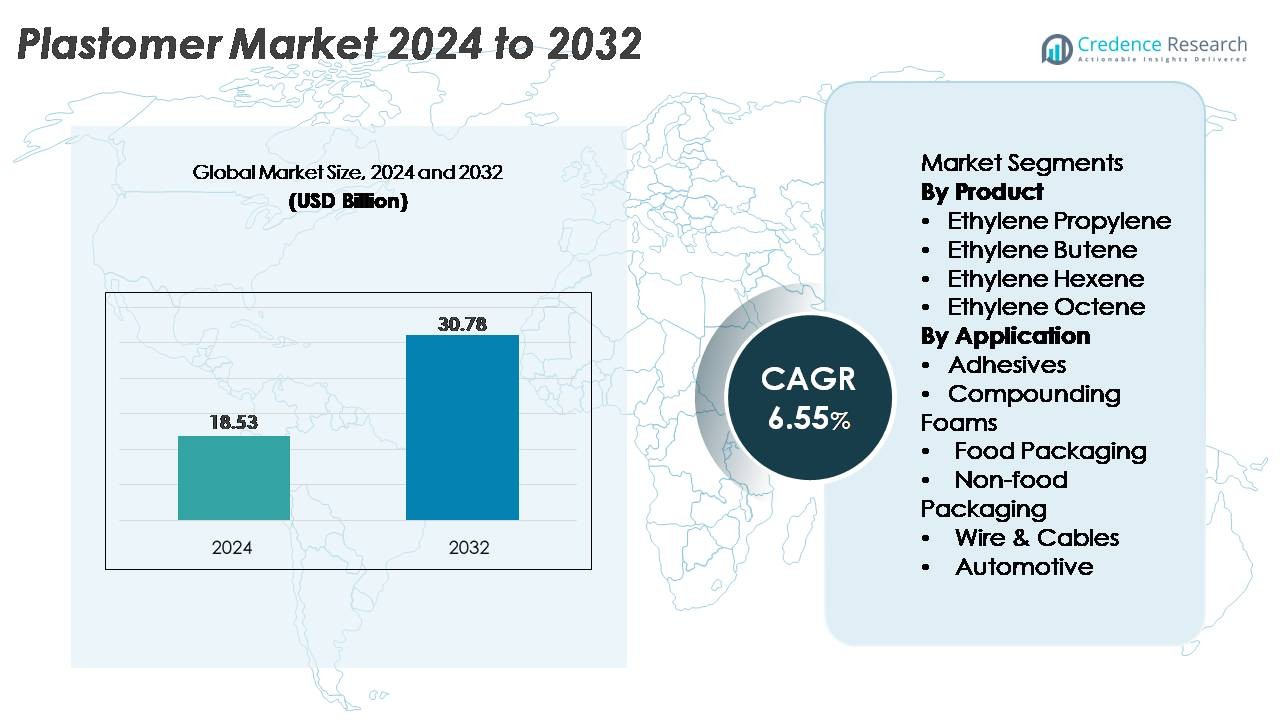
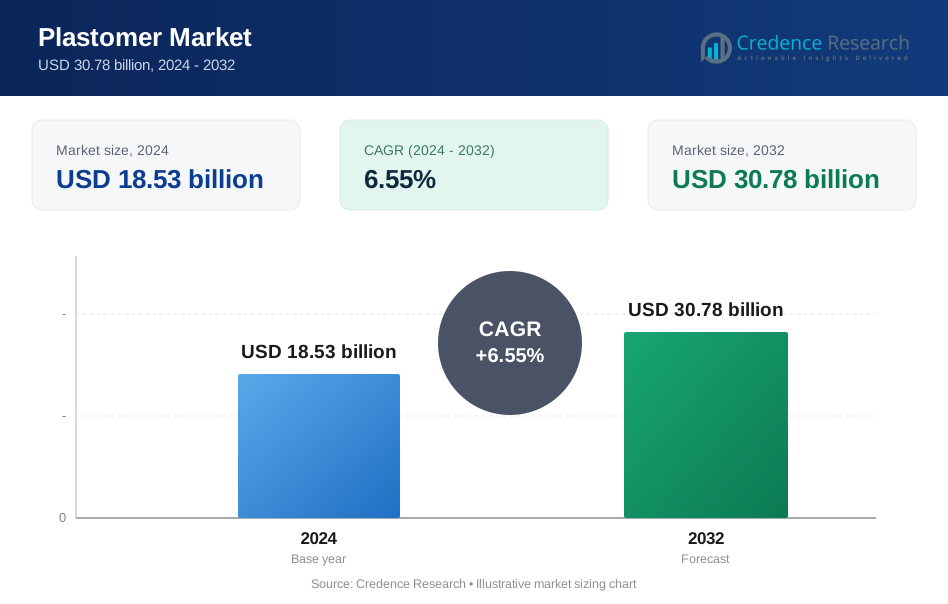
The global Plastomer Market was valued at USD 18.53 billion in 2024 and is projected to reach USD 30.78 billion by 2032, expanding at a CAGR of 6.55% during the forecast period.
| REPORT ATTRIBUTE | DETAILS |
|---|---|
| Historical Period | 2020-2023 |
| Base Year | 2024 |
| Forecast Period | 2025-2032 |
| Plastomer Market Size 2024 | USD 18.53 Billion |
| Plastomer Market, CAGR | 6.55% |
| Plastomer Market Size 2032 | USD 30.78 Billion |
The plastomer market is dominated by major global polyolefin producers including Chevron Phillips Chemical Company, LyondellBasell, Royal Dutch Shell, Dow Chemical Company, Westlake Chemical Corporation, ExxonMobil, Saudi Basic Industries Corporation (SABIC), and Borealis. These companies maintain strong leadership through integrated feedstock operations, advanced metallocene catalyst technologies, and extensive product portfolios serving high-performance packaging, adhesives, foams, and wire & cable applications. Regionally, Asia-Pacific leads the global market with a 38% share, driven by large-scale converting capacity, rapid industrialization, and expanding food and hygiene packaging demand. North America and Europe follow, supported by strong sustainability-driven adoption of recyclable PE-based film structures.
Market Insights:
- The global plastomer market was valued at USD 18.53 billion in 2024 and is projected to reach USD 30.78 billion by 2032, expanding at a CAGR of 6.55% during the forecast period.
- Demand is driven by the rapid adoption of plastomer-enhanced flexible packaging, hygiene films, and adhesive formulations, with ethylene octene emerging as the dominant product sub-segment due to its superior elasticity and sealing performance.
- Key trends include accelerated investments in recyclable mono-material PE packaging, metallocene catalyst-based resin advancement, and increased use of plastomers in wire & cable insulation, automotive components, and specialty foams.
- The competitive landscape remains consolidated, with leading players such as ExxonMobil, SABIC, Dow, LyondellBasell, and Borealis leveraging integrated feedstock capacities and high-performance PE portfolios, though volatility in ethylene and alpha-olefin pricing continues to restrain smaller converters.
- Regionally, Asia-Pacific leads with 38% share, followed by North America at 28% and Europe at 24%, reflecting strong packaging, industrial, and automotive demand across key manufacturing hubs.
 Market Segmentation Analysis:
By Product
Ethylene octene remains the dominant sub-segment in the plastomer market, supported by its superior elasticity, seal strength, and suitability for high-performance flexible packaging films. Its widespread use in hygiene films, stretch-hood applications, and advanced multilayer packaging structures strengthens its market leadership. Ethylene hexene and ethylene butene grades follow due to their balance of toughness and cost efficiency, particularly in compounding and extrusion. Meanwhile, ethylene propylene plastomers gain adoption in applications requiring improved clarity and softness. Overall, the segment benefits from rising production of metallocene-based polyethylene grades that enhance processing efficiency and material consistency.
- For instance, ExxonMobil’s metallocene-based Exact™ plastomers are produced at multiple global sites, including its Singapore Chemical Plant, which operates a large-scale steam cracker capable of generating 1.9 million tons per year of ethylene used to feed plastomer production.
By Application
Food packaging represents the largest application segment, driven by rapid adoption of plastomer-based films that offer enhanced puncture resistance, controlled tear properties, and excellent heat-seal performance. Brands increasingly rely on plastomer-modified PE structures to achieve downgauging without compromising barrier integrity, reinforcing its dominant share. Non-food packaging and hygiene films also see strong traction as manufacturers shift toward lightweight, recyclable materials. Growth in adhesives, compounding foams, and wire & cable jacketing further expands diversification, while automotive applications gain importance due to improved impact absorption and flexibility. Collectively, performance, sustainability, and processing advantages steer segment expansion.
- For instance, Dow’s AFFINITY™ GA plastomers are used in high-performance food packaging films and are supported by large-scale production at Dow’s Freeport, Texas complex, which operates an ethylene cracker with a nameplate capacity of 1.5 million metric tons per year, ensuring robust feedstock supply for plastomer manufacturing.
Key Growth Drivers
Expanding Demand for High-Performance Flexible Packaging
The rapid expansion of flexible packaging remains the strongest growth driver for the plastomer market, supported by rising global consumption of premium food, personal care, and hygiene products. Plastomers enhance film clarity, seal integrity, and puncture resistance, enabling brand owners to adopt downgauged structures without compromising strength or product shelf life. The shift toward lightweight, recyclable mono-material packaging accelerates the use of ethylene-octene and ethylene-hexene plastomers in multilayer structures. Converters prefer plastomers due to their processability in blown and cast film systems, improving throughput and film uniformity. Growth of e-commerce, demand for leak-proof pouches, and expansion of cold-chain food distribution reinforce the adoption of plastomer-modified polyethylene. Additionally, rising consumer preference for resealable, tamper-evident, and barrier-enhanced packaging formats further strengthens long-term usage across North America, Europe, and Asia-Pacific manufacturing hubs.
- For instance, ExxonMobil’s proprietary Exceed™ XP performance PE grades are produced at its Singapore Chemical Plant, which operates a fully integrated petrochemical complex capable of generating 1.9 million metric tons of ethylene per year, supplying feedstock for high-performance packaging resins used globally.
Increasing Adoption in Adhesives, Foams, and Polymer Modification
Plastomers are seeing accelerated demand as key performance enhancers in hot-melt adhesives, polyolefin foams, impact modifiers, and elastomer-blended compounds. In adhesive formulations, plastomers improve flexibility, cohesive strength, and low-temperature bonding, making them suitable for hygiene products, woodworking, and industrial lamination. Their compatibility with polyethylene and polypropylene enables material engineers to achieve softer, more elastic polymer blends used in footwear midsoles, cushioning foams, and specialty molded components. Automotive and consumer goods sectors are adopting plastomer-modified resins to improve impact resistance and tactile feel while maintaining lightweight characteristics. The trend toward low-VOC, solvent-free adhesive technologies and high-efficiency compounding lines supports broader adoption. Packaging converters also use plastomers as sealing-layer modifiers to achieve consistent performance on high-speed filling lines. This wide applicability positions plastomers as strategic materials across diversified manufacturing ecosystems.
- For instance, Dow’s AFFINITY™ GA plastomers are produced using the company’s proprietary INSITE™ catalyst technology. This production is supported by Dow’s Plaquemine, Louisiana complex, which operates an ethylene cracker with a capacity of approximately 1.5 million metric tons per year across its units, supplying critical feedstock for high-performance adhesive and polymer-modification resins.
Growth in Cable Insulation, Automotive Components, and Technical Applications
Demand for plastomers is rising steadily in wire & cable insulation, automotive interiors, and extrusion-molded technical parts due to their durability, thermal stability, and superior flexibility. In cable jacketing, plastomers provide improved crack resistance, low-temperature toughness, and smooth surface finish, supporting telecom expansion and renewable energy grid upgrades. Automotive manufacturers use plastomer-based compounds in dashboards, weather seals, soft-touch interior trims, and lightweight impact components to meet safety, fuel efficiency, and sustainability goals. With increasing EV production, plastomers enable flexible wire harnesses that withstand dynamic vibration and bending cycles. Their compatibility with polyolefins also simplifies recycling, aligning with OEM sustainability mandates. Construction, industrial roofing membranes, and protective films further broaden the application base. These performance drivers reinforce long-term penetration into engineering-grade material segments.
Key Trends & Opportunities
Strong Shift Toward Sustainable, Recyclable, and Mono-Material Packaging Systems
A major market trend involves the shift to recyclable mono-material packaging aligned with global sustainability mandates. Plastomer-modified polyethylene structures enable the replacement of multi-material laminates traditionally made with PET, PA, or aluminum, improving recyclability while maintaining high mechanical performance. Packaging manufacturers increasingly adopt plastomers in PE-PE or PE-EVOH structures to meet circular economy targets set by FMCG companies and regulatory bodies. Opportunities are expanding for suppliers offering grades with lower melting points, improved barrier compatibility, and enhanced sealability for recyclable pouches and films. The growth of chemical recycling infrastructure further accelerates the adoption of compatible materials such as plastomers, which integrate efficiently into polyolefin recycling streams. Innovations in downgauged films, compostable-ready blends, and clear, high-strength food packaging create new value pools for material developers across all regions.
- For instance, LyondellBasell’s MoReTec™ advanced recycling technology was first tested at its pilot plant in Ferrara, Italy, which is capable of processing between 5 and 10 kilograms of household plastic waste per hour.
Rising Penetration of Advanced Catalyst Technologies and High-Purity Feedstock Innovations
Metallocene catalyst technology continues to reshape plastomer manufacturing, enabling precise control over comonomer distribution, molecular weight uniformity, and branching. This evolution supports the production of plastomers with higher clarity, elasticity, and sealing performance tailored to next-generation applications. Producers are investing in high-purity alpha-olefin feedstocks and advanced reactor configurations to expand product portfolios with improved durability, odor-performance, and film processability. These advancements create opportunities for application developers to engineer tailored solutions in hygiene films, industrial stretch hoods, breathable membranes, and thermoformed packaging. As global capacity expansions emerge-particularly in the Middle East, China, and the U.S.-manufacturers can secure cost-advantaged supply chains and support innovation-driven growth. This technology-led trend is unlocking new product differentiation avenues for both converters and brand owners.
- For instance, ExxonMobil’s Baytown, Texas petrochemical complex operates one of the world’s largest metallocene-enabled polyethylene units, supported by an ethylene cracker with a capacity of 1.5 million metric tons per year, providing high-purity feedstocks essential for advanced plastomer and specialty PE manufacturing.
Key Challenges
Volatility in Feedstock Prices and Supply Chain Disruptions
The plastomer market faces structural challenges due to dependence on ethylene and alpha-olefin feedstocks, which are highly sensitive to crude oil fluctuations, geopolitical tensions, and refinery operating rates. Supply disruptions in butene, hexene, and octene comonomers directly affect production stability and contract pricing for plastomer manufacturers. The increasing frequency of planned and unplanned petrochemical shutdowns, alongside logistics bottlenecks for bulk chemical transport, contributes to uncertainty in lead times and procurement planning. Converters relying on plastomers for high-speed packaging, adhesives, and compounding applications often face margin pressures when feedstock costs spike. The lack of backward integration among smaller players further magnifies vulnerability. These dynamics compel end users to optimize formulations, explore alternative materials, and negotiate long-term supply contracts to mitigate cost volatility.
Performance Competition from Conventional Polyolefins and Elastomers
Despite strong growth potential, plastomers face intense competition from newer high-performance PE, PP elastomers, and cost-effective ethylene-vinyl acetate (EVA) grades that offer comparable flexibility and sealing properties. Some converters prefer metallocene LLDPE or elastomer-PP blends when price sensitivity outweighs performance advantages. Additionally, advancements in elastomer modification technologies allow conventional materials to bridge performance gaps previously dominated by plastomers. Regulatory complexities around food-contact compliance also slow adoption for certain grades. Converters in emerging markets may limit usage due to higher material costs, reinforcing competition from locally available alternatives. These pressures require plastomer producers to innovate continuously, optimize catalyst technologies, and expand application-specific grades with differentiated performance attributes.
Regional Analysis:
North America
North America holds approximately 28% of the global plastomer market, driven by strong demand for advanced packaging, hygiene films, and wire & cable insulation. The U.S. leads consumption due to its mature flexible packaging sector, robust e-commerce logistics, and widespread adoption of metallocene-based polyethylene in food and non-food applications. Rising investments in lightweight automotive components and the expansion of telecom infrastructure further support regional consumption. Major chemical producers with integrated ethylene capacities strengthen supply stability, enabling consistent adoption across converters and compounders. Sustainability commitments from FMCG and retail brands accelerate the shift toward recyclable mono-material packaging formats.
Europe
Europe accounts for roughly 24% of the global plastomer market, supported by stringent sustainability regulations and rapid transition toward recyclable PE-based packaging structures. Demand is primarily driven by food packaging, medical films, and industrial stretch-hood applications. Germany, Italy, and the U.K. remain key consumption hubs due to their advanced converting infrastructure and strong adoption of metallocene catalyst-based materials. The region’s focus on circular economy targets encourages substitution of multi-material laminates with plastomer-modified mono-material systems. Automotive lightweighting initiatives also contribute to higher demand for plastomer-enhanced foams, adhesives, and impact-resistant compounds across Tier-1 manufacturing clusters.
Asia-Pacific
Asia-Pacific dominates the plastomer market with an estimated 38% share, propelled by rapid industrialization, expanding flexible packaging production, and large-scale polymer capacity additions in China, South Korea, and India. The region benefits from high consumption of food packaging films, hygiene products, and automotive components, supporting significant downstream demand for plastomers. China leads the market due to its extensive converting base and strong adoption of PE-PE recyclable structures. Southeast Asia contributes additional growth through export-oriented packaging manufacturing. Rising telecom investments and construction activity further increase plastomer usage in wire & cable insulation, roofing membranes, and specialty extrusion applications.
Latin America
Latin America represents approximately 6% of the global plastomer market, with growth centered in Brazil, Mexico, and Chile. Demand is primarily supported by the food and beverage packaging industry, which increasingly adopts plastomer-modified polyethylene films for enhanced seal strength and downgauging. Regional hygiene product manufacturing also contributes to sustained consumption. Infrastructure upgrades and expansion of telecom networks drive additional demand in wire & cable jacketing applications. However, dependence on imported plastomer grades and fluctuations in ethylene supply occasionally affect availability and pricing. Despite these constraints, sustainability-driven packaging transitions continue to open new opportunities in the region.
Middle East & Africa
The Middle East & Africa region accounts for nearly 4% of the global plastomer market, supported by increasing investments in packaging manufacturing, construction activity, and polymer processing capacity. The Middle East benefits from cost-advantaged ethylene feedstocks and large petrochemical complexes, enabling improved regional availability of plastomer grades. Adoption is growing in PE film manufacturing for food packaging, agricultural films, and industrial liners. In Africa, rising urbanization and the expansion of FMCG distribution networks increase demand for durable, lightweight packaging formats. Infrastructure development and electrification initiatives further promote usage in wire & cable insulation and extrusion-molded components.
Market Segmentations:
By Product
- Ethylene Propylene
- Ethylene Butene
- Ethylene Hexene
- Ethylene Octene
By Application
- Adhesives
- Compounding Foams
- Food Packaging
- Non-food Packaging
- Wire & Cables
- Automotive
By Geography
- North America
- U.S.
- Canada
- Mexico
- Europe
- Germany
- France
- U.K.
- Italy
- Spain
- Rest of Europe
- Asia Pacific
- China
- Japan
- India
- South Korea
- South-east Asia
- Rest of Asia Pacific
- Latin America
- Brazil
- Argentina
- Rest of Latin America
- Middle East & Africa
- GCC Countries
- South Africa
- Rest of the Middle East and Africa
Competitive Landscape:
The competitive landscape of the plastomer market is shaped by a concentrated group of global polyolefin producers with strong integration across ethylene, alpha-olefin comonomers, and advanced catalyst technologies. Market leaders such as ExxonMobil, Dow, Borealis, SABIC, Mitsui Chemicals, and LyondellBasell maintain a competitive edge through large-scale metallocene PE production capacities, consistent resin quality, and broad application-focused product portfolios. These companies prioritize high-performance grades tailored for flexible packaging, hygiene films, wire & cable insulation, impact modifiers, and adhesives. Continuous investment in reactor debottlenecking, feedstock efficiency, and R&D accelerates innovation in downgauged, recyclable, and mono-material packaging solutions. Partnerships with converters and brand owners further strengthen market positioning by enabling customized film formulations that align with sustainability goals. Regional players in Asia and the Middle East are expanding aggressively, increasing global competition through cost-advantaged supply chains and expanded plastomer production footprints.
Key Player Analysis:
- Chevron Phillips Chemical Company
- LyondellBasell
- Royal Dutch Shell
- Dow Chemical Company
- Westlake Chemical Corporation
- ExxonMobil
- Saudi Basic Industries Corporation (SABIC)
- Borealis
Recent Developments:
- In October 2024, CPChem invested in a circular-plastic process technology, joining other investors to support the commercialization of advanced recycling solutions through partnership with Alterra.
- In August 2022: SABIC revealed plans to increase the production capacity of its NEXLENE plant in Ulsan, South Korea, through its joint venture, SABIC SK NEXLENE Company. This expansion is expected to be completed by the second quarter of 2024 and is aimed at addressing the rising demand for advanced polyolefin materials, including SUPEER mLLDPE, COHERE metallocene polyolefin plastomers (POP), and FORTIFY POE. The expansion responds to the growing requirement for NEXLENE-based solutions in high-end sectors such as photovoltaics, new mobility, footwear, and advanced packaging.
- IN 2023, LyondellBasell is listed among dominant players in recent industry-wide assessments of the plastomer market along with CPChem and ExxonMobil - highlighting its ongoing significant role in supplying plastomer and polyolefin resins.
Report Coverage:
The research report offers an in-depth analysis based on Product , Application and Geography. It details leading market players, providing an overview of their business, product offerings, investments, revenue streams, and key applications. Additionally, the report includes insights into the competitive environment, SWOT analysis, current market trends, as well as the primary drivers and constraints. Furthermore, it discusses various factors that have driven market expansion in recent years. The report also explores market dynamics, regulatory scenarios, and technological advancements that are shaping the industry. It assesses the impact of external factors and global economic changes on market growth. Lastly, it provides strategic recommendations for new entrants and established companies to navigate the complexities of the market.
Future Outlook:
- Demand for plastomer-modified mono-material packaging films will accelerate as global brands intensify commitments to recyclable PE structures.
- Adoption of metallocene-based plastomer grades will rise due to improved sealing, clarity, and downgauging performance across flexible packaging.
- Use of plastomers in hot-melt adhesives, hygiene products, and elastic films will expand as manufacturers shift toward low-VOC and high-efficiency formulations.
- Automotive applications will grow as OEMs prioritize lightweight, flexible, and impact-resistant polyolefin components.
- Wire & cable insulation demand will strengthen with continued telecom expansion and grid modernization projects.
- Emerging economies in Asia and the Middle East will add new production capacities, increasing global supply competitiveness.
- Technological innovation in reactor design and catalyst systems will enable more tailored plastomer grades for specialized applications.
- Mechanical and chemical recycling integration will enhance compatibility of plastomers in circular polyolefin systems.
- Converters will increasingly use plastomers to achieve downgauged, high-strength films for e-commerce and cold-chain logistics.
- Sustainability regulations across Europe and North America will accelerate replacement of multi-material laminates with plastomer-enhanced alternatives.
Request a Free Sample
Fill in your details and we'll send you a free sample report.
- Sample data tables & charts
- Research methodology
Market Dynamics
Expansion of High-Performance Flexible Packaging
The rapid growth of flexible packaging, especially for food, hygiene, and personal care products, is driving demand for plastomers due to their superior seal strength, clarity, and puncture resistance. The shift toward lightweight, recyclable mono-material packaging further accelerates adoption of plastomer-modified polyethylene films.
Advancements in Metallocene Catalyst Technology
Innovations in metallocene catalyst systems enable the production of plastomers with enhanced elasticity, clarity, and processability, supporting the development of high-performance grades for packaging, adhesives, and technical applications. This technological progress allows manufacturers to tailor materials for specific end-use requirements.
Rising Adoption in Adhesives, Foams, and Polymer Modification
Plastomers are increasingly used as performance enhancers in hot-melt adhesives, polyolefin foams, and impact modifiers, improving flexibility, bonding strength, and low-temperature performance. Their compatibility with other polyolefins enables the creation of softer, more elastic blends for automotive, footwear, and consumer goods.
Growth in Wire & Cable Insulation and Automotive Components
The need for durable, flexible, and lightweight materials in wire & cable insulation and automotive parts is boosting plastomer consumption. Their superior crack resistance, thermal stability, and recyclability make them attractive for telecom, renewable energy, and automotive OEMs focused on safety and sustainability.
Sustainability and Regulatory Push for Recyclable Packaging
Global sustainability mandates and circular economy initiatives are prompting brand owners and converters to replace multi-material laminates with recyclable, mono-material packaging structures. Plastomers enable these transitions by providing the necessary mechanical and sealing properties while maintaining recyclability.
Need a Custom Version of This Report?
Tailor the scope, geography, or segments to your exact requirements.
- Custom geography or segment scope
- Direct access to our analyst team
Frequently Asked Questions
What is the current market size for the Plastomer market, and what is its projected size in 2032?
At what Compound Annual Growth Rate is the Plastomer market projected to grow between 2024 and 2032?
Which Plastomer segment held the largest share in 2024?
What are the primary factors fueling the growth of the Plastomer market?
Who are the leading companies in the Plastomer market?
Which region commanded the largest share of the Plastomer market in 2024?
Table of Content
Chapter 1 Market Segmentation
- 1.1 Segmentation Framework
- 1.1.1 Product and Service Classification
- 1.1.2 Application and End-Use Classification
- 1.1.3 Technology and Solution Classification
- 1.1.4 Customer and Distribution Channel Classification
- 1.1.5 Geographic Segmentation
- 1.1.6 Market Segment Definitions and Boundaries
- 1.2 By Product
- 1.2.1 Ethylene Propylene
- 1.2.2 Ethylene Butene
- 1.2.3 Ethylene Hexene
- 1.2.4 Ethylene Octene
- 1.3 By Application
- 1.3.1 Adhesives
- 1.3.2 Compounding Foams
- 1.3.3 Food Packaging
- 1.3.4 Non-food Packaging
- 1.3.5 Wire & Cables
- 1.3.6 Automotive
Chapter 2 Introduction
- 2.1 Report Objectives and Scope
- 2.2 Product Definition and Industry Terminology
- 2.3 Market Inclusions and Exclusions
- 2.4 Research Process
- 2.4.1 Primary Research and Expert Interviews
- 2.4.2 Secondary Research and Source Review
- 2.4.3 Top-Down and Bottom-Up Estimation
- 2.4.4 Data Triangulation and Verification
- 2.5 Market Size Measurement Basis
- 2.5.1 2024: USD 18.53 billion → 2032: USD 30.78 billion
- 2.6 Historical and Forecast Reference Periods
- 2.6.1 Base Year: 2024
- 2.6.2 Forecast Period: 2024-2032
- 2.7 Research Assumptions and Limitations
Chapter 3 Executive Summary
- 3.1 Market Snapshot and Key Findings
- 3.2 Base-Year Market Size, 2024
- 3.3 Forecast Market Size, 2032
- 3.4 Revenue and Volume Growth Outlook
- 3.5 Key Demand and Supply Indicators
- 3.6 Leading Market Segments
- 3.7 Fastest-Growing Market Opportunities
- 3.8 Regional Performance Highlights
- 3.9 Technology and Industry Transformation
- 3.10 Competitive Landscape Summary
- 3.11 Analyst View and Strategic Implications
Chapter 4 Global Plastomer Market Trends and Developments
- 4.1 Historical Industry Development
- 4.2 Recent Market Trends and Developments
- 4.3 Demand and Customer Behavior Trends
- 4.4 Technology and Product Innovation
- 4.5 Artificial Intelligence, Automation and Digitalization
- 4.6 Local Manufacturing and Supply Chain Realignment
- 4.7 Industry Partnerships, Mergers and Acquisitions
- 4.8 Sustainability and Circular Economy Developments
- 4.9 Government and Private Sector Investment Trends
- 4.10 Emerging Business Models and Commercialization
- 4.11 Industry Developments and Announcements
Chapter 5 Global Plastomer Market Production, Supply and Demand Analysis
- 5.1 Demand Trend and Consumption Analysis
- 5.2 Demand Forecast, 2024-2032
- 5.3 Production and Output Trend
- 5.4 Production and Output Forecast, 2024-2032
- 5.5 Installed Capacity and Capacity Utilization
- 5.6 Company-Wise Production Plants and Statistics
- 5.6.1 Installed Production Capacity
- 5.6.2 Actual Production
- 5.6.3 Planned Capacity and Expansion Targets
- 5.7 Supply Chain Structure and Procurement Trends
- 5.8 Supply-Demand Gap and Bottlenecks
- 5.9 Import Dependence and Sourcing Structure
- 5.10 Contract Manufacturing and Outsourcing
- 5.11 Regional Supply and Demand Concentration
Chapter 6 Global Plastomer Market Pricing Analysis
- 6.1 Pricing Structure and Measurement
- 6.2 Historical Pricing Trends
- 6.3 Pricing Outlook, 2024-2032
- 6.4 Average Selling Price and Unit Economics
- 6.5 Pricing by Product and Market Segment
- 6.6 Geographic Pricing Differences
- 6.7 Key Input, Energy, Labor and Logistics Costs
- 6.8 Contract Pricing and Purchasing Models
- 6.9 Pricing Sensitivity and Competitive Positioning
- 6.10 Price, Margin and Profitability Implications
Chapter 7 Global Plastomer Market Dynamics
- 7.1 Market Growth Drivers
- 7.1.1 Demand-Side Drivers
- 7.1.2 Technology and Innovation Drivers
- 7.1.3 Infrastructure and Investment Drivers
- 7.1.4 Regulatory and Policy Drivers
- 7.2 Market Restraints
- 7.2.1 Cost and Affordability Constraints
- 7.2.2 Technology and Adoption Barriers
- 7.2.3 Supply Chain and Operational Constraints
- 7.3 Market Challenges
- 7.3.1 Competitive Pressure and Margin Erosion
- 7.3.2 Skills, Infrastructure and Implementation Gaps
- 7.4 Emerging Market Opportunities
- 7.5 Market Dynamics Impact and Time-Horizon Assessment
Chapter 8 Global Plastomer Value Chain Analysis
- 8.1 Industry Value Chain Overview
- 8.2 Upstream Suppliers and Critical Inputs
- 8.3 Technology and Component Providers
- 8.4 Manufacturing or Service Delivery
- 8.5 Distribution, Channel Partners and Integrators
- 8.6 Downstream Applications and End Users
- 8.7 Value Addition and Profit Pools
- 8.8 Vertical Integration and Outsourcing
- 8.9 Supplier Concentration and Risk
- 8.10 Supply Chain Localization and Resilience
Chapter 9 Global Plastomer Market Regulations and Policies
- 9.1 Relevant Laws, Standards and Compliance Frameworks
- 9.2 Product, Service, Safety and Quality Requirements
- 9.3 Government Policies, Incentives and Subsidies
- 9.4 Imports, Exports and Trade Barriers
- 9.5 Public Procurement and Local Content Requirements
- 9.6 Environmental and Sustainability Compliance
- 9.7 Upcoming Policy Changes and Market Implications
Chapter 10 Global Plastomer Market Hotspots and Opportunities
- 10.1 Market Opportunity Mapping and Growth Hotspots
- 10.2 High-Growth Applications and Customer Groups
- 10.3 Underserved Markets and White-Space Opportunities
- 10.4 Emerging Technology and Product Opportunities
- 10.5 New Capacity and Investment Hotspots
- 10.6 Market Entry and Expansion Opportunities
- 10.7 Distribution and Partnership Opportunities
- 10.8 Near-Term and Long-Term Commercial Potential
- 10.9 Opportunity Attractiveness and Execution Risks
Chapter 11 Global Plastomer Market Outlook, 2024-2032
- 11.1 Market Size and Analysis
- 11.1.1 Revenue (Market Measurement: 2024: USD 18.53 billion → 2032: USD 30.78 billion)
- 11.1.2 Market Volume and Quantity Sold
- 11.1.3 Historical Market Size
- 11.1.4 Base-Year Market Size, 2024
- 11.2 Market Forecast, 2024-2032
- 11.2.1 Revenue Forecast to 2032
- 11.2.2 Volume Forecast to 2032
- 11.2.3 CAGR and Year-on-Year Growth
- 11.2.4 Incremental Revenue Opportunity
- 11.3 Forecast Assumptions and Scenario Analysis
- 11.3.1 Base-Case Forecast
- 11.3.2 Optimistic and Conservative Scenarios
- 11.3.3 Technology, Pricing and Policy Sensitivities
- 11.4 Market Attractiveness and Growth Outlook
Chapter 12 Global Plastomer Market Segmentation and Outlook
- 12.1 Segmentation Summary and Market Shares, 2024
- 12.2 Largest and Fastest-Growing Segments
- 12.3 By Product - Market Size and Forecast, 2024-2032
- 12.3.1 Segment Definition and Scope
- 12.3.2 Historical Market Size
- 12.3.3 Revenue Forecast, 2024-2032
- 12.3.4 Volume Forecast, 2024-2032
- 12.3.5 Base-Year Market Share, 2024
- 12.3.6 Segment CAGR and Growth Drivers
- 12.3.7 Subsegment Market Size and Forecast
- 12.3.7.1 Ethylene Propylene
- 12.3.7.2 Ethylene Butene
- 12.3.7.3 Ethylene Hexene
- 12.3.7.4 Ethylene Octene
- 12.3.8 Subsegment Pricing and Adoption Trends
- 12.3.9 Leading Suppliers and Competition
- 12.3.10 Regional Demand and Opportunities
- 12.4 By Application - Market Size and Forecast, 2024-2032
- 12.4.1 Segment Definition and Scope
- 12.4.2 Historical Market Size
- 12.4.3 Revenue Forecast, 2024-2032
- 12.4.4 Volume Forecast, 2024-2032
- 12.4.5 Base-Year Market Share, 2024
- 12.4.6 Segment CAGR and Growth Drivers
- 12.4.7 Subsegment Market Size and Forecast
- 12.4.7.1 Adhesives
- 12.4.7.2 Compounding Foams
- 12.4.7.3 Food Packaging
- 12.4.7.4 Non-food Packaging
- 12.4.7.5 Wire & Cables
- 12.4.7.6 Automotive
- 12.4.8 Subsegment Pricing and Adoption Trends
- 12.4.9 Leading Suppliers and Competition
- 12.4.10 Regional Demand and Opportunities
- 12.5 Segment Growth Comparison
- 12.6 Segment Attractiveness and Priority Matrix
Chapter 13 Global Plastomer End-Use and Application Market Outlook
- 13.1 End-Use Industry and Customer Demand Structure
- 13.2 Leading Applications and Customer Groups
- 13.3 End-Use Market Size, Share and Forecast
- 13.4 Major End-Use Industry Deep Dives
- 13.4.1 Customer Requirements and Use Cases
- 13.4.2 Demand and Replacement Cycles
- 13.4.3 Technical and Regulatory Considerations
- 13.4.4 Purchasing and Procurement Models
- 13.4.5 Leading Vendors and Distribution Channels
- 13.4.6 Forecast and Commercial Opportunities
- 13.5 Emerging Applications and Cross-Segment Demand
- 13.6 End-Use Industry Investment Priorities
Chapter 14 Global Plastomer Geographic Market Outlook, 2024-2032
- 14.1 Regional Market Size and Share, 2024
- 14.2 Regional Market Forecast, 2024-2032
- 14.3 Regional Pricing, Production and Demand Differences
- 14.4 North America
- 14.4.1 United States
- 14.4.2 Canada
- 14.4.3 Mexico
- 14.5 Europe
- 14.5.1 Germany
- 14.5.2 France
- 14.5.3 Italy
- 14.5.4 United Kingdom
- 14.5.5 Spain
- 14.5.6 Poland
- 14.5.7 Russia
- 14.5.8 Netherlands
- 14.5.9 Belgium
- 14.5.10 Sweden
- 14.5.11 Denmark
- 14.5.12 Norway
- 14.5.13 Rest of Europe
- 14.6 Asia Pacific
- 14.6.1 China
- 14.6.2 India
- 14.6.3 Japan
- 14.6.4 South Korea
- 14.6.5 Thailand
- 14.6.6 Indonesia
- 14.6.7 Vietnam
- 14.6.8 Malaysia
- 14.6.9 Australia
- 14.6.10 Rest of Asia Pacific
- 14.7 Latin America
- 14.7.1 Brazil
- 14.7.2 Argentina
- 14.7.3 Colombia
- 14.7.4 Chile
- 14.7.5 Rest of Latin America
- 14.8 Middle East
- 14.8.1 Saudi Arabia
- 14.8.2 United Arab Emirates
- 14.8.3 Turkey
- 14.8.4 Israel
- 14.8.5 Iran
- 14.8.6 Rest of the Middle East
- 14.9 Africa
- 14.9.1 South Africa
- 14.9.2 Egypt
- 14.9.3 Nigeria
- 14.9.4 Morocco
- 14.9.5 Rest of Africa
- 14.10 Regional Investment, Policy and Supply Chain Differences
- 14.11 Regional Competitive Landscape
- 14.12 Geographic Growth Hotspots
Chapter 15 Global Plastomer Technology, Innovation and Sustainability Outlook
- 15.1 Technology Landscape and Maturity
- 15.2 Product, Process and Service Innovation
- 15.3 AI, Automation and Digital Tools in the Industry
- 15.4 Technology Adoption and Performance Benchmarking
- 15.5 Innovation Pipeline and R&D Investment
- 15.6 Patent and Intellectual Property Trends
- 15.7 Energy Efficiency and Resource Management
- 15.8 Sustainability, Recycling and Circularity
- 15.9 Technology Roadmap, 2024-2032
- 15.10 Risks of Obsolescence and Technology Substitution
Chapter 16 Global Plastomer Market Key Strategic Imperatives
- 16.1 Growth and Market Entry Priorities
- 16.2 High-Return Products and Segments
- 16.3 Pricing, Profitability and Cost Optimization
- 16.4 Technology Investment and Product Differentiation
- 16.5 Supply Chain Localization and Resilience
- 16.6 Distribution and Customer Acquisition
- 16.7 Partnership, Acquisition and Capacity Strategy
- 16.8 Regional Expansion Priorities
- 16.9 Short-, Medium- and Long-Term Actions
Chapter 17 Competition Outlook
- 17.1 Industry Competition Characteristics
- 17.2 Market Structure and Concentration
- 17.3 Market Share and Competitive Positioning, 2024
- 17.4 Company-Wise Revenue and Product Benchmarking
- 17.5 Production and Service Capacity Benchmarking
- 17.6 Technology, Pricing and Differentiation
- 17.7 Regional Footprint and Distribution Strength
- 17.8 Mergers, Acquisitions and Strategic Alliances
- 17.9 New Entrants and Competitive Threats
- 17.10 Porter's Five Forces and Industry Attractiveness
- 17.11 Competitive Outlook, 2024-2032
Chapter 18 Company Profiles
- 18.1 Company Coverage and Selection Criteria
- 18.2 Chevron Phillips Chemical Company
- 18.2.1 Business Description
- 18.2.2 Company Ownership and Geographic Presence
- 18.2.3 Product and Service Portfolio
- 18.2.4 Manufacturing and Operating Footprint
- 18.2.5 Production Capacity and Expansion Plans
- 18.2.6 Financial Performance and Investment
- 18.2.7 Market Share and Competitive Position
- 18.2.8 Technology and Innovation Capabilities
- 18.2.9 Strategic Alliances or Partnerships
- 18.2.10 Recent Developments
- 18.2.11 Growth Strategy and Outlook
- 18.3 LyondellBasell
- 18.4 Royal Dutch Shell
- 18.5 Dow Chemical Company
- 18.6 Westlake Chemical Corporation
- 18.7 ExxonMobil
- 18.8 Saudi Basic Industries Corporation (SABIC)
- 18.9 Borealis
- 18.10 Mitsui Chemicals
- 18.11 Other Relevant Market Participants
Note: Every listed company is profiled on the structure shown under the first company. The company list is preliminary and may change based on research findings, market developments, data availability and client requirements.
Chapter 19 Disclaimer
- 19.1 Research and Forecast Disclaimer
- 19.2 Data Source and Estimation Limitations
Note: The depth of individual sections depends on data availability for this market. Volume, capacity, trade and other unit-based metrics are included where applicable.