
Market Overview:
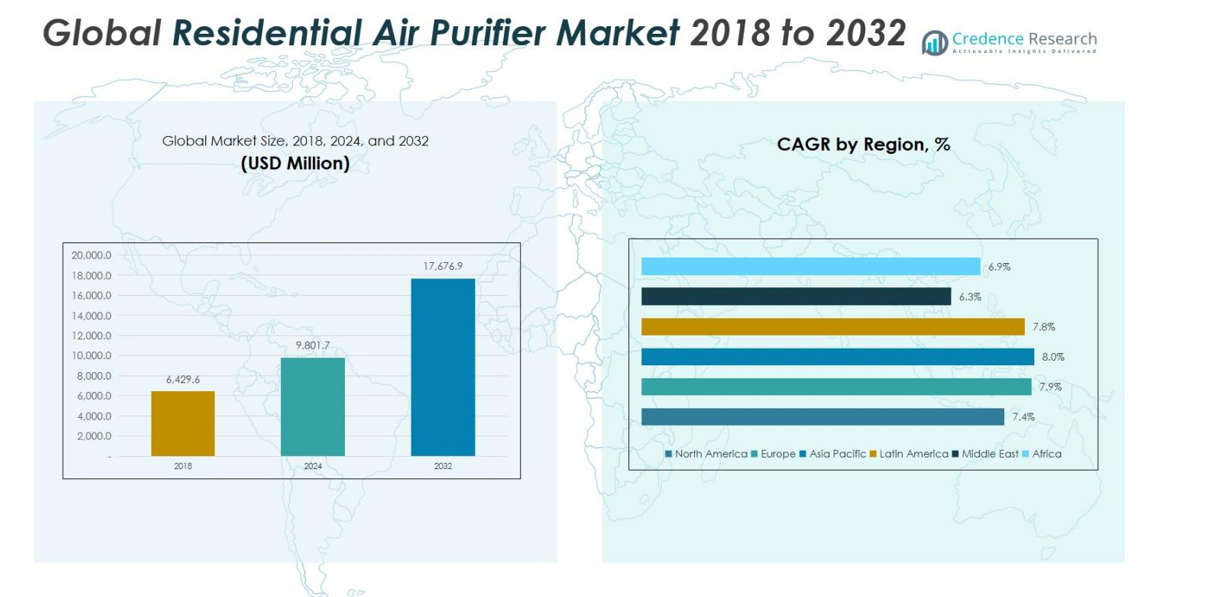
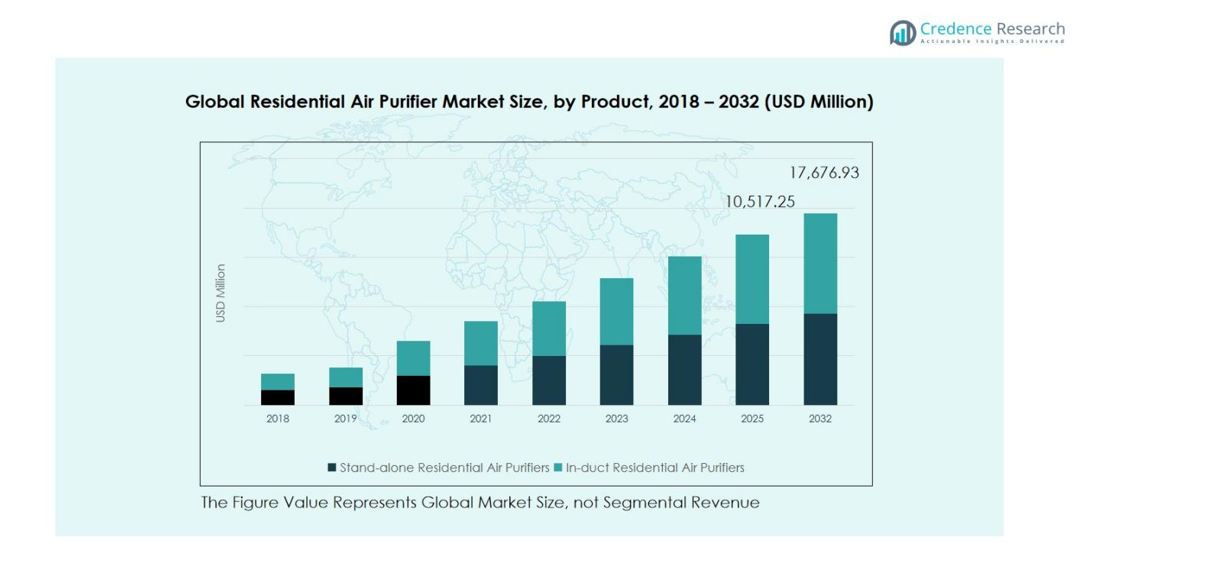
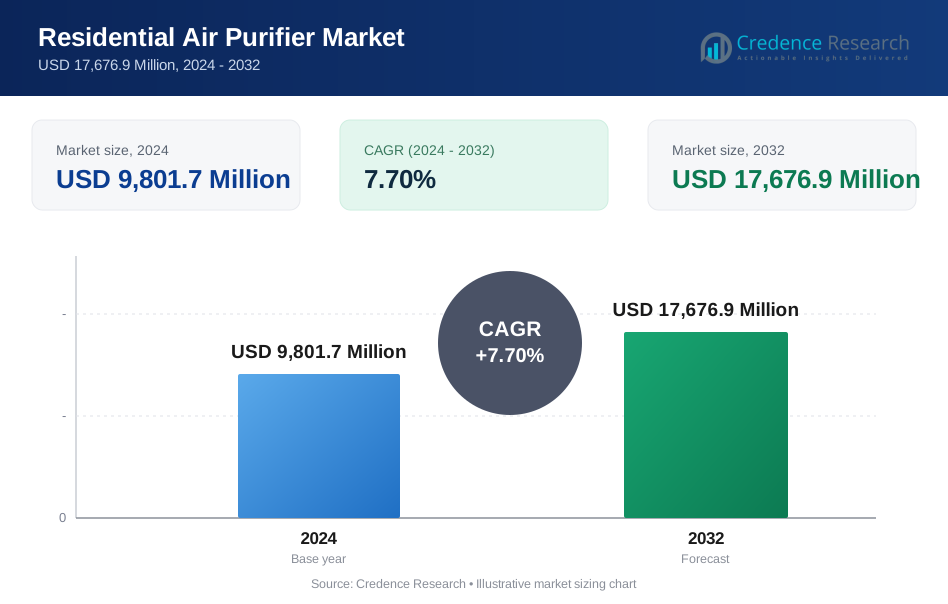
Residential Air Purifier Market size was valued at USD 6,429.6 Million in 2018, growing to USD 9,801.7 Million in 2024, and is anticipated to reach USD 17,676.9 Million by 2032, at a CAGR of 7.70% during the forecast period.
| REPORT ATTRIBUTE | DETAILS |
|---|---|
| Historical Period | 2020-2023 |
| Base Year | 2024 |
| Forecast Period | 2025-2032 |
| Residential Air Purifier Market Size 2024 | USD 9,801.7 Million |
| Residential Air Purifier Market, CAGR | 7.70% |
| Residential Air Purifier Market Size 2032 | USD 17,676.9 Million |
The Residential Air Purifier Market is highly competitive, led by prominent players such as Daikin Industries, Ltd., Sharp Corporation, Honeywell International, Inc., LG Electronics Inc., Camfil AB, Whirlpool Corporation, AllerAir Industries, Inc., Blueair AB, Winix Co., Ltd, and Airgle Corporation. These companies drive market growth through continuous innovation, advanced filtration technologies, and expansion of distribution channels. HEPA-based and smart residential air purifiers are key focus areas, allowing players to differentiate and capture consumer attention. Regionally, Asia Pacific dominates the market, holding approximately 29% of the global share in 2018, followed by Europe with 24% and North America with 22%. High urban pollution levels, rising health awareness, and growing adoption of energy-efficient and connected devices in these regions fuel demand. Strategic partnerships, R&D, and expansion into emerging markets remain critical for maintaining competitive advantage and sustaining long-term growth.
Market Insights
- The Residential Air Purifier Market was valued at USD 9,801.7 Million in 2024 and is projected to reach USD 17,676.9 Million by 2032, growing at a CAGR of 7.70%.
- Rising urban air pollution, increasing health awareness, and technological advancements in HEPA and smart air purifiers are driving market growth.
- Key trends include the adoption of smart and connected devices with IoT integration, energy-efficient and eco-friendly products, and increasing preference for stand-alone residential air purifiers, which account for 65% of the market.
- The market is competitive, led by companies such as Daikin Industries, Ltd., Sharp Corporation, Honeywell International, Inc., LG Electronics Inc., Camfil AB, Whirlpool Corporation, and Blueair AB. Continuous innovation, distribution expansion, and R&D investments are key strategies.
- Regionally, Asia Pacific dominates with 29% market share, followed by Europe at 24% and North America at 22%, while emerging markets in Latin America, Middle East, and Africa are witnessing steady adoption.
Market Segmentation Analysis:
By Product:
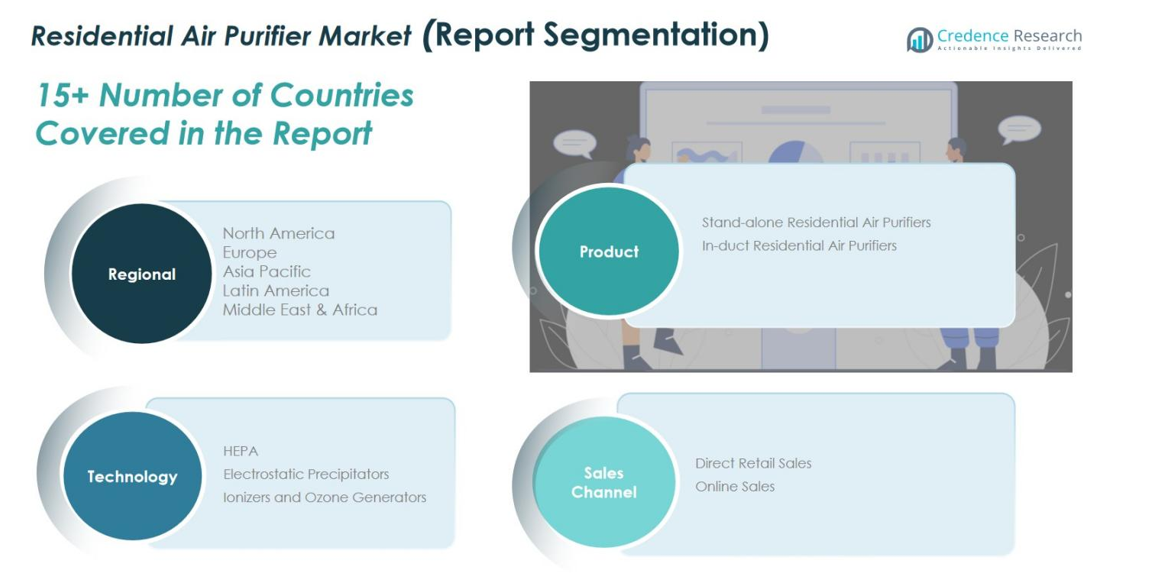
The residential air purifier market by product is primarily divided into stand-alone and in-duct air purifiers. Stand-alone residential air purifiers dominate the market, accounting for 65% of the total revenue. Their popularity stems from portability, ease of installation, and flexibility for individual room usage. Consumers increasingly prefer compact devices for bedrooms and living areas, driving demand. In contrast, in-duct air purifiers, while suitable for whole-home applications, face higher installation costs and maintenance requirements, limiting their adoption. Rising awareness about indoor air quality and increasing urban pollution levels continue to fuel the growth of stand-alone units.
- For instance, Coway's Airmega AP-1512HH Mighty, a best-selling portable model tested by Wirecutter, exemplifies consumer preference for compact, high-performance devices suitable for individual rooms like bedrooms and living areas.
By Technology:
Among various technologies, HEPA-based residential air purifiers hold the largest market share at 58%, driven by their proven efficiency in trapping fine particulate matter, allergens, and airborne pollutants. Electrostatic precipitators and ionizers, including ozone generators, cater to niche segments due to specific applications and lower energy consumption but contribute less to overall revenue. The increasing prevalence of respiratory disorders, coupled with heightened consumer preference for certified HEPA filtration, supports sustained growth. Product innovations enhancing filter life and noise reduction further reinforce HEPA technology’s dominance.
- For instance, Fantech's HEPA filtration system captures 99.97% of particles as small as 0.3 microns, making it ideal for home and commercial use up to 3,000 sq. ft., with a three-stage process including carbon pre-filters enhancing air quality.
By Sales Channel:
In terms of sales channels, direct retail sales account for 60% of the market, driven by the availability of personalized consultation, in-store product demonstrations, and instant product availability. Online sales are growing rapidly, supported by e-commerce convenience, wider product variety, and competitive pricing, representing about 40% of market revenue. The shift toward digital retail is accelerated by increasing smartphone penetration and home delivery services. Consumers are leveraging online platforms for detailed product reviews and comparisons, influencing purchase decisions and expanding reach for emerging brands.
Key Growth Drivers
Rising Air Pollution Levels
Increasing urbanization and industrial activities have significantly worsened air quality, especially in metropolitan regions. The growing concentration of particulate matter, allergens, and harmful gases has led to heightened health concerns, particularly respiratory and cardiovascular issues. Consumers are increasingly prioritizing indoor air quality to protect family health, driving the adoption of residential air purifiers. Governments and environmental agencies are also promoting awareness about air pollution mitigation, further encouraging household investments in air purification solutions. This trend positions the market for sustained growth across both developed and emerging regions.
- For instance, the World Health Organization highlights that indoor air pollution from household cooking methods, such as the use of solid fuels, significantly contributes to health issues in many developing countries, including India and Bangladesh.
Growing Health Awareness
Heightened awareness about the impact of indoor air pollutants on health is fueling demand for residential air purifiers. Consumers are increasingly recognizing the importance of controlling allergens, dust, smoke, and microbial contamination to prevent chronic respiratory conditions and enhance overall well-being. The preference for technologically advanced filtration systems, such as HEPA and activated carbon filters, reflects the shift toward health-conscious lifestyles. Regular health campaigns and media coverage of indoor air quality risks reinforce this trend, encouraging households to invest in effective air purification solutions.
- For instance, Coway’s AirMega Aim utilizes a long-life HEPA filter capable of sustaining up to approximately 8,500 hours of use, targeting allergens and dust effectively in urban environments.
Technological Advancements in Air Purifiers
Continuous innovation in air purifier technologies is expanding market potential. Developments in HEPA filtration, electrostatic precipitators, ionizers, and smart devices with IoT integration improve performance, energy efficiency, and user convenience. Features such as real-time air quality monitoring, automated operation, and low-noise design enhance user experience, increasing adoption rates. Manufacturers are also focusing on sustainable and low-maintenance solutions, which appeal to eco-conscious consumers. These technological enhancements are driving premium product adoption and enabling companies to differentiate offerings in a competitive residential air purifier market.
Key Trends & Opportunities
Trend of Smart and Connected Devices
The increasing integration of IoT and smart technologies in residential air purifiers is reshaping consumer preferences. Wi-Fi-enabled devices, smartphone apps, and voice control allow users to monitor indoor air quality remotely and automate purifier functions, enhancing convenience and efficiency. Smart sensors adjust purification levels based on real-time air quality, reducing energy consumption. This trend also supports subscription-based filter replacement services, creating recurring revenue opportunities for manufacturers. Adoption of connected devices aligns with rising demand for smart homes, providing both convenience and health benefits to end-users.
- For instance, Xiaomi's Mi Air Purifier 4, which connects to the Mi Home app for remote monitoring and control, and uses laser particle sensors to modulate its fan speed based on detected pollution levels.
Rising Preference for Eco-Friendly and Energy-Efficient Products
Consumers are increasingly favoring energy-efficient and environmentally sustainable air purifiers, aligning with global sustainability goals. Devices with low power consumption, recyclable filters, and eco-friendly materials are gaining traction, particularly among urban households. Manufacturers are responding by designing products that meet energy certifications and reduce environmental impact while maintaining high purification efficiency. This trend not only addresses environmental concerns but also lowers operational costs for consumers, driving adoption. Energy-efficient solutions present opportunities for market growth, especially in regions with stringent energy regulations and high electricity costs.
- For instance, Briiv offers an eco-friendly air purifier with biodegradable filters made from natural materials such as coconut fiber and moss, which decompose naturally after use.
Key Challenges
High Initial Cost of Advanced Air Purifiers
One of the primary challenges in the residential air purifier market is the high purchase cost of technologically advanced devices. Premium models with HEPA filtration, smart connectivity, and multi-stage purification often carry significant price tags, which can restrict adoption among price-sensitive consumers. The maintenance costs, including filter replacements and energy consumption, further deter potential buyers. Despite rising awareness of health benefits, affordability remains a barrier, especially in emerging markets, slowing market penetration and challenging manufacturers to balance performance with cost-effectiveness.
Lack of Consumer Awareness in Emerging Markets
In several emerging regions, limited awareness of indoor air pollution risks hampers residential air purifier adoption. Many consumers are unfamiliar with the health benefits of air purification or the differences in filtration technologies. Misconceptions regarding device efficiency and maintenance requirements contribute to hesitancy in purchase decisions. This challenge necessitates intensified educational campaigns, marketing initiatives, and demonstration programs by manufacturers to bridge knowledge gaps. Without targeted awareness strategies, market growth in these regions may remain slow despite the rising need for clean indoor air.
Regional Analysis
North America
North America accounted for 22% of the global residential air purifier market in 2018, with a market size of USD 1,521.89 million. The region is projected to reach USD 2,278.06 million in 2024 and USD 4,007.36 million by 2032, expanding at a CAGR of 7.4%. Growth is fueled by increasing urbanization, rising air pollution levels, and high consumer awareness of indoor air quality. The U.S. leads regional demand, driven by the adoption of HEPA-based and smart air purifiers. Stringent government regulations and growing preference for technologically advanced, energy-efficient devices further support market expansion.
Europe
Europe represented 24% of the global market in 2018, with a value of USD 1,700.63 million. The market is expected to reach USD 2,624.06 million in 2024 and USD 4,808.13 million by 2032, growing at a CAGR of 7.9%. Key drivers include increasing health awareness, rising incidence of respiratory diseases, and stringent air quality regulations. Germany, France, and the UK dominate adoption, favoring HEPA filtration and smart air purifiers. Technological innovations, eco-friendly designs, and urban pollution concerns continue to accelerate market growth across the region.
Asia Pacific
Asia Pacific held the largest share, roughly 29% of the global market in 2018, valued at USD 2,065.19 million. The region is projected to grow to USD 3,196.20 million in 2024 and USD 5,879.35 million by 2032, at a CAGR of 8.0%. Rising industrialization, severe urban pollution, and growing disposable incomes drive adoption. China, Japan, and India lead demand for stand-alone and HEPA-based air purifiers. Increased awareness of respiratory health, rising middle-class populations, and adoption of smart, connected devices further bolster market growth across Asia Pacific.
Latin America
Latin America accounted for 10% of the global market in 2018, with a size of USD 693.11 million. The market is expected to reach USD 1,061.25 million in 2024 and USD 1,925.02 million by 2032, reflecting a CAGR of 7.8%. Growth is supported by rising urban pollution, expanding middle-class households, and growing awareness of indoor air quality. Brazil and Argentina dominate the regional market, with increasing demand for stand-alone and HEPA air purifiers. E-commerce growth and the convenience of online sales channels are also driving adoption across Latin America.
Middle East
The Middle East contributed 4% of the global market in 2018, valued at USD 307.34 million. The market is projected to reach USD 435.76 million in 2024 and USD 707.08 million by 2032, growing at a CAGR of 6.3%. Adoption is driven by desert dust, urban pollution, and rising health awareness in GCC countries, Israel, and Turkey. Consumers are increasingly preferring energy-efficient, technologically advanced, and smart air purifiers. Government initiatives promoting air quality awareness and the expansion of premium residential projects further support regional market growth.
Africa
Africa held about 2% of the global market in 2018, with a market size of USD 141.45 million. The market is expected to grow to USD 206.40 million in 2024 and USD 350.00 million by 2032, at a CAGR of 6.9%. Urbanization, growing concerns about indoor air pollution, and rising awareness among middle-class consumers are key drivers. South Africa and Egypt lead adoption, favoring cost-effective and stand-alone air purifiers. Limited consumer awareness and economic constraints remain challenges; however, increasing income levels and government campaigns are expected to support gradual market expansion.
Market Segmentations:
By Product:
- Stand-alone Residential Air Purifiers
- In-duct Residential Air Purifiers
By Technology:
- HEPA
- Electrostatic Precipitators
- Ionizers and Ozone Generators
By Sales Channel:
- Direct Retail Sales
- Online Sales
By Region:
- North America
- U.S.
- Canada
- Mexico
- Europe
- Germany
- France
- U.K.
- Italy
- Spain
- Rest of Europe
- Asia Pacific
- China
- Japan
- India
- South Korea
- South-east Asia
- Rest of Asia Pacific
- Latin America
- Brazil
- Argentina
- Rest of Latin America
- Middle East & Africa
- GCC Countries
- South Africa
- Rest of the Middle East and Africa
Competitive Landscape
The competitive landscape of the residential air purifier market is characterized by strong presence of key players such as Daikin Industries, Ltd., Sharp Corporation, Honeywell International, Inc., LG Electronics Inc., Camfil AB, Whirlpool Corporation, AllerAir Industries, Inc., Blueair AB, Winix Co., Ltd, and Airgle Corporation. These companies compete through continuous product innovation, expansion of distribution channels, and strategic partnerships to enhance market presence. Manufacturers focus on technologically advanced air purifiers, including HEPA, smart, and energy-efficient models, to meet evolving consumer demands. Emphasis on R&D, superior filtration technologies, and eco-friendly designs allows players to differentiate their offerings. Additionally, aggressive marketing, after-sales service, and regional expansion strategies strengthen brand loyalty and market share. Smaller local manufacturers also contribute to market growth by offering cost-effective solutions, particularly in emerging regions, intensifying competition while driving product accessibility.
Key Player Analysis
- Daikin Industries, Ltd.
- Sharp Corporation
- Honeywell International, Inc.
- LG Electronics Inc.
- Camfil AB
- Whirlpool Corporation
- AllerAir Industries, Inc.
- Blueair AB
- Winix Co., Ltd
- Airgle Corporation
- Others
Recent Developments
- In May 2025, Madison Industries acquired Research Products Corporation (RPC) to strengthen its portfolio of residential and commercial indoor air quality solutions.
- In July 2025, Air Support Project partnered with ATOM Innovation to launch the VELLO XL, a next-generation air purifier designed to make clean indoor air more accessible to households.
- In September 2025, Dyson introduced the HushJet Purifier Compact HJ10, featuring advanced electrostatic HEPA filtration and ultra-quiet operation to enhance home air purification efficiency
Report Coverage
The research report offers an in-depth analysis based on Product, Technology, Sales Channel and Region. It details leading market players, providing an overview of their business, product offerings, investments, revenue streams, and key applications. Additionally, the report includes insights into the competitive environment, SWOT analysis, current market trends, as well as the primary drivers and constraints. Furthermore, it discusses various factors that have driven market expansion in recent years. The report also explores market dynamics, regulatory scenarios, and technological advancements that are shaping the industry. It assesses the impact of external factors and global economic changes on market growth. Lastly, it provides strategic recommendations for new entrants and established companies to navigate the complexities of the market.
Future Outlook
- The market is expected to witness steady growth driven by rising urban air pollution.
- Increasing health awareness will continue to boost demand for residential air purifiers.
- HEPA and multi-stage filtration technologies will remain the preferred choice among consumers.
- Smart and connected air purifiers with IoT integration will gain higher adoption.
- Energy-efficient and eco-friendly products will see growing preference in both developed and emerging regions.
- Online sales channels will expand, complementing direct retail distribution.
- Asia Pacific is projected to remain the largest regional market with rapid adoption.
- Product innovations focusing on low noise, compact design, and automated operation will drive consumer interest.
- Emerging markets will offer new growth opportunities with increasing urbanization and disposable incomes.
- Manufacturers will focus on strategic partnerships, R&D, and regional expansion to strengthen market position.
Request a Free Sample
Fill in your details and we'll send you a free sample report.
- Sample data tables & charts
- Research methodology
Need a Custom Version of This Report?
Tailor the scope, geography, or segments to your exact requirements.
- Custom geography or segment scope
- Direct access to our analyst team
Frequently Asked Questions
What is the current market size for Residential Air Purifier Market, and what is its projected size in 2032?
At what Compound Annual Growth Rate is the Residential Air Purifier Market projected to grow between 2025 and 2032?
Which Residential Air Purifier Market segment held the largest share in 2024?
What are the primary factors fueling the growth of the Residential Air Purifier Market?
Who are the major players in this market?
Which region commanded the largest share of the Residential Air Purifier Market in 2024?
Table of Content
Chapter 1. Report Introduction
- 1.1 Report Description & Purpose
- 1.1.1 Report Title & Market Definition
- 1.1.2 Unique Selling Propositions (USP) & Key Differentiators
- 1.1.3 Value Proposition for Stakeholders
- 1.2 Research Objectives
- 1.2.1 Market Sizing Objectives (Volume & Revenue)
- 1.2.2 Segmentation Objectives
- 1.2.3 Competitive Intelligence Objectives
- 1.2.4 Forecast & Scenario Objectives
- 1.3 Report Scope
- 1.3.1 Residential Air Purifier Scope – Types & Subtypes Covered
- 1.3.2 Geographic Scope – Regions & Countries Covered
- 1.3.3 Historical Period, Base Year & Forecast Period (2024; forecast to 2032)
- 1.3.4 Inclusions & Exclusions
- 1.4 HS Code & Classification Framework
- 1.5 Currency, Units & Pricing Basis
- 1.6 Target Stakeholders
- 1.7 Limitations & Assumptions
Chapter 2. Executive Summary
- 2.1 Global Residential Air Purifier Market Snapshot
- 2.1.1 Market Size – Historical (2024) & Forecast (2024-2032) (2024: USD 9,801.7 Million → 2032: USD 17,676.9 Million)
- 2.1.2 Volume & Revenue – Global Totals
- 2.1.3 Key Market Highlights – Top Five Facts
- 2.2 Residential Air Purifier Market Segmentation Snapshot
- 2.2.1 Market Split by Region – 2024 vs. 2032
- 2.3 Competitive Snapshot
- 2.3.1 Top 10 Players by Revenue Share – 2024
- 2.3.2 Top 10 Players by Volume Share – 2024
- 2.3.3 Recent Strategic Developments (18-Month Summary)
- 2.4 Key Investment Highlights & Strategic Conclusions
Chapter 3. Residential Air Purifier Market Dynamics & Industry Analysis
- 3.1 Market Overview & Context
- 3.1.1 Residential Air Purifier Market Position in the Broader Automotive Value Chain
- 3.1.2 OEM vs. Replacement Market Dynamics
- 3.1.3 Market Maturity & Development Stage by Region
- 3.2 Residential Air Purifier Market Drivers
- 3.3 Residential Air Purifier Market Restraints & Challenges
- 3.4 Residential Air Purifier Market Opportunities
- 3.5 Porter's Five Forces Analysis
- 3.5.1 Threat of New Entrants
- 3.5.2 Bargaining Power of Suppliers
- 3.5.3 Bargaining Power of Buyers
- 3.5.4 Threat of Substitutes
- 3.5.5 Competitive Rivalry – Intensity Assessment
- 3.6 Residential Air Purifier Value Chain Analysis
- 3.6.1 Upstream – Raw Material/Input Suppliers
- 3.6.1.1 Raw Material/Input 1
- 3.6.1.2 Raw Material/Input 2
- 3.6.1.3 Raw Material/Input 3
- 3.6.2 Midstream – Production/Manufacturing/Service Delivery
- 3.6.2.1 Production/Process Overview
- 3.6.2.2 Key Facility Locations & Capacity by Manufacturer
- 3.6.3 Downstream – Distribution & End Consumer
- 3.6.3.1 Primary Channel – B2B/OEM
- 3.6.3.2 Secondary Channels – Dealer, Retail, Online, Direct
- 3.6.4 Value Chain Profitability Analysis
- 3.6.1 Upstream – Raw Material/Input Suppliers
- 3.7 PESTEL Analysis
- 3.7.1 Political Factors
- 3.7.2 Economic Factors
- 3.7.3 Social Factors
- 3.7.4 Technological Factors
- 3.7.5 Environmental Factors
- 3.7.6 Legal Factors
- 3.8 Residential Air Purifier Supply Chain Analysis
- 3.8.1 Raw Material/Input Supply Risk Assessment
- 3.8.2 Manufacturing Concentration Risk (Geographic Exposure)
- 3.8.3 Trade Disruption Impact Analysis
- 3.9 Regulatory & Policy Landscape
Note: The regulatory and policy landscape section covers regulations based on their applicability to the market, Residential Air Purifier category, geography, and scope of the study. Only regulatory frameworks with a material impact on operations, compliance, trade, sustainability, or market access are analyzed in detail.
Chapter 4. Key Investment Pockets & Opportunity Analysis
- 4.1 Residential Air Purifier Market Attractiveness Analysis
- 4.1.1 By Region – Investment Attractiveness Matrix (Volume × CAGR)
- 4.2 Absolute Revenue Growth Opportunity
- 4.2.1 By Region – Absolute USD Growth Through 2032
- 4.3 Incremental Volume Opportunity
- 4.3.1 By Region – Incremental Volume Through 2032
- 4.3.2 Segment – Incremental Volume
- 4.4 Emerging Submarket Opportunity Deep Dive (Subject to Applicability)
- 4.5 Emerging Market Opportunity Scorecards
- 4.5.1 United States
- 4.5.2 Europe
- 4.5.3 Asia
- 4.5.4 Middle East & Africa
Note: Emerging Market Opportunity Scorecards will be included based on relevance and strategic importance. Regions listed are indicative and may vary depending on data availability and market dynamics.
Chapter 5. Residential Air Purifier Import-Export Analysis & Trade Flows
- 5.1 Global Trade Overview
- 5.1.1 Global Export Value by Country (2024)
- 5.1.2 Global Export Volume by Country (2024)
- 5.1.3 Global Import Value by Country (2024)
- 5.1.4 Global Import Volume by Country (2024)
- 5.1.5 Net Trade Balance by Country (2024)
- 5.2 Export Analysis – Segment
- 5.2.1 Type 1 (HS Code)
- 5.2.2 Type 2 (HS Code)
- 5.2.3 Type 3 (HS Code)
- 5.2.4 Type 4 (HS Code)
- 5.2.5 Type 5 (HS Code)
- 5.3 Import Analysis – Segment
- 5.3.1 Type 1 (HS Code)
- 5.3.2 Type 2 (HS Code)
- 5.3.3 Type 3 (HS Code)
- 5.3.4 Type 4 (HS Code)
- 5.3.5 Type 5 (HS Code)
- 5.4 Average Unit Trade Prices
- 5.4.1 Average Export Price – Segment & Country
- 5.4.2 Average Import Price – Segment & Source Country
- 5.4.3 Price Trends (2024)
- 5.5 Key Trade Route Analysis
- 5.5.1 Trade Route 1
- 5.5.2 Trade Route 2
- 5.5.3 Trade Route 3
- 5.5.4 Trade Route 4
- 5.5.5 Trade Route 5
- 5.6 Trade Policy Impact Assessment
- 5.6.1 US Anti-Dumping & Section 301 Tariffs
- 5.6.2 EU Customs Union Impact
- 5.6.3 Major Free Trade Agreements
- 5.6.4 USMCA Rules of Origin
Note: Trade policy analysis will be included only where relevant to the Residential Air Purifier market.
Chapter 6. Competitive Landscape & Company Benchmarking
- 6.1 Residential Air Purifier Market Concentration & Structure
- 6.1.1 Herfindahl-Hirschman Index (HHI) – vs. 2024
- 6.1.2 Tier 1, Tier 2 & Tier 3 Market Structure
- 6.1.3 Global, Regional & Local Player Dynamics
- 6.2 Residential Air Purifier Market Share Analysis – 2024
- 6.2.1 Global Revenue Share by Company
- 6.2.2 Global Volume Share by Company
- 6.2.3 Regional Revenue Share
- 6.2.4 Market Share Evolution ( vs. 2024)
- 6.2.5 OEM Segment Share by Company
- 6.2.6 Replacement Segment Share by Company
- 6.3 Production/Delivery Capacity & Facility Analysis
- 6.3.1 Global Installed Capacity
- 6.3.2 Capacity Utilization Rates
- 6.3.3 Production/Output Volume
- 6.3.4 Facility Locations & Capacity Map
- 6.3.5 Planned Capacity Additions
- 6.4 Residential Air Purifier Competitive Benchmarking Matrix
- 6.4.1 Revenue, Volume, CAGR & Profitability Comparison
- 6.4.2 Channel Revenue Mix
- 6.4.3 Geographic Revenue Exposure
- 6.4.4 R&D Intensity
- 6.4.5 Sustainability Maturity
- 6.5 Strategic Developments in Residential Air Purifier (Last 24 Months)
- 6.5.1 Mergers, Acquisitions & Divestments
- 6.5.2 New Residential Air Purifier Launches
- 6.5.3 Facility Expansions
- 6.5.4 Strategic Alliances, Joint Ventures & Partnerships
- 6.5.5 Distribution Expansion & Market Entry
- 6.5.6 Sustainability & ESG Initiatives
- 6.6 Competitive Strategy Mapping
- 6.6.1 Leader, Challenger, Follower & Niche Classification
- 6.6.2 Pricing Strategy Comparison
- 6.6.3 Channel Strategy Matrix
Note: Strategic developments are included based on their materiality and the availability of reliable information.
Chapter 7. Global Residential Air Purifier Market – By Distribution Channel
- 7.1 Segment Overview
- 7.1.1 Volume & Revenue Split by Channel (2024 & 2032)
- 7.1.2 Channel Mix Evolution (2024-2032)
Chapter 8. Regional Market Analysis – Global Overview
- 8.1 Global Regional Overview
- 8.1.1 Regional Volume Share
- 8.1.2 Regional Revenue Share
- 8.1.3 Regional Volume by Region
- 8.1.4 Regional Revenue by Region
- 8.1.5 Regional Forecast Through 2032
- 8.2 Cross-Regional Segment Analysis
- 8.2.1 By Distribution Channel
- 8.2.2 By Brand/Price Tier
Chapter 9. North America Residential Air Purifier Market
- 9.1 United States
- 9.2 Canada
- 9.3 Mexico
Chapter 10. Europe Residential Air Purifier Market
- 10.1 Germany
- 10.2 France
- 10.3 Italy
- 10.4 United Kingdom
- 10.5 Spain
- 10.6 Poland
- 10.7 Russia
- 10.8 Netherlands
- 10.9 Belgium
- 10.10 Sweden
- 10.11 Denmark
- 10.12 Norway
- 10.13 Rest of Europe
Chapter 11. Asia Pacific Residential Air Purifier Market
- 11.1 China
- 11.2 India
- 11.3 Japan
- 11.4 South Korea
- 11.5 Thailand
- 11.6 Indonesia
- 11.7 Vietnam
- 11.8 Malaysia
- 11.9 Australia
- 11.10 Rest of Asia Pacific
Chapter 12. Latin America Residential Air Purifier Market
- 12.1 Brazil
- 12.2 Argentina
- 12.3 Colombia
- 12.4 Chile
- 12.5 Rest of Latin America
Chapter 13. Middle East Residential Air Purifier Market
- 13.1 Saudi Arabia
- 13.2 United Arab Emirates
- 13.3 Turkey
- 13.4 Israel
- 13.5 Iran
- 13.6 Rest of the Middle East
Chapter 14. Africa Residential Air Purifier Market
- 14.1 South Africa
- 14.2 Egypt
- 14.3 Nigeria
- 14.4 Morocco
- 14.5 Rest of Africa
Chapter 15. Residential Air Purifier Company Profiles
- 15.1 [Company 01]
- 15.1.1 Company Overview
- 15.1.2 Key Management Personnel
- 15.1.3 Products & Services Portfolio
- 15.1.4 Financial Performance
- 15.1.5 Key Market Focus & Geographic Presence
- 15.1.6 Recent Developments & Strategic Initiatives
Note: The company profile list is preliminary and may change based on research findings, market developments, data availability, and client requirements.
Chapter 16. Appendices
- Appendix A – List of Abbreviations & Acronyms
- Appendix B – Industry Classification Code Reference – Full Series
- Appendix C – Production & Capacity Data Tables
- Appendix D – End-Use & Demand Base Tables
- Appendix E – Consumption & Replacement Rate Assumptions
- Appendix F – ASP Reference Tables
- Appendix G – Manufacturing & Facility Database
- Appendix H – Import-Export Data Tables
- Appendix I – Regulatory Summary Tables
- Appendix J – Primary Research Participant List (Anonymized)
- Appendix K – Primary Research Questionnaire Framework
- Appendix L – Data Sources & Bibliography
- Appendix M – Market Size Divergence & Source Comparison
Chapter 17. Research Methodology
- 17.1 Research Framework & Philosophy
- 17.2 Secondary Research – Sources, Hierarchy & Data Extraction
- 17.3 Data Modeling – Bottom-Up & Top-Down Market Sizing
- 17.4 Primary Research – Stakeholder Framework, LOI & Sample Sizes
- 17.5 Forecast Methodology – Regression, Scenario & Sensitivity Analysis
- 17.6 Quality Control – Four-Layer Validation Framework
- 17.7 Limitations & Standard Assumptions
- 17.8 Disclaimer
