
| REPORT ATTRIBUTE | DETAILS |
|---|---|
| Historical Period | 2019-2022 |
| Base Year | 2023 |
| Forecast Period | 2024-2032 |
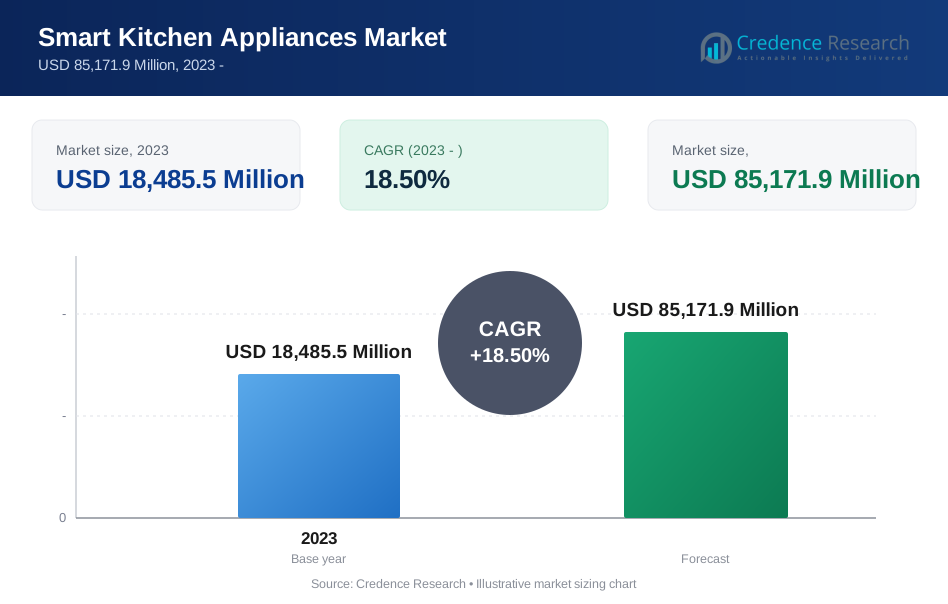
| Smart Kitchen Appliances Market Size 2023 | USD 18,485.5 Million |
| Smart Kitchen Appliances Market, CAGR | 18.50% |
| Smart Kitchen Appliances Market Size 2032 | USD 85,171.9 Million |
Market Insights
- The global Smart Kitchen Appliances Market was valued at USD 18,485.5 Million in 2023 and is anticipated to reach USD 85,171.9 Million in 2032, experiencing a robust CAGR of 18.50% between 2024 and 2032.
- Smart Refrigerators emerged as the market leader among product types, contributing to more than 20% of the total market value in 2023, while Smart Ovens and Ranges are expected to witness rapid growth throughout the forecast period.
- The residential sector dominates the global demand for smart kitchen appliances, accounting for over 20% in 2023 and is predicted to expand at a high CAGR. Within this, Smart Coffee Makers are anticipated to grow the fastest, while Smart Dishwashers will hold a market share of more than 19% in 2023.
- Over the projection period, Smart Features like App-Based Control and Voice Control are expected to witness the highest growth rate, while Appliances with Sustainable Materials will dominate the market in 2023 with a 25% share in the Energy Efficiency and Sustainability category.
- The Online Retailers distribution channel is projected to expand rapidly over the forecast period, while Offline Retailers will have the greatest market share in 2023.
- Leading Appliance Brands, including Whirlpool Corporation, LG Electronics, and Electrolux AB, dominated the market with a combined 45% of the total revenue share by brand in 2023. However, Emerging and Niche Brands are expected to grow fastest throughout the projected period.
- North America is a key driver for the growth of the Smart Kitchen Appliances Market, holding over one-third share in 2023, while Asia-Pacific and Europe collectively account for just under 55% share in 2023, with Europe contributing over 20% share in 2023.
- the Smart Kitchen Appliances Market is driven by the increasing adoption of smart kitchen devices and the integration of advanced technologies.
- Key opportunities in the market include significant growth potential in North America, increased acceptance from residential users, and innovative distribution methods.
Executive Summary
Market Definition
The Smart Kitchen Appliances Market refers to the global market for smart kitchen appliances, which are devices that can be connected to the internet and controlled remotely or through voice commands. These appliances are designed to enhance the user experience, improve efficiency, and offer convenience in the kitchen. The market is expected to grow at a significant rate due to factors such as the rise in adoption of smart homes, increasing demand for energy-efficient appliances, and the integration of artificial intelligence (AI) into smart kitchen appliances..
Market Overview
The Smart Kitchen Appliances Market encompasses a range of connected devices that utilize advanced technologies to enhance cooking, food preparation, and kitchen management. The market includes smart refrigerators, ovens, dishwashers, coffee makers, blenders, mixers, cooktops, sous vide precision cookers, air fryers, toasters, and toaster ovens.
These smart kitchen appliances go beyond traditional functionalities, incorporating features such as voice control, app-based control, artificial intelligence (AI) integration, and compatibility with smart home ecosystems. They offer innovative solutions for energy efficiency, sustainability, and eco-friendly features, catering to the evolving preferences of consumers seeking modern and technologically advanced kitchen solutions.
The market serves both residential and commercial users, including restaurants and cafes. It spans various price ranges, from premium/high-end smart appliances to mid-range and budget/lower-priced options, providing diverse choices for consumers with different preferences and budgets.
Leading appliance brands, such as Whirlpool Corporation, LG Electronics, Electrolux AB, Samsung Electronics Co., Ltd., and others, contribute to the market's growth and competition. Additionally, emerging and niche brands are introducing new and innovative products, adding dynamism to the evolving landscape of smart kitchen appliances.
The Smart Kitchen Appliances Market is driven by the increasing demand for convenient and connected kitchen solutions, influenced by the proliferation of smartphones, laptops, and the integration of smart technologies into daily life.
Segmentation by Product Type
Smart Refrigerators dominate the Smart Kitchen Appliances Market, holding a significant share in 2023. The adoption of smart features like temperature control, inventory management, and connectivity with other kitchen devices contributes to their prominence.
Smart Ovens and Ranges follow closely, showcasing a substantial market share with their advanced cooking functionalities and connectivity options.
Smart Dishwashers, Smart Coffee Makers, Smart Blenders and Mixers, and Smart Cooktops collectively contribute to the diverse range of smart kitchen appliances available in the market.
Segmentation by Connectivity Type
- Wi-Fi Enabled Appliances lead the Connectivity Type segment in the Smart Kitchen Appliances Market. The seamless connectivity allows users to control and monitor their smart kitchen appliances remotely.
- Bluetooth Enabled Appliances provide a convenient short-range wireless connection, enhancing the user experience for specific devices.
- Smart Hub Integration is growing in popularity, creating a centralized control system for various smart kitchen appliances within a smart home ecosystem.
Segmentation by Distribution Channel
- Online Retailers play a crucial role in the Smart Kitchen Appliances Market, offering a wide range of products and the convenience of online shopping.
- Offline Retailers, including brick-and-mortar stores and specialty appliance shops, contribute significantly to the distribution of smart kitchen appliances. Consumers often prefer physical stores for hands-on experiences with the products.
Segmentation by End-User
- Residential Users are the primary consumers of smart kitchen appliances, driving the demand for innovative and connected kitchen solutions.
- Commercial Users, including restaurants and cafes, form a growing segment as they increasingly adopt smart kitchen appliances for efficient and high-quality food preparation.
Segmentation by Price Range
- Premium/High-End Smart Appliances cater to consumers seeking top-of-the-line features and design in their smart kitchen appliances.
- Mid-Range Smart Appliances strike a balance between quality and affordability, appealing to a broad consumer base.
- Budget/Lower-Priced Smart Appliances offer cost-effective options for those entering the smart kitchen appliances market.
Segmentation by Energy Efficiency and Sustainability
- Energy-Efficient Smart Appliances are gaining popularity, reflecting the market's commitment to sustainability and reduced environmental impact.
- Appliances with Sustainable Materials contribute to environmentally friendly practices in the manufacturing and design of smart kitchen appliances.
- Smart Appliances with Eco-Friendly Features encompass various innovations aimed at minimizing the ecological footprint of kitchen devices.
Segmentation by Smart Features
- Voice Control remains a key feature in the Smart Kitchen Appliances Market, allowing users to operate appliances hands-free.
- App-Based Control provides users with the flexibility to manage their smart kitchen appliances through dedicated mobile applications.
- Artificial Intelligence (AI) Integration enhances the intelligence of appliances, enabling adaptive and personalized functionality.
- Recipe Suggestions and Guidance offer culinary assistance, guiding users in preparing diverse and delicious meals.
- Integration with Smart Home Ecosystems fosters a seamless connection between smart kitchen appliances and other devices within a smart home.
Segmentation by Brand
- Leading Appliance Brands, including Whirlpool Corporation, LG Electronics, and Samsung Electronics Co., Ltd., dominate the market, known for their innovation and reliability.
- Emerging and Niche Brands contribute to the diversity of offerings, bringing unique features and designs to the Smart Kitchen Appliances Market.
Segmentation by Region
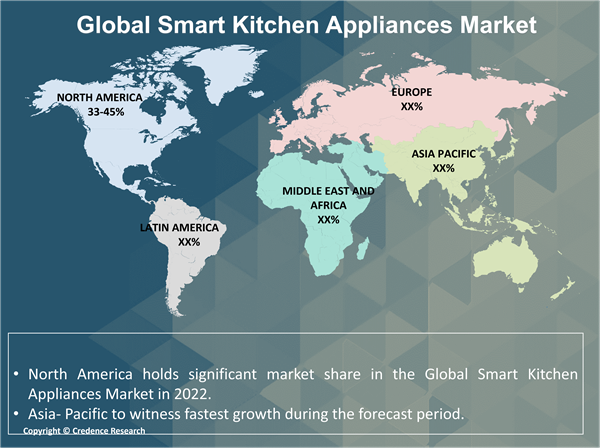
- North America is propelling the growth of the Smart Kitchen Appliances Market, holding over one-third share in 2023. This growth is attributed to the region's expanding interest in smart kitchen solutions, driven by advancements in kitchen technology and increased disposable income.
- Asia Pacific and Europe collectively contribute to just under 55% share in 2023, with Europe holding over 20% share in the same year. The growing awareness and adoption of smart kitchen appliances in these regions are key factors influencing market dynamics.
- The rest of the world, including Latin America, the Middle East, and Africa, caters to the remaining demand for smart kitchen appliances. Emerging markets in these regions are witnessing an increased interest in modern kitchen technologies.
- The Smart Kitchen Appliances Market is witnessing substantial growth due to the rising usage of smartphones and an increased inclination towards smart kitchen solutions.
North America, a pioneering region in adopting technological advancements and a hub for innovation, similarly impacts the Smart Kitchen Appliances Market. The market in North America is driven by factors such as the presence of key enterprises, increasing consumer spending, and a growing reliance on technological innovations.
The integration of smartphones with kitchen devices allows users to enhance their cooking experiences, leveraging features like app-based control and voice commands. For instance, in January 2022, Whirlpool Brand unveils enhanced connected features for its Smart Appliances, introducing the Air Fry Mode and Yummly® Smart Thermometer connectivity. Users can receive over-the-air upgrades, making appliances smarter over time. The new features aim to offer innovative ways for families to care for one another.
In the Asia Pacific region, economic indicators signal robust growth and increasing disposable incomes, contributing positively to the Smart Kitchen Appliances Market. According to the National Bureau of Statistics of China, the country experienced a notable 6.3% increase in per capita disposable income in 2023, reaching 39,218 yuan (approximately 5,511 U.S. dollars). This upswing reflects the region's economic prosperity, creating favorable conditions for consumers to invest in advanced kitchen technologies.
In India, data from Trading Economics and the RBI reveals a substantial uptick in disposable personal income. In 2023, disposable personal income surged to ($3,564,887 million) 297,059,026.70 INR Million, compared to ($3,303,450 million) 273,364,818.90 INR Million in 2022. This growth underscores India's economic development, providing consumers with greater financial capacity to embrace innovative and smart kitchen appliances.
Key Highlights of the Report
The global Smart Kitchen Appliances Market is segmented by product type, connectivity type, distribution channel, end-user, price range, energy efficiency, smart features, and brand. Smart Refrigerators, Smart Ovens and Ranges, Smart Dishwashers, Smart Coffee Makers, Smart Blenders and Mixers, Smart Cooktops, Smart Sous Vide Precision Cookers, Smart Air Fryers, and Smart Toasters and Toaster Ovens contribute to the diverse product landscape.
Wi-Fi Enabled Appliances, Bluetooth Enabled Appliances, and Smart Hub Integration define the connectivity options, while online and offline retailers serve as key distribution channels. The market caters to both Residential Users and Commercial Users, including restaurants and cafes. Price range options encompass Premium/High-End Smart Appliances, Mid-Range Smart Appliances, and Budget/Lower-Priced Smart Appliances.
Energy efficiency and sustainability play a crucial role, with offerings ranging from Energy-Efficient Smart Appliances to those made with Sustainable Materials, and Smart Appliances with Eco-Friendly Features. Various smart features such as Voice Control, App-Based Control, Artificial Intelligence (AI) Integration, Recipe Suggestions and Guidance, and Integration with Smart Home Ecosystems further enhance the appeal of these appliances.
The market is characterized by leading appliance brands and emerging niche brands, including Whirlpool Corporation, LG Electronics, Electrolux AB, Samsung Electronics Co., Ltd., Haier Group, Panasonic Corporation, BSH Hausgerate GmbH, Breville, Miele & Cie. KG, and Dongbu Daewoo Electronics.
The Smart Kitchen Appliances Market is poised for significant growth, driven by the increasing adoption of smart technologies in kitchens worldwide. Residential users seeking convenience and commercial establishments aiming for efficiency contribute to the market's expansion.
What Are The Main Drivers Of the Smart Kitchen Appliances Market?
The primary drivers of the Smart Kitchen Appliances Market include the growing trend of adopting smart technologies in kitchens globally. The increased use of consumer electronics like smartphones contributes significantly to the market's growth. The rising demand for smart kitchen appliances stems from their benefits, including high efficiency in data and power transfer capacity.
What Are The Major Challenges Faced By The Smart Kitchen Appliances Market?
The Smart Kitchen Appliances Market confronts challenges such as high initial costs, interoperability issues, data security concerns, and the need for consumer education. Additionally, technological obsolescence, reliability issues, limited infrastructure support, and environmental impacts present hurdles requiring industry collaboration for sustainable growth and widespread adoption.
What Are The Growth Opportunities In The Smart Kitchen Appliances Market?
Growth opportunities in the smart kitchen appliances market include increased adoption of smart home technology, rising demand for convenient and efficient cooking solutions, and expansion into new product categories such as smart utensils and cookware. Additionally, integration with emerging technologies like artificial intelligence, machine learning, and voice assistance will drive future growth.
Market Drivers
Increasing Demand For Smart Home Solutions And The Growing Trend Toward Connected Kitchens
The increasing demand for smart home solutions and the growing trend toward connected kitchens is a key driver in the smart kitchen appliance market. This demand can be attributed to several factors, including technological advancements, changing consumer preferences, and the increasing focus on energy efficiency and sustainability. One of the main reasons behind this trend is the rapid development of technology and the increasing accessibility of smart devices. As more households adopt smartphones and other connected devices, consumers are becoming more comfortable with the concept of a connected home. This has led to a surge in demand for smart home solutions, which include smart kitchen appliances. As a result market players are coming up with new and innovative solutions to fulfill the demand of the market. For instance, January 2023, Samsung unveils new additions to its Bespoke Home lineup at CES 2023, offering customizable and connected kitchen experiences. Features include a larger 32-inch screen for the Bespoke 4-Door Flex™ with Family Hub™+, advanced AI Pro Cooking for the Bespoke AI™ Oven, and expanded Bespoke refrigerator types. Moreover, the growing focus on energy efficiency and sustainability is also contributing to the popularity of smart kitchen appliances. Many of these devices are designed to be more energy-efficient than their traditional counterparts, helping consumers reduce their carbon footprint and save money on utility bills. For instance,January 2021, Panasonic expanded its home appliance portfolio in India with the launch of Prime Convertible Refrigerators. The new range, manufactured in India, features advanced modes for preserving food, energy conservation, and is designed to meet Indian lifestyle needs.
Market Restraints
High Initial Costs And Affordability Concerns
High initial costs and affordability concerns pose a significant restraint in the smart kitchen appliance market. The adoption of smart kitchen appliances has been slow due to the high prices associated with these devices. This can be attributed to several factors, such as the complexity of the technology, the production cost, and the profit margins of the manufacturers. Also, high initial costs of smart kitchen appliances can be a significant barrier to consumer adoption. Many potential buyers may be hesitant to invest in these expensive devices, especially if they perceive the benefits as not outweighing the costs. Affordability concerns can be further exacerbated by the fact that some consumers may not see the need for smart features in their kitchen appliances, as they may be satisfied with traditional models.
Opportunities
Integration Of Artificial Intelligence (AI) And Machine Learning Technologies
AI-driven features such as recipe suggestions, personalized cooking recommendations, and adaptive learning capabilities enhance user experiences. The opportunity lies in the continuous development of intelligent algorithms and data analytics to provide more personalized and efficient cooking solutions, catering to the evolving preferences of users and fostering market growth. For instnace Upliance.ai, a consumer hardware start-up, integrates ChatGPT into its flagship product, delishUp, becoming one of the companies to incorporate conversational AI into a home appliance. The smart cooking assistant simplifies meal preparation, offering over 250 guided recipes with generative and responsive suggestions, aiming to encourage more home cooking in India.
Competitive Landscape
Key Players
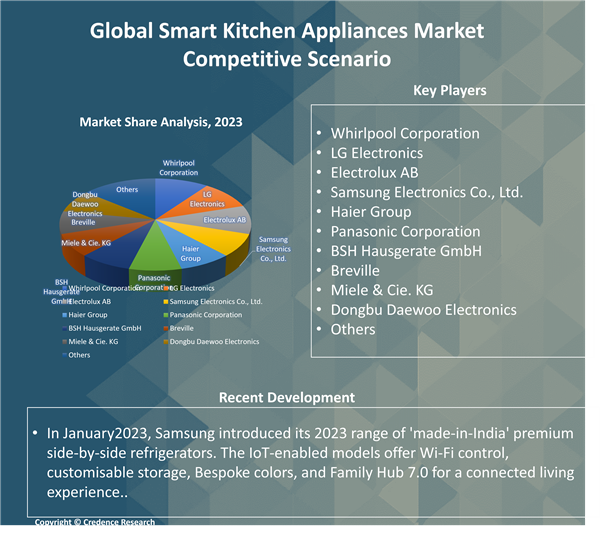
The global Smart Kitchen Appliances Market is highly competitive, with several key players. Some of the major players in the market and their market share are as follows:
- Whirlpool Corporation
- LG Electronics
- Electrolux AB
- Samsung Electronics Co., Ltd.
- Haier Group
- Panasonic Corporation
- BSH Hausgerate GmbH
- Breville
- Miele & Cie. KG
- Dongbu Daewoo Electronics
- Other
These organizations prioritize product innovation, distribution channel expansion, and mergers and acquisitions to stay competitive. The Smart Kitchen Appliances market's key players continually seek to stay ahead by offering new products and developments.
In November 2023, Thermomix opens its first U.S. retail store in Miami, showcasing the TM6 appliance. The move follows strong sales growth and aims to provide an immersive cooking experience for customers.
In March 2023, Fresco launched KitchenOS, an all-in-one operating system for smart kitchens, offering cross-brand connectivity. Instant Pot Pro Plus is the first appliance on the platform, aiming to streamline the connected kitchen experience.
Summary of Key Findings
- The demand for smart kitchen appliances is on the rise due to the increasing preference for connected and technologically advanced kitchen devices, driven by factors such as convenience and efficiency in cooking and household tasks.
- Market segmented by product type, connectivity type, distribution channel, end-user, price range, energy efficiency and sustainability, smart features, and brand.
- Wi-Fi-enabled appliances and app-based control are gaining popularity, with smart refrigerators and ovens being primary choices for residential and commercial users.
- North America is leading the market growth, with key players including Whirlpool Corporation, LG Electronics, Electrolux AB, Samsung Electronics Co., Ltd., and others contributing to the highly competitive landscape.
Future Outlook:
- Positive outlook for the global smart kitchen appliances market with significant growth potential, especially in North America.
- The market expansion is fueled by the increasing adoption of smart kitchen appliances in both residential and commercial sectors.
- During the forecast period, consumer preferences for technologically advanced features and connectivity may drive market growth, while the challenge lies in balancing the increasing demand for wireless solutions.
- Key firms should prioritize product innovation, market expansion, and competitive pricing to stay ahead in the dynamic market of smart kitchen appliances.
How CXOs Can Benefit from the Smart Kitchen Appliances Market Report
The Smart Kitchen Appliances Market Report offers CXOs a comprehensive overview of the market, presenting valuable insights and information for strategic decision-making. Here are key aspects covered in the report:
Market Size and Growth Forecast: The report provides detailed estimates of the global smart kitchen appliances market size for 2023 and forecasts growth through 2032. Segmentation is done by product type, connectivity type, distribution channel, end-user, price range, energy efficiency, and brand.
Market Segmentation: CXOs gain a granular understanding of the market through segmentation by various criteria. This includes product types, connectivity types, distribution channels, end-users, and more, allowing for targeted strategies in specific market segments.
Competitive Landscape: Profiles of key players in the smart kitchen appliances market are included, offering insights into their strategies, product offerings, and financial performance. This information aids CXOs in identifying and assessing their competition, enabling informed decision-making.
Key Trends and Drivers: Identification and analysis of key trends and drivers shaping the smart kitchen appliances market are crucial for CXOs. This information empowers them to make informed decisions regarding investments and strategic planning.
How CXOs Can Utilize the Insights:
Identify Growth Opportunities: The report helps CXOs identify growth opportunities within the smart kitchen appliances market. For instance, recognizing the increasing demand for Wi-Fi-enabled appliances or the growth potential in the commercial sector.
Informed Investment Decisions: CXOs can make informed investment decisions by leveraging insights into key factors influencing the market. This includes considerations when evaluating suppliers, selecting products, and staying abreast of emerging technologies.
Develop Competitive Strategies: Understanding the competitive landscape and key strategies used by market players enables CXOs to formulate effective competitive strategies. This might involve differentiation through innovative features or strategic partnerships.
Track Market Developments: Staying ahead of market developments is essential. The report provides insights into the latest trends and innovations in the smart kitchen appliances market, allowing CXOs to adapt their strategies accordingly.
In conclusion, the Smart Kitchen Appliances Market Report is a valuable resource for CXOs seeking a deeper understanding of the market dynamics and looking to capitalize on growth opportunities in the smart kitchen appliances industry.
Segmentation
- By Product Type
- Smart Refrigerators
- Smart Ovens and Ranges
- Smart Dishwashers
- Smart Coffee Makers
- Smart Blenders and Mixers
- Smart Cooktops
- Smart Sous Vide Precision Cookers
- Smart Air Fryers
- Smart Toasters and Toaster Ovens
- By Connectivity Type
- Wi-Fi Enabled Appliances
- Bluetooth Enabled Appliances
- Smart Hub Integration
- By Distribution Channel
- Online Retailers
- Offline Retailers
- By End-User
- Residential Users
- Commercial Users (Restaurants, Cafes, etc.)
- By Price Range
- Premium/High-End Smart Appliances
- Mid-Range Smart Appliances
- Budget/Lower-Priced Smart Appliances
- By Energy Efficiency and Sustainability
- Energy-Efficient Smart Appliances
- Appliances with Sustainable Materials
- Smart Appliances with Eco-Friendly Features
- By Smart Features
- Voice Control
- App-Based Control
- Artificial Intelligence (AI) Integration
- Recipe Suggestions and Guidance
- Integration with Smart Home Ecosystems
- By Brand
- Leading Appliance Brands
- Emerging and Niche Brands
- By Region
- North America
- US
- Canada
- Mexico
- Europe
- Germany
- France
- UK
- Italy
- Spain
- Rest of Europe
- Asia Pacific
- China
- Japan
- India
- South Korea
- South-east Asia
- Rest of Asia Pacific
- Latin America
- Brazil
- Argentina
- Rest of Latin America
- Middle East & Africa
- GCC Countries
- South Africa
- Rest of Middle East and Africa
- North America
Adjacent Markets
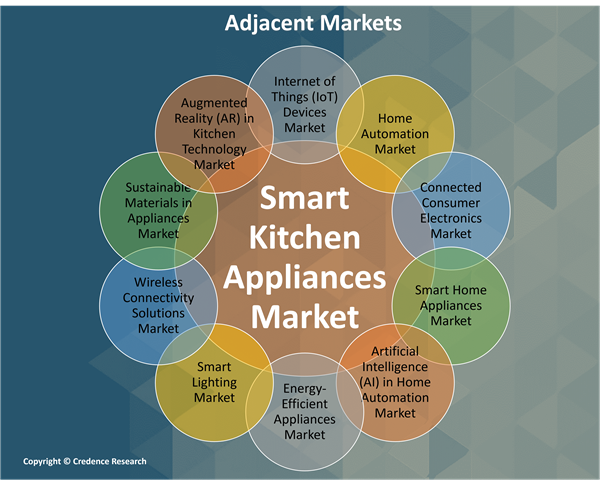
In the Smart Kitchen Appliances Market, there are several adjacent markets which has high revenue growth opportunities. The key adjacent markets for Smart Kitchen Appliances Market-
Request a Free Sample
Fill in your details and we'll send you a free sample report.
- Sample data tables & charts
- Research methodology
Need a Custom Version of This Report?
Tailor the scope, geography, or segments to your exact requirements.
- Custom geography or segment scope
- Direct access to our analyst team
Frequently Asked Questions
What is the current size of the global Smart Kitchen Appliances Market?
What is the expected growth rate of the Smart Kitchen Appliances Market between 2024and 2032?
Which end-users segment governs the demand for Smart Kitchen Appliances globally?
Which connectivity type is most popular in the Smart Kitchen Appliances Market?
Which region is fueling the growth of the Smart Kitchen Appliances industry?
Who are the major players in the global Smart Kitchen Appliances Market?
What are the major market drivers of the Smart Kitchen Appliances industry?
Table of Content
Chapter 1. Report Introduction
- 1.1 Report Description & Purpose
- 1.1.1 Report Title & Market Definition
- 1.1.2 Unique Selling Propositions (USP) & Key Differentiators
- 1.1.3 Value Proposition for Stakeholders
- 1.2 Research Objectives
- 1.2.1 Market Sizing Objectives (Volume & Revenue)
- 1.2.2 Segmentation Objectives
- 1.2.3 Competitive Intelligence Objectives
- 1.2.4 Forecast & Scenario Objectives
- 1.3 Report Scope
- 1.3.1 Smart Kitchen Appliances Scope – Types & Subtypes Covered
- 1.3.2 Geographic Scope – Regions & Countries Covered
- 1.3.3 Historical Period, Base Year & Forecast Period (2023; forecast to the forecast period)
- 1.3.4 Inclusions & Exclusions
- 1.4 HS Code & Classification Framework
- 1.5 Currency, Units & Pricing Basis
- 1.6 Target Stakeholders
- 1.7 Limitations & Assumptions
Chapter 2. Executive Summary
- 2.1 Global Smart Kitchen Appliances Market Snapshot
- 2.1.1 Market Size – Historical (2023) & Forecast (the forecast period) (2023: USD 18,485.5 Million → forecast year: USD 85,171.9 Million)
- 2.1.2 Volume & Revenue – Global Totals
- 2.1.3 Key Market Highlights – Top Five Facts
- 2.2 Smart Kitchen Appliances Market Segmentation Snapshot
- 2.2.1 Market Split by Region – 2023 vs.
- 2.3 Competitive Snapshot
- 2.3.1 Top 10 Players by Revenue Share – 2023
- 2.3.2 Top 10 Players by Volume Share – 2023
- 2.3.3 Recent Strategic Developments (18-Month Summary)
- 2.4 Key Investment Highlights & Strategic Conclusions
Chapter 3. Smart Kitchen Appliances Market Dynamics & Industry Analysis
- 3.1 Market Overview & Context
- 3.1.1 Smart Kitchen Appliances Market Position in the Broader Automotive Value Chain
- 3.1.2 OEM vs. Replacement Market Dynamics
- 3.1.3 Market Maturity & Development Stage by Region
- 3.2 Smart Kitchen Appliances Market Drivers
- 3.3 Smart Kitchen Appliances Market Restraints & Challenges
- 3.4 Smart Kitchen Appliances Market Opportunities
- 3.5 Porter's Five Forces Analysis
- 3.5.1 Threat of New Entrants
- 3.5.2 Bargaining Power of Suppliers
- 3.5.3 Bargaining Power of Buyers
- 3.5.4 Threat of Substitutes
- 3.5.5 Competitive Rivalry – Intensity Assessment
- 3.6 Smart Kitchen Appliances Value Chain Analysis
- 3.6.1 Upstream – Raw Material/Input Suppliers
- 3.6.1.1 Raw Material/Input 1
- 3.6.1.2 Raw Material/Input 2
- 3.6.1.3 Raw Material/Input 3
- 3.6.2 Midstream – Production/Manufacturing/Service Delivery
- 3.6.2.1 Production/Process Overview
- 3.6.2.2 Key Facility Locations & Capacity by Manufacturer
- 3.6.3 Downstream – Distribution & End Consumer
- 3.6.3.1 Primary Channel – B2B/OEM
- 3.6.3.2 Secondary Channels – Dealer, Retail, Online, Direct
- 3.6.4 Value Chain Profitability Analysis
- 3.6.1 Upstream – Raw Material/Input Suppliers
- 3.7 PESTEL Analysis
- 3.7.1 Political Factors
- 3.7.2 Economic Factors
- 3.7.3 Social Factors
- 3.7.4 Technological Factors
- 3.7.5 Environmental Factors
- 3.7.6 Legal Factors
- 3.8 Smart Kitchen Appliances Supply Chain Analysis
- 3.8.1 Raw Material/Input Supply Risk Assessment
- 3.8.2 Manufacturing Concentration Risk (Geographic Exposure)
- 3.8.3 Trade Disruption Impact Analysis
- 3.9 Regulatory & Policy Landscape
Note: The regulatory and policy landscape section covers regulations based on their applicability to the market, Smart Kitchen Appliances category, geography, and scope of the study. Only regulatory frameworks with a material impact on operations, compliance, trade, sustainability, or market access are analyzed in detail.
Chapter 4. Key Investment Pockets & Opportunity Analysis
- 4.1 Smart Kitchen Appliances Market Attractiveness Analysis
- 4.1.1 By Region – Investment Attractiveness Matrix (Volume × CAGR)
- 4.2 Absolute Revenue Growth Opportunity
- 4.2.1 By Region – Absolute USD Growth Through the forecast period
- 4.3 Incremental Volume Opportunity
- 4.3.1 By Region – Incremental Volume Through the forecast period
- 4.3.2 Segment – Incremental Volume
- 4.4 Emerging Submarket Opportunity Deep Dive (Subject to Applicability)
- 4.5 Emerging Market Opportunity Scorecards
- 4.5.1 United States
- 4.5.2 Europe
- 4.5.3 Asia
- 4.5.4 Middle East & Africa
Note: Emerging Market Opportunity Scorecards will be included based on relevance and strategic importance. Regions listed are indicative and may vary depending on data availability and market dynamics.
Chapter 5. Smart Kitchen Appliances Import-Export Analysis & Trade Flows
- 5.1 Global Trade Overview
- 5.1.1 Global Export Value by Country (2023)
- 5.1.2 Global Export Volume by Country (2023)
- 5.1.3 Global Import Value by Country (2023)
- 5.1.4 Global Import Volume by Country (2023)
- 5.1.5 Net Trade Balance by Country (2023)
- 5.2 Export Analysis – Segment
- 5.2.1 Type 1 (HS Code)
- 5.2.2 Type 2 (HS Code)
- 5.2.3 Type 3 (HS Code)
- 5.2.4 Type 4 (HS Code)
- 5.2.5 Type 5 (HS Code)
- 5.3 Import Analysis – Segment
- 5.3.1 Type 1 (HS Code)
- 5.3.2 Type 2 (HS Code)
- 5.3.3 Type 3 (HS Code)
- 5.3.4 Type 4 (HS Code)
- 5.3.5 Type 5 (HS Code)
- 5.4 Average Unit Trade Prices
- 5.4.1 Average Export Price – Segment & Country
- 5.4.2 Average Import Price – Segment & Source Country
- 5.4.3 Price Trends (2023)
- 5.5 Key Trade Route Analysis
- 5.5.1 Trade Route 1
- 5.5.2 Trade Route 2
- 5.5.3 Trade Route 3
- 5.5.4 Trade Route 4
- 5.5.5 Trade Route 5
- 5.6 Trade Policy Impact Assessment
- 5.6.1 US Anti-Dumping & Section 301 Tariffs
- 5.6.2 EU Customs Union Impact
- 5.6.3 Major Free Trade Agreements
- 5.6.4 USMCA Rules of Origin
Note: Trade policy analysis will be included only where relevant to the Smart Kitchen Appliances market.
Chapter 6. Competitive Landscape & Company Benchmarking
- 6.1 Smart Kitchen Appliances Market Concentration & Structure
- 6.1.1 Herfindahl-Hirschman Index (HHI) – vs. 2023
- 6.1.2 Tier 1, Tier 2 & Tier 3 Market Structure
- 6.1.3 Global, Regional & Local Player Dynamics
- 6.2 Smart Kitchen Appliances Market Share Analysis – 2023
- 6.2.1 Global Revenue Share by Company
- 6.2.2 Global Volume Share by Company
- 6.2.3 Regional Revenue Share
- 6.2.4 Market Share Evolution ( vs. 2023)
- 6.2.5 OEM Segment Share by Company
- 6.2.6 Replacement Segment Share by Company
- 6.3 Production/Delivery Capacity & Facility Analysis
- 6.3.1 Global Installed Capacity
- 6.3.2 Capacity Utilization Rates
- 6.3.3 Production/Output Volume
- 6.3.4 Facility Locations & Capacity Map
- 6.3.5 Planned Capacity Additions
- 6.4 Smart Kitchen Appliances Competitive Benchmarking Matrix
- 6.4.1 Revenue, Volume, CAGR & Profitability Comparison
- 6.4.2 Channel Revenue Mix
- 6.4.3 Geographic Revenue Exposure
- 6.4.4 R&D Intensity
- 6.4.5 Sustainability Maturity
- 6.5 Strategic Developments in Smart Kitchen Appliances (Last 24 Months)
- 6.5.1 Mergers, Acquisitions & Divestments
- 6.5.2 New Smart Kitchen Appliances Launches
- 6.5.3 Facility Expansions
- 6.5.4 Strategic Alliances, Joint Ventures & Partnerships
- 6.5.5 Distribution Expansion & Market Entry
- 6.5.6 Sustainability & ESG Initiatives
- 6.6 Competitive Strategy Mapping
- 6.6.1 Leader, Challenger, Follower & Niche Classification
- 6.6.2 Pricing Strategy Comparison
- 6.6.3 Channel Strategy Matrix
Note: Strategic developments are included based on their materiality and the availability of reliable information.
Chapter 7. Global Smart Kitchen Appliances Market – By Distribution Channel
- 7.1 Segment Overview
- 7.1.1 Volume & Revenue Split by Channel (2023 & )
- 7.1.2 Channel Mix Evolution (the forecast period)
Chapter 8. Regional Market Analysis – Global Overview
- 8.1 Global Regional Overview
- 8.1.1 Regional Volume Share
- 8.1.2 Regional Revenue Share
- 8.1.3 Regional Volume by Region
- 8.1.4 Regional Revenue by Region
- 8.1.5 Regional Forecast Through the forecast period
- 8.2 Cross-Regional Segment Analysis
- 8.2.1 By Distribution Channel
- 8.2.2 By Brand/Price Tier
Chapter 9. North America Smart Kitchen Appliances Market
- 9.1 United States
- 9.2 Canada
- 9.3 Mexico
Chapter 10. Europe Smart Kitchen Appliances Market
- 10.1 Germany
- 10.2 France
- 10.3 Italy
- 10.4 United Kingdom
- 10.5 Spain
- 10.6 Poland
- 10.7 Russia
- 10.8 Netherlands
- 10.9 Belgium
- 10.10 Sweden
- 10.11 Denmark
- 10.12 Norway
- 10.13 Rest of Europe
Chapter 11. Asia Pacific Smart Kitchen Appliances Market
- 11.1 China
- 11.2 India
- 11.3 Japan
- 11.4 South Korea
- 11.5 Thailand
- 11.6 Indonesia
- 11.7 Vietnam
- 11.8 Malaysia
- 11.9 Australia
- 11.10 Rest of Asia Pacific
Chapter 12. Latin America Smart Kitchen Appliances Market
- 12.1 Brazil
- 12.2 Argentina
- 12.3 Colombia
- 12.4 Chile
- 12.5 Rest of Latin America
Chapter 13. Middle East Smart Kitchen Appliances Market
- 13.1 Saudi Arabia
- 13.2 United Arab Emirates
- 13.3 Turkey
- 13.4 Israel
- 13.5 Iran
- 13.6 Rest of the Middle East
Chapter 14. Africa Smart Kitchen Appliances Market
- 14.1 South Africa
- 14.2 Egypt
- 14.3 Nigeria
- 14.4 Morocco
- 14.5 Rest of Africa
Chapter 15. Smart Kitchen Appliances Company Profiles
- 15.1 [Company 01]
- 15.1.1 Company Overview
- 15.1.2 Key Management Personnel
- 15.1.3 Products & Services Portfolio
- 15.1.4 Financial Performance
- 15.1.5 Key Market Focus & Geographic Presence
- 15.1.6 Recent Developments & Strategic Initiatives
Note: The company profile list is preliminary and may change based on research findings, market developments, data availability, and client requirements.
Chapter 16. Appendices
- Appendix A – List of Abbreviations & Acronyms
- Appendix B – Industry Classification Code Reference – Full Series
- Appendix C – Production & Capacity Data Tables
- Appendix D – End-Use & Demand Base Tables
- Appendix E – Consumption & Replacement Rate Assumptions
- Appendix F – ASP Reference Tables
- Appendix G – Manufacturing & Facility Database
- Appendix H – Import-Export Data Tables
- Appendix I – Regulatory Summary Tables
- Appendix J – Primary Research Participant List (Anonymized)
- Appendix K – Primary Research Questionnaire Framework
- Appendix L – Data Sources & Bibliography
- Appendix M – Market Size Divergence & Source Comparison
Chapter 17. Research Methodology
- 17.1 Research Framework & Philosophy
- 17.2 Secondary Research – Sources, Hierarchy & Data Extraction
- 17.3 Data Modeling – Bottom-Up & Top-Down Market Sizing
- 17.4 Primary Research – Stakeholder Framework, LOI & Sample Sizes
- 17.5 Forecast Methodology – Regression, Scenario & Sensitivity Analysis
- 17.6 Quality Control – Four-Layer Validation Framework
- 17.7 Limitations & Standard Assumptions
- 17.8 Disclaimer
