
Market Overview:
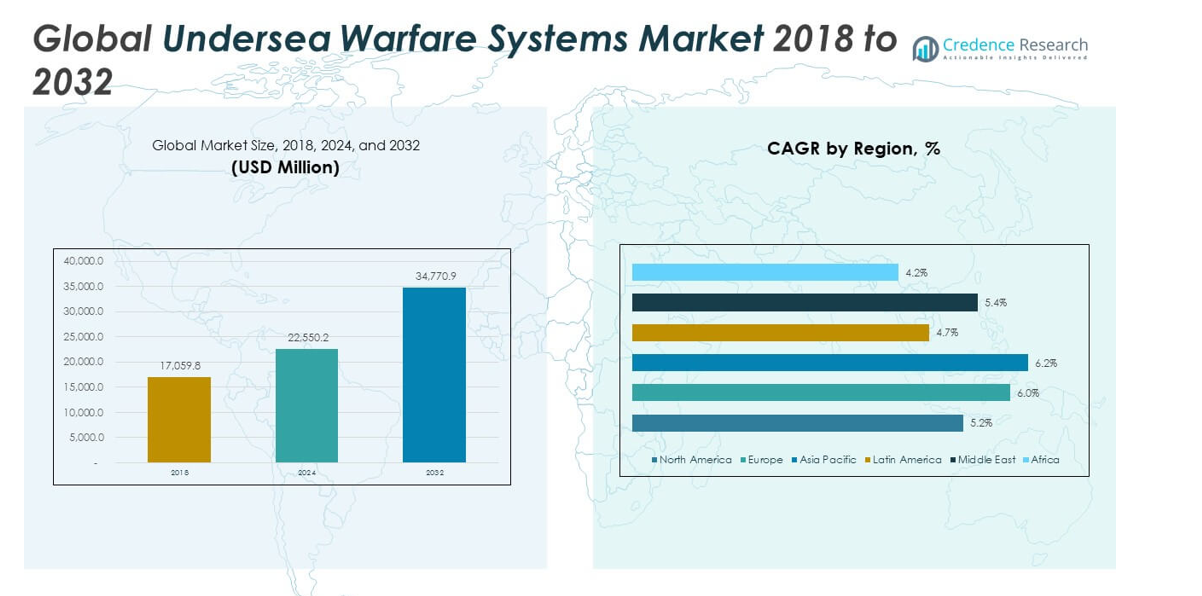
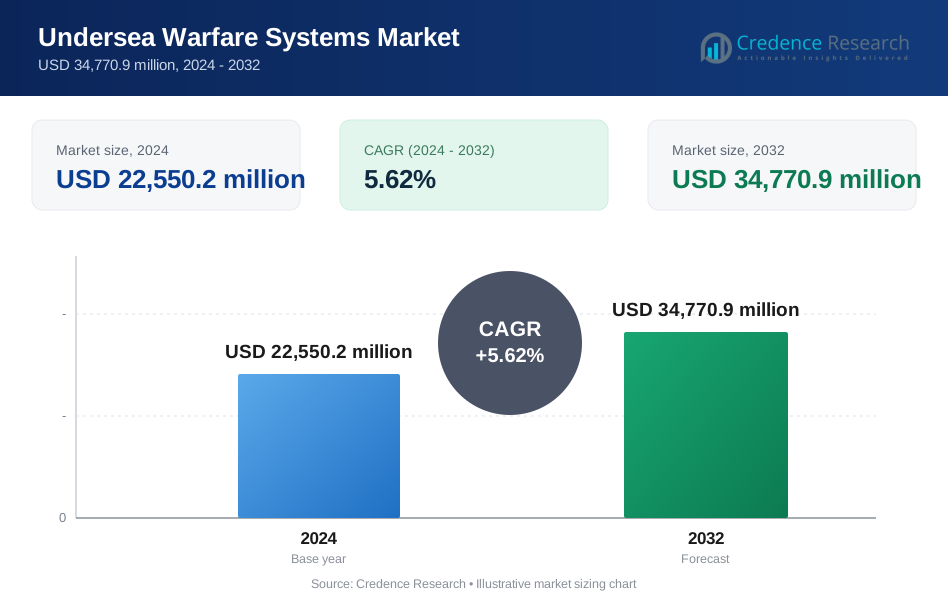
The Global Undersea Warfare Systems Market size was valued at USD 17,059.8 million in 2018 to USD 22,550.2 million in 2024 and is anticipated to reach USD 34,770.9 million by 2032, at a CAGR of 5.62% during the forecast period.
| REPORT ATTRIBUTE | DETAILS |
|---|---|
| Historical Period | 2020-2023 |
| Base Year | 2024 |
| Forecast Period | 2025-2032 |
| Undersea Warfare Systems Market Size 2024 | USD 22,550.2 million |
| Undersea Warfare Systems Market, CAGR | 5.62% |
| Undersea Warfare Systems Market Size 2032 | USD 34,770.9 million |
Market growth is driven by rising geopolitical tensions, increased defense budgets, and the need for advanced naval capabilities. Nations are focusing on submarine modernization, deployment of unmanned underwater vehicles, and integration of advanced sonar and communication systems. It is further supported by technological innovation, investments in stealth platforms, and growing demand for effective anti-submarine warfare solutions across global naval forces.
North America leads the Global Undersea Warfare Systems Market due to strong naval dominance and consistent investment in modernization. Europe follows with collaborative defense projects and steady procurement of advanced platforms. Asia Pacific is emerging rapidly, fueled by territorial disputes, maritime trade security needs, and expanding defense budgets in countries like China, India, Japan, and South Korea. The Middle East and Latin America show gradual growth with targeted investments, while Africa remains at an early adoption stage.
Market Insights:
- The Global Undersea Warfare Systems Market size was USD 17,059.8 million in 2018, reached USD 22,550.2 million in 2024, and is projected to achieve USD 34,770.9 million by 2032, registering a CAGR of 5.62% during the forecast period.
- North America leads with 34% share, supported by strong naval modernization and high defense spending, followed by Europe at 27% with collaborative defense projects, and Asia Pacific at 24% driven by territorial disputes and expanding fleets.
- Asia Pacific is the fastest-growing region with 6.2% CAGR and a 24% market share, propelled by maritime security concerns, growing defense budgets, and indigenous naval development in China, India, Japan, and South Korea.
- In technology segmentation, autonomous systems account for 68% share in 2024, reflecting rising adoption of unmanned underwater vehicles for surveillance, detection, and multi-role missions.
- Remotely operated systems hold 32% share, continuing to support critical tasks requiring human oversight and precision in complex undersea environments.
Market Drivers
Rising Geopolitical Tensions and Growing Focus on Maritime Security
The Global Undersea Warfare Systems Market is expanding as nations seek stronger naval dominance. Increasing territorial disputes and maritime border conflicts drive countries to invest heavily in advanced undersea warfare technologies. Governments focus on strengthening naval assets to ensure protection of trade routes and exclusive economic zones. The integration of sophisticated sonar, sensors, and anti-submarine systems enhances operational readiness. It reflects the rising demand for tactical deterrence in both peacetime surveillance and combat scenarios. Defense budgets are being directed toward undersea warfare programs at unprecedented levels. Naval alliances and regional security collaborations support this spending surge. Strategic investments are shaping a new defense ecosystem centered on undersea capabilities.
Growing Investments in Modernization of Naval Fleets Worldwide
Continuous modernization of naval fleets fuels demand for cutting-edge undersea warfare platforms. Major economies are replacing outdated systems with next-generation submarines, unmanned underwater vehicles, and detection technologies. The Global Undersea Warfare Systems Market benefits from this cycle of replacement and fleet enhancement. It supports the development of stealth capabilities and multi-mission underwater assets. Research programs are producing lighter, more efficient systems that integrate seamlessly into naval networks. Defense authorities prioritize systems that combine surveillance, strike, and communication functions. The replacement of traditional equipment with digital and autonomous solutions accelerates adoption. Fleet modernization ensures that naval forces maintain readiness against evolving threats.
- For instance, HMS Astute, the lead submarine of the Astute-class built by BAE Systems, measures 97 meters in length, displaces 7,400 tons, and is nuclear-powered, enabling mission deployments of up to 90 days without surfacing, a capability highlighted by the Royal Navy.
Advancement of Unmanned Systems and Underwater Surveillance Technologies
Unmanned underwater vehicles are becoming central to undersea warfare strategies. These systems provide cost-effective solutions for mine detection, anti-submarine missions, and surveillance. The Global Undersea Warfare Systems Market witnesses increasing integration of unmanned assets into both defensive and offensive operations. It strengthens naval autonomy while reducing risks to personnel. Cutting-edge underwater sensors and surveillance platforms deliver real-time intelligence to commanders. Multi-domain integration enhances coordination between surface, air, and underwater assets. Nations invest heavily in AI-enabled systems to improve targeting precision and situational awareness. The growth of unmanned solutions underscores the shift toward technology-led naval dominance.
Increasing Emphasis on Multi-Domain Defense and Strategic Deterrence Capabilities
The demand for integrated defense capabilities across land, sea, and air is intensifying. The Global Undersea Warfare Systems Market reflects this shift through systems designed for seamless coordination with allied forces. It allows navies to establish stronger deterrence against potential aggressors. Submarines equipped with advanced missile systems enhance strike potential in contested waters. Nations are prioritizing joint operations that combine undersea, cyber, and space technologies. Defense contractors develop modular systems adaptable to multiple mission requirements. Multi-domain strategies ensure interoperability across national and allied fleets. This emphasis creates sustained demand for advanced undersea warfare solutions that secure long-term superiority.
- For instance, in April 2025, Anduril handed over its first Dive-LD autonomous underwater vehicle (AUV) to the US Navy’s UUVRON-1 squadron, featuring a modular design for long-endurance missions, supporting payload adaptations for undersea mapping, communications, and infrastructure inspection, forming part of systems integration for future multi-domain naval operations.
Market Trends
Rapid Integration of Artificial Intelligence and Autonomous Systems in Naval Platforms
The Global Undersea Warfare Systems Market is witnessing a shift toward AI-driven automation. Autonomous undersea vehicles enhance endurance, navigation, and mission accuracy without constant human intervention. It accelerates the adoption of predictive maintenance and operational planning. AI supports improved sonar data interpretation, leading to faster decision-making in combat environments. Defense forces prioritize platforms that reduce human risk during deep-sea missions. Vendors compete to integrate advanced learning algorithms for tactical adaptability. The trend highlights the movement toward smart and independent naval systems. AI adoption sets the foundation for future-ready undersea warfare capabilities.
Expansion of Undersea Communication Networks and Secure Data Exchange Systems
The growing importance of secure communication drives innovation in underwater networks. The Global Undersea Warfare Systems Market is evolving with technologies that improve long-range connectivity. It enhances fleet coordination and real-time data exchange across multiple assets. Fiber-optic links, acoustic communication, and laser-based systems are under development. Navies require uninterrupted links for operational effectiveness in contested waters. The focus lies on encryption technologies that protect sensitive intelligence. Collaborative projects between nations strengthen advancements in secure communication frameworks. These trends underscore the vital role of connectivity in sustaining modern undersea operations.
- For instance, Saab’s AUV62-AT system provides fully programmable active and passive acoustic communication underwater, supporting operations at depths of up to 300 meters with a frequency response range of 1 kHz to 100 kHz, as documented by official Saab technical brochures and product releases.
Shift Toward Green Naval Technologies and Energy-Efficient Undersea Platforms
Sustainability goals are reshaping naval procurement strategies. The Global Undersea Warfare Systems Market reflects a trend toward eco-friendly propulsion and power systems. It encourages the use of hybrid engines, battery-powered submarines, and fuel-efficient technologies. Reduced emissions and quieter engines enhance stealth operations in deep-sea environments. Defense organizations invest in research programs supporting renewable energy adoption in undersea fleets. Energy-efficient designs reduce long-term operational costs while improving endurance. The integration of sustainable technologies boosts naval reputation in global defense diplomacy. The shift signals alignment with broader climate-conscious defense initiatives.
- For instance, the Type 212CD submarine by ThyssenKrupp Marine Systems uses a PEM fuel-cell air-independent propulsion module that lets it stay submerged for several weeks without snorkeling. The predecessor Type 212A demonstrated up to three weeks of continuous submerged endurance using its AIP system. Public program documents confirm that the 212CD will retain this capability and feature an upgraded, larger fuel cell module.
Growing Role of Simulation, Training, and Virtual Reality in Naval Preparedness
Advanced training tools are transforming naval readiness strategies. The Global Undersea Warfare Systems Market increasingly adopts simulation and VR platforms for crew training. It enables realistic combat scenarios without the cost and risk of live exercises. Virtual systems provide adaptive environments to test new tactics and strategies. They improve crew performance and reduce training time for complex systems. Vendors design multi-level simulators to enhance decision-making under pressure. Governments allocate funds to integrate advanced training programs with new undersea assets. This trend accelerates preparedness while ensuring optimal use of advanced warfare technologies.
Market Challenges Analysis
High Costs of Development and Complexities in System Integration
The Global Undersea Warfare Systems Market faces challenges tied to heavy investment needs. Developing advanced submarines, unmanned vehicles, and detection systems requires significant capital. It strains defense budgets, especially for developing nations. The integration of multi-domain platforms increases technical complexity and delays deployment timelines. Vendors must ensure compatibility across old and new fleet systems. Rising costs of raw materials and advanced electronics compound the issue. Some nations delay procurement plans due to budgetary restrictions. The financial and technical barriers create slower adoption in several regions.
Regulatory Constraints and Geopolitical Risks in Defense Procurement
Export restrictions and international arms regulations impact cross-border trade in undersea systems. The Global Undersea Warfare Systems Market must navigate these limitations while pursuing global expansion. It complicates procurement for smaller nations reliant on imports. Political tensions hinder technology transfers between allies and restrict cooperative projects. Procurement delays arise from lengthy approval processes and compliance requirements. Vendors encounter hurdles in balancing innovation with regulatory frameworks. Intellectual property disputes add further risk for global contractors. These constraints limit the pace of market growth and collaboration.
Market Opportunities
Rising Demand for Advanced Submarine Capabilities in Emerging Economies
Several developing nations are investing in advanced naval capabilities. The Global Undersea Warfare Systems Market benefits from this rising demand. It encourages vendors to provide modular and cost-effective systems tailored for new buyers. Emerging economies seek submarines with stealth, endurance, and multi-role flexibility. Growing trade route security concerns drive long-term procurement commitments. Vendors targeting these regions expand their presence through localized manufacturing. This creates opportunities for supply chain diversification and wider global reach. The demand shift opens new revenue streams for defense companies.
Expansion of Collaborative Defense Programs and Joint Naval Research Initiatives
Joint defense initiatives create growth opportunities across allied nations. The Global Undersea Warfare Systems Market reflects an increase in cooperative R&D projects. It enables shared innovation and reduces cost burdens for individual governments. Multinational programs focus on next-generation submarine designs and unmanned underwater assets. Collaborative ventures strengthen interoperability among regional fleets. Vendors gain access to cross-border markets through strategic partnerships. This environment fosters rapid adoption of innovative solutions. Expanding collaborations accelerate both market penetration and technological progress.
Market Segmentation Analysis:
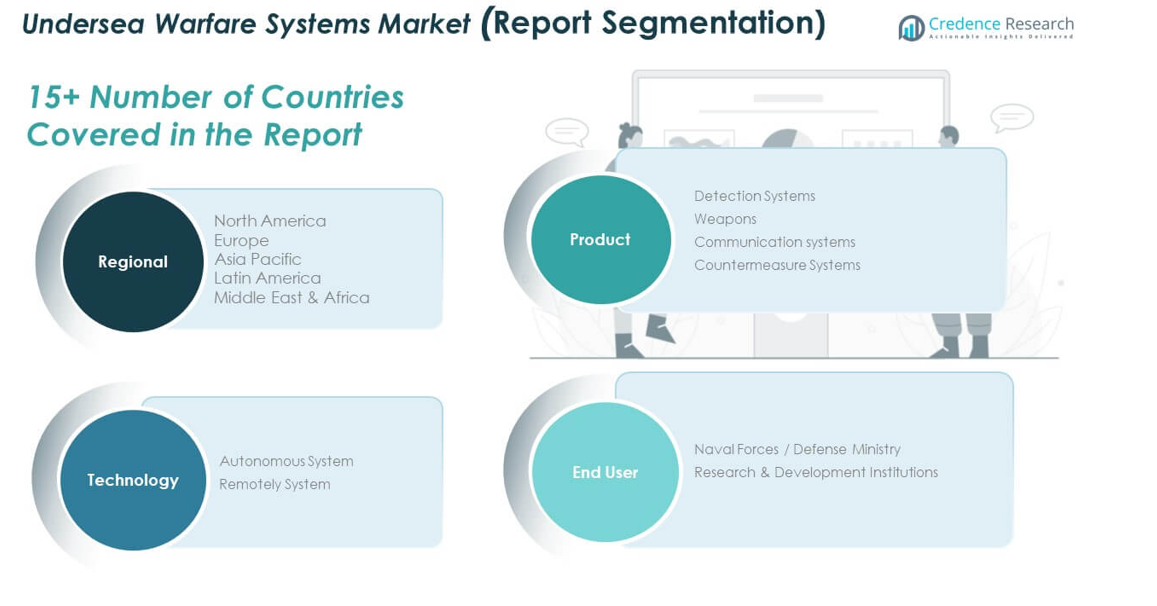
The Global Undersea Warfare Systems Market is segmented
By product into detection systems, weapons, communication systems, and countermeasure systems. Detection systems lead the market, supported by strong demand for advanced sonar and surveillance solutions to counter stealth threats. Weapons such as torpedoes and depth charges remain vital for naval strike capabilities, while communication systems secure undersea connectivity and coordination. Countermeasure systems are gaining importance, designed to neutralize incoming threats and safeguard naval assets in contested waters.
- For instance, on September 9, 2025, Thales and HII announced the integration and field exercise of the SAMDIS 600 multi-aspect synthetic aperture sonar with HII’s REMUS 620 medium unmanned underwater vehicle, completed at the HII Pocasset facility in Massachusetts, offering enhanced mine detection and imaging for NATO and allied naval forces.
By technology, the Global Undersea Warfare Systems Market is divided into autonomous systems and remotely operated systems. It reflects rising adoption of autonomous platforms that deliver longer endurance, improved efficiency, and reduced risk for personnel. Remotely operated systems continue to support missions requiring precision, control, and adaptability in tactical environments.
By end-user segmentation includes naval forces or defense ministries and research & development institutions. Naval forces dominate demand, driven by fleet modernization, defense spending, and strategic deterrence requirements. Research and development institutions contribute through innovation, prototyping, and integration of advanced technologies, supporting the continuous evolution of undersea warfare soluions.
- For instance, the MK 54 MOD 0 lightweight torpedo, jointly developed by the U.S. Navy and RTX, employs active and passive acoustic homing combined with inertial navigation for precision targeting. In September 2025, the DSCA approved a proposed sale of 50 units to Norway, naming RTX as the prime contractor with full support and integration services.

Segmentation:
By Product
- Detection Systems
- Weapons
- Communication Systems
- Countermeasure Systems
By Technology
- Autonomous System
- Remotely System
By End User
- Naval Forces / Defense Ministry
- Research & Development Institutions
By Region
- North America
- U.S.
- Canada
- Mexico
- Europe
- UK
- France
- Germany
- Italy
- Spain
- Russia
- Belgium
- Netherlands
- Austria
- Sweden
- Poland
- Denmark
- Switzerland
- Rest of Europe
- Asia Pacific
- China
- Japan
- South Korea
- India
- Australia
- Thailand
- Indonesia
- Vietnam
- Malaysia
- Philippines
- Taiwan
- Rest of Asia Pacific
- Latin America
- Brazil
- Argentina
- Peru
- Chile
- Colombia
- Rest of Latin America
- Middle East
- UAE
- KSA
- Israel
- Turkey
- Iran
- Rest of Middle East
- Africa
- Egypt
- Nigeria
- Algeria
- Morocco
- Rest of Africa
Regional Analysis:
North America
The North America Global Undersea Warfare Systems Market size was valued at USD 5,933.41 million in 2018 to USD 7,670.94 million in 2024 and is anticipated to reach USD 11,474.38 million by 2032, at a CAGR of 5.2% during the forecast period. North America holds a 34% share of the Global Undersea Warfare Systems Market. The region benefits from large defense budgets, advanced R&D capabilities, and established naval industries. The U.S. Navy leads modernization programs focusing on submarines, unmanned vehicles, and undersea detection systems. Canada and Mexico follow with investments in naval modernization and defense partnerships. It demonstrates leadership in integrating AI-driven technologies for surveillance and undersea communications. Strong alliances, including NATO cooperation, expand strategic relevance. Regional vendors collaborate closely with global defense primes to sustain dominance. The market continues to expand through ongoing modernization and fleet readiness priorities.
Europe
The Europe Global Undersea Warfare Systems Market size was valued at USD 4,568.62 million in 2018 to USD 6,156.85 million in 2024 and is anticipated to reach USD 9,735.84 million by 2032, at a CAGR of 6.0% during the forecast period. Europe contributes a 27% share to the Global Undersea Warfare Systems Market. Regional growth is fueled by modernization initiatives across the UK, France, Germany, and Italy. European nations emphasize cooperative programs to strengthen undersea deterrence. It invests in stealth submarines, advanced sonar systems, and unmanned underwater vehicles. NATO’s collective defense commitments drive procurement of interoperable platforms. Strong industrial bases in France and Germany create competitive advantages. Eastern Europe increases naval spending in response to heightened security risks. The market advances with both national programs and collaborative EU-led initiatives.
Asia Pacific
The Asia Pacific Global Undersea Warfare Systems Market size was valued at USD 3,904.99 million in 2018 to USD 5,355.03 million in 2024 and is anticipated to reach USD 8,654.47 million by 2032, at a CAGR of 6.2% during the forecast period. Asia Pacific represents a 24% share of the Global Undersea Warfare Systems Market. Regional expansion is driven by rising defense budgets in China, India, Japan, and South Korea. Nations invest heavily in submarines, surveillance systems, and anti-submarine warfare technologies. It reflects the focus on safeguarding maritime trade routes and addressing territorial disputes. China leads regional investments with advanced naval modernization programs. India emphasizes indigenous production while expanding defense partnerships. Japan and South Korea prioritize cutting-edge technologies for regional security. The region emerges as a key growth hub for future naval procurement.
Latin America
The Latin America Global Undersea Warfare Systems Market size was valued at USD 1,520.03 million in 2018 to USD 1,910.65 million in 2024 and is anticipated to reach USD 2,743.42 million by 2032, at a CAGR of 4.7% during the forecast period. Latin America accounts for an 8% share of the Global Undersea Warfare Systems Market. Brazil leads the region with investments in submarine fleets and coastal security systems. It emphasizes modernization programs to strengthen maritime surveillance capabilities. Argentina follows with smaller but strategic procurements for naval readiness. Regional growth is limited by budgetary constraints yet supported by international collaborations. Defense partnerships with European and U.S. contractors expand capabilities. Naval modernization aligns with protecting offshore energy assets and trade routes. The region presents gradual but steady opportunities for defense suppliers.
Middle East
The Middle East Global Undersea Warfare Systems Market size was valued at USD 815.46 million in 2018 to USD 1,067.27 million in 2024 and is anticipated to reach USD 1,623.80 million by 2032, at a CAGR of 5.4% during the forecast period. The Middle East holds a 5% share of the Global Undersea Warfare Systems Market. Regional dynamics are shaped by maritime security challenges in the Gulf and Eastern Mediterranean. Gulf Cooperation Council countries invest in modern submarines and detection technologies. Israel focuses on advanced underwater surveillance and defense integration. Turkey expands production through domestic shipbuilding programs. It reflects growing interest in coastal defense and offshore protection. Strategic partnerships with global suppliers drive capability development. The region maintains steady demand linked to maritime infrastructure protection.
Africa
The Africa Global Undersea Warfare Systems Market size was valued at USD 317.31 million in 2018 to USD 389.47 million in 2024 and is anticipated to reach USD 538.95 million by 2032, at a CAGR of 4.2% during the forecast period. Africa accounts for a 2% share of the Global Undersea Warfare Systems Market. Growth is concentrated in South Africa and Egypt, which lead procurement efforts. It reflects limited but targeted investments in surveillance and naval modernization. Coastal nations prioritize securing trade corridors and offshore energy reserves. Budget constraints limit large-scale procurement across many countries. International aid and partnerships support naval capability building. South Africa advances through domestic shipbuilding and collaborations with European vendors. The market shows potential through gradual expansion of maritime security programs.
Key Player Analysis:
- Northrop Grumman Corporation
- Lockheed Martin Corporation
- Boeing Co.
- QinetiQ Limited
- General Dynamics Corporation
- Naval Group
- Other Key Players
Competitive Analysis:
The Global Undersea Warfare Systems Market is highly competitive with strong participation from global defense contractors and regional suppliers. Northrop Grumman, Lockheed Martin, Boeing, General Dynamics, and Naval Group dominate through advanced product portfolios and long-term government contracts. It emphasizes continuous R&D investment, focusing on stealth technologies, unmanned underwater vehicles, and advanced sonar systems. European players such as BAE Systems, Saab, and Thales strengthen competition with collaborative programs and regional partnerships. Asian manufacturers, led by domestic shipbuilding industries, expand through localized production and technology integration. The market demonstrates increasing consolidation through mergers, acquisitions, and strategic alliances. Vendors compete by offering modular, multi-mission systems that align with modern naval strategies. It is shaped by defense modernization efforts, international collaborations, and the need for interoperable solutions across allied fleets, ensuring consistent competitive intensity worldwide.
Recent Developments:
- In September 2025, Babcock International Group and HII announced a major new partnership to integrate HII’s REMUS unmanned underwater vehicles with Babcock’s submarine Weapon Handling and Launch Systems, enabling autonomous launch and recovery of UUVs from submarine torpedo tubes and significantly enhancing allied navy capabilities in undersea warfare.
- In September 2025, Saab was selected to lead NATO’s new Allied Underwater Battlespace Mission Network project as the leader of the MANGROVE consortium, commencing on September 1, 2025, and focusing on delivering interoperability for Maritime Uncrewed Systems and conventional platforms in the undersea battlespace.
- In January 2025, Lockheed Martin secured a nearly $1 billion U.S. Navy contract for the development, integration, and testing of the AN/SQQ-89A(V)15 anti-submarine warfare combat systems, intended to enhance undersea threat detection on surface ships through 2029. Lockheed Martin also received a $551-million contract in February 2025 to equip U.S.
Report Coverage:
The research report offers an in-depth analysis based on Product, Technology and End User. It details leading market players, providing an overview of their business, product offerings, investments, revenue streams, and key applications. Additionally, the report includes insights into the competitive environment, SWOT analysis, current market trends, as well as the primary drivers and constraints. Furthermore, it discusses various factors that have driven market expansion in recent years. The report also explores market dynamics, regulatory scenarios, and technological advancements that are shaping the industry. It assesses the impact of external factors and global economic changes on market growth. Lastly, it provides strategic recommendations for new entrants and established companies to navigate the complexities of the market.
Future Outlook:
- The Global Undersea Warfare Systems Market will expand steadily, driven by modernization of naval fleets worldwide.
- Rising geopolitical tensions will strengthen demand for advanced detection and countermeasure solutions.
- Integration of unmanned underwater vehicles will accelerate, creating new growth opportunities for defense contractors.
- Artificial intelligence and machine learning adoption will enhance operational efficiency and mission planning.
- Nations will prioritize secure undersea communication systems to support network-centric defense strategies.
- Sustainable propulsion and energy-efficient platforms will gain attention in response to environmental directives.
- Regional collaborations and joint R&D programs will expand to share costs and improve interoperability.
- Simulation and training platforms will grow in importance, ensuring better crew preparedness and tactical execution.
- Regulatory restrictions and export controls will shape competitive dynamics and market accessibility.
- Defense partnerships with emerging economies will provide new avenues for technology transfer and localized production.
Request a Free Sample
Fill in your details and we'll send you a free sample report.
- Sample data tables & charts
- Research methodology
Need a Custom Version of This Report?
Tailor the scope, geography, or segments to your exact requirements.
- Custom geography or segment scope
- Direct access to our analyst team
Frequently Asked Questions
What is the current market size for Global Undersea Warfare Systems Market, and what is its projected size in 2032?
At what Compound Annual Growth Rate is the Global Undersea Warfare Systems Market projected to grow between 2024 and 2032?
What are the primary factors fueling the growth of the Global Undersea Warfare Systems Market?
Who are the major players in this Market?
Table of Content
Chapter 1. Report Introduction
- 1.1 Report Description & Purpose
- 1.1.1 Report Title & Market Definition
- 1.1.2 Unique Selling Propositions (USP) & Key Differentiators
- 1.1.3 Value Proposition for Stakeholders
- 1.2 Research Objectives
- 1.2.1 Market Sizing Objectives (Volume & Revenue)
- 1.2.2 Segmentation Objectives
- 1.2.3 Competitive Intelligence Objectives
- 1.2.4 Forecast & Scenario Objectives
- 1.3 Report Scope
- 1.3.1 Undersea Warfare Systems Scope – Types & Subtypes Covered
- 1.3.2 Geographic Scope – Regions & Countries Covered
- 1.3.3 Historical Period, Base Year & Forecast Period (2024; forecast to 2032)
- 1.3.4 Inclusions & Exclusions
- 1.4 HS Code & Classification Framework
- 1.5 Currency, Units & Pricing Basis
- 1.6 Target Stakeholders
- 1.7 Limitations & Assumptions
Chapter 2. Executive Summary
- 2.1 Global Undersea Warfare Systems Market Snapshot
- 2.1.1 Market Size – Historical (2024) & Forecast (2024-2032) (2024: USD 22,550.2 million → 2032: USD 34,770.9 million)
- 2.1.2 Volume & Revenue – Global Totals
- 2.1.3 Key Market Highlights – Top Five Facts
- 2.2 Undersea Warfare Systems Market Segmentation Snapshot
- 2.2.1 Market Split by Region – 2024 vs. 2032
- 2.3 Competitive Snapshot
- 2.3.1 Top 10 Players by Revenue Share – 2024
- 2.3.2 Top 10 Players by Volume Share – 2024
- 2.3.3 Recent Strategic Developments (18-Month Summary)
- 2.4 Key Investment Highlights & Strategic Conclusions
Chapter 3. Undersea Warfare Systems Market Dynamics & Industry Analysis
- 3.1 Market Overview & Context
- 3.1.1 Undersea Warfare Systems Market Position in the Broader Automotive Value Chain
- 3.1.2 OEM vs. Replacement Market Dynamics
- 3.1.3 Market Maturity & Development Stage by Region
- 3.2 Undersea Warfare Systems Market Drivers
- 3.3 Undersea Warfare Systems Market Restraints & Challenges
- 3.4 Undersea Warfare Systems Market Opportunities
- 3.5 Porter's Five Forces Analysis
- 3.5.1 Threat of New Entrants
- 3.5.2 Bargaining Power of Suppliers
- 3.5.3 Bargaining Power of Buyers
- 3.5.4 Threat of Substitutes
- 3.5.5 Competitive Rivalry – Intensity Assessment
- 3.6 Undersea Warfare Systems Value Chain Analysis
- 3.6.1 Upstream – Raw Material/Input Suppliers
- 3.6.1.1 Raw Material/Input 1
- 3.6.1.2 Raw Material/Input 2
- 3.6.1.3 Raw Material/Input 3
- 3.6.2 Midstream – Production/Manufacturing/Service Delivery
- 3.6.2.1 Production/Process Overview
- 3.6.2.2 Key Facility Locations & Capacity by Manufacturer
- 3.6.3 Downstream – Distribution & End Consumer
- 3.6.3.1 Primary Channel – B2B/OEM
- 3.6.3.2 Secondary Channels – Dealer, Retail, Online, Direct
- 3.6.4 Value Chain Profitability Analysis
- 3.6.1 Upstream – Raw Material/Input Suppliers
- 3.7 PESTEL Analysis
- 3.7.1 Political Factors
- 3.7.2 Economic Factors
- 3.7.3 Social Factors
- 3.7.4 Technological Factors
- 3.7.5 Environmental Factors
- 3.7.6 Legal Factors
- 3.8 Undersea Warfare Systems Supply Chain Analysis
- 3.8.1 Raw Material/Input Supply Risk Assessment
- 3.8.2 Manufacturing Concentration Risk (Geographic Exposure)
- 3.8.3 Trade Disruption Impact Analysis
- 3.9 Regulatory & Policy Landscape
Note: The regulatory and policy landscape section covers regulations based on their applicability to the market, Undersea Warfare Systems category, geography, and scope of the study. Only regulatory frameworks with a material impact on operations, compliance, trade, sustainability, or market access are analyzed in detail.
Chapter 4. Key Investment Pockets & Opportunity Analysis
- 4.1 Undersea Warfare Systems Market Attractiveness Analysis
- 4.1.1 By Region – Investment Attractiveness Matrix (Volume × CAGR)
- 4.2 Absolute Revenue Growth Opportunity
- 4.2.1 By Region – Absolute USD Growth Through 2032
- 4.3 Incremental Volume Opportunity
- 4.3.1 By Region – Incremental Volume Through 2032
- 4.3.2 Segment – Incremental Volume
- 4.4 Emerging Submarket Opportunity Deep Dive (Subject to Applicability)
- 4.5 Emerging Market Opportunity Scorecards
- 4.5.1 United States
- 4.5.2 Europe
- 4.5.3 Asia
- 4.5.4 Middle East & Africa
Note: Emerging Market Opportunity Scorecards will be included based on relevance and strategic importance. Regions listed are indicative and may vary depending on data availability and market dynamics.
Chapter 5. Undersea Warfare Systems Import-Export Analysis & Trade Flows
- 5.1 Global Trade Overview
- 5.1.1 Global Export Value by Country (2024)
- 5.1.2 Global Export Volume by Country (2024)
- 5.1.3 Global Import Value by Country (2024)
- 5.1.4 Global Import Volume by Country (2024)
- 5.1.5 Net Trade Balance by Country (2024)
- 5.2 Export Analysis – Segment
- 5.2.1 Type 1 (HS Code)
- 5.2.2 Type 2 (HS Code)
- 5.2.3 Type 3 (HS Code)
- 5.2.4 Type 4 (HS Code)
- 5.2.5 Type 5 (HS Code)
- 5.3 Import Analysis – Segment
- 5.3.1 Type 1 (HS Code)
- 5.3.2 Type 2 (HS Code)
- 5.3.3 Type 3 (HS Code)
- 5.3.4 Type 4 (HS Code)
- 5.3.5 Type 5 (HS Code)
- 5.4 Average Unit Trade Prices
- 5.4.1 Average Export Price – Segment & Country
- 5.4.2 Average Import Price – Segment & Source Country
- 5.4.3 Price Trends (2024)
- 5.5 Key Trade Route Analysis
- 5.5.1 Trade Route 1
- 5.5.2 Trade Route 2
- 5.5.3 Trade Route 3
- 5.5.4 Trade Route 4
- 5.5.5 Trade Route 5
- 5.6 Trade Policy Impact Assessment
- 5.6.1 US Anti-Dumping & Section 301 Tariffs
- 5.6.2 EU Customs Union Impact
- 5.6.3 Major Free Trade Agreements
- 5.6.4 USMCA Rules of Origin
Note: Trade policy analysis will be included only where relevant to the Undersea Warfare Systems market.
Chapter 6. Competitive Landscape & Company Benchmarking
- 6.1 Undersea Warfare Systems Market Concentration & Structure
- 6.1.1 Herfindahl-Hirschman Index (HHI) – vs. 2024
- 6.1.2 Tier 1, Tier 2 & Tier 3 Market Structure
- 6.1.3 Global, Regional & Local Player Dynamics
- 6.2 Undersea Warfare Systems Market Share Analysis – 2024
- 6.2.1 Global Revenue Share by Company
- 6.2.2 Global Volume Share by Company
- 6.2.3 Regional Revenue Share
- 6.2.4 Market Share Evolution ( vs. 2024)
- 6.2.5 OEM Segment Share by Company
- 6.2.6 Replacement Segment Share by Company
- 6.3 Production/Delivery Capacity & Facility Analysis
- 6.3.1 Global Installed Capacity
- 6.3.2 Capacity Utilization Rates
- 6.3.3 Production/Output Volume
- 6.3.4 Facility Locations & Capacity Map
- 6.3.5 Planned Capacity Additions
- 6.4 Undersea Warfare Systems Competitive Benchmarking Matrix
- 6.4.1 Revenue, Volume, CAGR & Profitability Comparison
- 6.4.2 Channel Revenue Mix
- 6.4.3 Geographic Revenue Exposure
- 6.4.4 R&D Intensity
- 6.4.5 Sustainability Maturity
- 6.5 Strategic Developments in Undersea Warfare Systems (Last 24 Months)
- 6.5.1 Mergers, Acquisitions & Divestments
- 6.5.2 New Undersea Warfare Systems Launches
- 6.5.3 Facility Expansions
- 6.5.4 Strategic Alliances, Joint Ventures & Partnerships
- 6.5.5 Distribution Expansion & Market Entry
- 6.5.6 Sustainability & ESG Initiatives
- 6.6 Competitive Strategy Mapping
- 6.6.1 Leader, Challenger, Follower & Niche Classification
- 6.6.2 Pricing Strategy Comparison
- 6.6.3 Channel Strategy Matrix
Note: Strategic developments are included based on their materiality and the availability of reliable information.
Chapter 7. Global Undersea Warfare Systems Market – By Distribution Channel
- 7.1 Segment Overview
- 7.1.1 Volume & Revenue Split by Channel (2024 & 2032)
- 7.1.2 Channel Mix Evolution (2024-2032)
Chapter 8. Regional Market Analysis – Global Overview
- 8.1 Global Regional Overview
- 8.1.1 Regional Volume Share
- 8.1.2 Regional Revenue Share
- 8.1.3 Regional Volume by Region
- 8.1.4 Regional Revenue by Region
- 8.1.5 Regional Forecast Through 2032
- 8.2 Cross-Regional Segment Analysis
- 8.2.1 By Distribution Channel
- 8.2.2 By Brand/Price Tier
Chapter 9. North America Undersea Warfare Systems Market
- 9.1 United States
- 9.2 Canada
- 9.3 Mexico
Chapter 10. Europe Undersea Warfare Systems Market
- 10.1 Germany
- 10.2 France
- 10.3 Italy
- 10.4 United Kingdom
- 10.5 Spain
- 10.6 Poland
- 10.7 Russia
- 10.8 Netherlands
- 10.9 Belgium
- 10.10 Sweden
- 10.11 Denmark
- 10.12 Norway
- 10.13 Rest of Europe
Chapter 11. Asia Pacific Undersea Warfare Systems Market
- 11.1 China
- 11.2 India
- 11.3 Japan
- 11.4 South Korea
- 11.5 Thailand
- 11.6 Indonesia
- 11.7 Vietnam
- 11.8 Malaysia
- 11.9 Australia
- 11.10 Rest of Asia Pacific
Chapter 12. Latin America Undersea Warfare Systems Market
- 12.1 Brazil
- 12.2 Argentina
- 12.3 Colombia
- 12.4 Chile
- 12.5 Rest of Latin America
Chapter 13. Middle East Undersea Warfare Systems Market
- 13.1 Saudi Arabia
- 13.2 United Arab Emirates
- 13.3 Turkey
- 13.4 Israel
- 13.5 Iran
- 13.6 Rest of the Middle East
Chapter 14. Africa Undersea Warfare Systems Market
- 14.1 South Africa
- 14.2 Egypt
- 14.3 Nigeria
- 14.4 Morocco
- 14.5 Rest of Africa
Chapter 15. Undersea Warfare Systems Company Profiles
- 15.1 [Company 01]
- 15.1.1 Company Overview
- 15.1.2 Key Management Personnel
- 15.1.3 Products & Services Portfolio
- 15.1.4 Financial Performance
- 15.1.5 Key Market Focus & Geographic Presence
- 15.1.6 Recent Developments & Strategic Initiatives
Note: The company profile list is preliminary and may change based on research findings, market developments, data availability, and client requirements.
Chapter 16. Appendices
- Appendix A – List of Abbreviations & Acronyms
- Appendix B – Industry Classification Code Reference – Full Series
- Appendix C – Production & Capacity Data Tables
- Appendix D – End-Use & Demand Base Tables
- Appendix E – Consumption & Replacement Rate Assumptions
- Appendix F – ASP Reference Tables
- Appendix G – Manufacturing & Facility Database
- Appendix H – Import-Export Data Tables
- Appendix I – Regulatory Summary Tables
- Appendix J – Primary Research Participant List (Anonymized)
- Appendix K – Primary Research Questionnaire Framework
- Appendix L – Data Sources & Bibliography
- Appendix M – Market Size Divergence & Source Comparison
Chapter 17. Research Methodology
- 17.1 Research Framework & Philosophy
- 17.2 Secondary Research – Sources, Hierarchy & Data Extraction
- 17.3 Data Modeling – Bottom-Up & Top-Down Market Sizing
- 17.4 Primary Research – Stakeholder Framework, LOI & Sample Sizes
- 17.5 Forecast Methodology – Regression, Scenario & Sensitivity Analysis
- 17.6 Quality Control – Four-Layer Validation Framework
- 17.7 Limitations & Standard Assumptions
- 17.8 Disclaimer
