
Market Overview
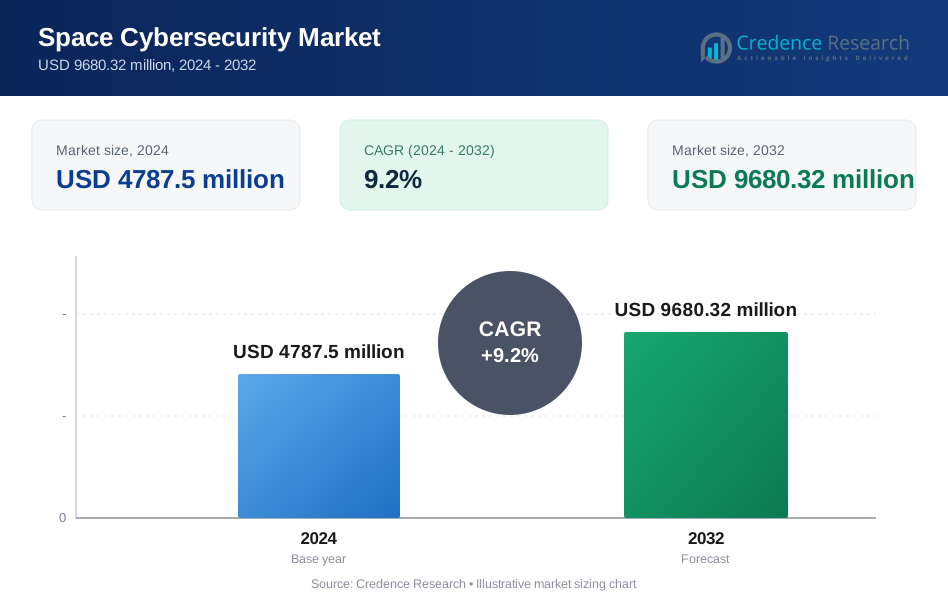
Space Cybersecurity Market size was valued at USD 4787.5 million in 2024 and is anticipated to reach USD 9680.32 million by 2032, at a CAGR of 9.2% during the forecast period.
| REPORT ATTRIBUTE | DETAILS |
|---|---|
| Historical Period | 2020-2023 |
| Base Year | 2024 |
| Forecast Period | 2025-2032 |
| Space Cybersecurity Market Size 2024 | USD 4787.5 million |
| Space Cybersecurity Market, CAGR | 9.2% |
| Space Cybersecurity Market Size 2032 | USD 9680.32 million |
The Space Cybersecurity Market is shaped by major players, including Thales Group, Airbus Defence and Space, Northrop Grumman, Lockheed Martin, RTX, Boeing, L3Harris Technologies, BAE Systems, Leonardo S.p.A., and General Dynamics. These companies strengthen space mission security through advanced encryption, protected communication links, and AI-enabled threat detection across satellite and ground networks. Their focus on zero-trust models and secure-by-design spacecraft supports rising demand from government, defense, and commercial operators. North America remained the leading region in 2024 with about 41% share, driven by strong investment in secure satellite networks and national defense space programs.
Market Insights
- The Space Cybersecurity Market reached USD 4787.5 million in 2024 and is projected to reach USD 9680.32 million by 2032, registering a CAGR of 9.2%. • Rising cyber threats to satellites and ground systems drive strong demand for secure communication links, encryption tools, and real-time threat detection across government, defense, and commercial missions. • AI-based monitoring, zero-trust security models, and secure-by-design satellite architectures shape major trends as operators upgrade mission resilience and automate cybersecurity functions. • Leading players compete through advanced space-grade security solutions, stronger software protection, and integrated platforms, with the solution segment holding about 64% share in 2024. • North America led the market with nearly 41% share, followed by Europe at about 27% and Asia Pacific at around 21%, supported by expanding satellite fleets and rising investment in mission protection.
Market Segmentation Analysis:
By Offering
The solution segment led the Space Cybersecurity Market in 2024 with about 64% share. Strong adoption came from rising demand for encryption, secure communication links, intrusion detection, and threat monitoring across satellite and ground networks. Agencies and operators invested in advanced solutions due to frequent cyber intrusions on satellite control systems and growing risks to mission data. Services grew at a steady pace as operators relied on managed security, vulnerability assessment, and continuous monitoring to maintain system resilience. The shift toward real-time space threat intelligence further supported solution-focused spending.
- For instance, Thales is securing the Galileo navigation system, which is planned for up to 38 first-generation satellites, supported by two security monitoring centres, two system control centres, and 16 stations for orbit control and clock synchronisation.
By Platform
The satellite platform held the dominant position in 2024 with nearly 58% share. Growth came from expanding satellite fleets, higher use of software-defined satellites, and rising cyber risks targeting telemetry, tracking, and command channels. Operators focused on strong encryption, secure uplink protocols, and onboard cybersecurity to safeguard mission continuity. Ground stations also saw rising demand for secure gateways as they handle sensitive command data. Launch vehicles and spaceports adopted cybersecurity tools to protect flight software, mission automation systems, and operational networks from targeted cyber threats.
- For instance, Airbus built the Eutelsat Quantum software-defined satellite, which uses 8 independently reconfigurable beams that can be reshaped and redirected in orbit through secured ground commands.
By End User
The government segment led the market in 2024 with about 46% share. Demand increased as national space agencies and public-sector operators strengthened cyber defense for critical space assets, military communication satellites, and navigation networks. Governments prioritized resilient architectures, secure cross-domain data transfer, and compliance-driven security frameworks. Defense users expanded investments to protect strategic missions and enhance threat detection across space-based ISR networks. Commercial operators adopted cybersecurity to secure satellite constellations, bandwidth delivery platforms, and data services as cyberattacks on commercial space systems continued to rise.
Key Growth Drivers
Rising cyberattacks on space systems
Cyberattacks on satellites, ground stations, and command networks increased as space assets became central to communication, navigation, and Earth-observation services. Attacks on uplink channels, GNSS spoofing events, and ransomware incidents on satellite operators pushed agencies to expand cybersecurity programs. This rising threat landscape drove investment in strong encryption, secure protocols, and mission-resilient architectures. Growing commercial constellations and defense missions also raised the exposure level, making advanced cyber protection a priority across government and private operators.
- For instance, after the February 2022 KA-SAT incident, Viasat and its partner shipped nearly 30 000 replacement satellite modems to distributors to restore services for affected customers in Europe.
Expansion of satellite constellations and digitalization
Large constellations in LEO and the shift toward software-defined satellites increased system complexity and created new cyber entry points. Operators adopted automated networking, cloud-based mission systems, and virtualized ground infrastructure, which demanded stronger cybersecurity integration. Digitalized satellites use remote updates and flexible payloads, raising the need for secure software pathways and real-time monitoring. This expansion supported higher spending on threat detection, secure data routing, and resilient communication frameworks to protect dynamic satellite networks.
- For instance, SpaceX’s Starlink network had 8 811 satellites in orbit, with 8 795 functioning, as of late October 2025, highlighting the cyber exposure of very large software-driven constellations.
Growing defense reliance on space assets
Defense organizations expanded their use of space systems for surveillance, secure communication, and missile warning operations. This dependence raised concern over cyber vulnerabilities that could disrupt national security missions. Governments invested in advanced intrusion detection, protected command channels, and classified network protection to ensure mission assurance. Joint military-space programs also supported demand for hardened cybersecurity systems. This increasing defense reliance positioned cybersecurity as a strategic requirement rather than a supportive function across modern space programs.
Key Trends & Opportunities
Adoption of AI-driven space threat detection
AI and machine learning gained strong traction in detecting anomalous activity across satellite networks, ground systems, and mission data flows. Automated analytics helped operators identify cyber patterns faster than manual monitoring. Real-time behavior modeling supported better protection of command channels and payload data. The opportunity lies in integrating AI-powered engines into mission control, enabling predictive alerts that support resilience against sophisticated attacks targeting multi-orbit constellations and defense missions.
- For instance, Microsoft’s security platforms now process over 100 trillion security signals each day, an increase from the 78 trillion signals reported in the 2024 Digital Defense Report.
Growth of zero-trust architecture in space missions
Zero-trust principles advanced across government and commercial space programs as operators shifted from perimeter-based models to identity-centric security. This trend supported continuous verification of users, devices, and data paths across satellites, cloud networks, and mission systems. Secure-by-design spacecraft and zero-trust ground stations emerged as new opportunities, enabling safer command access and reducing breach risks in multi-vendor mission environments. Adoption accelerated with rising multi-orbit networks and global satellite communication expansion.
- For instance, Cloudflare reports inspecting on average around 81 million HTTP requests every second, based on recent data from late 2025
Expansion of space-to-cloud security integration
More operators linked satellites to cloud platforms for data processing and mission automation. This integration created new opportunities for cloud-native encryption, secure API management, and protected ground-to-cloud pathways. Space-cloud ecosystems allowed faster analytics and scalable operations but required strict cybersecurity to prevent unauthorized access. The trend supported development of hybrid mission platforms that use cloud resilience and strong cyber layers to ensure secure handling of sensitive space data.
Key Challenges
High vulnerability from interconnected space infrastructures
Modern space networks connect satellites, ground stations, cloud systems, and mission control. This interconnected model increases potential cyber entry points and exposes operators to cascading failures. Weakness in one node can affect navigation networks, communication links, or Earth-observation services. Managing large attack surfaces remains difficult due to diverse hardware, legacy systems, and rapid constellation growth. Operators struggle to establish unified security frameworks across mixed fleets and multi-vendor platforms.
Lack of standardized global space cybersecurity regulations
Countries follow different security rules for satellite operations, encryption, data handling, and threat reporting. This lack of harmonization creates challenges for global operators and joint missions. Inconsistent compliance frameworks slow adoption of strong cybersecurity practices and limit information sharing about attacks. Commercial operators face complexity when securing cross-border data flows and multi-orbit services. The absence of unified standards delays coordinated threat response and increases long-term risk for the global space ecosystem.
Regional Analysis
North America
North America held the leading position in the Space Cybersecurity Market in 2024 with about 41% share. Growth came from strong investment by government agencies, defense programs, and major commercial satellite operators. Rising cyber threats to communication satellites, GPS networks, and space-based defense assets supported rapid adoption of advanced protection tools. The United States led spending with expanding security frameworks for national space missions and large LEO constellations. Canada increased focus on secure satellite communication and resilient ground systems. High regulatory maturity and strong industry presence kept the region dominant.
Europe
Europe accounted for nearly 27% share in 2024, supported by strong initiatives from ESA members and national space agencies. The region advanced cybersecurity adoption through secure satellite communication programs, protected navigation systems, and resilience standards for future missions. Countries such as France, Germany, and the U.K. strengthened cyber defenses for dual-use satellites and Earth-observation networks. Investments increased in secure data links, encrypted command channels, and risk assessment systems for commercial operators. Growing deployment of multi-orbit constellations and collaborative space missions supported steady regional expansion.
Asia Pacific
Asia Pacific held around 21% share in 2024, driven by rising satellite launches and expanding commercial space programs. China, Japan, and India increased spending on cybersecurity to protect communication satellites, navigation systems, and remote-sensing networks from advanced cyber threats. Regional operators adopted stronger encryption, secure telemetry systems, and monitoring tools for large constellation projects. Growing collaboration with defense agencies supported advanced security integration. Rapid digitalization of ground systems and mission automation platforms accelerated demand, making Asia Pacific one of the fastest-growing regions in the market.
Latin America
Latin America captured about 6% share in 2024, supported by expanding satellite communication use across government, telecom, and environmental monitoring agencies. Countries increased investments in protected ground infrastructure and secure data handling tools to counter rising cyber intrusion attempts. Brazil and Argentina led adoption through national satellite programs and secure mission control upgrades. Limited cybersecurity budgets slowed broader deployment, but rising digital connectivity and regional cooperation programs encouraged steady progress. Growing participation in global satellite services also strengthened demand for resilient cyber frameworks.
Middle East and Africa
Middle East and Africa accounted for nearly 5% share in 2024, driven by rising adoption of secure satellite communication for defense, energy, and governmental services. Countries in the Gulf region invested in protected ground systems and encrypted communication channels to support national security missions. Africa increased reliance on commercial satellite bandwidth, which pushed operators to adopt stronger cyber monitoring tools. Despite lower spending compared to other regions, growing space programs and strategic communication needs supported gradual improvement in cybersecurity capabilities across the region.
Market Segmentations:
By Offering
- Solution
- Services
By Platform
- Satellites
- Launch vehicles
- Ground stations
- Spaceports & launch facilities
- Command & control centers
- Others
By End User
- Government
- Defense
- Commercial
By Geography
- North America
- U.S.
- Canada
- Mexico
- Europe
- Germany
- France
- U.K.
- Italy
- Spain
- Rest of Europe
- Asia Pacific
- China
- Japan
- India
- South Korea
- South-east Asia
- Rest of Asia Pacific
- Latin America
- Brazil
- Argentina
- Rest of Latin America
- Middle East & Africa
- GCC Countries
- South Africa
- Rest of the Middle East and Africa
Competitive Landscape
The Space Cybersecurity Market features key players such as Leonardo S.p.A. (Italy), RTX (U.S.), Airbus Defence and Space GmbH (Germany), General Dynamics (U.S.), Thales Group (France), Boeing (U.S.), BAE Systems (U.K.), Northrop Grumman (U.S.), L3Harris Technologies (U.S.), and Lockheed Martin (U.S.). Companies in this market focus on developing strong encryption systems, secure satellite communication links, and advanced threat detection tools to protect mission data and command channels. Vendors invest in AI-driven monitoring, zero-trust security models, and resilient architectures that support multi-orbit constellations and defense missions. Strategic partnerships with government agencies and commercial operators help expand solution portfolios and improve integration across satellite, ground, and cloud systems. Firms also emphasize compliance with emerging cybersecurity standards to strengthen global competitiveness. Continuous upgrades in software-defined satellites and automated ground networks further drive innovation across the competitive landscape.
Key Player Analysis
- Leonardo S.p.A. (Italy)
- RTX (Raytheon) (U.S.)
- Airbus Defence and Space GmbH (Germany)
- General Dynamics (U.S.)
- Thales Group (France)
- Boeing (U.S.)
- BAE Systems (U.K.)
- Northrop Grumman (U.S.)
- L3Harris Technologies (U.S.)
- Lockheed Martin (U.S.)
Recent Developments
- In 2025, L3Harris received NSA Cybersecurity Directorate certification for its KSV-650 space hub end cryptographic unit, enabling secure, reprogrammable SATCOM that resists emerging cyber threats.
- In 2024, Airbus acquired German cybersecurity provider INFODAS to boost cyber capabilities for highly connected aerospace and defense platforms, including satellite missions.
- In 2023, Thales Alenia Space won ESA contracts for Galileo Second Generation ground mission systems, including integrating advanced cybersecurity for navigation infrastructure.
Report Coverage
The research report offers an in-depth analysis based on Offering, Platform, End-User and Geography. It details leading market players, providing an overview of their business, product offerings, investments, revenue streams, and key applications. Additionally, the report includes insights into the competitive environment, SWOT analysis, current market trends, as well as the primary drivers and constraints. Furthermore, it discusses various factors that have driven market expansion in recent years. The report also explores market dynamics, regulatory scenarios, and technological advancements that are shaping the industry. It assesses the impact of external factors and global economic changes on market growth. Lastly, it provides strategic recommendations for new entrants and established companies to navigate the complexities of the market.
Future Outlook
- The market will expand as satellite constellations grow across LEO, MEO, and GEO.
- AI-driven threat detection will become standard in satellite and ground security systems.
- Zero-trust architecture will see wider adoption across government and commercial missions.
- Demand for secure-by-design satellites will increase as cyber risks intensify.
- Space-to-cloud cybersecurity frameworks will strengthen with rising cloud integration.
- Nations will boost investment in protecting navigation, communication, and defense satellites.
- Cross-border collaboration on space cybersecurity standards will gain momentum.
- Encryption and secure uplink technologies will advance to counter sophisticated attacks.
- Commercial operators will adopt continuous monitoring tools for constellation resilience.
- Cybersecurity for launch vehicles and spaceports will grow as operational automation increases.
Request a Free Sample
Fill in your details and we'll send you a free sample report.
- Sample data tables & charts
- Research methodology
Need a Custom Version of This Report?
Tailor the scope, geography, or segments to your exact requirements.
- Custom geography or segment scope
- Direct access to our analyst team
Frequently Asked Questions
What is the current market size for Space Cybersecurity Market, and what is its projected size in 2032?
At what Compound Annual Growth Rate is the Space Cybersecurity Market projected to grow between 2024 and 2032?
Which Space Cybersecurity Market segment held the largest share in 2024?
What are the primary factors fueling the growth of the Space Cybersecurity Market?
Who are the leading companies in the Space Cybersecurity Market?
Table of Content
Chapter 1. Report Introduction
- 1.1 Report Description & Purpose
- 1.1.1 Report Title & Market Definition
- 1.1.2 Unique Selling Propositions (USP) & Key Differentiators
- 1.1.3 Value Proposition for Stakeholders
- 1.2 Research Objectives
- 1.2.1 Market Sizing Objectives (Volume & Revenue)
- 1.2.2 Segmentation Objectives
- 1.2.3 Competitive Intelligence Objectives
- 1.2.4 Forecast & Scenario Objectives
- 1.3 Report Scope
- 1.3.1 Space Cybersecurity Scope – Types & Subtypes Covered
- 1.3.2 Geographic Scope – Regions & Countries Covered
- 1.3.3 Historical Period, Base Year & Forecast Period (2024; forecast to 2032)
- 1.3.4 Inclusions & Exclusions
- 1.4 HS Code & Classification Framework
- 1.5 Currency, Units & Pricing Basis
- 1.6 Target Stakeholders
- 1.7 Limitations & Assumptions
Chapter 2. Executive Summary
- 2.1 Global Space Cybersecurity Market Snapshot
- 2.1.1 Market Size – Historical (2024) & Forecast (2024-2032) (2024: USD 4787.5 million → 2032: USD 9680.32 million)
- 2.1.2 Volume & Revenue – Global Totals
- 2.1.3 Key Market Highlights – Top Five Facts
- 2.2 Space Cybersecurity Market Segmentation Snapshot
- 2.2.1 Market Split by Region – 2024 vs. 2032
- 2.3 Competitive Snapshot
- 2.3.1 Top 10 Players by Revenue Share – 2024
- 2.3.2 Top 10 Players by Volume Share – 2024
- 2.3.3 Recent Strategic Developments (18-Month Summary)
- 2.4 Key Investment Highlights & Strategic Conclusions
Chapter 3. Space Cybersecurity Market Dynamics & Industry Analysis
- 3.1 Market Overview & Context
- 3.1.1 Space Cybersecurity Market Position in the Broader Automotive Value Chain
- 3.1.2 OEM vs. Replacement Market Dynamics
- 3.1.3 Market Maturity & Development Stage by Region
- 3.2 Space Cybersecurity Market Drivers
- 3.3 Space Cybersecurity Market Restraints & Challenges
- 3.4 Space Cybersecurity Market Opportunities
- 3.5 Porter's Five Forces Analysis
- 3.5.1 Threat of New Entrants
- 3.5.2 Bargaining Power of Suppliers
- 3.5.3 Bargaining Power of Buyers
- 3.5.4 Threat of Substitutes
- 3.5.5 Competitive Rivalry – Intensity Assessment
- 3.6 Space Cybersecurity Value Chain Analysis
- 3.6.1 Upstream – Raw Material/Input Suppliers
- 3.6.1.1 Raw Material/Input 1
- 3.6.1.2 Raw Material/Input 2
- 3.6.1.3 Raw Material/Input 3
- 3.6.2 Midstream – Production/Manufacturing/Service Delivery
- 3.6.2.1 Production/Process Overview
- 3.6.2.2 Key Facility Locations & Capacity by Manufacturer
- 3.6.3 Downstream – Distribution & End Consumer
- 3.6.3.1 Primary Channel – B2B/OEM
- 3.6.3.2 Secondary Channels – Dealer, Retail, Online, Direct
- 3.6.4 Value Chain Profitability Analysis
- 3.6.1 Upstream – Raw Material/Input Suppliers
- 3.7 PESTEL Analysis
- 3.7.1 Political Factors
- 3.7.2 Economic Factors
- 3.7.3 Social Factors
- 3.7.4 Technological Factors
- 3.7.5 Environmental Factors
- 3.7.6 Legal Factors
- 3.8 Space Cybersecurity Supply Chain Analysis
- 3.8.1 Raw Material/Input Supply Risk Assessment
- 3.8.2 Manufacturing Concentration Risk (Geographic Exposure)
- 3.8.3 Trade Disruption Impact Analysis
- 3.9 Regulatory & Policy Landscape
Note: The regulatory and policy landscape section covers regulations based on their applicability to the market, Space Cybersecurity category, geography, and scope of the study. Only regulatory frameworks with a material impact on operations, compliance, trade, sustainability, or market access are analyzed in detail.
Chapter 4. Key Investment Pockets & Opportunity Analysis
- 4.1 Space Cybersecurity Market Attractiveness Analysis
- 4.1.1 By Region – Investment Attractiveness Matrix (Volume × CAGR)
- 4.2 Absolute Revenue Growth Opportunity
- 4.2.1 By Region – Absolute USD Growth Through 2032
- 4.3 Incremental Volume Opportunity
- 4.3.1 By Region – Incremental Volume Through 2032
- 4.3.2 Segment – Incremental Volume
- 4.4 Emerging Submarket Opportunity Deep Dive (Subject to Applicability)
- 4.5 Emerging Market Opportunity Scorecards
- 4.5.1 United States
- 4.5.2 Europe
- 4.5.3 Asia
- 4.5.4 Middle East & Africa
Note: Emerging Market Opportunity Scorecards will be included based on relevance and strategic importance. Regions listed are indicative and may vary depending on data availability and market dynamics.
Chapter 5. Space Cybersecurity Import-Export Analysis & Trade Flows
- 5.1 Global Trade Overview
- 5.1.1 Global Export Value by Country (2024)
- 5.1.2 Global Export Volume by Country (2024)
- 5.1.3 Global Import Value by Country (2024)
- 5.1.4 Global Import Volume by Country (2024)
- 5.1.5 Net Trade Balance by Country (2024)
- 5.2 Export Analysis – Segment
- 5.2.1 Type 1 (HS Code)
- 5.2.2 Type 2 (HS Code)
- 5.2.3 Type 3 (HS Code)
- 5.2.4 Type 4 (HS Code)
- 5.2.5 Type 5 (HS Code)
- 5.3 Import Analysis – Segment
- 5.3.1 Type 1 (HS Code)
- 5.3.2 Type 2 (HS Code)
- 5.3.3 Type 3 (HS Code)
- 5.3.4 Type 4 (HS Code)
- 5.3.5 Type 5 (HS Code)
- 5.4 Average Unit Trade Prices
- 5.4.1 Average Export Price – Segment & Country
- 5.4.2 Average Import Price – Segment & Source Country
- 5.4.3 Price Trends (2024)
- 5.5 Key Trade Route Analysis
- 5.5.1 Trade Route 1
- 5.5.2 Trade Route 2
- 5.5.3 Trade Route 3
- 5.5.4 Trade Route 4
- 5.5.5 Trade Route 5
- 5.6 Trade Policy Impact Assessment
- 5.6.1 US Anti-Dumping & Section 301 Tariffs
- 5.6.2 EU Customs Union Impact
- 5.6.3 Major Free Trade Agreements
- 5.6.4 USMCA Rules of Origin
Note: Trade policy analysis will be included only where relevant to the Space Cybersecurity market.
Chapter 6. Competitive Landscape & Company Benchmarking
- 6.1 Space Cybersecurity Market Concentration & Structure
- 6.1.1 Herfindahl-Hirschman Index (HHI) – vs. 2024
- 6.1.2 Tier 1, Tier 2 & Tier 3 Market Structure
- 6.1.3 Global, Regional & Local Player Dynamics
- 6.2 Space Cybersecurity Market Share Analysis – 2024
- 6.2.1 Global Revenue Share by Company
- 6.2.2 Global Volume Share by Company
- 6.2.3 Regional Revenue Share
- 6.2.4 Market Share Evolution ( vs. 2024)
- 6.2.5 OEM Segment Share by Company
- 6.2.6 Replacement Segment Share by Company
- 6.3 Production/Delivery Capacity & Facility Analysis
- 6.3.1 Global Installed Capacity
- 6.3.2 Capacity Utilization Rates
- 6.3.3 Production/Output Volume
- 6.3.4 Facility Locations & Capacity Map
- 6.3.5 Planned Capacity Additions
- 6.4 Space Cybersecurity Competitive Benchmarking Matrix
- 6.4.1 Revenue, Volume, CAGR & Profitability Comparison
- 6.4.2 Channel Revenue Mix
- 6.4.3 Geographic Revenue Exposure
- 6.4.4 R&D Intensity
- 6.4.5 Sustainability Maturity
- 6.5 Strategic Developments in Space Cybersecurity (Last 24 Months)
- 6.5.1 Mergers, Acquisitions & Divestments
- 6.5.2 New Space Cybersecurity Launches
- 6.5.3 Facility Expansions
- 6.5.4 Strategic Alliances, Joint Ventures & Partnerships
- 6.5.5 Distribution Expansion & Market Entry
- 6.5.6 Sustainability & ESG Initiatives
- 6.6 Competitive Strategy Mapping
- 6.6.1 Leader, Challenger, Follower & Niche Classification
- 6.6.2 Pricing Strategy Comparison
- 6.6.3 Channel Strategy Matrix
Note: Strategic developments are included based on their materiality and the availability of reliable information.
Chapter 7. Global Space Cybersecurity Market – By Distribution Channel
- 7.1 Segment Overview
- 7.1.1 Volume & Revenue Split by Channel (2024 & 2032)
- 7.1.2 Channel Mix Evolution (2024-2032)
Chapter 8. Regional Market Analysis – Global Overview
- 8.1 Global Regional Overview
- 8.1.1 Regional Volume Share
- 8.1.2 Regional Revenue Share
- 8.1.3 Regional Volume by Region
- 8.1.4 Regional Revenue by Region
- 8.1.5 Regional Forecast Through 2032
- 8.2 Cross-Regional Segment Analysis
- 8.2.1 By Distribution Channel
- 8.2.2 By Brand/Price Tier
Chapter 9. North America Space Cybersecurity Market
- 9.1 United States
- 9.2 Canada
- 9.3 Mexico
Chapter 10. Europe Space Cybersecurity Market
- 10.1 Germany
- 10.2 France
- 10.3 Italy
- 10.4 United Kingdom
- 10.5 Spain
- 10.6 Poland
- 10.7 Russia
- 10.8 Netherlands
- 10.9 Belgium
- 10.10 Sweden
- 10.11 Denmark
- 10.12 Norway
- 10.13 Rest of Europe
Chapter 11. Asia Pacific Space Cybersecurity Market
- 11.1 China
- 11.2 India
- 11.3 Japan
- 11.4 South Korea
- 11.5 Thailand
- 11.6 Indonesia
- 11.7 Vietnam
- 11.8 Malaysia
- 11.9 Australia
- 11.10 Rest of Asia Pacific
Chapter 12. Latin America Space Cybersecurity Market
- 12.1 Brazil
- 12.2 Argentina
- 12.3 Colombia
- 12.4 Chile
- 12.5 Rest of Latin America
Chapter 13. Middle East Space Cybersecurity Market
- 13.1 Saudi Arabia
- 13.2 United Arab Emirates
- 13.3 Turkey
- 13.4 Israel
- 13.5 Iran
- 13.6 Rest of the Middle East
Chapter 14. Africa Space Cybersecurity Market
- 14.1 South Africa
- 14.2 Egypt
- 14.3 Nigeria
- 14.4 Morocco
- 14.5 Rest of Africa
Chapter 15. Space Cybersecurity Company Profiles
- 15.1 [Company 01]
- 15.1.1 Company Overview
- 15.1.2 Key Management Personnel
- 15.1.3 Products & Services Portfolio
- 15.1.4 Financial Performance
- 15.1.5 Key Market Focus & Geographic Presence
- 15.1.6 Recent Developments & Strategic Initiatives
Note: The company profile list is preliminary and may change based on research findings, market developments, data availability, and client requirements.
Chapter 16. Appendices
- Appendix A – List of Abbreviations & Acronyms
- Appendix B – Industry Classification Code Reference – Full Series
- Appendix C – Production & Capacity Data Tables
- Appendix D – End-Use & Demand Base Tables
- Appendix E – Consumption & Replacement Rate Assumptions
- Appendix F – ASP Reference Tables
- Appendix G – Manufacturing & Facility Database
- Appendix H – Import-Export Data Tables
- Appendix I – Regulatory Summary Tables
- Appendix J – Primary Research Participant List (Anonymized)
- Appendix K – Primary Research Questionnaire Framework
- Appendix L – Data Sources & Bibliography
- Appendix M – Market Size Divergence & Source Comparison
Chapter 17. Research Methodology
- 17.1 Research Framework & Philosophy
- 17.2 Secondary Research – Sources, Hierarchy & Data Extraction
- 17.3 Data Modeling – Bottom-Up & Top-Down Market Sizing
- 17.4 Primary Research – Stakeholder Framework, LOI & Sample Sizes
- 17.5 Forecast Methodology – Regression, Scenario & Sensitivity Analysis
- 17.6 Quality Control – Four-Layer Validation Framework
- 17.7 Limitations & Standard Assumptions
- 17.8 Disclaimer
