
Market Overview:
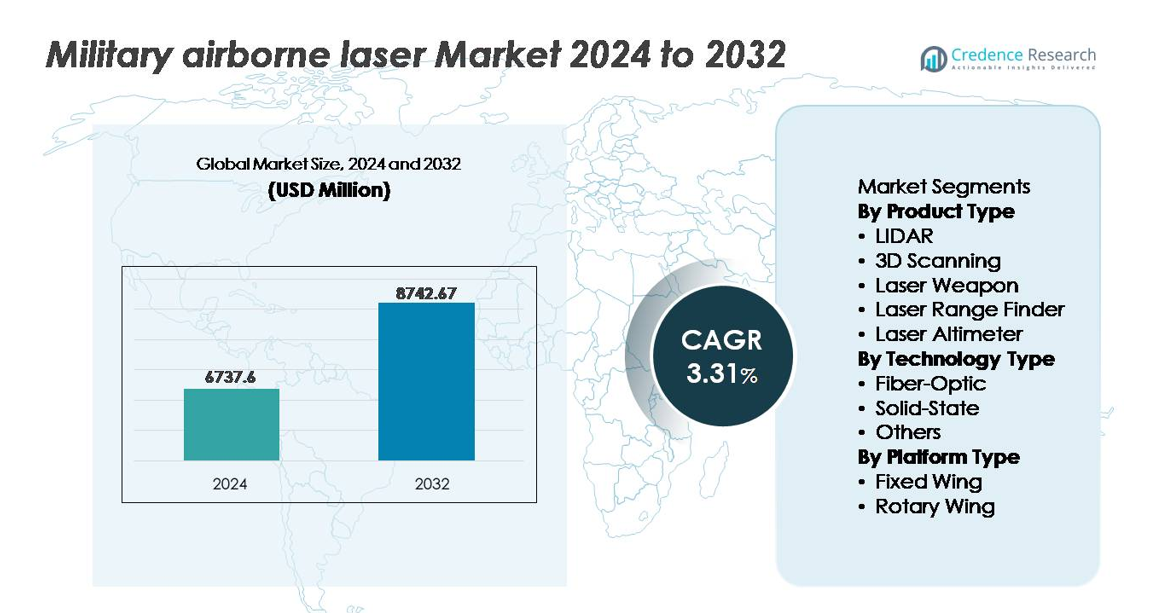
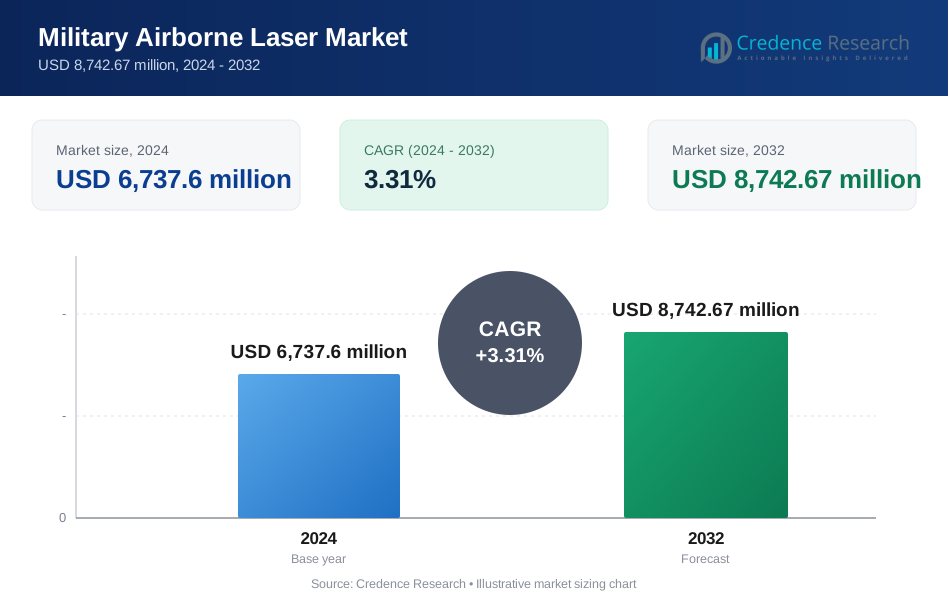
The global military airborne laser market was valued at USD 6,737.6 million in 2024 and is projected to reach USD 8,742.67 million by 2032, reflecting a compound annual growth rate (CAGR) of 3.31% during the forecast period.
| REPORT ATTRIBUTE | DETAILS |
|---|---|
| Historical Period | 2020-2023 |
| Base Year | 2024 |
| Forecast Period | 2025-2032 |
| Military Airborne Laser Market Size 2024 | USD 6,737.6 million |
| Military Airborne Laser Market, CAGR | 3.31% |
| Military Airborne Laser Market Size 2032 | USD 8,742.67 million |
The military airborne laser market is shaped by a competitive mix of global defense leaders and specialized laser technology providers, including Thales SA, Frankfurt Laser Company (FLC), American Laser Enterprises LLC, Saab AB, Coherent Corp, Northrop Grumman Corporation, Leonardo Electronics US Inc., RTX Corporation, BAE Systems plc, and Lockheed Martin Corporation. These companies focus on high-energy laser weaponization, airborne ISR support, and compact laser integration for fixed- and rotary-wing platforms. North America leads the global market with approximately 38% share, supported by sustained defense modernization, directed-energy deployment programs, and strong domestic aerospace supply chains, positioning the region at the forefront of laser-enabled combat capabilities.
Market Insights:
- The military airborne laser market was valued at USD 6,737.6 million in 2024 and is projected to reach USD 8,742.67 million by 2032, expanding at a CAGR of 3.31% during the forecast period.
- Market growth is driven by rising demand for precision engagement, real-time ISR mapping, and counter-UAS operations as defense forces enhance battlefield intelligence and long-range strike capabilities.
- Solid-state technology holds the largest segment share due to higher energy efficiency and ruggedization for fixed-wing platforms, while compact fiber-based systems gain adoption in UAVs and rotary-wing fleets.
- Intensifying competitive strategies focus on directed-energy innovation, miniaturization, and modular upgrade frameworks, with major players aligning their portfolios with national modernization programs and export defense agreements.
- Regionally, North America leads with 38% share, followed by Europe at 27% and Asia-Pacific at 24%, driven by modernization agendas, increasing aerospace capabilities, and mounting cross-border threat surveillance requirements.
Market Segmentation Analysis:
By Product Type
LIDAR represents the dominant sub-segment in the military airborne laser market, holding the largest market share due to expanding deployment in intelligence, surveillance, reconnaissance (ISR), and target acquisition missions. Defense forces leverage high-resolution, real-time mapping to support precision strike coordination and autonomous navigation. The increasing integration of LIDAR with unmanned aerial platforms strengthens operational efficiency in contested environments. Meanwhile, laser weapons and 3D scanning systems are gaining traction as armed forces modernize counter-drone capabilities and enhance structural inspection accuracy for mission-critical airframes and infrastructure.
- For instance, the Northrop Grumman RQ-4 Global Hawk unmanned aerial system provides high-resolution surveillance using both an Integrated Sensor Suite (ISS) and, on Block 40 variants, the Multi-Platform Radar Technology Insertion Program (MP-RTIP) radar.
By Technology Type
Solid-state laser technology dominates the market, driven by its superior electrical-to-optical efficiency, structural compactness, and ability to withstand harsh operating conditions during high-vibration, high-altitude missions. Solid-state platforms are widely favored in advanced targeting, missile guidance, and airborne directed-energy applications due to improved beam stability and reduced thermal load. Fiber-optic technology is steadily emerging as a fast-growing segment as militaries explore lightweight, lower power-consumption solutions for rotary-wing and unmanned aircraft. The demand for scalable laser output and modular system architecture continues to accelerate adoption acrossair-launched defense programs.
- For instance, Lockheed Martin’s ATHENA solid-state laser demonstrator achieved a 30-kilowatt output during field testing, successfully disabling aerial targets through sustained, precision-directed energy.
By Platform Type
Fixed-wing aircraft constitute the dominant platform segment, attributed to their higher payload capacity, long-range sortie capability, and suitability for hosting large-format LIDAR, laser weapons, and ISR-focused systems. Strategic bombers, combat aircraft, and large surveillance platforms rely on multi-mission laser systems to enhance precision engagement and optimize reconnaissance operations. Rotary-wing aircraft represent a rising opportunity as armed forces retrofit helicopters with laser range finders and target designation equipment for close air support. Advancements in compact and lightweight laser payloads continue to expand deployment feasibility for multiple aircraft classes.
Key Growth Drivers:
Rising Demand for Precision Targeting and ISR Dominance
Advanced militaries prioritize precision strike capabilities, real-time intelligence, and contested-airspace superiority, which fuels the adoption of airborne laser systems. Enhanced beam accuracy allows units to detect, track, and neutralize small, fast-moving, and low-visibility targets more effectively than conventional kinetic platforms. These systems reduce collateral damage and support long-range engagement through cloud-penetrating and multi-spectral sensing capabilities. Growing investments in unmanned combat aerial vehicles (UCAVs), network-centric warfare, and electronic attack-resistant technologies further strengthen demand. Modern battlefield requirements for silent, light-speed engagement and reduced logistics tail reinforce airborne laser relevance across strategic, tactical, and homeland-defense missions.
- For instance, Northrop Grumman demonstrated precision laser tracking accuracy below 2 microradians during airborne field tests of its directed-energy prototype, enabling sustained lock on maneuvering targets at significant stand-off distances.
Government Modernization Programs and Directed Energy Initiatives
Defense modernization programs across North America, Europe, and Asia-Pacific prioritize directed-energy weapons (DEWs) as future frontline assets, propelling procurement pipelines. Governments accelerate R&D in next-generation laser platforms to counter drones, hypersonic threats, and precision-guided munitions. Large-scale defense budgets facilitate prototype-to-deployment transitions and establish joint industrial-military development frameworks. These initiatives mitigate reliance on legacy projectiles and reduce lifetime operational costs through lower ammunition consumption. Cross-border defense alliances promote interoperability standards and shared testing environments, allowing faster system validation and supporting ecosystem scalability. This coordinated policy environment strengthens adoption as militaries shift toward energy-based deterrence.
- For instance, the U.S. Army’s Directed Energy Maneuver-Short Range Air Defense (DE M-SHORAD) program equipped Stryker vehicles with a 50-kilowatt laser developed by RTX Corporation, achieving successful live-fire interceptions during 2023 demonstrations.
Integration of Airborne Lasers with AI, Automation, and Networked Combat Systems
The integration of AI-enabled image processing, autonomous targeting, and predictive sensor analytics enhances airborne laser systems’ speed and reliability, enabling rapid threat recognition and engagement. Automated beam control minimizes human intervention, supporting multi-target tracking and precision designation in dynamic combat environments. Networked lasers linked through battlefield communication grids strengthen joint-force coordination, providing fused situational awareness across air, land, and naval platforms. As defense forces deploy swarms, smart munitions, and autonomous aircraft, interoperable laser systems become critical force multipliers. AI-driven mission planning, system diagnostics, and autonomous ISR tasks further elevate operational capability.
Key Trends & Opportunities:
Shift Toward Compact, Lightweight, and High-Energy Laser Systems
The miniaturization of airborne laser systems unlocks opportunities for deployment on tactical drones, lightweight rotary platforms, and unmanned cargo aircraft. Advances in thermal management, battery density, and solid-state laser engineering reduce system mass while increasing energy output. High-energy lasers provide greater destructive capability against low-cost aerial threats such as UAVs and cruise missiles. As battlefield focus shifts toward rapid mobility and flexible deployment, demand rises for scalable systems that combine high-power projection with low logistical burden. These innovations enable broader integration into multi-domain operations and emerging aircraft platforms.
- For instance, Lockheed Martin’s DEIMOS laser architecture, announced in 2024, is engineered as a scalable, modular system capable of delivering outputs in the 50-kilowatt class, configured within compact form factors optimized for future airborne deployments.
Expanding Role in Counter-UAS, Reconnaissance, and Border Defense
Military airborne lasers are evolving from niche tools into mission-critical assets for counter-UAS, reconnaissance, and perimeter defense operations. The proliferation of commercial and weaponized drones makes airborne lasers essential for precision interception without explosive risks. Border forces and maritime patrol fleets adopt laser-based detection and tracking to monitor illegal transport routes and stealth aircraft movement. Integration with communication relay systems offers real-time analytics for surveillance and interdiction. These applications position airborne lasers as cost-effective, reload-free alternatives to traditional air defense and ISR solutions, especially in sustained conflict or remote operations.
- For instance, RTX Corporation’s High-Energy Laser Weapon System (HELWS) demonstrated successful engagement of Group 1 and Group 2 drones at distances exceeding 1,000 meters during U.S. Air Force field evaluations, operating with a stabilized beam-director and radar-cueing architecture for real-time targeting.
Growing Opportunities in Joint Military-Industrial Laser Research Programs
Collaboration between defense agencies, industrial laser manufacturers, and academic research institutes accelerates prototype evolution, materials science breakthroughs, and system ruggedization. Joint development programs shorten technology cycles and reduce integration risks for high-value airborne platforms. These partnerships foster innovation in coherent beam combining, enhanced optical fibers, and atmospheric compensation algorithms. Dual-use technology applications in aerospace engineering, environmental sensing, and national security enable wider commercialization pathways, attracting private investment. As export regulations evolve, domestically co-developed airborne laser systems present opportunities for regional defense export strategies.
Key Challenges:
Atmospheric Interference and Range Limitations in Real-World Combat Environments
Despite performance improvements, airborne lasers face technical hurdles due to atmospheric distortion, fog, dust, and moisture, which degrade beam intensity over long ranges. Combat conditions rarely provide controlled environments, making adaptive optics and compensation algorithms vital but costly. Laser effectiveness may diminish in adverse weather or during high-speed aircraft maneuvers. Maintaining beam stability across variable altitudes and thermal gradients demands sophisticated hardware and real-time software correction. These limitations constrain mission reliability and require continuous investment in optical science, material engineering, and advanced sensor fusion to sustain operational viability.
High Cost of Development, Integration, and Lifecycle Support
Airborne laser programs involve high initial investment, complex integration with avionics and power systems, and stringent safety and certification requirements. Specialized materials, cooling architectures, and reinforced airframes elevate production and retrofitting costs. Sustaining system performance requires regular calibration, component replacement, and specialized maintenance infrastructure. The steep cost curve may restrict acquisition to major defense spenders, slowing global adoption. Budget uncertainties, export controls, and lengthy procurement cycles create commercial risk for suppliers, making long-term partnerships, modular upgrade pathways, and cost-sharing agreements critical to program sustainability.
Regional Analysis:
North America
North America holds the dominant position in the military airborne laser market, accounting for around 38% of global share, driven by extensive directed-energy investments and early adoption of laser-equipped aircraft for ISR and counter-UAS operations. The United States leads regional growth through modernization initiatives across bomber, fighter, and unmanned platforms, supported by large defense budgets and strong aerospace manufacturing ecosystems. Collaboration between defense agencies and private contractors accelerates prototype testing and platform integration. Increasing focus on hypersonic threat detection and border surveillance further motivates procurement of high-performance laser targeting and range-finding systems.
Europe
Europe represents approximately 27% of market share, propelled by joint-defense initiatives, cross-border military industrial cooperation, and modernization of fixed-wing and rotary fleets across NATO members. The United Kingdom, France, and Germany lead development and field testing of directed-energy technology for missile defense, reconnaissance, and autonomous aircraft support. Growing geopolitical tensions and commitments to collective deterrence drive investment into multi-domain sensing and counter-drone capabilities. EU programs focusing on digital battlefield integration create opportunities for lightweight, modular airborne laser payloads. However, procurement cycles and export regulations slightly temper short-term deployment velocity.
Asia-Pacific
Asia-Pacific captures around 24% of market share, emerging as the fastest-advancing region due to escalating defense expenditures and accelerated deployment of indigenous airborne laser systems. China, India, South Korea, and Japan prioritize laser-based ISR and targeting technologies to support contested-airspace operations, island defense strategies, and border surveillance. Domestic aerospace manufacturing capability continues to scale, supporting integration of airborne lasers into UAVs and tactical aircraft. Regional competition, territorial disputes, and drone proliferation stimulate demand for range finders, LIDAR reconnaissance systems, and counter-UAS capabilities tailored to mountainous and maritime environments.
Middle East & Africa
The Middle East and Africa collectively account for approximately 7% of the global market, driven by sustained security modernization, cross-border threat surveillance, and investments in advanced reconnaissance aircraft. Gulf nations deploy airborne laser systems to enhance protection of infrastructure, maritime trade routes, and critical energy assets. Partnerships between regional defense ministries and global aerospace companies facilitate technology transfers and customization for harsh climatic conditions. Meanwhile, gradual fleet upgrades among African nations support incremental adoption of laser range-finding and mapping payloads. Budget constraints, however, continue to limit large-scale directed-energy procurement.
Latin America
Latin America holds about 4% market share, supported mainly by selective investments in airborne surveillance, anti-smuggling operations, and natural disaster response mapping. Brazil and Mexico lead adoption, integrating laser range finders and LIDAR mapping systems to enhance defense intelligence and border patrol missions. Regional governments explore cost-efficient upgrades to existing air fleets rather than large-scale procurement of new directed-energy platforms. Opportunities emerge from environmental monitoring, illegal mining detection, and maritime enforcement. However, fiscal limitations, slower procurement pipelines, and reliance on foreign defense suppliers moderate overall market expansion.
Market Segmentations:
By Product Type
- LIDAR
- 3D Scanning
- Laser Weapon
- Laser Range Finder
- Laser Altimeter
By Technology Type
- Fiber-Optic
- Solid-State
- Others
By Platform Type
- Fixed Wing
- Rotary Wing
By Geography
- North America
- U.S.
- Canada
- Mexico
- Europe
- Germany
- France
- U.K.
- Italy
- Spain
- Rest of Europe
- Asia Pacific
- China
- Japan
- India
- South Korea
- South-east Asia
- Rest of Asia Pacific
- Latin America
- Brazil
- Argentina
- Rest of Latin America
- Middle East & Africa
- GCC Countries
- South Africa
- Rest of the Middle East and Africa
Competitive Landscape:
The competitive landscape of the military airborne laser market is characterized by a concentrated group of defense prime contractors, laser technology specialists, and aerospace integrators competing to advance high-energy capability, miniaturization, and operational resiliency. Companies prioritize partnerships with defense ministries to secure long-term procurement and development contracts, while joint ventures support system co-manufacturing and export positioning. Investment in solid-state laser engineering, directed-energy weapons, and AI-enabled beam tracking strengthens differentiation as militaries pursue precision engagement solutions. Competitive momentum is influenced by prototype-to-field deployment speed, integration with fixed- and rotary-wing platforms, and modular upgrade pathways that reduce lifecycle cost. Suppliers also focus on ruggedization for extreme altitudes, atmospheric compensation algorithms, and interoperability with autonomous and unmanned aircraft systems. As national defense strategies evolve toward multi-domain command and rapid threat interception, market competition intensifies around compact, higher-output laser platforms capable of neutralizing hypersonic and low-altitude aerial threats at greater distance with reduced collateral impact.
Key Player Analysis:
- Thales SA
- Frankfurt Laser Company (FLC)
- American Laser Enterprises, LLC
- Saab AB
- Coherent Corp
- Northrop Grumman Corporation
- Leonardo Electronics US, Inc.
- RTX Corporation
- BAE Systems plc
- Lockheed Martin Corporation
Recent Developments:
- In August 2025, Thales SA the French Defence Procurement Agency (DGA) placed an order for a high-power laser weapon demonstrator, SYDERAL (New Generation Laser Defence System), with Thales as part of a consortium.
- In February 2025, Saab signed a Memorandum of Understanding (MoU) with Hindustan Aeronautics Limited (HAL) to collaborate on the Laser Warning System-310 (LWS-310), enabling HAL to manufacture the laser warning system locally in India.
- In November 2024, Thales Australia partnered with the University of Adelaide to explore long-range counter-UAS laser technology, aiming to develop advanced directed-energy weapons for drone threats.
Report Coverage:
The research report offers an in-depth analysis based on Product type, Technology type, Platform type and Geography. It details leading market players, providing an overview of their business, product offerings, investments, revenue streams, and key applications. Additionally, the report includes insights into the competitive environment, SWOT analysis, current market trends, as well as the primary drivers and constraints. Furthermore, it discusses various factors that have driven market expansion in recent years. The report also explores market dynamics, regulatory scenarios, and technological advancements that are shaping the industry. It assesses the impact of external factors and global economic changes on market growth. Lastly, it provides strategic recommendations for new entrants and established companies to navigate the complexities of the market.
Future Outlook:
- Adoption of high-energy laser weapons will accelerate as militaries shift toward cost-efficient precision engagement.
- Compact and lightweight laser payloads will expand integration across UAVs, helicopters, and next-generation tactical aircraft.
- AI-enabled target recognition and autonomous beam control will enhance response speed in multi-domain operations.
- Counter-UAS capabilities will remain a primary deployment focus amid rising drone swarm threats.
- Solid-state and fiber-laser systems will gain dominance due to improved thermal management and power efficiency.
- Cross-border defense partnerships will increase joint development and technology-sharing programs.
- Ruggedized lasers will support operations in extreme climates and high-altitude environments.
- Directed-energy solutions will complement kinetic weapons rather than fully replace them in the near term.
- Modular upgrade pathways will reduce lifecycle cost and extend platform relevance.
- Regional defense strategies will influence adoption pace, with Asia-Pacific emerging as a high-growth deployment zone.
Request a Free Sample
Fill in your details and we'll send you a free sample report.
- Sample data tables & charts
- Research methodology
Need a Custom Version of This Report?
Tailor the scope, geography, or segments to your exact requirements.
- Custom geography or segment scope
- Direct access to our analyst team
Frequently Asked Questions
What is the current market size for the military airborne laser market, and what is its projected size in 2032?
At what Compound Annual Growth Rate is the military airborne laser market projected to grow between 2024 and 2032?
Which military airborne laser segment held the largest share in 2024?
What are the primary factors fueling the growth of the military airborne laser market?
Who are the leading companies in the military airborne laser market?
Table of Content
Chapter 1. Report Introduction
- 1.1 Report Description & Purpose
- 1.1.1 Report Title & Market Definition
- 1.1.2 Unique Selling Propositions (USP) & Key Differentiators
- 1.1.3 Value Proposition for Stakeholders
- 1.2 Research Objectives
- 1.2.1 Market Sizing Objectives (Volume & Revenue)
- 1.2.2 Segmentation Objectives
- 1.2.3 Competitive Intelligence Objectives
- 1.2.4 Forecast & Scenario Objectives
- 1.3 Report Scope
- 1.3.1 Military Airborne Laser Scope – Types & Subtypes Covered
- 1.3.2 Geographic Scope – Regions & Countries Covered
- 1.3.3 Historical Period, Base Year & Forecast Period (2024; forecast to 2032)
- 1.3.4 Inclusions & Exclusions
- 1.4 HS Code & Classification Framework
- 1.5 Currency, Units & Pricing Basis
- 1.6 Target Stakeholders
- 1.7 Limitations & Assumptions
Chapter 2. Executive Summary
- 2.1 Global Military Airborne Laser Market Snapshot
- 2.1.1 Market Size – Historical (2024) & Forecast (2024-2032) (2024: USD 6,737.6 million → 2032: USD 8,742.67 million)
- 2.1.2 Volume & Revenue – Global Totals
- 2.1.3 Key Market Highlights – Top Five Facts
- 2.2 Military Airborne Laser Market Segmentation Snapshot
- 2.2.1 Market Split by Region – 2024 vs. 2032
- 2.3 Competitive Snapshot
- 2.3.1 Top 10 Players by Revenue Share – 2024
- 2.3.2 Top 10 Players by Volume Share – 2024
- 2.3.3 Recent Strategic Developments (18-Month Summary)
- 2.4 Key Investment Highlights & Strategic Conclusions
Chapter 3. Military Airborne Laser Market Dynamics & Industry Analysis
- 3.1 Market Overview & Context
- 3.1.1 Military Airborne Laser Market Position in the Broader Automotive Value Chain
- 3.1.2 OEM vs. Replacement Market Dynamics
- 3.1.3 Market Maturity & Development Stage by Region
- 3.2 Military Airborne Laser Market Drivers
- 3.3 Military Airborne Laser Market Restraints & Challenges
- 3.4 Military Airborne Laser Market Opportunities
- 3.5 Porter's Five Forces Analysis
- 3.5.1 Threat of New Entrants
- 3.5.2 Bargaining Power of Suppliers
- 3.5.3 Bargaining Power of Buyers
- 3.5.4 Threat of Substitutes
- 3.5.5 Competitive Rivalry – Intensity Assessment
- 3.6 Military Airborne Laser Value Chain Analysis
- 3.6.1 Upstream – Raw Material/Input Suppliers
- 3.6.1.1 Raw Material/Input 1
- 3.6.1.2 Raw Material/Input 2
- 3.6.1.3 Raw Material/Input 3
- 3.6.2 Midstream – Production/Manufacturing/Service Delivery
- 3.6.2.1 Production/Process Overview
- 3.6.2.2 Key Facility Locations & Capacity by Manufacturer
- 3.6.3 Downstream – Distribution & End Consumer
- 3.6.3.1 Primary Channel – B2B/OEM
- 3.6.3.2 Secondary Channels – Dealer, Retail, Online, Direct
- 3.6.4 Value Chain Profitability Analysis
- 3.6.1 Upstream – Raw Material/Input Suppliers
- 3.7 PESTEL Analysis
- 3.7.1 Political Factors
- 3.7.2 Economic Factors
- 3.7.3 Social Factors
- 3.7.4 Technological Factors
- 3.7.5 Environmental Factors
- 3.7.6 Legal Factors
- 3.8 Military Airborne Laser Supply Chain Analysis
- 3.8.1 Raw Material/Input Supply Risk Assessment
- 3.8.2 Manufacturing Concentration Risk (Geographic Exposure)
- 3.8.3 Trade Disruption Impact Analysis
- 3.9 Regulatory & Policy Landscape
Note: The regulatory and policy landscape section covers regulations based on their applicability to the market, Military Airborne Laser category, geography, and scope of the study. Only regulatory frameworks with a material impact on operations, compliance, trade, sustainability, or market access are analyzed in detail.
Chapter 4. Key Investment Pockets & Opportunity Analysis
- 4.1 Military Airborne Laser Market Attractiveness Analysis
- 4.1.1 By Region – Investment Attractiveness Matrix (Volume × CAGR)
- 4.2 Absolute Revenue Growth Opportunity
- 4.2.1 By Region – Absolute USD Growth Through 2032
- 4.3 Incremental Volume Opportunity
- 4.3.1 By Region – Incremental Volume Through 2032
- 4.3.2 Segment – Incremental Volume
- 4.4 Emerging Submarket Opportunity Deep Dive (Subject to Applicability)
- 4.5 Emerging Market Opportunity Scorecards
- 4.5.1 United States
- 4.5.2 Europe
- 4.5.3 Asia
- 4.5.4 Middle East & Africa
Note: Emerging Market Opportunity Scorecards will be included based on relevance and strategic importance. Regions listed are indicative and may vary depending on data availability and market dynamics.
Chapter 5. Military Airborne Laser Import-Export Analysis & Trade Flows
- 5.1 Global Trade Overview
- 5.1.1 Global Export Value by Country (2024)
- 5.1.2 Global Export Volume by Country (2024)
- 5.1.3 Global Import Value by Country (2024)
- 5.1.4 Global Import Volume by Country (2024)
- 5.1.5 Net Trade Balance by Country (2024)
- 5.2 Export Analysis – Segment
- 5.2.1 Type 1 (HS Code)
- 5.2.2 Type 2 (HS Code)
- 5.2.3 Type 3 (HS Code)
- 5.2.4 Type 4 (HS Code)
- 5.2.5 Type 5 (HS Code)
- 5.3 Import Analysis – Segment
- 5.3.1 Type 1 (HS Code)
- 5.3.2 Type 2 (HS Code)
- 5.3.3 Type 3 (HS Code)
- 5.3.4 Type 4 (HS Code)
- 5.3.5 Type 5 (HS Code)
- 5.4 Average Unit Trade Prices
- 5.4.1 Average Export Price – Segment & Country
- 5.4.2 Average Import Price – Segment & Source Country
- 5.4.3 Price Trends (2024)
- 5.5 Key Trade Route Analysis
- 5.5.1 Trade Route 1
- 5.5.2 Trade Route 2
- 5.5.3 Trade Route 3
- 5.5.4 Trade Route 4
- 5.5.5 Trade Route 5
- 5.6 Trade Policy Impact Assessment
- 5.6.1 US Anti-Dumping & Section 301 Tariffs
- 5.6.2 EU Customs Union Impact
- 5.6.3 Major Free Trade Agreements
- 5.6.4 USMCA Rules of Origin
Note: Trade policy analysis will be included only where relevant to the Military Airborne Laser market.
Chapter 6. Competitive Landscape & Company Benchmarking
- 6.1 Military Airborne Laser Market Concentration & Structure
- 6.1.1 Herfindahl-Hirschman Index (HHI) – vs. 2024
- 6.1.2 Tier 1, Tier 2 & Tier 3 Market Structure
- 6.1.3 Global, Regional & Local Player Dynamics
- 6.2 Military Airborne Laser Market Share Analysis – 2024
- 6.2.1 Global Revenue Share by Company
- 6.2.2 Global Volume Share by Company
- 6.2.3 Regional Revenue Share
- 6.2.4 Market Share Evolution ( vs. 2024)
- 6.2.5 OEM Segment Share by Company
- 6.2.6 Replacement Segment Share by Company
- 6.3 Production/Delivery Capacity & Facility Analysis
- 6.3.1 Global Installed Capacity
- 6.3.2 Capacity Utilization Rates
- 6.3.3 Production/Output Volume
- 6.3.4 Facility Locations & Capacity Map
- 6.3.5 Planned Capacity Additions
- 6.4 Military Airborne Laser Competitive Benchmarking Matrix
- 6.4.1 Revenue, Volume, CAGR & Profitability Comparison
- 6.4.2 Channel Revenue Mix
- 6.4.3 Geographic Revenue Exposure
- 6.4.4 R&D Intensity
- 6.4.5 Sustainability Maturity
- 6.5 Strategic Developments in Military Airborne Laser (Last 24 Months)
- 6.5.1 Mergers, Acquisitions & Divestments
- 6.5.2 New Military Airborne Laser Launches
- 6.5.3 Facility Expansions
- 6.5.4 Strategic Alliances, Joint Ventures & Partnerships
- 6.5.5 Distribution Expansion & Market Entry
- 6.5.6 Sustainability & ESG Initiatives
- 6.6 Competitive Strategy Mapping
- 6.6.1 Leader, Challenger, Follower & Niche Classification
- 6.6.2 Pricing Strategy Comparison
- 6.6.3 Channel Strategy Matrix
Note: Strategic developments are included based on their materiality and the availability of reliable information.
Chapter 7. Global Military Airborne Laser Market – By Distribution Channel
- 7.1 Segment Overview
- 7.1.1 Volume & Revenue Split by Channel (2024 & 2032)
- 7.1.2 Channel Mix Evolution (2024-2032)
Chapter 8. Regional Market Analysis – Global Overview
- 8.1 Global Regional Overview
- 8.1.1 Regional Volume Share
- 8.1.2 Regional Revenue Share
- 8.1.3 Regional Volume by Region
- 8.1.4 Regional Revenue by Region
- 8.1.5 Regional Forecast Through 2032
- 8.2 Cross-Regional Segment Analysis
- 8.2.1 By Distribution Channel
- 8.2.2 By Brand/Price Tier
Chapter 9. North America Military Airborne Laser Market
- 9.1 United States
- 9.2 Canada
- 9.3 Mexico
Chapter 10. Europe Military Airborne Laser Market
- 10.1 Germany
- 10.2 France
- 10.3 Italy
- 10.4 United Kingdom
- 10.5 Spain
- 10.6 Poland
- 10.7 Russia
- 10.8 Netherlands
- 10.9 Belgium
- 10.10 Sweden
- 10.11 Denmark
- 10.12 Norway
- 10.13 Rest of Europe
Chapter 11. Asia Pacific Military Airborne Laser Market
- 11.1 China
- 11.2 India
- 11.3 Japan
- 11.4 South Korea
- 11.5 Thailand
- 11.6 Indonesia
- 11.7 Vietnam
- 11.8 Malaysia
- 11.9 Australia
- 11.10 Rest of Asia Pacific
Chapter 12. Latin America Military Airborne Laser Market
- 12.1 Brazil
- 12.2 Argentina
- 12.3 Colombia
- 12.4 Chile
- 12.5 Rest of Latin America
Chapter 13. Middle East Military Airborne Laser Market
- 13.1 Saudi Arabia
- 13.2 United Arab Emirates
- 13.3 Turkey
- 13.4 Israel
- 13.5 Iran
- 13.6 Rest of the Middle East
Chapter 14. Africa Military Airborne Laser Market
- 14.1 South Africa
- 14.2 Egypt
- 14.3 Nigeria
- 14.4 Morocco
- 14.5 Rest of Africa
Chapter 15. Military Airborne Laser Company Profiles
- 15.1 [Company 01]
- 15.1.1 Company Overview
- 15.1.2 Key Management Personnel
- 15.1.3 Products & Services Portfolio
- 15.1.4 Financial Performance
- 15.1.5 Key Market Focus & Geographic Presence
- 15.1.6 Recent Developments & Strategic Initiatives
Note: The company profile list is preliminary and may change based on research findings, market developments, data availability, and client requirements.
Chapter 16. Appendices
- Appendix A – List of Abbreviations & Acronyms
- Appendix B – Industry Classification Code Reference – Full Series
- Appendix C – Production & Capacity Data Tables
- Appendix D – End-Use & Demand Base Tables
- Appendix E – Consumption & Replacement Rate Assumptions
- Appendix F – ASP Reference Tables
- Appendix G – Manufacturing & Facility Database
- Appendix H – Import-Export Data Tables
- Appendix I – Regulatory Summary Tables
- Appendix J – Primary Research Participant List (Anonymized)
- Appendix K – Primary Research Questionnaire Framework
- Appendix L – Data Sources & Bibliography
- Appendix M – Market Size Divergence & Source Comparison
Chapter 17. Research Methodology
- 17.1 Research Framework & Philosophy
- 17.2 Secondary Research – Sources, Hierarchy & Data Extraction
- 17.3 Data Modeling – Bottom-Up & Top-Down Market Sizing
- 17.4 Primary Research – Stakeholder Framework, LOI & Sample Sizes
- 17.5 Forecast Methodology – Regression, Scenario & Sensitivity Analysis
- 17.6 Quality Control – Four-Layer Validation Framework
- 17.7 Limitations & Standard Assumptions
- 17.8 Disclaimer
