| REPORT ATTRIBUTE |
DETAILS |
| Historical Period |
2020-2023 |
| Base Year |
2024 |
| Forecast Period |
2025-2032 |
| Kitchen Towel Market Size 2024 |
USD 18,512.79 Million |
| Kitchen Towel Market, CAGR |
6.34% |
| Kitchen Towel Market Size 2032 |
USD 31,358.33 Million |
Market Overview
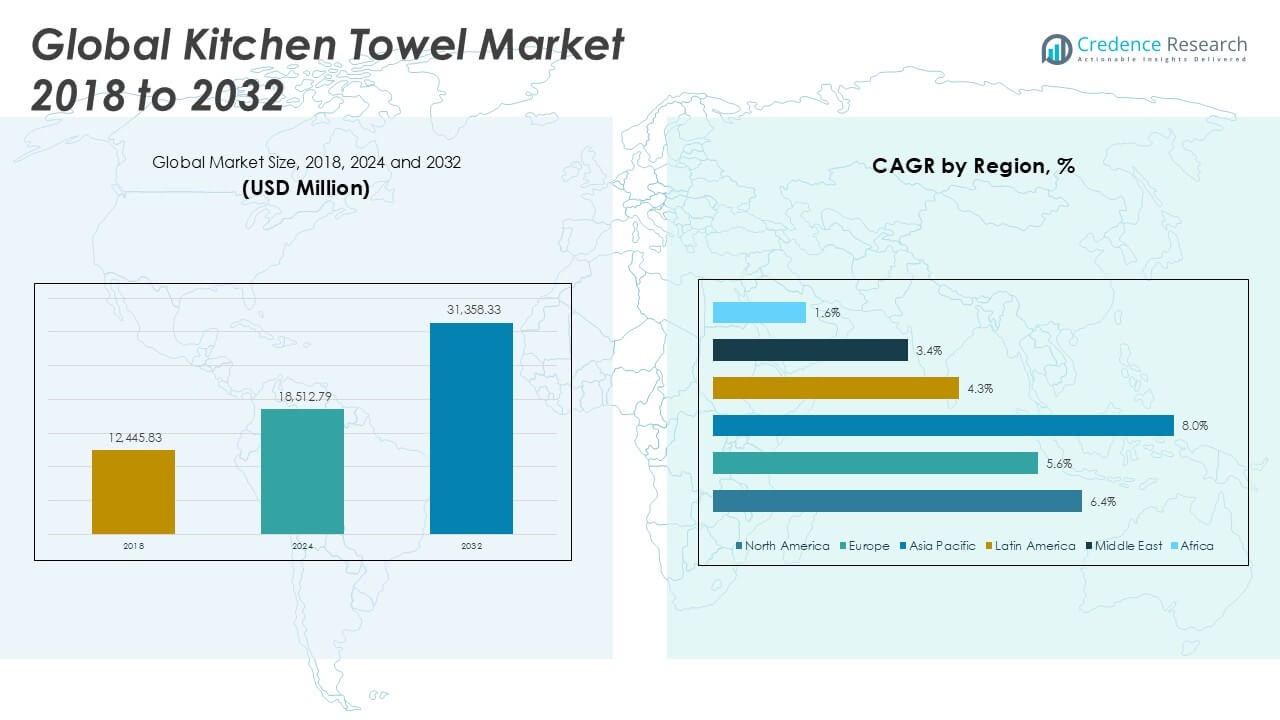
The Kitchen Towel Market size was valued at USD 12,445.83 million in 2018, reached USD 18,512.79 million in 2024, and is anticipated to reach USD 31,358.33 million by 2032, at a CAGR of 6.34% during the forecast period.
The Kitchen Towel Market is driven by rising consumer awareness regarding hygiene and cleanliness, particularly in residential and commercial kitchens. The increasing demand for disposable and eco-friendly towel options, along with the growing influence of organized retail and e-commerce, has supported market expansion. Urbanization, rising disposable incomes, and lifestyle changes have further contributed to the adoption of premium kitchen towel products. Manufacturers are focusing on innovations such as high-absorbency materials and biodegradable options to align with environmental concerns. Market trends include a shift toward sustainable packaging and the integration of antimicrobial properties to enhance functionality. Additionally, private label brands are gaining traction due to competitive pricing and wide availability. Demand from hotels, restaurants, and catering services continues to rise, further stimulating growth. The evolving consumer preference for convenient, cost-effective, and multipurpose kitchen solutions positions the market for steady advancement over the forecast period.
The geographical landscape of the Kitchen Towel Market spans key regions such as North America, Europe, Asia Pacific, Latin America, the Middle East, and Africa. North America leads in terms of product demand, driven by high hygiene standards and a mature retail sector. Europe follows with strong emphasis on sustainability and premium kitchen towel variants. Asia Pacific is emerging rapidly due to urbanization, rising disposable income, and expanding consumer awareness. Latin America, the Middle East, and Africa are gradually witnessing growth through improving retail access and lifestyle changes. Prominent players shaping the global market include Kimberly-Clark, known for its strong product portfolio and brand recognition; Essity, offering sustainable and innovative hygiene products; and Clearwater Paper, which focuses on private label tissue solutions. Accrol Group is also notable for its competitive pricing and supply to major UK retailers, further enhancing regional reach and product availability.
Access crucial information at unmatched prices!
Request your sample report today & start making informed decisions powered by Credence Research Inc.!
Download Sample
Market Insights
- The Kitchen Towel Market was valued at USD 18,512.79 million in 2024 and is projected to reach USD 31,358.33 million by 2032, registering a CAGR of 6.34% during the forecast period.
- Increasing consumer focus on hygiene and sanitation in both residential and commercial kitchens continues to drive demand for disposable and high-absorbency kitchen towels.
- Sustainable and biodegradable kitchen towels are gaining popularity as consumers prefer eco-friendly alternatives to reduce environmental impact.
- North America and Europe remain dominant regions due to advanced retail infrastructure, while Asia Pacific shows the fastest growth supported by rising disposable income and urban lifestyle adoption.
- Major players such as Kimberly-Clark, Essity, Clearwater Paper, and Accrol Group compete through product innovation, expanded distribution, and sustainable offerings.
- Fluctuations in raw material costs, along with rising pressure to meet environmental regulations, present key challenges for manufacturers in maintaining profitability.
- Online retail and subscription-based models are reshaping distribution strategies, offering convenience and recurring revenue opportunities for brands targeting diverse consumer bases.
Market Drivers
Rising Demand for Hygiene and Sanitation in Household Kitchens
The Kitchen Towel Market is benefiting from heightened consumer focus on hygiene and food safety. Households increasingly prefer kitchen towels over cloth alternatives due to their single-use convenience and improved absorption. It supports quick cleanups, reducing the risk of bacterial contamination on kitchen surfaces. This shift is influenced by health awareness and the growing adoption of disposable kitchen products. Increased spending on home care and cleaning essentials further drives product uptake. It aligns with broader consumer behavior trends toward maintaining cleaner, more organized kitchen spaces.
- For instance, Kimberly-Clark reported the production of over 2.3 billion rolls of kitchen paper towels globally in a single year across its 41 tissue manufacturing facilities, underscoring the growing demand for hygienic disposable options.
Expansion of the HoReCa Sector and Institutional Consumption
The growth of hotels, restaurants, and catering services has expanded the application base of kitchen towels. It meets the high-frequency cleaning needs of professional kitchens where hygiene standards are strictly regulated. The HoReCa sector demands bulk quantities of durable, absorbent towels, encouraging suppliers to offer industrial-grade variants. Rising tourism and foodservice activities in urban centers contribute to consistent product demand. The Kitchen Towel Market sees growth from institutional contracts that require regular, high-volume replenishment. This sector supports brand visibility and recurring revenue streams for manufacturers.
- For instance, Essity supplies more than 1.2 million professional-grade towel rolls annually to foodservice clients through its Tork brand, with specific formats designed to meet HACCP compliance in commercial kitchens.
Product Innovations and Eco-Friendly Material Adoption
Manufacturers are responding to consumer expectations by introducing eco-conscious kitchen towel variants. It includes biodegradable, recycled, and bamboo-based products designed to minimize environmental impact. Product innovations such as textured patterns for enhanced cleaning and multi-layered structures for improved durability have strengthened market competitiveness. The Kitchen Towel Market is witnessing investment in R&D to align with sustainability goals without compromising performance. It enables companies to differentiate their offerings in a saturated market. Regulatory pressure on single-use plastics is pushing brands to reformulate packaging and raw materials.
Retail Modernization and E-Commerce Penetration
The expansion of modern retail formats and online platforms has increased product accessibility and brand exposure. Supermarkets, hypermarkets, and online marketplaces support varied consumer preferences through product assortment and competitive pricing. It allows brands to offer both value and premium kitchen towels across distribution channels. Digital platforms enhance consumer reach, encouraging trial and repeat purchases. The Kitchen Towel Market benefits from e-commerce tools like subscription models and targeted promotions that improve consumer engagement. It continues to evolve through diversified sales strategies and regional distribution networks.
Market Trends
Shift Toward Sustainable and Biodegradable Product Options
The Kitchen Towel Market is witnessing a strong trend toward eco-friendly products driven by consumer preference for sustainable living. Brands are introducing kitchen towels made from recycled paper, bamboo pulp, and other biodegradable materials. It responds to growing environmental concerns and regulatory restrictions on plastic-based packaging. Companies are redesigning product lines to include FSC-certified paper and compostable packaging to appeal to environmentally conscious consumers. Demand for green-label products is rising across developed and emerging economies. It creates opportunities for premium pricing and product differentiation.
- For instance, Clearwater Paper processed over 355,000 metric tons of recycled fiber in one year, integrating sustainability into more than 70% of its towel and tissue products sold under private labels.
Premiumization and the Rise of Multi-Purpose Kitchen Towels
Consumers are increasingly seeking higher-quality kitchen towels that deliver better absorbency, strength, and durability. The Kitchen Towel Market is evolving toward premium offerings that serve multiple cleaning needs beyond kitchen counters, including glass surfaces and appliances. It encourages manufacturers to invest in product features such as embossed textures and quilted layers. The growing interest in home aesthetics also influences packaging and design appeal. Premium products target urban households with higher disposable incomes and modern lifestyle habits. It enables brands to position themselves as essential kitchen hygiene solutions rather than commodity paper goods.
- For instance, Accrol Group introduced over 30 SKUs of embossed and quilted kitchen towels under its branded and private label lines in the UK market, tailored for both performance and visual appeal.
Growth of Private Label Brands Across Retail Channels
Private label kitchen towels are gaining traction in both offline and online retail spaces. It reflects consumers’ openness to cost-effective alternatives that match national brand quality. The Kitchen Towel Market has seen retailers expanding their house-brand portfolios with a focus on competitive pricing and improved product quality. Supermarkets and discount chains use private labels to drive customer loyalty and margin growth. Online marketplaces also feature white-label products with strong ratings and reviews, enhancing consumer trust. It puts pressure on established brands to innovate and defend market share.
Increased Influence of E-Commerce and Subscription-Based Models
Digital retailing is reshaping how consumers access kitchen towels, with a rising share of purchases now occurring online. E-commerce platforms offer convenience, price comparisons, and doorstep delivery, making them a preferred channel for bulk or recurring purchases. The Kitchen Towel Market is adapting by leveraging subscription models and customized packs to improve consumer retention. It provides brands with valuable consumer data to optimize inventory and pricing. Direct-to-consumer strategies further enhance brand visibility and engagement. It supports flexible and scalable distribution beyond traditional retail formats.
Market Challenges Analysis
Rising Raw Material Costs and Pressure on Margins
The Kitchen Towel Market faces challenges from fluctuating prices of raw materials such as pulp and paper. It impacts manufacturing costs and reduces profit margins, particularly for small and mid-sized producers. Energy prices, logistics, and packaging expenses also contribute to overall cost inflation. Price-sensitive consumers may shift toward lower-cost alternatives or reduce usage frequency, affecting demand stability. Companies struggle to maintain product quality while controlling operational costs under tight margin environments. It forces manufacturers to reconsider pricing strategies and supply chain efficiencies to stay competitive.
Environmental Concerns and Regulatory Constraints
Growing environmental concerns about deforestation and single-use paper waste place regulatory pressure on the market. The Kitchen Towel Market must adapt to tightening guidelines around sustainable sourcing and waste reduction. It creates compliance costs and limits product design flexibility, especially for brands dependent on traditional paper manufacturing. Consumer expectations for eco-labels and plastic-free packaging increase production complexity. Failure to meet evolving environmental standards can harm brand reputation and reduce access to key markets. It drives a need for long-term investment in greener technologies and raw material alternatives.
Market Opportunities
Expansion into Emerging Markets and Untapped Consumer Segments
The Kitchen Towel Market has strong potential for growth in emerging economies where hygiene awareness and disposable income are rising. Urbanization and changing lifestyles in regions such as Asia-Pacific, Latin America, and the Middle East drive demand for convenient cleaning products. It creates opportunities for brands to introduce affordable and accessible kitchen towel options tailored to local preferences. Low product penetration in rural and semi-urban areas presents a viable entry point for expansion. Partnerships with regional distributors and retailers can strengthen market presence and supply chains. The growing middle class in these markets supports long-term demand for disposable household products.
Product Customization and Innovation in Packaging Solutions
Manufacturers can capitalize on rising consumer interest in personalized, functional, and sustainable kitchen towels. The Kitchen Towel Market offers room for innovations in sheet size, texture, absorbency level, and multipurpose use. It enables brands to cater to diverse kitchen needs while maintaining product relevance. Smart packaging solutions, including resealable packs and space-efficient rolls, appeal to urban consumers with limited storage. Brands that invest in unique design and branding can differentiate their offerings and improve shelf appeal. It allows companies to build customer loyalty and increase repeat purchases through practical and aesthetic enhancements.
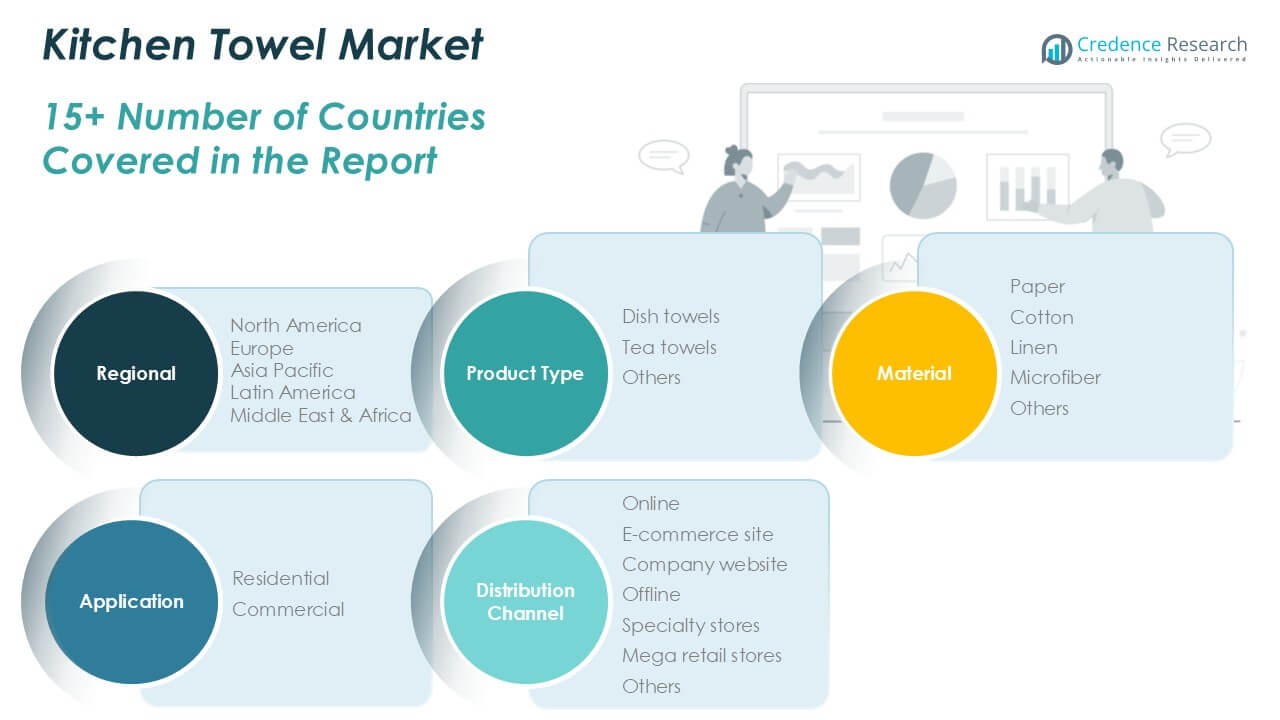
Market Segmentation Analysis:
By Product Type:
The Kitchen Towel Market is segmented by product type into dish towels, tea towels, and others. Dish towels hold the largest share due to their versatility in cleaning dishes, surfaces, and spills. It appeals to both households and commercial kitchens seeking high-absorbency, quick-drying cloths for everyday use. Tea towels are gaining popularity in urban households for drying glassware and serving decorative purposes. These towels are often made from cotton or linen, offering both utility and aesthetic appeal. The “others” category includes multipurpose and decorative kitchen towels that cater to niche or premium segments.
- For instance, Metsa Tissue’s Serla and Katrin brands together offer more than 40 differentiated towel variants across Nordic and Central European markets, targeting specific functional and decorative needs.
By Material:
Material segmentation includes paper, cotton, linen, microfiber, and others. Paper towels dominate due to their single-use convenience and widespread use in residential and commercial kitchens. It supports quick disposal and helps maintain hygiene by reducing cross-contamination risks. Cotton towels remain popular for their durability and softness, commonly used in homes and professional settings. Linen towels, though less common, are valued for their natural texture and elegant appearance. Microfiber is emerging due to its superior absorbency and quick-drying properties, appealing to eco-conscious and performance-driven consumers. The “others” segment includes blended fabrics and innovative materials designed to enhance utility and sustainability.
- For instance, Kruger Products processes more than 65,000 tons of virgin and recycled fiber annually across its kitchen towel lines, offering a material mix that balances strength, sustainability, and affordability.
By Application:
Application-wise, the market is divided into residential and commercial segments. Residential users form the bulk of demand, driven by daily kitchen cleaning needs and a growing preference for hygienic practices in households. It includes routine use of paper towels and reusable fabric towels for different purposes. Commercial users, including restaurants, hotels, and catering services, require bulk, durable, and efficient kitchen towels to meet regulatory hygiene standards. The commercial segment favors high-absorbency and industrial-grade towels for heavy-duty applications. The Kitchen Towel Market benefits from both segments, with tailored product offerings and packaging formats that cater to distinct user requirements.
Segments:
Based on Product Type:
- Dish Towels
- Tea Towels
- Others
Based on Material:
- Paper
- Cotton
- Linen
- Microfiber
- Others
Based on Application:
Based on Distribution Channel:
- Online
- E-commerce Site
- Company Website
- Offline
- Specialty Stores
- Mega Retail Stores
- Others
Based on the Geography:
- North America
- Europe
- UK
- France
- Germany
- Italy
- Spain
- Russia
- Belgium
- Netherlands
- Austria
- Sweden
- Poland
- Denmark
- Switzerland
- Rest of Europe
- Asia Pacific
- China
- Japan
- South Korea
- India
- Australia
- Thailand
- Indonesia
- Vietnam
- Malaysia
- Philippines
- Taiwan
- Rest of Asia Pacific
- Latin America
- Brazil
- Argentina
- Peru
- Chile
- Colombia
- Rest of Latin America
- Middle East
- UAE
- KSA
- Israel
- Turkey
- Iran
- Rest of Middle East
- Africa
- Egypt
- Nigeria
- Algeria
- Morocco
- Rest of Africa
Regional Analysis
North America Kitchen Towel Market
North America Kitchen Towel Market grew from USD 5,270.81 million in 2018 to USD 7,756.21 million in 2024 and is projected to reach USD 13,175.67 million by 2032, reflecting a compound annual growth rate (CAGR) of 6.4%. North America is holding a 42% market share. The region benefits from high household consumption, premium product adoption, and strong retail infrastructure. The United States accounts for the majority of the regional demand, driven by frequent usage, hygiene awareness, and demand from the HoReCa sector. Canada follows with rising usage of sustainable paper-based kitchen towels. Consumers in this region show strong preference for multipurpose and eco-friendly towel options. Brands gain traction through innovations in texture, absorbency, and packaging.
Europe Kitchen Towel Market
Europe Kitchen Towel Market grew from USD 3,888.08 million in 2018 to USD 5,594.06 million in 2024 and is projected to reach USD 8,973.90 million by 2032, reflecting a CAGR of 5.6%. Europe holds a 26% market share. The region emphasizes environmental sustainability, driving demand for biodegradable and FSC-certified paper towels. Germany, the UK, and France lead the region due to high per capita consumption and structured retail. Consumer demand for both functional and decorative towels influences product formats. The commercial sector also drives sales through hospitality and foodservice demand. Brands focus on recyclable packaging and premium textures to meet consumer expectations.
Asia Pacific Kitchen Towel Market
Asia Pacific Kitchen Towel Market grew from USD 2,418.72 million in 2018 to USD 3,896.48 million in 2024 and is projected to reach USD 7,466.89 million by 2032, reflecting a CAGR of 8.0%. Asia Pacific is holding a 24% market share. Rapid urbanization, rising income levels, and growing awareness of hygiene practices support regional demand. China, Japan, and India lead the market with expanding retail channels and evolving consumer preferences. Product availability through supermarkets and e-commerce is improving access in both urban and semi-urban areas. Growth in the hospitality sector and domestic kitchen upgrades drive consumption. Companies tailor offerings to regional needs with smaller packs and lower price points.
Latin America Kitchen Towel Market
Latin America Kitchen Towel Market grew from USD 466.10 million in 2018 to USD 682.43 million in 2024 and is projected to reach USD 987.88 million by 2032, reflecting a CAGR of 4.3%. Latin America holds a 2% market share. Brazil and Mexico dominate the region due to expanding middle-class populations and improved access to retail products. Growth in household disposable income and lifestyle changes drive increased usage of disposable towels. Commercial usage is also rising in foodservice and hospitality sectors. The market remains price-sensitive, requiring competitive pricing strategies. Brands offering economy packs and sustainable options see better traction.
Middle East Kitchen Towel Market
Middle East Kitchen Towel Market grew from USD 278.04 million in 2018 to USD 369.02 million in 2024 and is projected to reach USD 499.65 million by 2032, reflecting a CAGR of 3.4%. The Middle East holds a 2% market share. The region sees moderate demand, primarily from the UAE and Saudi Arabia where hospitality and tourism industries are growing. Increased hygiene awareness and a preference for premium disposable products support market presence. The market is developing gradually, with opportunities in private label expansion and retail penetration. Distribution through supermarkets and hypermarkets plays a key role. Rising tourism indirectly contributes to increased commercial towel usage.
Africa Kitchen Towel Market
Africa Kitchen Towel Market grew from USD 124.08 million in 2018 to USD 214.58 million in 2024 and is projected to reach USD 254.35 million by 2032, reflecting a CAGR of 1.6%. Africa holds a 1% market share. Market growth remains limited due to low disposable income and limited product awareness in rural regions. South Africa leads in regional demand, driven by urban households and modern retail infrastructure. Consumer preference for reusable cloth options still dominates over disposable products. Manufacturers face pricing challenges and distribution barriers. Efforts to raise hygiene awareness and introduce low-cost kitchen towel options may help expand future demand.
Key Player Analysis
- Accrol Group
- Aldar Tissues
- Clearwater Paper
- Essity
- Kimberly-Clark
- Koch Industries
- Kruger
- Marcal Manufacturing
- Metsa Tissue
- National Paper Products
Competitive Analysis
The Kitchen Towel Market features a competitive landscape driven by innovation, sustainability, and strategic partnerships. Leading players such as Kimberly-Clark, Essity, Clearwater Paper, Accrol Group, Koch Industries, and Kruger dominate the global market through a diverse product portfolio and established distribution networks. These companies invest significantly in R&D to develop high-absorbency, eco-friendly, and value-added kitchen towels that meet evolving consumer preferences. Players are also investing in sustainable packaging and biodegradable options to meet regulatory requirements and appeal to environmentally conscious customers. Competition is further intensified by the rise of private label brands, especially in supermarkets and discount retailers, offering similar quality at lower prices. Manufacturers are strengthening their market positions through multi-channel distribution strategies, including direct-to-consumer platforms and subscription models. Expansion into emerging markets, backed by region-specific product variants and pricing models, allows companies to tap into growing demand. Continuous emphasis on cost efficiency, branding, and digital presence defines success in this evolving landscape.
Recent Developments
- In January 2024, Co-op introduced an own-brand kitchen towel made from 100% recycled content, including 70% recycled cardboard and 30% office paper waste. Developed with supplier WEPA, the product aims to save 230 tonnes of virgin pulp annually. The towel features a natural beige hue due to its recycled materials. Available in 1,000 stores, this launch underscores Co-op’s commitment to sustainability and circular economic practices.
- In February 2024, Tesco introduced a new range of toilet rolls and kitchen towels made from recycled cardboard and pulp, developed in collaboration with supplier WEPA. This initiative repurposes corrugated cardboard from home deliveries and supermarket packaging into soft, absorbent paper products. The manufacturing process consumes less water, chemicals, and energy compared to traditional methods using virgin tree fibers. The unbleached, beige-colored products are initially available in 100 Tesco Extra stores, aligning with Tesco’s commitment to sustainability and the circular economy.
- In December 2023, Co-op introduced an exclusive line of kitchen towels composed of 100% recycled materials, including cardboard.
Market Concentration & Characteristics
The Kitchen Towel Market exhibits moderate to high market concentration, with a few established players holding significant shares due to their strong brand presence, extensive distribution networks, and continuous product innovation. It remains characterized by intense competition among global and regional manufacturers striving to offer cost-effective, high-performance, and sustainable solutions. The market is consumer-driven, influenced by hygiene habits, lifestyle changes, and environmental concerns. It features both premium and economy product segments, with growing traction for biodegradable and multipurpose towel variants. Product differentiation depends heavily on material quality, absorbency, texture, and eco-friendly features. While developed regions favor premium and branded products, price sensitivity defines consumer behavior in emerging markets. It also includes a growing base of private label and store-brand offerings, intensifying competition in value segments. Technological advancements in manufacturing and packaging contribute to operational efficiency and product appeal. The Kitchen Towel Market continues to evolve with rising digital engagement, sustainable innovation, and a focus on consumer-centric product development.
Shape Your Report to Specific Countries or Regions & Enjoy 30% Off!
Report Coverage
The research report offers an in-depth analysis based on Product Type, Material, Application, Distribution Channel and Geography. It details leading market players, providing an overview of their business, product offerings, investments, revenue streams, and key applications. Additionally, the report includes insights into the competitive environment, SWOT analysis, current market trends, as well as the primary drivers and constraints. Furthermore, it discusses various factors that have driven market expansion in recent years. The report also explores market dynamics, regulatory scenarios, and technological advancements that are shaping the industry. It assesses the impact of external factors and global economic changes on market growth. Lastly, it provides strategic recommendations for new entrants and established companies to navigate the complexities of the market.
Future Outlook
- The Kitchen Towel Market will expand further due to growing consumer emphasis on hygiene.
- Manufacturers will introduce more eco-friendly and biodegradable products to meet sustainability goals.
- Premium self-cleaning and antimicrobial towel variants will enter mainstream retail.
- Multi-layered and textured designs will become standard to enhance absorbency and strength.
- Private label kitchen towels will capture increased shelf space in supermarkets and e-commerce platforms.
- Smart packaging with resealable features will gain popularity, especially among urban consumers.
- Subscription models and auto-replenishment services will grow, fostering customer retention.
- Market penetration in developing regions will rise through localized production and affordable product ranges.
- Digital marketing and direct-to-consumer strategies will strengthen brand-consumer relationships.
- Regulatory pressure on single-use products will accelerate the shift toward sustainable materials and processes.



