Home » Information and Communications Technology » IT & Telecom » Software Defined Perimeter (SDP) Market

Software Defined Perimeter (SDP) Market By Enforcement Point (Gateway, Controller, End-Point); By Application (Defense, Telecom & IT, BFSI, E-commerce & Retail, Healthcare, Government, Others); By Deployment (Cloud, On-Premise); By Organization Size (Large Enterprises, Small and Medium Enterprises) – Growth, Share, Opportunities & Competitive Analysis, 2024 – 2032

Report ID: 10491 | Report Format : Excel, PDF

Market Overview

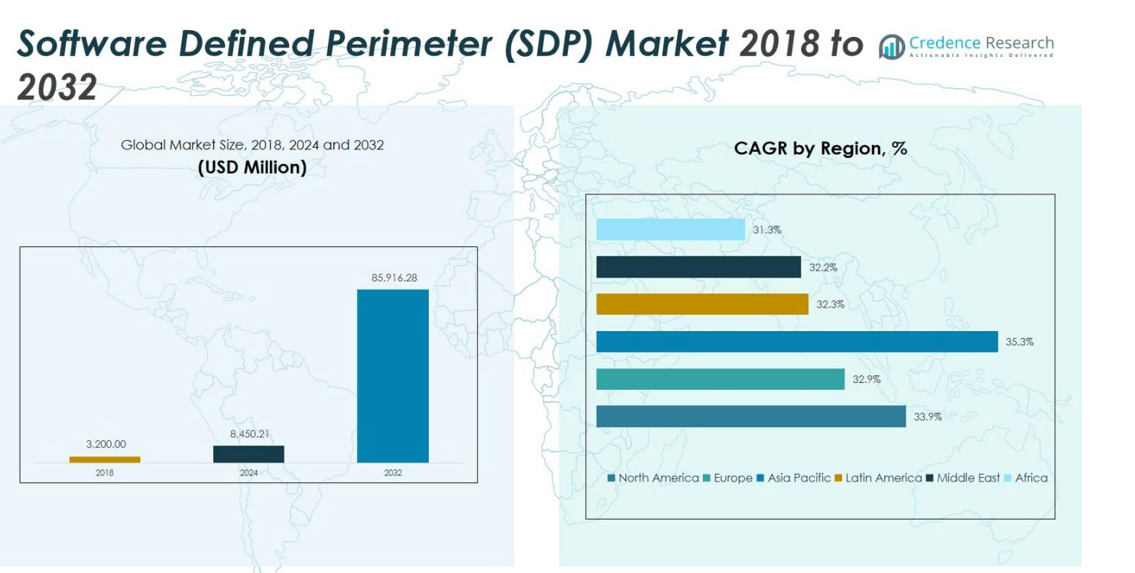
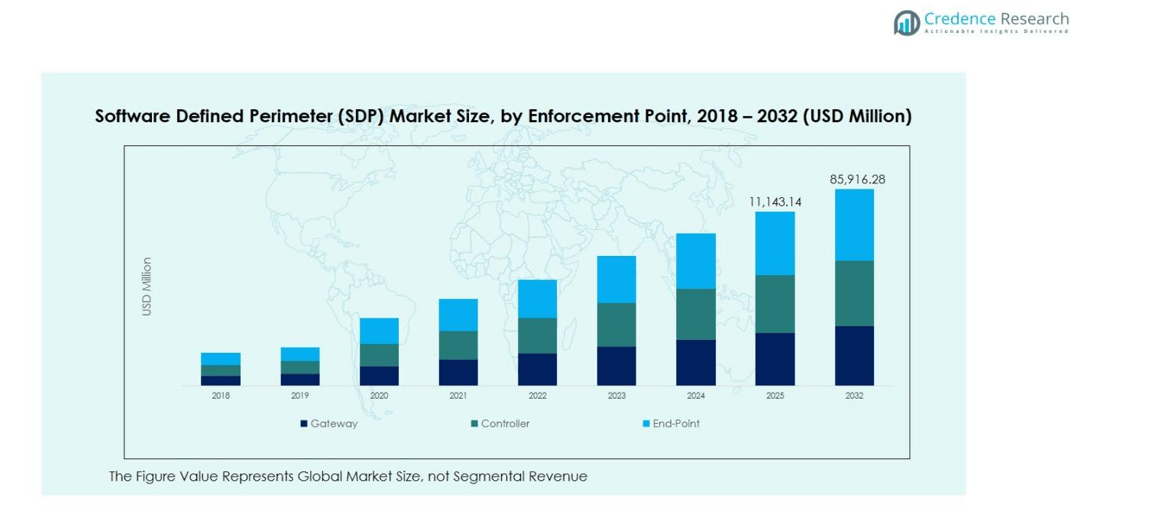
The Global Software Defined Perimeter (SDP) Market size was valued at USD 3,200.00 million in 2018, increased to USD 8,450.21 million in 2024, and is anticipated to reach USD 85,916.28 million by 2032, expanding at a CAGR of 33.88% during the forecast period.

REPORT ATTRIBUTE DETAILS
Historical Period 2020-2023
Base Year 2024
Forecast Period 2025-2032
Software Defined Perimeter (SDP) Market Size 2024  USD 8,450.21 million
Software Defined Perimeter (SDP) Market, CAGR 33.88%
Software Defined Perimeter (SDP) Market Size 2032 USD 85,916.28 million


The Software Defined Perimeter (SDP) Market is dominated by major players such as Akamai Technologies, Broadcom, Cisco Systems, Dell Inc., Zscaler, Fortinet, Intel Corporation, Palo Alto Networks, Proofpoint, Verizon, Unisys Corporation, and Check Point Software Technologies Ltd. These companies focus on enhancing zero-trust network access (ZTNA) solutions, integrating AI for advanced threat detection, and expanding cloud security capabilities. North America leads the global market with a 36% share, driven by strong technological infrastructure and early adoption of SDP frameworks. Asia Pacific follows with 28%, supported by rapid digitalization, cloud investments, and growing cybersecurity awareness across major economies like China, Japan, and India.

Software Defined Perimeter (SDP) Market size

Market Insights

  • The Global Software Defined Perimeter (SDP) Market was valued at USD 8,450.21 million in 2024 and is projected to reach USD 85,916.28 million by 2032, growing at a CAGR of 33.88% during the forecast period.
  • Growing demand for zero-trust security frameworks and cloud-based access control is driving market expansion across industries such as IT, BFSI, and defense.
  • Integration of AI and machine learning into SDP solutions enhances real-time threat detection and automated risk mitigation, shaping future market trends.
  • The market is moderately fragmented, with key players like Cisco Systems, Zscaler, Palo Alto Networks, and Akamai Technologies focusing on product innovation and partnerships to expand global reach.
  • North America leads with a 36% share, followed by Asia Pacific at 28% and Europe at 26%, while Latin America, the Middle East, and Africa collectively contribute the remaining 10%, showing rising adoption in developing economies.

Access crucial information at unmatched prices!

Request your sample report today & start making informed decisions powered by Credence Research Inc.!

Download Sample

Market Segmentation Analysis:

By Enforcement Point

The gateway segment dominates the Software Defined Perimeter (SDP) Market, accounting for 48% of total revenue in 2024. Gateways act as the first line of defense, managing access control and user authentication between networks and cloud resources. Their adoption is driven by rising demand for secure hybrid network environments and zero-trust architectures. Controllers hold a moderate share of 32%, ensuring centralized policy enforcement, while end-points represent 20%, supported by growing endpoint security integration in remote work solutions. The gateway’s scalability and compatibility with cloud-based applications keep it the preferred choice among enterprises.

  • For instance, Fortinet integrates gateways as critical enforcement points in its FortiGate SDP solution. Its gateways provide secure, identity-based access control to cloud and on-premises resources, widely adopted in industries needing strong compliance assurance.

By Application

The telecom and IT segment leads the SDP Market with 35% market share in 2024, driven by rapid digitalization, 5G deployment, and growing cloud service adoption. These industries rely heavily on SDP solutions to secure distributed workloads and virtualized environments. The BFSI sector follows with 22%, emphasizing secure remote transactions and data protection. Defense and government collectively contribute 25%, fueled by cybersecurity modernization programs. Healthcare and ecommerce segments are growing steadily, driven by data privacy compliance and increasing online activity. Expanding enterprise connectivity continues to boost SDP adoption across industries.

  • For instance, hSenid SDP has enabled telecom companies to reduce time-to-market for new digital services through its low-code application development environment.

By Deployment

The cloud-based segment holds the dominant position in the SDP Market, capturing 68% market share in 2024. This dominance stems from the widespread transition toward cloud-native architectures and remote workforce enablement. Organizations prefer cloud deployment for its scalability, reduced maintenance, and cost efficiency. On-premise deployment retains 32% share, appealing to sectors with strict regulatory and data sovereignty requirements such as defense and BFSI. The cloud segment’s momentum is strengthened by integration with identity and access management tools and the growing shift toward software-as-a-service (SaaS) delivery models across global enterprises.

Key Growth Drivers

Rising Demand for Zero-Trust Security Architectures

The growing focus on zero-trust network access (ZTNA) is a primary driver of the Software Defined Perimeter (SDP) Market. Enterprises are shifting away from traditional perimeter-based security to identity-centric models that authenticate every user and device before granting access. This transition helps minimize data breaches and insider threats. Large organizations, particularly in BFSI and IT sectors, are adopting SDP solutions to secure remote connections and hybrid infrastructures. The rising complexity of cyberattacks further accelerates SDP implementation across global enterprises seeking adaptive protection.

  • For instance, Zscaler strengthened its zero-trust capabilities by acquiring Airgap Networks to integrate agentless segmentation with its Zero Trust SD-WAN platform, providing comprehensive secure access across hybrid infrastructures.

Expansion of Cloud-Based Workloads and Remote Operations

Rapid cloud adoption and the expansion of remote work ecosystems are fueling SDP market growth. Organizations increasingly deploy multi-cloud and hybrid environments that require unified access management and encryption. SDP solutions enable seamless, policy-driven connectivity between users and distributed cloud resources. The pandemic-driven remote work culture has strengthened this trend, with companies prioritizing cloud security and device-agnostic access. Enterprises prefer SDP due to its scalability, flexibility, and reduced dependency on traditional VPNs, making it essential for modern, distributed network architectures.

  • For instance, Appgate deployed its SDP solution to secure a global financial services client’s cloud and remote access environments, resulting in a significant reduction in attack surface by cloaking infrastructure and controlling access via single-packet authorization.

Growing Regulatory and Compliance Requirements

Tightening global regulations on data protection and privacy are boosting SDP demand. Frameworks such as GDPR, HIPAA, and CCPA push organizations to adopt advanced network security models that provide visibility and control. SDP architectures help meet compliance standards by isolating network resources and enforcing least-privilege access. Industries handling sensitive information, such as finance, healthcare, and government, are leading adopters. As compliance audits become stricter, SDP offers a proactive approach to safeguard data and ensure adherence to security mandates while improving operational transparency.

Software Defined Perimeter (SDP) Market share

Key Trends & Opportunities

Integration with AI and Machine Learning for Threat Detection

Artificial intelligence (AI) and machine learning (ML) are transforming SDP capabilities through predictive analytics and real-time anomaly detection. Vendors are integrating AI-driven behavioral insights to automate risk assessment and strengthen access control mechanisms. This integration enhances visibility into user activity and network traffic, enabling faster threat response. The growing adoption of AI-enabled SDP solutions presents strong opportunities for vendors focusing on intelligent network monitoring, adaptive authentication, and continuous security posture improvement across diverse enterprise environments.

  • For instance, SentinelOne’s Singularity™ Endpoint Security leverages AI algorithms to analyze network traffic and user interactions, detecting threats with high accuracy and automatically initiating mitigation actions to prevent breaches.

Rising Opportunities in SMEs and Developing Economies

Small and medium enterprises (SMEs) and developing regions are emerging as new growth frontiers for SDP providers. The increasing digitization of operations, coupled with limited internal IT resources, drives SMEs to adopt cloud-based SDP solutions. Affordable subscription models and managed security services make SDP accessible to mid-tier organizations. Meanwhile, Asia-Pacific, Latin America, and Africa offer untapped potential due to expanding internet infrastructure and growing cybersecurity awareness. This shift enables vendors to capture long-term opportunities in fast-evolving regional markets.

  • For instance, in Asia-Pacific, Sumitomo Mitsui Financial Group has integrated platform-as-a-service cloud solutions into its supply chain workflows, demonstrating how hybrid cloud architectures support SME digital transformation.

Key Challenges

High Implementation Complexity and Integration Barriers

Despite its benefits, SDP deployment involves complex integration with legacy systems and existing security frameworks. Many enterprises face challenges aligning SDP with their current identity management, network monitoring, and cloud configurations. This complexity increases deployment time and cost, discouraging adoption among smaller organizations. The lack of skilled cybersecurity professionals further complicates integration efforts. Vendors must focus on simplifying implementation processes and enhancing interoperability to overcome these barriers and ensure broader market penetration.

Limited Awareness and Misconceptions about SDP Technology

Awareness gaps regarding the distinct advantages of SDP over traditional VPNs or firewalls remain a significant challenge. Many enterprises still view SDP as a niche or experimental technology rather than a mainstream solution. Misunderstandings about scalability, cost-effectiveness, and performance can slow adoption. Continuous education, demonstrations, and pilot projects are crucial to address these misconceptions. Industry partnerships and awareness campaigns can help bridge this gap, driving confidence and accelerating global adoption of software-defined perimeter solutions.

Regional Analysis

North America

North America dominates the Software Defined Perimeter (SDP) Market, holding the largest share of 36% in 2024. The market was valued at USD 1,113.60 million in 2018, increased to USD 2,903.44 million in 2024, and is projected to reach USD 29,478.03 million by 2032, expanding at a CAGR of 33.9%. Growth is driven by early adoption of zero-trust architectures, strong cybersecurity infrastructure, and presence of leading players such as Cisco, Zscaler, and Palo Alto Networks. High cloud adoption across BFSI, IT, and defense sectors further strengthens regional dominance in the global SDP market.

Europe

Europe holds a significant 26% market share in the global Software Defined Perimeter (SDP) Market. The regional market stood at USD 820.80 million in 2018, reached USD 2,081.06 million in 2024, and is anticipated to hit USD 19,954.29 million by 2032, recording a CAGR of 32.9%. Growth is supported by stringent data protection regulations such as GDPR and increasing investments in network security modernization. Countries including the UK, Germany, and France lead adoption due to rising cloud migration and demand for zero-trust frameworks across financial, healthcare, and government sectors.

Asia Pacific

Asia Pacific is the fastest-growing region in the Software Defined Perimeter (SDP) Market, capturing 28% market share in 2024. The market was valued at USD 892.48 million in 2018, rose to USD 2,448.41 million in 2024, and is projected to reach USD 27,166.80 million by 2032, growing at a CAGR of 35.3%. Rapid digital transformation, increasing cloud investments, and expansion of SMEs across China, India, Japan, and South Korea drive market acceleration. Growing awareness of cybersecurity and government-backed digital infrastructure programs continue to propel adoption of SDP solutions in the region.

Latin America

Latin America accounts for 5% of the global SDP market share, reflecting steady adoption across enterprises modernizing their IT infrastructure. The market stood at USD 163.20 million in 2018, expanded to USD 425.81 million in 2024, and is estimated to reach USD 3,940.98 million by 2032, growing at a CAGR of 32.3%. Brazil and Mexico lead regional deployment, driven by expanding digital ecosystems and rising cloud-based service adoption. Increasing investments in cybersecurity resilience and managed service offerings also strengthen the region’s growth potential in the global SDP landscape.

Middle East

The Middle East holds a 3% market share in the global Software Defined Perimeter (SDP) Market. The market was valued at USD 124.48 million in 2018, increased to USD 308.38 million in 2024, and is expected to reach USD 2,835.71 million by 2032, with a CAGR of 32.2%. Rapid digital transformation initiatives in GCC countries, rising adoption of cloud security in BFSI and government sectors, and expansion of smart city projects drive regional growth. Increasing partnerships between global cybersecurity vendors and regional telecom providers further accelerate SDP market expansion.

Africa

Africa represents an emerging market with a 2% share in the global Software Defined Perimeter (SDP) Market. The regional market grew from USD 85.44 million in 2018 to USD 283.12 million in 2024, and is projected to reach USD 2,540.48 million by 2032, advancing at a CAGR of 31.3%. Growth is fueled by improving digital connectivity, increasing adoption of cloud computing, and government initiatives to strengthen cybersecurity frameworks. South Africa, Egypt, and Kenya are leading adopters, with rising awareness about zero-trust security models and demand for cost-efficient, scalable SDP solutions.

Software Defined Perimeter (SDP) Market segmentation

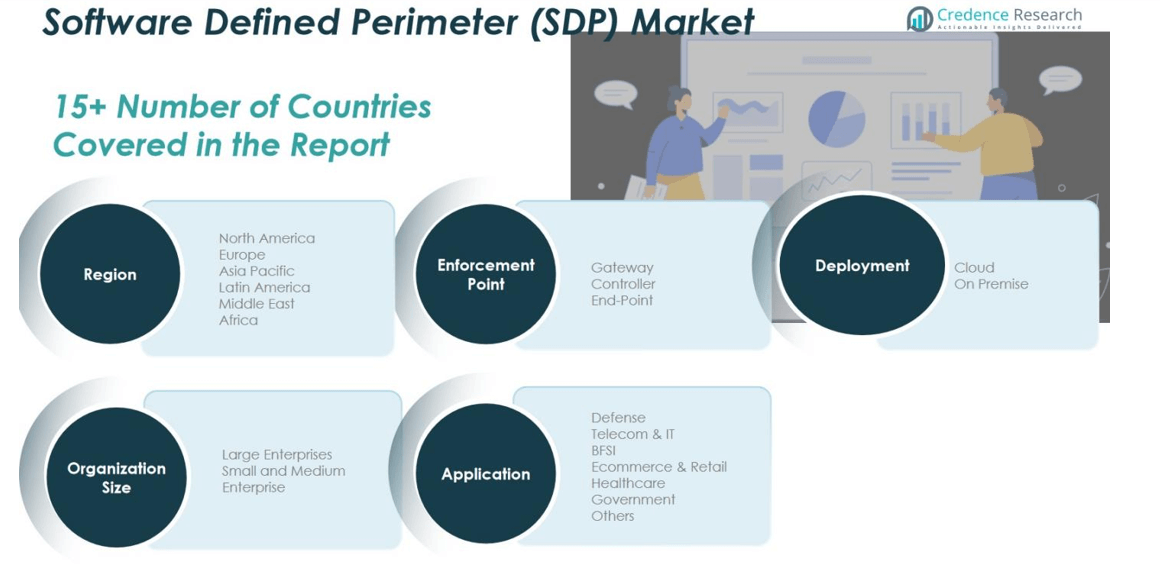
Market Segmentations:

By Enforcement Point:

  • Gateway
  • Controller
  • End-Point

By Application:

  • Defense
  • Telecom & IT
  • BFSI
  • Ecommerce & Retail
  • Healthcare
  • Government
  • Others

By Deployment:

  • Cloud
  • On-Premise

By Organization Size:

  • Large Enterprises
  • Small and Medium Enterprises

 By Region

  • North America
    • U.S.
    • Canada
    • Mexico
  • Europe
    • Germany
    • France
    • U.K.
    • Italy
    • Spain
    • Rest of Europe
  • Asia Pacific
    • China
    • Japan
    • India
    • South Korea
    • South-east Asia
    • Rest of Asia Pacific
  • Latin America
    • Brazil
    • Argentina
    • Rest of Latin America
  • Middle East & Africa
    • GCC Countries
    • South Africa
    • Rest of the Middle East and Africa

Competitive Landscape

The competitive landscape of the Software Defined Perimeter (SDP) Market features prominent players such as Akamai Technologies, Broadcom, Cisco Systems, Dell Inc., Zscaler, Fortinet, Intel Corporation, Palo Alto Networks, Proofpoint, Verizon, Unisys Corporation, and Check Point Software Technologies Ltd. The market is highly dynamic and innovation-driven, with companies focusing on expanding zero-trust network access (ZTNA) capabilities, integrating AI for threat detection, and enhancing interoperability across hybrid cloud environments. Strategic initiatives such as mergers, acquisitions, and partnerships are common as vendors aim to strengthen their security portfolios and global reach. Continuous R&D investment supports advancements in automation, scalability, and analytics-based security models. Startups are also entering the space with niche solutions, intensifying competition. Established players leverage their broad product ecosystems and enterprise client base to maintain leadership positions, while emerging providers compete through agility, cost efficiency, and managed service offerings tailored to small and mid-sized organizations.

Shape Your Report to Specific Countries or Regions & Enjoy 30% Off!

Key Player Analysis

  • Akamai Technologies
  • Broadcom
  • Cisco Systems, Inc.
  • Dell Inc.
  • Zscaler, Inc.
  • Fortinet, Inc.
  • Intel Corporation
  • Palo Alto Networks, Inc.
  • Proofpoint, Inc.
  • Verizon, Inc.
  • Unisys Corporation
  • Check Point Software Technologies Ltd.

Recent Developments

  • In 2025, Check Point Software Technologies Ltd. announced a strategic partnership with Microsoft Corporation to integrate its SDP solutions with Microsoft Azure’s cloud infrastructure.
  • In January 2023, InstaSafe entered into a partnership with iValue InfoSolutions to broaden its SDP-based zero-trust security solutions across multi-cloud and on-premise environments in India.
  • On September 17, 2024, Zscaler and CrowdStrike announced a strategic integration pairing Zscaler’s Zero Trust Exchange™ with the CrowdStrike Falcon® platform to unify AI-powered endpoint and network access protections

Report Coverage

The research report offers an in-depth analysis based on Enforcement Point, Application, Deployment, Organization Size and Region. It details leading market players, providing an overview of their business, product offerings, investments, revenue streams, and key applications. Additionally, the report includes insights into the competitive environment, SWOT analysis, current market trends, as well as the primary drivers and constraints. Furthermore, it discusses various factors that have driven market expansion in recent years. The report also explores market dynamics, regulatory scenarios, and technological advancements that are shaping the industry. It assesses the impact of external factors and global economic changes on market growth. Lastly, it provides strategic recommendations for new entrants and established companies to navigate the complexities of the market.

Future Outlook

  1. The Software Defined Perimeter (SDP) Market will witness rapid adoption due to the growing zero-trust security trend.
  2. Cloud-native SDP solutions will become standard as enterprises expand hybrid and multi-cloud environments.
  3. Integration of AI and machine learning will enhance real-time threat detection and automated policy enforcement.
  4. SMEs will increasingly adopt SDP through affordable SaaS-based and managed service models.
  5. Government and defense sectors will prioritize SDP for securing critical infrastructure and sensitive data.
  6. Partnerships between cybersecurity vendors and telecom providers will drive large-scale deployment.
  7. Demand for SDP in remote workforce management will continue to rise post-digital transformation.
  8. Vendors will focus on interoperability to integrate SDP with identity management and network access control systems.
  9. Regulatory compliance and data privacy mandates will further accelerate market growth.
  10. The market will see consolidation as leading players acquire niche security firms to expand technological capabilities.

CHAPTER NO. 1 :         GENESIS OF THE MARKET     

1.1 Market Prelude – Introduction & Scope

1.2 The Big Picture – Objectives & Vision

1.3 Strategic Edge – Unique Value Proposition

1.4 Stakeholder Compass – Key Beneficiaries

CHAPTER NO. 2 :             EXECUTIVE LENS

2.1 Pulse of the Industry – Market Snapshot

2.2 Growth Arc – Revenue Projections (USD Million)

2.3. Premium Insights – Based on Primary Interviews

CHAPTER NO. 3 :             SOFTWARE DEFINED PERIMETER (SDP) MARKET FORCES & INDUSTRY PULSE

3.1 Foundations of Change – Market Overview
3.2 Catalysts of Expansion – Key Market Drivers
3.2.1 Momentum Boosters – Growth Triggers
3.2.2 Innovation Fuel – Disruptive Technologies
3.3 Headwinds & Crosswinds – Market Restraints
3.3.1 Regulatory Tides – Compliance Challenges
3.3.2 Economic Frictions – Inflationary Pressures
3.4 Untapped Horizons – Growth Potential & Opportunities
3.5 Strategic Navigation – Industry Frameworks
3.5.1 Market Equilibrium – Porter’s Five Forces
3.5.2 Ecosystem Dynamics – Value Chain Analysis
3.5.3 Macro Forces – PESTEL Breakdown

3.6 Price Trend Analysis

3.6.1 Regional Price Trend
3.6.2 Price Trend by product

CHAPTER NO. 4 :             KEY INVESTMENT EPICENTER    

4.1 Regional Goldmines – High-Growth Geographies

4.2 Product Frontiers – Lucrative Product Categories

4.3 Application Sweet Spots – Emerging Demand Segments

CHAPTER NO. 5: REVENUE TRAJECTORY & WEALTH MAPPING

5.1 Momentum Metrics – Forecast & Growth Curves

5.2 Regional Revenue Footprint – Market Share Insights

5.3 Segmental Wealth Flow – Enforcement Point & Application Revenue

CHAPTER NO. 6 :             TRADE & COMMERCE ANALYSIS              

6.1.        Import Analysis by Region

6.1.1.     Global Software Defined Perimeter (SDP) Market Import Revenue By Region

6.2.        Export Analysis by Region

6.2.1.     Global Software Defined Perimeter (SDP) Market Export Revenue By Region

CHAPTER NO. 7 :             COMPETITION ANALYSIS            

7.1.        Company Market Share Analysis

7.1.1.     Global Software Defined Perimeter (SDP) Market: Company Market Share

7.2.        Global Software Defined Perimeter (SDP) Market Company Revenue Market Share

7.3.        Strategic Developments

7.3.1.     Acquisitions & Mergers

7.3.2.     New Product Launch

7.3.3.     Regional Expansion

7.4.        Competitive Dashboard

7.5.    Company Assessment Metrics, 2024

CHAPTER NO. 8 :             SOFTWARE DEFINED PERIMETER (SDP) MARKET – BY ENFORCEMENT POINT SEGMENT ANALYSIS

8.1.        Software Defined Perimeter (SDP) Market Overview by Enforcement Point Segment

8.1.1.     Software Defined Perimeter (SDP) Market Revenue Share By Enforcement Point

8.2.        Gateway

8.3.        Controller

8.4.        End-Point

CHAPTER NO. 9 :             SOFTWARE DEFINED PERIMETER (SDP) MARKET – BY APPLICATION SEGMENT ANALYSIS      

9.1.        Software Defined Perimeter (SDP) Market Overview by Application Segment

9.1.1.     Software Defined Perimeter (SDP) Market Revenue Share By Application

9.2.        Defense

9.3.        Telecom & IT

9.4.        BFSI

9.5.        Ecommerce & Retail

9.6.        Healthcare

9.7.        Government

9.8.        Others

CHAPTER NO. 10 :           SOFTWARE DEFINED PERIMETER (SDP) MARKET – BY DEPLOYMENT SEGMENT ANALYSIS      

10.1.      Software Defined Perimeter (SDP) Market Overview by Deployment Segment

10.1.1.  Software Defined Perimeter (SDP) Market Revenue Share By Deployment

10.2.      Cloud

10.3.      On Premise

CHAPTER NO. 11 :           SOFTWARE DEFINED PERIMETER (SDP) MARKET – BY ORGANIZATION SIZE SEGMENT ANALYSIS           

11.1.      Software Defined Perimeter (SDP) Market Overview by Organization Size Segment

11.1.1.  Software Defined Perimeter (SDP) Market Revenue Share By Organization Size

11.2.      Large Enterprises

11.3.      Small and Medium Enterprise

CHAPTER NO. 12 :           SOFTWARE DEFINED PERIMETER (SDP) MARKET – REGIONAL ANALYSIS           

12.1.      Software Defined Perimeter (SDP) Market Overview by Region Segment

12.1.1.  Global Software Defined Perimeter (SDP) Market Revenue Share By Region

12.1.2.  Regions

12.1.3.  Global Software Defined Perimeter (SDP) Market Revenue By Region

12.1.4.  Enforcement Point

12.1.5.  Global Software Defined Perimeter (SDP) Market Revenue By Enforcement Point

12.1.6.  Application

12.1.7.  Global Software Defined Perimeter (SDP) Market Revenue By Application

12.1.8.  Deployment

12.1.9.  Global Software Defined Perimeter (SDP) Market Revenue By Deployment

12.1.10.               Organization Size

12.1.11.               Global Software Defined Perimeter (SDP) Market Revenue By Organization Size

CHAPTER NO. 13 :           NORTH AMERICA SOFTWARE DEFINED PERIMETER (SDP) MARKET – COUNTRY ANALYSIS      

13.1.      North America Software Defined Perimeter (SDP) Market Overview by Country Segment

13.1.1.  North America Software Defined Perimeter (SDP) Market Revenue Share By Region

13.2.      North America

13.2.1.  North America Software Defined Perimeter (SDP) Market Revenue By Country

13.2.2.  Enforcement Point

13.2.3.  North America Software Defined Perimeter (SDP) Market Revenue By Enforcement Point

13.2.4.  Application

13.2.5.  North America Software Defined Perimeter (SDP) Market Revenue By Application

13.2.6.  Deployment

13.2.7.  North America Software Defined Perimeter (SDP) Market Revenue By Deployment

13.2.8.  Organization Size

13.2.9.  North America Software Defined Perimeter (SDP) Market Revenue By Organization Size

13.3.      U.S.

13.4.      Canada

13.5.      Mexico

CHAPTER NO. 14 :           EUROPE SOFTWARE DEFINED PERIMETER (SDP) MARKET – COUNTRY ANALYSIS

14.1.      Europe Software Defined Perimeter (SDP) Market Overview by Country Segment

14.1.1.  Europe Software Defined Perimeter (SDP) Market Revenue Share By Region

14.2.      Europe

14.2.1.  Europe Software Defined Perimeter (SDP) Market Revenue By Country

14.2.2.  Enforcement Point

14.2.3.  Europe Software Defined Perimeter (SDP) Market Revenue By Enforcement Point

14.2.4.  Application

14.2.5.  Europe Software Defined Perimeter (SDP) Market Revenue By Application

14.2.6.  Deployment

14.2.7.  Europe Software Defined Perimeter (SDP) Market Revenue By Deployment

14.2.8.  Organization Size

14.2.9.  Europe Software Defined Perimeter (SDP) Market Revenue By Organization Size

14.3.      UK

14.4.      France

14.5.      Germany

14.6.      Italy

14.7.      Spain

14.8.      Russia

14.9.   Rest of Europe

CHAPTER NO. 15 :           ASIA PACIFIC SOFTWARE DEFINED PERIMETER (SDP) MARKET – COUNTRY ANALYSIS      

15.1.      Asia Pacific Software Defined Perimeter (SDP) Market Overview by Country Segment

15.1.1.  Asia Pacific Software Defined Perimeter (SDP) Market Revenue Share By Region

15.2.      Asia Pacific

15.2.1.  Asia Pacific Software Defined Perimeter (SDP) Market Revenue By Country

15.2.2.  Enforcement Point

15.2.3.  Asia Pacific Software Defined Perimeter (SDP) Market Revenue By Enforcement Point

15.2.4.  Application

15.2.5.  Asia Pacific Software Defined Perimeter (SDP) Market Revenue By Application

15.2.6.  Deployment

15.2.7.  Asia Pacific Software Defined Perimeter (SDP) Market Revenue By Deployment

15.2.8.  Organization Size

15.2.9.  Asia Pacific Software Defined Perimeter (SDP) Market Revenue By Organization Size

15.3.      China

15.4.      Japan

15.5.      South Korea

15.6.      India

15.7.      Australia

15.8.      Southeast Asia

15.9.      Rest of Asia Pacific

CHAPTER NO. 16 :           LATIN AMERICA SOFTWARE DEFINED PERIMETER (SDP) MARKET – COUNTRY ANALYSIS

16.1.      Latin America Software Defined Perimeter (SDP) Market Overview by Country Segment

16.1.1.  Latin America Software Defined Perimeter (SDP) Market Revenue Share By Region

16.2.      Latin America

16.2.1.  Latin America Software Defined Perimeter (SDP) Market Revenue By Country

16.2.2.  Enforcement Point

16.2.3.  Latin America Software Defined Perimeter (SDP) Market Revenue By Enforcement Point

16.2.4.  Application

16.2.5.  Latin America Software Defined Perimeter (SDP) Market Revenue By Application

16.2.6.  Deployment

16.2.7.  Latin America Software Defined Perimeter (SDP) Market Revenue By Deployment

16.2.8.  Organization Size

16.2.9.  Latin America Software Defined Perimeter (SDP) Market Revenue By Organization Size

16.3.      Brazil

16.4.      Argentina

16.5.      Rest of Latin America

CHAPTER NO. 17 :           MIDDLE EAST SOFTWARE DEFINED PERIMETER (SDP) MARKET – COUNTRY ANALYSIS

17.1.      Middle East Software Defined Perimeter (SDP) Market Overview by Country Segment

17.1.1.  Middle East Software Defined Perimeter (SDP) Market Revenue Share By Region

17.2.      Middle East

17.2.1.  Middle East Software Defined Perimeter (SDP) Market Revenue By Country

17.2.2.  Enforcement Point

17.2.3.  Middle East Software Defined Perimeter (SDP) Market Revenue By Enforcement Point

17.2.4.  Application

17.2.5.  Middle East Software Defined Perimeter (SDP) Market Revenue By Application

17.2.6.  Deployment

17.2.7.  Middle East Software Defined Perimeter (SDP) Market Revenue By Deployment

17.2.8.  Organization Size

17.2.9.  Middle East Software Defined Perimeter (SDP) Market Revenue By Organization Size

17.3.      GCC Countries

17.4.      Israel

17.5.      Turkey

17.6.      Rest of Middle East

CHAPTER NO. 18 :           AFRICA SOFTWARE DEFINED PERIMETER (SDP) MARKET – COUNTRY ANALYSIS

18.1.      Africa Software Defined Perimeter (SDP) Market Overview by Country Segment

18.1.1.  Africa Software Defined Perimeter (SDP) Market Revenue Share By Region

18.2.      Africa

18.2.1.  Africa Software Defined Perimeter (SDP) Market Revenue By Country

18.2.2.  Enforcement Point

18.2.3.  Africa Software Defined Perimeter (SDP) Market Revenue By Enforcement Point

18.2.4.  Application

18.2.5.  Africa Software Defined Perimeter (SDP) Market Revenue By Application

18.2.6.  Deployment

18.2.7.  Africa Software Defined Perimeter (SDP) Market Revenue By Deployment

18.2.8.  Organization Size

18.2.9.  Africa Software Defined Perimeter (SDP) Market Revenue By Organization Size

18.3.      South Africa

18.4.      Egypt

18.5.      Rest of Africa

CHAPTER NO. 19 :           COMPANY PROFILES     

19.1.      Akamai Technologies

19.1.1.  Company Overview

19.1.2.  Product Portfolio

19.1.3.  Financial Overview

19.1.4.  Recent Developments

19.1.5.  Growth Strategy

19.1.6.  SWOT Analysis

19.2.      Broadcom

19.3.      Cisco Systems, Inc.

19.4.      Dell Inc.

19.5.      Zscaler, Inc.

19.6.      Fortinet, Inc.

19.7.      Intel Corporation

19.8.      Palo Alto Networks, Inc.

19.9.      Proofpoint, Inc.,

19.10.    Verizon, Inc

19.11.    Unisys Corporation

19.12.    Check Point Software Technologies Ltd.

Request Free Sample

We prioritize the confidentiality and security of your data. Our promise: your information remains private.

Ready to Transform Data into Decisions?

Request Your Sample Report and Start Your Journey of Informed Choices


Providing the strategic compass for industry titans.

cr-clients-logos

Frequently Asked Questions:

What is the current size of the Software Defined Perimeter Market?

The Software Defined Perimeter (SDP) Market was valued at USD 8,450.21 million in 2024 and is projected to reach USD 85,916.28 million by 2032.

At what Compound Annual Growth Rate is the Software Defined Perimeter (SDP) Market projected to grow between 2025 and 2032?

The Software Defined Perimeter (SDP) Market is expected to expand at a CAGR of 33.88% during the forecast period.

What factors are driving the growth of the Software Defined Perimeter market?

Key factors driving market growth include the adoption of cloud-based services, the increasing shift toward remote and hybrid work models, and the inadequacy of traditional security solutions in combating evolving cyber threats such as data breaches and DDoS attacks. Demand for regulatory compliance and heightened security awareness across sectors such as finance, healthcare, and government also drive the adoption of SDP solutions.

What are some challenges faced by the Software Defined Perimeter market?

Challenges include the complexity of deploying and integrating SDP solutions with existing infrastructure, a lack of standardization and interoperability across solutions, high implementation costs, and a skills gap in cybersecurity expertise. Ensuring compliance with stringent data protection regulations also poses challenges for organizations adopting SDP.

Who are the major players in the Software Defined Perimeter Market?

Major players include Cisco Systems, Akamai Technologies, Palo Alto Networks, Fortinet, Symantec Corporation, Check Point Software Technologies Ltd., Intel Corporation, VeloCloud Networks, Vidder, Inc., and Catbird, Inc.

Which segment is leading the market share?

The solutions segment leads the market, driven by strong demand for SDP frameworks that provide secure, identity-based access control, network invisibility, and enhanced threat protection for enterprise environments.

About Author

Sushant Phapale

Sushant Phapale

ICT & Automation Expert

Sushant is an expert in ICT, automation, and electronics with a passion for innovation and market trends.

View Profile

Related Reports

Smart Rings Market

The Smart Rings Market size was valued at USD 319.4 million in 2024 and is anticipated to reach USD 2,404.16 million by 2032, at a CAGR of 28.7% during the forecast period (2024-2032).

Enterprise Collaboration Services Market

The Enterprise Collaboration Services Market size was valued at USD 36,500.00 million in 2018 to USD 53,989.35 million in 2024 and is anticipated to reach USD 136,561.96 million by 2032, at a CAGR of 12.33% during the forecast period.

Online Project Management Software Market

Online Project Management Software Market size was valued USD 7 billion in 2024 and is anticipated to reach USD 11.67 billion by 2032, at a CAGR of 6.6% during the forecast period.

Web Content Filtering Market

The Web Content Filtering Market was valued at USD 5,147.5 million in 2024 and is projected to reach USD 13,869.5 million by 2032, expanding at a CAGR of 13.19% during the forecast period (2025–2032)

Purpose Built Backup Appliance (PBBA) Market

Purpose Built Backup Appliance (PBBA) Market size was valued USD 8.6 billion in 2024 and is anticipated to reach USD 19.25 billion by 2032, at a CAGR of 10.6% during the forecast period.

Digital Transformation Market

The Digital Transformation Market was valued at USD 1,194.46 Billion in 2024 and is anticipated to reach USD 6,912.64 Billion by 2032, growing at a CAGR of 24.54% during the forecast period.

RF-Over-Fiber Market

RF-Over-Fiber Market size was valued USD 648.5 million in 2024 and is anticipated to reach USD 1173.91 million by 2032, at a CAGR of 7.7% during the forecast period.

Trade Surveillance Market

The Global Trade Surveillance Market size was valued at USD 1,000.00 million in 2018 to USD 1,934.72 million in 2024 and is anticipated to reach USD 8,486.85 million by 2032, at a CAGR of 20.46% during the forecast period.

Trade Management Software Market

The Global Trade Management Software Market size was valued at USD 3,200.00 million in 2018 to USD 4,121.74 million in 2024 and is anticipated to reach USD 7,279.16 million by 2032, at a CAGR of 7.44% during the forecast period.

Thyristor Market

The Global Thyristor Market size was valued at USD 1,360.00 million in 2018 to USD 1,567.63 million in 2024 and is anticipated to reach USD 2,280.83 million by 2032, at a CAGR of 4.86% during the forecast period.

Industrial Wireless Instrumentation Market

Industrial Wireless Instrumentation Market size was valued at USD 6.28 Billion in 2024 and is anticipated to reach USD 10.79 Billion by 2032, at a CAGR of 7% during the forecast period

Data Science And Predictive Analytics Market

The Data Science and Predictive Analytics Market was valued at USD 14.39 billion in 2024 and is projected to reach USD 56.32 billion by 2032, expanding at a CAGR of 18.6% during the forecast period.

Licence Option

The report comes as a view-only PDF document, optimized for individual clients. This version is recommended for personal digital use and does not allow printing. Use restricted to one purchaser only.
$4999

To meet the needs of modern corporate teams, our report comes in two formats: a printable PDF and a data-rich Excel sheet. This package is optimized for internal analysis. Unlimited users allowed within one corporate location (e.g., regional office).
$6999

The report will be delivered in printable PDF format along with the report’s data Excel sheet. This license offers 100 Free Analyst hours where the client can utilize Credence Research Inc. research team. Permitted for unlimited global use by all users within the purchasing corporation, such as all employees of a single company.
$12999

Report delivery within 24 to 48 hours

Credence Staff 3

WILLIAM, North America

Support Staff at Credence Research

KEITH PHILLIPS, Europe

Lee - CR Sales Staff

LEE VALLANCE, Asia Pacific

Kieran Jameson

KIERAN JAMESON, Australia

Smallform of Sample request
User Review

Thank you for the data! The numbers are exactly what we asked for and what we need to build our business case.

Materials Scientist
(privacy requested)

User Review

The report was an excellent overview of the Industrial Burners market. This report does a great job of breaking everything down into manageable chunks.

Imre Hof
Management Assistant, Bekaert

cr-clients-logos

Request Sample