Trade Surveillance Market By Component (Solutions [Risk and Compliance, Reporting and Monitoring, Surveillance & Analytics, Case Management, Others], Services [Managed Services, Professional Services]); By Deployment (Cloud Based, On-Premises) – Growth, Share, Opportunities & Competitive Analysis, 2024 – 2032

Report ID: 11522 | Report Format : Excel, PDF

Market Overview:

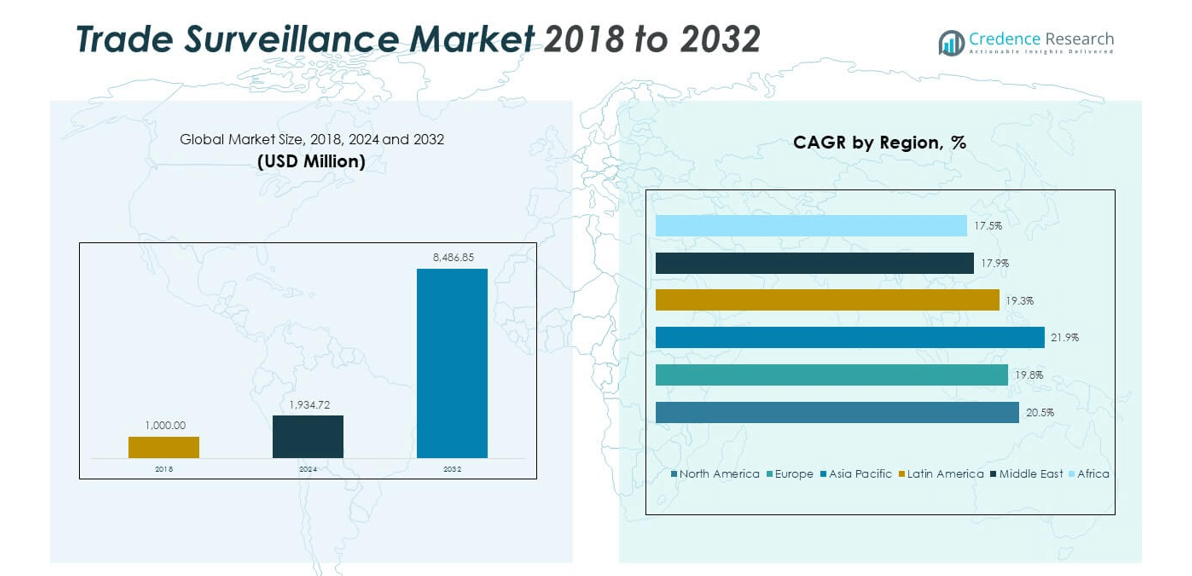
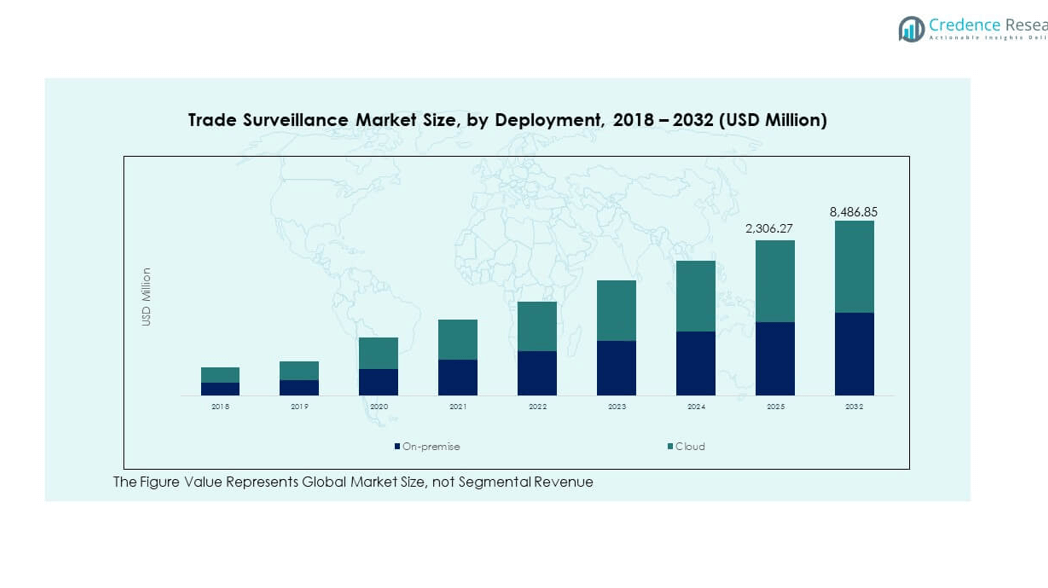
The Global Trade Surveillance Market size was valued at USD 1,000.00 million in 2018 to USD 1,934.72 million in 2024 and is anticipated to reach USD 8,486.85 million by 2032, at a CAGR of 20.46% during the forecast period.

REPORT ATTRIBUTE DETAILS
Historical Period 2020-2023
Base Year 2024
Forecast Period 2025-2032
Trade Surveillance Market Size 2024 USD 1,934.72 million
Trade Surveillance Market, CAGR 20.46%
Trade Surveillance Market Size 2032 USD 8,486.85 million

Demand rises due to stricter market-abuse rules and the growing need for better oversight across trading environments. Financial firms adopt advanced tools that detect insider activity and suspicious patterns. Rising digital trades push firms toward automated checks that offer faster response. AI platforms help identify anomalies that standard methods fail to capture. Cloud systems support wider monitoring across global desks with ease. Firms also invest in tools that blend structured and unstructured data for deeper insight. Strong pressure from regulators keeps adoption stable across sectors.

North America leads the Global Trade Surveillance Market due to strong regulatory frameworks and high investment by major financial institutions. Europe follows due to strict market-abuse directives that require wide monitoring across exchanges. Asia Pacific emerges quickly with rising electronic trading and expanding fintech ecosystems. The Middle East shows progress with modern trading infrastructure and stronger compliance needs. Latin America gains momentum through digital upgrades in major economies. Global momentum stays strong due to fast adoption of automated surveillance tools across cross-border markets.

Trade Surveillance Market size

Market Insights:

  1. The Global Trade Surveillance Market was USD 1,000.00 million in 2018, reached USD 1,934.72 million in 2024, and is projected to hit USD 8,486.85 million by 2032 at a CAGR of 20.46%, driven by rising digital trades, stricter market-abuse rules, and strong adoption of AI-enabled oversight tools.
  2. Europe leads with 46% share due to strict directives, followed by North America at 28.03% supported by strong compliance rules, and Asia Pacific at 26.49% driven by heavy digital trading growth; these regions dominate because they hold mature regulatory systems and advanced financial infrastructure.
  3. Asia Pacific is the fastest-growing region with a 49% share, supported by expanding fintech ecosystems, rising electronic trading, and rapid cloud adoption across major markets.
  4. Cloud deployment holds the larger share at about 64%, driven by scalable infrastructure and demand for flexible real-time monitoring across global trading desks.
  5. On-premise deployment represents about 36%, supported by institutions that prioritise strict data control and operate in high-security environments where internal infrastructure remains essential.

Access crucial information at unmatched prices!

Request your sample report today & start making informed decisions powered by Credence Research Inc.!

Download Sample

Market Drivers:

Growing Regulatory Pressure Across Trading Environments

The Global Trade Surveillance Market grows due to strict rules that demand high transparency. Firms deploy advanced systems to detect unfair trades before risks spread. It supports compliance teams that face rising scrutiny from global regulators. AI models scan large data sets to flag unusual activity with high accuracy. Cloud platforms give faster access to monitoring tools across global desks. Many banks upgrade legacy tools to match new rule changes. Increased digital trades push firms toward automated checks. Strong pressure from oversight bodies keeps adoption steady across sectors.

  • For instance, Nasdaq SMARTS is used by more than 47 exchanges and regulators worldwide to detect manipulation across large trade volumes.

Rising Need For Real-Time Risk Detection

Financial institutions seek real-time insight to stop harmful trades before markets shift. It drives fast uptake of systems that analyze orders within seconds. Firms use behavioral maps to detect insider moves earlier. Real-time alerts help teams respond before misconduct grows. Many trading desks rely on automated tools to manage large volumes. Cross-asset monitoring improves risk checks across complex portfolios. High-speed analytics support compliance groups with stronger control. The Global Trade Surveillance Market gains momentum from this rapid shift.

  • For instance, NICE Actimize SURVEIL-X processes hundreds of millions of trade and communication events per day to support real-time detection workflows. Real-time alerts help teams respond before misconduct grows.

Expansion Of Digital Trading And Complex Instruments

Digital platforms create higher demand for tools that track complex trade patterns. Firms monitor new asset classes that shift fast across global markets. AI engines handle diverse data and track hidden trends. It improves detection across derivatives, crypto, and structured products. Many firms upgrade tools to manage multi-venue trading. Cross-border flows push firms toward unified oversight. Strong interest in automated checks supports safer digital growth. The Global Trade Surveillance Market sees wide adoption due to this shift.

Growing Focus On Data Integration And Unified Oversight

Trading institutions seek platforms that merge structured and unstructured data. It helps teams track communication trails with trading patterns. Unified dashboards support faster decisions for compliance groups. Machine learning scans voice logs, chat records, and order books. Firms invest in deeper analytics to match rising market complexity. Integrated systems help reduce blind spots across global desks. Automation reduces manual checks and strengthens audit readiness. The Global Trade Surveillance Market gains traction due to this focus.

Market Trends:

Adoption Of AI-Native Surveillance Platforms

AI-native systems become central across trading environments. These tools deliver strong accuracy in detecting hidden patterns. It helps compliance groups track new forms of misconduct. Many desks shift from rule-based engines to learning-based platforms. AI supports deep insight into trader behavior. Automated scoring tools highlight risky conduct with precision. Cloud-native AI improves scale and processing speed. The Global Trade Surveillance Market benefits from this rapid evolution.

  • For instance, TradingHub’s TCA analytics platform supports over 100 global financial institutions by running high-speed models that detect anomalous trading behaviors. AI supports deep insight into trader behavior. Automated scoring tools highlight risky conduct with precision.

Wider Use Of NLP For Communication Monitoring

Firms adopt NLP tools to track voice calls, emails, and chat records. NLP engines translate speech patterns into actionable alerts. It helps detect code words and attempts to mask intent. Many desks rely on NLP to link messages with trades. Automated review reduces long manual audits. Cross-language support increases global effectiveness. NLP tools also adapt to new communication channels. The Global Trade Surveillance Market moves toward stronger communication oversight.

  • For instance, Bloomberg Vault has archived communications across emails, chats, and voice logs, enabling NLP tools to detect high-risk phrases. Many desks rely on NLP to link messages with trades. Automated review reduces long manual audits.

Shift Toward Cloud-First Deployment Models

Trading firms prefer cloud platforms to support scale and faster updates. It reduces heavy hardware needs across global offices. Cloud systems improve access to surveillance engines during peak loads. Many institutions adopt hybrid models to balance control and flexibility. Secure cloud zones support safe data handling. Faster deployment improves compliance readiness. Upgrades roll out quicker through a centralized setup. The Global Trade Surveillance Market shifts toward cloud adoption at a fast pace.

Integration Of Surveillance With Trade Lifecycle Platforms

Firms blend surveillance tools with order management systems for accuracy. It helps teams detect issues before orders reach execution. Many desks use unified systems to prevent trade mismatches. Lifecycle integration supports a full audit trail for oversight groups. Automation helps maintain clean data across platforms. Integrated workflows reduce process delays. It enhances transparency across pre-trade and post-trade layers. The Global Trade Surveillance Market advances through this tighter integration.

Trade Surveillance Market share

Market Challenges Analysis:

High Complexity In Monitoring Multi-Asset And Cross-Border Trades

The Global Trade Surveillance Market faces rising complexity across diverse asset classes. Firms struggle to track fast flows across global venues. It becomes harder to maintain accuracy when markets shift quickly. Many surveillance models need constant tuning to detect new risks. Cross-border trades introduce rule differences that increase strain. Fragmented data makes oversight difficult for compliance teams. Legacy systems slow down detection across heavy volumes. Many firms invest in upgrades but face long integration cycles.

Cost Pressure And Skill Gaps Across Compliance Teams

Firms face high costs while building advanced surveillance setups. Many teams lack skilled analysts who can manage AI-driven tools. It increases dependence on external partners for key tasks. Slow hiring cycles weaken internal capability. Many institutions struggle to maintain strong coverage across busy desks. It pushes firms to adopt automation but creates training challenges. Complex tools increase learning demands across teams. The Global Trade Surveillance Market experiences these hurdles across regions.

Market Opportunities:

Rising Scope For AI-Enriched Surveillance Across New Asset Classes

The Global Trade Surveillance Market gains new prospects as firms expand into digital assets. AI engines help detect patterns that legacy systems miss. It creates demand for fresh tools across fast-growing markets. Many regulators push firms to adopt stronger oversight. Digital platforms rely on wide monitoring to stay compliant. Firms tap cloud AI to handle global scale. Strong interest in hybrid models opens new growth paths. Wider datasets help improve detection accuracy.

Growth Potential In Emerging Regions With Expanding Trading Activity

Emerging markets show strong interest in modern oversight tools. It creates scope for new deployments across digital exchanges. Many regional desks shift toward automated checks. Local regulators strengthen rules to improve trust. Firms invest in platforms that support multi-language communication tracking. Demand grows for cloud systems with low setup needs. Many providers target these regions with modular offerings. This shift opens wider opportunities for rapid expansion.

Market Segmentation Analysis:

By Component

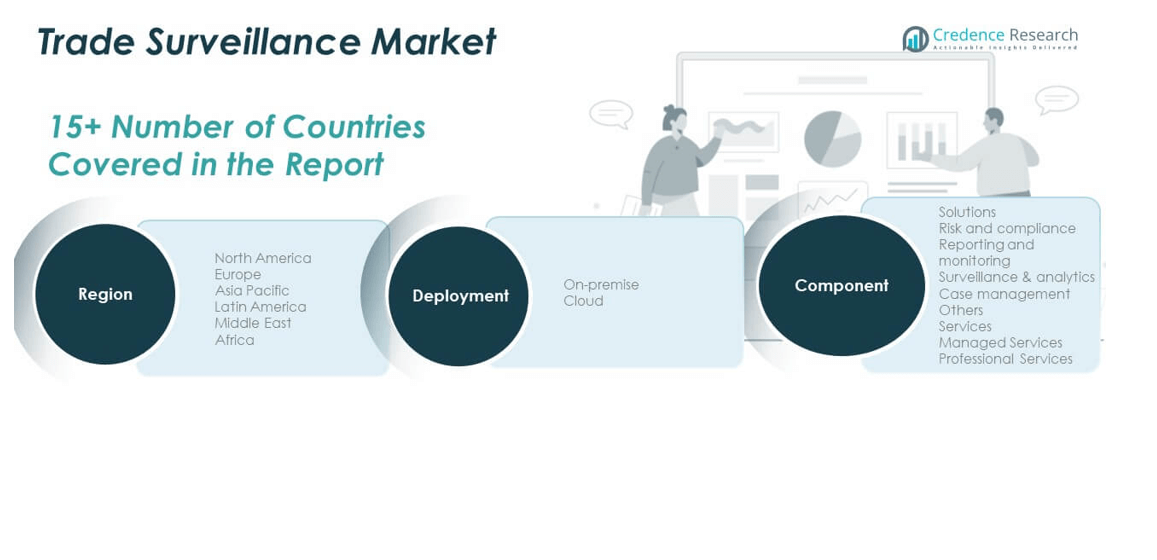
The Global Trade Surveillance Market expands through strong demand for advanced solutions that support strict oversight needs. Risk and compliance tools help institutions detect unfair practices with high accuracy. Reporting and monitoring platforms improve audit readiness for global regulators. Surveillance and analytics engines track large trade volumes and uncover hidden patterns. Case management systems streamline investigation cycles for compliance teams. Other niche tools support hybrid workflows across trading desks. Services play a key role in guiding firms through complex deployments. Managed services and professional services strengthen system performance across fast-moving environments.

  • For instance, Nasdaq SMARTS analyzes billions of market messages per day across its client exchanges to flag anomalies in trading behavior. Case management systems streamline investigation cycles for compliance teams.

By Deployment

Deployment preferences shift toward cloud-based models that offer strong scale and quick updates. It supports firms that handle multi-venue trades and require faster access to analytics. Many institutions use cloud zones to cut hardware load and improve agility. On-premises setups remain important for teams that need full control of sensitive data. These systems support tight governance across high-security environments. Deployment choices vary by region based on regulatory expectations. Cloud adoption grows among firms seeking flexible operating models. Both approaches shape steady progress across the surveillance landscape.

  • For instance, NICE Actimize’s cloud-native SURVEIL-X platform is deployed across major global banks and processes hundreds of millions of events daily through scalable cloud infrastructure. On-premises setups remain important for teams that need full control of sensitive data.

Trade Surveillance Market segmentation

Segmentation:

By Component

  • Solutions
    • Risk and Compliance
    • Reporting and Monitoring
    • Surveillance & Analytics
    • Case Management
    • Others
  • Services
    • Managed Services
    • Professional Services

By Deployment

  • Cloud Based
  • On-Premises

By Region

  • North America
    • U.S.
    • Canada
    • Mexico
  • Europe
    • UK
    • France
    • Germany
    • Italy
    • Spain
    • Russia
    • Rest of Europe
  • Asia Pacific
    • China
    • Japan
    • South Korea
    • India
    • Australia
    • Southeast Asia
    • Rest of Asia Pacific
  • Latin America
    • Brazil
    • Argentina
    • Rest of Latin America
  • Middle East
    • GCC Countries
    • Israel
    • Turkey
    • Rest of Middle East
  • Africa
    • South Africa
    • Egypt
    • Rest of Africa

Regional Analysis:

North America

The North America Global Trade Surveillance Market size was valued at USD 284.70 million in 2018 to USD 542.29 million in 2024 and is anticipated to reach USD 2,374.63 million by 2032, at a CAGR of 20.5% during the forecast period. North America holds a market share of 28.03%. The Global Trade Surveillance Market grows in this region due to strong regulatory systems across major exchanges. It benefits from strict laws that demand effective detection of market abuse. Firms enhance oversight tools to manage high electronic trading volumes. AI platforms support early signals that guide teams toward faster action. Cloud adoption rises to boost speed and scalability across trading desks. Many banks replace legacy systems to meet rising oversight pressure. Cross-asset monitoring strengthens detection across diverse instruments. It gains steady demand from firms that seek resilient compliance systems.

Europe

The Europe Global Trade Surveillance Market size was valued at USD 354.80 million in 2018 to USD 666.65 million in 2024 and is anticipated to reach USD 2,805.35 million by 2032, at a CAGR of 19.8% during the forecast period. Europe holds a market share of 34.46%. The Global Trade Surveillance Market expands in Europe due to strict market-abuse rules under regional directives. Firms deploy surveillance tools that help prevent misconduct across large exchanges. Automation improves detection quality during heavy trading cycles. Cloud systems support flexible oversight for multinational institutions. AI-driven systems track complex derivative trades with greater accuracy. Many brokers modernize checks to align with new reporting structures. Cross-border activity pushes demand for unified dashboards. It gains momentum from rising digital trade flows across major economies.

Asia Pacific

The Asia Pacific Global Trade Surveillance Market size was valued at USD 254.00 million in 2018 to USD 512.40 million in 2024 and is anticipated to reach USD 2,472.22 million by 2032, at a CAGR of 21.9% during the forecast period. Asia Pacific holds a market share of 26.49%. The Global Trade Surveillance Market advances in this region due to rapid expansion of digital trading. Growing fintech ecosystems support wider adoption of automated monitoring tools. Many exchanges modernize platforms to handle high-speed trades. AI engines track emerging threats across diverse asset classes. Cloud-first systems gain traction due to lower operating barriers. Regional regulators tighten rules to improve market integrity. Cross-market connectivity drives demand for integrated oversight. It gains strong momentum from rising investor participation across key markets.

Latin America

The Latin America Global Trade Surveillance Market size was valued at USD 62.30 million in 2018 to USD 119.35 million in 2024 and is anticipated to reach USD 485.19 million by 2032, at a CAGR of 19.3% during the forecast period. Latin America holds a market share of 6.17%. The Global Trade Surveillance Market sees gradual progress due to modernization across regional exchanges. Many institutions adopt tools that help detect potential manipulation. Cloud-based systems appeal to firms seeking low-cost upgrades. AI platforms improve visibility across fast-growing trading channels. Regulators strengthen guidelines to raise transparency across markets. Cross-border activities increase demand for structured oversight. Firms enhance reporting structures to improve compliance response. It gains traction as trading becomes more digital across the region.

Middle East

The Middle East Global Trade Surveillance Market size was valued at USD 24.50 million in 2018 to USD 42.74 million in 2024 and is anticipated to reach USD 157.90 million by 2032, at a CAGR of 17.9% during the forecast period. The Middle East holds a market share of 2.21%. The Global Trade Surveillance Market grows in this region due to upgrades in financial infrastructure. Many exchanges deploy stronger tools to align with global norms. AI models support early alerts during market fluctuations. Cloud platforms help institutions modernize oversight with less complexity. Regional regulators push stricter controls across trading venues. Financial hubs invest in integrated systems that improve accuracy. Firms explore analytics engines to handle rising volumes. It continues to expand as more markets digitize operations.

Africa

The Africa Global Trade Surveillance Market size was valued at USD 19.70 million in 2018 to USD 51.28 million in 2024 and is anticipated to reach USD 191.54 million by 2032, at a CAGR of 17.5% during the forecast period. Africa holds a market share of 2.65%. The Global Trade Surveillance Market develops slowly but steadily due to rising digital adoption. Regional exchanges upgrade monitoring systems to improve trust. Firms adopt AI-led tools to strengthen oversight quality. Cloud solutions help lower resource barriers for smaller institutions. Regulatory authorities work toward stronger reporting rules. Many markets seek support for integrated risk detection. Growing investor activity pushes firms to improve controls. It gains regional traction as financial systems modernize.

Shape Your Report to Specific Countries or Regions & Enjoy 30% Off!

Key Player Analysis:

  • Crisil Limited
  • Software GmbH
  • Aquis Exchange
  • Nexi S.p.A.
  • Nasdaq, Inc.
  • Scila
  • OneMarketData, LLC
  • ACA Group
  • IPC System, Inc.
  • Wipro
  • Red Deer

Competitive Analysis:

The Global Trade Surveillance Market features strong competition among technology providers that focus on advanced detection, analytics, and compliance automation. Leading firms integrate AI-driven models that track abnormal behavior across multi-asset environments. Many vendors expand cloud capabilities to support fast deployment across global trading desks. It benefits from rising demand for unified platforms that merge trade data with communication records. Firms compete on speed, accuracy, and workflow automation to serve stricter oversight needs. Providers enhance case management tools to reduce investigation time. Strategic partnerships strengthen integration across trading systems. Vendors maintain active development cycles to address evolving regulatory rules.

Recent Developments:

  • In November 2025, TPG, a firm specializing in alternative asset management, made a binding offer of approximately €1 billion for the digital banking solutions unit of Nexi S.p.A., with the payments firm having until mid-December 2025 to decide whether to proceed with the transaction. This follows months of negotiations between the two companies.
  • In September 2025, CRISIL announced the acquisition of McKinsey PriceMetrix Co. to strengthen its global benchmarking offerings in wealth management. This strategic acquisition is expected to expand CRISIL’s capabilities in the wealth management segment, with the transaction set to be completed in the coming months. The company continues to maintain leadership in corporate bond ratings while focusing on domain-led AI solutions and talent development to drive sustainable growth.
  • In July 2025, SIX Group, the Swiss and Spanish financial market infrastructure operator, completed its acquisition of Aquis Exchange. The deal, which was a recommended cash offer, was initially announced in November 2024 when agreed upon by the boards of both companies. While public reports referenced a deal value of approximately £207 million based on the treasury stock methodology, sources also noted a higher value of £225 million on a fully diluted basis.

Report Coverage:

The research report offers an in-depth analysis based on By Component and By Deployment. It details leading market players, providing an overview of their business, product offerings, investments, revenue streams, and key applications. Additionally, the report includes insights into the competitive environment, SWOT analysis, current market trends, as well as the primary drivers and constraints. Furthermore, it discusses various factors that have driven market expansion in recent years. The report also explores market dynamics, regulatory scenarios, and technological advancements that are shaping the industry. It assesses the impact of external factors and global economic changes on market growth. Lastly, it provides strategic recommendations for new entrants and established companies to navigate the complexities of the market.

Future Outlook:

  • AI-native surveillance engines will drive stronger pattern detection across asset classes.
  • Cloud platforms will support wider deployment across fast-growing digital exchanges.
  • Real-time alerts will strengthen decision support for compliance teams.
  • Communication monitoring will expand through advanced NLP and voice analytics.
  • Multi-asset coverage will improve detection accuracy across global venues.
  • Hybrid deployment models will help institutions balance security and scale.
  • Case management automation will speed investigation cycles.
  • Integrated platforms will unify trade data with behavioral insights.
  • Regulatory tightening will push faster upgrades across financial institutions.
  • Emerging markets will increase adoption as digital trading accelerates.

CHAPTER NO. 1 :             GENESIS OF THE MARKET           

1.1 Market Prelude – Introduction & Scope

1.2 The Big Picture – Objectives & Vision

1.3 Strategic Edge – Unique Value Proposition

1.4 Stakeholder Compass – Key Beneficiaries

CHAPTER NO. 2 :             EXECUTIVE LENS

2.1 Pulse of the Industry – Market Snapshot

2.2 Growth Arc – Revenue Projections (USD Million)

2.3. Premium Insights – Based on Primary Interviews

CHAPTER NO. 3 :             TRADE SURVEILLANCE MARKET FORCES & INDUSTRY PULSE      

3.1 Foundations of Change – Market Overview
3.2 Catalysts of Expansion – Key Market Drivers
3.2.1 Momentum Boosters – Growth Triggers
3.2.2 Innovation Fuel – Disruptive Technologies
3.3 Headwinds & Crosswinds – Market Restraints
3.3.1 Regulatory Tides – Compliance Challenges
3.3.2 Economic Frictions – Inflationary Pressures
3.4 Untapped Horizons – Growth Potential & Opportunities
3.5 Strategic Navigation – Industry Frameworks
3.5.1 Market Equilibrium – Porter’s Five Forces
3.5.2 Ecosystem Dynamics – Value Chain Analysis
3.5.3 Macro Forces – PESTEL Breakdown

3.6 Price Trend Analysis

    3.6.1 Regional Price Trend
3.6.2 Price Trend by product

CHAPTER NO. 4 :             KEY INVESTMENT EPICENTER    

4.1 Regional Goldmines – High-Growth Geographies

4.2 Product Frontiers – Lucrative Product Categories

4.3 Deployment Sweet Spots – Emerging Demand Segments

CHAPTER NO. 5: REVENUE TRAJECTORY & WEALTH MAPPING

5.1 Momentum Metrics – Forecast & Growth Curves

5.2 Regional Revenue Footprint – Market Share Insights

5.3 Segmental Wealth Flow – Component & Deployment Revenue

CHAPTER NO. 6 :             TRADE & COMMERCE ANALYSIS              

6.1.        Import Analysis by Region

6.1.1.     Global Trade Surveillance Market Import Revenue By Region

6.2.        Export Analysis by Region

6.2.1.     Global Trade Surveillance Market Export Revenue By Region

CHAPTER NO. 7 :             COMPETITION ANALYSIS            

7.1.        Company Market Share Analysis

7.1.1.     Global Trade Surveillance Market: Company Market Share

7.2.        Global Trade Surveillance Market Company Revenue Market Share

7.3.        Strategic Developments

7.3.1.     Acquisitions & Mergers

7.3.2.     New Product Launch

7.3.3.     Regional Expansion

7.4.        Competitive Dashboard

7.5.    Company Assessment Metrics, 2024

CHAPTER NO. 8 :             TRADE SURVEILLANCE MARKET – BY COMPONENT SEGMENT ANALYSIS           

8.1.        Trade Surveillance Market Overview by Component Segment

8.1.1.     Trade Surveillance Market Revenue Share By Component

8.1.2.     Trade Surveillance Market Revenue Share By Component

8.2.        Solutions

8.2.1      Risk and compliance

8.2.2      Reporting and monitoring

8.2.3.     Surveillance & analytics

8.2.4      Case management

8.2.5      Others

8.3.        Services

8.3.1      Managed Services

8.3.2      Professional Services

CHAPTER NO. 9 :             TRADE SURVEILLANCE MARKET – BY DEPLOYMENT SEGMENT ANALYSIS

9.1.        Trade Surveillance Market Overview by Deployment Segment

9.1.1.     Trade Surveillance Market Revenue Share By Deployment

9.1.2.     Trade Surveillance Market Revenue Share By Deployment

9.2.        Cloud based

9.3.        On-premises

CHAPTER NO. 10 :           TRADE SURVEILLANCE MARKET – REGIONAL ANALYSIS 

10.1.      Trade Surveillance Market Overview by Region Segment

10.1.1.  Global Trade Surveillance Market Revenue Share By Region

10.1.2.  Regions

10.1.3.  Global Trade Surveillance Market Revenue By Region

10.1.4.  Global Trade Surveillance Market Revenue By Region

10.1.5.  Component

10.1.6.  Global Trade Surveillance Market Revenue By Component

10.1.7.  Global Trade Surveillance Market Revenue By Component

10.1.8.  Deployment

10.1.9.  Global Trade Surveillance Market Revenue By Deployment

10.1.10.               Global Trade Surveillance Market Revenue By Deployment

CHAPTER NO. 11 :           NORTH AMERICA TRADE SURVEILLANCE MARKET – COUNTRY ANALYSIS           

11.1.      North America Trade Surveillance Market Overview by Country Segment

11.1.1.  North America Trade Surveillance Market Revenue Share By Region

11.2.      North America

11.2.1.  North America Trade Surveillance Market Revenue By Country

11.2.2.  Component

11.2.3.  North America Trade Surveillance Market Revenue By Component

11.2.4.  Deployment

11.2.5.  North America Trade Surveillance Market Revenue By Deployment

11.3.      U.S.

11.4.      Canada

11.5.      Mexico

CHAPTER NO. 12 :           EUROPE TRADE SURVEILLANCE MARKET – COUNTRY ANALYSIS

12.1.      Europe Trade Surveillance Market Overview by Country Segment

12.1.1.  Europe Trade Surveillance Market Revenue Share By Region

12.2.      Europe

12.2.1.  Europe Trade Surveillance Market Revenue By Country

12.2.2.  Component

12.2.3.  Europe Trade Surveillance Market Revenue By Component

12.2.4.  Deployment

12.2.5.  Europe Trade Surveillance Market Revenue By Deployment

12.3.      UK

12.4.      France

12.5.      Germany

12.6.      Italy

12.7.      Spain

12.8.      Russia

12.9.   Rest of Europe

CHAPTER NO. 13 :           ASIA PACIFIC TRADE SURVEILLANCE MARKET – COUNTRY ANALYSIS

13.1.      Asia Pacific Trade Surveillance Market Overview by Country Segment

13.1.1.  Asia Pacific Trade Surveillance Market Revenue Share By Region

13.2.      Asia Pacific

13.2.1.  Asia Pacific Trade Surveillance Market Revenue By Country

13.2.2.  Component

13.2.3.  Asia Pacific Trade Surveillance Market Revenue By Component

13.2.4.  Deployment

13.2.5.  Asia Pacific Trade Surveillance Market Revenue By Deployment

13.3.      China

13.4.      Japan

13.5.      South Korea

13.6.      India

13.7.      Australia

13.8.      Southeast Asia

13.9.      Rest of Asia Pacific

CHAPTER NO. 14 :           LATIN AMERICA TRADE SURVEILLANCE MARKET – COUNTRY ANALYSIS

14.1.      Latin America Trade Surveillance Market Overview by Country Segment

14.1.1.  Latin America Trade Surveillance Market Revenue Share By Region

14.2.      Latin America

14.2.1.  Latin America Trade Surveillance Market Revenue By Country

14.2.2.  Component

14.2.3.  Latin America Trade Surveillance Market Revenue By Component

14.2.4.  Deployment

14.2.5.  Latin America Trade Surveillance Market Revenue By Deployment

14.3.      Brazil

14.4.      Argentina

14.5.      Rest of Latin America

CHAPTER NO. 15 :           MIDDLE EAST TRADE SURVEILLANCE MARKET – COUNTRY ANALYSIS

15.1.      Middle East Trade Surveillance Market Overview by Country Segment

15.1.1.  Middle East Trade Surveillance Market Revenue Share By Region

15.2.      Middle East

15.2.1.  Middle East Trade Surveillance Market Revenue By Country

15.2.2.  Component

15.2.3.  Middle East Trade Surveillance Market Revenue By Component

15.2.4.  Deployment

15.2.5.  Middle East Trade Surveillance Market Revenue By Deployment

15.3.      GCC Countries

15.4.      Israel

15.5.      Turkey

15.6.      Rest of Middle East

CHAPTER NO. 16 :           AFRICA TRADE SURVEILLANCE MARKET – COUNTRY ANALYSIS  

16.1.      Africa Trade Surveillance Market Overview by Country Segment

16.1.1.  Africa Trade Surveillance Market Revenue Share By Region

16.2.      Africa

16.2.1.  Africa Trade Surveillance Market Revenue By Country

16.2.2.  Component

16.2.3.  Africa Trade Surveillance Market Revenue By Component

16.2.4.  Deployment

16.2.5.  Africa Trade Surveillance Market Revenue By Deployment

16.3.      South Africa

16.4.      Egypt

16.5.      Rest of Africa

CHAPTER NO. 17 :           COMPANY PROFILES     

17.1.      Crisil Limited

17.1.1.  Company Overview

17.1.2.  Product Portfolio

17.1.3.  Financial Overview

17.1.4.  Recent Developments

17.1.5.  Growth Strategy

17.1.6.  SWOT Analysis

17.2.      Software GmbH

17.3.      Aquis Exchange

17.4.      Nexi S.p.A.

17.5.      Nasdaq, Inc.

17.6.      Scila

17.7.      OneMarketData, LLC

17.8.      ACA Group

17.9.      IPC System, Inc.

17.10.    Wipro

17.11.    Red Deer

Request Free Sample

We prioritize the confidentiality and security of your data. Our promise: your information remains private.

Ready to Transform Data into Decisions?

Request Your Sample Report and Start Your Journey of Informed Choices


Providing the strategic compass for industry titans.

cr-clients-logos


Frequently Asked Questions:

What is the current size of the Trade Surveillance market?

The Global Trade Surveillance Market size was valued at USD 1,000.00 million in 2018 and reached USD 1,934.72 million in 2024. It is projected to reach USD 8,486.85 million by 2032, driven by stronger oversight needs. Growing digital trading activity supports wider adoption across global financial institutions. Rising regulatory pressure continues to shape long-term growth.

At what Compound Annual Growth Rate is the Global Trade Surveillance Market projected to grow between 2025 and 2032?

The market is projected to grow at a CAGR of 20.46% during the forecast period. Strong regulatory scrutiny drives firms toward advanced monitoring platforms. AI-led systems support better detection of suspicious trading behavior. Cloud deployment strengthens flexibility across global trading desks

What factors are driving the growth of the Trade Surveillance market?

Growth is driven by stricter regulatory frameworks imposed by authorities such as the U.S. Securities and Exchange Commission (SEC) and the European Securities and Markets Authority (ESMA), increasing need for compliance and market integrity, and advanced technologies like AI, ML, and big data analytics that enable real-time monitoring, predictive insights, and automated alerts.

What are some challenges faced by the Trade Surveillance market?

Challenges include high implementation and operational costs, data privacy and compliance complexity, integration issues with legacy systems, and the need to keep pace with evolving market and technological complexities.

Who are the major players in the Trade Surveillance market?

Major players include NICE Ltd., Nasdaq, BAE Systems, FIS (Fidelity National Information Services), SIA S.p.A., Software AG, eFlow Ltd., Aquis Technologies, B-Next Group, and ACA Compliance Group.

Which segment is leading the market share?

Market surveillance solutions lead the market due to their critical role in detecting and preventing market abuse and fraud, while banks and brokerage firms represent the largest end-users, driven by stringent compliance requirements and the need to mitigate financial misconduct.

About Author

Sushant Phapale

Sushant Phapale

ICT & Automation Expert

Sushant is an expert in ICT, automation, and electronics with a passion for innovation and market trends.

View Profile

Related Reports

Trade Management Software Market

The Global Trade Management Software Market size was valued at USD 3,200.00 million in 2018 to USD 4,121.74 million in 2024 and is anticipated to reach USD 7,279.16 million by 2032, at a CAGR of 7.44% during the forecast period.

Thyristor Market

The Global Thyristor Market size was valued at USD 1,360.00 million in 2018 to USD 1,567.63 million in 2024 and is anticipated to reach USD 2,280.83 million by 2032, at a CAGR of 4.86% during the forecast period.

Industrial Wireless Instrumentation Market

Industrial Wireless Instrumentation Market size was valued at USD 6.28 Billion in 2024 and is anticipated to reach USD 10.79 Billion by 2032, at a CAGR of 7% during the forecast period

Data Science And Predictive Analytics Market

The Data Science and Predictive Analytics Market was valued at USD 14.39 billion in 2024 and is projected to reach USD 56.32 billion by 2032, expanding at a CAGR of 18.6% during the forecast period.

Tokenization Market

The Global Tokenization Market size was valued at USD 1,200.00 million in 2018, rising to USD 2,524.75 million in 2024, and is anticipated to reach USD 14,936.54 million by 2032, at a CAGR of 24.99% during the forecast period.

India E-Commerce Market

India E commerce Market size was valued USD 124998 million in 2024 and is anticipated to reach USD 379719.8 million by 2032, at a CAGR of 14.9% during the forecast period.

Professional Speakers Market

Professional Speakers Market size was valued USD 2.23 billion in 2024 and is anticipated to reach USD 2.92 billion by 2032, at a CAGR of 3.43% during the forecast period.

Hardware Asset Management Market

Hardware Asset Management Market size was valued USD 30 billion in 2024 and is anticipated to reach USD 72.58 billion by 2032, at a CAGR of 11.7% during the forecast period.

Transmission Towers Market

Transmission Tower Market was valued at USD 19.17 billion in 2024 and is anticipated to reach USD 25.83 billion by 2032, growing at a CAGR of 3.8 % during the forecast period.

IBM Bluemix Services Market

The IBM Bluemix Services Market size was valued at USD 11,400.00 million in 2018, increasing to USD 25,922.14 million in 2024, and is anticipated to reach USD 171,486.00 million by 2032, growing at a CAGR of 26.76% during the forecast period.

U.S. IT Staffing Market

he U.S. IT Staffing Market size was valued at USD 23,035.4 million in 2018, increasing to USD 32,969.6 million in 2024, and is anticipated to reach USD 49,693.4 million by 2032, growing at a CAGR of 5.22% during the forecast period.

Software Defined Perimeter (SDP) Market

The Global Software Defined Perimeter (SDP) Market size was valued at USD 3,200.00 million in 2018, increased to USD 8,450.21 million in 2024, and is anticipated to reach USD 85,916.28 million by 2032, expanding at a CAGR of 33.88% during the forecast period.

Licence Option

The report comes as a view-only PDF document, optimized for individual clients. This version is recommended for personal digital use and does not allow printing. Use restricted to one purchaser only.
$4999

To meet the needs of modern corporate teams, our report comes in two formats: a printable PDF and a data-rich Excel sheet. This package is optimized for internal analysis. Unlimited users allowed within one corporate location (e.g., regional office).
$6999

The report will be delivered in printable PDF format along with the report’s data Excel sheet. This license offers 100 Free Analyst hours where the client can utilize Credence Research Inc. research team. Permitted for unlimited global use by all users within the purchasing corporation, such as all employees of a single company.
$12999

Report delivery within 24 to 48 hours

Credence Staff 3

WILLIAM, North America

Support Staff at Credence Research

KEITH PHILLIPS, Europe

Lee - CR Sales Staff

LEE VALLANCE, Asia Pacific

Kieran Jameson

KIERAN JAMESON, Australia

Smallform of Sample request
User Review

Thank you for the data! The numbers are exactly what we asked for and what we need to build our business case.

Materials Scientist
(privacy requested)

User Review

The report was an excellent overview of the Industrial Burners market. This report does a great job of breaking everything down into manageable chunks.

Imre Hof
Management Assistant, Bekaert

cr-clients-logos

Request Sample