Market Overview
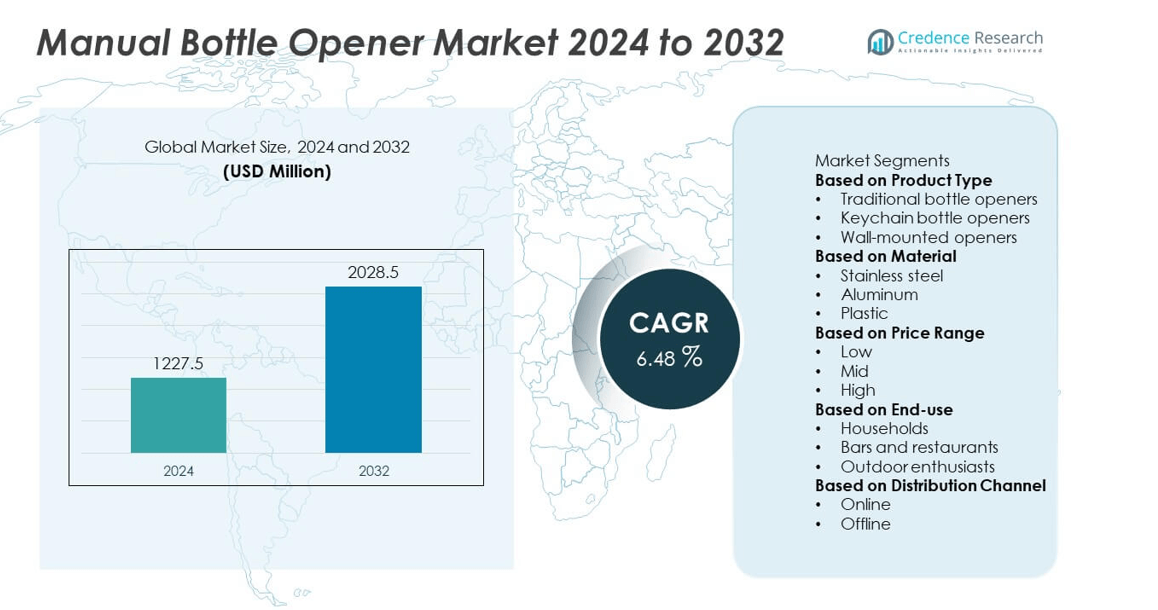
The Manual Bottle Opener Market was valued at USD 1,227.5 million in 2024 and is projected to reach USD 2,028.5 million by 2032, reflecting a CAGR of 6.48% during the forecast period.
| REPORT ATTRIBUTE |
DETAILS |
| Historical Period |
2020-2023 |
| Base Year |
2024 |
| Forecast Period |
2025-2032 |
| Manual Bottle Opener Market Size 2024 |
USD 1,227.5 million |
| Manual Bottle Opener Market, CAGR |
6.48% |
| Manual Bottle Opener Market Size 2032 |
USD 2,028.5 million |
The Manual Bottle Opener Market grows on strong drivers such as rising global beverage consumption, increasing demand for durable kitchenware, and the popularity of home bars and outdoor gatherings. Consumers prefer manual openers for their portability, reliability, and ease of use, which supports steady adoption across households, restaurants, and hospitality sectors.
The geographical landscape of the Manual Bottle Opener Market highlights strong presence across North America, Europe, Asia-Pacific, Latin America, and the Middle East & Africa. North America maintains significant growth driven by high beverage consumption and strong hospitality infrastructure. Asia-Pacific records rapid expansion supported by urbanization, rising disposable incomes, and the growing popularity of western dining and home bar culture. Latin America shows consistent growth fueled by increasing beer consumption and household demand, whereas the Middle East & Africa demonstrate steady adoption through hospitality and tourism expansion. Key players shaping the market include Le Creuset, known for premium kitchenware, Joseph Joseph, offering innovative and ergonomic designs, Oster, with strong distribution in household appliances, and Corkcicle, focusing on stylish and multifunctional openers that blend utility with aesthetic appeal.
Market Insights
- The Manual Bottle Opener Market was valued at USD 1227.5 million in 2024 and is expected to reach USD 2028.5 million by 2032, expanding at a CAGR of 6.48% during the forecast period.
- Strong market growth is driven by rising global consumption of alcoholic and non-alcoholic beverages, supported by increasing hospitality sector expansion and household demand for functional kitchen tools.
- Market trends highlight the growing popularity of premium, ergonomic, and multifunctional designs, with consumers seeking durable materials such as stainless steel and wood, alongside compact openers for on-the-go use.
- Competitive analysis shows key players like Le Creuset, Joseph Joseph, Oster, and Corkcicle focusing on design innovation, branding, and distribution strength, while smaller firms compete with niche designs and cost-effective offerings.
- The market faces restraints from the rising adoption of electric and automatic openers, along with shifting consumer preferences toward convenience-driven alternatives, which could limit manual opener demand in certain regions.
- Regional analysis indicates strong growth in North America due to high beer and wine consumption, while Europe drives demand through premium and sustainable products, and Asia-Pacific expands rapidly through rising disposable incomes and modern dining culture.
- The market demonstrates resilience through its adaptability, with traditional appeal sustaining household use and innovation ensuring continued relevance across restaurants, bars, and retail channels worldwide.
Access crucial information at unmatched prices!
Request your sample report today & start making informed decisions powered by Credence Research Inc.!
Download Sample
Market Drivers
Rising Global Beverage Consumption and Hospitality Expansion
The Manual Bottle Opener Market grows strongly with rising global beverage consumption, particularly in beer, carbonated drinks, and bottled beverages. Expanding bars, pubs, restaurants, and hotels worldwide demand reliable and durable openers to support high-volume operations. It remains a necessary tool for the hospitality sector where efficiency and durability influence service quality. Increasing disposable incomes and social drinking trends further boost product demand in both developed and emerging economies. Manufacturers enhance designs with improved grip and stainless-steel durability to meet commercial requirements. This steady demand from the foodservice and beverage industries strengthens the market’s long-term outlook.
- For instance, the Oster Baldwin 6‑inch manual stainless‑steel opener incorporates a pull‑tab for cans, a ridged compartment for twist caps, and a hanging hole for easy storage—features that collectively improve durability and daily utility in commercial environments
Increasing Household and Recreational Use
Household adoption contributes significantly to growth in the Manual Bottle Opener Market, driven by rising home consumption of beverages and recreational gatherings. Consumers value compact, easy-to-use tools that support convenience in kitchens and outdoor activities. It appeals to households looking for cost-effective and long-lasting solutions compared to electric alternatives. Growing popularity of outdoor events, picnics, and camping activities further accelerates demand for portable openers. Manufacturers introduce ergonomic and multifunctional designs that combine openers with corkscrews or keychains to increase utility. This segment demonstrates consistent adoption across both urban and rural households.
- For instance, the BarCraft Lazy Fish corkscrew employs a concertina mechanism within a robust stainless‑steel body, delivering enhanced leverage and ease of use—paired with a five‑year guarantee that underscores its industrial‑grade reliability for everyday and recreational use
Innovation in Design and Sustainable Materials
Design innovation and material advancement play a critical role in the growth of the Manual Bottle Opener Market. Producers introduce openers made with stainless steel, zinc alloy, and eco-friendly wood or bamboo handles to attract environmentally conscious consumers. It helps brands differentiate themselves through both functionality and sustainability. Compact folding designs and decorative variants cater to lifestyle-driven purchases, blending utility with aesthetics. Global emphasis on eco-friendly consumer goods further enhances the demand for recyclable and biodegradable materials in product development. Innovation ensures that manual openers remain relevant in a market where automation is expanding.
Growth of E-Commerce and Global Retail Channels
Expanding digital platforms and retail channels accelerate the distribution of manual bottle openers worldwide. The Manual Bottle Opener Market benefits from strong sales through e-commerce giants and specialized online stores that offer wide product assortments at competitive prices. It enables small and mid-sized manufacturers to reach global consumers without heavy investments in physical retail. Promotional strategies such as customization, bundling, and gift sets further boost sales online. Growing consumer preference for quick delivery and easy availability of international brands fuels this trend. This driver ensures broad accessibility and rising penetration across both developed and emerging economies.
Market Trends
Shift Toward Premium and Customized Designs
The Manual Bottle Opener Market reflects a strong shift toward premium and customized designs that cater to consumer lifestyles. Demand rises for openers made with high-quality finishes such as stainless steel, brass, or wood to align with luxury dining and gifting. It creates opportunities for brands to differentiate through personalization, including engraved logos, corporate branding, and event memorabilia. Hospitality businesses also adopt customized openers as part of marketing campaigns to build brand recognition. The growing focus on aesthetics positions manual openers as both functional and collectible items. This trend reinforces consumer preference for durable yet stylish tools.
- For instance, Le Creuset introduced a One‑Step Waiter’s Friend corkscrew in late 2024 featuring a refined design with stainless‑steel and black walnut finishes, specifically created to offer effortless cork removal while elevating table presentation and gifting appeal
Rising Popularity of Multi-Functional Tools
Multi-functional openers that combine corkscrews, can openers, and keychains gain popularity across global markets. The Manual Bottle Opener Market benefits from increasing consumer preference for compact tools that serve multiple purposes in households, bars, and outdoor activities. It reduces the need for carrying or storing multiple tools, enhancing convenience. Outdoor enthusiasts, including campers and travelers, strongly prefer multifunctional options that blend portability with practicality. Manufacturers introduce innovative folding mechanisms and lightweight alloys to strengthen this demand. The emphasis on versatile solutions continues to drive product evolution in this space.
- For instance, Joseph Joseph’s Pivot™ 3‑in‑1 can opener offers a robust stainless-steel cutting mechanism, a bottle‑cap opener, and a 360° ring-pull lifter all within a single compact gadget measuring approximately 18.5 × 5 × 5.8 cm, designed to maximize space efficiency and functionality.
Adoption of Sustainable and Eco-Friendly Materials
Sustainability shapes consumer choices, creating demand for manual openers made with eco-friendly materials such as bamboo, recycled wood, or biodegradable plastics. The Manual Bottle Opener Market adapts by replacing conventional plastic handles with natural alternatives that appeal to environmentally conscious buyers. It allows manufacturers to align with global sustainability goals while capturing the attention of green consumer segments. Retailers promote eco-friendly collections as part of broader corporate responsibility programs. Growing awareness of plastic reduction initiatives further accelerates this trend. This development strengthens the position of manual openers as sustainable, long-lasting household products.
Expansion Through Online Retail and Lifestyle Gifting
The market experiences growth through the rising popularity of manual openers in lifestyle gifting categories. The Manual Bottle Opener Market benefits from online retail platforms that promote creative packaging, gift bundles, and limited-edition collections. It enhances visibility among younger demographics who favor unique and stylish accessories for social occasions. Companies focus on seasonal promotions and collaboration with beverage brands to expand reach. The appeal of manual openers as affordable yet practical gift items strengthens their relevance across retail categories. This trend highlights the growing influence of e-commerce in shaping consumer purchasing behavior.
Market Challenges Analysis
Competition From Electric and Automatic Alternatives
The Manual Bottle Opener Market faces significant pressure from the rising popularity of electric and automatic openers that promise speed, ease of use, and convenience. Consumers in urban households and modern hospitality environments often prefer automated solutions, especially in premium dining or high-volume usage contexts. It creates a barrier for manual openers in terms of perceived efficiency and modernization. Manufacturers must focus on design appeal, craftsmanship, and cost competitiveness to retain relevance. The challenge is further amplified by younger consumers who are more inclined toward technology-driven solutions. Sustaining demand for manual options requires innovation in design and positioning.
Low Price Margins and Counterfeit Products
Intense price competition in the Manual Bottle Opener Market limits profit margins, especially among small manufacturers and local brands. The availability of low-cost alternatives and counterfeit products reduces consumer trust and affects brand loyalty. It makes it difficult for premium players to justify higher pricing without distinct quality features. Retailers often prioritize cheaper options, reducing visibility for high-quality products. Counterfeit goods also raise concerns regarding durability and safety, damaging the reputation of genuine brands. This challenge pushes established companies to invest in brand differentiation, quality certification, and supply chain transparency to secure long-term growth.
Market Opportunities
Rising Demand for Premium and Customized Designs
The Manual Bottle Opener Market presents strong opportunities through the growing preference for premium, collectible, and customized openers. Consumers increasingly view openers not only as functional tools but also as lifestyle accessories and gifting items. It creates space for innovation in materials such as stainless steel, wood, brass, and eco-friendly composites that enhance durability and appeal. Brands can differentiate by offering laser-engraved personalization, ergonomic shapes, and limited-edition collections. Hospitality and promotional industries also drive demand for branded openers used in marketing campaigns. The shift toward design-driven products supports revenue growth for established and niche players.
Expanding Reach Through E-commerce and Global Distribution
Global retail expansion offers another key opportunity for the Manual Bottle Opener Market, particularly through e-commerce platforms and cross-border trade. Online marketplaces enable small and medium manufacturers to reach international customers without heavy distribution costs. It also provides visibility for artisanal and handcrafted products that resonate with collectors and enthusiasts. Strategic partnerships with lifestyle brands and breweries enhance sales opportunities by integrating openers into promotional bundles. Demand from emerging markets with expanding middle-class populations strengthens prospects for affordable and stylish openers. Companies that leverage digital marketing and direct-to-consumer models stand to capture a broader share of global demand.
Market Segmentation Analysis:
By Product Type
The Manual Bottle Opener Market segments by product type into wall-mounted, handheld, and multifunctional designs. Handheld openers remain the most widely used due to their portability, ease of storage, and affordability. It continues to dominate both household and commercial use. Wall-mounted variants gain traction in bars, restaurants, and outdoor spaces where durability and convenience are essential. Multifunctional designs that integrate corkscrews, keychains, or magnetic catchers appeal to consumers seeking added value and compact solutions. This diversity of products allows manufacturers to cater to a broad spectrum of end-users across personal and professional settings.
- For instance, Le Creuset’s PM‑110 pocket corkscrew measures approximately 14.5 cm in length, 4.5 cm in width, and 2.5 cm in height—demonstrating the compact dimensions achievable in multifunctional handheld designs.
By Material
Segmentation by material highlights stainless steel, aluminum, wood, and plastic as the key categories. Stainless steel openers lead adoption because of their strength, resistance to corrosion, and long service life. It secures preference in professional and premium segments. Aluminum openers attract buyers for their lightweight and portable nature, often paired with promotional branding. Wooden and eco-friendly composite handles expand among consumers prioritizing aesthetics and sustainability. Plastic openers remain popular in cost-sensitive markets and promotional giveaways. Each material category reflects a balance between durability, design appeal, and affordability.
- For instance, the BarCraft Lazy Fish stainless steel corkscrew and bottle opener measures 16.5 cm in length, 7.5 cm in width, and 4.5 cm in depth, demonstrating how steel construction ensures robust performance in a practical form factor.
By Price Range
The Manual Bottle Opener Market divides by price range into low, mid, and premium tiers. Low-cost openers dominate sales volumes, particularly in emerging markets and mass consumer segments. It benefits from bulk purchases in promotional and hospitality sectors. Mid-range products combine functionality with improved designs and materials, appealing to households and casual users seeking quality without high costs. Premium openers command attention through luxury finishes, ergonomic enhancements, and collectible designs that target niche consumer bases. Growth in gifting and lifestyle segments continues to drive innovation in the higher price ranges, strengthening the overall product mix.
Segments:
Based on Product Type
- Traditional bottle openers
- Keychain bottle openers
- Wall-mounted openers
Based on Material
- Stainless steel
- Aluminum
- Plastic
Based on Price Range
Based on End-use
- Households
- Bars and restaurants
- Outdoor enthusiasts
Based on Distribution Channel
Based on the Geography:
- North America
- Europe
- UK
- France
- Germany
- Italy
- Spain
- Russia
- Belgium
- Netherlands
- Austria
- Sweden
- Poland
- Denmark
- Switzerland
- Rest of Europe
- Asia Pacific
- China
- Japan
- South Korea
- India
- Australia
- Thailand
- Indonesia
- Vietnam
- Malaysia
- Philippines
- Taiwan
- Rest of Asia Pacific
- Latin America
- Brazil
- Argentina
- Peru
- Chile
- Colombia
- Rest of Latin America
- Middle East
- UAE
- KSA
- Israel
- Turkey
- Iran
- Rest of Middle East
- Africa
- Egypt
- Nigeria
- Algeria
- Morocco
- Rest of Africa
Regional Analysis
North America
North America holds the largest share of the Manual Bottle Opener Market at 32%, driven by strong demand from both households and the commercial foodservice industry. The U.S. leads the region, supported by widespread use of handheld and wall-mounted openers in restaurants, bars, and sporting events. Canada follows with steady growth, reflecting rising consumer interest in multifunctional and eco-friendly opener designs. It benefits from well-established distribution channels, including online platforms and specialty stores, which ensure product availability across urban and rural areas. Promotional bottle openers distributed by beverage companies further expand product penetration. The region continues to invest in premium and customized openers, supporting growth in niche markets such as collectibles and branded merchandise.
Europe
Europe accounts for 28% of the Manual Bottle Opener Market, with Germany, the UK, and France representing the major contributors. Strong cultural traditions in beer and wine consumption sustain high demand for both handheld and decorative openers. It gains momentum from tourism and hospitality sectors where bottle openers remain indispensable tools. Manufacturers in Europe emphasize sustainable materials, including wood and recycled metals, aligning with regional preferences for eco-conscious products. Growth in e-commerce platforms supports broader accessibility, while premium segments thrive through innovative designs that merge utility with aesthetics. Countries such as Italy and Spain also play important roles, with demand linked to home dining and entertainment culture.
Asia-Pacific
Asia-Pacific holds a 25% market share, emerging as the fastest-growing region in the Manual Bottle Opener Market. China and India lead demand due to rising middle-class consumption and increasing popularity of home entertainment. Japan and South Korea contribute with high adoption of premium and multifunctional openers tailored to consumer lifestyle preferences. It benefits from expanding e-commerce penetration, which allows international and domestic brands to reach rural and urban buyers alike. Local manufacturers focus on cost-effective products for mass consumption while global players target premium markets. The region’s cultural festivals and events also create demand for promotional openers distributed by beverage and hospitality companies.
Latin America
Latin America captures 9% of the Manual Bottle Opener Market, with Brazil and Mexico serving as the primary growth engines. Widespread beer consumption across the region sustains consistent demand for both handheld and wall-mounted openers. It shows strong adoption in restaurants, bars, and households where affordable openers dominate sales. Local manufacturers emphasize low-cost production to cater to mass markets, while international brands expand through retail and online channels. Decorative and novelty openers also gain attention, particularly as souvenirs in tourism-driven markets. Expansion in urban hospitality and nightlife culture ensures continued demand growth in the region.
Middle East & Africa
The Middle East & Africa account for 6% of the Manual Bottle Opener Market, reflecting steady yet smaller-scale adoption compared to other regions. The UAE and South Africa drive demand, supported by urban hospitality sectors and growing retail distribution. It benefits from the tourism industry where premium and decorative openers are sold as part of lifestyle products. Markets in North Africa and the Gulf Cooperation Council countries also contribute, particularly through specialty retail and gifting channels. While affordability remains a key driver, premium categories are expanding gradually with urban consumers showing greater interest in quality and design. The region is expected to grow steadily with increasing beverage consumption and rising retail penetration.
Shape Your Report to Specific Countries or Regions & Enjoy 30% Off!
Key Player Analysis
- Oster
- Motta
- BarCraft
- Le Creuset Group
- Joseph Joseph
- Corkcicle
- Godinger
- Boker
- Kohler
- Le Creuset
Competitive Analysis
The competitive analysis of the Manual Bottle Opener Market highlights leading players such as BarCraft, Boker, Corkcicle, Godinger, Joseph Joseph, Kohler, Le Creuset, Le Creuset Group, Motta, and Oster, who collectively influence market dynamics through innovation, design, and distribution strength. These companies focus on premium quality, ergonomic designs, and durable materials to meet the needs of both household and hospitality consumers. Le Creuset and Joseph Joseph drive growth in the premium category with stylish and functional offerings, while Oster and Corkcicle leverage strong retail networks to dominate the mass market. BarCraft and Godinger emphasize gifting and lifestyle-oriented designs, whereas Motta and Boker cater to niche audiences with craftsmanship-focused products. Kohler differentiates with multifunctional kitchenware integration, strengthening its position in modern households. The market remains moderately fragmented, with global brands leading high-value segments and regional manufacturers offering affordable alternatives, while competition increasingly centers on sustainability, innovation, and expanding digital retail channels.
Recent Developments
- In April 2025, Kohler’s product focus is primarily on kitchen and bathroom fixtures, with no indication of engagement in the manual bottle opener market.
- In January 2025, BarCraft introduced the “Lazy Fish” corkscrew and bottle opener. This stainless-steel opener utilizes a concertina mechanism for efficient uncorking, converting gentle pulls into a powerful action. It comes with a five-year guarantee for durability.
Market Concentration & Characteristics
The Manual Bottle Opener Market reflects a moderately fragmented structure with the presence of both global brands and regional manufacturers competing for consumer attention. It demonstrates characteristics of a mature consumer goods segment where brand reputation, design innovation, and material durability play central roles in defining competitiveness. Leading players emphasize ergonomics, multifunctionality, and premium finishes to attract lifestyle-oriented buyers, while smaller firms target affordability and niche cultural preferences. It maintains steady demand driven by household usage, hospitality, and gifting applications, ensuring consistent product relevance. The market highlights strong differentiation in product design, with companies focusing on stainless steel, wood, and specialty finishes to cater to varying consumer expectations. It also shows a balance between traditional retail and e-commerce channels, allowing both established and emerging brands to capture diverse consumer bases. The Manual Bottle Opener Market thus combines heritage utility with evolving consumer design trends, making it a resilient segment in the broader kitchenware and barware industry.
Report Coverage
The research report offers an in-depth analysis based on Product Type, Material, Price Range, End-User, Distribution Channel and Geography. It details leading market players, providing an overview of their business, product offerings, investments, revenue streams, and key applications. Additionally, the report includes insights into the competitive environment, SWOT analysis, current market trends, as well as the primary drivers and constraints. Furthermore, it discusses various factors that have driven market expansion in recent years. The report also explores market dynamics, regulatory scenarios, and technological advancements that are shaping the industry. It assesses the impact of external factors and global economic changes on market growth. Lastly, it provides strategic recommendations for new entrants and established companies to navigate the complexities of the market.
Future Outlook
- The market will grow steadily with consistent demand from households, hospitality, and gifting applications.
- Companies will invest in ergonomic and multifunctional designs to enhance user convenience.
- Premium and designer bottle openers will gain traction among lifestyle-oriented consumers.
- E-commerce platforms will expand product reach and strengthen consumer accessibility worldwide.
- Sustainable materials such as recycled metals and eco-friendly wood will see higher adoption.
- Limited-edition and customized bottle openers will attract gifting and collector segments.
- Integration of manual openers with barware sets will increase brand positioning.
- Demand from emerging markets will rise with growing dining and beverage culture.
- Competition will intensify as both established and niche brands expand portfolios.
- Innovation in packaging and branding will influence consumer purchase preferences.



