Market Overview
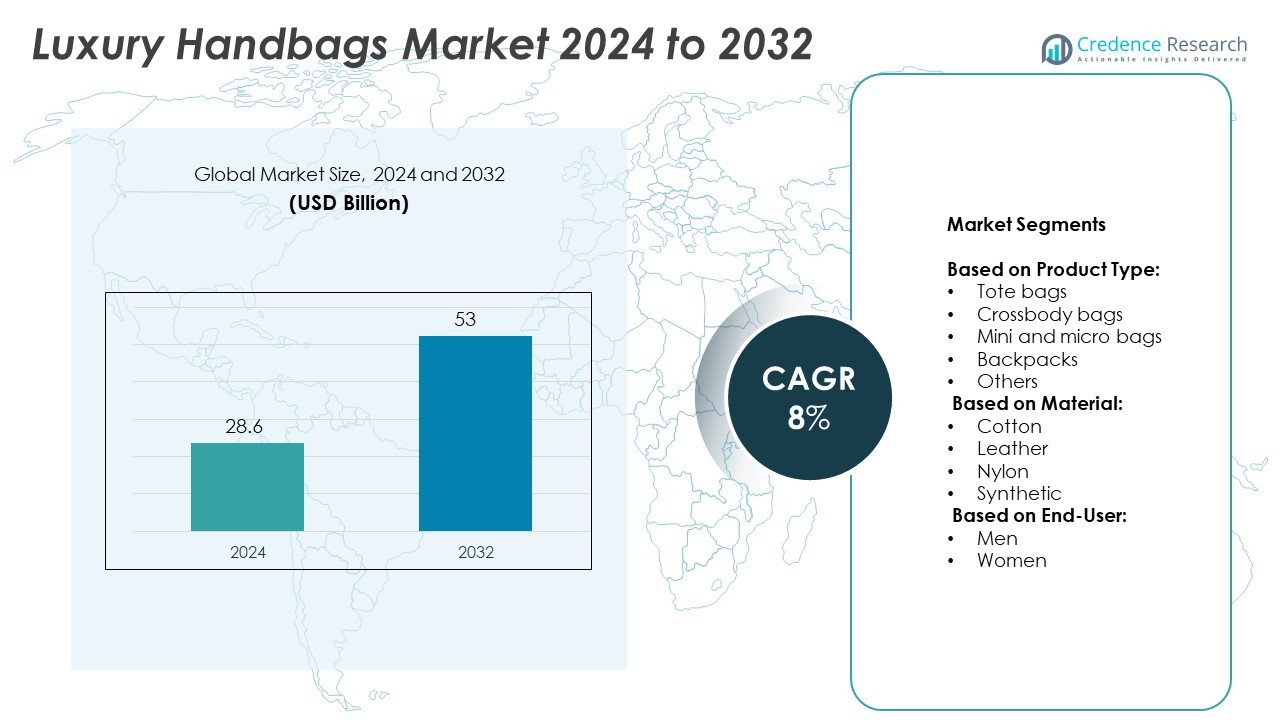
Luxury Handbags Market size was valued at USD 28.6 billion in 2024 and is anticipated to reach USD 53 billion by 2032, at a CAGR of 8% during the forecast period.
| REPORT ATTRIBUTE |
DETAILS |
| Historical Period |
2020-2024 |
| Base Year |
2024 |
| Forecast Period |
2025-2032 |
| Luxury Handbags Market Size 2024 |
USD 28.6 Billion |
| Luxury Handbags Market , CAGR |
8% |
| Luxury Handbags Market Size 2032 |
USD 53 Billion |
The Luxury Handbags market grows rapidly due to rising demand for premium fashion, personalized products, and innovative designs. Increasing disposable incomes, evolving lifestyles, and a strong preference for exclusive collections drive market expansion. Digital retail channels, influencer marketing, and celebrity collaborations boost brand visibility and consumer engagement. Sustainability trends encourage brands to adopt eco-friendly materials and transparent production processes. Advancements in design and smart features further strengthen market competitiveness, attracting younger consumers and expanding the global luxury customer base.
The Luxury Handbags market shows strong geographic diversity, with North America, Europe, Asia Pacific, Latin America, and the Middle East & Africa all driving growth through distinct consumer tastes and retail dynamics. Brands tailor strategies to local markets—North America focuses on digital innovation, Europe emphasizes craftsmanship and heritage, Asia Pacific targets aspirational millennials, and the Middle East leverages luxury tourism. Key players like Louis Vuitton, Hermès, Chanel, and Gucci enhance their regional presence through flagship stores, localized marketing, and exclusive collections.
Access crucial information at unmatched prices!
Request your sample report today & start making informed decisions powered by Credence Research Inc.!
Download Sample
Market Insights
- The Luxury Handbags market was valued at USD 28.6 billion in 2024 and is projected to reach USD 53 billion by 2032, growing at a CAGR of 8%.
- Rising demand for premium fashion products, innovative designs, and personalized collections drives market expansion globally.
- Growing sustainability trends and increasing use of eco-friendly materials influence design choices and purchasing patterns among consumers.
- Intense competition among brands leads to continuous product innovation, celebrity collaborations, and technology-driven shopping experiences.
- Counterfeit products and fluctuating raw material costs remain key challenges, pushing brands to invest in authentication solutions and secure supply chains.
- North America dominates the market, followed by Europe and Asia Pacific, while Latin America and the Middle East & Africa show promising growth potential.
- Leading brands, including Louis Vuitton, Hermès, Gucci, Chanel, and Burberry, strengthen their global presence through flagship stores, digital platforms, and limited-edition launches.
Market Drivers
Rising Demand for Premium Fashion and Lifestyle Products
The Luxury Handbags market experiences strong demand due to increasing consumer preference for high-end fashion. Consumers prioritize brand value, exclusivity, and superior craftsmanship when choosing handbags. Growing disposable incomes in urban regions drive purchases of premium products. It benefits from changing fashion trends and an expanding middle-class population seeking luxury status symbols. Personalization options, limited-edition collections, and exclusive launches attract affluent buyers. Brands continue to focus on introducing innovative designs that align with modern lifestyles.
- For instance, Hermès is famously secretive about Birkin bag production to maintain its exclusivity, with independent estimates of annual production ranging widely. Regardless of the exact number, the supply is kept intentionally limited, which drives sustained high demand and contributes to the bags’ legendary status.
Expansion of E-Commerce and Digital Retail Channels
The Luxury Handbags market gains significant momentum from online retail platforms and omnichannel strategies. Digital channels allow brands to reach global customers and provide a seamless shopping experience. Advanced tools like virtual try-ons and AI-powered recommendations enhance customer engagement. Social media platforms influence consumer decisions through targeted campaigns and influencer marketing. It drives traffic toward both brand websites and premium marketplaces. Retailers invest in integrating online and offline strategies to strengthen customer loyalty and boost sales.
- For instance,Saint Laurent bags, vintage models may have a 12-digit serial number, sometimes with a dot in the middle. Newer bags use a format of three letters, followed by a six-digit style number, a dot, and a four-digit date code.
Technological Advancements in Design and Materials
The Luxury Handbags market benefits from innovation in design, sustainability, and material technology. Brands adopt lightweight, durable, and eco-friendly materials to meet evolving consumer preferences. Sustainable leather alternatives and recycled fabrics are increasingly incorporated into premium collections. Advanced production techniques improve product quality and customization options. It drives differentiation in an increasingly competitive market. Companies emphasize innovation while maintaining traditional craftsmanship to enhance customer satisfaction and brand reputation.
Influence of Celebrity Culture and Global Marketing Strategies
The Luxury Handbags market grows rapidly due to celebrity endorsements and digital marketing campaigns. Collaborations between fashion houses and high-profile personalities create limited-edition launches that drive high demand. Global marketing strategies strengthen brand visibility and attract aspirational buyers. Social media platforms amplify trends and connect consumers with new collections instantly. It encourages brand loyalty and accelerates product adoption across regions. Luxury brands increasingly invest in storytelling-driven campaigns to build emotional connections with customers.
Market Trends
Growing Popularity of Personalization and Custom-Made Collections
The Luxury Handbags market observes strong demand for personalized and custom-designed products. Consumers increasingly seek exclusive pieces that reflect individuality and lifestyle preferences. Brands introduce monogramming, limited editions, and tailored designs to meet this need. It enhances customer engagement and builds brand loyalty in competitive markets. Premium labels focus on offering bespoke services through flagship stores and online platforms. Rising demand for unique collections drives innovation in design and material selection.
- For instance, Burberry uses innovative packaging materials. 40 % of its new paper packaging is made from recycled coffee cups.
Sustainability and Ethical Sourcing Driving Consumer Choices
The Luxury Handbags market witnesses a major shift toward eco-friendly and ethically sourced materials. Consumers prefer brands adopting sustainable leather alternatives, plant-based fabrics, and recycled components. Luxury houses highlight transparent supply chains to meet evolving buyer expectations. It pushes companies to integrate eco-conscious production techniques and circular economy practices. Several brands launch exclusive green collections to capture environmentally aware buyers. Growing sustainability awareness reshapes marketing strategies and product development across the sector.
- For instance, Goyard offers hand-painted personalization details. A standard custom order takes around 4 weeks to complete, with some reports noting a wait up to 3 months
Integration of Technology and Smart Features in Luxury Handbags
The Luxury Handbags market evolves with the adoption of advanced technology and functional features. Brands incorporate RFID tracking, wireless charging, and anti-theft systems into high-end designs. These innovations enhance usability while maintaining aesthetic appeal. It drives differentiation and attracts tech-savvy consumers seeking modern functionality. Smart handbags gain popularity in premium retail segments and luxury fashion events. Technology-led advancements position brands as forward-thinking while appealing to younger, innovation-driven buyers.
Rising Influence of Social Media and Celebrity Collaborations
The Luxury Handbags market experiences significant growth through celebrity endorsements and influencer-driven promotions. Fashion houses collaborate with global icons to launch exclusive collections with high resale value. Social media campaigns on platforms like Instagram and TikTok amplify brand visibility. It accelerates consumer engagement and creates strong aspirational demand. Collaborations between brands and digital influencers help target younger demographics. Trend-driven launches and limited editions strengthen market competitiveness and customer retention.
Market Challenges Analysis
Rising Counterfeiting Issues and Brand Dilution Risks
The Luxury Handbags market faces significant challenges due to the increasing prevalence of counterfeit products. Unauthorized replicas affect brand reputation and reduce consumer trust in premium labels. High demand for luxury items encourages illegal manufacturing and parallel trade in global markets. It pushes brands to invest heavily in advanced authentication technologies and blockchain-based tracking solutions. Counterfeiting impacts pricing strategies and forces companies to strengthen supply chain security. Maintaining exclusivity becomes critical as competition intensifies in both physical and online retail spaces.
Volatile Raw Material Costs and Supply Chain Disruptions
The Luxury Handbags market encounters difficulties caused by fluctuating prices of leather, metals, and eco-friendly materials. Unstable global trade policies and unpredictable supply shortages increase production challenges. Brands are compelled to diversify sourcing strategies to maintain consistent product quality and availability. It forces manufacturers to adopt advanced inventory management and flexible production techniques. Unforeseen disruptions, such as logistic delays and geopolitical tensions, directly affect delivery timelines. Maintaining profitability while meeting evolving consumer expectations becomes increasingly complex for luxury brands.
Market Opportunities
Expansion into Emerging Markets and Untapped Consumer Segments
The Luxury Handbags market holds significant growth potential in emerging economies driven by rising disposable incomes and urbanization. Rapid economic development in regions like Asia-Pacific, Latin America, and the Middle East fuels consumer demand for premium products. Brands focus on strengthening retail networks and tailoring collections to regional preferences. It enables companies to capture aspirational buyers seeking exclusive and high-quality handbags. Younger consumers, particularly millennials and Gen Z, represent a growing target segment for luxury brands. Strategic investments in these markets help businesses build long-term brand loyalty and market dominance.
Growing Demand for Sustainable and Tech-Enhanced Luxury Products
The Luxury Handbags market creates new opportunities through the rising popularity of eco-friendly materials and innovative designs. Consumers increasingly prefer products crafted from recycled leather, plant-based alternatives, and responsibly sourced fabrics. Brands integrating technology, such as RFID security, wireless charging, and smart compartments, attract modern buyers. It allows companies to differentiate their offerings and expand customer bases. Limited-edition launches and exclusive personalization services further strengthen brand positioning. Companies leveraging these trends gain a competitive advantage in an evolving global luxury landscape.
Market Segmentation Analysis:
By Product Type:
The Luxury Handbags market shows strong growth across various product categories driven by evolving consumer preferences. Tote bags dominate the segment due to their versatility, large storage capacity, and suitability for both casual and formal use. Crossbody bags witness increasing demand from urban buyers seeking comfort and hands-free convenience. Mini and micro bags gain popularity among younger consumers who favor compact, statement pieces for social occasions. Backpacks in luxury segments cater to professionals and travelers seeking style with functionality. It also sees steady demand for other designs, including clutches and satchels, targeting niche fashion preferences.
- For instance, Tiffany offers both standard and hand engraving services for select products. Delivery for standard engraved items takes an additional 1–2 days, while hand-engraved items require an extra 3–4 days.
By Material:
The Luxury Handbags market highlights leather as the most preferred material due to durability, premium appeal, and timeless aesthetics. Leading brands introduce high-quality full-grain and vegan leather to match sustainability trends. Cotton handbags gain traction for eco-friendly and lightweight alternatives, especially among conscious buyers. Nylon-based luxury handbags remain popular for their strength, flexibility, and modern textures appealing to younger audiences. Synthetic materials create opportunities for innovation in cost-effective yet stylish offerings. It reflects a growing shift toward sustainable and technologically advanced material solutions without compromising design or quality.
- For instance, Gucci has made substantial progress in adopting metal-free leather tanning. The company’s efforts grew significantly since launching a pilot project in 2015, which covered three bag and wallet collections. By 2023, Gucci had scaled its metal-free leather usage to 42% of its total leather production, with a goal of achieving 100% metal-free or chrome-free tanning by 2025.
By End-User:
The Luxury Handbags market serves both men and women, with women holding a dominant share due to high product variety and changing fashion trends. Brands expand collections targeting women with exclusive seasonal designs, personalization options, and limited editions. Men’s luxury handbags gain steady growth fueled by rising adoption of premium backpacks, messenger bags, and briefcases. It reflects shifting lifestyles where men increasingly value functionality blended with luxury appeal. Gender-neutral collections and unisex styles also gain attention among younger demographics. Expanding offerings for diverse customer groups enhances brand visibility and strengthens market competitiveness.
Segments:
Based on Product Type:
- Tote bags
- Crossbody bags
- Mini and micro bags
- Backpacks
- Others
Based on Material:
- Cotton
- Leather
- Nylon
- Synthetic
Based on End-User:
Based on the Geography:
- North America
- Europe
- UK
- France
- Germany
- Italy
- Spain
- Russia
- Belgium
- Netherlands
- Austria
- Sweden
- Poland
- Denmark
- Switzerland
- Rest of Europe
- Asia Pacific
- China
- Japan
- South Korea
- India
- Australia
- Thailand
- Indonesia
- Vietnam
- Malaysia
- Philippines
- Taiwan
- Rest of Asia Pacific
- Latin America
- Brazil
- Argentina
- Peru
- Chile
- Colombia
- Rest of Latin America
- Middle East
- UAE
- KSA
- Israel
- Turkey
- Iran
- Rest of Middle East
- Africa
- Egypt
- Nigeria
- Algeria
- Morocco
- Rest of Africa
Regional Analysis
North America
North America dominates the Luxury Handbags market, accounting for 34% of the global share in 2024. Strong consumer purchasing power and rising demand for premium fashion accessories drive significant growth across the region. The United States leads sales due to a large concentration of luxury retail outlets and high adoption of digital channels. Brands focus on offering personalized collections and exclusive launches to attract affluent consumers. It benefits from increasing collaborations between luxury labels and celebrities, which enhance brand appeal and visibility. E-commerce platforms further strengthen the market by enabling seamless access to premium products for a wider audience.
Europe
Europe holds a substantial share of 28% in the Luxury Handbags market, supported by its heritage in luxury fashion and craftsmanship. Countries like France, Italy, and the United Kingdom remain key contributors, housing leading luxury houses and renowned designers. Premium brands focus on seasonal launches, high-end boutiques, and exclusive collections to cater to evolving fashion trends. It thrives on a strong tourism industry where international travelers significantly contribute to luxury sales. Cross-border shopping and flagship store experiences further boost brand loyalty among European consumers. Increasing adoption of sustainable and ethically sourced handbags strengthens brand positioning across the region.
Asia Pacific
Asia Pacific captures 25% of the Luxury Handbags market, emerging as the fastest-growing region during the forecast period. Rising disposable incomes, expanding urban populations, and shifting lifestyle preferences contribute to significant demand. China, Japan, and South Korea lead sales, driven by increasing interest in luxury brands among younger consumers. It benefits from the growing popularity of limited editions and exclusive launches that target aspirational buyers. Rapid digitalization and strong adoption of online shopping platforms enhance market reach. Expanding investments by international brands in flagship stores and localized marketing strategies further fuel regional growth.
Latin America
Latin America holds a market share of 7% in the Luxury Handbags market, driven by rising luxury consumption in countries like Brazil, Mexico, and Argentina. Growth is supported by increasing urbanization, an expanding affluent population, and evolving fashion preferences. Brands introduce premium collections tailored to regional tastes, attracting both local and international buyers. It benefits from the growing popularity of e-commerce channels that connect consumers with global luxury labels. Regional players also collaborate with global brands to strengthen their product portfolios. Exclusive retail partnerships and targeted campaigns improve brand recognition across emerging metropolitan markets.
Middle East & Africa
The Middle East & Africa region contributes 6% to the Luxury Handbags market, with steady growth driven by rising disposable incomes and luxury lifestyle adoption. Countries like the UAE, Saudi Arabia, and South Africa dominate sales through premium retail hubs and flagship stores. It gains traction from high tourist spending and duty-free luxury outlets across major cities. International brands focus on launching exclusive collections to match cultural preferences and regional festivals. Increasing demand for personalized, high-quality handbags boosts market expansion. Enhanced digital retail infrastructure and omnichannel strategies further attract affluent consumers across the region.
Shape Your Report to Specific Countries or Regions & Enjoy 30% Off!
Key Player Analysis
- Giorgio Armani S.p.A.
- Marc Jacobs International LLC
- Hermès International S.A
- Dolce & Gabbana S.R.L.
- Chanel S.A.
- Louis Vuitton
- Lacoste
- Coach Inc. (now known as Tapestry, Inc.)
- Burberry Group PLC
- Guccio Gucci S.p.A.
Competitive Analysis
The Luxury Handbags market remains highly competitive, with leading players including Giorgio Armani S.p.A., Marc Jacobs International LLC, Hermès International S.A, Dolce & Gabbana S.R.L., Chanel S.A., Louis Vuitton, Lacoste, Coach Inc. (now known as Tapestry, Inc.), Burberry Group PLC, and Guccio Gucci S.p.A. These brands dominate through strong global presence, premium product offerings, and continuous innovation in design and materials. Companies invest heavily in developing exclusive collections, limited editions, and personalized services to attract affluent consumers. The market focuses on expanding digital platforms and omnichannel retail strategies to strengthen customer engagement and accessibility. Luxury brands integrate advanced technologies like AI-driven recommendations and virtual try-ons to enhance shopping experiences. Strategic collaborations with celebrities, influencers, and designers create high-demand launches that drive customer loyalty. Sustainability also plays a crucial role, with brands adopting eco-friendly materials and transparent supply chains to align with changing consumer preferences. Growing competition pushes companies to maintain exclusivity while expanding into emerging markets through localized campaigns and premium flagship stores. This evolving landscape encourages continuous innovation, ensuring leading brands retain dominance in a highly dynamic luxury fashion industry.
Recent Developments
- In May 2025, Burberry company revealed plans to reduce its workforce by up to 1,700 jobs to save costs by the end of 2027
- In March 2025, The Chanel 25 handbag, debuted in Spring/Summer 2025, emerged as a luxury staple at festivals and beaches, blending practicality with style.
- In March 2024, Valentino Appoints New Creative Director Valentino named a new creative director to lead its accessories division, with a focus on revitalizing its luxury handbag offerings.
Report Coverage
The research report offers an in-depth analysis based on Product Type, Material, End-User and Geography. It details leading market players, providing an overview of their business, product offerings, investments, revenue streams, and key applications. Additionally, the report includes insights into the competitive environment, SWOT analysis, current market trends, as well as the primary drivers and constraints. Furthermore, it discusses various factors that have driven market expansion in recent years. The report also explores market dynamics, regulatory scenarios, and technological advancements that are shaping the industry. It assesses the impact of external factors and global economic changes on market growth. Lastly, it provides strategic recommendations for new entrants and established companies to navigate the complexities of the market.
Future Outlook
- Brands will adopt advanced technologies to enhance personalization and improve customer experiences.
- Digital platforms will expand further, increasing global reach and seamless shopping accessibility.
- The resale and secondhand market will grow, driven by sustainability and changing consumer preferences.
- Bold, statement-making designs and logo-centric products will dominate upcoming fashion trends.
- Luxury handbags will increasingly be viewed as long-term investment assets by affluent buyers.
- Companies will focus on launching limited-edition and exclusive collections to boost brand desirability.
- Rising Gen Z demand for premium products will reshape brand strategies and product portfolios.
- Sustainable materials and transparent production practices will become key competitive differentiators.
- Authentication technologies and traceable supply chains will gain importance to combat counterfeiting.
- Hybrid retail models combining online shopping and experiential in-store services will drive stronger consumer engagement.



