Market Overview:
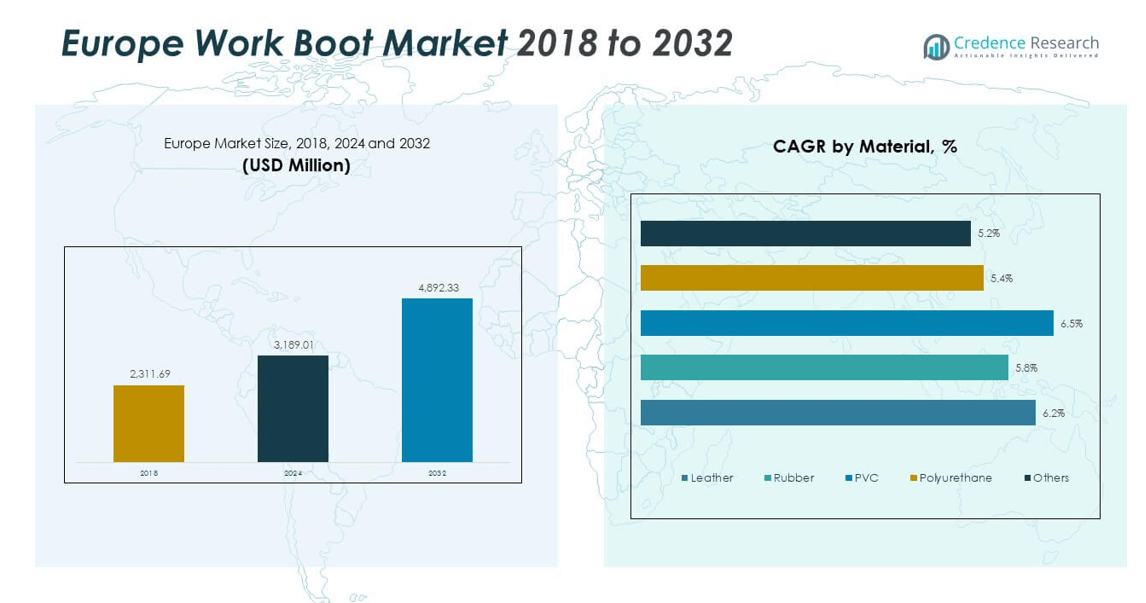
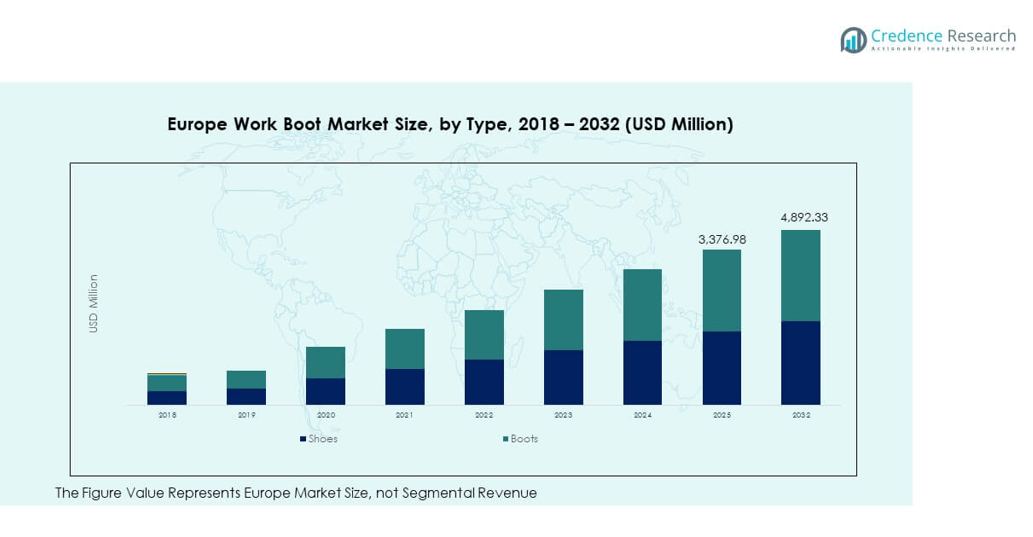
The Europe Work Boot Market size was valued at USD 2,311.69 million in 2018 to USD 3,189.01 million in 2024 and is anticipated to reach USD 4,892.33 million by 2032, at a CAGR of 5.44% during the forecast period.
| REPORT ATTRIBUTE |
DETAILS |
| Historical Period |
2020-2023 |
| Base Year |
2024 |
| Forecast Period |
2025-2032 |
| Europe Work Boot Market Size 2024 |
USD 3,189.01 million |
| Europe Work Boot Market, CAGR |
5.44% |
| Europe Work Boot Market Size 2032 |
USD 4,892.33 million |
The market growth is driven by rising demand for protective footwear across industrial, construction, and manufacturing sectors. Increasing workplace safety regulations and awareness of occupational hazards are major factors encouraging adoption. Technological innovations, such as lightweight composite materials, ergonomic designs, and improved durability, enhance user comfort and productivity. Growing emphasis on sustainability and eco-friendly production processes also supports market expansion among key European manufacturers.
Regionally, Western Europe dominates the Europe Work Boot Market due to strong industrial infrastructure and strict safety compliance standards in countries like Germany, France, and the UK. Eastern Europe shows growing demand, driven by expanding construction activities and industrial modernization. Southern European nations are emerging markets, supported by tourism, logistics, and light manufacturing industries, which are steadily adopting protective footwear for improved workplace safety and performance.
Market Insights:
- The Europe Work Boot Market was valued at USD 2,311.69 million in 2018, reached USD 3,189.01 million in 2024, and is projected to reach USD 4,892.33 million by 2032, expanding at a CAGR of 5.44% during the forecast period.
- Western Europe (46%), Northern & Central Europe (31%), and Southern & Eastern Europe (23%) together dominate the regional landscape. Western Europe leads due to established industries, stringent EU safety regulations, and widespread adoption of premium-quality protective footwear.
- Southern and Eastern Europe (23%) is the fastest-growing region, supported by rising construction activities, infrastructure investments, and stronger workplace safety mandates across developing economies.
- By type, boots hold a 63% share in the Europe Work Boot Market, driven by higher durability, impact protection, and suitability for heavy-duty operations in industrial environments.
- Shoes account for 37% of the market, appealing to sectors such as light manufacturing, logistics, and maintenance services that prioritize comfort, flexibility, and lighter protection levels.
Access crucial information at unmatched prices!
Request your sample report today & start making informed decisions powered by Credence Research Inc.!
Download Sample
Market Drivers:
Rising Industrial Safety Regulations Strengthening the Adoption of Protective Footwear
Growing emphasis on workplace safety across construction, mining, and manufacturing sectors drives strong demand for durable protective footwear. The Europe Work Boot Market benefits from strict compliance laws like EU PPE Regulation (EU) 2016/425, enforcing the use of certified safety gear. Industries are prioritizing boots with advanced slip resistance, insulation, and impact protection. Rising construction and industrial projects in Germany, the UK, and France expand product demand. Companies focus on improving worker comfort through lightweight and ergonomic materials. It supports long-hour operations in demanding environments. Increasing penalties for safety violations encourage employers to invest in certified work boots. The growing shift toward sustainability in production enhances market credibility and growth potential.
- For instance, the UVEX 2 Construction boot was certified to S3 protection class under EN ISO 20345:2022, providing penetration resistance via its steel midsole and SRC slip resistance. The boot uses water-repellent leather and a foamed polyurethane scuffcap for durability in heavy-duty environments.
Growing Construction and Infrastructure Projects Boosting Safety Footwear Demand
Expanding infrastructure development across Europe creates new opportunities for work boot manufacturers. Ongoing residential and commercial construction projects raise the demand for heavy-duty footwear that ensures worker protection. The Europe Work Boot Market witnesses strong orders from road, rail, and renewable energy construction sectors. Governments promote worker safety to reduce on-site accidents and maintain project efficiency. The need for waterproof, anti-puncture, and reinforced designs gains prominence. Manufacturers focus on integrating comfort technologies such as shock absorption and breathable linings. It helps increase worker productivity and reduce fatigue during long shifts. The trend also supports customization based on country-specific safety standards and climate conditions.
- For instance, Dunlop Protective Footwear is internationally recognized for supplying protective boots to major rail and infrastructure projects, and its products are used in the general construction sector due to their quality and safety standards.
Technological Advancements Enhancing Product Performance and Worker Comfort
Innovations in material science are improving the durability and comfort of safety footwear. The use of composite toe caps, memory foam insoles, and anti-static soles enhances product performance. The Europe Work Boot Market is increasingly shaped by innovation that combines protection with design flexibility. Smart manufacturing technologies improve production efficiency and product consistency. Companies invest in automation and 3D modeling to reduce production errors. It enables the creation of ergonomic designs suited to multiple job environments. Integration of antimicrobial and odor-control features adds hygiene value. Continuous R&D efforts in materials like thermoplastic polyurethane (TPU) are expanding product lifespan and sustainability.
Rising Awareness of Worker Health and Comfort in Industrial Environments
Employers recognize the link between worker comfort and productivity, driving preference for ergonomic boots. Growing focus on fatigue reduction encourages adoption of lightweight, cushioned designs. The Europe Work Boot Market gains traction among industries prioritizing employee welfare and retention. Demand for boots with moisture control and temperature regulation features continues to rise. Companies integrate breathable membranes to enhance comfort during prolonged use. It reduces injuries caused by foot strain or sweat accumulation. The increasing inclusion of gender-specific designs widens customer reach across sectors. The trend strengthens the market’s alignment with employee wellness programs and corporate safety goals.
Market Trends:
Sustainability and Eco-Friendly Materials Transforming Product Development
Environmental responsibility is becoming a core focus among European footwear manufacturers. Companies are adopting recycled rubber, biodegradable leather, and water-based adhesives to minimize carbon impact. The Europe Work Boot Market is witnessing a clear shift toward sustainable material sourcing. Brands highlight eco-label certifications to meet green procurement policies. Consumers and industries prefer boots with minimal environmental footprint without compromising protection. It encourages suppliers to reengineer production lines for energy efficiency. Growing awareness of circular economy practices supports sustainable disposal and recycling initiatives. The trend also fosters brand differentiation in a highly competitive market.
- For instance, Elten GmbH launched new models with linings made of 75% recycled materials and laces made of 100% recycled content, demonstrating measurable reductions in material consumption and waste in accordance with European foot protection standards.
Digital Retail Expansion and E-Commerce Integration Strengthening Sales Channels
Online retail growth is reshaping distribution dynamics for industrial footwear. E-commerce platforms enable direct access to a wider customer base, including small contractors and independent workers. The Europe Work Boot Market experiences rapid digital adoption supported by brand-owned websites and third-party portals. Enhanced product visualization tools and AI-driven size recommendation systems improve purchase confidence. It helps manufacturers reduce returns and enhance customer satisfaction. Digital marketing campaigns target niche industrial segments and urban consumers seeking style with function. Partnerships with logistics firms ensure faster product delivery across Europe. The trend enhances competitiveness and accessibility in both B2B and B2C markets.
- For instance, leading safety footwear brands such as UVEX and Elten provide robust e-commerce solutions, allowing their products to reach customers across Europe with rapid logistics and online sales platforms backed by company data on their official websites.
Growing Demand for Custom-Fit and Ergonomic Footwear Designs
End users increasingly prefer customized solutions to match their work environment and comfort needs. The demand for tailor-fit designs reflects the broader shift toward personalization in industrial gear. The Europe Work Boot Market is adopting modular design features for flexibility in fit and support. Manufacturers are leveraging 3D scanning and digital fitting technologies to enhance accuracy. It allows the creation of boots that adapt to diverse foot shapes and working conditions. Premium brands focus on ergonomic soles that improve posture and reduce strain. This focus supports worker retention and reduces workplace fatigue. Rising awareness of health-oriented footwear reinforces this trend across Europe.
Integration of Smart Technologies in Industrial Footwear
Smart technology integration is transforming traditional work boots into connected safety tools. Embedded sensors track temperature, pressure, and step count to prevent fatigue-related injuries. The Europe Work Boot Market is adopting wearable innovations to align with Industry 4.0 environments. IoT-enabled boots can alert supervisors about hazardous movements or unsafe conditions. Manufacturers explore Bluetooth connectivity for real-time data transmission and predictive maintenance. It promotes smarter workplace safety management across sectors like logistics and construction. The integration of tech improves safety accountability while enhancing comfort. Growing R&D funding for smart PPE solutions supports this evolving trend in Europe.
Market Challenges Analysis:
High Product Cost and Competition from Low-Cost Imports Affecting Profit Margins
Premium safety footwear often carries higher production costs due to quality materials and certifications. Many local producers face pricing pressure from cheaper imports originating from Asia. The Europe Work Boot Market struggles to balance product quality with affordability in competitive segments. Manufacturers must manage fluctuating raw material prices and labor costs. It limits profitability for small and mid-sized brands competing against large global players. Some end users still prefer low-cost, non-certified alternatives despite safety risks. The challenge lies in convincing buyers about the long-term value of durable and compliant boots. Branding, warranty, and certification awareness are key to countering this issue.
Complex Supply Chains and Sustainability Compliance Burdening Production Efficiency
European manufacturers face growing challenges in maintaining sustainable and transparent supply chains. The enforcement of new environmental laws and traceability standards increases operational costs. The Europe Work Boot Market experiences delays due to sourcing constraints in leather and rubber supplies. It impacts production schedules and delivery timelines. Rising logistics costs across Europe further strain manufacturing profitability. Companies must balance environmental responsibility with cost competitiveness. Adopting circular production models requires capital investment and technical expertise. Ensuring supplier compliance with sustainability goals remains a key industry challenge.
Market Opportunities:
Expanding Demand from Women Workforce and Service Sector Employees
Rising female participation in construction, logistics, and manufacturing industries creates new opportunities for manufacturers. The Europe Work Boot Market benefits from the demand for gender-specific, stylish, and comfortable footwear. Brands design boots with better fitting, lighter weight, and aesthetic appeal to target this segment. It encourages diversification of product portfolios to attract a wider audience. Service sectors such as hospitality and healthcare also require non-slip safety footwear. The expansion of these industries fuels steady product adoption. Marketing strategies focused on inclusivity and ergonomics strengthen future growth prospects.
Adoption of Advanced Materials and Smart Manufacturing Practices
The growing shift toward advanced materials and automated production improves product efficiency and cost control. The Europe Work Boot Market leverages 3D printing, robotics, and AI for faster customization. These technologies help reduce waste and improve consistency in production. Companies investing in such innovation enhance their global competitiveness. It aligns with European Union’s sustainability and digitalization goals. The focus on comfort, lightweight design, and intelligent safety solutions creates new product categories. Partnerships with technology providers will accelerate innovation and expand market potential.
Market Segmentation Analysis:
By Type
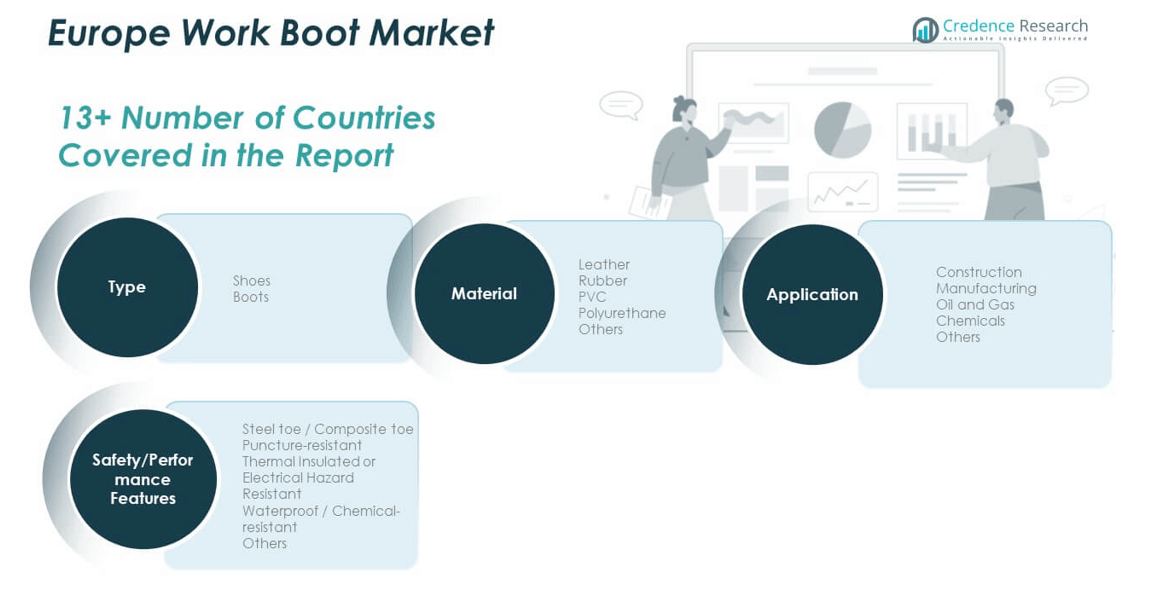
The Europe Work Boot Market is divided into shoes and boots. Boots dominate due to their superior protection, durability, and suitability for heavy industrial use. Shoes hold a steady share in sectors requiring mobility and light-duty performance. Growing demand for safety compliance and comfort features supports both categories. Manufacturers focus on designing flexible, lightweight products for diverse working environments. The introduction of hybrid models combining durability with casual styling expands adoption in non-industrial applications.
- For instance, the UVEX 2 Construction model, designed as a boot, delivers stability, all-round protection, and safe slip resistance with anatomically shaped soles, supporting workers in high-risk industrial environments. Shoes and hybrid designs, such as those listed by Elten, meet a range of standards for comfort and safety across various sectors.
By Application
Key application areas include construction, manufacturing, oil and gas, chemicals, and others. Construction leads due to strict safety mandates and extensive use of heavy equipment. Manufacturing and oil and gas sectors follow, driven by the need for protection from mechanical and chemical hazards. Chemical industries prefer boots with corrosion and slip resistance. Other applications such as logistics and maintenance services contribute through rising urban infrastructure projects and labor mobility.
- For instance, Elten GmbH’s product lines are certified for protection against heat up to 200°C and incorporate polyurethane midsoles, making them suitable for applications in construction, manufacturing, and chemical industries. These boots are CE-labeled and compliant with EN ISO 20345 for worker safety across multiple industrial settings.
By Material
Leather and rubber dominate due to their resilience, comfort, and water resistance. PVC and polyurethane materials are gaining preference for being lightweight, affordable, and easy to maintain. It enables manufacturers to serve varied climates and cost segments. Eco-friendly material development aligns with Europe’s sustainability focus. Continuous material innovation enhances durability, flexibility, and comfort across product lines.
By Safety/Performance Features
Segments include steel toe or composite toe, puncture-resistant, thermal insulated or electrical hazard resistant, waterproof or chemical-resistant, and others. Steel and composite toe designs remain in high demand for superior impact protection. Puncture and waterproof variants cater to harsh industrial conditions. Thermal and electrical hazard-resistant footwear ensure safety across diverse work settings.
Segmentation:
By Type:
By Application:
- Construction
- Manufacturing
- Oil and Gas
- Chemicals
- Others
By Material:
- Leather
- Rubber
- PVC
- Polyurethane
- Others
By Safety/Performance Features:
- Steel Toe / Composite Toe
- Puncture-Resistant
- Thermal Insulated or Electrical Hazard Resistant
- Waterproof / Chemical-Resistant
- Others
By Country:
- UK
- France
- Germany
- Italy
- Spain
- Russia
- Rest of Europe
Regional Analysis:
Western Europe – Established Industrial Powerhouse (46% Market Share)
Western Europe dominates the Europe Work Boot Market, accounting for 46% of total revenue in 2024. The region benefits from strong manufacturing, construction, and automotive sectors across Germany, France, and the United Kingdom. Strict occupational safety regulations and enforcement of EU standards drive steady product demand. The high concentration of industrial and infrastructure projects sustains consistent purchasing patterns. Manufacturers in this region focus on premium materials, ergonomic designs, and eco-friendly production methods. It maintains leadership through advanced R&D capabilities and robust distribution networks. Growing adoption of certified protective footwear across both public and private sectors continues to strengthen market maturity.
Northern and Central Europe – Innovation and Technology Integration (31% Market Share)
Northern and Central Europe collectively hold 31% of the market, supported by countries like Sweden, Finland, Denmark, and Poland. These regions emphasize innovation, safety, and technological integration in industrial operations. The Europe Work Boot Market here benefits from rapid adoption of lightweight, insulated, and weather-resistant designs suited for cold environments. Local manufacturers invest in automation and digital customization technologies. It supports higher efficiency, sustainability, and better customer experience. Industrial modernization programs and worker safety campaigns encourage widespread product adoption. High consumer awareness and preference for sustainable materials continue to shape purchasing behavior.
Southern and Eastern Europe – Emerging Construction and Infrastructure Hubs (23% Market Share)
Southern and Eastern Europe collectively represent 23% of the regional market, with Italy, Spain, Russia, and other developing economies showing strong growth. Expanding construction, logistics, and oil sectors drive increasing demand for durable, affordable work boots. Governments are strengthening occupational safety frameworks to reduce workplace injuries and enhance compliance. It creates new opportunities for international brands to enter emerging industrial zones. Local manufacturers focus on cost-effective production and regional customization. Rising infrastructure investments, especially in urban and transport projects, continue to boost long-term product adoption. Growing workforce safety awareness further enhances regional market potential.
Shape Your Report to Specific Countries or Regions & Enjoy 30% Off!
Key Player Analysis:
- Black Diamond
- Timberland PRO
- KEEN Utility
- Skechers Work
- Red Wing Shoes
- Wolverine
- Carhartt, Inc.
- Ariat
- Sievi
- Anbu Safety
- Carolina Shoe Company
- Honeywell International
Competitive Analysis:
The Europe Work Boot Market is characterized by strong competition among established brands and regional manufacturers. Key players focus on expanding their product portfolios, enhancing safety standards, and integrating advanced comfort technologies. It emphasizes sustainable materials and lightweight construction to meet evolving industrial demands. Global brands such as Timberland PRO, Red Wing Shoes, and Honeywell International dominate premium categories through innovation and certification compliance. Regional companies like Sievi and Anbu Safety compete by offering cost-effective, durable solutions tailored to local industries. Continuous R&D and digital sales platforms strengthen competitive positioning across the region.
Recent Developments:
- In September 2025, Black Diamond unveiled its Fall/Winter 2025–26 collection, introducing mountain performance apparel such as the Recon Stretch Kit and Dawn Patrol Kit, which feature advanced waterproof materials and reinforced durability for harsh European outdoor working environments.
- In May 2025, Timberland PRO partnered with Pabst Blue Ribbon to launch a limited-edition work boot and apparel collection in US, featuring professional-grade waterproof work boots infused with PBR branding, designed for both durability and post-work relaxation; these products became available in late May and were offered through July 2025.
- KEEN Utility introduced the Stronglite work boot in late September 2025, specifically tailored for tough job environments in Europe; this model features waterproof membranes, a carbon toe, slip-resistant sole, and advanced cushioning with KEEN.FUSION bonding for improved longevity.
- Skechers expanded its performance retail concept to Europe in May 2025 by opening its first flagship performance store in Ghent, Belgium. This store showcases football, running, golf, and work boot products equipped with Glide-Technology and Hyper Burst Pro Technology—marking its strategic move to strengthen its footprint in European work footwear.
- Red Wing Shoes made a significant impact in Fall 2024 and Spring 2025 by collaborating with Fendi for the Milan Fashion Week, unveiling exclusive Classic Moc designs on global runways; these high-profile partnerships were accompanied by new men’s products and distinctive women’s styles available in Europe.
Report Coverage:
The research report offers an in-depth analysis based on type, application, material, and safety/performance features. It details leading market players, providing an overview of their business, product offerings, investments, revenue streams, and key applications. Additionally, the report includes insights into the competitive environment, SWOT analysis, current market trends, as well as the primary drivers and constraints. Furthermore, it discusses various factors that have driven market expansion in recent years. The report also explores market dynamics, regulatory scenarios, and technological advancements that are shaping the industry. It assesses the impact of external factors and global economic changes on market growth. Lastly, it provides strategic recommendations for new entrants and established companies to navigate the complexities of the market.
Future Outlook:
- Demand will increase with industrial modernization and stricter workplace safety regulations.
- Lightweight and ergonomic materials will dominate product innovation cycles.
- Digital retail and direct-to-consumer channels will expand brand reach.
- Sustainability initiatives will drive the shift toward recyclable and biodegradable materials.
- Smart boots with integrated sensors will gain traction in advanced industrial sectors.
- Construction and oil industries will remain core revenue contributors across Europe.
- Regional manufacturers will strengthen competitiveness through design flexibility and cost efficiency.
- Premium brands will continue focusing on comfort, durability, and performance differentiation.
- Technological collaborations will enhance production automation and quality consistency.
- Evolving labor laws and occupational safety standards will shape long-term demand growth.



