Market Overview
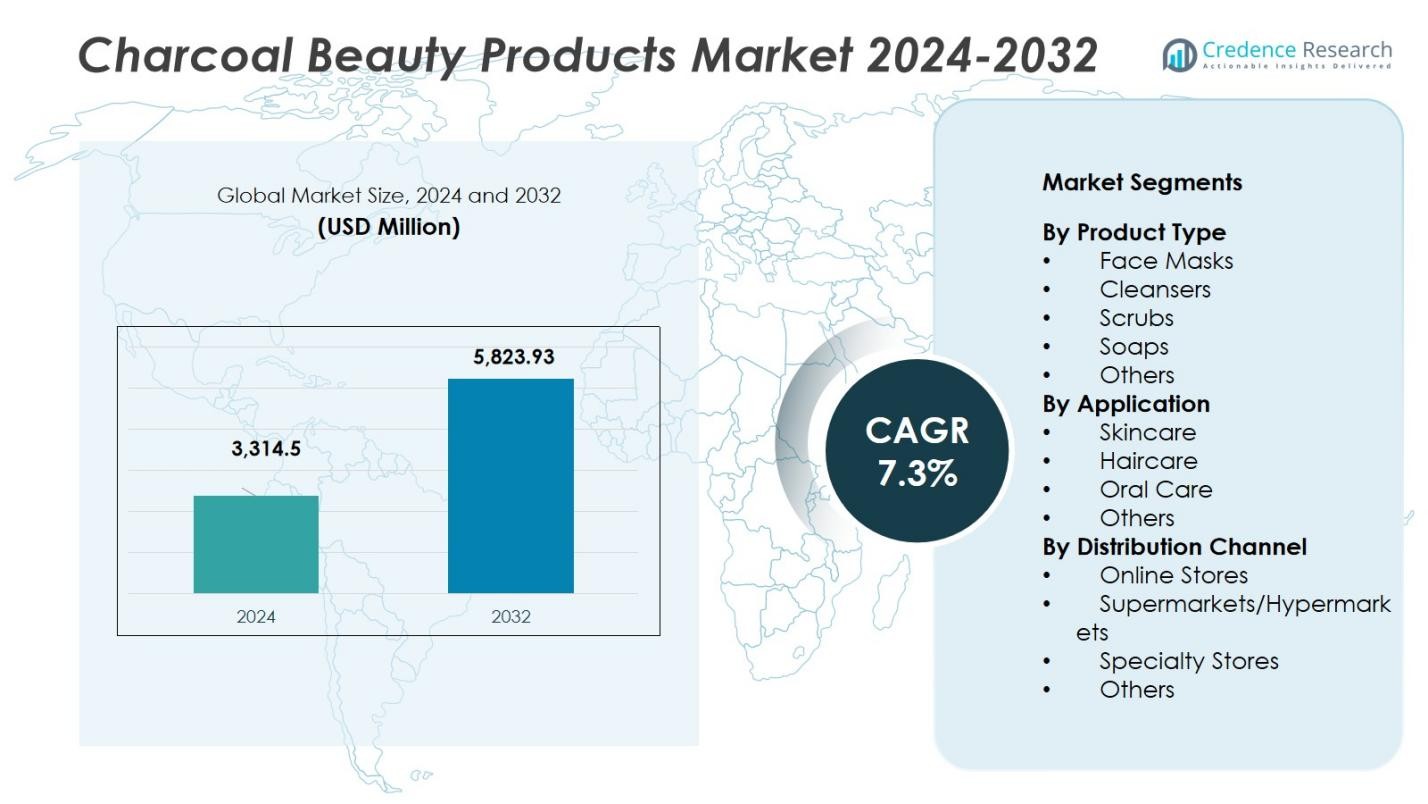
The Charcoal Beauty Products Market size was valued at USD 3,314.5 million in 2024 and is anticipated to reach USD 5,823.93 million by 2032, growing at a CAGR of 7.3% during the forecast period.
| REPORT ATTRIBUTE |
DETAILS |
| Historical Period |
2020-2023 |
| Base Year |
2024 |
| Forecast Period |
2025-2032 |
| Charcoal Beauty Products Market Size 2024 |
USD 3,314.5 Million |
| Charcoal Beauty Products Market, CAGR |
7.3% |
| Charcoal Beauty Products Market Size 2032 |
USD 5,823.93 Million |
The Charcoal Beauty Products Market is dominated by key players such as L’Oréal S.A., Procter & Gamble Co., Unilever PLC, Shiseido Company, Limited, and The Estée Lauder Companies Inc., each contributing significantly to the market’s growth with diverse product offerings across skincare, haircare, and oral care segments. These companies leverage strong distribution networks and invest heavily in product innovation, particularly focusing on charcoal’s detoxifying properties. In terms of regional leadership, North America holds the largest market share at 35%, driven by high consumer awareness and strong retail channels. Asia Pacific follows with a 30% market share, bolstered by rapid urbanization, increasing disposable incomes, and a growing preference for natural beauty products among younger consumers. Europe maintains a 20% share, supported by demand for sustainable and clean-label ingredients. Latin America and the Middle East & Africa regions account for smaller shares, but are seeing gradual adoption driven by local beauty trends.
Access crucial information at unmatched prices!
Request your sample report today & start making informed decisions powered by Credence Research Inc.!
Download Sample
Market Insights
- The Charcoal Beauty Products Market was valued at USD 3,314.5 million in 2024 and is projected to reach USD 5,823.93 million by 2032, growing at a CAGR of 7.3% during the forecast period.
- The market is driven by increasing demand for natural and clean-label ingredients, with activated charcoal being highly valued for its detoxifying and impurity-absorbing properties.
- Key trends include the expansion of charcoal-based products into skincare, haircare, and oral care, along with a shift towards sustainable and eco-friendly formulations.
- Leading companies such as L’Oréal, Procter & Gamble, and Unilever dominate the market, supported by robust distribution networks and continuous product innovation.
- North America holds the largest market share at 35%, followed by Asia Pacific at 30%, with Europe contributing 20%. Latin America and the Middle East & Africa account for smaller shares, but are witnessing growth in product adoption.
Market Segmentation Analysis:
By Product Type
The product-type segmentation of the charcoal beauty products market is led by the face-masks sub-segment, which holds 40% of the global market share. This dominance reflects consumer demand for rapid-action, detoxifying treatments that visibly cleanse and purify the skin in short sessions. The key driver is the perceived “deep-clean” benefit of activated charcoal formulations, which appeal especially to millennials battling pollution and oily skin. Secondary sub-segments such as cleansers hold a 30% share, and scrubs represent 20%, but masks retain the premium pricing and innovation momentum in the product-type category.
- For instance, VLCC’s activated charcoal face wash, formulated to absorb excess oil and reduce enlarged pores, highlighting the product’s focus on deep cleansing and detoxification.
By Application
Within the application segmentation, skincare dominates with 55% of the market share, driven by the surge in charcoal-based products for daily skin purifying, oil control, and blackhead reduction. The key driver is the rising consumer preference for natural and multifunctional skincare solutions that harness activated charcoal’s detoxifying and adsorptive properties, combined with increasing digital content around skincare routines and wellness-driven beauty. Other applications, including haircare and oral care, make up 25% and 15% of the market, respectively.
- For instance,Yardley launched its Gentleman range of face and body washes infused with activated charcoal to address dirt removal and pollution protection for men’s skin.
By Distribution Channel
In terms of distribution channels, the offline channel especially supermarkets/hypermarkets retains the dominant share of the charcoal beauty products market, representing around 50% of total sales, owing to broad consumer reach and volume sales via physical retail. However, the online store channel is rapidly gaining ground and is expected to account for 35% of the market share, driven by digital shopping trends, influencer promotions, and access to niche/indie charcoal-beauty brands. Other distribution channels, including specialty stores, account for the remaining 15%.
Key Growth Driver
Rising Demand for Natural and Clean-Label Ingredients
The increasing consumer inclination toward natural and clean-label beauty solutions drives the charcoal beauty products market. Activated charcoal, positioned as a naturally derived detoxifying agent, appeals to consumers seeking alternatives to synthetic chemicals and more transparent ingredient lists. This trend fuels growth as brands highlight charcoal’s deep-cleansing and impurity-absorbing properties and promote certified natural or organic credentials. Rising environmental consciousness further amplifies adoption, as consumers favour products that align with wellness and sustainability values. These dynamics continuously expand the addressable market and elevate charcoal-infused formulations across skincare, haircare, and oral care formats.
- For instance, The Body Shop offers the Himalayan Charcoal Purifying Clay Wash, which deeply cleanses pores using natural charcoal and clay, emphasizing its detoxifying properties.
Growing Skincare and Oil-Control Concerns
Heightened consumer focus on skincare issues such as excess oil, blackheads, and environmental pollution underpins demand for charcoal beauty products. Activated charcoal’s affinity for absorbing impurities and excess sebum positions it as a relevant ingredient for oil-control and purifying regimes. As urbanisation intensifies and air-quality concerns mount, lifestyle factors propel seeking deeper cleansing and detoxification. This drives proliferation of charcoal-based cleansers, masks, and scrubs. Brands respond by launching targeted solutions for teenagers and young adults, thus broadening appeal and reinforcing growth momentum in high-issue segments where charcoal holds distinct value.
- For instance, Garnier’s charcoal-based cleansers leverage activated charcoal to absorb excess oil effectively, supporting a balanced, shine-free complexion tailored for oily skin.
Expansion of Digital & E-commerce Channels
E-commerce platforms and social-media driven beauty culture significantly boost the charcoal beauty products market. Digital channels enable rapid product launches, influencer endorsements of charcoal-infused treatments, and direct-to-consumer access for niche or premium variants. This channel expansion lowers barriers to entry, accelerates customer reach and supports subscription-model offerings. Enhanced visibility through social video content creates viral adoption of charcoal masks and cleansers, accelerating category growth. As online penetration deepens globally, this strategic channel becomes a growth lever for brands to scale and personalise charcoal-beauty offerings efficiently.
Key Trend & Opportunity
Product Portfolio Diversification and Multi-Functionality
Brands increasingly extend charcoal beyond traditional masks and cleansers into haircare, oral care and body treatments, capitalising on charcoal’s versatility and consumer appetite for multifunctional cosmetics. This trend opens growth opportunities by entering adjacent categories and addressing holistic beauty routines. For instance, charcoal-infused shampoos, toothpaste, and body scrubs emerge, enabling brands to cross-sell and capture broader consumer spend. Diversification supports market expansion into under-penetrated segments and enhances brand loyalty by offering full regime solutions anchored on charcoal’s “detox” narrative.
- For instance, The Man Company offers a charcoal shampoo infused with peppermint and clove oil, which deeply cleanses the scalp, removes excess oil, prevents frizz, and promotes hair growth with regular use.
Sustainability and Ingredient Traceability
Sustainable practices and transparency around charcoal sourcing present a compelling opportunity within the market. Consumers increasingly demand ethical supply chains, eco-friendly packaging and plant-based charcoal sources (such as bamboo or coconut shells). Brands that certify origin, disclose processing purity and adopt recyclable or biodegradable formats differentiate their charcoal-beauty lines. This sustainability positioning not only aligns with consumer values but also builds premium-brand strength and can command higher margins. Navigating this trend successfully can create competitive advantage and boost long-term category growth.
- For instance, L’Oréal has committed to guaranteeing the traceability of all renewable raw materials, including sustainable sourcing practices that preserve biodiversity and empower local producers.
Key Challenge
Price Sensitivity and Limited Accessibility in Emerging Markets
High pricing of premium charcoal beauty products restricts adoption in price-sensitive markets, particularly in developing regions. Many charcoal-infused offerings are positioned as premium or niche, limiting reach among budget-conscious consumers. Additionally, limited distribution networks and lower digital penetration hinder availability in rural or under-served markets. These factors constrain market expansion outside established geographies and may slow uptake despite favourable ingredient interest, thereby representing a notable growth barrier for the category.
Regulatory Ambiguity and Ingredient Efficacy Credibility
The charcoal beauty products market faces regulatory uncertainty and consumer scepticism regarding ingredient efficacy and safety. Variations in charcoal source, processing purity and formulation concentration raise questions about consistent performance. Regulatory frameworks in major markets remain fragmented, making compliance and claims challenging. Some consumers perceive charcoal-based treatments as trendy rather than scientifically substantiated, reducing trust and adoption. This challenge necessitates robust R&D, transparent documentation and clear efficacy claims to sustain credible growth in this category.
Regional Analysis
North America
The North American region commands a market share of 35% in the global charcoal beauty products market. Demand is driven by sophisticated consumer preferences for detox‑ing and natural skincare solutions. Higher disposable incomes and strong e‑commerce penetration underpin growth, as do product innovations launched by major players in the United States and Canada. The market benefits from well‑established retail networks, high awareness of activated charcoal’s deep‑cleansing benefits, and regulatory clarity that supports rapid commercialisation. These factors combine to maintain North America’s leadership and create a benchmark for global best‑practice in formulation, branding and distribution.
Asia Pacific
Asia Pacific accounts for a market share of 30% in the charcoal beauty products market. Rapid urbanisation, rising disposable incomes and expanding beauty routines among young adult consumers drive this regional growth. Markets such as China, India, Japan and South Korea show heightened demand for charcoal‑infused skincare and haircare products, supported by strong influencer marketing and rapid growth of online retail platforms. Localised formulations and mainstreaming of natural and eco‑friendly ingredients further bolster adoption. As a result, Asia Pacific emerges as the fastest‑expanding region and a key focus area for global beauty brands.
Europe
In the European region, the charcoal beauty products market holds a market share of 20%. The region benefits from mature beauty markets, strong demand for sustainable, clean‑label ingredients and regulatory frameworks that favour certified natural products. Consumers in the United Kingdom, Germany, France and other Western European countries increasingly prefer detoxifying skincare and are influenced by ethical sourcing and eco‑packaging trends. These preferences drive innovation in charcoal‑based soaps, masks and specialty treatments, thereby reinforcing Europe’s position as a key innovation hub in the global market.
Latin America
Latin America represents a market share of 10% in the global charcoal beauty products market. Growth is underpinned by expanding middle‑class populations in countries such as Brazil and Mexico, increased awareness of skincare and grooming among younger demographics, and rising internet penetration that enhances access to niche beauty brands. Local retailers and online platforms are playing a growing role in distribution. While price sensitivity remains a constraint, demand for premium ingredients and brand‑driven value propositions is steadily elevating the region’s growth trajectory.
Middle East & Africa (MEA)
The Middle East & Africa region holds a market share of 5% in the charcoal beauty products market. The region’s growth is supported by rising beauty‑conscious consumers, oil‑rich markets with higher spending power in the Gulf Cooperation Council (GCC) countries, and increasing adoption of online retail in urban centres. Challenges include uneven infrastructure and regulatory fragmentation across African markets, but the growing focus on personal grooming and increasing tourism‑driven retail opportunities position MEA as a developing frontier region for charcoal‑infused beauty offerings.
Market Segmentations:
By Product Type
- Face Masks
- Cleansers
- Scrubs
- Soaps
- Others
By Application
- Skincare
- Haircare
- Oral Care
- Others
By Distribution Channel
- Online Stores
- Supermarkets/Hypermarkets
- Specialty Stores
- Others
By Region
- North America
- Europe
- Germany
- France
- U.K.
- Italy
- Spain
- Rest of Europe
- Asia Pacific
- China
- Japan
- India
- South Korea
- South-east Asia
- Rest of Asia Pacific
- Latin America
- Brazil
- Argentina
- Rest of Latin America
- Middle East & Africa
- GCC Countries
- South Africa
- Rest of the Middle East and Africa
Competitive Landscape
The competitive landscape in the Charcoal Beauty Products Market is marked by the presence of several prominent players, including L’Oréal S.A., Procter & Gamble Co., Unilever PLC, Shiseido Company, Limited, and The Estée Lauder Companies Inc. These companies dominate the market with diverse product offerings spanning skincare, haircare, and oral care segments. They focus heavily on product innovation, including the incorporation of activated charcoal in various beauty solutions such as face masks, cleansers, and scrubs. With increasing consumer preference for natural and clean-label ingredients, these key players have capitalized on the growing demand for charcoal-based products by emphasizing sustainable sourcing and ethical production practices. Moreover, their strong distribution networks, both offline and online, ensure broad market reach and accessibility. As competition intensifies, companies are investing in research and development to enhance product efficacy and diversify their portfolios, while leveraging influencer marketing and social media strategies to attract younger, beauty-conscious consumers.
Shape Your Report to Specific Countries or Regions & Enjoy 30% Off!
Key Player Analysis
- L’Oréal S.A.
- Procter & Gamble Co.
- Unilever PLC
- Shiseido Company, Limited
- The Estée Lauder Companies Inc.
- Johnson & Johnson Services, Inc.
- Kao Corporation
- Beiersdorf AG
- Amorepacific Corporation
- LVMH Moët Hennessy Louis Vuitton
Recent Developments
- In November 2024, Himalaya Wellness Company launched its “Pollution Detox Charcoal” campaign and product range (face wash, scrub & face pack) to address urban skin pollution.
- In May 2024, Eminence Organic Skin Care introduced its “Charcoal & Black Seed Collection” (clay masque, face oil & gel) focused on detoxifying and balancing skin with charcoal and black seed extract.
- In April 2025, El Jannah (an Australian brand) unveiled the “Flame & Glow Charcoal Care Pack”, a limited‑edition skincare line with face mask and charcoal‑infused items inspired by their charcoal‑grill heritage.
Report Coverage
The research report offers an in-depth analysis based on Product Type, Application, Distribution Channel and Region. It details leading market players, providing an overview of their business, product offerings, investments, revenue streams, and key applications. Additionally, the report includes insights into the competitive environment, SWOT analysis, current market trends, as well as the primary drivers and constraints. Furthermore, it discusses various factors that have driven market expansion in recent years. The report also explores market dynamics, regulatory scenarios, and technological advancements that are shaping the industry. It assesses the impact of external factors and global economic changes on market growth. Lastly, it provides strategic recommendations for new entrants and established companies to navigate the complexities of the market.
Future Outlook
- The Charcoal Beauty Products Market is expected to witness sustained growth, driven by increasing consumer awareness of the benefits of natural skincare ingredients.
- Rising demand for eco-friendly, clean-label, and sustainable beauty products will continue to shape market dynamics.
- The expansion of charcoal-based offerings across skincare, haircare, and oral care categories will open new growth avenues.
- Younger consumers, particularly millennials and Gen Z, will remain key drivers due to their preference for multifunctional and innovative beauty solutions.
- E-commerce platforms will see continued growth as the primary distribution channel for charcoal beauty products, aided by social media and influencer marketing.
- Research and development in charcoal product formulations will focus on enhancing effectiveness and targeting specific skin concerns.
- Brands will increasingly leverage sustainability practices, such as using bamboo or coconut-sourced charcoal, to appeal to environmentally conscious consumers.
- Competition will intensify as both established beauty brands and new entrants launch innovative charcoal-based products to capture market share.
- Emerging markets, particularly in Asia Pacific and Latin America, will experience significant adoption of charcoal beauty products due to rising disposable incomes and beauty consciousness.
- Regulatory clarity and growing consumer education will further enhance the credibility and adoption of charcoal-based beauty products globally.



