Market Overview
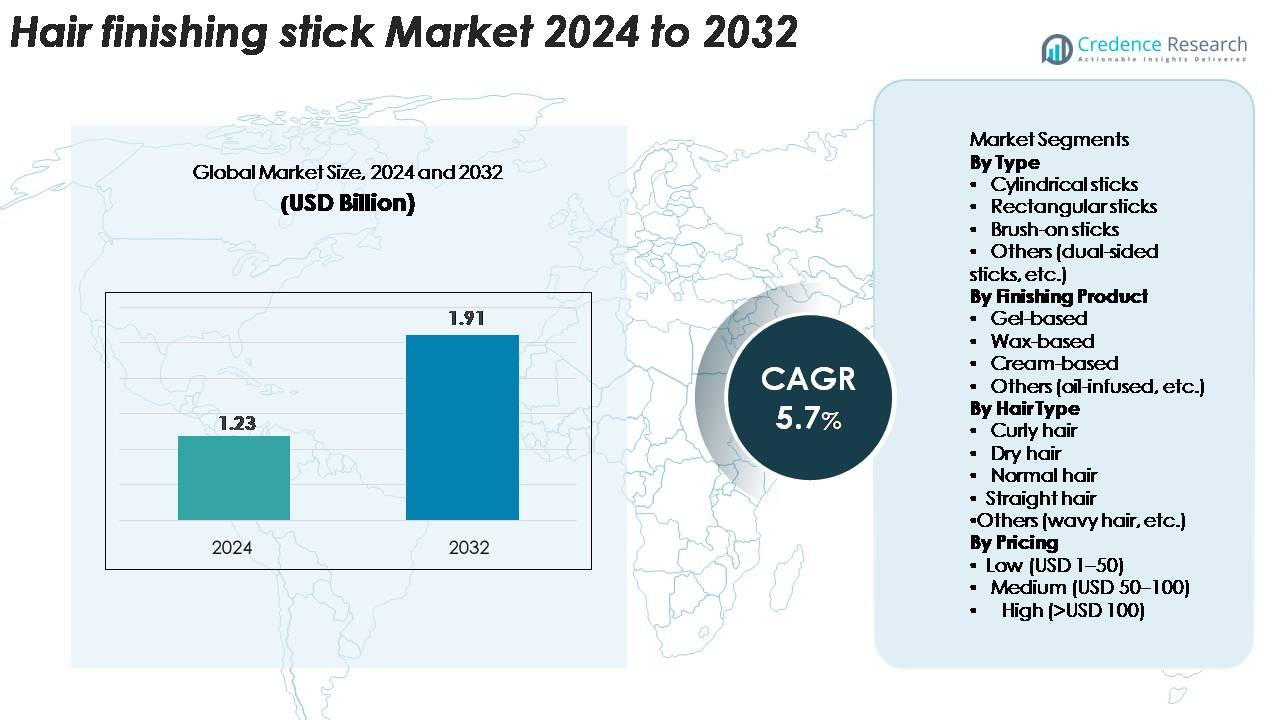
The hair finishing stick market was valued at USD 1.23 billion in 2024 and is projected to reach USD 1.91 billion by 2032, reflecting a CAGR of 5.7% over the forecast period.
| REPORT ATTRIBUTE |
DETAILS |
| Historical Period |
2020-2023 |
| Base Year |
2024 |
| Forecast Period |
2025-2032 |
| Hair Finishing Stick Market Size 2024 |
USD 1.23 Billion |
| Hair Finishing Stick Market, CAGR |
5.7% |
| Hair Finishing Stick Market Size 2032 |
USD 1.91 Billion |
The hair finishing stick market is shaped by a mix of emerging natural-beauty brands and performance-focused players, with companies such as Nourish Mantra, Adomour, ORGATRE, Aravi Organic, Little Extra, JBabe USA, Ktein Biotech, Happy Heads, KAPCO International Limited, and Incolor strengthening competitiveness through clean formulations, targeted digital marketing, and diversified product ranges. North America leads the global market with approximately 32% share, driven by high spending on premium grooming and strong e-commerce influence, while Asia-Pacific follows closely with around 29% share, supported by large consumer bases, social-commerce adoption, and rising demand for quick styling solutions across varied hair types.
Access crucial information at unmatched prices!
Request your sample report today & start making informed decisions powered by Credence Research Inc.!
Download Sample
Market Insights
- The hair finishing stick market was valued at USD 1.23 billion in 2024 and is projected to reach USD 1.91 billion by 2032, registering a 5.7% CAGR during the forecast period.
- Market growth is fueled by rising demand for on-the-go grooming, clean formulations, and multifunctional styling solutions, with brush-on sticks holding the largest segment share due to ease of application and strong consumer adoption.
- Key trends include the shift toward natural, silicone-free ingredients, customized variants for different hair types, and expanding influence of social commerce platforms that accelerate product visibility and user engagement.
- Competitive intensity remains high as brands like Nourish Mantra, Adomour, JBabe USA, ORGATRE, Aravi Organic, Ktein Biotech, and others introduce performance-enhanced or plant-based variants, while price competition and product duplication act as notable restraints.
- Regionally, North America leads with 32% share, followed by Asia-Pacific at 29%, Europe at 27%, while Latin America and the Middle East & Africa collectively account for the remaining market presence.
Market Segmentation Analysis:
By Type
The market by type is led by brush-on sticks, which account for the largest share due to their ease of application and ability to offer precise, quick touch-ups for flyaways and baby hair. Consumers prefer this format for its portability and user-friendly design, especially in daily grooming routines. Cylindrical and rectangular sticks continue to gain traction among users seeking broader coverage, while dual-sided and other hybrid designs expand niche demand. Product innovation focused on ergonomic designs and multifunctional use further strengthens the dominance of brush-on sticks.
- For instance, Orgatre’s Hair Finishing Stick reports “a long-lasting sleek look for 12 hours” using aloe vera for improved hair elasticity in a compact “stick” format.
By Finishing Product
Wax-based hair finishing sticks dominate the market, supported by their strong hold, humidity resistance, and suitability for a wide range of hairstyles. Their ability to provide long-lasting sleek finishes makes them popular among both casual and professional users. Gel-based variants attract consumers seeking lighter texture and shine, whereas cream-based products appeal to individuals with dry or coarse hair needing additional nourishment. Oil-infused formulations are emerging as a premium segment, driven by rising demand for clean-beauty products that combine styling with conditioning benefits.
- For instance, the product Arata Hair Fix Stick Anti‑Frizz Gel Applicator is supplied in a 15 ml tube and is formulated with jojoba oil plus hyaluronic acid; the manufacturer states that a single-application swipe flattens flyaways in fewer than 2 minutes, and the applicator retains full dispensing function after 50 uses.
By Hair Type
The market by hair type is primarily driven by straight hair users, who represent the largest share due to the high adoption of finishing sticks for smoothing flyaways common in straight and fine hair textures. Curly and wavy hair users also contribute significantly, favoring products with stronger hold and moisturization to manage frizz. Demand from consumers with dry hair is rising as brands introduce nourishing, conditioning-focused formulas. The segment’s growth is supported by increasing personalization trends, with manufacturers launching hair-type-specific variants to improve performance and user satisfaction.
Key Growth Drivers
Rising Adoption of On-the-Go Grooming and Styling Solutions
The demand for quick, portable grooming solutions strongly drives the hair finishing stick market, particularly among working professionals, commuters, and digitally active consumers seeking instant styling. Busy lifestyles have intensified the need for compact, travel-friendly products that deliver immediate results without the complexity of traditional styling products. Hair finishing sticks meet this requirement by offering fast application, minimal residue, and compatibility with various hair types. Influencers and beauty content creators further accelerate market traction by showcasing before-and-after transformations, positioning these sticks as daily essentials. The growing emphasis on polished appearance in social and professional settings also supports adoption, especially as consumers increasingly value convenience over lengthy styling routines. Collectively, these factors reinforce the strong momentum of on-the-go grooming products and broaden usage occasions across work, events, and travel.
- For instance, Bare Anatomy Expert Sleek Hair Finishing Stick is offered in a 10 ml net content size and its claims include “sleek, non-greasy, non-crunchy look in 7 seconds” for styling and fly-away control.
Expanding Consumer Shift Toward Clean, Natural, and Safe Formulations
Consumers are increasingly prioritizing clean-label beauty products, fueling demand for finishing sticks formulated with natural waxes, nourishing oils, and dermatologically tested ingredients. Sensitivity to harsh chemicals, rising awareness of scalp health, and a broader preference for minimalistic beauty regimens drive this shift. Brands respond by introducing silicone-free, paraben-free, and vegan variants that appeal to health-conscious buyers. The growing influence of the “skinification of haircare” trend—where hair products include skincare-grade ingredients like jojoba oil, argan oil, and plant extracts—further elevates demand for premium formulations. As regulatory bodies strengthen guidelines on ingredient transparency, clean-beauty claims increasingly become key differentiators, boosting consumer trust and brand loyalty. This transition toward safer and more sustainable formulations significantly accelerates market growth.
- For instance, the Ktein 100% Natural Plant‑Based Hair Styling Stick is made with a 12 ml net content and utilises 100 % plant-based ingredients including almond oil, olive oil, Japonica seed oil, sunflower seed oil and vitamin E.
Strong Penetration Through E-Commerce and Social Commerce Channels
E-commerce growth significantly amplifies the reach of hair finishing sticks, enabling wide availability across global markets and niche consumer groups. Online channels allow brands to showcase product benefits through videos, user reviews, and influencer partnerships that effectively drive conversions. Social commerce platforms—particularly Instagram, TikTok, and YouTube—play an essential role in accelerating product visibility through viral content and short-form demonstrations. Subscription boxes, digital-exclusive bundles, and targeted advertisements further support category expansion. Small and mid-sized brands leverage these platforms to compete with established players by offering differentiated products and engaging directly with consumers. As beauty shoppers increasingly rely on online discovery and convenience-based purchasing, e-commerce continues to act as a powerful growth catalyst.
Key Trends & Opportunities
Increasing Customization and Hair-Type-Specific Formulations
Customization emerges as a major opportunity as consumers seek products tailored to their unique hair textures, concerns, and styling routines. Brands increasingly introduce specialized variants for straight, curly, coily, or dry hair, each offering the appropriate balance of hold, nourishment, and shine. This trend aligns with the growing diversity in beauty standards and inclusivity initiatives across global markets. Personalized solutions—such as lightweight formulas for fine hair or extra-hold waxes for textured hair—enable companies to expand their portfolios while improving customer satisfaction. As AI-powered hair diagnostics and virtual product advisors gain traction, brands can further refine segmentation and deliver more precise recommendations, ultimately strengthening customer engagement and retention.
· For instance, the WOONGMI Hair Finishing Stick (Anti-Curly Hair, 8 g net quantity)
is explicitly positioned for managing flyaways or ‘broken hair’, providing a medium-hold liquid or cream-gel in a compact stick with a mascara-style brush applicator for a sleek look.
Innovation in Multifunctional and Hybrid Styler-Conditioning Products
A key trend shaping the market is the development of multifunctional finishing sticks that combine styling, nourishment, and protection in a single application. Consumers increasingly prefer products that offer multiple benefits—such as anti-frizz control, hydration, UV protection, and heat resistance—without requiring layered product routines. This opportunity allows brands to incorporate hybrid formulas enriched with botanical oils, keratin, ceramides, and anti-static agents to enhance both performance and hair health. Additionally, the shift toward minimalism in beauty encourages “one product, many uses” solutions. These innovations not only strengthen product appeal but also create pathways for premiumization, especially in professional and salon-focused segments.
- For instance, Bare Anatomy’s Expert Sleek Hair Finishing Stick integrates argan oil and biotin within a 10 ml formula and delivers visible smoothing in 7 seconds, according to the brand’s published product testing. This demonstrates a hybrid approach that merges styling with active nourishment.
Key Challenges
Ingredient Stability and Performance Limitations Across Climates
One of the major challenges in the hair finishing stick market is ensuring consistent product performance across varying weather conditions, hair textures, and humidity levels. Wax-based and gel-based formulations may become too soft in warm climates or too rigid in colder environments, compromising ease of application and overall user experience. Achieving long-lasting hold without heaviness, flaking, or residue also poses formulation complexities. Moreover, consumers increasingly expect clean, non-irritating ingredients, which can further limit the use of synthetic stabilizers that traditionally enhance durability. Addressing these formulation constraints requires advanced R&D capabilities, stable raw material sourcing, and climate-adaptive product testing.
Growing Competition and Product Duplication in a Low-Entry Market
The market faces significant competitive pressure due to low entry barriers and rapid product replication, particularly across online marketplaces. Numerous small and private-label brands introduce similar products with aggressive pricing, making differentiation challenging for established players. Counterfeit and imitation products also dilute brand value and create safety concerns among consumers. Maintaining visibility in a crowded digital landscape requires continuous investment in marketing, influencer partnerships, and product innovation—adding to overall operational costs. As competition intensifies, brands must strengthen their intellectual property, enhance product uniqueness, and focus on value-added features to retain market share.
Regional Analysis
North America
North America holds the largest market share, accounting for around 32%, driven by strong consumer spending on premium grooming and the widespread influence of social media–led beauty trends. High adoption among working professionals and robust penetration of e-commerce platforms further sustain demand. The U.S. leads the region due to its mature beauty industry, rapid product innovation, and high preference for clean-label formulations. Growing salon usage of finishing sticks and the expansion of influencer-driven brands reinforce market growth. Canada contributes steadily through rising interest in minimalistic, quick-application hair styling products.
Europe
Europe represents approximately 27% of the market, supported by the region’s strong inclination toward clean beauty, dermatologically safe formulations, and sustainable packaging. Countries such as Germany, France, and the UK lead demand due to heightened grooming awareness and a growing emphasis on polished, professional appearance. The region’s stringent cosmetic regulations encourage higher-quality formulations, strengthening consumer trust. Rising adoption among young women, coupled with the expansion of online beauty retail, accelerates category growth. Additionally, the growing popularity of travel-sized grooming essentials supports broader market penetration across both Western and Eastern European markets.
Asia-Pacific
Asia-Pacific holds around 29% of the global market, emerging as the fastest-growing region due to its large population, expanding beauty-conscious middle class, and rising influence of K-beauty and J-beauty styling routines. Countries like China, Japan, and South Korea drive demand with strong digital adoption and high engagement in social commerce. The region’s humid climate encourages greater usage of anti-frizz and long-hold finishing sticks. Increasing penetration of affordable, locally manufactured products also boosts volume consumption. As grooming trends spread rapidly across Southeast Asia and India, APAC continues to strengthen its position as a key growth engine.
Latin America
Latin America accounts for about 7% of the market, driven by growing beauty awareness, rising influence of local haircare trends, and increased participation in social media–focused grooming. Brazil, Mexico, and Colombia lead regional consumption, particularly among young female consumers seeking quick styling solutions for frizz and humidity-related hair challenges. Expanding urbanization and greater availability of international brands in retail and e-commerce channels support demand. Although price sensitivity remains high, the introduction of affordable wax- and gel-based variants is helping brands widen market reach. The region shows steady growth with strong future potential.
Middle East & Africa
The Middle East & Africa region holds approximately 5% of the global share, with growth driven by rising adoption of grooming products among urban consumers and the increasing popularity of sleek, polished hairstyles. High temperatures and humidity in Gulf countries create strong demand for long-lasting, anti-frizz finishing sticks. The UAE and Saudi Arabia lead consumption due to their expanding beauty retail networks and strong presence of international brands. In Africa, markets like South Africa and Nigeria show rising interest in multifunctional products suitable for textured and curly hair. Despite lower penetration levels, MEA presents growing opportunities.
Market Segmentations:
By Type
- Cylindrical sticks
- Rectangular sticks
- Brush-on sticks
- Others (dual-sided sticks, etc.)
By Finishing Product
- Gel-based
- Wax-based
- Cream-based
- Others (oil-infused, etc.)
By Hair Type
- Curly hair
- Dry hair
- Normal hair
- Straight hair
- Others (wavy hair, etc.)
By Pricing
- Low (USD 1–50)
- Medium (USD 50–100)
- High (>USD 100)
By Geography
- North America
- Europe
- Germany
- France
- U.K.
- Italy
- Spain
- Rest of Europe
- Asia Pacific
- China
- Japan
- India
- South Korea
- South-east Asia
- Rest of Asia Pacific
- Latin America
- Brazil
- Argentina
- Rest of Latin America
- Middle East & Africa
- GCC Countries
- South Africa
- Rest of the Middle East and Africa
Competitive Landscape
The competitive landscape of the hair finishing stick market is characterized by a mix of established personal care brands, emerging clean-beauty companies, and digitally native start-ups competing through product innovation, ingredient differentiation, and strong online positioning. Players such as Nourish Mantra, Ktein Biotech, Incolor, Adomour, ORGATRE, Little Extra, and others focus on natural, non-toxic formulations that appeal to health-conscious consumers, while brands like JBabe USA and KAPCO International emphasize performance-driven solutions with stronger hold and long-lasting effects. Companies increasingly leverage social commerce, influencer partnerships, and targeted digital campaigns to strengthen brand visibility and drive engagement. Product diversification across wax-based, gel-based, and oil-infused variants helps brands cater to multiple hair types and styling needs. Additionally, competitive pricing in the mid- and mass-market segments creates pressure for continuous innovation and packaging upgrades. As e-commerce penetration rises and clean grooming trends intensify, competition is expected to further accelerate, prompting brands to invest in R&D and differentiated brand narratives.
Shape Your Report to Specific Countries or Regions & Enjoy 30% Off!
Key Player Analysis
- Nourish Mantra
- Adomour
- ORGATRE
- Aravi Organic
- Little Extra
- JBabe USA
- Ktein Biotech Private Limited
- Happy Heads
- KAPCO INTERNATIONAL LIMITED
- Incolor
Recent Developments
- In 2024, ORGATRE shared a blog post discussing its Hair Finishing Stick infused with Aloe Vera, Vitamin E and Rosemary Oil, marking its promotional push for that SKU.
- In March 2024, Samisha Organic listed its “Hair Finishing Stick” (12 ml) on its official site, with content published in a blog post titled “Control Your Baby Hair with Non-Sticky Hair Finishing Stick.
Report Coverage
The research report offers an in-depth analysis based on Type, Finishing product, Hair type, Pricing and Geography. It details leading market players, providing an overview of their business, product offerings, investments, revenue streams, and key applications. Additionally, the report includes insights into the competitive environment, SWOT analysis, current market trends, as well as the primary drivers and constraints. Furthermore, it discusses various factors that have driven market expansion in recent years. The report also explores market dynamics, regulatory scenarios, and technological advancements that are shaping the industry. It assesses the impact of external factors and global economic changes on market growth. Lastly, it provides strategic recommendations for new entrants and established companies to navigate the complexities of the market.
Future Outlook
- The market will continue expanding as consumers prioritize quick, on-the-go styling and polished everyday grooming.
- Clean, natural, and chemical-free formulations will gain stronger preference across all consumer groups.
- Brands will increasingly offer hair-type-specific variants to address straight, curly, wavy, and dry hair needs more precisely.
- Multifunctional sticks combining styling, nourishment, and protection will become mainstream.
- Social commerce and influencer-driven marketing will play a larger role in product discovery and purchase decisions.
- Premiumization will rise as consumers seek long-lasting hold, non-greasy textures, and dermatologically tested formulas.
- Eco-friendly packaging solutions will gain momentum as sustainability expectations grow.
- Product differentiation will become critical as competition intensifies among global and regional brands.
- Online-first brands will expand rapidly due to strong digital adoption and subscription-based grooming models.
- Emerging markets will show strong uptake as urbanization, grooming awareness, and beauty spending increase.



