Market Overview:
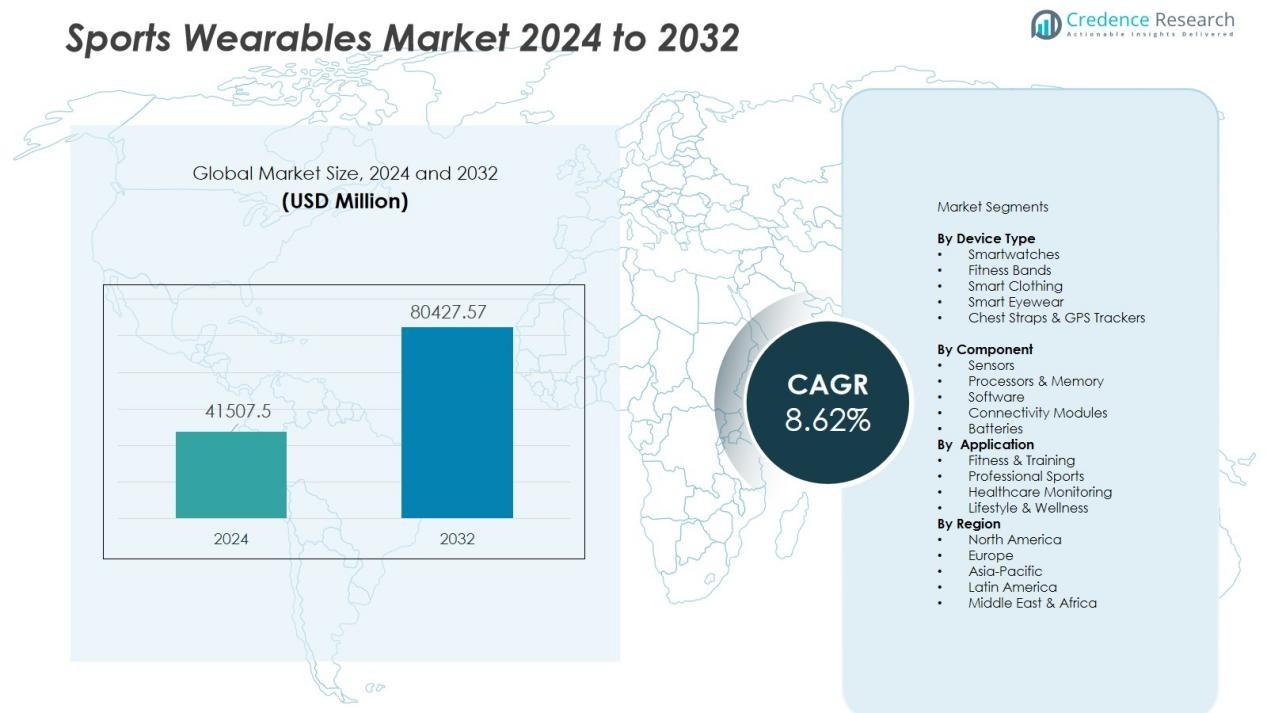
The Sports Wearables Market size was valued at USD 41507.5 million in 2024 and is anticipated to reach USD 80427.57 million by 2032, at a CAGR of 8.62 % during the forecast period.
| REPORT ATTRIBUTE |
DETAILS |
| Historical Period |
2020-2023 |
| Base Year |
2024 |
| Forecast Period |
2025-2032 |
| Sports Wearables Market Size 2024 |
USD 41507.5 Million |
| Sports Wearables Market, CAGR |
8.62% |
| Sports Wearables Market Size 2032 |
USD 80427.57 Million |
Market growth is driven by increasing health awareness, rising sports participation, and strong demand for goal-oriented workout tracking solutions. Smart wearables support preventive healthcare initiatives by enabling early detection of fatigue, stress, and potential injuries, which encourages broader consumer adoption. The growing popularity of professional sports leagues, home fitness ecosystems, and AI-supported coaching further accelerates technology penetration. Advancements in biometric sensing, wireless charging, and durable, lightweight designs enhance user experience and expand usage from amateur enthusiasts to elite athletes.
Regionally, North America leads the Sports Wearables Market due to strong consumer spending on fitness technologies and high adoption of smart devices among professional sports organizations. Europe follows with rising investment in sports science, digital wellness programs, and wearable-based performance optimization. Asia-Pacific is emerging as the fastest-growing region, driven by growing fitness awareness, expanding middle-class income, and increasing popularity of smart gyms and athletic training systems across China, India, Japan, and Southeast Asia.
Access crucial information at unmatched prices!
Request your sample report today & start making informed decisions powered by Credence Research Inc.!
Download Sample
Market Insights:
- The Sports Wearables Market was valued at USD 41,507.5 million in 2024 and is projected to reach USD 80,427.57 million by 2032, growing at a CAGR of 8.62% during the forecast period.
- North America leads the market with a 39.8% share, driven by high consumer spending, professional sports tech integration, and strong digital infrastructure.
- Europe holds 27.3% due to its focus on digital wellness and elite sports training; Asia-Pacific follows with 21.5%, supported by fitness investments and smart device adoption.
- Asia-Pacific is the fastest-growing region, expanding rapidly due to rising disposable incomes, fitness-focused youth, government-backed health initiatives, and widespread smart gym infrastructure.
- Wearable devices accounted for 66.4% of the market share, reflecting strong demand for smartwatches, bands, and GPS trackers used in fitness tracking and performance monitoring.
- Among applications, the performance tracking segment held a 54.7% share, fueled by rising adoption among athletes and fitness enthusiasts seeking real-time insights and personalized workout data.
 Market Drivers:
Growing Consumer Focus on Fitness Tracking and Performance Optimization
Rising demand for accurate workout statistics and personalized fitness insights drives strong uptake of wearable devices. Users rely on smart bands, biometric sensors, and GPS-enabled trackers to monitor calorie expenditure, heart rate variability, VO₂ max levels, and muscle activity. The Sports Wearables Market benefits from the shift toward data-informed training routines. It supports both casual users and advanced athletes who seek performance improvement and safer workout planning. Higher awareness of fitness monitoring fuels consistent market expansion.
- For instance, Garmin’s Vivoactive 5 delivers precise GPS tracking with body battery scoring across 30+ activity modes for recovery insights.
Advancements in Sensor Technology and Real-Time Health Monitoring Capabilities
Innovations in low-power sensors, microelectronics, and wireless communication enhance the precision of sports wearables. Devices now capture oxygen saturation, impact force, stress levels, and hydration indicators with improved reliability. It allows real-time feedback for injury risk assessment and post-workout recovery insights. Powerful analytics platforms translate raw biometric data into actionable recommendations. Users prefer devices that deliver measurable health outcomes supported by accurate diagnostics.
- For instance, Garmin’s Forerunner 955 integrates a dual-frequency GPS chip that achieves 99% accuracy in distance tracking during runs, enabling precise impact force measurements up to 20G
Rapid Adoption of Smart Fitness Applications and Connected Ecosystem Services
Growth accelerates through the integration of wearable devices with fitness apps, cloud dashboards, and AI-assisted coaching platforms. Connected ecosystems provide long-term motivation via customized exercise plans, competitive leaderboards, and progress tracking. It encourages subscription-based engagement models, improving revenue potential for manufacturers and software providers. Enhanced device-app compatibility supports seamless data exchange across smartphones and virtual training solutions. The market gains broader consumer adoption through personalized digital coaching.
Healthcare Integration and Rising Demand for Preventive Well-Being Technologies
Increasing use of wearables for health monitoring supports preventive healthcare initiatives. Devices detect irregular heart rhythms, stress spikes, fatigue indicators, and sleep quality deterioration, promoting proactive lifestyle management. It enables physicians and trainers to evaluate biomarker trends for performance and wellness planning. Growing medical relevance strengthens consumer trust in wearable products. Demand rises among aging populations, professional athletes, and fitness-focused individuals seeking early risk detection and continuous wellness monitoring.
Market Trends:
Integration of AI-Driven Insights, Smart Fabrics, and Biometric Innovation
Artificial intelligence plays a crucial role in the evolution of wearable sports devices, offering advanced coaching insights based on personalized performance profiles. Smart fabrics embedded with nanosensors support continuous biometric monitoring in apparel without bulky hardware. It enhances comfort, durability, and mobility during athletic activities, encouraging broader adoption among professional athletes. Manufacturers increasingly combine ECG sensors, cortisol trackers, gait analyzers, and muscle load detectors to provide deeper insights into fatigue, posture, and injury risk. Subscription-based analytics platforms support performance diagnostics and specialized workout recommendations that extend product value beyond simple tracking. The Sports Wearables Market gains traction from these integrated ecosystems that pair sensor precision with intelligent data modeling. Expanded R&D in miniaturization, flexible circuitry, and sweat-based diagnostics reinforces innovation.
- For instance, Under Armour’s RUSH fabric integrates mineral-infused fibers (specifically, bioceramic infrared technology powered by Celliant) that absorb body heat and reflect it back as infrared energy during activity to help reduce muscle fatigue and promote recovery.
Shift Toward Personalized Wellness, Gamified Fitness, and Multi-Sport Compatibility
Consumers increasingly prefer customized wellness experiences through wearables that adapt to different training programs, lifestyle goals, and medical conditions. Multi-sport compatibility allows one device to track cycling, running, swimming, yoga, and resistance training without performance loss. It strengthens demand among users seeking all-in-one solutions supported by high accuracy across diverse activities. Gamification trends promote competitiveness and consistency through reward systems, virtual challenges, and performance scoreboards that encourage continued usage. Integration with smart gyms, digital therapeutics, and remote coaching platforms expands the role of wearables in holistic fitness ecosystems. Strong interoperability with smartphones, VR fitness platforms, and cloud dashboards enhances user engagement through seamless data access. Sustainability also becomes a trend, pushing brands to adopt recyclable components, longer battery life, and eco-responsible manufacturing in new product lines.
- For instance, Fitbit’s Sense 2 wearable uses advanced cEDA (continuous electrodermal activity) sensors to detect physical signs of stress or autonomic arousal throughout the day.
Market Challenges Analysis:
High Device Costs, Data Accuracy Issues, and Limited Standardization
Premium sports wearable devices require advanced sensors, high-performance processors, and robust materials, which elevate product cost and limit affordability for many consumers. Some devices still struggle with sensor precision during high-motion activities, leading to inconsistent calorie, heart rate, or pace readings. The Sports Wearables Market faces growing demand for accuracy, especially from professional trainers and athletes. It must address algorithm variance and calibration challenges to build stronger user confidence. Lack of unified measurement standards among manufacturers creates discrepancies in performance data and restricts interoperability across platforms. The absence of common benchmarks also discourages seamless integration with medical and coaching systems.
Privacy Risks, Short Battery Life, and Limited Long-Term User Engagement
Personal health data stored on cloud-based platforms raises concerns about privacy breaches and unauthorized usage. Consumers require secure data practices, transparent policies, and strong cyber protection to trust wearable technology. Short battery life remains a recurring limitation that affects product reliability during long-duration training sessions. It pushes brands to invest in power-efficient chips and improved energy management architectures. Many users lose motivation after initial adoption, reducing long-term utilization of wearables. Manufacturers must enhance engagement with adaptive content, gamification, and personalized coaching to sustain continuous usage and maximize device value.
Market Opportunities:
Expansion of Health Monitoring, Sports Medicine Integration, and AI-Based Coaching Services
Growing demand for preventive healthcare opens new opportunities for advanced wearables that track cardiovascular activity, stress levels, sleep quality, and metabolic response. These features support collaboration between wearable brands, sports medicine providers, and digital health platforms. The Sports Wearables Market can expand its role in remote diagnostics, athlete recovery monitoring, and injury risk prediction. It enables sports teams, physiotherapists, and medical institutions to leverage real-time biomarker insights. AI-driven coaching and predictive analytics create recurring revenue through personalized guidance subscriptions. Partnerships with insurance companies may also accelerate adoption by rewarding healthy behavior.
Growth in Smart Apparel, Sustainability Solutions, and Emerging Market Penetration
Smart apparel embedded with flexible sensors offers comfort and unobtrusive monitoring, creating demand beyond traditional wrist devices. It appeals to professional athletes, fitness enthusiasts, and consumers seeking ergonomic wellness products. Wider adoption in Asia-Pacific, Latin America, and the Middle East reflects rising urban fitness culture and expanding middle-class spending. Eco-friendly product designs with recyclable components offer strong opportunities for differentiation in competitive markets. It encourages long-term brand loyalty among environmentally conscious consumers. Integration with smart gyms, connected sports equipment, and personalized fitness ecosystems can establish new revenue channels for wearable innovators.
Market Segmentation Analysis:
By Device Type
Smartwatches and fitness bands dominate this segment due to strong consumer preference for multifunctional health and activity tracking. These devices offer heart rate monitoring, GPS navigation, workout analytics, and mobile notifications in compact formats. The Sports Wearables Market gains significant adoption from professional athletes who rely on advanced chest straps, GPS trackers, and smart apparel for biometric precision. It sees growth in sensor-embedded clothing and sports eyewear, driven by miniaturized electronics and flexible materials. Head-mounted displays for augmented sports training also enter commercial use, expanding niche applications.
- For instance, Garmin’s Forerunner 945 smartwatch delivers VO2 max estimation with 95% accuracy during runs, alongside real-time lactate threshold detection for optimized training
By Component
Sensors hold a major share due to their role in capturing heart rate variability, motion patterns, oxygen levels, and muscle activity. Growth in low-power processors and AI-enabled chips supports seamless tracking and real-time analytics. Software platforms gain traction through subscription-based coaching programs and cloud-stored performance dashboards. It encourages recurring revenue opportunities that extend beyond hardware sales. Batteries and connectivity modules such as Bluetooth and LTE remain critical for performance reliability and device endurance.
- For instance, Ambiq’s modern Apollo Series processors leverage their SPOT® technology to deliver remarkable active power consumption figures, often around 4 to 6 µA/MHz in wearable SoCs.
By Application
The fitness and sports performance category leads due to rising interest in personalized training, endurance improvement, and activity tracking. Professional sports teams and trainers use wearables for injury prediction, athlete monitoring, and tactical assessment. It also supports healthcare applications, including remote diagnostics, sleep monitoring, and chronic disease management. Wearables expand in lifestyle segments through stress tracking, wellness scores, and step monitoring for daily use. Integration with smart gyms and connected fitness platforms enhances demand across both consumer and enterprise users.
Segmentations:
By Device Type
- Smartwatches
- Fitness Bands
- Smart Clothing
- Smart Eyewear
- Chest Straps & GPS Trackers
By Component
- Sensors
- Processors & Memory
- Software
- Connectivity Modules
- Batteries
By Region
- North America
- Europe
- Germany
- France
- U.K.
- Italy
- Spain
- Rest of Europe
- Asia Pacific
- China
- Japan
- India
- South Korea
- South-east Asia
- Rest of Asia Pacific
- Latin America
- Brazil
- Argentina
- Rest of Latin America
- Middle East & Africa
- GCC Countries
- South Africa
- Rest of the Middle East and Africa
Regional Analysis:
Strong Market Penetration in North America Supported by High Consumer Spending and Sports Technology Integration
North America holds a prominent share of the Sports Wearables Market due to strong adoption of fitness technologies and premium devices. Professional sports leagues and university athletic programs increasingly integrate wearable trackers for performance analytics, injury reduction, and player evaluation. It gains support from tech-savvy consumers who invest in smartwatches, fitness bands, and AI-enabled health monitors. High healthcare awareness encourages use of wearables for stress detection, heart monitoring, and chronic condition tracking. Robust digital infrastructure supports cloud-based sports software, remote coaching, and subscription-based fitness applications. Partnerships between wearable brands, insurance providers, and sports institutions further strengthen market expansion.
Rising Focus on Performance Optimization and Digital Wellness Drives Growth in Europe
Europe shows consistent growth driven by strong demand from football clubs, athletics training centers, and fitness chains adopting wearable technology. Regulatory support for digital health tools encourages integration of wearables in wellness programs and physiotherapy routines. It benefits from growing investment in smart apparel and advanced sensors that provide biomarker analysis for athlete recovery. Consumers show strong preference for premium brands offering reliable biometric accuracy and long battery performance. Expansion of connected gyms, wellness tourism, and outdoor sports culture supports continuous demand. Rising collaborations between medical researchers and wearable manufacturers increase clinical validation of sports technologies.
Asia-Pacific Emerges as the Fastest-Growing Market with Expanding Fitness Culture and Smart Device Adoption
Asia-Pacific experiences rapid growth led by rising disposable income, smartphone penetration, and expanding youth participation in fitness activities. Countries such as China, India, Japan, and South Korea invest heavily in digital health ecosystems, smart gyms, and professional sports training facilities. It benefits from strong demand for cost-effective wearables with multifunctional features that appeal to mass consumers. Government support for sports development and preventive healthcare strengthens market acceptance across urban populations. Local manufacturers increase competitive pricing and innovation in smart clothing, GPS trackers, and sensor footwear. Growth in e-commerce and fitness app integration further accelerates wearable sales across emerging markets.
Key Player Analysis:
- Apple, Inc.
- Sony Corporation
- Fitbit Inc.
- Garmin Ltd.
- Catapult Sports Pty Ltd.
- Under Armour, Inc.
- Google LLC
- Samsung Electronics, Inc.
- Xiaomi Corporation
- Huawei Technologies Co., Ltd.
- Adidas AG
- ShotTracker Inc.
Competitive Analysis:
The Sports Wearables Market features strong competition driven by innovation, brand loyalty, and technology integration. Leading players include Apple, Inc., Sony Corporation, Fitbit Inc., Garmin Ltd., Catapult Sports Pty Ltd., and Under Armour, Inc. Global brands focus on advanced sensor accuracy, AI-driven analytics, and enhanced device interoperability to strengthen market presence. It gains momentum from companies expanding into smart apparel, cloud-based coaching platforms, and sports performance software. Product differentiation increasingly depends on biometric precision, user engagement features, and integration with health monitoring solutions.
Companies targeting professional sports invest in GPS trackers, impact sensors, hydration analytics, and wearable performance modules for team-based training. Consumer-focused brands emphasize ergonomic design, extended battery life, and personalized wellness insights to build long-term customer retention. Strategic partnerships with fitness clubs, healthcare providers, and insurance organizations create opportunities for bundled ecosystem solutions. Continuous software updates and subscription-based analytics services support recurring revenue and elevate competitive positioning.
Recent Developments:
- In October 2025, Apple CEO Tim Cook confirmed openness to AI acquisitions and partnerships during the Q4 2025 earnings call to advance Siri and Apple Intelligence,
- In September 2025, saw Garmin Ltd. partner with Noonan, a golf strategy app, to integrate launch monitor data for real-time AI-driven guidance on Garmin Golf devices.
Shape Your Report to Specific Countries or Regions & Enjoy 30% Off!
Report Coverage:
The research report offers an in-depth analysis based on Device Type, Component, Application and Region. It details leading Market players, providing an overview of their business, product offerings, investments, revenue streams, and key applications. Additionally, the report includes insights into the competitive environment, SWOT analysis, current Market trends, as well as the primary drivers and constraints. Furthermore, it discusses various factors that have driven Market expansion in recent years. The report also explores Market dynamics, regulatory scenarios, and technological advancements that are shaping the industry. It assesses the impact of external factors and global economic changes on Market growth. Lastly, it provides strategic recommendations for new entrants and established companies to navigate the complexities of the Market.
Future Outlook:
- Sports wearables will integrate AI-driven coaching features that deliver real-time performance insights for both professional and recreational users.
- Expanded adoption of smart apparel with embedded nanosensors will redefine comfort, flexibility, and biometric accuracy during training.
- Cloud-based analytics platforms will support advanced athlete monitoring, remote diagnostics, and customized recovery strategies.
- Interoperability with digital healthcare systems will promote preventive health tracking and medical-grade wellness applications.
- Longer battery life and energy-efficient chipsets will become a priority to enhance user experience during extended sports activities.
- Gamification features, virtual competitions, and personalized fitness scoring will strengthen user engagement and retention.
- Smart footwear and sensor-based gait analysis solutions will gain traction for injury prevention and athletic optimization.
- Sustainability will influence product innovation through recyclable materials, low-impact manufacturing, and eco-conscious packaging.
- Wearable brands will collaborate with sports teams, insurers, and physiotherapists to create integrated performance ecosystems.
- Growing demand from emerging markets will expand global competition, introducing cost-effective, multifunctional wearable solutions.



