Home » Information and Communications Technology » IT & Telecom » Wireless Connectivity Market

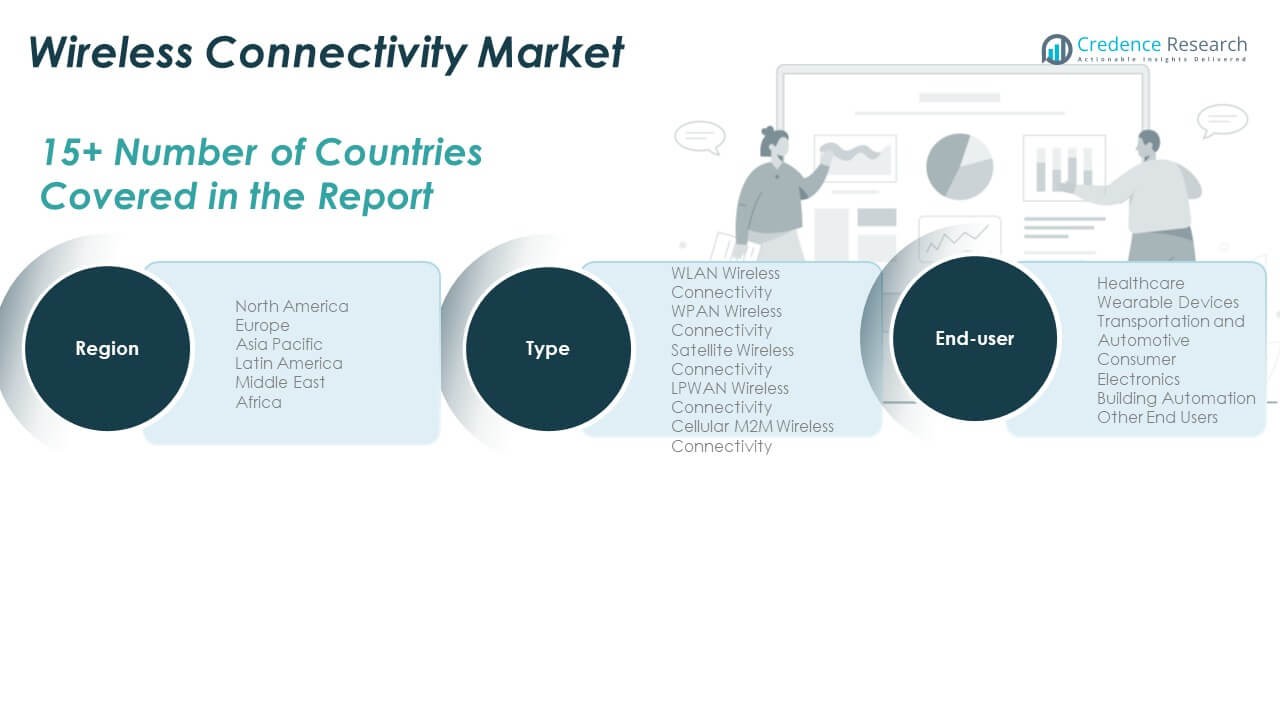
Wireless Connectivity Market By Type (WLAN Wireless Connectivity, WPAN Wireless Connectivity, Satellite Wireless Connectivity, LPWAN Wireless Connectivity, Cellular M2M Wireless Connectivity); By End User (Healthcare, Wearable Devices, Transportation and Automotive, Consumer Electronics, Building Automation, Other End Users) – Growth, Share, Opportunities & Competitive Analysis, 2024 – 2032

Report ID: 4108 | Report Format : Excel, PDF

Market Overview:

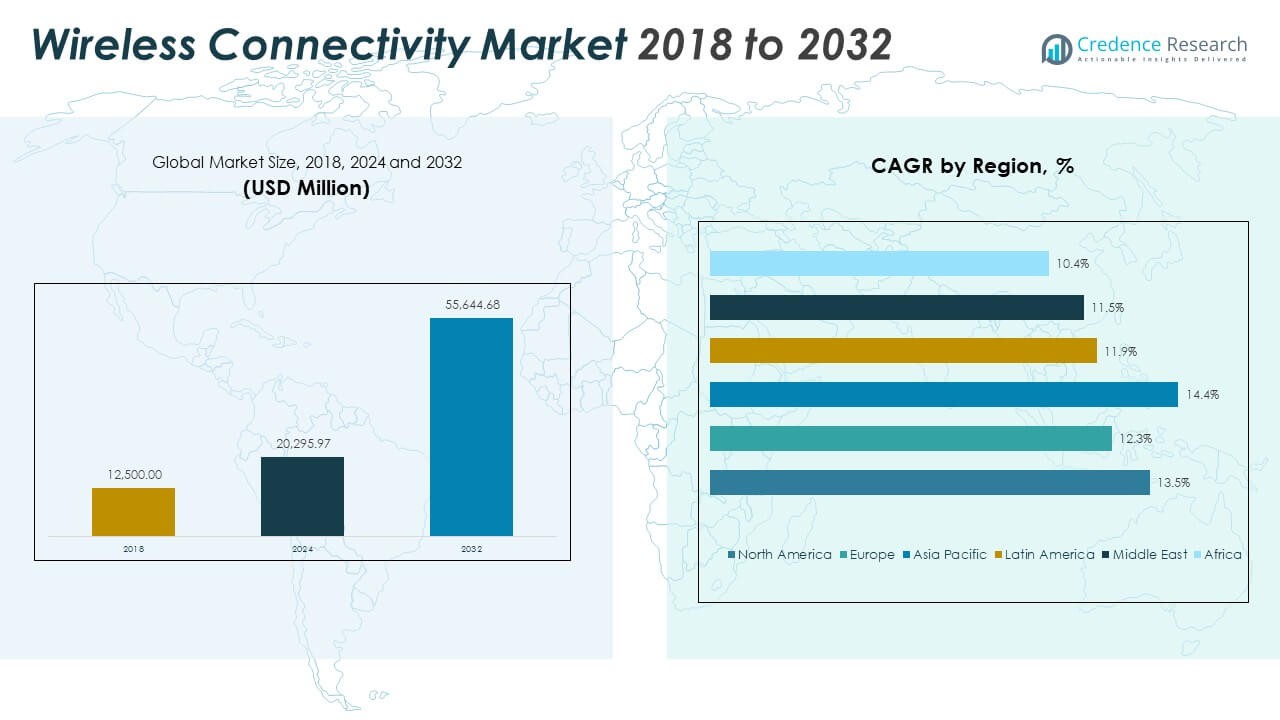
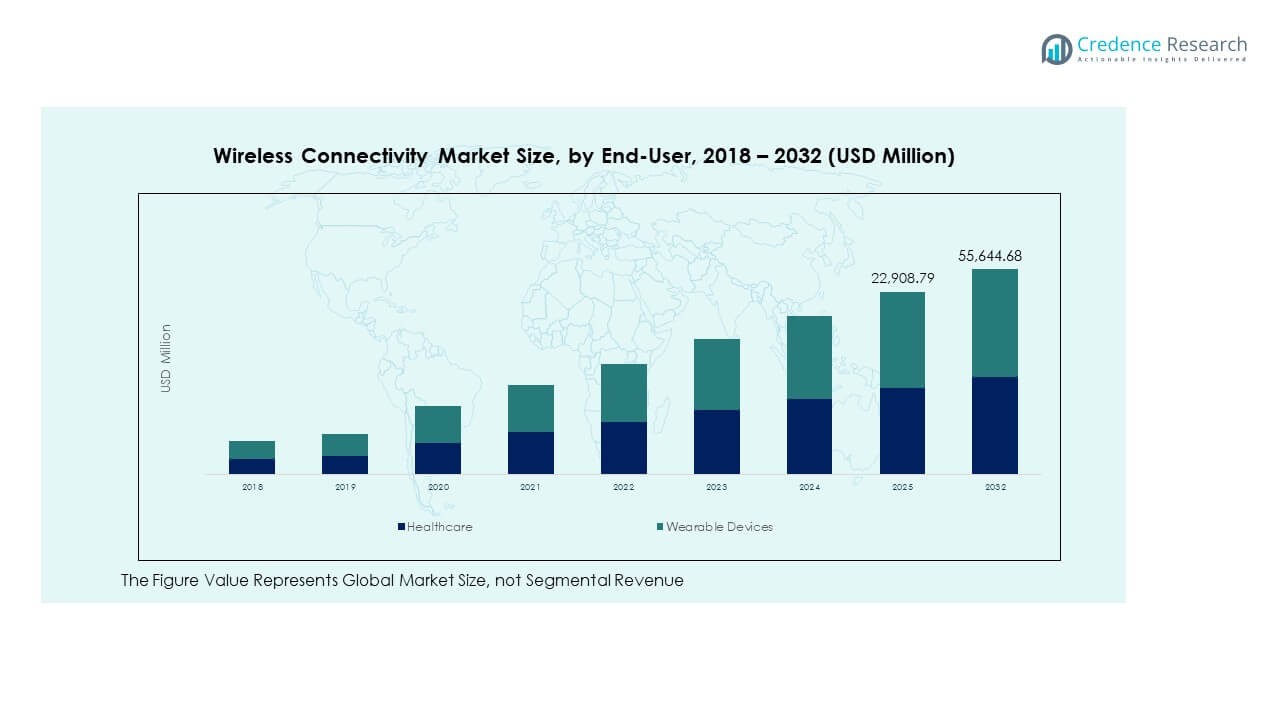
The Global Wireless Connectivity Market size was valued at USD 12,500.00 million in 2018 to USD 20,295.97 million in 2024 and is anticipated to reach USD 55,644.68 million by 2032, at a CAGR of 13.52% during the forecast period.

REPORT ATTRIBUTE DETAILS
Historical Period 2020-2023
Base Year 2024
Forecast Period 2025-2032
 Wireless Connectivity Market Size 2024 USD 20,295.97 Million
 Wireless Connectivity Market, CAGR 13.52%
 Wireless Connectivity Market Size 2032 USD 55,644.68 Million


The market growth is driven by the rising demand for smart devices, IoT solutions, and real-time data communication. Increasing adoption of wireless technologies such as Wi-Fi, Bluetooth, and Zigbee across industries including consumer electronics, healthcare, automotive, and manufacturing is fueling demand. Expanding deployment of 5G networks and growing need for reliable, low-latency connectivity solutions further strengthen market expansion.

North America leads the market due to early 5G adoption and strong IoT infrastructure. Asia-Pacific is an emerging region, driven by rising industrial automation and smart city initiatives in China, Japan, South Korea, and India. Europe shows steady growth, supported by advanced industrial connectivity and government-led digital transformation projects.

Access crucial information at unmatched prices!

Request your sample report today & start making informed decisions powered by Credence Research Inc.!

Download Sample

Market Insights:

  • The Global Wireless Connectivity Market was valued at USD 12,500.00 million in 2018, grew to USD 20,295.97 million in 2024, and is projected to reach USD 55,644.68 million by 2032, expanding at a CAGR of 13.52%.
  • Asia Pacific (37%), North America (32%), and Europe (17%) dominate due to early 5G adoption, industrial automation, and high IoT integration. These regions benefit from strong manufacturing bases and extensive digital infrastructure.
  • Asia Pacific remains the fastest-growing region, supported by rapid smart city deployment, expanding telecom networks, and large-scale consumer electronics production.
  • Among end users, Healthcare accounts for about 40% share, driven by connected medical devices, remote monitoring, and telehealth solutions.
  • Wearable Devices represent nearly 60% share, supported by rising fitness tracking demand, personal health awareness, and integration with smart ecosystems.

Global Wireless Connectivity Market Size

Market Drivers:

Rising Demand for IoT Devices and Smart Connectivity Solutions

The Global Wireless Connectivity Market is expanding due to the growing adoption of Internet of Things (IoT) devices across homes, industries, and cities. Smart homes, wearables, and connected vehicles are driving the need for seamless wireless communication. Rapid urbanization and digital transformation have led to the deployment of connected infrastructure. It benefits from the integration of Wi-Fi, Bluetooth, and Zigbee technologies to enable device interoperability. Industrial automation and real-time monitoring are boosting wireless technology investments. Increasing affordability of connected devices encourages adoption among small enterprises. Expanding government support for IoT development enhances market penetration. The demand for intelligent ecosystems continues to shape wireless technology evolution.

  • For instance, Cisco’s IoT Control Center platform manages connectivity for over 250 million IoT devices across 32,000 enterprises, supporting real-time management and automation on mass scale deployments in 2025.​

Expanding 5G Infrastructure and Low-Latency Network Demand

Deployment of 5G networks is accelerating growth in the Global Wireless Connectivity Market by enabling faster data transfer and reduced latency. Telecom operators are investing in network upgrades to support connected devices and applications. It supports industrial robotics, autonomous vehicles, and healthcare monitoring systems requiring uninterrupted communication. The expansion of 5G spectrum availability enhances efficiency across industrial and commercial environments. Enterprises adopt advanced wireless modules to meet performance standards of ultra-reliable networks. The increasing preference for edge computing strengthens the need for dependable wireless infrastructure. Governments worldwide are emphasizing digital connectivity initiatives. Continuous investments in 5G technology fuel long-term adoption and innovation.

  • For instance, Ericsson and AT&T’s multi-billion-dollar partnership drove a 96% increase in 5G network traffic volume in 2024 and achieved up to 20% annual power efficiency gains at upgraded sites through open radio and cloud technologies, as verified by official statements and industry reports.​

Growing Integration Across Consumer Electronics and Smart Devices

Consumer electronics remain a major contributor to the Global Wireless Connectivity Market due to widespread use of smartphones, tablets, and laptops. Manufacturers integrate wireless chipsets to improve user experience and device synchronization. It allows faster data transfer and supports smart assistants, streaming, and gaming platforms. Growth in wireless audio devices such as earbuds and smart speakers reinforces connectivity innovation. Cloud computing and data-sharing capabilities further increase dependency on wireless solutions. The surge in remote work and online education has elevated network reliability demands. Companies are prioritizing efficient power consumption and improved transmission range. These factors collectively elevate consumer engagement and product demand.

Adoption of Industrial Automation and Machine-to-Machine Communication

Industrial sectors are adopting machine-to-machine (M2M) communication to optimize operations and enhance productivity. The Global Wireless Connectivity Market benefits from the growing focus on predictive maintenance, real-time data exchange, and safety monitoring. Wireless protocols like Wi-Fi 6 and LoRaWAN are transforming smart manufacturing facilities. It facilitates energy-efficient data collection from remote equipment and sensors. Businesses in logistics and utilities rely on wireless solutions for improved tracking and operational control. Rising digitalization in oil and gas, agriculture, and construction further supports deployment. Investments in private industrial networks are expanding across developed and emerging economies. Continuous evolution in industrial IoT frameworks drives consistent growth in this segment.

Market Trends:

Emergence of Wi-Fi 6 and Wi-Fi 7 Standards Enhancing Network Efficiency

The Global Wireless Connectivity Market is witnessing a strong transition toward next-generation Wi-Fi technologies. Wi-Fi 6 and Wi-Fi 7 offer higher throughput, improved reliability, and efficient bandwidth utilization. It supports dense network environments such as airports, stadiums, and enterprises with multiple connected devices. The adoption of these standards is strengthening seamless communication across industries. Device manufacturers are integrating updated chipsets to support advanced connectivity protocols. Enterprises are upgrading infrastructure to ensure compatibility with new Wi-Fi generations. Growth in smart city and retail applications fuels deployment of high-speed networks. The continuous evolution of Wi-Fi standards remains a key trend shaping global wireless infrastructure.

  • For instance, real-world tests using Cisco Catalyst 9800 series controllers demonstrated Wi-Fi 7 providing 47% higher throughput than Wi-Fi 6 with average measured rates reaching 747 Mbps; multi-link operation (MLO) ensured more efficient spectrum use and significantly improved latency at large-scale enterprise test sites.​

Increasing Role of AI and Edge Computing in Wireless Networks

Integration of artificial intelligence and edge computing is transforming the operational landscape of the Global Wireless Connectivity Market. It enables faster data processing near the source, minimizing network congestion and latency. AI-driven analytics enhance real-time decision-making for smart factories, vehicles, and healthcare systems. The shift toward distributed computing is strengthening wireless network intelligence. Companies are developing AI-powered routers and IoT gateways to optimize data transmission. Edge solutions are crucial for applications requiring minimal delay and high security. Industries are increasingly leveraging hybrid connectivity frameworks. This trend promotes efficiency and scalability across network infrastructures.

  • For instance, NVIDIA Jetson Thor, launched in August 2025, delivers up to 2,070 FP4 teraflops of AI compute and 128GB of memory, achieving 7.5x greater AI compute capacity and 3.5x higher energy efficiency versus its predecessor, and attracting global industry leaders such as Amazon Robotics and Medtronic for advanced robotics and healthcare deployments.​

Rising Adoption of LPWAN Technologies for Wide-Area IoT Applications

Low-Power Wide-Area Network (LPWAN) technologies are gaining traction in the Global Wireless Connectivity Market. They support long-range communication while consuming minimal energy, ideal for IoT and industrial sensors. It is widely used in agriculture, smart metering, and asset tracking. LPWAN enables cost-effective connectivity for devices transmitting small data packets over large distances. Enterprises are deploying LPWAN networks to extend connectivity in rural and remote areas. Governments are supporting LPWAN-based initiatives to promote sustainable smart city development. Network operators are enhancing spectrum availability for IoT growth. The steady integration of LPWAN is broadening accessibility and connectivity in multiple sectors.

Growth of Connected Vehicle Ecosystems and V2X Communication

Connected vehicle technology is a major emerging trend within the Global Wireless Connectivity Market. It supports Vehicle-to-Everything (V2X) communication that improves road safety, traffic management, and autonomous driving. Automakers are integrating advanced wireless modules to connect cars with infrastructure and networks. It enables over-the-air updates and predictive diagnostics through high-speed data exchange. Governments are investing in smart transportation systems to enhance urban mobility. Advancements in cellular and satellite communication are driving vehicle connectivity improvements. The trend is fostering collaborations between telecom and automotive industries. Increasing focus on connected mobility continues to transform wireless communication standards.

Market Challenges:

High Infrastructure Costs and Spectrum Limitations Restricting Adoption

The Global Wireless Connectivity Market faces barriers due to high infrastructure development costs and limited spectrum availability. Network operators require large investments to deploy 5G and other wireless systems at scale. It impacts small enterprises and developing regions that lack capital-intensive capabilities. Spectrum congestion in urban areas leads to reduced transmission efficiency and interference issues. Managing multiple frequency bands for different wireless standards adds complexity. Governments are working to reallocate and auction new frequencies, yet regulatory delays hinder expansion. The cost of upgrading legacy systems further restricts rapid modernization. Balancing coverage, cost, and performance remains a major industry challenge.

Cybersecurity Risks and Data Privacy Concerns Impacting User Confidence

Rising cybersecurity threats pose significant risks to the Global Wireless Connectivity Market. Increased device interconnectivity raises exposure to unauthorized access and data breaches. It pressures companies to strengthen encryption and authentication protocols. Lack of uniform global security standards complicates interoperability. Businesses must continuously update firmware and adopt AI-based monitoring to mitigate risks. Data privacy concerns among consumers can limit trust in connected devices. Regulatory compliance across different regions adds further operational burden. Building secure wireless ecosystems is critical to sustaining user confidence and long-term adoption.

Market Opportunities:

Expansion of Smart Infrastructure and Connected Ecosystems

The Global Wireless Connectivity Market holds vast potential through the expansion of smart cities and connected infrastructure projects. Governments are investing in intelligent transportation, energy management, and surveillance systems. It creates opportunities for network providers and equipment manufacturers to deliver innovative connectivity solutions. Integration of IoT and cloud systems is driving efficiency in public and private sectors. Emerging markets are adopting digital infrastructure to support population growth and urban development. Partnerships between telecom companies and technology providers strengthen deployment capabilities. The move toward sustainable and connected environments continues to unlock commercial potential worldwide.

Advancements in Healthcare and Industrial Connectivity Applications

Wireless technologies are creating new opportunities in healthcare and industrial automation. The Global Wireless Connectivity Market benefits from increasing use of remote patient monitoring, robotic surgery, and smart manufacturing. It supports real-time communication between devices, improving efficiency and reliability. Industries are deploying private wireless networks to enhance safety and operational performance. Healthcare providers are embracing connected wearables and diagnostic systems for continuous monitoring. Expansion of Industry 4.0 initiatives boosts demand for seamless machine communication. These advancements open new pathways for innovation and revenue generation across multiple industries.

Global Wireless Connectivity Market Seg

Market Segmentation Analysis:

By Type

The Global Wireless Connectivity Market is segmented into WLAN, WPAN, Satellite, LPWAN, and Cellular M2M wireless connectivity. WLAN dominates due to its broad use in enterprise networks, homes, and public infrastructure. WPAN, led by Bluetooth and Zigbee, is vital for personal devices and IoT ecosystems. Satellite wireless connectivity supports remote communication and critical operations in defense, logistics, and maritime sectors. LPWAN enables low-power, long-range connections ideal for smart metering and industrial IoT. Cellular M2M connectivity is expanding in automotive and manufacturing sectors, supporting real-time monitoring and automation. Each type serves distinct connectivity needs, shaping the market’s diverse growth base.

  • For instance, Semtech’s LoRa technology, verified at IoT Solutions World Congress and supported by Omdia research in February 2025, powers over 410 million end nodes globally and accounts for more than 30% of all LPWAN connections across industrial and smart metering sectors.

By End User

The market serves healthcare, wearable devices, transportation and automotive, consumer electronics, building automation, and other end users. Healthcare uses wireless solutions for patient monitoring and telehealth integration. Wearable devices rely on Bluetooth and low-energy protocols for health tracking and connectivity. Transportation and automotive sectors adopt wireless systems for vehicle communication, diagnostics, and infotainment. Consumer electronics remain the largest user base, driven by smartphones, laptops, and smart appliances. Building automation applies wireless networks to control lighting, HVAC, and security systems efficiently. It supports digital transformation across industries through scalable and seamless connectivity solutions.

  • For instance, Philips launched its next-generation Telemetry Monitor 5500 platform in September 2025, streamlining alarm management and wireless patient monitoring for hospital networks, enabling clinicians to track patient data enterprise-wide and reducing alarm burden across thousands of deployed devices in cardiac care.​

Global Wireless Connectivity Market Seg1

Segmentation:

By Type

  • WLAN Wireless Connectivity
  • WPAN Wireless Connectivity
  • Satellite Wireless Connectivity
  • LPWAN Wireless Connectivity
  • Cellular M2M Wireless Connectivity

By End User

  • Healthcare
  • Wearable Devices
  • Transportation and Automotive
  • Consumer Electronics
  • Building Automation
  • Other End Users

By Region

  • North America
    • S.
    • Canada
    • Mexico
  • Europe
    • UK
    • France
    • Germany
    • Italy
    • Spain
    • Russia
    • Rest of Europe
  • Asia Pacific
    • China
    • Japan
    • South Korea
    • India
    • Australia
    • Southeast Asia
    • Rest of Asia Pacific
  • Latin America
    • Brazil
    • Argentina
    • Rest of Latin America
  • Middle East
    • GCC Countries
    • Israel
    • Turkey
    • Rest of Middle East
  • Africa
    • South Africa
    • Egypt
    • Rest of Africa

Regional Analysis:

North America

The North America Global Wireless Connectivity Market size was valued at USD 4,062.50 million in 2018 to USD 6,506.76 million in 2024 and is anticipated to reach USD 17,811.96 million by 2032, at a CAGR of 13.5% during the forecast period. North America holds around 32% of the total market share. The region leads due to strong adoption of advanced communication technologies and early deployment of 5G networks. The presence of major technology firms in the U.S. drives innovation and infrastructure expansion. It benefits from growing IoT integration across smart homes, healthcare, and automotive sectors. Enterprises are investing heavily in network modernization and edge computing. Canada and the U.S. are advancing public safety networks and connected city initiatives. Government policies encouraging spectrum allocation and broadband expansion enhance market penetration. Consistent R&D efforts and early commercialization sustain North America’s leadership in wireless innovation.

Europe

The Europe Global Wireless Connectivity Market size was valued at USD 2,300.00 million in 2018 to USD 3,526.88 million in 2024 and is anticipated to reach USD 8,889.39 million by 2032, at a CAGR of 12.3% during the forecast period. Europe accounts for around 17% of the global share. The market benefits from strong industrial automation, digital transformation, and connected mobility programs. Germany, France, and the UK are leading adopters of IoT-driven manufacturing systems. It supports 5G infrastructure deployment to enhance energy, logistics, and public sector communication. European Union policies promoting data security and spectrum standardization aid growth. Smart city development projects are expanding wireless applications in transportation and energy management. The automotive sector’s focus on V2X communication strengthens adoption further. Technological collaborations and cross-border R&D initiatives drive innovation across the region.

Asia Pacific

The Asia Pacific Global Wireless Connectivity Market size was valued at USD 5,065.00 million in 2018 to USD 8,444.05 million in 2024 and is anticipated to reach USD 24,622.82 million by 2032, at a CAGR of 14.4% during the forecast period. Asia Pacific dominates with nearly 37% of the global market share. Rapid digitalization and expanding manufacturing bases in China, Japan, South Korea, and India are key drivers. It experiences strong demand for connected devices and industrial IoT platforms. Governments are promoting smart city initiatives and 5G rollout at scale. Rising disposable income supports consumer electronics growth and wearable adoption. Local semiconductor production and telecom investments enhance supply stability. The region is witnessing increasing collaborations between telecom and IT firms to strengthen connectivity. Urban infrastructure modernization continues to create major business opportunities across sectors.

Latin America

The Latin America Global Wireless Connectivity Market size was valued at USD 512.50 million in 2018 to USD 819.75 million in 2024 and is anticipated to reach USD 1,995.97 million by 2032, at a CAGR of 11.9% during the forecast period. Latin America represents about 5% of the total market share. The market is growing steadily, supported by expanding mobile broadband usage and digital transformation initiatives. Brazil and Mexico are key countries driving demand through large-scale telecommunication projects. It benefits from increased investments in network modernization and IoT applications. The consumer electronics segment is growing rapidly with higher smartphone and wearable adoption. Governments are focusing on bridging connectivity gaps in rural regions. Regional operators are collaborating with international players to deploy cost-effective 4G and 5G networks. Improving regulatory frameworks and digital inclusion programs strengthen the region’s connectivity ecosystem.

Middle East

The Middle East Global Wireless Connectivity Market size was valued at USD 350.00 million in 2018 to USD 519.44 million in 2024 and is anticipated to reach USD 1,230.05 million by 2032, at a CAGR of 11.5% during the forecast period. The Middle East contributes roughly 4% of the global market share. Strong investments in smart infrastructure, IoT, and automation drive market expansion. GCC countries lead adoption through smart city development and 5G implementation. It benefits from digital transformation across oil, gas, and logistics sectors. Governments are supporting data-driven operations to improve efficiency and sustainability. Telecommunications operators are investing in next-generation wireless technologies. Saudi Arabia and the UAE are prioritizing diversification through digital connectivity projects. Strategic partnerships between public and private sectors are accelerating technological advancement in the region.

Africa

The Africa Global Wireless Connectivity Market size was valued at USD 210.00 million in 2018 to USD 479.07 million in 2024 and is anticipated to reach USD 1,094.49 million by 2032, at a CAGR of 10.4% during the forecast period. Africa holds about 3% of the overall market share. The market is gradually developing with growing demand for mobile connectivity and digital services. Expansion of telecom infrastructure in Nigeria, South Africa, and Egypt is fueling growth. It is driven by affordable smartphones and low-cost data plans. Governments are investing in rural broadband and ICT inclusion programs. The rise of fintech and e-commerce platforms increases data traffic and connectivity needs. Satellite and LPWAN networks are extending coverage to remote areas. The region’s improving digital readiness presents long-term growth prospects for wireless technologies.

Shape Your Report to Specific Countries or Regions & Enjoy 30% Off!

Key Player Analysis:

  • Intel Corporation
  • Texas Instruments Incorporated
  • Qualcomm Incorporated
  • Broadcom Inc.
  • STMicroelectronics N.V.
  • NXP Semiconductors N.V.
  • Microchip Technology Inc.
  • MediaTek Inc.
  • Cypress Semiconductor Corporation
  • Renesas Electronics Corporation

Competitive Analysis:

The Global Wireless Connectivity Market features intense competition with major semiconductor and connectivity firms leading innovation and growth. Companies are intensifying efforts to expand product portfolios, support new wireless standards like Wi-Fi 7 and 5G, and enhance IoT connectivity services. It requires sustained investment in research and development to maintain competitive advantage and respond to shifting technology trends. Firms that build strong partnerships across ecosystems, including device makers, cloud providers and telecom operators, gain strategic edge. Market players that offer differentiated solutions in LPWAN, satellite connectivity and private networks enjoy elevated market positioning. It drives mergers and acquisitions to scale capabilities and geographic presence. Widespread adoption of smart infrastructure and industrial IoT raises entry barriers for smaller vendors. Firms that deliver secure, flexible and scalable wireless modules establish long-term value in the competitive setting.

Recent Developments:

  • In September 2025, Intel announced a landmark multi-generational partnership with NVIDIA to jointly develop custom data center and personal computing CPUs utilizing NVIDIA’s NVLink technology. The collaboration aims to accelerate workloads in hyperscale, enterprise, and consumer markets, integrating NVIDIA’s accelerated computing stack with Intel’s CPU technologies. Notably, NVIDIA is investing $5 billion in Intel common stock, highlighting their long-term alliance for next-generation wireless and AI infrastructure solutions.​
  • Texas Instruments remains prominent in wireless connectivity. While there is no record of a major launch from October 2025, TI recently expanded its portfolio with Wi-Fi and Bluetooth modules for industrial and consumer IoT, offering mission-critical solutions for energy-efficient wireless connectivity competing directly in the IoT market against industry peers like Semtech and Silicon Labs.

Report Coverage:

The research report offers an in-depth analysis based on Type and End User segments. It details leading market players, providing an overview of their business, product offerings, investments, revenue streams, and key applications. Additionally, the report includes insights into the competitive environment, SWOT analysis, current market trends, as well as the primary drivers and constraints. Furthermore, it discusses various factors that have driven market expansion in recent years. The report also explores market dynamics, regulatory scenarios, and technological advancements that are shaping the industry. It assesses the impact of external factors and global economic changes on market growth. Lastly, it provides strategic recommendations for new entrants and established companies to navigate the complexities of the market.

Future Outlook:

  • Expansion of 5G private networks for enterprises and industrial sites
  • Growth in LPWAN deployment for IoT in utilities, agriculture and logistics
  • Increased satellite-based connectivity for remote regions and mobility
  • Rising demand for Wi-Fi 7 and beyond in dense device environments
  • Integration of edge computing with wireless modules for real-time responsiveness
  • Growing adoption of connected vehicles and V2X communications
  • Scaling of secure wireless ecosystems for healthcare, wearables and automation
  • Deployment of modular, low-power wireless devices enabling new use cases
  • Strategic consolidation among component vendors and connectivity platform providers
  • Enhanced focus on sustainability and energy-efficient wireless connectivity solutions
CHAPTER NO. 1 : GENESIS OF THE MARKET 
1.1 Market Prelude – Introduction & Scope
1.2 The Big Picture – Objectives & Vision
1.3 Strategic Edge – Unique Value Proposition
1.4 Stakeholder Compass – Key Beneficiaries
CHAPTER NO. 2 : EXECUTIVE LENS
2.1 Pulse of the Industry – Market Snapshot
2.2 Growth Arc – Revenue Projections (USD Million)
2.3. Premium Insights – Based on Primary Interviews
CHAPTER NO. 3 :WIRELESS CONNECTIVITY MARKET FORCES & INDUSTRY PULSE
3.1 Foundations of Change – Market Overview
3.2 Catalysts of Expansion – Key Market Drivers
    3.2.1 Momentum Boosters – Growth Triggers
    3.2.2 Innovation Fuel – Disruptive Technologies
3.3 Headwinds & Crosswinds – Market Restraints
    3.3.1 Regulatory Tides – Compliance Challenges
    3.3.2 Economic Frictions – Inflationary Pressures
3.4 Untapped Horizons – Growth Potential & Opportunities
3.5 Strategic Navigation – Industry Frameworks
    3.5.1 Market Equilibrium – Porter’s Five Forces
    3.5.2 Ecosystem Dynamics – Value Chain Analysis
    3.5.3 Macro Forces – PESTEL Breakdown
3.6 Price Trend Analysis
    3.6.1 Regional Price Trend
    3.6.2 Price Trend by product
CHAPTER NO. 4 :KEY INVESTMENT EPICENTER
4.1 Regional Goldmines – High-Growth Geographies
4.2 Product Frontiers – Lucrative Product Categories
4.3 End User Sweet Spots – Emerging Demand Segments
CHAPTER NO. 5: REVENUE TRAJECTORY & WEALTH MAPPING
5.1 Momentum Metrics – Forecast & Growth Curves
5.2 Regional Revenue Footprint – Market Share Insights
5.3 Segmental Wealth Flow – Type & End User Revenue
CHAPTER NO. 6 :TRADE & COMMERCE ANALYSIS
6.1.Import Analysis by Region
6.1.1. Global Wireless Connectivity Market Import Revenue By Region
6.2.Export Analysis by Region
6.2.1. Global Wireless Connectivity Market Export Revenue By Region
CHAPTER NO. 7 :COMPETITION ANALYSIS
7.1.Company Market Share Analysis
7.1.1. Global Wireless Connectivity Market: Company Market Share
7.2. Global Wireless Connectivity Market Company Revenue Market Share
7.3.Strategic Developments
7.3.1.Acquisitions & Mergers
7.3.2. New Product Launch
7.3.3. Regional Expansion
7.4. Competitive Dashboard
7.5.    Company Assessment Metrics, 2024
CHAPTER NO. 8 :WIRELESS CONNECTIVITY MARKET – BY TYPE SEGMENT ANALYSIS
8.1.Wireless Connectivity Market Overview by Type Segment
8.1.1. Wireless Connectivity Market Revenue Share By Type
8.1.2. Wireless Connectivity Market Revenue Share By Type
8.2. WLAN Wireless Connectivity
8.3. WPAN Wireless Connectivity
8.4. Satellite Wireless Connectivity
8.5. LPWAN Wireless Connectivity
8.6. Cellular M2M Wireless Connectivity
CHAPTER NO. 9 :WIRELESS CONNECTIVITY MARKET – BY END USER SEGMENT ANALYSIS
9.1.Wireless Connectivity Market Overview by End User Segment
9.1.1. Wireless Connectivity Market Revenue Share By End User
9.1.2. Wireless Connectivity Market Revenue Share By End User
9.2. Healthcare
9.3 Wearable Devices
9.4. Transportation and Automotive
9.5. Consumer Electronics
9.6. Building Automation
9.7. Other End Users
CHAPTER NO. 10 :WIRELESS CONNECTIVITY MARKET – REGIONAL ANALYSIS
10.1.Wireless Connectivity Market Overview by Region Segment
10.1.1. Global Wireless Connectivity Market Revenue Share By Region
10.1.2.Regions
10.1.3.Global Wireless Connectivity Market Revenue By Region
10.1.4.Global Wireless Connectivity Market Revenue By Region
10.1.5.Type
10.1.6.Global Wireless Connectivity Market Revenue By Type
10.1.7.Global Wireless Connectivity Market Revenue By Type
10.1.8.End User
10.1.9. Global Wireless Connectivity Market Revenue By End User
10.1.10. Global Wireless Connectivity Market Revenue By End User
CHAPTER NO. 11 :NORTH AMERICA WIRELESS CONNECTIVITY MARKET – COUNTRY ANALYSIS
11.1.North America Wireless Connectivity Market Overview by Country Segment
11.1.1.North America Wireless Connectivity Market Revenue Share By Region
11.2.North America
11.2.1.North America Wireless Connectivity Market Revenue By Country
11.2.2.Type
11.2.3.North America Wireless Connectivity Market Revenue By Type
11.2.4.End User
11.2.5.North America Wireless Connectivity Market Revenue By End User
11.3.U.S.
11.4.Canada
11.5.Mexico
CHAPTER NO. 12 : EUROPE WIRELESS CONNECTIVITY MARKET – COUNTRY ANALYSIS
12.1. Europe Wireless Connectivity Market Overview by Country Segment
12.1.1. Europe Wireless Connectivity Market Revenue Share By Region
12.2.Europe
12.2.1.Europe Wireless Connectivity Market Revenue By Country
12.2.2.Type
12.2.3.Europe Wireless Connectivity Market Revenue By Type
12.2.4.End User
12.2.5. Europe Wireless Connectivity Market Revenue By End User
12.3.UK
12.4.France
12.5.Germany
12.6.Italy
12.7.Spain
12.8.Russia
12.9.   Rest of Europe
CHAPTER NO. 13 :ASIA PACIFIC WIRELESS CONNECTIVITY MARKET – COUNTRY ANALYSIS
13.1.Asia Pacific Wireless Connectivity Market Overview by Country Segment
13.1.1.Asia Pacific Wireless Connectivity Market Revenue Share By Region
13.2.Asia Pacific
13.2.1. Asia Pacific Wireless Connectivity Market Revenue By Country
13.2.2.Type
13.2.3.Asia Pacific Wireless Connectivity Market Revenue By Type
13.2.4.End User
13.2.5.Asia Pacific Wireless Connectivity Market Revenue By End User
13.3.China
13.4.Japan
13.5.South Korea
13.6.India
13.7.Australia
13.8.Southeast Asia
13.9. Rest of Asia Pacific
CHAPTER NO. 14 : LATIN AMERICA WIRELESS CONNECTIVITY MARKET – COUNTRY ANALYSIS
14.1.Latin America Wireless Connectivity Market Overview by Country Segment
14.1.1.Latin America Wireless Connectivity Market Revenue Share By Region
14.2. Latin America
14.2.1. Latin America Wireless Connectivity Market Revenue By Country
14.2.2.Type
14.2.3. Latin America Wireless Connectivity Market Revenue By Type
14.2.4.End User
14.2.5.Latin America Wireless Connectivity Market Revenue By End User
14.3.Brazil
14.4.Argentina
14.5.Rest of Latin America
CHAPTER NO. 15 : MIDDLE EAST WIRELESS CONNECTIVITY MARKET – COUNTRY ANALYSIS
15.1.Middle East Wireless Connectivity Market Overview by Country Segment
15.1.1.Middle East Wireless Connectivity Market Revenue Share By Region
15.2.Middle East
15.2.1. Middle East Wireless Connectivity Market Revenue By Country
15.2.2.Type
15.2.3.Middle East Wireless Connectivity Market Revenue By Type
15.2.4.End User
15.2.5.Middle East Wireless Connectivity Market Revenue By End User
15.3.GCC Countries
15.4. Israel
15.5. Turkey
15.6.Rest of Middle East
CHAPTER NO. 16 :AFRICA WIRELESS CONNECTIVITY MARKET – COUNTRY ANALYSIS
16.1. Africa Wireless Connectivity Market Overview by Country Segment
16.1.1.Africa Wireless Connectivity Market Revenue Share By Region
16.2. Africa
16.2.1.Africa Wireless Connectivity Market Revenue By Country
16.2.2.Type
16.2.3.Africa Wireless Connectivity Market Revenue By Type
16.2.4.End User
16.2.5. Africa Wireless Connectivity Market Revenue By End User
16.3. South Africa
16.4.Egypt
16.5.Rest of Africa
CHAPTER NO. 17 :COMPANY PROFILES
17.1. Intel Corporation
17.1.1.Company Overview
17.1.2.Product Portfolio
17.1.3.Financial Overview
17.1.4.Recent Developments
17.1.5.Growth Strategy
17.1.6.SWOT Analysis
17.2. Texas Instruments Incorporated
17.3. Qualcomm Incorporated
17.4. Broadcom
17.5. STMicroelectronics N.V.,
17.6. NXP Semiconductors N.V.
17.7. Microchip Technology Inc.
17.8. MediaTek Inc.
17.9. Cypress Semiconductor Corporation
17.10. Renesas Electronics Corporation

Request Free Sample

We prioritize the confidentiality and security of your data. Our promise: your information remains private.

Ready to Transform Data into Decisions?

Request Your Sample Report and Start Your Journey of Informed Choices


Providing the strategic compass for industry titans.

cr-clients-logos

Frequently asked questions about global wireless connectivity market

What is the current market size for Global Wireless Connectivity Market, and what is its projected size in 2032?

The market was valued at USD 20,295.97 million in 2024 and is anticipated to reach USD 55,644.68 million by 2032, at a healthy growth rate. The projection reflects strong demand for wireless modules, IoT connectivity and expanding network infrastructure.

At what Compound Annual Growth Rate is the Global Wireless Connectivity Market projected to grow between 2025 and 2032?

The market is projected to grow at a CAGR of 13.52% during the forecast period. That rate drives expansion across types, end-users and geographies in the connectivity ecosystem.

Which Global Wireless Connectivity Market segment held the largest share in 2024?

By type, the WLAN (Wireless Local Area Network) segment held a dominant share in 2024, reflecting broad usage in consumer electronics, enterprise networks and public infrastructure. It continues to serve a wide range of devices and applications.

What are the primary factors fueling the growth of the Global Wireless Connectivity Market?

Key growth factors include rising deployment of smart devices, expansion of 5G infrastructure, growth in IoT and connected applications, and industrial automation. Network upgrades and adoption across sectors such as healthcare, automotive and consumer electronics also support growth.

Who are the leading companies in the Global Wireless Connectivity Market?

Leading players include Intel Corporation, Texas Instruments Incorporated, Qualcomm Incorporated, Broadcom, STMicroelectronics, NXP Semiconductors, Microchip Technology Inc., MediaTek Inc., Cypress Semiconductor Corporation and Renesas Electronics Corporation. Each contributes chips, modules and connectivity solutions across multiple wireless standards.

Which region commanded the largest share of the Global Wireless Connectivity Market in 2024?

The Asia-Pacific region commanded the largest share of the market in 2024 owing to high device adoption, expanding industrial base, smart city deployments and strong manufacturing ecosystem. Its growth momentum remains significant worldwide.

About Author

Sushant Phapale

Sushant Phapale

ICT & Automation Expert

Sushant is an expert in ICT, automation, and electronics with a passion for innovation and market trends.

View Profile

Related Reports

Smart Rings Market

The Smart Rings Market size was valued at USD 319.4 million in 2024 and is anticipated to reach USD 2,404.16 million by 2032, at a CAGR of 28.7% during the forecast period (2024-2032).

Enterprise Collaboration Services Market

The Enterprise Collaboration Services Market size was valued at USD 36,500.00 million in 2018 to USD 53,989.35 million in 2024 and is anticipated to reach USD 136,561.96 million by 2032, at a CAGR of 12.33% during the forecast period.

Online Project Management Software Market

Online Project Management Software Market size was valued USD 7 billion in 2024 and is anticipated to reach USD 11.67 billion by 2032, at a CAGR of 6.6% during the forecast period.

Web Content Filtering Market

The Web Content Filtering Market was valued at USD 5,147.5 million in 2024 and is projected to reach USD 13,869.5 million by 2032, expanding at a CAGR of 13.19% during the forecast period (2025–2032)

Purpose Built Backup Appliance (PBBA) Market

Purpose Built Backup Appliance (PBBA) Market size was valued USD 8.6 billion in 2024 and is anticipated to reach USD 19.25 billion by 2032, at a CAGR of 10.6% during the forecast period.

Digital Transformation Market

The Digital Transformation Market was valued at USD 1,194.46 Billion in 2024 and is anticipated to reach USD 6,912.64 Billion by 2032, growing at a CAGR of 24.54% during the forecast period.

RF-Over-Fiber Market

RF-Over-Fiber Market size was valued USD 648.5 million in 2024 and is anticipated to reach USD 1173.91 million by 2032, at a CAGR of 7.7% during the forecast period.

Trade Surveillance Market

The Global Trade Surveillance Market size was valued at USD 1,000.00 million in 2018 to USD 1,934.72 million in 2024 and is anticipated to reach USD 8,486.85 million by 2032, at a CAGR of 20.46% during the forecast period.

Trade Management Software Market

The Global Trade Management Software Market size was valued at USD 3,200.00 million in 2018 to USD 4,121.74 million in 2024 and is anticipated to reach USD 7,279.16 million by 2032, at a CAGR of 7.44% during the forecast period.

Thyristor Market

The Global Thyristor Market size was valued at USD 1,360.00 million in 2018 to USD 1,567.63 million in 2024 and is anticipated to reach USD 2,280.83 million by 2032, at a CAGR of 4.86% during the forecast period.

Industrial Wireless Instrumentation Market

Industrial Wireless Instrumentation Market size was valued at USD 6.28 Billion in 2024 and is anticipated to reach USD 10.79 Billion by 2032, at a CAGR of 7% during the forecast period

Data Science And Predictive Analytics Market

The Data Science and Predictive Analytics Market was valued at USD 14.39 billion in 2024 and is projected to reach USD 56.32 billion by 2032, expanding at a CAGR of 18.6% during the forecast period.

Licence Option

The report comes as a view-only PDF document, optimized for individual clients. This version is recommended for personal digital use and does not allow printing. Use restricted to one purchaser only.
$4999

To meet the needs of modern corporate teams, our report comes in two formats: a printable PDF and a data-rich Excel sheet. This package is optimized for internal analysis. Unlimited users allowed within one corporate location (e.g., regional office).
$6999

The report will be delivered in printable PDF format along with the report’s data Excel sheet. This license offers 100 Free Analyst hours where the client can utilize Credence Research Inc. research team. Permitted for unlimited global use by all users within the purchasing corporation, such as all employees of a single company.
$12999

Report delivery within 24 to 48 hours

Credence Staff 3

WILLIAM, North America

Support Staff at Credence Research

KEITH PHILLIPS, Europe

Lee - CR Sales Staff

LEE VALLANCE, Asia Pacific

Kieran Jameson

KIERAN JAMESON, Australia

Smallform of Sample request
User Review

Thank you for the data! The numbers are exactly what we asked for and what we need to build our business case.

Materials Scientist
(privacy requested)

User Review

The report was an excellent overview of the Industrial Burners market. This report does a great job of breaking everything down into manageable chunks.

Imre Hof
Management Assistant, Bekaert

cr-clients-logos

Request Sample