Cyber Weapon Market By Type (Defensive, Offensive); By Application (National Defensive System, Industrial Control System, Communication Network, Automated Transportation System, Smart Power Grid, Others); By End-User (Government, BFSI, Defense, Corporate, Others) – Growth, Share, Opportunities & Competitive Analysis, 2024 – 2032

Report ID: 4312 | Report Format : Excel, PDF

Market Overview:

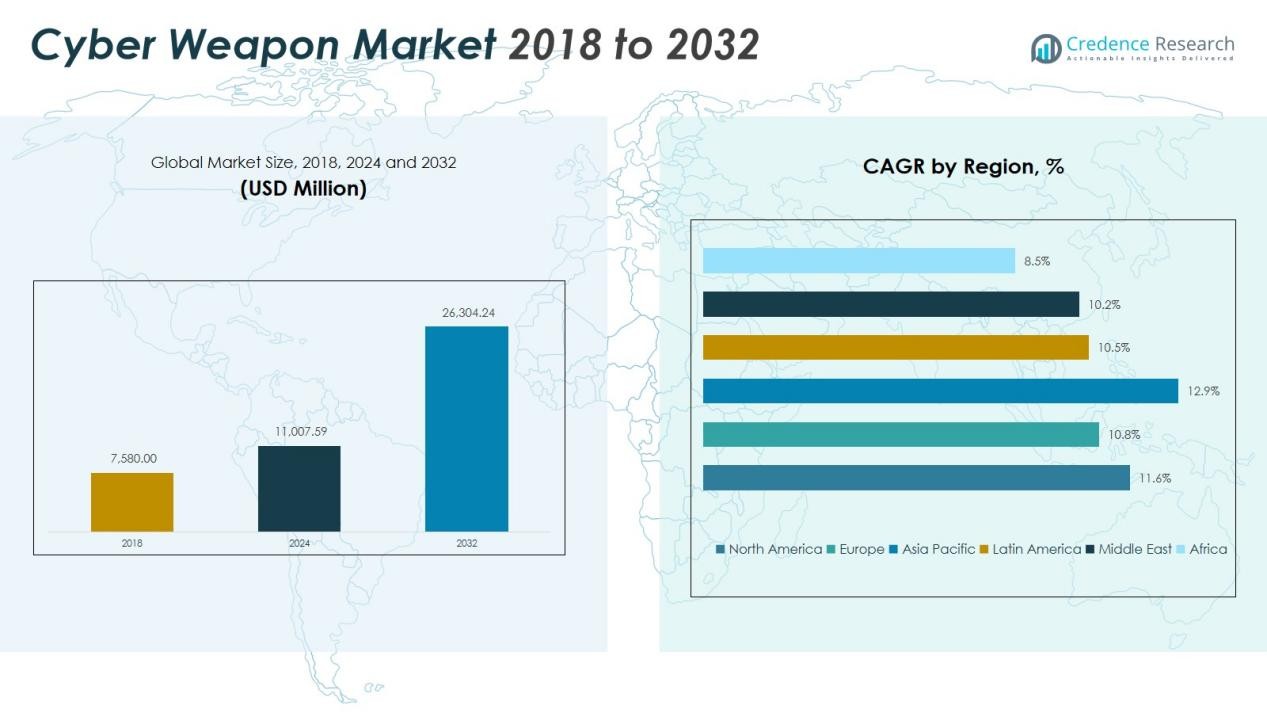
The Global Cyber Weapon Market size was valued at USD 7,580 million in 2018 to USD  11,007.59 million in 2024 and is anticipated to reach USD   26,304.24 million by 2032, at a CAGR of 11.59% during the forecast period.

REPORT ATTRIBUTE DETAILS
Historical Period 2020-2023
Base Year 2024
Forecast Period 2025-2032
Cyber Weapon Market Size 2024 USD 11,007.59 Million
Cyber Weapon Market, CAGR 11.59%
Cyber Weapon Market Size 2032 USD 26,304.24 Million


Key drivers include heightened geopolitical tensions, expanding cyberattack surfaces, and the growing reliance on digital networks for national security and defense operations. Governments and defense agencies are heavily investing in AI-driven threat detection, malware countermeasures, and advanced encryption systems. The proliferation of state-sponsored cyber activities and increasing awareness about cybersecurity resilience are further boosting demand for cyber weapons globally.

Regionally, North America dominates the market due to strong defense infrastructure and high cybersecurity budgets in the U.S. and Canada. Europe follows, supported by robust regulatory frameworks and increased cyber defense collaboration among NATO countries. The Asia-Pacific region is witnessing the fastest growth, driven by expanding military modernization programs, increasing cyber threats, and large-scale digital transformation initiatives across China, India, and Japan.

Access crucial information at unmatched prices!

Request your sample report today & start making informed decisions powered by Credence Research Inc.!

Download Sample

Market Insights:

  • The Global Cyber Weapon Market was valued at USD 7,580 million in 2018, reached USD 11,007.59 million in 2024, and is projected to attain USD 26,304.24 million by 2032, growing at a CAGR of 11.59% during the forecast period.
  • North America leads the market with a 34% share due to advanced defense infrastructure, strong cybersecurity budgets, and early adoption of digital warfare systems.
  • Europe holds 26% of the share, supported by NATO-led cyber defense programs and strict regulatory frameworks enhancing cybersecurity across key industries.
  • Asia Pacific follows with 28% of the market and is the fastest-growing region, driven by military modernization, AI integration, and increasing cyber threats in China, India, Japan, and South Korea.
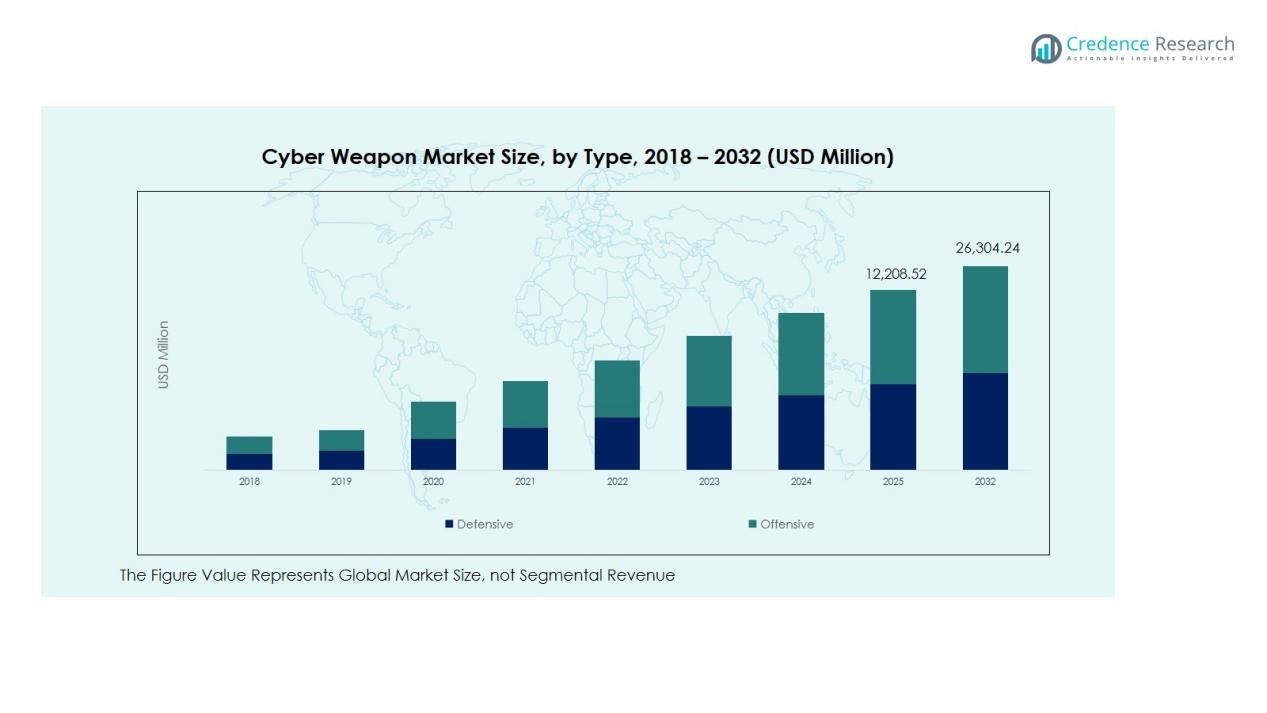
  • By type, defensive cyber weapons account for 58% of total revenue, while offensive cyber weapons represent 42%, reflecting rising global investments in both protection and counterattack capabilities.

Cyber Weapon Market Size

Market Drivers:

Rising Geopolitical Tensions and State-Sponsored Cyber Operations

The Global Cyber Weapon Market is expanding due to increasing geopolitical conflicts and cyber espionage campaigns. Governments are deploying offensive and defensive cyber tools to safeguard national interests and disrupt adversary networks. It benefits from growing state-sponsored cyberattacks targeting financial systems, defense infrastructure, and communication networks. Nations are investing heavily in digital warfare capabilities to strengthen deterrence and intelligence gathering. The trend underscores cyber dominance as a critical component of modern defense strategy.

  • For instance, Taiwan’s government networks faced an average of 2.4 million daily cyberattacks in 2024 attributed to Chinese state-backed hackers, representing a 100% increase from the 1.2 million daily average in 2023, while the country’s telecommunications sector experienced a 650% surge in targeted cyberattacks.

Growing Threats to Critical Infrastructure and National Security

The growing vulnerability of power grids, transportation systems, and defense communication networks is accelerating the demand for advanced cyber weapons. It enables governments to prevent, detect, and neutralize cyber intrusions before they escalate. High-profile ransomware and sabotage incidents have prompted countries to adopt proactive cyber defense postures. The development of malware and counter-malware tools supports rapid response mechanisms during crises. Governments are prioritizing cybersecurity funding to ensure resilience against evolving digital threats.

  • For instance, the United States allocated more than 100 million dollars in FY2025 grants to bolster state, local, and tribal cybersecurity defenses, including a dedicated 91.7 million for state/local improvements and 12.1 million for tribal initiatives.

Advancements in Artificial Intelligence and Cybersecurity Technologies

Rapid progress in artificial intelligence, machine learning, and behavioral analytics is transforming cyber warfare capabilities. It allows faster detection and prediction of hostile actions in complex digital environments. AI-powered cyber weapons enhance precision, automation, and adaptability during digital conflicts. Defense contractors are integrating autonomous threat assessment tools to minimize human intervention. The growing fusion of AI and cyber technologies continues to shape the next generation of cyber defense systems.

Expansion of Defense Budgets and Strategic Collaborations

Increasing defense expenditure among major economies is fueling the adoption of offensive and defensive cyber tools. It has encouraged joint ventures between technology firms, cybersecurity providers, and government agencies. Collaborative research projects aim to strengthen national and allied cyber resilience. The integration of private-sector innovation enhances capability development and intelligence sharing. Rising defense allocations ensure sustained investments in secure, scalable, and sophisticated cyber weapon systems.

Market Trends:

Integration of Artificial Intelligence and Machine Learning in Cyber Warfare Systems

The Global Cyber Weapon Market is witnessing a strong shift toward AI- and ML-powered cyber defense and offense systems. Advanced algorithms now detect and neutralize threats with greater speed and accuracy than manual methods. It enables autonomous response mechanisms that minimize human error during high-pressure cyber conflicts. Defense organizations are adopting predictive analytics to identify attack patterns and simulate potential threats. AI-driven adaptive malware, self-learning intrusion detection systems, and automated vulnerability scanners are redefining cyber warfare dynamics. Governments and private defense firms are collaborating to develop AI frameworks that strengthen cyber situational awareness and real-time intelligence sharing. These developments reflect a growing preference for intelligent, self-evolving digital defense systems across global security networks.

  • For instance, DARPA’s AI Cyber Challenge demonstrated that autonomous AI systems identified 77% of 70 synthetic vulnerabilities planted in code and successfully patched 43 of them, with Team Atlanta’s winning system processing efficiency costs averaging $152 per task compared to traditional bug bounty costs running into thousands.

Growing Emphasis on Offensive Cyber Capabilities and Cyber Deterrence Strategies

Countries are expanding their offensive cyber capabilities to establish deterrence and strategic dominance in the digital arena. It supports national defense agencies in disrupting enemy infrastructure, espionage channels, and communication networks. Cyber arsenals are now being treated with the same strategic importance as nuclear or conventional weapons. Governments are formalizing doctrines to regulate offensive operations under military command structures. The market is also seeing a rise in ethical hacking units and digital strike forces dedicated to proactive defense. Emerging technologies such as quantum cryptography and blockchain are being explored for secure communication and attack prevention. The trend signals a long-term transformation in how nations define and exercise power in cyberspace.

  • For instance, the UK Ministry of Defence announced in May 2025 a new Cyber and Electromagnetic Command with £1 billion in investment, establishing unified command over offensive cyber operations coordinated with the previously established National Cyber Force, with the capability to conduct offensive cyber strikes integrated into the Digital Targeting Web system enabling real-time weapon targeting across platforms.

Cyber Weapon Market Share

Market Challenges Analysis:

Regulatory Uncertainty and Ethical Concerns Over Cyber Weapon Deployment

The Global Cyber Weapon Market faces major hurdles due to unclear international regulations and ethical constraints. Countries lack unified frameworks governing the creation and use of offensive digital weapons. It raises concerns about accountability, attribution, and proportional response in cyber conflicts. The absence of global treaties increases risks of misuse and escalation between rival states. Ethical debates on state-sponsored hacking and collateral damage to civilian systems further complicate policy formation. Defense agencies must balance offensive capabilities with legal obligations and public trust. These uncertainties limit transparency and slow down collaborative cybersecurity initiatives.

Rapidly Evolving Threat Landscape and Technology Obsolescence

The constant evolution of malware and attack vectors challenges the long-term effectiveness of cyber weapons. It forces governments and defense firms to upgrade tools continuously to counter new vulnerabilities. Short innovation cycles create high development costs and operational risks. Cyber weapons can quickly lose impact once detected or neutralized by adversaries. Ensuring resilience against zero-day exploits requires significant R&D investments and advanced threat intelligence. Smaller nations and organizations often lack resources to maintain such rapid adaptation. The growing sophistication of hackers continues to pressure defense systems to evolve faster and smarter.

Market Opportunities:

Rising Demand for Advanced Defensive Cyber Capabilities and Intelligence Systems

The Global Cyber Weapon Market presents strong opportunities in developing advanced defensive cyber solutions for governments and enterprises. The growing frequency of ransomware and espionage attacks has increased demand for next-generation firewalls, AI-driven monitoring tools, and real-time intrusion detection systems. It enables continuous protection of critical infrastructure such as defense networks, power grids, and financial institutions. Governments are investing in predictive analytics platforms to identify threats before they occur. The expansion of cyber threat intelligence sharing between allies creates new opportunities for global defense collaboration. Companies offering scalable, automated, and adaptive defense platforms are likely to gain competitive advantage. Rising cybersecurity awareness supports the adoption of hybrid cyber defense systems across both public and private sectors.

Emergence of Cybersecurity-as-a-Service and International Defense Partnerships

The growing shift toward Cybersecurity-as-a-Service models is opening new commercial avenues for defense technology providers. It allows organizations to access advanced protection tools without extensive infrastructure costs. Defense contractors are forming international partnerships to co-develop cyber arsenals and training programs. Emerging economies in Asia-Pacific and the Middle East are investing in sovereign cyber defense ecosystems. Collaborative programs between government and private players encourage innovation in quantum-safe encryption and autonomous cyber response systems. The increasing focus on digital sovereignty and strategic alliances continues to expand market reach. Rising demand for managed cyber defense services creates sustained growth potential for industry leaders.

Market Segmentation Analysis:

By Type

The Global Cyber Weapon Market is segmented into defensive and offensive types. Defensive cyber weapons dominate due to rising demand for threat detection, data protection, and infrastructure security. It plays a vital role in safeguarding national defense systems and private networks from sophisticated attacks. Offensive cyber weapons are gaining traction with governments investing in tactical cyber strike capabilities. Growing geopolitical tensions and digital espionage have increased the use of offensive tools for intelligence and counterattack operations. The balance between these two types reflects the evolving nature of modern cyber warfare.

  • For instance, Fortinet’s FortiGate 600F next-generation firewall achieved a 99.88% security effectiveness score in independent third-party testing, blocking 100% of client-initiated exploits and evasions while maintaining 10 Gbps of threat protection throughput

By Application

Cyber weapons are increasingly applied in national defensive systems, industrial control systems, communication networks, automated transportation systems, and smart power grids. National defense applications lead the market, driven by continuous investments in cyber resilience. It supports governments in securing classified data and preventing cyber intrusions. Industrial control and communication systems follow closely, with organizations focusing on preventing operational disruptions. The demand for smart power grid protection is expanding due to the integration of IoT and digital energy management platforms.

By End-User

Key end-users include government, defense, BFSI, corporate, and others. Government and defense sectors account for the largest share, driven by ongoing digital modernization of security systems. It benefits from strong funding for cyber intelligence and warfare programs. The BFSI sector also contributes significantly due to the growing need for fraud detection and transaction security. Corporate adoption is accelerating with increased awareness of ransomware and insider threats.

Cyber Weapon Market Segmentation

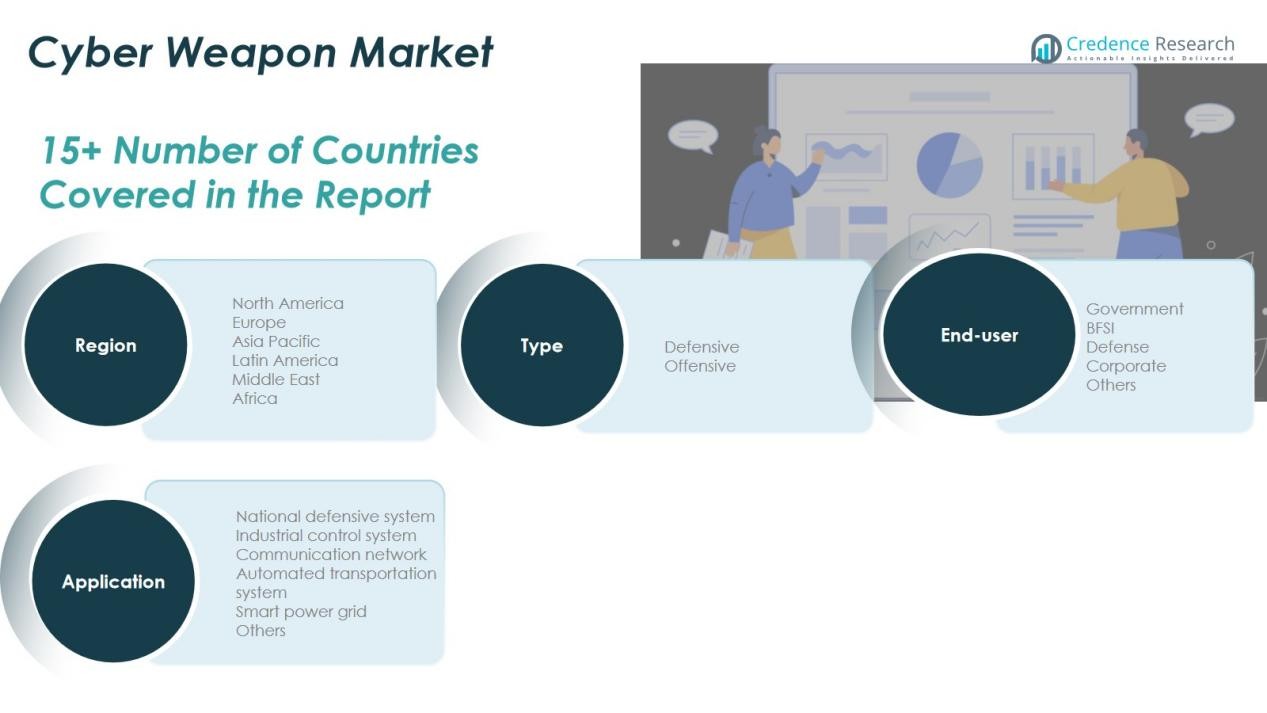
Segmentations:

By Type

  • Defensive
  • Offensive

By Application

  • National Defensive System
  • Industrial Control System
  • Communication Network
  • Automated Transportation System
  • Smart Power Grid
  • Others

By End-User

  • Government
  • BFSI
  • Defense
  • Corporate
  • Others

By Region

North America

  • U.S.
  • Canada
  • Mexico
  • Europe
  • U.K.
  • France
  • Germany
  • Italy
  • Spain
  • Russia
  • Rest of Europe

Asia Pacific

  • China
  • Japan
  • South Korea
  • India
  • Australia
  • Southeast Asia
  • Rest of Asia Pacific

Latin America

  • Brazil
  • Argentina
  • Rest of Latin America

Middle East

  • GCC Countries
  • Israel
  • Turkey
  • Rest of Middle East

Africa

  • South Africa
  • Egypt
  • Rest of Africa

Regional Analysis:

North America

The North America Cyber Weapon Market size was valued at USD 2,922.85 million in 2018 to USD 4,196.03 million in 2024 and is anticipated to reach USD 10,014.07 million by 2032, at a CAGR of 11.6% during the forecast period. North America holds the largest share of the Global Cyber Weapon Market, accounting for over 34% of total revenue. The region benefits from strong defense budgets, advanced cybersecurity infrastructure, and early adoption of digital warfare technologies. It continues to lead in developing offensive and defensive cyber capabilities through major defense contractors and government-backed programs. The U.S. Department of Defense and Homeland Security play critical roles in funding cyber weapon R&D. Growing incidents of ransomware and cyber espionage have increased the focus on national cyber resilience. High investments in AI-based defense systems further strengthen regional market dominance.

Europe

The Europe Cyber Weapon Market size was valued at USD 1,872.26 million in 2018 to USD 2,606.30 million in 2024 and is anticipated to reach USD 5,859.34 million by 2032, at a CAGR of 10.8% during the forecast period. Europe accounts for around 26% of the market share, driven by rising digital threats and increasing cooperation among NATO members. The region emphasizes cyber defense modernization to protect energy, transportation, and communication networks. It benefits from coordinated efforts by the European Union to strengthen collective cybersecurity frameworks. Countries such as the U.K., Germany, and France invest heavily in military-grade cyber intelligence programs. The region’s focus on regulatory compliance, such as GDPR, enhances the need for secure digital ecosystems. Expansion of national cyber command centers supports continuous growth.

Asia Pacific

The Asia Pacific Cyber Weapon Market size was valued at USD 1,925.32 million in 2018 to USD 2,915.31 million in 2024 and is anticipated to reach USD 7,662.45 million by 2032, at a CAGR of 12.9% during the forecast period. Asia Pacific holds a 28% market share and is the fastest-growing regional segment. Rapid digital transformation, rising geopolitical tensions, and large-scale defense modernization projects drive regional demand. It experiences strong government initiatives in China, India, Japan, and South Korea aimed at developing indigenous cyber defense programs. Increasing cyberattacks targeting government and corporate systems have accelerated investments in advanced threat detection tools. The region’s expanding IT infrastructure and growing reliance on smart technologies create a wide attack surface. Continuous innovation in AI-based cyber solutions enhances regional competitiveness.

Latin America

The Latin America Cyber Weapon Market size was valued at USD 439.64 million in 2018 to USD 631.73 million in 2024 and is anticipated to reach USD 1,390.70 million by 2032, at a CAGR of 10.5% during the forecast period. Latin America accounts for nearly 6% of the market share, supported by gradual digitalization across public and private sectors. The region faces growing threats to banking networks and government institutions, pushing adoption of cybersecurity defense tools. It benefits from rising regional cooperation and international cybersecurity partnerships. Countries like Brazil and Mexico are enhancing national cyber capabilities through policy reforms and training programs. The demand for managed security services is expanding as organizations seek affordable defense solutions. Local technology start-ups are emerging to provide specialized digital threat management tools.

Middle East

The Middle East Cyber Weapon Market size was valued at USD 294.86 million in 2018 to USD 401.71 million in 2024 and is anticipated to reach USD 868.18 million by 2032, at a CAGR of 10.2% during the forecast period. The region contributes about 4% of total market revenue, fueled by rising investment in critical infrastructure protection. Governments are adopting cyber defense strategies to secure energy grids, defense networks, and financial systems. It benefits from the establishment of national cybersecurity agencies and regional alliances focused on digital resilience. Countries such as Israel, Saudi Arabia, and the UAE lead in adopting advanced cyber technologies. The growth of smart city projects has further raised the need for network protection. The region’s focus on cybersecurity awareness and digital governance supports steady expansion.

Africa

The Africa Cyber Weapon Market size was valued at USD 125.07 million in 2018 to USD 256.52 million in 2024 and is anticipated to reach USD 509.49 million by 2032, at a CAGR of 8.5% during the forecast period. Africa holds approximately 2% of the market share, reflecting early-stage adoption of cyber defense infrastructure. Growing internet penetration and digital banking have increased exposure to cyber threats. It is witnessing government-led initiatives to strengthen cybersecurity policies and public awareness. Countries such as South Africa and Egypt are leading regional investments in network defense and digital monitoring. Limited technical expertise and budget constraints remain key challenges. International collaboration and capacity-building programs are supporting gradual development across the region.

Key Player Analysis:

  • A.E. Systems (U.K.)
  • Airbus S.A.S (Netherlands)
  • FireEye, Inc. (U.S.)
  • Broadcom (U.S.)
  • Northrop Grumman (U.S.)
  • Avast Software (Czech Republic)
  • Boeing (U.S.)
  • Kaspersky Lab (Russia)
  • Cisco Systems (U.S.)
  • McAfee L.L.C. (U.S.)
  • Lockheed Martin Corporation (U.S.)

Competitive Analysis:

The Global Cyber Weapon Market is highly competitive with several leading defense and cybersecurity companies developing advanced digital warfare solutions. Major players include B.A.E. Systems (U.K.), Airbus S.A.S (Netherlands), FireEye, Inc. (U.S.), Broadcom (U.S.), Northrop Grumman (U.S.), Avast Software (Czech Republic), and Boeing (U.S.). It is characterized by continuous innovation, heavy R&D investment, and strategic collaborations with government defense agencies. Companies focus on expanding AI-driven threat detection, encryption technologies, and offensive cyber capabilities. Partnerships between defense contractors and technology firms are increasing to enhance operational readiness and digital intelligence. Strong emphasis on national security projects supports long-term contracts and recurring revenue streams. The competition centers on developing scalable, secure, and adaptive cyber platforms capable of neutralizing advanced digital threats.

Shape Your Report to Specific Countries or Regions & Enjoy 30% Off!

Recent Developments:

  • In August 2025, B.A.E. Systems announced a strategic investment in Oxford Dynamics, a UK-based AI start-up, to enhance its defense capabilities through advanced artificial intelligence and data analytics for rapid deployment across air, land, sea, space, and cyber domains.
  • In July 2025, Airbus marked 25 years as an integrated company, highlighting its continued evolution and integration of various business lines under the Airbus umbrella, with ongoing strategic focus on aerospace innovation and global expansion.

Report Coverage:

The research report offers an in-depth analysis based on Type, Application, End-User and Region. It details leading market players, providing an overview of their business, product offerings, investments, revenue streams, and key applications. Additionally, the report includes insights into the competitive environment, SWOT analysis, current market trends, as well as the primary drivers and constraints. Furthermore, it discusses various factors that have driven market expansion in recent years. The report also explores market dynamics, regulatory scenarios, and technological advancements that are shaping the industry. It assesses the impact of external factors and global economic changes on market growth. Lastly, it provides strategic recommendations for new entrants and established companies to navigate the complexities of the market.

Future Outlook:

  • The Global Cyber Weapon Market will experience strong growth driven by rising digital warfare threats and geopolitical rivalries.
  • Governments will increase investments in AI-powered and quantum-resistant cyber defense systems.
  • Integration of autonomous technologies will enhance real-time threat detection and countermeasure precision.
  • Defense agencies will prioritize the development of indigenous cyber weapon programs for strategic independence.
  • Collaborations between defense contractors and private cybersecurity firms will expand global innovation networks.
  • Cyber deterrence strategies will become a central part of national defense doctrines.
  • Cloud security and data protection solutions will gain prominence across critical infrastructure sectors.
  • Emerging economies will strengthen their cyber capabilities through public–private partnerships and global alliances.
  • Ethical and regulatory frameworks will evolve to balance national security needs with international law.
  • Continuous technological advancements will redefine digital warfare and sustain long-term market opportunities.

CHAPTER NO. 1 : GENESIS OF THE MARKET

1.1 Market Prelude – Introduction & Scope

1.2 The Big Picture – Objectives & Vision

1.3 Strategic Edge – Unique Value Proposition

1.4 Stakeholder Compass – Key Beneficiaries

CHAPTER NO. 2 : EXECUTIVE LENS

2.1 Pulse of the End-user – Market Snapshot

2.2 Growth Arc – Revenue Projections (USD Million)

2.3. Premium Insights – Based on Primary Interviews

CHAPTER NO. 3 : CYBER WEAPON MARKET FORCES & INDUSTRY PULSE

3.1 Foundations of Change – Market Overview

3.2 Catalysts of Expansion – Key Market Drivers

3.2.1 Momentum Boosters – Growth Triggers

3.2.2 Innovation Fuel – Disruptive Technologies

3.3 Headwinds & Crosswinds – Market Restraints

3.3.1 Regulatory Tides – Compliance Challenges

3.3.2 Economic Frictions – Inflationary Pressures

3.4 Untapped Horizons – Growth Potential & Opportunities

3.5 Strategic Navigation – End-user Frameworks

3.5.1 Market Equilibrium – Porter’s Five Forces

3.5.2 Ecosystem Dynamics – Value Chain Analysis

3.5.3 Macro Forces – PESTEL Breakdown

3.6 Price Trend Analysis

3.6.1 Regional Price Trend

3.6.2 Price Trend by product

CHAPTER NO. 4 : KEY INVESTMENT EPICENTER

4.1 Regional Goldmines – High-Growth Geographies

4.2 End-user Frontiers – Lucrative End-user Categories

4.3 Application Sweet Spots – Emerging Demand Segments

CHAPTER NO. 5: REVENUE TRAJECTORY & WEALTH MAPPING

5.1 Momentum Metrics – Forecast & Growth Curves

5.2 Regional Revenue Footprint – Market Share Insights

5.3 Segmental Wealth Flow – End-user & Application Revenue

CHAPTER NO. 6 : TRADE & COMMERCE ANALYSIS

6.1. Import Analysis by Region

6.1.1. Global Cyber Weapon Market Import Revenue By Region

6.2. Export Analysis by Region

6.2.1. Global Cyber Weapon Market Export Revenue By Region

CHAPTER NO. 7 : COMPETITION ANALYSIS

7.1. Company Market Share Analysis

7.1.1. Global Cyber Weapon Market: Company Market Share

7.2. Global Cyber Weapon Market Company Revenue Market Share

7.3. Strategic Developments

7.3.1. Acquisitions & Mergers

7.3.2. New End-user Launch

7.3.3. Regional Expansion

7.4. Competitive Dashboard

7.5. Company Assessment Metrics, 2024

CHAPTER NO. 8 : CYBER WEAPON MARKET – BY TYPE SEGMENT ANALYSIS

8.1. Cyber Weapon Market Overview by Type Segment

8.1.1. Cyber Weapon Market Revenue Share By Type

8.2. Defensive

8.3. Offensive

CHAPTER NO. 9 : CYBER WEAPON MARKET – BY APPLICATION SEGMENT ANALYSIS

9.1. Cyber Weapon Market Overview by Application Segment

9.1.1. Cyber Weapon Market Revenue Share By Application

9.2. National defensive system

9.3. Industrial control system

9.4. Communication network

9.5. Automated transportation system

9.6. Smart power grid

9.7. Others

CHAPTER NO. 10 : CYBER WEAPON MARKET – BY END-USER SEGMENT ANALYSIS

10.1. Cyber Weapon Market Overview by End-user Segment

10.1.1. Cyber Weapon Market Revenue Share By End-user

10.2. Government

10.3. BFSI

10.4. Defense

10.5. Corporate

10.6. Others

CHAPTER NO. 11 : CYBER WEAPON MARKET – REGIONAL ANALYSIS

11.1. Cyber Weapon Market Overview by Region Segment

11.1.1. Global Cyber Weapon Market Revenue Share By Region

11.1.3. Regions

11.1.4. Global Cyber Weapon Market Revenue By Region

.1.6. End-user

11.1.7. Global Cyber Weapon Market Revenue By End-user

11.1.9. Application

11.1.10. Global Cyber Weapon Market Revenue By Application

11.1.12. End-user

11.1.13. Global Cyber Weapon Market Revenue By End-user

CHAPTER NO. 12 : NORTH AMERICA CYBER WEAPON MARKET – COUNTRY ANALYSIS

12.1. North America Cyber Weapon Market Overview by Country Segment

12.1.1. North America Cyber Weapon Market Revenue Share By Region

12.2. North America

12.2.1. North America Cyber Weapon Market Revenue By Country

12.2.2. End-user

12.2.3. North America Cyber Weapon Market Revenue By End-user

12.2.4. Application

12.2.5. North America Cyber Weapon Market Revenue By Application

2.2.6. End-user

12.2.7. North America Cyber Weapon Market Revenue By End-user

2.3. U.S.

12.4. Canada

12.5. Mexico

CHAPTER NO. 13 : EUROPE CYBER WEAPON MARKET – COUNTRY ANALYSIS

13.1. Europe Cyber Weapon Market Overview by Country Segment

13.1.1. Europe Cyber Weapon Market Revenue Share By Region

13.2. Europe

13.2.1. Europe Cyber Weapon Market Revenue By Country

13.2.2. End-user

13.2.3. Europe Cyber Weapon Market Revenue By End-user

13.2.4. Application

13.2.5. Europe Cyber Weapon Market Revenue By Application

13.2.6. End-user

13.2.7. Europe Cyber Weapon Market Revenue By End-user

13.3. UK

13.4. France

13.5. Germany

13.6. Italy

13.7. Spain

13.8. Russia

13.9. Rest of Europe

CHAPTER NO. 14 : ASIA PACIFIC CYBER WEAPON MARKET – COUNTRY ANALYSIS

14.1. Asia Pacific Cyber Weapon Market Overview by Country Segment

14.1.1. Asia Pacific Cyber Weapon Market Revenue Share By Region

14.2. Asia Pacific

14.2.1. Asia Pacific Cyber Weapon Market Revenue By Country

14.2.2. End-user

14.2.3. Asia Pacific Cyber Weapon Market Revenue By End-user

14.2.4. Application

14.2.5. Asia Pacific Cyber Weapon Market Revenue By Application

14.2.5. End-user

14.2.7. Asia Pacific Cyber Weapon Market Revenue By End-user

14.3. China

14.4. Japan

14.5. South Korea

14.6. India

14.7. Australia

14.8. Southeast Asia

14.9. Rest of Asia Pacific

CHAPTER NO. 15 : LATIN AMERICA CYBER WEAPON MARKET – COUNTRY ANALYSIS

15.1. Latin America Cyber Weapon Market Overview by Country Segment

15.1.1. Latin America Cyber Weapon Market Revenue Share By Region

15.2. Latin America

15.2.1. Latin America Cyber Weapon Market Revenue By Country

15.2.2. End-user

15.2.3. Latin America Cyber Weapon Market Revenue By End-user

15.2.4. Application

15.2.5. Latin America Cyber Weapon Market Revenue By Application

15.2.6. End-user

15.2.7. Latin America Cyber Weapon Market Revenue By End-user

15.3. Brazil

15.4. Argentina

15.5. Rest of Latin America

CHAPTER NO. 16 : MIDDLE EAST CYBER WEAPON MARKET – COUNTRY ANALYSIS

16.1. Middle East Cyber Weapon Market Overview by Country Segment

16.1.1. Middle East Cyber Weapon Market Revenue Share By Region

16.2. Middle East

16.2.1. Middle East Cyber Weapon Market Revenue By Country

16.2.2. End-user

16.2.3. Middle East Cyber Weapon Market Revenue By End-user

16.2.4. Application

16.2.5. Middle East Cyber Weapon Market Revenue By Application

16.2.6. End-user

16.2.7. Middle East Cyber Weapon Market Revenue By End-user

16.3. GCC Countries

16.4. Israel

16.5. Turkey

16.6. Rest of Middle East

CHAPTER NO. 17 : AFRICA CYBER WEAPON MARKET – COUNTRY ANALYSIS

17.1. Africa Cyber Weapon Market Overview by Country Segment

17.1.1. Africa Cyber Weapon Market Revenue Share By Region

17.2. Africa

17.2.1. Africa Cyber Weapon Market Revenue By Country

17.2.2. End-user

17.2.3. Africa Cyber Weapon Market Revenue By End-user

17.2.4. Application

17.2.5. Africa Cyber Weapon Market Revenue By Application

17.2.6. End-user

17.2.7. Africa Cyber Weapon Market Revenue By End-user

17.3. South Africa

17.4. Egypt

17.5. Rest of Africa

CHAPTER NO. 18 : COMPANY PROFILES

18.1. B.A.E. Systems (The U.K.)

18.1.1. Company Overview

18.1.2. End-user Portfolio

18.1.3. Financial Overview

18.1.4. Recent Developments

18.1.5. Growth Strategy

18.1.6. SWOT Analysis

18.2. Airbus S.A.S (Netherlands)

18.3. FireEye, Inc. (The U.S.)

18.4. Broadcom (The U.S.)

18.5. Northrop Grumman (The U.S.)

18.6. Avast Software (Czech Republic)

18.7. Boeing (The U.S.)

18.8. Kaspersky Lab (Russia)

18.9. Cisco Systems (The U.S.)

18.10. McAfee L.L.C. (The U.S.)

18.11. Lockheed Martin Corporation (The U.S.)

Request Free Sample

We prioritize the confidentiality and security of your data. Our promise: your information remains private.

Ready to Transform Data into Decisions?

Request Your Sample Report and Start Your Journey of Informed Choices


Providing the strategic compass for industry titans.

cr-clients-logos

Frequently asked questions:

What is the current market size for the Global Cyber Weapon Market, and what is its projected size in 2032?

The Global Cyber Weapon Market was valued at USD 7,580 million in 2018 and reached USD 11,007.59 million in 2024. It is projected to attain USD 26,304.24 million by 2032, reflecting strong long-term expansion across both developed and emerging economies.

At what Compound Annual Growth Rate is the Global Cyber Weapon Market projected to grow between 2024 and 2032?

The Global Cyber Weapon Market is expected to expand at a CAGR of 11.59% during the forecast period from 2024 to 2032, driven by increasing cyber warfare investments, technological advancements, and rising geopolitical conflicts.

Which Global Cyber Weapon Market segment held the largest share in 2024?

The defensive cyber weapon segment held the largest market share in 2024 due to strong demand for advanced threat detection, infrastructure protection, and data security solutions across government and defense sectors.

What are the primary factors fueling the growth of the Global Cyber Weapon Market?

Key drivers include heightened geopolitical tensions, state-sponsored cyber operations, expansion of AI-driven security systems, and increased reliance on digital networks for defense and intelligence applications.

Who are the leading companies in the Global Cyber Weapon Market?

Major players include B.A.E. Systems (U.K.), Airbus S.A.S (Netherlands), FireEye, Inc. (U.S.), Broadcom (U.S.), Northrop Grumman (U.S.), Avast Software (Czech Republic), Boeing (U.S.), Cisco Systems (U.S.), McAfee L.L.C. (U.S.), and Lockheed Martin Corporation (U.S.).

Which region commanded the largest share of the Global Cyber Weapon Market in 2024?

North America dominated the market in 2024, accounting for over 34% of total revenue, supported by advanced defense infrastructure, strong cybersecurity funding, and early adoption of digital warfare technologies in the U.S. and Canada.

About Author

Sushant Phapale

Sushant Phapale

ICT & Automation Expert

Sushant is an expert in ICT, automation, and electronics with a passion for innovation and market trends.

View Profile


Related Reports

Corporate Web Security Market

The corporate web security market was valued at USD 3,633 million in 2024 and is projected to reach USD 6,150.21 million by 2032, expanding at a compound annual growth rate (CAGR) of 6.8% during the forecast period.

Email Security Market

The global Email Security market was valued at USD 4,677.5 million in 2024 and is anticipated to reach USD 10,548.6 million by 2032, expanding at a CAGR of 10.7% during the forecast period (2025–2032).

Thermal Imaging Cameras Market

Thermal Imaging Cameras Market size was valued at USD 5.14 Billion in 2024 and is anticipated to reach USD 10.27 Billion by 2032, at a CAGR of 9.04% during the forecast period.

Unified Threat Management Market

The global Unified Threat Management (UTM) market was valued at USD 5,557.5 million in 2024 and is projected to reach USD 11,511.82 million by 2032, expanding at a CAGR of 9.53% during the forecast period.

Cyber Insurance Market

Cyber Insurance market was valued at USD 20.88 billion in 2024 and is anticipated to reach USD 118.97 billion by 2032, growing at a CAGR of 24.3 % during the forecast period.

Cyber Security Consulting Market

Cyber Security Consulting Market size was valued at USD 14.37 Billion in 2024 and is anticipated to reach USD 57.78 Billion by 2032, at a CAGR of 19% during the forecast period.

Airport Security Market

The global Airport Security Market was valued at USD 19.34 billion in 2024 and is projected to reach USD 32.98 billion by 2032, expanding at a CAGR of 6.9% during the forecast period.

Cloud Network Security Market

Cloud Network Security Market was valued at USD 9591 million in 2024 and is anticipated to reach USD 75301 million by 2032, growing at a CAGR of 29.38 % during the forecast period.

Drone Cybersecurity Market

Drone Cybersecurity Market size was valued USD 2.61 Billion in 2024 and is anticipated to reach USD 10.34 Billion by 2032, at a CAGR of 18.8% during the forecast period.

Fingerprint Access Control System Market

Fingerprint Access Control System Market Report size was valued USD 4.8 billion in 2024 and is anticipated to reach USD 11.97 billion by 2032, at a CAGR of 12.1% during the forecast period.

Electronic Security Market

Electronic Security Market size was valued USD 65284.5 million in 2024 and is anticipated to reach USD 97637.06 million by 2032, at a CAGR of 5.16% during the forecast period.

Identity as a Service Market

Identity as a Service Market size was valued USD 8.98 billion in 2024 and is anticipated to reach USD 51.8 billion by 2032, at a CAGR of 24.49% during the forecast period.

Licence Option

The report comes as a view-only PDF document, optimized for individual clients. This version is recommended for personal digital use and does not allow printing. Use restricted to one purchaser only.
$4999

To meet the needs of modern corporate teams, our report comes in two formats: a printable PDF and a data-rich Excel sheet. This package is optimized for internal analysis. Unlimited users allowed within one corporate location (e.g., regional office).
$6999

The report will be delivered in printable PDF format along with the report’s data Excel sheet. This license offers 100 Free Analyst hours where the client can utilize Credence Research Inc. research team. Permitted for unlimited global use by all users within the purchasing corporation, such as all employees of a single company.
$12999

Report delivery within 24 to 48 hours

Europe

North America

Email

Smallform of Sample request
User Review

Thank you for the data! The numbers are exactly what we asked for and what we need to build our business case.

Materials Scientist
(privacy requested)

User Review

The report was an excellent overview of the Industrial Burners market. This report does a great job of breaking everything down into manageable chunks.

Imre Hof
Management Assistant, Bekaert

cr-clients-logos

Request Sample