Home » Information and Communications Technology » IT & Telecom » Enterprise Collaboration Services Market

Enterprise Collaboration Services Market By Type (Solution, Services); By Organization Size (Large Enterprises, Small and Medium Enterprises [SMEs]); By Deployment Mode (On-premises, Cloud-based); By End-Use (IT & Telecom, BFSI, Healthcare, Retail & Consumer Goods, Manufacturing, Education, Travel & Hospitality, Others) – Growth, Share, Opportunities & Competitive Analysis, 2024 – 2032

Report ID: 5348 | Report Format : Excel, PDF

Market Overview:

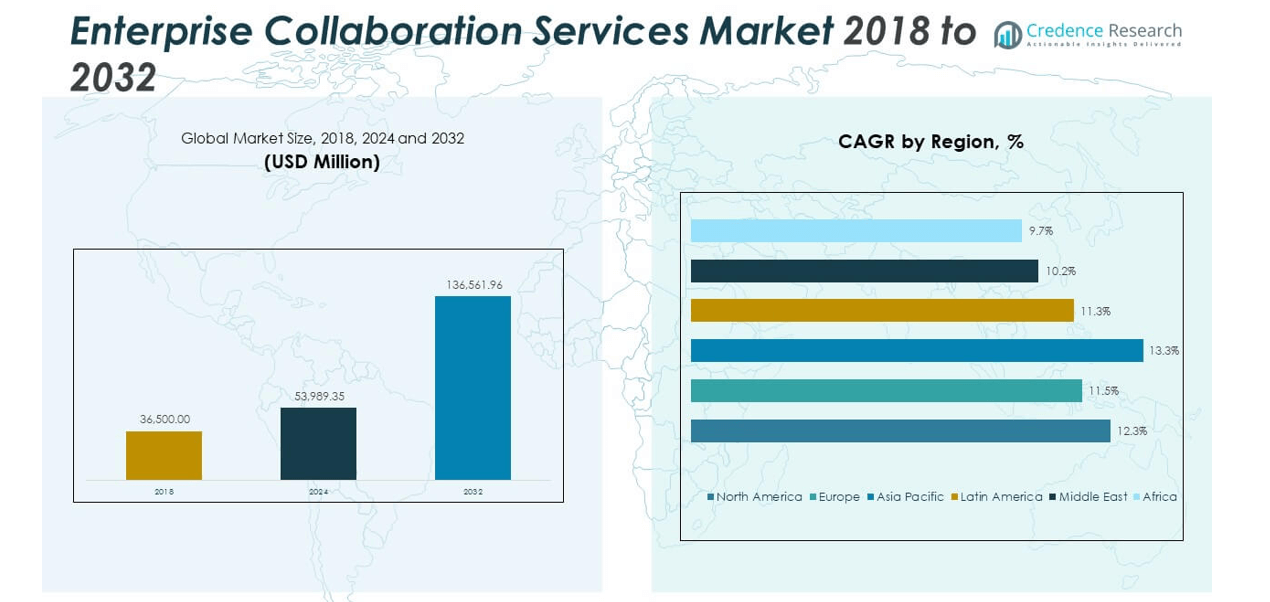
The Enterprise Collaboration Services Market size was valued at USD 36,500.00 million in 2018 to USD 53,989.35 million in 2024 and is anticipated to reach USD 136,561.96 million by 2032, at a CAGR of 12.33% during the forecast period.

REPORT ATTRIBUTE DETAILS
Historical Period 2020-2023
Base Year 2024
Forecast Period 2025-2032
Enterprise Collaboration Services Market Size 2024 USD 53,989.35 million
Enterprise Collaboration Services Market, CAGR 12.33%
Enterprise Collaboration Services Market Size 2032 USD 136,561.96 million


Growth in the Enterprise Collaboration Services Market is driven by the rising adoption of cloud-based platforms, remote work expansion, and digital transformation initiatives. Organizations implement unified communication tools integrating chat, video conferencing, and project management functions. It helps enterprises improve workflow efficiency, enhance decision-making speed, and maintain secure communication networks. Demand for AI-powered collaboration software grows as companies automate scheduling, document management, and data analysis. Strong focus on workplace flexibility, employee engagement, and cybersecurity further supports rapid adoption across industries worldwide.

North America leads the Enterprise Collaboration Services Market due to strong IT infrastructure and widespread use of digital workplace solutions. Europe follows with high compliance standards and growing enterprise modernization efforts. Asia Pacific emerges as the fastest-growing region, supported by large-scale cloud adoption in China, India, and Japan. Latin America shows increasing acceptance among SMEs aiming to digitalize operations. The Middle East and Africa experience steady progress driven by smart city projects and improving internet accessibility. Each region reflects distinct enterprise collaboration maturity influenced by economic scale and digital readiness.

Enterprise Collaboration Services Market size

Market Insights:

  • The Enterprise Collaboration Services Market was valued at USD 36,500.00 million in 2018, grew to USD 53,989.35 million in 2024, and is expected to reach USD 136,561.96 million by 2032, registering a CAGR of 12.33% during the forecast period.
  • North America (28.4%), Asia Pacific (36.8%), and Europe (24.3%) hold the top three regional shares. Their dominance is driven by advanced cloud infrastructure, strong enterprise digitalization, and large-scale IT investments supporting collaboration technologies.
  • Asia Pacific, the fastest-growing region with 8% share, leads due to rapid digital transformation, SME cloud adoption, and government-backed smart workplace initiatives in countries like China, India, and Japan.
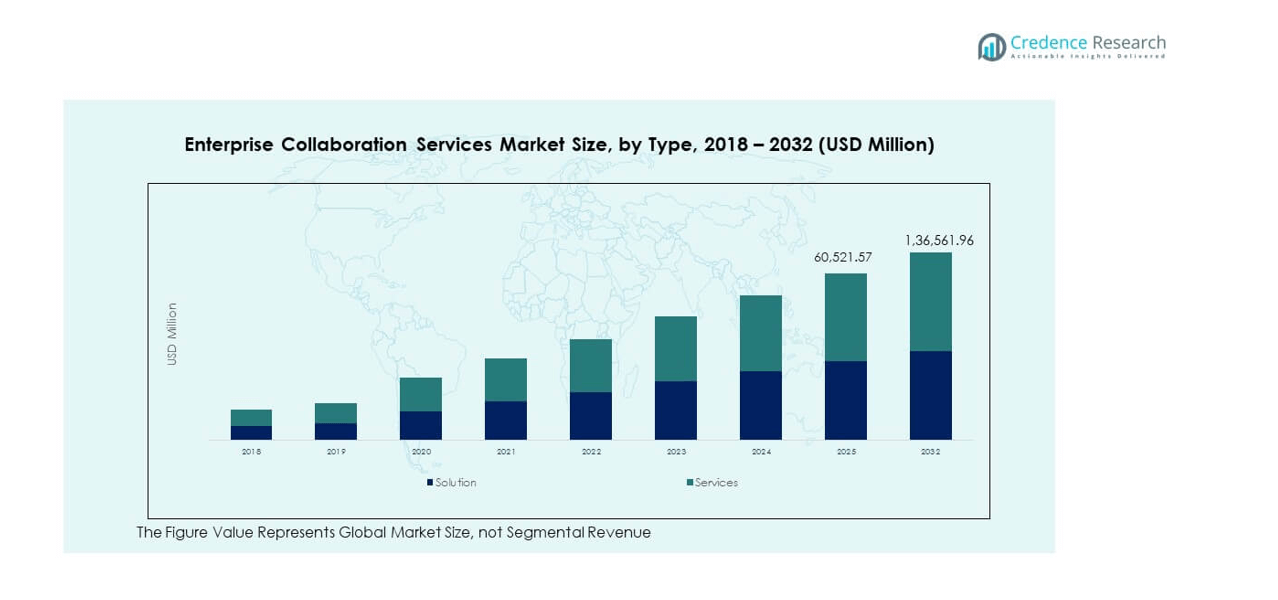
  • By type, solutions account for approximately 55–57% of the global market share, supported by high demand for unified communication and workflow management platforms among large organizations.
  • The services segment holds around 43–45% share, gaining momentum from growing demand for system integration, cloud migration, and managed collaboration support across diverse enterprise environments.

Access crucial information at unmatched prices!

Request your sample report today & start making informed decisions powered by Credence Research Inc.!

Download Sample

Market Drivers

Rising Need for Seamless Remote and Hybrid Work Communication

The Enterprise Collaboration Services Market expands due to the widespread shift toward remote and hybrid work models. Enterprises prioritize platforms that integrate chat, video, and document-sharing features. Businesses rely on cloud-based communication suites to maintain productivity across distributed teams. It helps organizations connect securely and efficiently regardless of physical location. Demand rises for tools that enable real-time decision-making and transparent communication. Companies adopt unified collaboration systems to replace fragmented software solutions. Rapid cloud migration strengthens operational flexibility across global enterprises. This shift enhances team connectivity and drives consistent market expansion.

  • For instance, Microsoft Teams reported over 320 million monthly active users globally as of early 2024, reflecting its strong position in enterprise collaboration. This milestone underscores the platform’s continued expansion across hybrid and remote work environments.

Increasing Integration of Artificial Intelligence and Automation in Collaboration Platforms

AI-powered automation drives efficiency across modern enterprise communication systems. The Enterprise Collaboration Services Market benefits from tools that automate meeting summaries, task tracking, and translation. It enables employees to focus on creative and strategic work. Smart assistants improve workflows by analyzing user behavior and suggesting context-based actions. Predictive tools help managers prioritize communication and monitor engagement patterns. Firms adopt AI-driven collaboration suites for faster data insights and improved productivity. Automation simplifies repetitive tasks and reduces operational strain. Growing investment in intelligent collaboration technology sustains steady market growth worldwide.

Growing Cloud Adoption and Shift Toward Unified Digital Workspaces

Cloud deployment accelerates collaboration across departments and external partners. The Enterprise Collaboration Services Market grows as companies migrate legacy systems to scalable cloud models. It supports better data storage, scalability, and accessibility from any device. Organizations integrate communication apps, project management tools, and analytics into single dashboards. This digital unification improves transparency and decision-making across teams. Hybrid cloud solutions address security concerns while offering flexibility for large enterprises. Businesses value real-time synchronization between tools, reducing delays and communication errors. Expanding cloud infrastructure strengthens market adoption across small and mid-sized firms.

Strong Focus on Employee Productivity and Cross-Department Collaboration

Firms invest in collaboration tools that enhance employee performance and engagement. The Enterprise Collaboration Services Market experiences demand for systems that streamline workflow management. It helps enterprises minimize time lost between communication channels. Managers use analytics to track employee interactions and improve knowledge sharing. Real-time updates promote accountability and project clarity across departments. Enhanced internal communication reduces misalignment between teams and boosts overall efficiency. Businesses favor platforms that combine productivity, creativity, and data security. Growing awareness of collaboration’s impact on performance accelerates product adoption globally.

  • For instance, Zoom introduced new self-service quoting and simplified pricing tools for partners in May 2025, aiming to boost channel-driven license sales and streamline partner operations.

Market Trends

Emergence of Advanced Virtual Collaboration Tools for Hybrid Workforce Management

The Enterprise Collaboration Services Market evolves with next-generation virtual tools that mimic real office interactions. Digital whiteboards, virtual workspaces, and immersive video environments become standard features. It helps hybrid teams maintain cohesion and creativity despite distance. Companies deploy virtual environments to conduct brainstorming sessions and workshops. These solutions enhance participation and reduce fatigue associated with long video calls. Developers focus on 3D collaboration interfaces and mixed-reality features. Global firms adopt immersive collaboration to replace traditional conferencing tools. The trend pushes technology providers to merge VR, AR, and AI functionalities.

  • For instance, Microsoft Teams supports webinars that can host up to 1,000 interactive participants and up to 10,000 attendees in view-only mode, providing moderation features and live engagement tools to enhance virtual collaboration for hybrid teams.

Growing Popularity of Mobile-First Collaboration Platforms Among Distributed Teams

Mobile-optimized collaboration tools dominate modern enterprise ecosystems. The Enterprise Collaboration Services Market gains from mobile-first strategies that improve accessibility for remote users. It allows workers to communicate and manage projects on smartphones or tablets. Enterprises focus on applications with offline access and high-level security. Mobile integration ensures continuity during travel and field operations. Startups and SMBs prefer mobile-first platforms due to lower infrastructure costs. Developers enhance app interfaces to support intuitive multitasking. The expanding mobile workforce strengthens long-term adoption of mobile collaboration technologies.

  • For instance, Slack’s mobile app supports real-time messaging and voice or video huddles for up to 50 participants, enabling teams to collaborate seamlessly across iOS and Android devices. Its canvas feature further enhances workspace coordination and content sharing for hybrid teams.

Rising Adoption of Data-Driven Collaboration Analytics and Performance Insights

Organizations leverage analytics to evaluate communication efficiency and employee engagement. The Enterprise Collaboration Services Market witnesses growth from tools offering detailed collaboration metrics. It enables firms to optimize workflows and identify communication bottlenecks. Predictive analytics improves decision-making by highlighting team strengths and weaknesses. Enterprises use insights to refine policies and project allocation. Integration of AI-powered dashboards supports real-time performance monitoring. Managers adopt these analytics tools to build more productive digital workplaces. Increasing demand for measurable collaboration outcomes accelerates the adoption of analytics-integrated systems.

Integration of Enterprise Collaboration with Cybersecurity and Compliance Frameworks

Companies prioritize compliance and data protection in digital communication platforms. The Enterprise Collaboration Services Market aligns with regulations such as GDPR and CCPA. It ensures safe information sharing across global operations. End-to-end encryption and multi-factor authentication become mandatory standards. Vendors integrate threat detection and access control features into collaboration software. Enterprises prefer platforms certified under global cybersecurity norms. This trend boosts confidence among financial, healthcare, and government sectors. The convergence of security and collaboration technologies defines a new growth direction for the market.

Enterprise Collaboration Services Market share

Market Challenges Analysis

Data Security Risks and Regulatory Compliance Complexities Across Global Operations

The Enterprise Collaboration Services Market faces growing scrutiny over data privacy and compliance. It must manage large volumes of sensitive information exchanged daily. Different regions enforce strict data protection rules, increasing legal complexity. Enterprises struggle to ensure consistent security standards across cloud environments. Unsecured file sharing and device vulnerabilities raise cyberattack risks. Vendors need continuous software updates and compliance certifications. These requirements increase operational costs and implementation delays. Companies demand transparent data governance frameworks to maintain trust and regulatory alignment.

Integration Barriers and User Adoption Difficulties Across Diverse Systems

Organizations encounter challenges when merging new collaboration tools with legacy infrastructure. The Enterprise Collaboration Services Market experiences slow adoption among firms with limited digital maturity. It requires extensive training and change management to ensure smooth transition. Compatibility issues arise when integrating with existing CRMs, ERPs, and communication networks. Users resist change due to steep learning curves and interface differences. Downtime during migration impacts productivity and business continuity. High implementation costs discourage smaller firms from large-scale deployment. Vendors need customizable, user-friendly platforms to reduce adoption friction.

Market Opportunities

Expansion Potential Through AI-Enhanced and Industry-Specific Collaboration Platforms

Artificial intelligence creates new opportunities for innovation within the Enterprise Collaboration Services Market. It supports personalized communication experiences and adaptive workflows. Industry-specific tools designed for healthcare, education, or finance deliver tailored collaboration functions. AI chatbots streamline customer communication and automate repetitive work. Intelligent search and contextual recommendations improve knowledge management. Vendors expanding into niche sectors gain a competitive advantage. Firms investing in specialized AI-driven platforms achieve higher retention and engagement levels.

Growth Scope in Emerging Economies and SMB Digital Transformation Initiatives

Developing nations offer vast potential for collaboration service providers. The Enterprise Collaboration Services Market benefits from rapid digital infrastructure development. It supports small and mid-sized businesses adopting low-cost cloud tools. Affordable internet and smartphone access drive market penetration in Asia and Africa. Governments promote digital workplaces under national innovation agendas. Localized pricing and language support expand user bases. Vendors providing scalable and secure cloud collaboration solutions capture strong regional growth.

Market Segmentation Analysis:

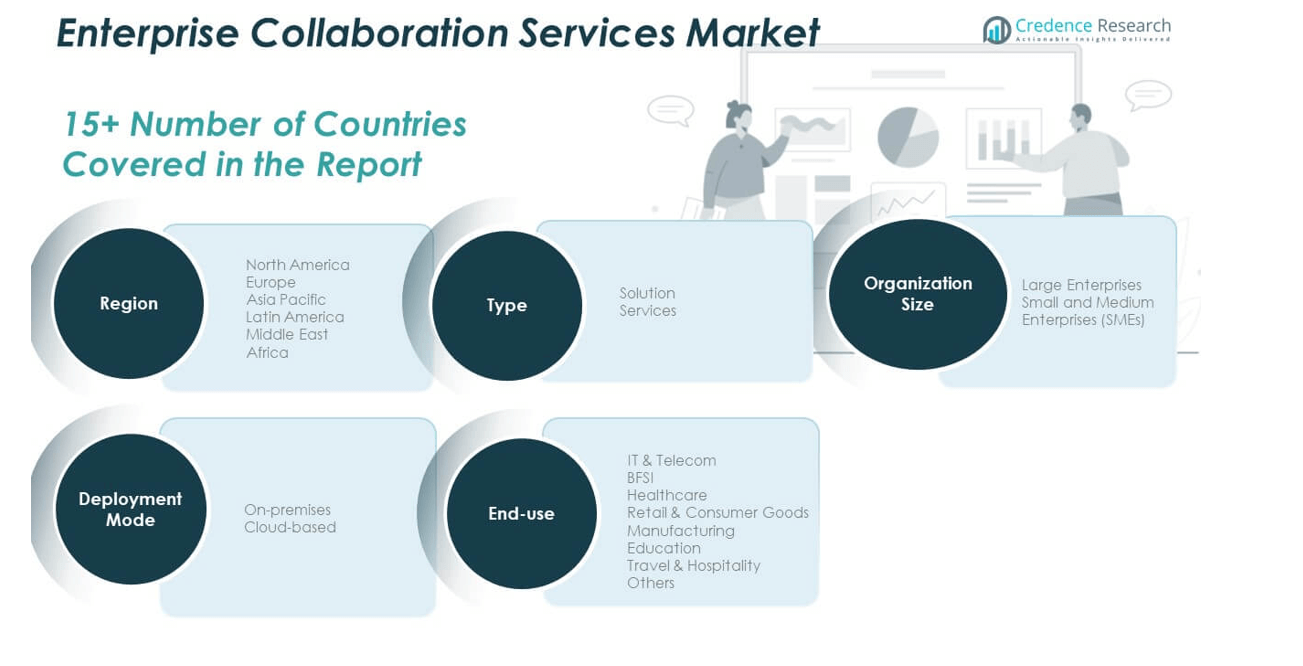
The Enterprise Collaboration Services Market is segmented by type, organization size, deployment mode, and end-use, reflecting diverse enterprise needs.

By type, solutions dominate due to growing demand for integrated platforms offering video conferencing, messaging, and file-sharing tools. Businesses focus on end-to-end systems that improve operational coordination and communication flow. Services follow with rising demand for consulting, integration, and managed support that ensure seamless platform adoption and security compliance. It supports enterprises in customizing collaboration environments aligned with business goals.

By organization size, large enterprises account for a significant share due to extensive use of advanced collaboration infrastructure across global operations. These firms invest in secure, scalable tools that connect teams across regions. Small and medium enterprises (SMEs) show rapid growth as affordable cloud-based platforms enable flexible and remote collaboration without heavy IT investment. It allows SMEs to remain agile and enhance productivity in cost-effective ways.

  • For instance, Google Workspace offers 9% uptime backed by a global infrastructure and is widely used by millions of business users for secure, real-time collaboration across Docs, Sheets, and Meet. It enables seamless teamwork and efficient communication across distributed enterprise environments.

By deployment mode, the cloud-based segment leads due to scalability, cost efficiency, and remote access convenience. Businesses prefer cloud deployment for its integration capability with existing enterprise systems. On-premises models maintain steady demand among organizations prioritizing data control and regulatory compliance. Hybrid models gain traction for balancing flexibility with enhanced data security.

  • For instance, Amazon Web Services (AWS) offers elastic cloud infrastructure with multiple global availability zones designed for high reliability and scalability. Its platform supports collaboration tools such as Amazon Chime, enabling secure, real-time communication and enterprise-grade performance for distributed teams.

By end-use, key adopters include IT & Telecom, BFSI, Healthcare, and Retail & Consumer Goods industries, driven by high data exchange needs and remote team coordination. Manufacturing, Education, and Travel & Hospitality also expand usage for internal communication, training, and customer engagement. It strengthens collaboration efficiency and accelerates digital transformation across industries.

Enterprise Collaboration Services Market segmentation

 Segmentation:

By Type

  • Solution
  • Services

By Organization Size

  • Large Enterprises
  • Small and Medium Enterprises (SMEs)

By Deployment Mode

  • On-premises
  • Cloud-based

By End-Use

  • IT & Telecom
  • BFSI
  • Healthcare
  • Retail & Consumer Goods
  • Manufacturing
  • Education
  • Travel & Hospitality
  • Others

By Region

  • North America
    • U.S.
    • Canada
    • Mexico
  • Europe
    • Germany
    • France
    • U.K.
    • Italy
    • Spain
    • Rest of Europe
  • Asia Pacific
    • China
    • Japan
    • India
    • South Korea
    • South-east Asia
    • Rest of Asia Pacific
  • Latin America
    • Brazil
    • Argentina
    • Rest of Latin America
  • Middle East & Africa
    • GCC Countries
    • South Africa
    • Rest of the Middle East and Africa

Regional Analysis:

North America

The North America Enterprise Collaboration Services Market size was valued at USD 10,548.50 million in 2018 to USD 15,365.05 million in 2024 and is anticipated to reach USD 38,797.50 million by 2032, at a CAGR of 12.3% during the forecast period. North America holds nearly 28.4% of the global share due to advanced ICT infrastructure and high enterprise digitization. The region benefits from widespread adoption of cloud communication tools among major corporations. It shows strong integration of AI-based collaboration platforms that improve workflow automation. Demand grows across IT, telecom, and BFSI sectors for secure, data-driven communication. The presence of key vendors such as Microsoft, Cisco, and Zoom strengthens the ecosystem. Organizations emphasize compliance and security standards for remote operations. Rapid expansion of hybrid work culture across industries drives continuous software innovation.

Europe

The Europe Enterprise Collaboration Services Market size was valued at USD 9,234.50 million in 2018 to USD 13,107.14 million in 2024 and is anticipated to reach USD 31,238.91 million by 2032, at a CAGR of 11.5% during the forecast period. Europe accounts for 24.3% of the global market share. The region witnesses strong uptake driven by digital workplace transformation and remote workforce management. Governments promote secure data sharing under GDPR compliance, encouraging adoption of reliable platforms. Enterprises in Germany, France, and the UK lead demand for collaboration software integrated with cloud and AI. BFSI and manufacturing sectors adopt digital communication tools to enhance coordination. Vendors focus on data sovereignty and regional hosting capabilities. Growing preference for open-source and customizable solutions supports adoption across small firms.

Asia Pacific

The Asia Pacific Enterprise Collaboration Services Market size was valued at USD 12,738.50 million in 2018 to USD 19,427.84 million in 2024 and is anticipated to reach USD 52,753.99 million by 2032, at a CAGR of 13.3% during the forecast period. Asia Pacific leads with 36.8% of the global share, emerging as the fastest-growing region. The region’s rapid digital transformation and strong cloud infrastructure drive collaboration service adoption. Enterprises in China, India, Japan, and South Korea deploy digital platforms to support distributed teams. It experiences expansion across technology, education, and manufacturing sectors. Startups and SMEs adopt affordable cloud-based systems to enhance operational connectivity. Government initiatives promoting smart workplaces accelerate digital adoption. Rising mobile workforce and remote learning trends reinforce market strength.

Latin America

The Latin America Enterprise Collaboration Services Market size was valued at USD 2,226.50 million in 2018 to USD 3,260.42 million in 2024 and is anticipated to reach USD 7,629.72 million by 2032, at a CAGR of 11.3% during the forecast period. Latin America captures 5.3% of the total market share. The region witnesses increasing demand from mid-sized companies seeking affordable digital collaboration tools. Brazil and Mexico dominate usage due to strong enterprise digitalization and expanding cloud networks. It gains momentum from government programs supporting remote business communication. Local vendors provide region-specific collaboration suites adapted to language and infrastructure needs. Businesses integrate collaboration platforms for employee training and remote client servicing. Slow digital infrastructure development remains a challenge, yet cloud expansion offsets limitations.

Middle East

The Middle East Enterprise Collaboration Services Market size was valued at USD 985.50 million in 2018 to USD 1,327.79 million in 2024 and is anticipated to reach USD 2,882.21 million by 2032, at a CAGR of 10.2% during the forecast period. The Middle East accounts for 2.0% of the global share, reflecting steady digital transition. Governments promote collaboration technology to enhance business resilience and workforce efficiency. GCC countries lead adoption with heavy investment in digital workplace modernization. The region’s focus on smart city projects supports demand for connected enterprise solutions. It sees growth in sectors such as banking, education, and healthcare. Vendors introduce secure cloud models compliant with local data regulations. Businesses adopt hybrid work tools to balance productivity and security.

Africa

The Africa Enterprise Collaboration Services Market size was valued at USD 766.50 million in 2018 to USD 1,501.12 million in 2024 and is anticipated to reach USD 3,259.63 million by 2032, at a CAGR of 9.7% during the forecast period. Africa holds 3.0% of the total market share, showing consistent improvement in digital maturity. It experiences growing collaboration adoption across small enterprises and public sectors. South Africa and Egypt dominate usage, supported by expanding broadband and cloud accessibility. Businesses implement digital tools to manage remote operations and workforce communication. It faces infrastructure constraints, but low-cost cloud offerings drive steady progress. Global vendors enter partnerships to localize solutions and improve accessibility. Adoption strengthens in education and service industries that prioritize communication agility.

Shape Your Report to Specific Countries or Regions & Enjoy 30% Off!

Key Player Analysis:

Competitive Analysis:

The Enterprise Collaboration Services Market sees intense competition among vendors offering integrated communication platforms, cloud services and managed collaboration tools. Large incumbents deliver feature-rich suites that combine messaging, video conferencing, document sharing and analytics. Niche providers target SMEs or vertical markets such as healthcare, education or manufacturing with tailored offerings. It drives continuous product improvement and frequent release cycles. Providers invest heavily in security, compliance and data governance to meet the demands of regulated industries. It forces price competition, compelling vendors to provide flexible subscription plans and modular pricing models. Consolidation proceeds through mergers, acquisitions or strategic alliances aimed at expanding geographic reach and capabilities. It raises entry barriers for smaller players lacking scale or compliance infrastructure. Buyers gain broader options, while vendors differentiate through AI-enabled workflows, localized language support and superior customer service. The competitive pressure will shape future market structure and innovation pace.

Recent Developments:

  • In November 2025 Cisco Systems, Inc. announced its intent to acquire two firms: EzDubs and NeuralFabric. The move aims to add real-time AI-driven speech translation and enterprise AI platform capabilities to Cisco’s collaboration solutions.
  • In October 2025, Zoho Corporation Pvt. Ltd. launched Vani, a visual collaboration platform with an infinite canvas, smart templates, and built-in video conferencing to boost team workflows in remote and hybrid settings.

Report Coverage:

The research report offers an in-depth analysis based on type, organization size, deployment mode, and end-use. It details leading market players, providing an overview of their business, product offerings, investments, revenue streams, and key applications. Additionally, the report includes insights into the competitive environment, SWOT analysis, current market trends, as well as the primary drivers and constraints. Furthermore, it discusses various factors that have driven market expansion in recent years. The report also explores market dynamics, regulatory scenarios, and technological advancements that are shaping the industry. It assesses the impact of external factors and global economic changes on market growth. Lastly, it provides strategic recommendations for new entrants and established companies to navigate the complexities of the market.

Future Outlook:

  • The Enterprise Collaboration Services Market will expand with growing hybrid and remote work adoption.
  • AI and automation will transform collaboration efficiency through intelligent assistants and real-time analytics.
  • Cloud-based deployment will continue to dominate, offering scalable and cost-effective solutions for all enterprise sizes.
  • Integration with advanced cybersecurity frameworks will become essential to maintain data privacy and compliance.
  • Mobile-first collaboration tools will gain popularity due to increasing remote workforce mobility.
  • Demand for industry-specific collaboration platforms will rise, driven by customized workflow needs in sectors like healthcare and BFSI.
  • Analytics-enabled collaboration will empower businesses with deeper insights into team performance and communication trends.
  • SMEs will emerge as key adopters due to accessible subscription models and minimal infrastructure needs.
  • Partnerships between software vendors and telecom providers will accelerate the development of unified communication ecosystems.
  • Continuous innovation in AR and VR collaboration tools will enhance immersive team experiences and redefine enterprise engagement.

CHAPTER NO. 1 :      GENESIS OF THE MARKET           

1.1 Market Prelude – Introduction & Scope

1.2 The Big Picture – Objectives & Vision

1.3 Strategic Edge – Unique Value Proposition

1.4 Stakeholder Compass – Key Beneficiaries

CHAPTER NO. 2 :      EXECUTIVE LENS

2.1 Pulse of the Industry – Market Snapshot

2.2 Growth Arc – Revenue Projections (USD Million)

2.3. Premium Insights – Based on Primary Interviews

CHAPTER NO. 3 :      ENTERPRISE COLLABORATION SERVICES MARKET FORCES & INDUSTRY PULSE        

3.1 Foundations of Change – Market Overview
3.2 Catalysts of Expansion – Key Market Drivers
3.2.1 Momentum Boosters – Growth Triggers
3.2.2 Innovation Fuel – Disruptive Technologies
3.3 Headwinds & Crosswinds – Market Restraints
3.3.1 Regulatory Tides – Compliance Challenges
3.3.2 Economic Frictions – Inflationary Pressures
3.4 Untapped Horizons – Growth Potential & Opportunities
3.5 Strategic Navigation – Industry Frameworks
3.5.1 Market Equilibrium – Porter’s Five Forces
3.5.2 Ecosystem Dynamics – Value Chain Analysis
3.5.3 Macro Forces – PESTEL Breakdown

3.6 Price Trend Analysis

3.6.1 Regional Price Trend
3.6.2 Price Trend by product

CHAPTER NO. 4 :      KEY INVESTMENT EPICENTER    

4.1 Regional Goldmines – High-Growth Geographies

4.2 Product Frontiers – Lucrative Product Categories

4.3 Organization Size  Sweet Spots – Emerging Demand Segments

CHAPTER NO. 5: REVENUE TRAJECTORY & WEALTH MAPPING

5.1 Momentum Metrics – Forecast & Growth Curves

5.2 Regional Revenue Footprint – Market Share Insights

5.3 Segmental Wealth Flow – Type & Organization Size  Revenue

CHAPTER NO. 6 :      TRADE & COMMERCE ANALYSIS

6.1.      Import Analysis by Region

6.1.1.    Global Enterprise Collaboration Services Market Import Revenue By Region

6.2.      Export Analysis by Region

6.2.1.    Global Enterprise Collaboration Services Market Export Revenue By Region

CHAPTER NO. 7 :      COMPETITION ANALYSIS 

7.1.      Company Market Share Analysis

7.1.1.    Global Enterprise Collaboration Services Market: Company Market Share

7.2.      Global Enterprise Collaboration Services Market Company Revenue Market Share

7.3.      Strategic Developments

7.3.1.    Acquisitions & Mergers

7.3.2.    New Product Launch

7.3.3.    Regional Expansion

7.4.      Competitive Dashboard

7.5.    Company Assessment Metrics, 2024

CHAPTER NO. 8 :      ENTERPRISE COLLABORATION SERVICES MARKET – BY TYPE SEGMENT ANALYSIS     

8.1.      Enterprise Collaboration Services Market Overview by Type Segment

8.1.1.    Enterprise Collaboration Services Market Revenue Share By Type

8.2.      Solution

8.3.      Services

CHAPTER NO. 9 :      ENTERPRISE COLLABORATION SERVICES MARKET – BY ORGANIZATION SIZE SEGMENT ANALYSIS

9.1.      Enterprise Collaboration Services Market Overview by Organization Size Segment

9.1.1.    Enterprise Collaboration Services Market Revenue Share By Organization Size

9.2.      Large Enterprises

9.3.      Small and Medium Enterprises (SMEs)

CHAPTER NO. 10 :    ENTERPRISE COLLABORATION SERVICES MARKET – BY DEPLOYMENT MODE SEGMENT ANALYSIS

10.1.     Enterprise Collaboration Services Market Overview by Deployment Mode Segment

10.1.1.  Enterprise Collaboration Services Market Revenue Share By Deployment Mode

10.2.     On-premises

10.3.     Cloud-based

CHAPTER NO. 11 :    ENTERPRISE COLLABORATION SERVICES MARKET – BY END-USE SEGMENT ANALYSIS

11.1.     Enterprise Collaboration Services Market Overview by End-use Segment

11.1.1.  Enterprise Collaboration Services Market Revenue Share By End-use

11.2.     IT & Telecom

11.3.     BFSI

11.4.     Healthcare

11.5.     Retail & Consumer Goods

11.6.     Manufacturing

11.7.     Education

11.8.     Travel & Hospitality

11.9.     Others

CHAPTER NO. 12 :    ENTERPRISE COLLABORATION SERVICES MARKET – REGIONAL ANALYSIS        

12.1.     Enterprise Collaboration Services Market Overview by Region Segment

12.1.1.  Global Enterprise Collaboration Services Market Revenue Share By Region

12.1.2.  Regions

12.1.3.  Global Enterprise Collaboration Services Market Revenue By Region

12.1.4.  Type

12.1.5.  Global Enterprise Collaboration Services Market Revenue By Type

12.1.6.  Organization Size

12.1.7.  Global Enterprise Collaboration Services Market Revenue By Organization Size

12.1.8.  Deployment Mode

12.1.9.  Global Enterprise Collaboration Services Market Revenue By Deployment Mode

12.1.10. End-use

12.1.11. Global Enterprise Collaboration Services Market Revenue By End-use

CHAPTER NO. 13 :    NORTH AMERICA ENTERPRISE COLLABORATION SERVICES MARKET – COUNTRY ANALYSIS      

13.1.     North America Enterprise Collaboration Services Market Overview by Country Segment

13.1.1.  North America Enterprise Collaboration Services Market Revenue Share By Region

13.2.     North America

13.2.1.  North America Enterprise Collaboration Services Market Revenue By Country

13.2.2.  Type

13.2.3.  North America Enterprise Collaboration Services Market Revenue By Type

13.2.4.  Organization Size

13.2.5.  North America Enterprise Collaboration Services Market Revenue By Organization Size

13.2.6.  Deployment Mode

13.2.7.  North America Enterprise Collaboration Services Market Revenue By Deployment Mode

13.2.8.  End-use

13.2.9.  North America Enterprise Collaboration Services Market Revenue By End-use

13.3.     U.S.

13.4.     Canada

13.5.     Mexico

CHAPTER NO. 14 :    EUROPE ENTERPRISE COLLABORATION SERVICES MARKET – COUNTRY ANALYSIS 

14.1.     Europe Enterprise Collaboration Services Market Overview by Country Segment

14.1.1.  Europe Enterprise Collaboration Services Market Revenue Share By Region

14.2.     Europe

14.2.1.  Europe Enterprise Collaboration Services Market Revenue By Country

14.2.2.  Type

14.2.3.  Europe Enterprise Collaboration Services Market Revenue By Type

14.2.4.  Organization Size

14.2.5.  Europe Enterprise Collaboration Services Market Revenue By Organization Size

14.2.6.  Deployment Mode

14.2.7.  Europe Enterprise Collaboration Services Market Revenue By Deployment Mode

14.2.8.  End-use

14.2.9.  Europe Enterprise Collaboration Services Market Revenue By End-use

14.3.     UK

14.4.     France

14.5.     Germany

14.6.     Italy

14.7.     Spain

14.8.     Russia

14.9.   Rest of Europe

CHAPTER NO. 15 :    ASIA PACIFIC ENTERPRISE COLLABORATION SERVICES MARKET – COUNTRY ANALYSIS 

15.1.     Asia Pacific Enterprise Collaboration Services Market Overview by Country Segment

15.1.1.  Asia Pacific Enterprise Collaboration Services Market Revenue Share By Region

15.2.     Asia Pacific

15.2.1.  Asia Pacific Enterprise Collaboration Services Market Revenue By Country

15.2.2.  Type

15.2.3.  Asia Pacific Enterprise Collaboration Services Market Revenue By Type

15.2.4.  Organization Size

15.2.5.  Asia Pacific Enterprise Collaboration Services Market Revenue By Organization Size

15.2.6.  Deployment Mode

15.2.7.  Asia Pacific Enterprise Collaboration Services Market Revenue By Deployment Mode

15.2.8.  End-use

15.2.9.  Asia Pacific Enterprise Collaboration Services Market Revenue By End-use

15.3.     China

15.4.     Japan

15.5.     South Korea

15.6.     India

15.7.     Australia

15.8.     Southeast Asia

15.9.     Rest of Asia Pacific

CHAPTER NO. 16 :    LATIN AMERICA ENTERPRISE COLLABORATION SERVICES MARKET – COUNTRY ANALYSIS

16.1.     Latin America Enterprise Collaboration Services Market Overview by Country Segment

16.1.1.  Latin America Enterprise Collaboration Services Market Revenue Share By Region

16.2.     Latin America

16.2.1.  Latin America Enterprise Collaboration Services Market Revenue By Country

16.2.2.  Type

16.2.3.  Latin America Enterprise Collaboration Services Market Revenue By Type

16.2.4.  Organization Size

16.2.5.  Latin America Enterprise Collaboration Services Market Revenue By Organization Size

16.2.6.  Deployment Mode

16.2.7.  Latin America Enterprise Collaboration Services Market Revenue By Deployment Mode

16.2.8.  End-use

16.2.9.  Latin America Enterprise Collaboration Services Market Revenue By End-use

16.3.     Brazil

16.4.     Argentina

16.5.     Rest of Latin America

CHAPTER NO. 17 :    MIDDLE EAST ENTERPRISE COLLABORATION SERVICES MARKET – COUNTRY ANALYSIS

17.1.     Middle East Enterprise Collaboration Services Market Overview by Country Segment

17.1.1.  Middle East Enterprise Collaboration Services Market Revenue Share By Region

17.2.     Middle East

17.2.1.  Middle East Enterprise Collaboration Services Market Revenue By Country

17.2.2.  Type

17.2.3.  Middle East Enterprise Collaboration Services Market Revenue By Type

17.2.4.  Organization Size

17.2.5.  Middle East Enterprise Collaboration Services Market Revenue By Organization Size

17.2.6.  Deployment Mode

17.2.7.  Middle East Enterprise Collaboration Services Market Revenue By Deployment Mode

17.2.8.  End-use

17.2.9.  Middle East Enterprise Collaboration Services Market Revenue By End-use

17.3.     GCC Countries

17.4.     Israel

17.5.     Turkey

17.6.     Rest of Middle East

CHAPTER NO. 18 :    AFRICA ENTERPRISE COLLABORATION SERVICES MARKET – COUNTRY ANALYSIS 

18.1.     Africa Enterprise Collaboration Services Market Overview by Country Segment

18.1.1.  Africa Enterprise Collaboration Services Market Revenue Share By Region

18.2.     Africa

18.2.1.  Africa Enterprise Collaboration Services Market Revenue By Country

18.2.2.  Type

18.2.3.  Africa Enterprise Collaboration Services Market Revenue By Type

18.2.4.  Organization Size

18.2.5.  Africa Enterprise Collaboration Services Market Revenue By Organization Size

18.2.6.  Deployment Mode

18.2.7.  Africa Enterprise Collaboration Services Market Revenue By Deployment Mode

18.2.8.  End-use

18.2.9.  Africa Enterprise Collaboration Services Market Revenue By End-use

18.3.     South Africa

18.4.     Egypt

18.5.     Rest of Africa

CHAPTER NO. 19 :    COMPANY PROFILES         

19.1.     Microsoft

19.1.1.  Company Overview

19.1.2.  Product Portfolio

19.1.3.  Financial Overview

19.1.4.  Recent Developments

19.1.5.  Growth Strategy

19.1.6.  SWOT Analysis

19.2.     Cisco Systems, Inc.

19.3.     Zoom Communications, Inc.

19.4.     Google LLC

19.5.     Salesforce, Inc.

19.6.     SAP SE

19.7.     Cloud Software Group, Inc.

19.8.     Atlassian

19.9.     Igloo Software

19.10.   Zoho Corporation Pvt. Ltd.



Request Free Sample

We prioritize the confidentiality and security of your data. Our promise: your information remains private.

Ready to Transform Data into Decisions?

Request Your Sample Report and Start Your Journey of Informed Choices


Providing the strategic compass for industry titans.

cr-clients-logos

Frequently Asked Questions:

What is the current market size for Enterprise Collaboration Services Market, and what is its projected size in 2032?

The Enterprise Collaboration Services Market was valued at USD 53,989.35 million in 2024 and is projected to reach USD 136,561.96 million by 2032.

At what Compound Annual Growth Rate is the Enterprise Collaboration Services Market projected to grow between 2024 and 2032?

The Enterprise Collaboration Services Market is expected to grow at a CAGR of 12.33% during the forecast period.

How do cloud-based collaboration tools differ from on-premise solutions?

Cloud-based collaboration tools are hosted on remote servers and accessed via the internet, offering scalability and lower upfront costs. In contrast, on-premise solutions are installed locally on an organization’s servers, providing greater control over data but requiring higher initial investments and maintenance.

What are the main benefits of using AI in collaboration tools?

AI enhances collaboration tools by providing features such as automated task management, real-time language translation, and predictive analytics. These capabilities improve efficiency, streamline workflows, and facilitate better decision-making by analyzing and acting on data insights.

Which industries are benefiting the most from enterprise collaboration services?

Industries such as healthcare, finance, education, and manufacturing are significantly benefiting from enterprise collaboration services. These tools help streamline operations, enhance communication, and manage complex workflows, leading to increased efficiency and better organizational outcomes.

What factors should businesses consider when choosing a collaboration tool?

Businesses should consider factors such as integration capabilities with existing systems, data security and compliance, scalability to accommodate growth, and user-friendliness. These considerations ensure the chosen tool meets organizational needs and enhances overall productivity.

Who are the leading companies in the Enterprise Collaboration Services Market?

Key players in the Enterprise Collaboration Services Market include Microsoft, Cisco, Zoom, Google, Salesforce, SAP, and Atlassian.

About Author

Sushant Phapale

Sushant Phapale

ICT & Automation Expert

Sushant is an expert in ICT, automation, and electronics with a passion for innovation and market trends.

View Profile

Related Reports

Online Project Management Software Market

Online Project Management Software Market size was valued USD 7 billion in 2024 and is anticipated to reach USD 11.67 billion by 2032, at a CAGR of 6.6% during the forecast period.

Web Content Filtering Market

The Web Content Filtering Market was valued at USD 5,147.5 million in 2024 and is projected to reach USD 13,869.5 million by 2032, expanding at a CAGR of 13.19% during the forecast period (2025–2032)

Purpose Built Backup Appliance (PBBA) Market

Purpose Built Backup Appliance (PBBA) Market size was valued USD 8.6 billion in 2024 and is anticipated to reach USD 19.25 billion by 2032, at a CAGR of 10.6% during the forecast period.

Digital Transformation Market

The Digital Transformation Market was valued at USD 1,194.46 Billion in 2024 and is anticipated to reach USD 6,912.64 Billion by 2032, growing at a CAGR of 24.54% during the forecast period.

RF-Over-Fiber Market

RF-Over-Fiber Market size was valued USD 648.5 million in 2024 and is anticipated to reach USD 1173.91 million by 2032, at a CAGR of 7.7% during the forecast period.

Trade Surveillance Market

The Global Trade Surveillance Market size was valued at USD 1,000.00 million in 2018 to USD 1,934.72 million in 2024 and is anticipated to reach USD 8,486.85 million by 2032, at a CAGR of 20.46% during the forecast period.

Trade Management Software Market

The Global Trade Management Software Market size was valued at USD 3,200.00 million in 2018 to USD 4,121.74 million in 2024 and is anticipated to reach USD 7,279.16 million by 2032, at a CAGR of 7.44% during the forecast period.

Thyristor Market

The Global Thyristor Market size was valued at USD 1,360.00 million in 2018 to USD 1,567.63 million in 2024 and is anticipated to reach USD 2,280.83 million by 2032, at a CAGR of 4.86% during the forecast period.

Industrial Wireless Instrumentation Market

Industrial Wireless Instrumentation Market size was valued at USD 6.28 Billion in 2024 and is anticipated to reach USD 10.79 Billion by 2032, at a CAGR of 7% during the forecast period

Data Science And Predictive Analytics Market

The Data Science and Predictive Analytics Market was valued at USD 14.39 billion in 2024 and is projected to reach USD 56.32 billion by 2032, expanding at a CAGR of 18.6% during the forecast period.

Tokenization Market

The Global Tokenization Market size was valued at USD 1,200.00 million in 2018, rising to USD 2,524.75 million in 2024, and is anticipated to reach USD 14,936.54 million by 2032, at a CAGR of 24.99% during the forecast period.

India E-Commerce Market

India E commerce Market size was valued USD 124998 million in 2024 and is anticipated to reach USD 379719.8 million by 2032, at a CAGR of 14.9% during the forecast period.

Licence Option

The report comes as a view-only PDF document, optimized for individual clients. This version is recommended for personal digital use and does not allow printing. Use restricted to one purchaser only.
$4999

To meet the needs of modern corporate teams, our report comes in two formats: a printable PDF and a data-rich Excel sheet. This package is optimized for internal analysis. Unlimited users allowed within one corporate location (e.g., regional office).
$6999

The report will be delivered in printable PDF format along with the report’s data Excel sheet. This license offers 100 Free Analyst hours where the client can utilize Credence Research Inc. research team. Permitted for unlimited global use by all users within the purchasing corporation, such as all employees of a single company.
$12999

Report delivery within 24 to 48 hours

Credence Staff 3

WILLIAM, North America

Support Staff at Credence Research

KEITH PHILLIPS, Europe

Lee - CR Sales Staff

LEE VALLANCE, Asia Pacific

Kieran Jameson

KIERAN JAMESON, Australia

Smallform of Sample request
User Review

Thank you for the data! The numbers are exactly what we asked for and what we need to build our business case.

Materials Scientist
(privacy requested)

User Review

The report was an excellent overview of the Industrial Burners market. This report does a great job of breaking everything down into manageable chunks.

Imre Hof
Management Assistant, Bekaert

cr-clients-logos

Request Sample