| REPORT ATTRIBUTE |
DETAILS |
| Historical Period |
2020-2023 |
| Base Year |
2024 |
| Forecast Period |
2025-2032 |
| Hand Sanitizer Marke Size 2024 |
USD 3,965.0 million |
| Hand Sanitizer Marke, CAGR |
3.22% |
| Hand Sanitizer Marke Size 2032 |
USD 5,124.9 million |
Market Overview:
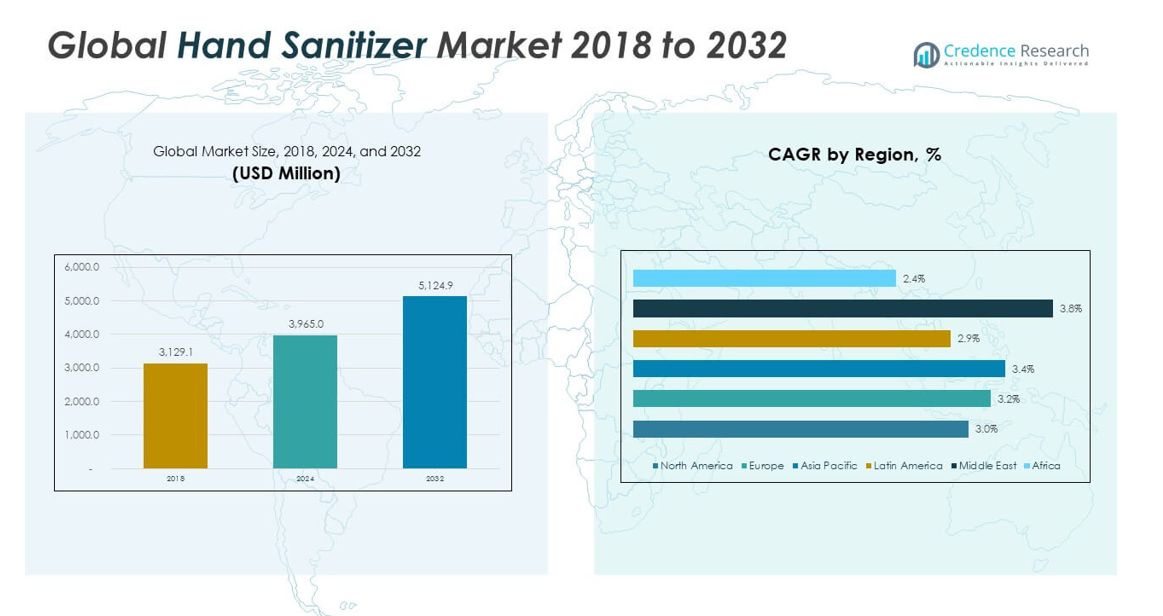
The Hand Sanitizer Market size was valued at USD 3,129.1 million in 2018 to USD 3,965.0 million in 2024 and is anticipated to reach USD 5,124.9 million by 2032, at a CAGR of 3.22% during the forecast period.
One of the primary drivers of the hand sanitizer market is the sustained emphasis on infection prevention across public and private spaces. Heightened consumer awareness regarding the transmission of bacteria and viruses has significantly influenced personal hygiene habits, leading to increased daily use of sanitizers at home, in schools, offices, and healthcare settings. Government guidelines and health organization campaigns promoting hand hygiene continue to support demand, especially in institutional and medical environments. In response to changing consumer expectations, manufacturers are developing alcohol-based and alcohol-free formulations, as well as products with moisturizing and skin-protective properties. Eco-friendly packaging and sustainable production methods are gaining traction, reflecting the growing demand for ethical and environmentally responsible hygiene products. Additionally, the rise of e-commerce and direct-to-consumer channels has improved product accessibility and boosted sales, particularly for niche and premium hand sanitizer brands.
Regionally, the market exhibits distinct patterns. North America holds a significant share of the global hand sanitizer market, with steady growth supported by advanced healthcare infrastructure and high public health awareness. Leading brands such as GOJO Industries and Reckitt maintain a strong foothold in this region. Asia-Pacific represents the fastest-growing market due to increasing population density, improved hygiene standards, and expanding disposable incomes in countries like China, India, and Japan. Consumer education campaigns and pandemic-driven behavioral shifts have strengthened product penetration across rural and urban segments. In Europe, stringent regulations ensure high product quality and safety, while demand continues to rise in public and institutional settings. Meanwhile, Latin America, the Middle East, and Africa are emerging markets, where increasing investment in public health and growing awareness of hand hygiene are gradually driving adoption.
Market Insights:
- The Hand Sanitizer Market was valued at USD 3,965.0 million in 2024 and is projected to reach USD 5,124.9 million by 2032, growing at a CAGR of 3.22%.
- Increased awareness of personal hygiene and infection prevention continues to drive daily use of hand sanitizers in homes, offices, schools, and healthcare facilities.
- Regulatory support and mandatory sanitization protocols across public institutions have solidified sanitizer usage as a health essential.
- Innovation in product formulations, such as alcohol-free, scented, and moisturizing variants, is attracting niche consumer groups and expanding brand loyalty.
- Growth in e-commerce and digital retail channels has improved access and visibility, especially for premium and direct-to-consumer brands.
- The market faces challenges like demand normalization post-COVID, pricing pressure, and regulatory compliance, especially for smaller manufacturers.
- Regionally, North America holds a major market share, Asia Pacific is the fastest-growing region, and Europe maintains steady demand under strict quality standards.
Access crucial information at unmatched prices!
Request your sample report today & start making informed decisions powered by Credence Research Inc.!
Download Sample
Market Drivers:
Rising Health Awareness and Hygiene Standards Across All Consumer Segments
Growing awareness of personal hygiene and its direct link to health protection continues to drive demand in the Hand Sanitizer Market. Public health campaigns by organizations such as the WHO and CDC have emphasized the importance of hand hygiene to prevent the spread of communicable diseases, including influenza, MRSA, and COVID-19. This awareness has penetrated both developed and developing economies, fostering a shift in consumer behavior toward frequent hand sanitization. It has led to a surge in household consumption as individuals incorporate sanitizers into their daily routines. The emphasis on hand hygiene in public spaces such as transport hubs, malls, and schools also supports sustained demand. The Hand Sanitizer Market benefits from this behavioral shift, as consumers increasingly prioritize products that offer both convenience and effective germ protection.
Government Regulations and Institutional Support Bolstering Product Usage
Regulatory bodies and health ministries across regions have introduced policies to promote the use of hand sanitizers in healthcare and public settings. Mandatory installation of sanitizing stations in offices, educational institutions, airports, and government buildings has become commonplace in many countries. These efforts have helped normalize regular sanitizer use beyond health emergencies. Governments often collaborate with manufacturers during crises to ensure an uninterrupted supply of sanitizing products, reinforcing their role as essential items. Public-private initiatives aimed at improving hygiene infrastructure have created a reliable foundation for long-term market expansion. The Hand Sanitizer Market leverages this institutional backing to maintain consistent product visibility and user engagement.
- For instance, Kimberly-Clark’s Scott® Pro Automatic Hand Sanitizer Dispenser, which dispenses 1.2 mL per use and is certified to deliver over 60,000 cycles per battery change, was chosen for its reliability and compliance with CDC recommendations. During the COVID-19 pandemic.
Product Innovation and Expansion into Niche Consumer Preferences
The market has seen a wave of innovation as companies diversify product offerings to meet varied consumer preferences. Innovations include alcohol-free formulas for sensitive skin, scented variants, moisturizing ingredients, and eco-conscious packaging. These developments not only enhance user experience but also attract segments such as children, elderly users, and individuals with dermatological concerns. Brands have also introduced compact packaging formats to cater to on-the-go lifestyles. It helps the Hand Sanitizer Market tap into convenience-driven demand while building consumer loyalty. With increasing competition, continuous product differentiation plays a central role in securing market share and expanding consumer appeal.
- For example, GOJO’s PURELL® Advanced Hand Sanitizer Green Certified Foam was the first to receive the EcoLogo™ certification, meeting UL 2783 standards for reduced environmental impact.
E-commerce Growth and Expanding Retail Distribution Channels
The widespread growth of e-commerce has significantly improved access to hand sanitizers, especially in remote areas and underserved regions. Online platforms enable both established players and niche brands to reach wider audiences without the limitations of traditional retail. Consumer preference for doorstep delivery and easy product comparisons has accelerated online purchases. Retail expansion through pharmacies, supermarkets, and specialty stores further strengthens the distribution network. It ensures product availability across multiple touchpoints, fostering higher frequency of purchase. The Hand Sanitizer Market benefits from this channel diversification, which enhances market penetration and supports sustained revenue growth.
Market Trends:
Growing Shift Toward Natural and Skin-Friendly Formulations
Consumer preference is moving toward hand sanitizers that use natural, organic, and skin-friendly ingredients. Awareness of skin sensitivity and long-term effects of alcohol-based products has encouraged manufacturers to develop gentle alternatives. These include products enriched with aloe vera, essential oils, and glycerin to prevent dryness and irritation. It aligns with the rising demand for wellness-oriented hygiene solutions. Brands that emphasize non-toxic, dermatologically tested, and eco-conscious ingredients are gaining traction. The Hand Sanitizer Market is witnessing strong consumer interest in these formulations, especially among health-conscious and premium product buyers.
- For instance, the Green Beaver Company’s Antiseptic Spray Hand Sanitizer features a 100% natural formula with 70% plant-based ethanol exceeding Health Canada’s minimum requirement of 60% and is enriched with vegetable glycerin to prevent skin dryness and irritation.
Increased Demand for Premium and Niche Product Offerings
The market is seeing a clear segmentation between value-based offerings and premium products with added benefits. Consumers are seeking sanitizers that go beyond basic disinfection, looking for features such as fragrance, anti-aging properties, or packaging aesthetics. Luxury hand sanitizers are now marketed through high-end retailers, hotels, and spas, reflecting their entry into lifestyle and beauty categories. It is helping brands elevate perceived value and differentiate themselves in a saturated market. Niche products targeting children, travel users, or sensitive skin types are also seeing increasing demand. The Hand Sanitizer Market is becoming more diverse in product positioning to meet this evolving consumer behavior.
- For example, Luxury dispensers, such as Nova of California’s Luxe Tabletop Touchless Hand Sanitizer Dispenser, combine high-end design with technical performance—dispensing 1,000 mL per fill, powered by a battery with a two-year life, and achieving 99.9% effectiveness in microbial reduction, as verified for use in premium hospitality venues.
Integration of Sustainable Packaging and Ethical Branding
Sustainability is becoming a key trend across the personal care and hygiene sectors, and the hand sanitizer segment is no exception. Consumers are paying more attention to recyclable packaging, biodegradable bottles, and reduced plastic usage. Companies are responding with eco-certified containers, refillable packaging options, and ethical sourcing labels. It reflects broader societal expectations around corporate responsibility and environmental impact. Brands that invest in green production processes and transparent communication are more likely to attract environmentally aware customers. The Hand Sanitizer Market is adapting to these values, which are reshaping product design and supply chain strategies.
Adoption of Digital and Direct-to-Consumer Sales Strategies
Digital platforms are playing a larger role in shaping how consumers discover and purchase hand sanitizers. E-commerce growth, fueled by convenience and accessibility, has become central to market expansion. Brands are using social media, influencer partnerships, and targeted advertising to increase visibility and build loyalty. It allows even smaller or emerging companies to gain rapid traction without relying solely on traditional retail outlets. Direct-to-consumer sales models are gaining popularity for enabling better customer interaction and higher margins. The Hand Sanitizer Market is leveraging digital engagement to enhance reach, collect consumer insights, and scale efficiently.
Market Challenges Analysis:
Regulatory Compliance and Quality Assurance Requirements Limit Market Flexibility
The hand sanitizer market operates under stringent regulatory scrutiny, especially concerning alcohol content, antimicrobial claims, and product labeling. Regulatory bodies such as the FDA and equivalent international agencies enforce safety and efficacy standards that manufacturers must meet to maintain market access. These requirements can delay product launches and increase compliance costs, particularly for smaller companies with limited resources. Frequent changes in health guidelines can also create uncertainty in product formulation and marketing strategies. It places continuous pressure on companies to invest in quality testing, documentation, and certifications. The Hand Sanitizer Market must maintain high consistency and transparency to meet these regulatory expectations across multiple regions.
Market Saturation and Declining Post-Pandemic Demand Impact Growth Trajectory
The rapid influx of new brands during the COVID-19 pandemic led to intense market saturation and competitive pricing. As consumer urgency declines in the post-pandemic period, demand has normalized, affecting sales volumes for many players. Price wars and heavy discounting have eroded margins and created challenges in maintaining brand loyalty. It forces companies to differentiate through innovation or niche targeting, which may require additional investment. Many smaller or opportunistic brands face difficulties sustaining operations amid reduced demand and increased competition. The Hand Sanitizer Market must adapt to this changing environment by aligning production with actual consumption patterns and focusing on long-term positioning.
Market Opportunities:
Rising Demand for Innovative and Specialized Hygiene Solutions
Consumers increasingly seek hand sanitizers that align with their specific health, lifestyle, and environmental values. This trend opens up opportunities for brands offering alcohol-free, dermatologically tested, or organic formulations. Companies can expand their portfolios with value-added features such as moisturizing properties, child-safe packaging, or fragrance options. It supports differentiation in a competitive market and helps build brand loyalty. Demand is also growing in professional sectors like food service, education, and public transport, where tailored sanitizer products can meet institutional needs. The Hand Sanitizer Market can leverage these niche demands to diversify its consumer base and create new revenue streams.
Expanding Reach Through Digital and Emerging Retail Channels
E-commerce growth and omnichannel strategies offer powerful tools to penetrate new markets and consumer segments. Direct-to-consumer models allow for greater control over branding, pricing, and customer engagement. It enables companies to respond quickly to market trends and collect real-time feedback for product refinement. Strategic partnerships with online marketplaces and subscription-based offerings can increase recurring sales. Demand for convenient delivery and easy access continues to favor digital platforms. The Hand Sanitizer Market can capitalize on this shift by investing in digital infrastructure and expanding into underpenetrated regions through online and hybrid retail models.
Market Segmentation Analysis:
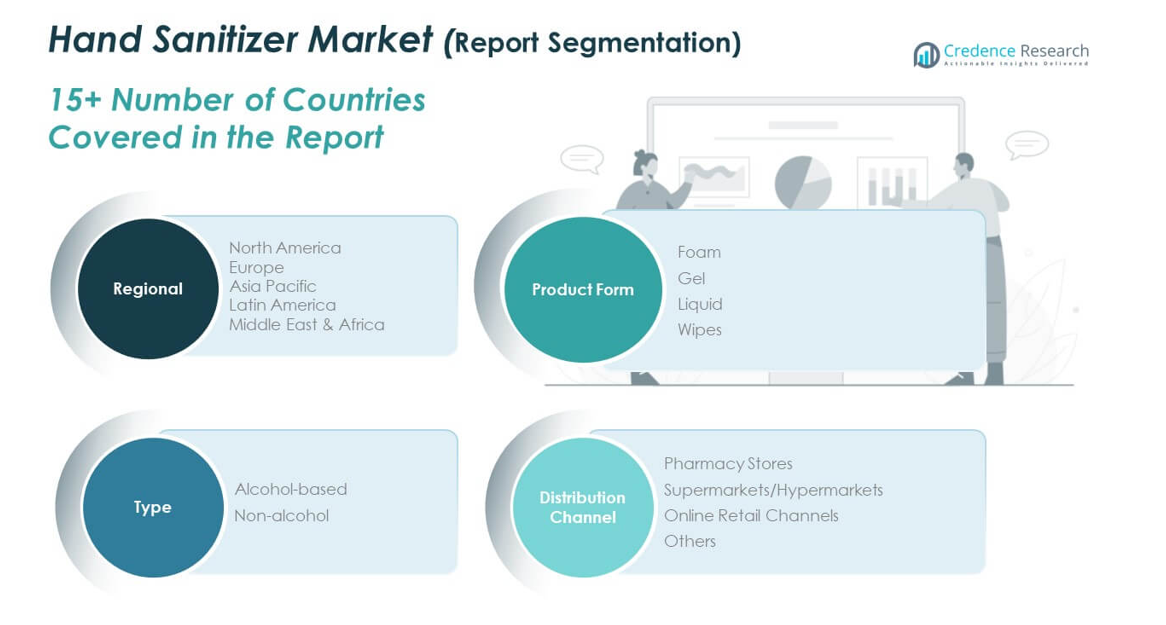
The Hand Sanitizer Market is segmented by product type, type, and distribution channel, each contributing uniquely to overall market dynamics.
By product type, gel-based sanitizers hold the largest share due to their ease of application and widespread availability across consumer and institutional settings. Foam sanitizers are gaining traction for their quick-drying properties and skin-friendly appeal, particularly in healthcare environments. Liquid variants cater to both personal and industrial applications, while wipes serve as a convenient option for on-the-go usage and surface disinfection.
- For example, Purell Advanced Hand Sanitizer Gel, contains 70% ethyl alcohol and is widely used in both consumer and institutional settings due to its ease of application and quick-drying properties. This product is consistently cited in company documentation as the market leader for gel-based formats, supporting its dominant share
By type, alcohol-based sanitizers dominate the market, driven by their proven effectiveness against a broad spectrum of pathogens. Healthcare guidelines and consumer trust continue to support their strong market presence. Non-alcohol sanitizers are steadily expanding, appealing to consumers with sensitive skin and preferences for natural or child-safe alternatives.
By distribution channel, pharmacy stores and supermarkets/hypermarkets remain primary retail sources due to their physical reach and brand visibility. Online retail channels are witnessing the fastest growth, supported by convenience, expanding product ranges, and rising digital adoption. It benefits from multi-channel accessibility, enabling both legacy brands and emerging players to scale rapidly across diverse consumer segments.
- For instance, Walmart Acts as a major retail channel offering an extensive product range and accessibility. Walmart’s corporate disclosures highlight its role in making hand sanitizers available to a broad consumer base.
Segmentation:
By Product Type:
By Type:
- Alcohol-based
- Non-alcohol
By Distribution Channel:
- Pharmacy Stores
- Supermarkets/Hypermarkets
- Online Retail Channels
- Others
By Region:
- North America
- Europe
- Germany
- France
- U.K.
- Italy
- Spain
- Rest of Europe
- Asia Pacific
- China
- Japan
- India
- South Korea
- South-east Asia
- Rest of Asia Pacific
- Latin America
- Brazil
- Argentina
- Rest of Latin America
- Middle East & Africa
- GCC Countries
- South Africa
- Rest of the Middle East and Africa
Regional Analysis:
North America
The North America Hand Sanitizer Market size was valued at USD 650.23 million in 2018 to USD 814.59 million in 2024 and is anticipated to reach USD 1,036.76 million by 2032, at a CAGR of 3.0% during the forecast period. North America accounts for nearly 21% of the global market share, driven by advanced healthcare infrastructure and high consumer awareness regarding hygiene practices. It benefits from strong institutional demand from hospitals, offices, schools, and public facilities. Leading brands such as GOJO Industries and Reckitt dominate the regional landscape through widespread retail availability and strong brand equity. Continued investment in product innovation and sustainability further supports market competitiveness. The Hand Sanitizer Market in North America also experiences stable demand through both B2B and B2C channels.
Europe
The Europe Hand Sanitizer Market size was valued at USD 879.60 million in 2018 to USD 1,114.57 million in 2024 and is anticipated to reach USD 1,440.60 million by 2032, at a CAGR of 3.2% during the forecast period. Europe represents roughly 28% of the global market share, supported by stringent regulatory frameworks and a strong culture of health-conscious consumerism. It maintains steady demand from healthcare, hospitality, and education sectors, where compliance and safety standards are strictly enforced. European consumers prefer eco-friendly, dermatologically tested products, encouraging brands to focus on natural and sustainable formulations. The region also supports local and organic brands through specialized retail outlets and pharmacies. The Hand Sanitizer Market in Europe continues to evolve through premium product positioning and innovation in packaging.
Asia Pacific
The Asia Pacific Hand Sanitizer Market size was valued at USD 1,170.92 million in 2018 to USD 1,495.27 million in 2024 and is anticipated to reach USD 1,952.58 million by 2032, at a CAGR of 3.4% during the forecast period. Asia Pacific holds the largest market share globally at nearly 37%, fueled by growing hygiene awareness, rapid urbanization, and rising middle-class incomes. It benefits from strong demand in densely populated countries like China, India, and Japan, where public health initiatives have improved access to sanitization products. Rising e-commerce penetration supports widespread product availability and consumer access. Local manufacturers are increasingly active, offering affordable and innovative products tailored to regional preferences. The Hand Sanitizer Market in Asia Pacific continues to expand across both urban and rural segments.
Latin America
The Latin America Hand Sanitizer Market size was valued at USD 198.39 million in 2018 to USD 246.28 million in 2024 and is anticipated to reach USD 309.54 million by 2032, at a CAGR of 2.9% during the forecast period. Latin America accounts for around 6% of global market share, with gradual growth supported by rising public health investments and hygiene education campaigns. It shows increasing demand from hospitals, transportation hubs, and urban households. Supply chain challenges and price sensitivity remain barriers to faster adoption in some regions. Brands focus on affordable, multi-purpose formulations to capture broader segments. The Hand Sanitizer Market in Latin America shows steady potential through partnerships with local distributors and institutional buyers.
Middle East
The Middle East Hand Sanitizer Market size was valued at USD 159.90 million in 2018 to USD 209.58 million in 2024 and is anticipated to reach USD 282.89 million by 2032, at a CAGR of 3.8% during the forecast period. The region holds nearly 5% of global market share and benefits from growing awareness in hospitality, healthcare, and religious tourism sectors. It experiences consistent institutional demand from airports, mosques, and public venues. Premium and luxury hand sanitizer products perform well in urban centers like Dubai, where consumers value branded, high-quality offerings. Import dependence presents challenges for pricing and logistics. The Hand Sanitizer Market in the Middle East continues to expand through retail diversification and private label growth.
Africa
The Africa Hand Sanitizer Market size was valued at USD 70.09 million in 2018 to USD 84.74 million in 2024 and is anticipated to reach USD 102.50 million by 2032, at a CAGR of 2.4% during the forecast period. Africa contributes around 3% to the global market share, with slower growth driven by uneven access to hygiene products across regions. Government campaigns and aid-supported health programs have improved product visibility in urban and semi-urban areas. Price and availability remain critical factors influencing purchase behavior. Local production is limited, increasing reliance on imports and affecting affordability. The Hand Sanitizer Market in Africa shows long-term potential through targeted distribution strategies and public health investments.
Shape Your Report to Specific Countries or Regions & Enjoy 30% Off!
Key Player Analysis:
- Chattem, Inc.
- Reckitt Benckiser Group
- Procter & Gamble
- Best Sanitizers, Inc.
- The Himalaya Drug Company
- 3M
- Deb Group Ltd (S.C. Johnson & Son, Inc.)
- Certus Medical
- ECOLAB
- Gojo Industries, Inc.
- Henkel Corporation
- Unilever Plc.
- VI-Jon Laboratories Inc.
Competitive Analysis:
The Hand Sanitizer Market features a highly competitive landscape dominated by global and regional players focusing on innovation, brand strength, and distribution efficiency. Key companies include GOJO Industries, Reckitt Benckiser, The Himalaya Drug Company, Unilever, Procter & Gamble, and 3M. It sees continuous product development in terms of formulation, scent, and skin-friendly ingredients to differentiate offerings and capture consumer interest. Strategic partnerships, acquisitions, and expansion into e-commerce channels have strengthened market positions. Local manufacturers in emerging markets are gaining traction by offering cost-effective alternatives and region-specific formulations. It remains dynamic, with players investing in marketing, eco-conscious packaging, and dermatological testing to retain consumer loyalty. The Hand Sanitizer Market continues to evolve through sustained competition, where both scale and specialization contribute to long-term growth opportunities.
Recent Developments:
- In May 2025, Church & Dwight Co., Inc. announced the acquisition of the rapidly growing Touchland® hand sanitizer brand for up to USD 880 million. The agreement includes USD 700 million in cash and stock, followed by a contingent payment up to USD 180 million upon achieving 2025 sales targets.
- In January 2025, Touchland introduced its first fragrance line Power Essence Mist under its hand sanitizer brand. The new product delivers a dual-purpose hair and body mist formulated with hyaluronic acid, panthenol, and niacinamide to counterbalance the drying effects of its alcohol base. It launched in eight unique scents ranging from Mango Mojo to Cashmere Woods across its website, Sephora, and Ulta Beauty. It reflects the brand’s strategy to expand beyond sanitizers into lifestyle fragrance and wellness categories
Market Concentration & Characteristics:
The Hand Sanitizer Market displays moderate market concentration, with a mix of multinational corporations and regional manufacturers competing across product categories and price points. It is characterized by high product visibility, brand-driven consumer preferences, and frequent innovation in packaging and formulation. Leading players hold significant market share in North America and Europe, while local producers play a stronger role in price-sensitive regions such as Asia Pacific and Africa. It demonstrates low entry barriers, encouraging new entrants during health crises or demand surges. Product differentiation through scent, ingredients, skin compatibility, and sustainability features is a key competitive factor. The Hand Sanitizer Market also shows seasonal and event-driven demand spikes, especially during outbreaks or public health campaigns.
Report Coverage:
The research report offers an in-depth analysis based on product type, type, and distribution channel. It details leading market players, providing an overview of their business, product offerings, investments, revenue streams, and key applications. Additionally, the report includes insights into the competitive environment, SWOT analysis, current market trends, as well as the primary drivers and constraints. Furthermore, it discusses various factors that have driven market expansion in recent years. The report also explores market dynamics, regulatory scenarios, and technological advancements that are shaping the industry. It assesses the impact of external factors and global economic changes on market growth. Lastly, it provides strategic recommendations for new entrants and established companies to navigate the complexities of the market.
Future Outlook:
- Demand for skin-friendly and alcohol-free formulations will increase among health-conscious consumers.
- E-commerce and direct-to-consumer channels will drive faster product access and brand visibility.
- Sustainable packaging and biodegradable ingredients will gain importance in purchasing decisions.
- Emerging economies will present growth opportunities through public health initiatives and hygiene education.
- Institutional demand from healthcare, education, and hospitality sectors will remain steady.
- Product innovation will focus on multifunctional sanitizers with added skincare or fragrance benefits.
- Private label brands will expand in price-sensitive regions due to competitive pricing.
- Strategic mergers and acquisitions will reshape competitive dynamics in mature markets.
- Regulations around formulation and marketing claims will tighten across key regions.
- Seasonal health trends and awareness campaigns will influence short-term demand patterns.



