Home » Consumer Goods » Residential Air Purifier Market

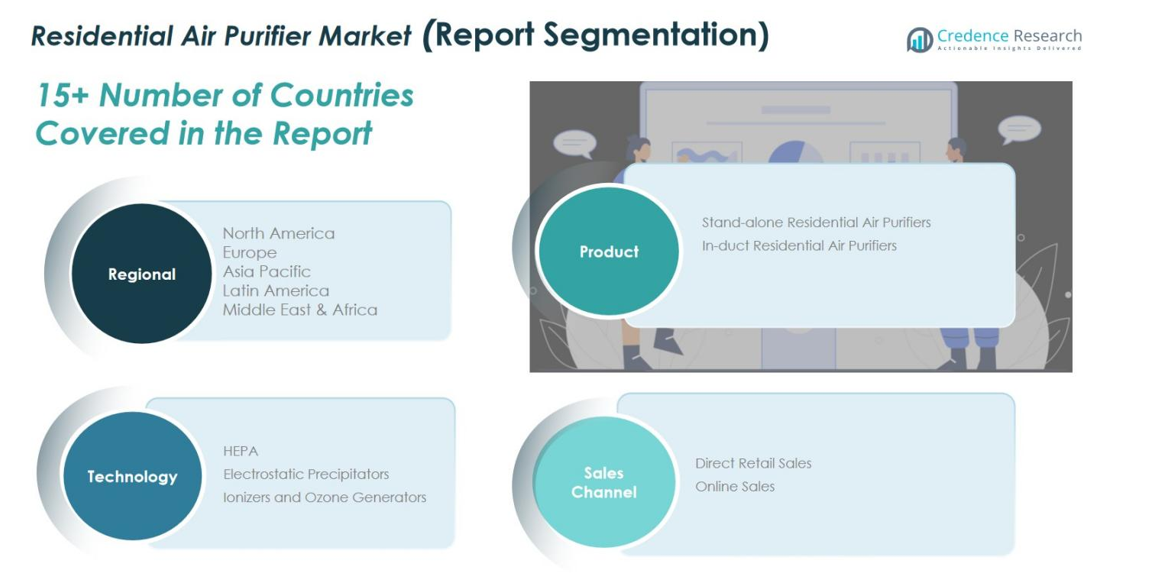
Residential Air Purifier Market By Product (Stand-alone Residential Air Purifiers, In-duct Residential Air Purifiers); By Technology (HEPA, Electrostatic Precipitators, Ionizers and Ozone Generators); By Sales Channel (Direct Retail Sales, Online Sales) – Growth, Share, Opportunities & Competitive Analysis, 2024 – 2032

Report ID: 9390 | Report Format : Excel, PDF

Market Overview:

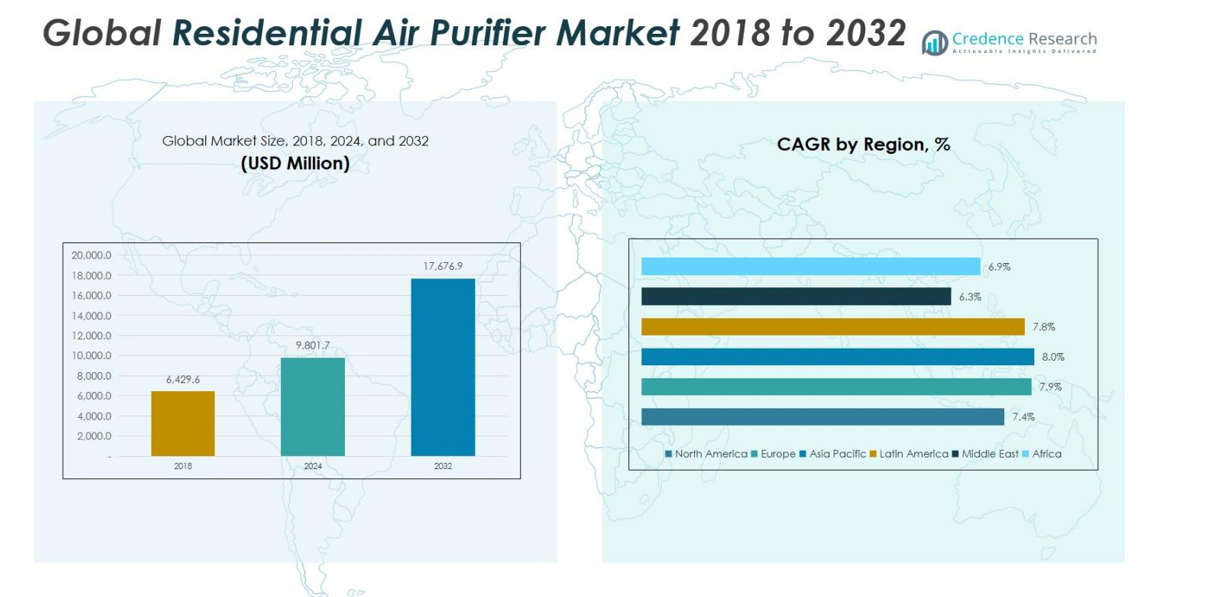
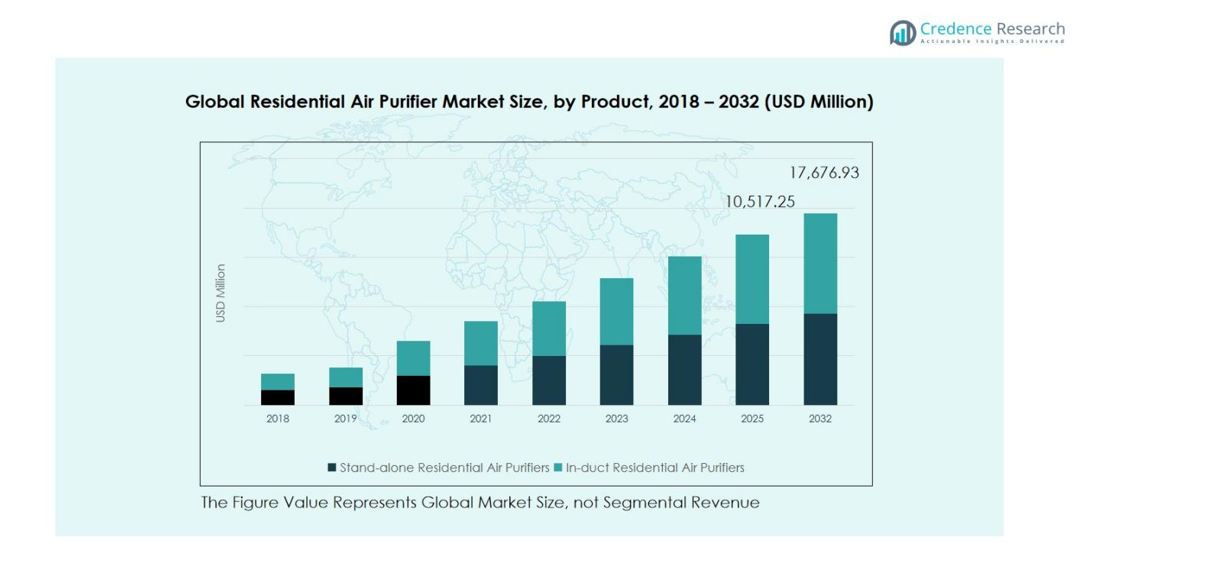
Residential Air Purifier Market size was valued at USD 6,429.6 Million in 2018, growing to USD 9,801.7 Million in 2024, and is anticipated to reach USD 17,676.9 Million by 2032, at a CAGR of 7.70% during the forecast period.

REPORT ATTRIBUTE DETAILS
Historical Period 2020-2023
Base Year 2024
Forecast Period 2025-2032
Residential Air Purifier Market Size 2024 USD 9,801.7 Million
Residential Air Purifier Market, CAGR 7.70%
Residential Air Purifier Market Size 2032 USD 17,676.9 Million


The Residential Air Purifier Market is highly competitive, led by prominent players such as Daikin Industries, Ltd., Sharp Corporation, Honeywell International, Inc., LG Electronics Inc., Camfil AB, Whirlpool Corporation, AllerAir Industries, Inc., Blueair AB, Winix Co., Ltd, and Airgle Corporation. These companies drive market growth through continuous innovation, advanced filtration technologies, and expansion of distribution channels. HEPA-based and smart residential air purifiers are key focus areas, allowing players to differentiate and capture consumer attention. Regionally, Asia Pacific dominates the market, holding approximately 29% of the global share in 2018, followed by Europe with 24% and North America with 22%. High urban pollution levels, rising health awareness, and growing adoption of energy-efficient and connected devices in these regions fuel demand. Strategic partnerships, R&D, and expansion into emerging markets remain critical for maintaining competitive advantage and sustaining long-term growth.

Residential Air Purifier Market size

Market Insights

  • The Residential Air Purifier Market was valued at USD 9,801.7 Million in 2024 and is projected to reach USD 17,676.9 Million by 2032, growing at a CAGR of 7.70%.
  • Rising urban air pollution, increasing health awareness, and technological advancements in HEPA and smart air purifiers are driving market growth.
  • Key trends include the adoption of smart and connected devices with IoT integration, energy-efficient and eco-friendly products, and increasing preference for stand-alone residential air purifiers, which account for 65% of the market.
  • The market is competitive, led by companies such as Daikin Industries, Ltd., Sharp Corporation, Honeywell International, Inc., LG Electronics Inc., Camfil AB, Whirlpool Corporation, and Blueair AB. Continuous innovation, distribution expansion, and R&D investments are key strategies.
  • Regionally, Asia Pacific dominates with 29% market share, followed by Europe at 24% and North America at 22%, while emerging markets in Latin America, Middle East, and Africa are witnessing steady adoption.

Access crucial information at unmatched prices!

Request your sample report today & start making informed decisions powered by Credence Research Inc.!

Download Sample

Market Segmentation Analysis:

By Product:

The residential air purifier market by product is primarily divided into stand-alone and in-duct air purifiers. Stand-alone residential air purifiers dominate the market, accounting for 65% of the total revenue. Their popularity stems from portability, ease of installation, and flexibility for individual room usage. Consumers increasingly prefer compact devices for bedrooms and living areas, driving demand. In contrast, in-duct air purifiers, while suitable for whole-home applications, face higher installation costs and maintenance requirements, limiting their adoption. Rising awareness about indoor air quality and increasing urban pollution levels continue to fuel the growth of stand-alone units.

  • For instance, Coway’s Airmega AP-1512HH Mighty, a best-selling portable model tested by Wirecutter, exemplifies consumer preference for compact, high-performance devices suitable for individual rooms like bedrooms and living areas.

By Technology:

Among various technologies, HEPA-based residential air purifiers hold the largest market share at 58%, driven by their proven efficiency in trapping fine particulate matter, allergens, and airborne pollutants. Electrostatic precipitators and ionizers, including ozone generators, cater to niche segments due to specific applications and lower energy consumption but contribute less to overall revenue. The increasing prevalence of respiratory disorders, coupled with heightened consumer preference for certified HEPA filtration, supports sustained growth. Product innovations enhancing filter life and noise reduction further reinforce HEPA technology’s dominance.

  • For instance, Fantech’s HEPA filtration system captures 99.97% of particles as small as 0.3 microns, making it ideal for home and commercial use up to 3,000 sq. ft., with a three-stage process including carbon pre-filters enhancing air quality.

By Sales Channel:

In terms of sales channels, direct retail sales account for 60% of the market, driven by the availability of personalized consultation, in-store product demonstrations, and instant product availability. Online sales are growing rapidly, supported by e-commerce convenience, wider product variety, and competitive pricing, representing about 40% of market revenue. The shift toward digital retail is accelerated by increasing smartphone penetration and home delivery services. Consumers are leveraging online platforms for detailed product reviews and comparisons, influencing purchase decisions and expanding reach for emerging brands.

Key Growth Drivers

Rising Air Pollution Levels

Increasing urbanization and industrial activities have significantly worsened air quality, especially in metropolitan regions. The growing concentration of particulate matter, allergens, and harmful gases has led to heightened health concerns, particularly respiratory and cardiovascular issues. Consumers are increasingly prioritizing indoor air quality to protect family health, driving the adoption of residential air purifiers. Governments and environmental agencies are also promoting awareness about air pollution mitigation, further encouraging household investments in air purification solutions. This trend positions the market for sustained growth across both developed and emerging regions.

  • For instance, the World Health Organization highlights that indoor air pollution from household cooking methods, such as the use of solid fuels, significantly contributes to health issues in many developing countries, including India and Bangladesh.

Growing Health Awareness

Heightened awareness about the impact of indoor air pollutants on health is fueling demand for residential air purifiers. Consumers are increasingly recognizing the importance of controlling allergens, dust, smoke, and microbial contamination to prevent chronic respiratory conditions and enhance overall well-being. The preference for technologically advanced filtration systems, such as HEPA and activated carbon filters, reflects the shift toward health-conscious lifestyles. Regular health campaigns and media coverage of indoor air quality risks reinforce this trend, encouraging households to invest in effective air purification solutions.

  • For instance, Coway’s AirMega Aim utilizes a long-life HEPA filter capable of sustaining up to approximately 8,500 hours of use, targeting allergens and dust effectively in urban environments.

Technological Advancements in Air Purifiers

Continuous innovation in air purifier technologies is expanding market potential. Developments in HEPA filtration, electrostatic precipitators, ionizers, and smart devices with IoT integration improve performance, energy efficiency, and user convenience. Features such as real-time air quality monitoring, automated operation, and low-noise design enhance user experience, increasing adoption rates. Manufacturers are also focusing on sustainable and low-maintenance solutions, which appeal to eco-conscious consumers. These technological enhancements are driving premium product adoption and enabling companies to differentiate offerings in a competitive residential air purifier market.

Residential Air Purifier Market share

Key Trends & Opportunities

Trend of Smart and Connected Devices

The increasing integration of IoT and smart technologies in residential air purifiers is reshaping consumer preferences. Wi-Fi-enabled devices, smartphone apps, and voice control allow users to monitor indoor air quality remotely and automate purifier functions, enhancing convenience and efficiency. Smart sensors adjust purification levels based on real-time air quality, reducing energy consumption. This trend also supports subscription-based filter replacement services, creating recurring revenue opportunities for manufacturers. Adoption of connected devices aligns with rising demand for smart homes, providing both convenience and health benefits to end-users.

  • For instance, Xiaomi’s Mi Air Purifier 4, which connects to the Mi Home app for remote monitoring and control, and uses laser particle sensors to modulate its fan speed based on detected pollution levels.

Rising Preference for Eco-Friendly and Energy-Efficient Products

Consumers are increasingly favoring energy-efficient and environmentally sustainable air purifiers, aligning with global sustainability goals. Devices with low power consumption, recyclable filters, and eco-friendly materials are gaining traction, particularly among urban households. Manufacturers are responding by designing products that meet energy certifications and reduce environmental impact while maintaining high purification efficiency. This trend not only addresses environmental concerns but also lowers operational costs for consumers, driving adoption. Energy-efficient solutions present opportunities for market growth, especially in regions with stringent energy regulations and high electricity costs.

  • For instance, Briiv offers an eco-friendly air purifier with biodegradable filters made from natural materials such as coconut fiber and moss, which decompose naturally after use.

Key Challenges

High Initial Cost of Advanced Air Purifiers

One of the primary challenges in the residential air purifier market is the high purchase cost of technologically advanced devices. Premium models with HEPA filtration, smart connectivity, and multi-stage purification often carry significant price tags, which can restrict adoption among price-sensitive consumers. The maintenance costs, including filter replacements and energy consumption, further deter potential buyers. Despite rising awareness of health benefits, affordability remains a barrier, especially in emerging markets, slowing market penetration and challenging manufacturers to balance performance with cost-effectiveness.

Lack of Consumer Awareness in Emerging Markets

In several emerging regions, limited awareness of indoor air pollution risks hampers residential air purifier adoption. Many consumers are unfamiliar with the health benefits of air purification or the differences in filtration technologies. Misconceptions regarding device efficiency and maintenance requirements contribute to hesitancy in purchase decisions. This challenge necessitates intensified educational campaigns, marketing initiatives, and demonstration programs by manufacturers to bridge knowledge gaps. Without targeted awareness strategies, market growth in these regions may remain slow despite the rising need for clean indoor air.

Regional Analysis

North America

North America accounted for 22% of the global residential air purifier market in 2018, with a market size of USD 1,521.89 million. The region is projected to reach USD 2,278.06 million in 2024 and USD 4,007.36 million by 2032, expanding at a CAGR of 7.4%. Growth is fueled by increasing urbanization, rising air pollution levels, and high consumer awareness of indoor air quality. The U.S. leads regional demand, driven by the adoption of HEPA-based and smart air purifiers. Stringent government regulations and growing preference for technologically advanced, energy-efficient devices further support market expansion.

Europe

Europe represented 24% of the global market in 2018, with a value of USD 1,700.63 million. The market is expected to reach USD 2,624.06 million in 2024 and USD 4,808.13 million by 2032, growing at a CAGR of 7.9%. Key drivers include increasing health awareness, rising incidence of respiratory diseases, and stringent air quality regulations. Germany, France, and the UK dominate adoption, favoring HEPA filtration and smart air purifiers. Technological innovations, eco-friendly designs, and urban pollution concerns continue to accelerate market growth across the region.

Asia Pacific

Asia Pacific held the largest share, roughly 29% of the global market in 2018, valued at USD 2,065.19 million. The region is projected to grow to USD 3,196.20 million in 2024 and USD 5,879.35 million by 2032, at a CAGR of 8.0%. Rising industrialization, severe urban pollution, and growing disposable incomes drive adoption. China, Japan, and India lead demand for stand-alone and HEPA-based air purifiers. Increased awareness of respiratory health, rising middle-class populations, and adoption of smart, connected devices further bolster market growth across Asia Pacific.

Latin America

Latin America accounted for 10% of the global market in 2018, with a size of USD 693.11 million. The market is expected to reach USD 1,061.25 million in 2024 and USD 1,925.02 million by 2032, reflecting a CAGR of 7.8%. Growth is supported by rising urban pollution, expanding middle-class households, and growing awareness of indoor air quality. Brazil and Argentina dominate the regional market, with increasing demand for stand-alone and HEPA air purifiers. E-commerce growth and the convenience of online sales channels are also driving adoption across Latin America.

Middle East

The Middle East contributed 4% of the global market in 2018, valued at USD 307.34 million. The market is projected to reach USD 435.76 million in 2024 and USD 707.08 million by 2032, growing at a CAGR of 6.3%. Adoption is driven by desert dust, urban pollution, and rising health awareness in GCC countries, Israel, and Turkey. Consumers are increasingly preferring energy-efficient, technologically advanced, and smart air purifiers. Government initiatives promoting air quality awareness and the expansion of premium residential projects further support regional market growth.

Africa

Africa held about 2% of the global market in 2018, with a market size of USD 141.45 million. The market is expected to grow to USD 206.40 million in 2024 and USD 350.00 million by 2032, at a CAGR of 6.9%. Urbanization, growing concerns about indoor air pollution, and rising awareness among middle-class consumers are key drivers. South Africa and Egypt lead adoption, favoring cost-effective and stand-alone air purifiers. Limited consumer awareness and economic constraints remain challenges; however, increasing income levels and government campaigns are expected to support gradual market expansion.

Residential Air Purifier Market segmentation

Market Segmentations:

By Product:

  • Stand-alone Residential Air Purifiers
  • In-duct Residential Air Purifiers

By Technology:

  • HEPA
  • Electrostatic Precipitators
  • Ionizers and Ozone Generators

By Sales Channel:

  • Direct Retail Sales
  • Online Sales

By Region:

  • North America
    • U.S.
    • Canada
    • Mexico
  • Europe
    • Germany
    • France
    • U.K.
    • Italy
    • Spain
    • Rest of Europe
  • Asia Pacific
    • China
    • Japan
    • India
    • South Korea
    • South-east Asia
    • Rest of Asia Pacific
  • Latin America
    • Brazil
    • Argentina
    • Rest of Latin America
  • Middle East & Africa
    • GCC Countries
    • South Africa
    • Rest of the Middle East and Africa

Competitive Landscape

The competitive landscape of the residential air purifier market is characterized by strong presence of key players such as Daikin Industries, Ltd., Sharp Corporation, Honeywell International, Inc., LG Electronics Inc., Camfil AB, Whirlpool Corporation, AllerAir Industries, Inc., Blueair AB, Winix Co., Ltd, and Airgle Corporation. These companies compete through continuous product innovation, expansion of distribution channels, and strategic partnerships to enhance market presence. Manufacturers focus on technologically advanced air purifiers, including HEPA, smart, and energy-efficient models, to meet evolving consumer demands. Emphasis on R&D, superior filtration technologies, and eco-friendly designs allows players to differentiate their offerings. Additionally, aggressive marketing, after-sales service, and regional expansion strategies strengthen brand loyalty and market share. Smaller local manufacturers also contribute to market growth by offering cost-effective solutions, particularly in emerging regions, intensifying competition while driving product accessibility.

Shape Your Report to Specific Countries or Regions & Enjoy 30% Off!

Key Player Analysis

  • Daikin Industries, Ltd.
  • Sharp Corporation
  • Honeywell International, Inc.
  • LG Electronics Inc.
  • Camfil AB
  • Whirlpool Corporation
  • AllerAir Industries, Inc.
  • Blueair AB
  • Winix Co., Ltd
  • Airgle Corporation
  • Others

Recent Developments

  • In May 2025, Madison Industries acquired Research Products Corporation (RPC) to strengthen its portfolio of residential and commercial indoor air quality solutions.
  • In July 2025, Air Support Project partnered with ATOM Innovation to launch the VELLO XL, a next-generation air purifier designed to make clean indoor air more accessible to households.
  • In September 2025, Dyson introduced the HushJet Purifier Compact HJ10, featuring advanced electrostatic HEPA filtration and ultra-quiet operation to enhance home air purification efficiency

Report Coverage

The research report offers an in-depth analysis based on Product, Technology, Sales Channel and Region. It details leading market players, providing an overview of their business, product offerings, investments, revenue streams, and key applications. Additionally, the report includes insights into the competitive environment, SWOT analysis, current market trends, as well as the primary drivers and constraints. Furthermore, it discusses various factors that have driven market expansion in recent years. The report also explores market dynamics, regulatory scenarios, and technological advancements that are shaping the industry. It assesses the impact of external factors and global economic changes on market growth. Lastly, it provides strategic recommendations for new entrants and established companies to navigate the complexities of the market.

Future Outlook

  1. The market is expected to witness steady growth driven by rising urban air pollution.
  2. Increasing health awareness will continue to boost demand for residential air purifiers.
  3. HEPA and multi-stage filtration technologies will remain the preferred choice among consumers.
  4. Smart and connected air purifiers with IoT integration will gain higher adoption.
  5. Energy-efficient and eco-friendly products will see growing preference in both developed and emerging regions.
  6. Online sales channels will expand, complementing direct retail distribution.
  7. Asia Pacific is projected to remain the largest regional market with rapid adoption.
  8. Product innovations focusing on low noise, compact design, and automated operation will drive consumer interest.
  9. Emerging markets will offer new growth opportunities with increasing urbanization and disposable incomes.
  10. Manufacturers will focus on strategic partnerships, R&D, and regional expansion to strengthen market position.

CHAPTER NO. 1 :             GENESIS OF THE MARKET           

1.1 Market Prelude – Introduction & Scope

1.2 The Big Picture – Objectives & Vision

1.3 Strategic Edge – Unique Value Proposition

1.4 Stakeholder Compass – Key Beneficiaries

CHAPTER NO. 2 :             EXECUTIVE LENS

2.1 Pulse of the Industry – Market Snapshot

2.2 Growth Arc – Revenue Projections (USD Million)

2.3. Premium Insights – Based on Primary Interviews

CHAPTER NO. 3 :             RESIDENTIAL AIR PURIFIER MARKET FORCES & INDUSTRY PULSE

3.1 Foundations of Change – Market Overview
3.2 Catalysts of Expansion – Key Market Drivers
3.2.1 Momentum Boosters – Growth Triggers
3.2.2 Innovation Fuel – Disruptive Technologies
3.3 Headwinds & Crosswinds – Market Restraints
3.3.1 Regulatory Tides – Compliance Challenges
3.3.2 Economic Frictions – Inflationary Pressures
3.4 Untapped Horizons – Growth Potential & Opportunities
3.5 Strategic Navigation – Industry Frameworks
3.5.1 Market Equilibrium – Porter’s Five Forces
3.5.2 Ecosystem Dynamics – Value Chain Analysis
3.5.3 Macro Forces – PESTEL Breakdown

CHAPTER NO. 4 : KEY INVESTMENT EPICENTER 

4.1 Regional Goldmines – High-Growth Geographies

4.2 Product Frontiers – Lucrative Product Categories

4.3 Sales Channel Vehicles Sweet Spots – Emerging Demand Segments

CHAPTER NO. 5: REVENUE TRAJECTORY & WEALTH MAPPING

5.1 Momentum Metrics – Forecast & Growth Curves

5.2 Regional Revenue Footprint – Market Share Insights

5.3 Segmental Wealth Flow – Product, Technology, and Sales Channel Vehicles Revenue

CHAPTER NO. 6 : TRADE & COMMERCE ANALYSIS           

6.1.        Import Analysis By Region

6.1.1.     Global Residential Air Purifier Market Import Revenue By Region

6.2.        Export Analysis By Region

6.2.1.     Global Residential Air Purifier Market Export Revenue By Region

CHAPTER NO. 7 :             COMPETITION ANALYSIS            

7.1.        Company Market Share Analysis

7.1.1.     Global Residential Air Purifier Market: Company Market Share

7.2.        Global Residential Air Purifier Market Company Revenue Market Share

7.3.        Strategic Developments

7.3.1.     Acquisitions & Mergers

7.3.2.     New Product Launch

7.3.3.     Regional Expansion

7.4.        Competitive Dashboard

7.5.      Company Assessment Metrics, 2024

CHAPTER NO. 8 : RESIDENTIAL AIR PURIFIER MARKET – BY PRODUCT SEGMENT ANALYSIS

8.1.        Residential Air Purifier Market Overview By Product Segment

8.1.1.     Residential Air Purifier Market Revenue Share By Product

8.2.       Stand-alone Residential Air Purifiers

8.3.       In-duct Residential Air Purifiers

CHAPTER NO. 9 : RESIDENTIAL AIR PURIFIER MARKET – BY TECHNOLOGY SEGMENT ANALYSIS

9.1.        Residential Air Purifier Market Overview By Technology Segment

9.1.1.     Residential Air Purifier Market Revenue Share By Technology

9.2.      HEPA

9.3.      Electrostatic Precipitators

9.4.      Ionizers and Ozone Generators

CHAPTER NO. 10 : RESIDENTIAL AIR PURIFIER MARKET – BY SALES CHANNEL VEHICLES SEGMENT ANALYSIS

10.1.      Residential Air Purifier Market Overview By Sales Channel Vehicles Segment

10.1.1.  Residential Air Purifier Market Revenue Share By Sales Channel Vehicles

10.2.    Direct Retail Sales

10.3.    Online Sales

CHAPTER NO. 11 : RESIDENTIAL AIR PURIFIER MARKET – REGIONAL ANALYSIS

11.1.      Residential Air Purifier Market Overview By Region Segment

11.1.1.  Global Residential Air Purifier Market Revenue Share By Region

10.1.2.  Regions

11.1.3.  Global Residential Air Purifier Market Revenue By Region

11.1.4.  Product

11.1.5.  Global Residential Air Purifier Market Revenue By Product

11.1.6.  Technology

11.1.7. Global Residential Air Purifier Market Revenue By Technology

11.1.8.  Sales Channel Vehicles

11.1.9. Global Residential Air Purifier Market Revenue By Sales Channel Vehicles

CHAPTER NO. 12 : NORTH AMERICA RESIDENTIAL AIR PURIFIER MARKET – COUNTRY ANALYSIS

12.1.      North America Residential Air Purifier Market Overview By Country Segment

12.1.1.  North America Residential Air Purifier Market Revenue Share By Region

12.2.      North America

12.2.1.  North America Residential Air Purifier Market Revenue By Country

12.2.2.  Product

12.2.3.  North America Residential Air Purifier Market Revenue By Product

12.2.4.  Technology

12.2.5.  North America Residential Air Purifier Market Revenue By Technology

12.2.6.  Sales Channel Vehicles

12.2.7.  North America Residential Air Purifier Market Revenue By Sales Channel Vehicles

12.3.      U.S.

12.4.      Canada

12.5.      Mexico

CHAPTER NO. 13 : EUROPE RESIDENTIAL AIR PURIFIER MARKET – COUNTRY ANALYSIS

13.1.      Europe Residential Air Purifier Market Overview By Country Segment

13.1.1.  Europe Residential Air Purifier Market Revenue Share By Region

13.2.      Europe

13.2.1.  Europe Residential Air Purifier Market Revenue By Country

13.2.2.  Product

13.2.3.  Europe Residential Air Purifier Market Revenue By Product

13.2.4.  Technology

13.2.5.  Europe Residential Air Purifier Market Revenue By Technology

13.2.6.  Sales Channel Vehicles

13.2.7.  Europe Residential Air Purifier Market Revenue By Sales Channel Vehicles

13.3.      UK

13.4.      France

13.5.      Germany

13.6.      Italy

13.7.      Spain

13.8.      Russia

13.9.    Rest of Europe

CHAPTER NO. 14 : ASIA PACIFIC RESIDENTIAL AIR PURIFIER MARKET – COUNTRY ANALYSIS

14.1.      Asia Pacific Residential Air Purifier Market Overview By Country Segment

14.1.1.  Asia Pacific Residential Air Purifier Market Revenue Share By Region

14.2.      Asia Pacific

14.2.1.  Asia Pacific Residential Air Purifier Market Revenue By Country

14.2.2.  Product

14.2.3.  Asia Pacific Residential Air Purifier Market Revenue By Product

14.2.4.  Technology

14.2.5.  Asia Pacific Residential Air Purifier Market Revenue By Technology

14.2.6.  Sales Channel Vehicles

14.2.7.  Asia Pacific Residential Air Purifier Market Revenue By Sales Channel Vehicles

14.3.      China

14.4.      Japan

14.5.      South Korea

14.6.      India

14.7.      Australia

14.8.      Southeast Asia

14.9.      Rest of Asia Pacific

CHAPTER NO. 15 : LATIN AMERICA RESIDENTIAL AIR PURIFIER MARKET – COUNTRY ANALYSIS

15.1.      Latin America Residential Air Purifier Market Overview By Country Segment

15.1.1.  Latin America Residential Air Purifier Market Revenue Share By Region

15.2.      Latin America

15.2.1.  Latin America Residential Air Purifier Market Revenue By Country

15.2.2.  Product

15.2.3.  Latin America Residential Air Purifier Market Revenue By Product

15.2.4.  Technology

15.2.5.  Latin America Residential Air Purifier Market Revenue By Technology

15.2.6.  Sales Channel Vehicles

15.2.7.  Latin America Residential Air Purifier Market Revenue By Sales Channel Vehicles

15.3.      Brazil

15.4.      Argentina

15.5.      Rest of Latin America

CHAPTER NO. 16 : MIDDLE EAST RESIDENTIAL AIR PURIFIER MARKET – COUNTRY ANALYSIS

16.1.      Middle East Residential Air Purifier Market Overview By Country Segment

16.1.1.  Middle East Residential Air Purifier Market Revenue Share By Region

16.2.      Middle East

16.2.1.  Middle East Residential Air Purifier Market Revenue By Country

16.2.2.  Product

16.2.3.  Middle East Residential Air Purifier Market Revenue By Product

16.2.4.  Technology

16.2.5.  Middle East Residential Air Purifier Market Revenue By Technology

16.2.6.  Sales Channel Vehicles

16.2.7.  Middle East Residential Air Purifier Market Revenue By Sales Channel Vehicles

16.3.      GCC Countries

16.4.      Israel

16.5.      Turkey

16.6.      Rest of Middle East

CHAPTER NO. 17 : AFRICA RESIDENTIAL AIR PURIFIER MARKET – COUNTRY ANALYSIS

17.1.      Africa Residential Air Purifier Market Overview By Country Segment

17.1.1.  Africa Residential Air Purifier Market Revenue Share By Region

17.2.      Africa

17.2.1.  Africa Residential Air Purifier Market Revenue By Country

17.2.2.  Product

17.2.3.  Africa Residential Air Purifier Market Revenue By Product

17.2.4.  Technology

17.2.5.  Africa Residential Air Purifier Market Revenue By Technology

17.2.6.  Sales Channel Vehicles

17.2.7.  Africa Residential Air Purifier Market Revenue By Sales Channel Vehicles

17.3.      South Africa

17.4.      Egypt

17.5.      Rest of Africa

CHAPTER NO. 18 : COMPANY PROFILES

18.1.      Daikin Industries, Ltd.

18.1.1.  Company Overview

18.1.2.  Product Portfolio

18.1.3.  Financial Overview

18.1.4.  Recent Developments

18.1.5.  Growth Strategy

18.1.6.  SWOT Analysis

18.2.    Sharp Corporation

18.3.    Honeywell International, Inc.

18.4.    LG Electronics Inc.

18.5.    Camfil AB

18.6.   Whirlpool Corporation

18.7.   AllerAir Industries, Inc.

18.8.   Blueair AB

18.9.   Winix Co., Ltd

18.10.  Airgle Corporation

18.11.  Other Key Players

Request Free Sample

We prioritize the confidentiality and security of your data. Our promise: your information remains private.

Ready to Transform Data into Decisions?

Request Your Sample Report and Start Your Journey of Informed Choices


Providing the strategic compass for industry titans.

cr-clients-logos

Frequently Asked Question

What is the current market size for Residential Air Purifier Market, and what is its projected size in 2032?

The Residential Air Purifier Market is valued at USD 9,801.7 Million in 2024 and is projected to reach USD 17,676.9 Million by 2032.

At what Compound Annual Growth Rate is the Residential Air Purifier Market projected to grow between 2025 and 2032?

The Residential Air Purifier Market is expected to grow at a CAGR of 7.70% during the forecast period.

Which Residential Air Purifier Market segment held the largest share in 2024?

The stand-alone residential air purifiers segment dominated the Residential Air Purifier Market in 2024, accounting for 65% of total revenue.

What are the primary factors fueling the growth of the Residential Air Purifier Market?

Rising urban air pollution, growing health awareness, and technological advancements in air purifiers are key drivers of the Residential Air Purifier Market.

Who are the major players in this market?

Key players in the Residential Air Purifier Market include Daikin Industries, Ltd., Sharp Corporation, Honeywell International, Inc., LG Electronics Inc., Camfil AB, Whirlpool Corporation, and others.

Which region commanded the largest share of the Residential Air Purifier Market in 2024?

Asia Pacific led the Residential Air Purifier Market in 2024, accounting for the largest regional share due to rapid adoption and rising urban pollution.

About Author

Rajdeep Kumar Deb

Rajdeep Kumar Deb

Lead Analyst – Consumer & Finance

Rajdeep brings a decade of consumer goods and financial services insight to strategic market analysis.

View Profile

Related Reports

Hand Sanitizer Gel Market

Hand Sanitizer Gel Market size was valued USD 7.23 Billion in 2024 and is anticipated to reach USD 8.65 Billion by 2032, at a CAGR of 2.27% during the forecast period.

Japan Cleaning Products Market

The Japan Cleaning Products Market size was valued at USD  35,234.17 million in 2018 to USD 41,125.91 million in 2024 and is anticipated to reach USD  59,146.08 million by 2032, at a CAGR of 4.65% during the forecast period.

India Cleaning Products Market

The India Cleaning Products Market size was valued at USD  22,343.62 million in 2018 to USD 26,584.91 million in 2024 and is anticipated to reach USD  44,030.58 million by 2032, at a CAGR of 6.51% during the forecast period.

Asia Pacific Compression Sportswear Market

Asia Pacific Compression Sportswear Market size was valued at USD 1,080.23 million in 2024 and is anticipated to reach USD 2,046.15 million by 2032, at a CAGR of 8.31% during the forecast period (2024-2032).

Women’s Clothing Market

Women’s Clothing market size was valued USD 1069.98 billion in 2024 and is anticipated to reach USD 1377.68 billion by 2032, at a CAGR of 3.21% during the forecast period.

Cat Furniture and Scratchers Market

The Cat Furniture and Scratchers Market is projected to grow from USD 1,279.8 million in 2024 to an estimated USD 2,009.22 million by 2032, with a compound annual growth rate (CAGR) of 5.8% from 2024 to 2032.

5-Gallon Water Bottles Market

The 5-Gallon Water Bottles Market is projected to grow from USD 1,179.8 million in 2024 to an estimated USD 1,824.4 million by 2032, reflecting a CAGR of 5.6% from 2024 to 2032.

Germany K-Beauty Product Market

The Germany K-beauty Products Market size was valued at USD 2,436.10 million in 2018 to USD 2,906.50 million in 2024 and is anticipated to reach USD 5,141.40 million by 2032, at a CAGR of 7.40% during the forecast period.

Laundry Care Market

Laundry Care Market size was valued USD 109.68 Billion in 2024 and is anticipated to reach USD 155.97 Billion by 2032, at a CAGR of 4.5% during the forecast period.

Plastic Nursing Bottle Market

The Plastic Nursing Bottle market was valued at USD 3.35 billion in 2024 and is expected to reach USD 4.65 billion by 2032, expanding at a CAGR of 4.18% during the forecast period.

Grout Cleaning Equipment Market

The grout cleaning equipment market size was valued at USD 261.27 Million in 2024 and is anticipated to reach USD 392.83 Million by 2032, at a CAGR of 5.23 % during the forecast period.

Candles Market

The candles market size was valued at USD 14054.5 million in 2024 and is anticipated to reach USD 22741.1 million by 2032, at a CAGR of 6.2 % during the forecast period.

Licence Option

The report comes as a view-only PDF document, optimized for individual clients. This version is recommended for personal digital use and does not allow printing. Use restricted to one purchaser only.
$4999

To meet the needs of modern corporate teams, our report comes in two formats: a printable PDF and a data-rich Excel sheet. This package is optimized for internal analysis. Unlimited users allowed within one corporate location (e.g., regional office).
$6999

The report will be delivered in printable PDF format along with the report’s data Excel sheet. This license offers 100 Free Analyst hours where the client can utilize Credence Research Inc. research team. Permitted for unlimited global use by all users within the purchasing corporation, such as all employees of a single company.
$12999

Report delivery within 24 to 48 hours

Credence Staff 3

WILLIAM, North America

Support Staff at Credence Research

KEITH PHILLIPS, Europe

Lee - CR Sales Staff

LEE VALLANCE, Asia Pacific

Kieran Jameson

KIERAN JAMESON, Australia

Smallform of Sample request
User Review

Thank you for the data! The numbers are exactly what we asked for and what we need to build our business case.

Materials Scientist
(privacy requested)

User Review

The report was an excellent overview of the Industrial Burners market. This report does a great job of breaking everything down into manageable chunks.

Imre Hof
Management Assistant, Bekaert

cr-clients-logos

Request Sample