| REPORT ATTRIBUTE |
DETAILS |
| Historical Period |
2020-2023 |
| Base Year |
2024 |
| Forecast Period |
2025-2032 |
| Isoparaffin Market Size 2024 |
USD 1,061.73 Million |
| Isoparaffin Market, CAGR |
6.47% |
| Isoparaffin Market Size 2032 |
USD 1,817.12 Million |
Market Overview
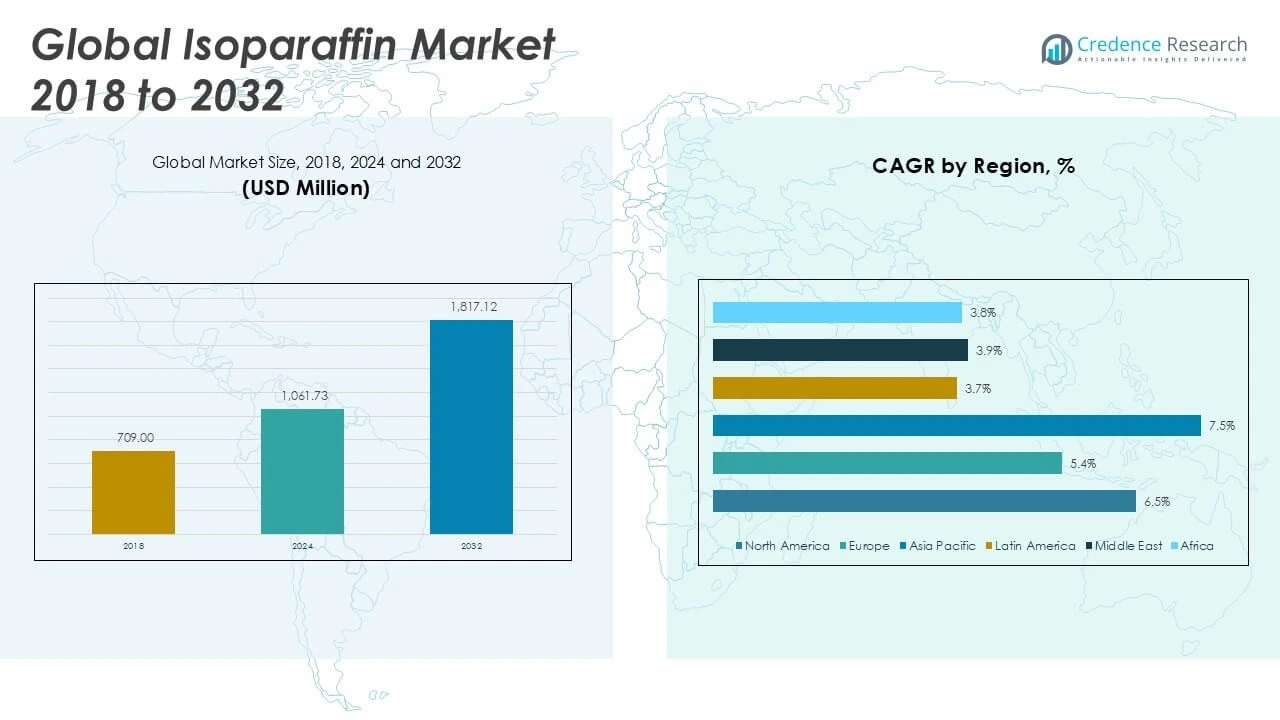
The Global Isoparaffin Market is projected to grow from USD 1,061.73 million in 2024 to an estimated USD 1,817.12 million by 2032, registering a compound annual growth rate (CAGR) of 6.47% from 2025 to 2032.
Key drivers propelling the Global Isoparaffin Market include its superior chemical stability, low toxicity, and excellent solvency, which make it a preferred ingredient in personal care and cosmetic formulations. The rising trend toward natural and sustainable ingredients has further boosted isoparaffin adoption, especially in skincare and haircare products. Innovations in formulation technologies and increasing demand for premium lubricants in automotive and industrial applications also contribute to market growth. Additionally, regulatory support encouraging the use of safer and eco-friendly chemicals supports ongoing market expansion.
Geographically, the Asia-Pacific region dominates the Global Isoparaffin Market, driven by rapid industrial growth and expanding consumer bases in countries like China, India, and Japan. North America and Europe follow, fueled by high demand in cosmetics and pharmaceutical industries. Key players in the market include ExxonMobil Chemical, Chevron Phillips Chemical Company, INEOS Group, Shell Chemicals, and Sasol Ltd. These companies invest significantly in research and development to enhance product performance and sustainability, thereby maintaining competitive advantage in the global market.
Access crucial information at unmatched prices!
Request your sample report today & start making informed decisions powered by Credence Research Inc.!
Download Sample
Market Insights
- The Global Isoparaffin Market is projected to grow from USD 1,061.73 million in 2024 to USD 1,817.12 million by 2032, registering a CAGR of 6.47% from 2025 to 2032.
- Rising demand in cosmetics, pharmaceuticals, and industrial lubricants drives market expansion due to isoparaffin’s chemical stability and low toxicity.
- Growing consumer preference for natural, sustainable, and eco-friendly ingredients boosts adoption in personal care and automotive lubricant formulations.
- Regulatory support for safer chemicals encourages manufacturers to increase the use of isoparaffins across various industries.
- Price volatility in raw materials and stringent environmental regulations pose challenges to consistent market growth.
- Asia-Pacific dominates the market with the largest revenue share, driven by rapid industrialization and expanding consumer bases in China, India, and Japan.
- North America and Europe follow closely, fueled by mature cosmetics and pharmaceutical sectors emphasizing innovation and regulatory compliance.
Market Drivers
Increasing Demand for Personal Care and Cosmetic Products Fuels Market Growth
The Global Isoparaffin Market experiences strong growth driven by rising demand in the personal care and cosmetics sector. Isoparaffins offer excellent emollient and solvent properties, making them ideal for formulations such as lotions, creams, and hair care products. Consumers increasingly seek high-quality, non-toxic, and skin-friendly ingredients, which boosts isoparaffin adoption. The shift toward premium and natural skincare products supports its expanded use. Manufacturers focus on innovative formulations incorporating isoparaffins to meet evolving consumer preferences. It plays a crucial role in enhancing product texture, spreadability, and stability, which drives sustained demand.
For instance, more than 15,000 skincare products launched globally in 2023 contained isoparaffin-based ingredients, highlighting its widespread adoption in formulations.
Expanding Applications in Industrial Lubricants and Specialty Chemicals
Industrial lubricants and specialty chemicals constitute another significant driver of the Global Isoparaffin Market. Its chemical stability and low volatility make it suitable for use in high-performance lubricants and greases. It enhances thermal stability and reduces environmental impact compared to traditional mineral oils. Growing industrial activities, particularly in automotive and manufacturing sectors, push demand for advanced lubricant formulations containing isoparaffins. The compound’s versatility enables its use in metalworking fluids, adhesives, and sealants, broadening its industrial appeal. Companies continuously develop formulations leveraging isoparaffins to improve efficiency and compliance with environmental regulations.
For instance, global lubricant production surpassed 35 million metric tons in 2023, with isoparaffins playing a crucial role in specialized formulations for enhanced performance.
Favorable Regulatory Environment Supporting Safe and Sustainable Ingredients
The Global Isoparaffin Market benefits from a regulatory landscape that favors safe, non-toxic, and environmentally sustainable chemical ingredients. Regulatory bodies increasingly mandate the use of ingredients with low toxicity and biodegradability in personal care and industrial products. It meets these criteria, facilitating easier approvals and faster market access for manufacturers. The focus on reducing volatile organic compounds (VOCs) in formulations aligns with isoparaffin’s low VOC profile. This regulatory support encourages manufacturers to substitute harmful solvents with isoparaffins. It strengthens the market by driving innovation focused on eco-friendly and safe products.
Technological Advancements and Innovation Enhance Product Performance
Technological progress in refining and synthesizing isoparaffins advances the Global Isoparaffin Market by improving product quality and application range. Companies invest in research to enhance purity, performance, and compatibility with other formulation ingredients. Advanced production techniques enable customization of isoparaffins to meet specific viscosity and volatility requirements. Innovations focus on reducing environmental impact while maintaining or improving functional benefits. It enables wider application across cosmetics, pharmaceuticals, and industrial chemicals. Continuous product development helps companies capture new market segments and respond to evolving customer needs efficiently.
Market Trends
Rising Preference for Eco-Friendly and Sustainable Ingredients in Formulations
The Global Isoparaffin Market reflects a growing trend toward eco-friendly and sustainable ingredients across personal care and industrial sectors. Consumers and manufacturers prioritize products that reduce environmental impact without compromising performance. It meets this demand through its low toxicity, biodegradability, and reduced volatile organic compound (VOC) emissions. The trend encourages formulators to replace conventional solvents and emollients with isoparaffins in cosmetics, pharmaceuticals, and lubricants. Increasing awareness about green chemistry drives innovation to develop more sustainable isoparaffin variants. This shift supports regulatory compliance and enhances brand value for manufacturers using environmentally responsible ingredients.
For instance, bio-based isoparaffin solvents are being developed to reduce environmental impact, with manufacturers focusing on low-VOC formulations to comply with stringent regulations.
Expansion of Isoparaffin Use in High-Performance Lubricants and Specialty Chemicals
The Global Isoparaffin Market shows significant growth in applications within high-performance lubricants and specialty chemicals. Its excellent thermal stability and chemical inertness improve lubricant efficiency and extend machinery life. Industries such as automotive, aerospace, and manufacturing increasingly adopt isoparaffin-based formulations to meet stringent operational requirements. It enables the creation of customized lubricants tailored to specific temperature ranges and environmental conditions. Rising industrialization and demand for machinery maintenance fuel this trend. Market players emphasize research and development to enhance product features and cater to evolving industry standards.
For instance, synthetic isoparaffin fluids are now widely used in metalworking and industrial cleaning applications due to their high chemical stability and low toxicity.
Integration of Advanced Refining Technologies to Enhance Product Quality
Advanced refining and synthesis technologies mark a key trend shaping the Global Isoparaffin Market. Producers invest in innovative processes to achieve higher purity, consistent quality, and tailored molecular structures. It supports diverse applications by allowing modification of viscosity, volatility, and solvency properties according to end-use requirements. These technological improvements increase product efficiency, safety, and environmental compatibility. The trend fosters stronger collaboration between manufacturers and end-users to develop application-specific solutions. Continuous process optimization reduces production costs, making isoparaffins more accessible to a broader market.
Growing Demand from Emerging Markets Drives Regional Market Expansion
Emerging markets in Asia-Pacific, Latin America, and the Middle East contribute significantly to the growth of the Global Isoparaffin Market. Rapid industrialization, expanding cosmetics industries, and rising consumer spending in these regions drive demand. It supports local manufacturers by providing a reliable, versatile ingredient for diverse applications. Increasing investments in infrastructure and manufacturing sectors further fuel the market. The trend encourages global companies to expand production capacities and distribution networks in these high-growth regions. This geographic diversification enhances competitive dynamics and fosters innovation tailored to regional needs.
Market Challenges
Volatility in Raw Material Prices and Supply Chain Disruptions Impact Market Stability
The Global Isoparaffin Market faces challenges due to fluctuations in raw material prices, primarily crude oil derivatives, which affect production costs and profit margins. It depends heavily on petrochemical feedstocks, making it vulnerable to global supply-demand imbalances and geopolitical tensions. Supply chain disruptions caused by logistical issues or regulatory restrictions further complicate consistent product availability. These factors increase operational uncertainties for manufacturers and can delay project timelines. Companies must implement strategic sourcing and optimize inventory management to mitigate risks. Price volatility also limits long-term contract agreements, impacting market predictability and investment decisions.
For instance, the global production capacity for isoparaffin solvents exceeds 5 million metric tons annually, with 700,000 metric tons allocated for the paints and coatings industry alone.
Stringent Regulatory Requirements and Environmental Concerns Pose Compliance Challenges
The Global Isoparaffin Market encounters regulatory challenges stemming from stricter environmental and safety standards worldwide. It must comply with regulations limiting volatile organic compounds (VOCs) and hazardous substances in personal care and industrial applications. Meeting these standards requires continuous product reformulation and additional testing, which increases costs and development time. Some regions impose complex certification processes that hinder swift market entry. Balancing regulatory compliance with performance and cost-effectiveness remains difficult for manufacturers. These challenges pressure companies to innovate sustainably while maintaining competitive pricing and product efficacy.
Market Opportunities
Expansion into Emerging End-Use Industries Offers Significant Growth Potential
The Global Isoparaffin Market holds substantial opportunities through expansion into emerging end-use industries such as pharmaceuticals, food packaging, and electronics. It offers versatile chemical properties that suit these sectors’ growing demand for safe and efficient solvents and additives. Rising healthcare awareness and pharmaceutical production in developing regions create new application avenues for isoparaffins. The packaging industry increasingly seeks lightweight, non-toxic materials that improve product safety and shelf life, further boosting demand. Collaborations between isoparaffin producers and end-users can foster tailored solutions to meet specific industry needs. This diversification reduces dependence on traditional markets and supports sustained revenue growth.
Innovation in Sustainable and Bio-Based Isoparaffin Variants Drives Market Expansion
Innovation focused on developing sustainable and bio-based isoparaffin alternatives presents significant growth opportunities in the Global Isoparaffin Market. Increasing consumer and regulatory pressure encourages manufacturers to explore renewable feedstocks and green production methods. It supports the creation of environmentally friendly products without sacrificing performance characteristics. Advancements in biotechnology and catalytic processes enable cost-effective production of bio-isoparaffins. These innovations open new markets driven by sustainability goals in personal care, lubricants, and specialty chemicals. Emphasizing eco-friendly product lines enhances brand reputation and attracts environmentally conscious customers, accelerating market penetration.
Market Segmentation Analysis
By Type
It includes high carbon, low carbon, and medium carbon isoparaffins. High carbon isoparaffins dominate the market due to their superior performance in industrial lubricants and specialty chemical applications. Low carbon variants find extensive use in cosmetics and pharmaceuticals for their favorable volatility and skin-friendly properties. Medium carbon isoparaffins serve as versatile intermediates across multiple sectors, balancing performance and cost-effectiveness. Each type addresses specific end-use requirements, driving varied demand patterns.
By grade type
The market classifies into cosmetic & pharmaceutical grade, high purity grade, and industrial grade. Cosmetic and pharmaceutical grades witness strong demand due to stringent purity and safety requirements in personal care and healthcare products. High purity grade is preferred in sensitive applications requiring minimal impurities, including electronics and specialty chemicals. Industrial grade is widely utilized in metalworking, paints, and coatings, where bulk performance parameters are prioritized over purity. The Global Isoparaffin Market reflects growth across these grades driven by evolving application needs.
By Application
Application-wise, isoparaffins cater to diverse industries such as agrochemicals, automotive, cosmetics & personal care, industrial cleaning, metalworking, paints & coatings, pharmaceuticals, and polymers & plastics. The cosmetics and personal care segment holds a significant market share due to rising consumer demand for safer and effective formulations. Industrial applications, including metalworking and automotive lubricants, also contribute substantially. Demand from pharmaceuticals and agrochemicals grows steadily, propelled by innovation and regulatory support.
By Distribution Channels
Distribution channels segment into offline and online sales. Offline channels remain dominant due to established supply chains and direct industry relationships. The Global Isoparaffin Market witnesses increasing penetration of online channels driven by digital transformation and enhanced accessibility. Online platforms provide convenience and broader market reach, especially for specialty and small-batch buyers. Market players leverage both channels to optimize distribution efficiency and customer engagement.
Segments
Based on Type
- High Carbon Isoparaffins
- Low Carbon Isoparaffins
- Medium Carbon Isoparaffins
Based on Grade Type
- Cosmetic & Pharmaceutical Grade
- High Purity Grade
- Industrial Grade
Based on Application
- Agrochemicals
- Automotive
- Cosmetics & Personal Care
- Industrial Cleaning
- Metal working
- Paints & Coatings
- Pharmaceuticals
- Polymers & Plastics
Based on Distribution Channel
Based on Region
- North America
- Europe
- UK
- France
- Germany
- Italy
- Spain
- Russia
- Belgium
- Netherlands
- Austria
- Sweden
- Poland
- Denmark
- Switzerland
- Rest of Europe
- Asia Pacific
- China
- Japan
- South Korea
- India
- Australia
- Thailand
- Indonesia
- Vietnam
- Malaysia
- Philippines
- Taiwan
- Rest of Asia Pacific
- Latin America
- Brazil
- Argentina
- Peru
- Chile
- Colombia
- Rest of Latin America
- Middle East
- UAE
- KSA
- Israel
- Turkey
- Iran
- Rest of Middle East
- Africa
- Egypt
- Nigeria
- Algeria
- Morocco
- Rest of Africa
Regional Analysis
North America Isoparaffin Market
The North America Isoparaffin Market held a significant market value of USD 408.68 million in 2024, representing approximately 29.6% of the global share. It is projected to reach USD 701.63 million by 2032, growing at a CAGR of 6.5% during the forecast period. The region’s market expansion is supported by a strong presence of personal care and pharmaceutical industries demanding high-purity isoparaffins. Advanced industrial sectors, including automotive and specialty chemicals, further boost demand. The established regulatory framework ensures product safety, driving innovation and adoption. The United States and Canada contribute substantially to the regional market value through ongoing product development and technological advancements.
Europe Isoparaffin Market
Europe accounted for a market value of USD 214.59 million in 2024, capturing around 15.5% of the global Isoparaffin Market. It is expected to grow to USD 338.19 million by 2032, at a CAGR of 5.4%. Demand in Europe is propelled by stringent regulations promoting safe and eco-friendly ingredients, especially in cosmetics and pharmaceuticals. Germany, France, and the United Kingdom emerge as key markets due to strong industrial bases and growing consumer awareness. Investments in green chemistry and sustainable product innovation enhance market growth. The region’s steady industrial demand from paints, coatings, and lubricants sectors further supports market expansion.
Asia Pacific Isoparaffin Market
Asia Pacific held a market value of USD 362.79 million in 2024, securing about 26.3% of the global share. It is forecasted to reach USD 671.14 million by 2032, exhibiting the highest CAGR of 7.5%. Rapid industrialization, expanding cosmetics and pharmaceutical sectors, and rising consumer purchasing power drive the region’s growth. China, India, and Japan lead the market due to increasing urbanization and manufacturing capacity. The region benefits from favorable government policies supporting chemical industry development. Growing demand for personal care products with safer ingredients further fuels the market. Asia Pacific remains a key focus for global manufacturers seeking expansion.
Latin America Isoparaffin Market
Latin America’s Isoparaffin Market was valued at USD 30.76 million in 2024, constituting roughly 2.2% of the global market share. It is projected to grow to USD 42.91 million by 2032 with a CAGR of 3.7%. The region’s growth stems from rising demand in agrochemicals, cosmetics, and industrial sectors. Brazil and Mexico serve as principal contributors due to their expanding manufacturing and consumer markets. Market growth faces challenges from economic fluctuations but benefits from increasing foreign investments. The development of infrastructure and increasing awareness of product safety influence market dynamics positively.
Middle East Isoparaffin Market
The Middle East Isoparaffin Market recorded a value of USD 24.35 million in 2024, representing nearly 1.8% of the global share. It is expected to grow to USD 34.40 million by 2032 at a CAGR of 3.9%. Growth drivers include rising industrial activity, especially in petrochemicals, automotive, and personal care segments. The region’s oil and gas reserves facilitate availability of raw materials, supporting cost-effective production. Saudi Arabia and the United Arab Emirates lead the regional market due to investments in diversification and manufacturing. Increasing adoption of advanced formulations enhances market penetration.
Africa Isoparaffin Market
Africa held a market value of USD 20.55 million in 2024, accounting for approximately 1.5% of the global Isoparaffin Market. It is projected to reach USD 28.85 million by 2032 with a CAGR of 3.8%. The market growth benefits from expanding industrial sectors and growing consumer demand for cosmetics and pharmaceuticals. South Africa and Nigeria act as key markets due to industrialization and rising disposable incomes. Challenges include infrastructure limitations and regulatory complexities. However, increasing foreign direct investment and government initiatives support gradual market development.
Key players
- Arham Petrochem Private Limited
- Braskem S.A.
- Calumet Specialty Products Partners, L.P.
- Chevron Phillips Chemical Company LLC
- Dowpol Corporation
- Exxon Mobil Corporation
- Idemitsu Kosan Co., Ltd.
- Mehta Petro Refineries Limited
- RB Products, Inc.
- Shell PLC
- Total Energies SE
- ITW Reagents, S.R.L.
Competitive Analysis
The Isoparaffin Market remains highly competitive with several key players striving to expand their product portfolios and geographic reach. Leading companies focus on technological innovation to enhance product purity and performance, differentiating themselves in a market driven by stringent quality and regulatory demands. It experiences intense competition based on product customization for diverse applications, especially in cosmetics, pharmaceuticals, and industrial sectors. Strategic partnerships, acquisitions, and capacity expansions characterize the market’s competitive landscape. Companies emphasize sustainability by investing in eco-friendly production methods to meet increasing environmental regulations. Price competitiveness and supply chain efficiency also play critical roles in gaining market share. Market leaders continuously adapt to evolving customer needs and regional dynamics to maintain their position and drive growth.
Recent Developments
- In May 2025, Chevron Phillips Chemical Company LLC was featured in the Gulf Petrochemicals and Chemicals Association (GPCA) newsletter, highlighting its role in the petrochemical industry.
- In May 2025, Exxon Mobil Corporation was featured in the Gulf Petrochemicals and Chemicals Association (GPCA) newsletter, highlighting its role in the petrochemical industry. This feature likely covered ExxonMobil’s activities, initiatives, and contributions to the petrochemical sector, potentially including news about their latest projects, investments, or partnerships within the region.
Market Concentration and Characteristics
The Global Isoparaffin Market exhibits a moderately concentrated structure dominated by a few key players that control a significant share of production and distribution. It features a blend of established multinational corporations and regional manufacturers competing on product quality, innovation, and cost efficiency. The market’s characteristics include high entry barriers due to capital-intensive refining processes and stringent regulatory compliance requirements. It demands continuous investment in research and development to meet evolving purity standards and sustainability goals. Customer preference for specialized grades and tailored applications drives differentiation among competitors. The market also emphasizes strong supply chain management to ensure timely delivery and maintain long-term client relationships. This competitive yet collaborative environment fosters steady innovation and expansion across various end-use industries.
Shape Your Report to Specific Countries or Regions & Enjoy 30% Off!
Report Coverage
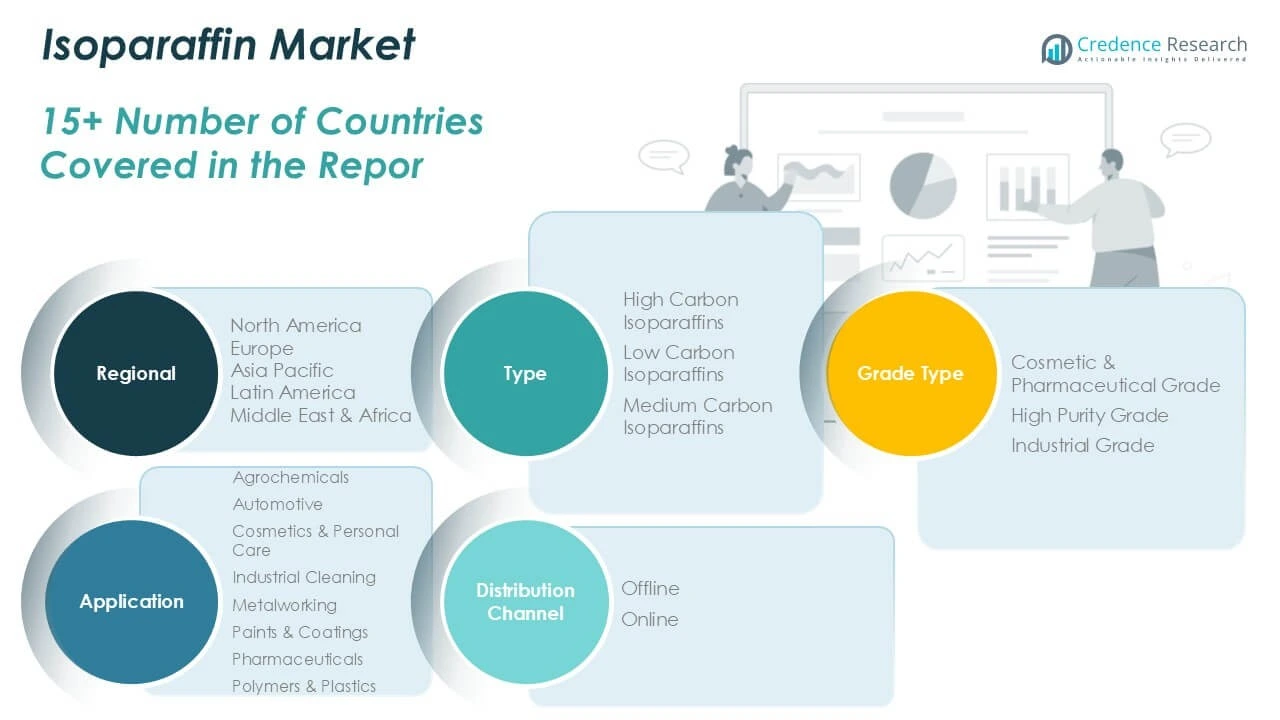
The research report offers an in-depth analysis based on Type, Grade Type, Application, Distribution Channel and Region. It details leading market players, providing an overview of their business, product offerings, investments, revenue streams, and key applications. Additionally, the report includes insights into the competitive environment, SWOT analysis, current market trends, as well as the primary drivers and constraints. Furthermore, it discusses various factors that have driven market expansion in recent years. The report also explores market dynamics, regulatory scenarios, and technological advancements that are shaping the industry. It assesses the impact of external factors and global economic changes on market growth. Lastly, it provides strategic recommendations for new entrants and established companies to navigate the complexities of the market.
Future Outlook
- The Global Isoparaffin Market will witness sustained growth driven by expanding applications in personal care, pharmaceuticals, and industrial sectors. Increasing consumer demand for high-quality, safe, and eco-friendly products will fuel market expansion.
- Technological advancements in refining processes will enhance product purity and customization, enabling isoparaffins to meet diverse application requirements. This will support broader adoption across specialty chemicals and high-performance lubricants.
- Growing emphasis on sustainability will accelerate development of bio-based and renewable isoparaffin variants. Manufacturers will invest in green technologies to reduce environmental impact and comply with stricter regulations.
- Emerging markets in Asia-Pacific, Latin America, and Africa will become key growth engines due to rising industrialization and increasing consumer spending. Market players will expand production and distribution networks to capitalize on regional opportunities.
- Regulatory frameworks globally will continue tightening limits on volatile organic compounds (VOCs) and hazardous substances, promoting isoparaffins as safer alternatives. Compliance will drive innovation in formulation and production technologies.
- Integration of digital supply chain management and e-commerce platforms will improve market accessibility and operational efficiency. Companies will leverage digital tools to optimize inventory, reduce costs, and enhance customer engagement.
- Increasing demand for high-performance lubricants in automotive and aerospace sectors will boost isoparaffin consumption. Its chemical stability and low volatility will make it a preferred choice for advanced lubricant formulations.
- Collaborations and strategic partnerships between chemical manufacturers and end-users will facilitate customized solutions tailored to specific industry needs. Such alliances will enhance market responsiveness and innovation capacity.
- Fluctuations in raw material prices will require companies to adopt flexible sourcing strategies and cost optimization measures. Risk management practices will become essential to maintain profitability and market stability.
- Continuous research and development efforts will focus on improving product functionality while minimizing environmental footprint. This will strengthen the Global Isoparaffin Market’s competitiveness and support sustainable long-term growth.



