
| REPORT ATTRIBUTE | DETAILS |
|---|---|
| Historical Period | 2019-2022 |
| Base Year | 2023 |
| Forecast Period | 2024-2032 |
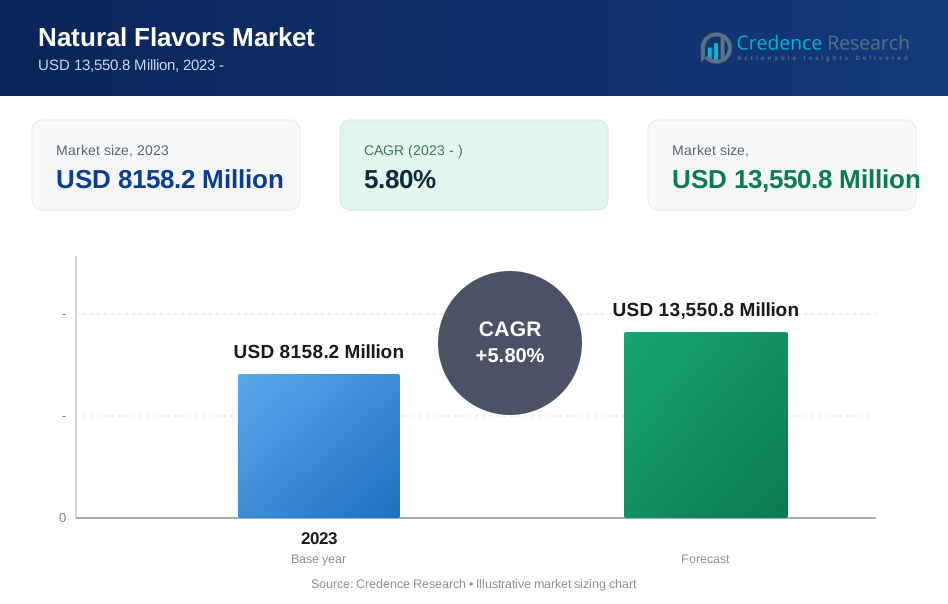
| Natural Flavors Market Size 2023 | USD 8158.2 Million |
| Natural Flavors Market, CAGR | 5.80% |
| Natural Flavors Market Size 2032 | USD 13550.8 Million |
Market Insights
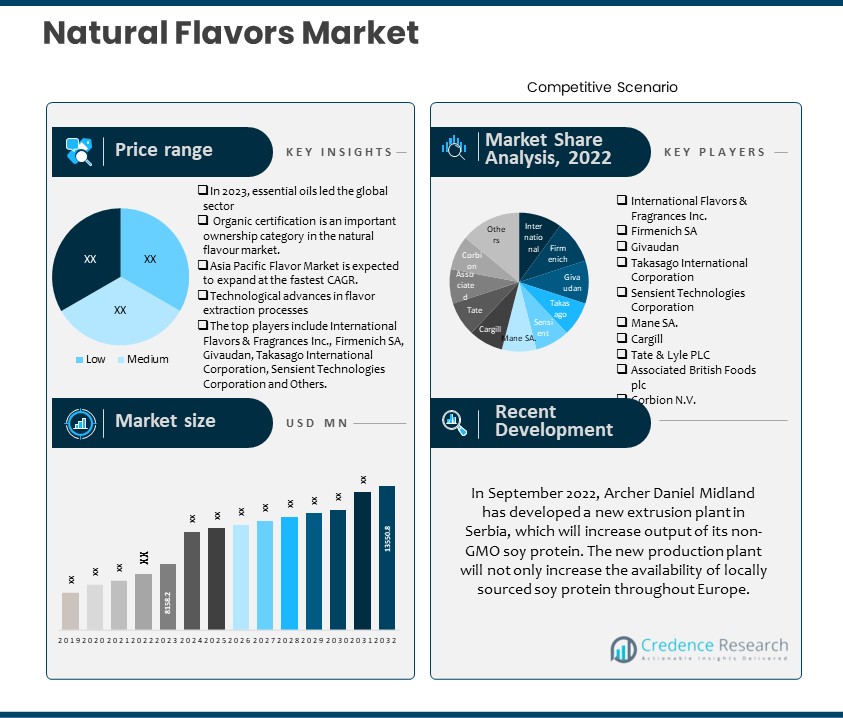
- The global demand for Natural Flavors was valued at USD 8158.2 Million in 2023 and is expected to reach USD 13550.8 Million in 2032, growing at a CAGR of 5.80% between 2024 and 2032.
- Essential oils dominated the global sector in 2023, with Fruit Flavors ranking second in global natural flavor demand.
- In 2023, the extracts and distillates technology category led the global industry, with the Fruit-Based Flavors section predicted to increase at the quickest rate over the forecast period.
- The beverage sector is anticipated to be the fastest-growing category during the forecast period, 2024-2032, while the Bakery & Pastry market is predicted to develop at a consistent rate throughout the projection period.
- Organic Certification is an important ownership category in the natural taste business.
- Europe dominated the market in 2023, accounting for 45.80% of total revenue, while North America Flavor Market retains the second-largest market share. The Asia Pacific Flavor Market is expected to expand at the fastest CAGR.
- Increased demand for natural flavors in dairy products and other beverages propels market expansion.
- Increased usage of artificial flavoring agents impedes market growth
Executive Summary
Market Definition
A natural flavor is an essential oil, oleoresin, protein hydrolysate, distillate, extractive, essence, or any product of roasting, heating, or enzymolysis that contains flavoring elements from a spice, fruit, vegetable, herb, bark, bud, root, leaf, meat, sea food, eggs, poultry, dairy products, and whose purpose is to flavor the food rather than add nutrition to it. Flavorists create natural flavors in a laboratory by combining naturally derived extractives.
Market Overview
The global Natural Flavors Market has witnessed steady growth in recent years and is expected to grow at a CAGR of 5.80% between 2024 and 2032. The market was valued at USD 8158.2 million in 2023 and is expected to reach USD 13550.8 million in 2032.
The key driver driving market revenue growth is the rising demand for natural flavors derived from fresh, natural foods, which help to preserve the flavor and aroma of the original components while also serving as nutritional spices in a variety of culinary goods. Natural flavors are derived from plant and animal sources such as fruit, vegetable, meat, fish, dairy products, herbs, spices, leaves, roots, bark, and buds and are used to generate diverse flavors for processed foods. According to studies, 63% of buyers reject artificial colors, while 71% avoid artificial flavors.
The rising need for natural flavors in the food industrialization process, driven by the need to make products more appealing and closer to the ideal taste while retaining nutritional content, is the primary factor driving revenue growth in the market. Alcohol is used to diminish the natural vanilla taste once it has been extracted from vanilla beans. Anisaldehyde, hydroxybenzoic acid, and hydroxybenzaldehyde are the most essential components responsible for vanilla's natural flavor.
Segmentation By Type of Natural Flavors
- In 2023, essential oils dominated the global industry, accounting for more than 74.65% of total sales. This large proportion is related to the vast range of applications for these items as aromatic and flavoring agents, including cleaning and household, food and beverage, medical, and spa and relaxation, among others.
- In 2023, the Fruit Flavors segment was the second most in demand in the global natural flavor industry, accounting for more than 53.65% of total revenue. Its substantial market share is related to the widespread use of diverse flavors in a variety of end-use industries, particularly in meals and beverages such as confectionery, convenience food, dairy food, and bakery items.
Segmentation By Source and Origin
- In 2023, the Extracts and Distillates technology category led the global industry with a share of more than 42.35%. This large share is attributable to the process's multiple advantages, including lower operating costs, increased extraction yield, shorter extraction time, effective heating, and faster energy transfer. Traditionally, microbes have been routinely utilized to create tastes.
- The Fruit-Based Flavors section is expected to grow at the fastest rate over the forecast period.
Segmentation by Formulation and Application
- The beverages sector dominated the market growth in 2023 and is predicted to be the fastest-growing segment during the forecast period, 2024–2032. The beverage sector is experiencing ongoing transformation as premiumization, functionality, convenience, and sustainability themes gain traction.
- The Bakery and Pastry market is predicted to grow at a steady rate throughout the projection period because to better stability and shelf life, particularly through the use of Plant Extracts with antibacterial properties. When natural flavors are added to baked goods at the levels used, they provide no nutritional benefit.
Segmentation By Certification and Labeling
- Organic Certification is a key ownership segment in the natural flavor market, reflecting consumers' increased desire for organic products. This accreditation guarantees that the flavors are produced from organic sources with no synthetic additives or pesticides.
Segmentation by Region
- Europe dominated the market in 2023, accounting for 45.80% of total revenue.
- North America Flavor Market holds the second-largest market share and The Asia Pacific Flavor Market is predicted to expand at the quickest CAGR
- The rest of the world, including Latin America, the Middle East, and Africa, supplies the remaining demand for Natural Flavors.
The Europe Flavor market accounted for approximately 45.80% and is predicted to develop at a substantial CAGR throughout the study period. Because of its massive population, Europe has the largest culinary flavor market share. The United Kingdom has the second-largest market share due to the ever-increasing demand for organic products. The U.K. market offers three goods, one of which is advertised as organic, leading to the growth of natural food flavors there. Market organizations' primary tactics include new product creation, partnerships, expansions, mergers, and acquisitions.
North America Flavor Market holds the second-largest market share. This is because the region consumes a wide variety of regional cuisines. Because of the region's migrant population, genuine food goods are consumed there, prompting the establishment of several foreign edible services. American consumers like Japanese and Indian food. Furthermore, the U.S. Flavor market had the biggest market share, while Canada's Flavor market was the fastest-growing in the region.
Furthermore, the Asia Pacific Flavor Market is predicted to expand at the quickest CAGR between 2024 and 2032. The Asia Pacific food flavor market is rapidly developing due to the region's high consumption of processed foods and beverages. The region's rising economy includes a large population and working professionals. Population trends are an important macroeconomic variable supporting the growth of the eatable flavoring agents market.
Key Highlights of the Report
Type of Natural Flavors, Source and Origin, Formulation and Application, Source, and Region segments of the global Natural Flavors Market. The Fruit-Based Flavors segment is anticipated to develop at the quickest rate during the forecast period, with the Extracts and Distillates technology category leading the global market in 2023. Additionally, the Bakery & Pastry market is anticipated to expand steadily over the projection period, with the Fruit Flavors segment ranking second in demand within the worldwide natural flavor industry and Europe, leading the market growth.
The market's primary drivers include growing customer demand, the regulatory environment, and sustainability and environmental concerns. In addition, supply chain difficulties, cost constraints, and limited shelf life and stability are the market's primary obstacles. Additionally, the market's significant potential are health and wellness trends, urbanization and changing lifestyles, and globalization and international trade.
The Europe Flavor market accounted for around 45.80% and is expected to grow at a significant CAGR over the study period. Furthermore, North America Flavor Market has the second-largest market share. This is because the region consumes a diverse range of regional cuisines. Furthermore, the Asia Pacific Flavor Market is expected to grow at the fastest CAGR between 2024 and 2032.
What Are The Main Drivers Of The Global Natural Flavors Market?
The market's primary drivers include growing customer demand, the regulatory environment, and sustainability and environmental concerns.
What Are The Major Challenges Faced By The Global Natural Flavors Market?
However, the primary market obstacles include supply chain difficulties, cost constraints, and limited shelf life and stability.
What Are The Growth Opportunities In The Global Natural Flavors Market?
Health and wellness trends, urbanization and changing lifestyles, and globalization and international trade are the market's significant opportunities.
Market Drivers
Several factors drive the global Natural Flavors Market. The following are the key drivers of the global Natural Flavors Market:
Rising Demand For Natural Flavors In Dairy Products And Other Beverages
Teas are frequently scented with plant essential oils such as lemon, bergamot, rose, and fragrant olive, which provide a nice flowery flavor to the tea's natural flavor. Other teas, like rosemary, peppermint, chamomile, and chrysanthemum, are flavored with flower petals, spices, or dried leaves. Tea with flavoring must have the necessary label disclosure. Firms that offer flavored tea must first register with the Tea Board. Tea is the perfect companion to natural flavors. One teaspoon of flavor is required per pound. The transportation agent Ethyl Alcohol takes up a large portion of it, and when it evaporates, the taste is conveyed through the tea by the evaporating alcohol. Both flavor and alcohol are soluble in water, thus they are blended with it. Once the water and alcohol have evaporated, the remaining taste is relatively mild.
Although botanicals are widely used to flavor tea, this does not always imply that the tea contains an exact percentage of any one botanical. For example, pineapple tea may contain pineapple, carrot, strawberry, and other natural tastes.
Market Restraints
The global Natural Flavors Market faces some challenges that may hinder its growth. These include the following:
Increased Use Of Artificial Flavoring Agents
The body typically manages any natural reaction that happens. Artificial flavoring is not natural, as most artificial sweeteners are made from synthetic chemicals. It can cause poisoning and other health issues because our bodies are not designed to handle such toxins. Artificial sweeteners increase body mass index and percentage of body fat. Artificial sweeteners raise the risk of type 2 diabetes. For example, women who consumed more than two artificially sweetened drinks each day had a significantly greater risk of heart disease. Artificial sweeteners may potentially increase the risk of hypertension.
Opportunities
The global Natural Flavors Market offers significant growth opportunities. These include the following:
Rising Global Demand For Food And Beverages
The growing demand for food and beverages is likely to fuel the expansion of the natural flavor industry. Food and beverage refers to goods taken for nourishment and refreshment, encompassing both solid and liquid foods. Natural flavors are employed in the food and beverage sector to suit consumer demand for natural, healthful, and clean-label products. They improve the sensory properties of food and beverages while remaining consistent with industry trends.
According to Common Thread Collective, a US-based advertising services business, the global revenue of the food and beverage industry is expected to increase from $506.3 billion in 2023 to $856.9 billion by 2032. As a result, growing demand for food and beverages is likely to boost the growth of the natural flavors market going forward.
Competitive Landscape
Key Players
The global Natural Flavors Market is highly competitive, with several key players. Some of the major players in the market and their market share are as follows:
- International Flavors & Fragrances Inc.
- Firmenich SA
- Givaudan
- Takasago International Corporation
- Sensient Technologies Corporation
- Mane SA.
- Cargill
- Tate & Lyle PLC
- Associated British Foods plc
- Corbion N.V.
- Sensient Te
These organizations prioritize product innovation, Formulation and Application expansion, and mergers and acquisitions to stay competitive.
The global Natural Flavors Market's key players continually seek to stay ahead by offering new products and developments.
In May 2021, Cargill brought out another probiotic product called EpiCor, which is a dry yeast fermentate that has been scientifically shown in dietary enhancement preliminary studies to assist in balancing the stomach flora and provide safe framework support.
In September 2020, ADM shipped out Arcon finished pea proteins, Prolite MeatTEX finished wheat protein, and Prolite MeatXT non-finished wheat protein. These extremely practical protein combinations would function on the surface and thickness of meat choices and are especially useful for achieving a customer-favored, meat-like surface. It would be easier for the company to overcome the obstacle by producing better-tasting products with more developed surfaces and diversity.
In February 2020, Grupo Arcor and Ingredion Incorporated formed a joint venture to help businesses improve their production skills, regional impressions, and business capacities in order to enhance food and beverage mending contributions to clients in Argentina, Chile, and Uruguay.
Summary of Key Findings
- The rising global demand for food and drinks promotes the expansion of the natural flavors industry.
- The market is segmented by Type of Natural flavors: Source and Origin, Formulation and Application, Source, and region.
- Organic Certification is a critical ownership area in the natural taste business.
- Bakery and Pastry market is expected to rise steadily during the projected period.
- Europe is leading in market growth; the market is highly competitive, with key players including International Flavors & Fragrances Inc., Firmenich SA, Givaudan, Takasago International Corporation, Sensient Technologies Corporation and Others.
Future Outlook
- Increasing customer demand for organic and natural products.
- Growth of the food and beverage industry
- Technological advances in flavor extraction processes.
- Increased awareness of health and wellness
- Transition to plant-based and sustainable components.
How CXOs Can Benefit from the Credence Research Natural Flavors Market Report
The Credence Research Natural Flavors Market Report provides CXOs with a comprehensive overview of the market, including:
- Market size and growth forecast: The report provides detailed estimates of the global Natural Flavors Market size, segmented By Type of Natural Flavors, Source and Origin, Formulation and Application, Certification and Labeling, and region. It also includes forecasts for the market through 2032 based on key trends and drivers.
- Market segmentation: The report segments the Natural Flavors Market By Type of Natural Flavors, Source and Origin, Formulation and Application, Certification and Labeling, and Region. This segmentation provides CXOs with a granular understanding of the market and the opportunities in each segment.
- Competitive Landscape: The report profiles the key players in the Natural Flavors Market and provides insights into their strategies, product offerings, and financial performance. This information can help CXOs to identify and assess their competition.
- Key trends and drivers: The report identifies and analyzes the key trends and drivers shaping the Natural Flavors Market. This information can help CXOs make informed decisions about their investments and strategies.
CXOs can use the insights from the Credence Research Natural Flavors Market Report to:
- Identify growth opportunities: The report can help CXOs identify new growth opportunities in the Natural Flavors Market. By analyzing the data and trends in the report, they can make informed decisions about where to invest and expand their business.
- Make informed investment decisions: The report can help CXOs make informed investment decisions about Natural Flavors. For example, it may provide useful insights into market trends, customer preferences, the competitive landscape, and growth prospects in the mobile accessories business..
- Develop competitive strategies: The report can help CXOs develop competitive strategies for their Natural Flavors businesses. For example, by analyzing market trends, client preferences, and the competitive environment mentioned in the report, CXOs can fine-tune their strategies, differentiate their offers, and effectively position their firms in the marketplace.
- Track market developments: The report can help CXOs monitor market developments and stay ahead of the curve. For example, it provides insights into the latest trends and innovations in the Natural Flavors Market.
Overall, the Credence Research Natural Flavors Market Report is a valuable source for CXOs who are looking to gain a deeper understanding of the market and identify opportunities for growth.
Segmentation
- By Type of Natural Flavors:
- Fruit Flavors
- Vegetable Flavors
- Herb and Spice Flavors
- Botanical Extracts
- Essential Oils
- Natural Sweeteners
- Fermentation-Derived Flavors
- By Source and Origin:
- Fruit-Based Flavors
- Botanical Flavors
- Extracts and Distillates
- Organic and Non-GMO Flavors
- Region-Specific Flavors
- By Formulation and Application:
- Beverages
- Dairy Products
- Confectionery and Snacks
- Bakery and Pastry
- Sauces and Dressings
- Soups and Ready Meals
- Functional Foods and Nutraceuticals
- By Certification and Labeling:
- Organic Certification
- Non-GMO Verification
- Clean Label
- Halal and Kosher Certification
- By Region
- North America
- The U.S.
- Canada
- Mexico
- Europe
- Germany
- France
- The U.K.
- Italy
- Spain
- Rest of Europe
- Asia Pacific
- China
- Japan
- India
- South Korea
- South-east Asia
- Rest of Asia Pacific
- Latin America
- Brazil
- Argentina
- Rest of Latin America
- Middle East & Africa
- GCC Countries
- South Africa
- Rest of the Middle East and Africa
- North America
Request a Free Sample
Fill in your details and we'll send you a free sample report.
- Sample data tables & charts
- Research methodology
Market Dynamics
Rising Demand for Natural Flavors in Dairy and Beverages
Consumers are increasingly seeking natural ingredients in dairy products and beverages, driving manufacturers to incorporate more natural flavors to meet clean label and health-conscious preferences.
Growth of the Food and Beverage Industry
The expanding global food and beverage sector, particularly in processed and convenience foods, is fueling demand for natural flavors to enhance taste profiles while aligning with consumer trends toward natural and authentic ingredients.
Preference for Organic and Clean Label Products
Heightened awareness of health and wellness is pushing consumers toward products with organic certification and clean labels, increasing the adoption of natural flavors that meet these criteria.
Technological Advances in Flavor Extraction
Innovations in extraction and distillation technologies are enabling more efficient, cost-effective, and higher-yield production of natural flavors, making them more accessible and appealing to manufacturers.
Need a Custom Version of This Report?
Tailor the scope, geography, or segments to your exact requirements.
- Custom geography or segment scope
- Direct access to our analyst team
Frequently Asked Questions
What is the current size of the global Natural Flavors Market?
What is the expected growth rate of the Natural Flavors Market between 2024 and 2032?
Which segment is leading the market share in terms of Source and Origin?
Which Type of Natural Flavors segment governs the demand for Natural Flavors in the world?
Who are the major players in the global Natural Flavors Market?
Table of Content
Chapter 1 Market Segmentation
- 1.1 Segmentation Framework
- 1.1.1 Product and Service Classification
- 1.1.2 Application and End-Use Classification
- 1.1.3 Technology and Solution Classification
- 1.1.4 Customer and Distribution Channel Classification
- 1.1.5 Geographic Segmentation
- 1.1.6 Market Segment Definitions and Boundaries
- 1.2 By Source and Origin
- 1.2.1 Fruit-Based Flavors
- 1.2.2 Botanical Flavors
- 1.2.3 Extracts and Distillates
- 1.2.4 Organic and Non-GMO Flavors
- 1.2.5 Region-Specific Flavors
- 1.3 By Type of Natural Flavors
- 1.3.1 Fruit Flavors
- 1.3.2 Vegetable Flavors
- 1.3.3 Herb and Spice Flavors
- 1.3.4 Botanical Extracts
- 1.3.5 Essential Oils
- 1.3.6 Natural Sweeteners
- 1.3.7 Fermentation-Derived Flavors
- 1.4 By Certification and Labeling
- 1.4.1 Organic Certification
- 1.4.2 Non-GMO Verification
- 1.4.3 Clean Label
- 1.4.4 Halal and Kosher Certification
- 1.5 By Formulation and Application
- 1.5.1 Beverages
- 1.5.2 Dairy Products
- 1.5.3 Confectionery and Snacks
- 1.5.4 Bakery and Pastry
- 1.5.5 Sauces and Dressings
- 1.5.6 Soups and Ready Meals
- 1.5.7 Functional Foods and Nutraceuticals
Chapter 2 Introduction
- 2.1 Report Objectives and Scope
- 2.2 Product Definition and Industry Terminology
- 2.3 Market Inclusions and Exclusions
- 2.4 Research Process
- 2.4.1 Primary Research and Expert Interviews
- 2.4.2 Secondary Research and Source Review
- 2.4.3 Top-Down and Bottom-Up Estimation
- 2.4.4 Data Triangulation and Verification
- 2.5 Market Size Measurement Basis
- 2.5.1 2023: USD 8158.2 Million → 2032: USD 13,550.8 Million
- 2.6 Historical and Forecast Reference Periods
- 2.6.1 Base Year: 2023
- 2.6.2 Forecast Period: 2023-2032
- 2.7 Research Assumptions and Limitations
Chapter 3 Executive Summary
- 3.1 Market Snapshot and Key Findings
- 3.2 Base-Year Market Size, 2023
- 3.3 Forecast Market Size, 2032
- 3.4 Revenue and Volume Growth Outlook
- 3.5 Key Demand and Supply Indicators
- 3.6 Leading Market Segments
- 3.7 Fastest-Growing Market Opportunities
- 3.8 Regional Performance Highlights
- 3.9 Technology and Industry Transformation
- 3.10 Competitive Landscape Summary
- 3.11 Analyst View and Strategic Implications
Chapter 4 Global Natural Flavors Market Trends and Developments
- 4.1 Historical Industry Development
- 4.2 Recent Market Trends and Developments
- 4.3 Demand and Customer Behavior Trends
- 4.4 Technology and Product Innovation
- 4.5 Artificial Intelligence, Automation and Digitalization
- 4.6 Local Manufacturing and Supply Chain Realignment
- 4.7 Industry Partnerships, Mergers and Acquisitions
- 4.8 Sustainability and Circular Economy Developments
- 4.9 Government and Private Sector Investment Trends
- 4.10 Emerging Business Models and Commercialization
- 4.11 Industry Developments and Announcements
Chapter 5 Global Natural Flavors Market Production, Supply and Demand Analysis
- 5.1 Demand Trend and Consumption Analysis
- 5.2 Demand Forecast, 2023-2032
- 5.3 Production and Output Trend
- 5.4 Production and Output Forecast, 2023-2032
- 5.5 Installed Capacity and Capacity Utilization
- 5.6 Company-Wise Production Plants and Statistics
- 5.6.1 Installed Production Capacity
- 5.6.2 Actual Production
- 5.6.3 Planned Capacity and Expansion Targets
- 5.7 Supply Chain Structure and Procurement Trends
- 5.8 Supply-Demand Gap and Bottlenecks
- 5.9 Import Dependence and Sourcing Structure
- 5.10 Contract Manufacturing and Outsourcing
- 5.11 Regional Supply and Demand Concentration
Chapter 6 Global Natural Flavors Market Pricing Analysis
- 6.1 Pricing Structure and Measurement
- 6.2 Historical Pricing Trends
- 6.3 Pricing Outlook, 2023-2032
- 6.4 Average Selling Price and Unit Economics
- 6.5 Pricing by Product and Market Segment
- 6.6 Geographic Pricing Differences
- 6.7 Key Input, Energy, Labor and Logistics Costs
- 6.8 Contract Pricing and Purchasing Models
- 6.9 Pricing Sensitivity and Competitive Positioning
- 6.10 Price, Margin and Profitability Implications
Chapter 7 Global Natural Flavors Market Dynamics
- 7.1 Market Growth Drivers
- 7.1.1 Demand-Side Drivers
- 7.1.2 Technology and Innovation Drivers
- 7.1.3 Infrastructure and Investment Drivers
- 7.1.4 Regulatory and Policy Drivers
- 7.2 Market Restraints
- 7.2.1 Cost and Affordability Constraints
- 7.2.2 Technology and Adoption Barriers
- 7.2.3 Supply Chain and Operational Constraints
- 7.3 Market Challenges
- 7.3.1 Competitive Pressure and Margin Erosion
- 7.3.2 Skills, Infrastructure and Implementation Gaps
- 7.4 Emerging Market Opportunities
- 7.5 Market Dynamics Impact and Time-Horizon Assessment
Chapter 8 Global Natural Flavors Value Chain Analysis
- 8.1 Industry Value Chain Overview
- 8.2 Upstream Suppliers and Critical Inputs
- 8.3 Technology and Component Providers
- 8.4 Manufacturing or Service Delivery
- 8.5 Distribution, Channel Partners and Integrators
- 8.6 Downstream Applications and End Users
- 8.7 Value Addition and Profit Pools
- 8.8 Vertical Integration and Outsourcing
- 8.9 Supplier Concentration and Risk
- 8.10 Supply Chain Localization and Resilience
Chapter 9 Global Natural Flavors Market Regulations and Policies
- 9.1 Relevant Laws, Standards and Compliance Frameworks
- 9.2 Product, Service, Safety and Quality Requirements
- 9.3 Government Policies, Incentives and Subsidies
- 9.4 Imports, Exports and Trade Barriers
- 9.5 Public Procurement and Local Content Requirements
- 9.6 Environmental and Sustainability Compliance
- 9.7 Upcoming Policy Changes and Market Implications
Chapter 10 Global Natural Flavors Market Hotspots and Opportunities
- 10.1 Market Opportunity Mapping and Growth Hotspots
- 10.2 High-Growth Applications and Customer Groups
- 10.3 Underserved Markets and White-Space Opportunities
- 10.4 Emerging Technology and Product Opportunities
- 10.5 New Capacity and Investment Hotspots
- 10.6 Market Entry and Expansion Opportunities
- 10.7 Distribution and Partnership Opportunities
- 10.8 Near-Term and Long-Term Commercial Potential
- 10.9 Opportunity Attractiveness and Execution Risks
Chapter 11 Global Natural Flavors Market Outlook, 2023-2032
- 11.1 Market Size and Analysis
- 11.1.1 Revenue (Market Measurement: 2023: USD 8158.2 Million → 2032: USD 13,550.8 Million)
- 11.1.2 Market Volume and Quantity Sold
- 11.1.3 Historical Market Size
- 11.1.4 Base-Year Market Size, 2023
- 11.2 Market Forecast, 2023-2032
- 11.2.1 Revenue Forecast to 2032
- 11.2.2 Volume Forecast to 2032
- 11.2.3 CAGR and Year-on-Year Growth
- 11.2.4 Incremental Revenue Opportunity
- 11.3 Forecast Assumptions and Scenario Analysis
- 11.3.1 Base-Case Forecast
- 11.3.2 Optimistic and Conservative Scenarios
- 11.3.3 Technology, Pricing and Policy Sensitivities
- 11.4 Market Attractiveness and Growth Outlook
Chapter 12 Global Natural Flavors Market Segmentation and Outlook
- 12.1 Segmentation Summary and Market Shares, 2023
- 12.2 Largest and Fastest-Growing Segments
- 12.3 By Source and Origin - Market Size and Forecast, 2023-2032
- 12.3.1 Segment Definition and Scope
- 12.3.2 Historical Market Size
- 12.3.3 Revenue Forecast, 2023-2032
- 12.3.4 Volume Forecast, 2023-2032
- 12.3.5 Base-Year Market Share, 2023
- 12.3.6 Segment CAGR and Growth Drivers
- 12.3.7 Subsegment Market Size and Forecast
- 12.3.7.1 Fruit-Based Flavors
- 12.3.7.2 Botanical Flavors
- 12.3.7.3 Extracts and Distillates
- 12.3.7.4 Organic and Non-GMO Flavors
- 12.3.7.5 Region-Specific Flavors
- 12.3.8 Subsegment Pricing and Adoption Trends
- 12.3.9 Leading Suppliers and Competition
- 12.3.10 Regional Demand and Opportunities
- 12.4 By Type of Natural Flavors - Market Size and Forecast, 2023-2032
- 12.4.1 Segment Definition and Scope
- 12.4.2 Historical Market Size
- 12.4.3 Revenue Forecast, 2023-2032
- 12.4.4 Volume Forecast, 2023-2032
- 12.4.5 Base-Year Market Share, 2023
- 12.4.6 Segment CAGR and Growth Drivers
- 12.4.7 Subsegment Market Size and Forecast
- 12.4.7.1 Fruit Flavors
- 12.4.7.2 Vegetable Flavors
- 12.4.7.3 Herb and Spice Flavors
- 12.4.7.4 Botanical Extracts
- 12.4.7.5 Essential Oils
- 12.4.7.6 Natural Sweeteners
- 12.4.7.7 Fermentation-Derived Flavors
- 12.4.8 Subsegment Pricing and Adoption Trends
- 12.4.9 Leading Suppliers and Competition
- 12.4.10 Regional Demand and Opportunities
- 12.5 By Certification and Labeling - Market Size and Forecast, 2023-2032
- 12.5.1 Segment Definition and Scope
- 12.5.2 Historical Market Size
- 12.5.3 Revenue Forecast, 2023-2032
- 12.5.4 Volume Forecast, 2023-2032
- 12.5.5 Base-Year Market Share, 2023
- 12.5.6 Segment CAGR and Growth Drivers
- 12.5.7 Subsegment Market Size and Forecast
- 12.5.7.1 Organic Certification
- 12.5.7.2 Non-GMO Verification
- 12.5.7.3 Clean Label
- 12.5.7.4 Halal and Kosher Certification
- 12.5.8 Subsegment Pricing and Adoption Trends
- 12.5.9 Leading Suppliers and Competition
- 12.5.10 Regional Demand and Opportunities
- 12.6 By Formulation and Application - Market Size and Forecast, 2023-2032
- 12.6.1 Segment Definition and Scope
- 12.6.2 Historical Market Size
- 12.6.3 Revenue Forecast, 2023-2032
- 12.6.4 Volume Forecast, 2023-2032
- 12.6.5 Base-Year Market Share, 2023
- 12.6.6 Segment CAGR and Growth Drivers
- 12.6.7 Subsegment Market Size and Forecast
- 12.6.7.1 Beverages
- 12.6.7.2 Dairy Products
- 12.6.7.3 Confectionery and Snacks
- 12.6.7.4 Bakery and Pastry
- 12.6.7.5 Sauces and Dressings
- 12.6.7.6 Soups and Ready Meals
- 12.6.7.7 Functional Foods and Nutraceuticals
- 12.6.8 Subsegment Pricing and Adoption Trends
- 12.6.9 Leading Suppliers and Competition
- 12.6.10 Regional Demand and Opportunities
- 12.7 Segment Growth Comparison
- 12.8 Segment Attractiveness and Priority Matrix
Chapter 13 Global Natural Flavors End-Use and Application Market Outlook
- 13.1 End-Use Industry and Customer Demand Structure
- 13.2 Leading Applications and Customer Groups
- 13.3 End-Use Market Size, Share and Forecast
- 13.4 Major End-Use Industry Deep Dives
- 13.4.1 Customer Requirements and Use Cases
- 13.4.2 Demand and Replacement Cycles
- 13.4.3 Technical and Regulatory Considerations
- 13.4.4 Purchasing and Procurement Models
- 13.4.5 Leading Vendors and Distribution Channels
- 13.4.6 Forecast and Commercial Opportunities
- 13.5 Emerging Applications and Cross-Segment Demand
- 13.6 End-Use Industry Investment Priorities
Chapter 14 Global Natural Flavors Geographic Market Outlook, 2023-2032
- 14.1 Regional Market Size and Share, 2023
- 14.2 Regional Market Forecast, 2023-2032
- 14.3 Regional Pricing, Production and Demand Differences
- 14.4 North America
- 14.4.1 United States
- 14.4.2 Canada
- 14.4.3 Mexico
- 14.5 Europe
- 14.5.1 Germany
- 14.5.2 France
- 14.5.3 Italy
- 14.5.4 United Kingdom
- 14.5.5 Spain
- 14.5.6 Poland
- 14.5.7 Russia
- 14.5.8 Netherlands
- 14.5.9 Belgium
- 14.5.10 Sweden
- 14.5.11 Denmark
- 14.5.12 Norway
- 14.5.13 Rest of Europe
- 14.6 Asia Pacific
- 14.6.1 China
- 14.6.2 India
- 14.6.3 Japan
- 14.6.4 South Korea
- 14.6.5 Thailand
- 14.6.6 Indonesia
- 14.6.7 Vietnam
- 14.6.8 Malaysia
- 14.6.9 Australia
- 14.6.10 Rest of Asia Pacific
- 14.7 Latin America
- 14.7.1 Brazil
- 14.7.2 Argentina
- 14.7.3 Colombia
- 14.7.4 Chile
- 14.7.5 Rest of Latin America
- 14.8 Middle East
- 14.8.1 Saudi Arabia
- 14.8.2 United Arab Emirates
- 14.8.3 Turkey
- 14.8.4 Israel
- 14.8.5 Iran
- 14.8.6 Rest of the Middle East
- 14.9 Africa
- 14.9.1 South Africa
- 14.9.2 Egypt
- 14.9.3 Nigeria
- 14.9.4 Morocco
- 14.9.5 Rest of Africa
- 14.10 Regional Investment, Policy and Supply Chain Differences
- 14.11 Regional Competitive Landscape
- 14.12 Geographic Growth Hotspots
Chapter 15 Global Natural Flavors Technology, Innovation and Sustainability Outlook
- 15.1 Technology Landscape and Maturity
- 15.2 Product, Process and Service Innovation
- 15.3 AI, Automation and Digital Tools in the Industry
- 15.4 Technology Adoption and Performance Benchmarking
- 15.5 Innovation Pipeline and R&D Investment
- 15.6 Patent and Intellectual Property Trends
- 15.7 Energy Efficiency and Resource Management
- 15.8 Sustainability, Recycling and Circularity
- 15.9 Technology Roadmap, 2023-2032
- 15.10 Risks of Obsolescence and Technology Substitution
Chapter 16 Global Natural Flavors Market Key Strategic Imperatives
- 16.1 Growth and Market Entry Priorities
- 16.2 High-Return Products and Segments
- 16.3 Pricing, Profitability and Cost Optimization
- 16.4 Technology Investment and Product Differentiation
- 16.5 Supply Chain Localization and Resilience
- 16.6 Distribution and Customer Acquisition
- 16.7 Partnership, Acquisition and Capacity Strategy
- 16.8 Regional Expansion Priorities
- 16.9 Short-, Medium- and Long-Term Actions
Chapter 17 Competition Outlook
- 17.1 Industry Competition Characteristics
- 17.2 Market Structure and Concentration
- 17.3 Market Share and Competitive Positioning, 2023
- 17.4 Company-Wise Revenue and Product Benchmarking
- 17.5 Production and Service Capacity Benchmarking
- 17.6 Technology, Pricing and Differentiation
- 17.7 Regional Footprint and Distribution Strength
- 17.8 Mergers, Acquisitions and Strategic Alliances
- 17.9 New Entrants and Competitive Threats
- 17.10 Porter's Five Forces and Industry Attractiveness
- 17.11 Competitive Outlook, 2023-2032
Chapter 18 Company Profiles
- 18.1 Company Coverage and Selection Criteria
- 18.2 International Flavors & Fragrances Inc.
- 18.2.1 Business Description
- 18.2.2 Company Ownership and Geographic Presence
- 18.2.3 Product and Service Portfolio
- 18.2.4 Manufacturing and Operating Footprint
- 18.2.5 Production Capacity and Expansion Plans
- 18.2.6 Financial Performance and Investment
- 18.2.7 Market Share and Competitive Position
- 18.2.8 Technology and Innovation Capabilities
- 18.2.9 Strategic Alliances or Partnerships
- 18.2.10 Recent Developments
- 18.2.11 Growth Strategy and Outlook
- 18.3 Firmenich SA
- 18.4 Givaudan
- 18.5 Takasago International Corporation
- 18.6 Sensient Technologies Corporation
- 18.7 Mane SA
- 18.8 Cargill
- 18.9 Tate & Lyle PLC
- 18.10 Associated British Foods plc
- 18.11 Corbion N.V.
- 18.12 Other Relevant Market Participants
Note: Every listed company is profiled on the structure shown under the first company. The company list is preliminary and may change based on research findings, market developments, data availability and client requirements.
Chapter 19 Disclaimer
- 19.1 Research and Forecast Disclaimer
- 19.2 Data Source and Estimation Limitations
Note: The depth of individual sections depends on data availability for this market. Volume, capacity, trade and other unit-based metrics are included where applicable.

