
Market Overview:
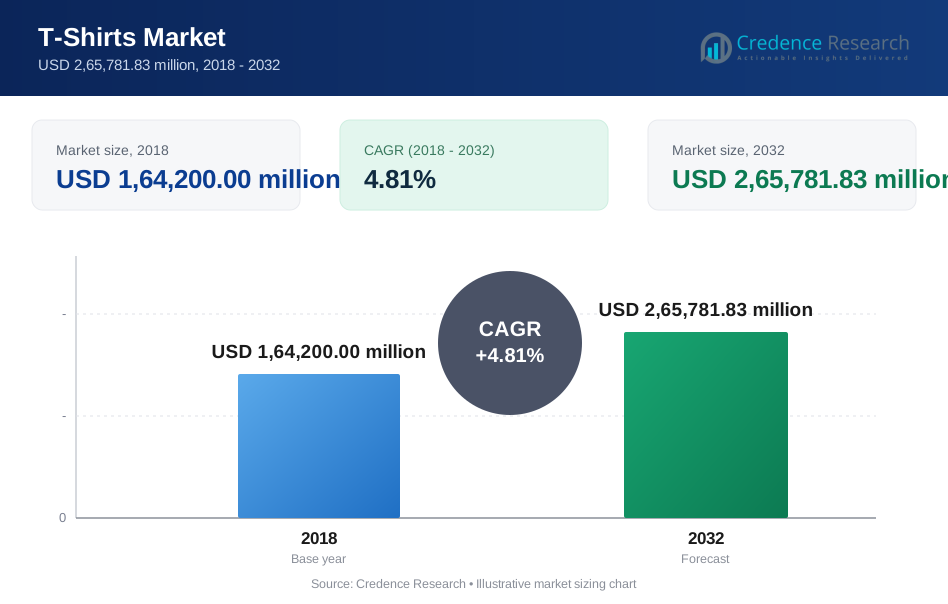
The Global T-Shirt Market size was valued at USD 1,64,200.00 million in 2018 to USD 1,83,891.48 million in 2024 and is anticipated to reach USD 2,65,781.83 million by 2032, at a CAGR of 4.81% during the forecast period.
| REPORT ATTRIBUTE | DETAILS |
|---|---|
| Historical Period | 2020-2023 |
| Base Year | 2024 |
| Forecast Period | 2025-2032 |
| T-Shirt Market Size 2024 | USD 1,83,891.48 Million |
| T-Shirt Market, CAGR | 4.81% |
| T-Shirt Market Size 2032 | USD 2,65,781.83 Million |
Growing interest in fast fashion drives steady consumption across many shopper groups. Brands release frequent designs that match lifestyle shifts and cultural trends. Many labels use organic cotton and recycled blends to strengthen their appeal. Direct-to-consumer channels support wider visibility and quick delivery. Influencer reach lifts brand awareness in young buyers. Custom prints gain traction due to corporate events and personal gifting. Strong supply chains in key textile hubs help producers meet rising volumes and short lead times.
North America and Europe lead due to strong brand presence and high fashion adoption. These regions benefit from mature e-commerce networks and strong demand for premium styles. Asia Pacific emerges fast due to large youth populations and rising urban spending. China, India, and Southeast Asia show strong growth driven by local manufacturing strength and fast retail expansion. Latin America gains traction through lifestyle shifts and expanding online channels. The Middle East and Africa show early growth supported by rising retail penetration and global brand entry.
Market Insights:
- The market grew from USD 1,64,200.00 million in 2018 to USD 1,83,891.48 million in 2024, and is expected to reach USD 2,65,781.83 million by 2032, posting a CAGR of 4.81%, driven by fast fashion cycles, rising casualwear use, and strong e-commerce presence.
- The top three regions-Asia Pacific (39.8%), North America (25.8%), and Europe (23.6%)-lead due to strong manufacturing bases, high brand penetration, and broad fashion adoption supported by digital retail networks.
- Asia Pacific, the fastest-growing region at 6% CAGR, expands quickly due to large youth populations, strong textile ecosystems, and rapid urban spending on casual and graphic styles.
- Based on the chart, Organic Cotton holds ~30% share, supported by rising demand for sustainable fabrics across premium and mass-market categories.
- Polyester and Others jointly contribute ~50%, reflecting strong adoption of performance fabrics and specialty blends that meet comfort, durability, and trend-driven needs.

Market Drivers:
Rising Adoption of Casual Apparel Across Diverse Age Groups
Growing interest in casual clothing strengthens steady demand across global markets. Buyers prefer soft fabrics and simple silhouettes for daily use. Fashion cycles push brands to refresh collections often. Rising online spending lifts exposure for small and large labels. Influencer culture shapes design direction for youth groups. Sustainability expectations push producers toward eco blends. Fast shipping improves buyer trust in digital channels. The Global T Shirt Market benefits from strong demand across lifestyle segments.
- For instance, H&M scaled its use of recycled polyester, with 94% of its polyester in 2024 coming from recycled sources, up from 79% in 2023. This was a significant step toward the company's long-term material goals, which include reaching 100% recycled polyester by 2025. Fast logistics also improve buyer trust in digital channels, with Zara's automated distribution system enabling rapid inventory turnover.
Shift Toward Sustainable Materials and Ethical Production Standards
Eco-focused shoppers prefer organic and recycled blends. Many brands invest in traceable supply chains that support ethical goals. Cleaner dye methods gain attention due to strict rules in major markets. Large factories integrate energy-efficient systems to cut waste. Certifications help brands build trust with conscious buyers. Digital tools support transparency across sourcing stages. Retailers highlight green collections in marketing work. This shift builds long-term value for producers and consumers.
- For instance, Adidas confirmed using 96% recycled polyester in its apparel lines by 2022 across several regions, marking a major shift toward low-impact materials globally.
Growth of E-Commerce Platforms and Direct-To-Consumer Brand Expansion
E-commerce channels allow brands to reach new regions quickly. Easy product discovery supports strong online traffic for apparel. Personalization tools improve engagement and lift conversion rates. Subscription packs help companies predict demand. Cross-border shipping introduces labels to new buyers. Social ads drive faster reach in target groups. Return-friendly policies improve shopper comfort. The Global T Shirt Market gains from strong digital retail adoption.
Rising Influence of Pop Culture, Custom Prints, and Brand Collaborations
Pop culture trends guide buyers toward themed prints and limited drops. Artists partner with labels to offer unique styles. Sports events lift demand for team-based apparel. Corporate gifting needs fuel custom print orders. Print-on-demand platforms scale quickly with digital tech. Viral designs spread across social channels within hours. Event merchandise strengthens seasonal revenue. This shift creates steady demand for expressive designs.
Market Trends:
High Uptake of Premium Fabrics and Performance-Driven T Shirt Designs
Brands launch blends that improve breathability and comfort. Moisture-wick features gain strong interest among active users. Stretch fabrics help labels meet fitnesswear demand. Soft-touch finishes improve the premium feel of new lines. Producers test smart yarns for temperature balance. Retailers promote performance pieces in targeted campaigns. Buyers accept higher prices for durable materials. The Global T Shirt Market tracks strong interest in premium designs.
- For instance, Nike’s Dri-FIT technology powers millions of units annually, with the company reporting that over 40% of its training apparel incorporates moisture-management fabrics.
Expansion of Minimalist Aesthetic and Neutral Color Palettes Across Regions
Shoppers pick clean cuts that match many outfits. Neutral tones fit well in casual and work settings. Many labels push capsule lines that feature simple basics. Buyers prefer timeless shapes that reduce wardrobe clutter. Influencers highlight minimal styling tips online. Retailers group neutral styles to lift sales. Global cities show strong love for muted palettes. This shift supports long-wear products for many lifestyles.
- For instance, Uniqlo’s minimalistic AIRism and Supima cotton T-shirt ranges consistently rank among its top sellers, with the brand confirming sales of over 100 million AIRism units in a single year across global markets.
Rapid Growth of Athleisure-Linked T Shirt Collections Supporting Fitness Culture
Fitness culture drives interest in active-focused tees. Gyms encourage branded apparel for members. Brands test compression fabrics for better performance. Seamless stitching supports comfort during workouts. Sports campaigns raise interest for training gear. Digital fitness creators promote activewear strongly. Many buyers mix gymwear with daily outfits. The Global T Shirt Market benefits from this lifestyle shift.
Rise of AI-Based Design Tools and Data-Driven Style Forecasting Adoption
AI tools help brands predict popular colors and prints. Machine learning supports faster design cycles. Automated systems guide inventory planning for each season. Virtual try-on tools reduce buyer hesitation. Retailers use data to track repeat orders. 3D tools speed prototype testing. Social insights shape collection ideas. This trend improves accuracy in product launch planning.
Market Challenges Analysis:
High Competition, Price Pressure, and Short Product Life Cycles
The Global T Shirt Market faces strong pressure from thousands of brands. Price wars limit margins for many sellers. Frequent design cycles strain supply chains. Counterfeit goods weaken trust among buyers. Many labels struggle to retain loyalty. Rapid trend shifts reduce shelf life for styles. Production delays hurt seasonal planning. It becomes difficult for brands to balance cost and quality efficiently.
Environmental Compliance, Supply Chain Complexity, and Volatile Raw Material Costs
Stricter rules around dyes and waste push producers to upgrade systems. Cotton price swings impact cost planning. Weather shifts affect crop quality worldwide. Supply chain disruptions extend delivery timelines. Ethical sourcing checks slow onboarding of vendors. Labor rules in textile hubs tighten each year. Brands invest more in audits to meet standards. These pressures raise operating difficulty for many companies.
Market Opportunities:
Growth of Customization Platforms, Emerging Markets, and Tech-Enabled Retail Models
The Global T Shirt Market gains new space through custom print tools. Buyers prefer unique designs for gifting and events. AI-driven personalization opens new revenue lines. Rising incomes in Asia and Africa expand demand. D2C channels allow small labels to scale. Virtual fitting improves buyer comfort. Soft logistics networks lift delivery speed. This shift supports long-term expansion.
Expanding Demand for Sustainable Apparel, Premium Basics, and Niche Collaborations
Eco apparel lines win support from conscious shoppers. Premium basics match long-term wardrobe goals. Limited drops attract collectors in many regions. Brands form niche partnerships with artists and designers. Recycled fibers gain adoption among youth. Digital retail improves reach for green lines. Cleaner production builds trust across markets. These factors create strong growth potential.

Market Segmentation Analysis:
By Product Type
Round neck T-shirts dominate due to strong use in daily wear and mass fashion lines. V-neck styles appeal to buyers who want a sharper silhouette across casual outfits. Collared T-shirts gain steady traction in semi-formal and uniform categories. Graphic T-shirts hold wide interest among younger groups that prefer expressive prints. Other specialty formats serve niche fashion and seasonal demand. The Global T Shirt Market benefits from broad product diversity that supports many lifestyle needs.
- For instance, Inditex's public disclosures detail the tonnage of raw materials used, such as the 42.3 million items put on the market with the "Right to Wear +" (later known as "Join Life") environmental sustainability standard across all brands in 2016. These reports outline broad environmental targets and achievements in sourcing sustainable materials, rather than confirming unit counts for specific product categories like "tens of millions of round-neck tees".
By Material
Cotton leads due to comfort, durability, and strong global sourcing networks. Polyester gains share through performance features suited for sportswear and outdoor use. Organic cotton expands among eco-focused buyers. Bamboo and other eco-friendly fabrics rise due to sustainability claims and soft textures. Linen, Merino, and other blends meet premium and climate-specific needs across many regions.
By End-User
Men form a large base driven by continuous wardrobe rotation and strong casualwear adoption. Women’s styles grow fast due to frequent design updates and trend-driven choices. Unisex formats gain scale through minimal aesthetics and broad size ranges used by global brands.
By Printing Technique
Screen printing remains common for bulk orders and uniform programs. Digital printing supports short runs and personalized design work. Sublimation attracts sportswear makers for vibrant and durable graphics. Embroidery meets premium and corporate requirements. Other methods support limited-edition designs and specialty effects.
By Distribution Channel
Online retail grows quickly through wide choice and strong digital marketing. Offline retail stays relevant through fit trials and brand visibility. Brand outlets support loyalty programs and curated collections. Wholesale networks serve bulk buyers. Other channels cover regional and niche retail needs.

Segmentation:
By Product Type
- Round Neck T-Shirts
- V-Neck T-Shirts
- Collared T-Shirts
- Graphic T-Shirts
- Others
By Material
- Cotton
- Polyester
- Organic Cotton
- Bamboo / Eco-Friendly Fabrics
- Others (Linen, Merino, etc.)
By End-User
- Men
- Women
- Unisex
By Printing Technique
- Screen Printing
- Digital Printing (DTG)
- Sublimation Printing
- Embroidery
- Others
By Distribution Channel
- Online Retail (E-commerce, Brand Websites)
- Offline Retail (Supermarkets, Specialty Stores)
- Brand Outlets
- Wholesale / Bulk Distribution
- Others
By Region
- North America
- U.S.
- Canada
- Mexico
- Europe
- Germany
- France
- U.K.
- Italy
- Spain
- Rest of Europe
- Asia Pacific
- China
- Japan
- India
- South Korea
- South-east Asia
- Rest of Asia Pacific
- Latin America
- Brazil
- Argentina
- Rest of Latin America
- Middle East & Africa
- GCC Countries
- South Africa
- Rest of the Middle East and Africa
Regional Analysis:
North America
The North America Global T Shirt Market size was valued at USD 42,363.60 million in 2018, reached USD 46,633.77 million in 2024, and is expected to reach USD 67,269.86 million by 2032 at a CAGR of 4.8%. North America holds a 25.8% share supported by strong apparel spending, wide fashion acceptance, and frequent collection launches that match lifestyle needs. E-commerce networks strengthen access through fast delivery and broad assortments, while sustainability goals push brands toward recycled and organic fabrics. Influencer culture boosts demand for premium and graphic designs, and retail chains maintain strong visibility in urban areas. Local producers test new fabrics for comfort and durability, and the region continues to favor casualwear for daily and work settings.
Europe
The Europe Global T Shirt Market was valued at USD 38,751.20 million in 2018, increased to USD 41,517.67 million in 2024, and is projected to reach USD 56,280.01 million by 2032 at a CAGR of 4.0%. Europe captures a 23.6% share driven by strong fashion culture, high-quality material preference, and premium brand influence. Eco-certified fabrics gain traction due to strict regional standards, while fast-fashion brands shape trends in major cities. E-commerce expands access for emerging designers, and retailers promote minimalist and seasonal looks. Graphic tees perform well among youth segments, and diverse consumer groups support stable regional growth.
Asia Pacific
The Asia Pacific Global T Shirt Market grew from USD 65,318.76 million in 2018 to USD 75,146.48 million in 2024 and is expected to hit USD 1,15,641.89 million by 2032 at a CAGR of 5.6%. Asia Pacific holds the largest share at 39.8%, driven by large populations, strong textile manufacturing, and rapid retail expansion. Youth buyers adopt global trends quickly through digital platforms, and urbanization lifts spending on expressive casualwear. Brands invest in omnichannel strategies to expand reach, while eco-friendly fabrics grow in popularity. International labels widen their store presence across key cities, making the region the strongest contributor to global volume growth.
Latin America
The Latin America Global T Shirt Market increased from USD 11,165.60 million in 2018 to USD 12,392.44 million in 2024 and is projected to reach USD 16,709.70 million by 2032 at a CAGR of 3.9%. Latin America holds a 6.8% share sustained by a young population, rising fashion interest, and growing digital access. Buyers follow global and regional trends across casualwear, while digital platforms extend reach into remote areas. Local manufacturers provide affordable options for mass consumers, and graphic styles remain popular among youth. Retail chains expand in major cities, sustainability awareness grows, and the region maintains steady long-term momentum.
Middle East
The Middle East Global T Shirt Market grew from USD 4,022.90 million in 2018 to USD 4,062.81 million in 2024 and is estimated to reach USD 4,945.00 million by 2032 at a CAGR of 2.6%. The region holds 2.45% share supported by expanding retail hubs, preference for premium styles, and tourism-driven seasonal demand. Malls enhance brand exposure, and online shopping grows with fast digital adoption. Lightweight fabrics suit climate needs, and local designers promote culturally inspired prints. The region records moderate but stable growth across major urban centers.
Africa
The Africa Global T Shirt Market expanded from USD 2,577.94 million in 2018 to USD 4,138.30 million in 2024 and is forecast to reach USD 4,935.37 million by 2032 at a CAGR of 1.8%. Africa holds a 1.57% share driven by rising urbanization, growing retail access, and strong demand for affordable cotton styles. Online retail increases product availability, while youth-driven interest fuels demand for graphic and casual formats. Local production grows in key economies, and global brands enter through franchise models. Climate conditions support year-round use of lightweight materials, and digital expansion improves market reach across the region.
Key Player Analysis:
- Nike
- Adidas
- Puma
- Under Armour
- Levi’s
- H&M
- Zara
- Uniqlo (Fast Retailing)
- Gap Inc.
- American Eagle Outfitters
Competitive Analysis:
The Global T Shirt Market features strong competition shaped by global brands, fast-fashion chains, and digital-first labels. Companies fight for share through rapid design cycles, sustainable materials, and tech-enabled retail strategies. Leading players rely on large supply chains that support scale and speed. Rising interest in personalization pushes firms to invest in advanced printing and digital customization platforms. E-commerce brands challenge traditional retailers with aggressive pricing and targeted marketing. Premium labels focus on quality and fabric innovation. It remains competitive due to low entry barriers and constant trend shifts that drive frequent product refresh cycles.
Recent Developments:
- In October 2025, Nike announced a transformative restructuring by creating a new unified Innovation Engine that consolidates its Innovation, Design and Product teams across Nike, Jordan Brand, and Converse. This strategic move was designed to accelerate athlete-centered innovation and drive product creation that addresses athletes' goals and struggles. The company also unveiled four innovation platforms as part of its commitment to delivering disruptive products and advancing the future of sport.
- In September 2025, Penn State Athletics and Adidas announced a landmark 10-year partnership effective July 1, 2026, making adidas the official footwear, uniform, apparel, and sideline partner of the Nittany Lions. This transformational agreement unites the university's storied athletic legacy with adidas' industry-leading innovation, creating a commitment to elevating the student-athlete experience and enhancing fan engagement.
- In March 2025, Puma unveiled its "Go Wild" campaign, representing its largest global marketing initiative to date and a major repositioning of the brand. The campaign marked an evolution in brand identity, reflecting findings from the largest consumer research in Puma's history. Positioned as "performance meets joy," the campaign departed from traditional athlete-focused advertising to celebrate everyday runners of all backgrounds, from early risers to community runners. Puma simultaneously announced a 40% increase in advertising investments compared to 2024, signaling significant commitment to this new strategic direction.
- In February 2025, Nike introduced the Air Max Dn8, marking a significant evolution in its Air Max franchise. A limited Hyper Pink colourway launched via SNKRS on February 6, 2025, with the first full colourway releasing globally on Nike.com on March 6, 2025, and additional colorways launching on Air Max Day on March 26, 2025. The Air Max Dn8 represents the future of Air technology with vibrant colors and visible Air pockets, designed for both performance and everyday wearability.
Report Coverage:
The research report offers an in-depth analysis based on Product Type, Material, End-User, Printing Technique, and Distribution Channel. It details leading market players, providing an overview of their business, product offerings, investments, revenue streams, and key applications. Additionally, the report includes insights into the competitive environment, SWOT analysis, current market trends, as well as the primary drivers and constraints. Furthermore, it discusses various factors that have driven market expansion in recent years. The report also explores market dynamics, regulatory scenarios, and technological advancements that are shaping the industry. It assesses the impact of external factors and global economic changes on market growth. Lastly, it provides strategic recommendations for new entrants and established companies to navigate the complexities of the market.
Future Outlook:
- Sustainability-driven fabrics will gain wider acceptance across major regions.
- Digital printing will expand due to the rising need for short-run and custom designs.
- E-commerce growth will reshape pricing, delivery, and inventory strategies.
- Premium basics will scale as buyers seek durability and comfort.
- Smart inventory models will reduce waste and improve forecasting accuracy.
- Athleisure-linked T-shirt demand will strengthen across global markets.
- Influencer-driven collaborations will create high-impact micro-trends.
- Local manufacturing hubs will grow to support shorter lead times.
- Brands will invest in circular material systems to meet compliance rules.
- AI-driven design tools will guide color, pattern, and trend decisions.
Request a Free Sample
Fill in your details and we'll send you a free sample report.
- Sample data tables & charts
- Research methodology
Market Dynamics
Rising Adoption of Casual Apparel Across Diverse Age Groups
Consumers across all age groups are increasingly favoring casualwear, driving steady demand for T-shirts as daily wardrobe staples. This trend is reinforced by frequent collection refreshes and the influence of online and social media marketing.
Shift Toward Sustainable Materials and Ethical Production Standards
Growing consumer awareness and regulatory pressure are pushing brands to adopt organic cotton, recycled polyester, and eco-friendly blends, making sustainability a key differentiator and growth lever in the T-shirt market.
Growth of E-Commerce Platforms and Direct-To-Consumer Brand Expansion
The proliferation of e-commerce and D2C channels enables brands to reach wider audiences, offer personalized shopping experiences, and respond quickly to trends, significantly boosting T-shirt sales globally.
Rising Influence of Pop Culture, Custom Prints, and Brand Collaborations
Pop culture trends, influencer partnerships, and demand for custom and graphic prints are fueling the popularity of expressive and limited-edition T-shirts, especially among younger consumers and for corporate or event-based gifting.
High Uptake of Premium Fabrics and Performance-Driven Designs
Consumers are increasingly willing to pay for T-shirts made from premium, durable, and performance-oriented fabrics, such as moisture-wicking and stretch materials, supporting higher price points and brand differentiation.
Need a Custom Version of This Report?
Tailor the scope, geography, or segments to your exact requirements.
- Custom geography or segment scope
- Direct access to our analyst team
Frequently Asked Questions
What is the current market size for the Global T Shirt Market, and what is its projected size in 2032?
At what Compound Annual Growth Rate is the Global T Shirt Market projected to grow between 2025 and 2032?
Which Global T Shirt Market segment held the largest share in 2024?
What are the primary factors fueling the growth of the Global T Shirt Market?
Who are the leading companies in the Global T Shirt Market?
Which region commanded the largest share of the Global T Shirt Market in 2024?
Table of Content
Chapter 1 Market Segmentation
- 1.1 Segmentation Framework
- 1.1.1 Product and Service Classification
- 1.1.2 Application and End-Use Classification
- 1.1.3 Technology and Solution Classification
- 1.1.4 Customer and Distribution Channel Classification
- 1.1.5 Geographic Segmentation
- 1.1.6 Market Segment Definitions and Boundaries
- 1.2 By End-User
- 1.2.1 Men
- 1.2.2 Women
- 1.2.3 Unisex
- 1.3 By Material
- 1.3.1 Cotton
- 1.3.2 Polyester
- 1.3.3 Organic Cotton
- 1.3.4 Bamboo / Eco-Friendly Fabrics
- 1.3.5 Others (Linen, Merino, etc.)
- 1.4 By Product Type
- 1.4.1 Round Neck T-Shirts
- 1.4.2 V-Neck T-Shirts
- 1.4.3 Collared T-Shirts
- 1.4.4 Graphic T-Shirts
- 1.4.5 Others
Chapter 2 Introduction
- 2.1 Report Objectives and Scope
- 2.2 Product Definition and Industry Terminology
- 2.3 Market Inclusions and Exclusions
- 2.4 Research Process
- 2.4.1 Primary Research and Expert Interviews
- 2.4.2 Secondary Research and Source Review
- 2.4.3 Top-Down and Bottom-Up Estimation
- 2.4.4 Data Triangulation and Verification
- 2.5 Market Size Measurement Basis
- 2.5.1 2018: USD 1,64,200.00 million → 2032: USD 2,65,781.83 million
- 2.6 Historical and Forecast Reference Periods
- 2.6.1 Base Year: 2018
- 2.6.2 Forecast Period: 2018-2032
- 2.7 Research Assumptions and Limitations
Chapter 3 Executive Summary
- 3.1 Market Snapshot and Key Findings
- 3.2 Base-Year Market Size, 2018
- 3.3 Forecast Market Size, 2032
- 3.4 Revenue and Volume Growth Outlook
- 3.5 Key Demand and Supply Indicators
- 3.6 Leading Market Segments
- 3.7 Fastest-Growing Market Opportunities
- 3.8 Regional Performance Highlights
- 3.9 Technology and Industry Transformation
- 3.10 Competitive Landscape Summary
- 3.11 Analyst View and Strategic Implications
Chapter 4 Global T-Shirts Market Trends and Developments
- 4.1 Historical Industry Development
- 4.2 Recent Market Trends and Developments
- 4.3 Demand and Customer Behavior Trends
- 4.4 Technology and Product Innovation
- 4.5 Artificial Intelligence, Automation and Digitalization
- 4.6 Local Manufacturing and Supply Chain Realignment
- 4.7 Industry Partnerships, Mergers and Acquisitions
- 4.8 Sustainability and Circular Economy Developments
- 4.9 Government and Private Sector Investment Trends
- 4.10 Emerging Business Models and Commercialization
- 4.11 Industry Developments and Announcements
Chapter 5 Global T-Shirts Market Production, Supply and Demand Analysis
- 5.1 Demand Trend and Consumption Analysis
- 5.2 Demand Forecast, 2018-2032
- 5.3 Production and Output Trend
- 5.4 Production and Output Forecast, 2018-2032
- 5.5 Installed Capacity and Capacity Utilization
- 5.6 Company-Wise Production Plants and Statistics
- 5.6.1 Installed Production Capacity
- 5.6.2 Actual Production
- 5.6.3 Planned Capacity and Expansion Targets
- 5.7 Supply Chain Structure and Procurement Trends
- 5.8 Supply-Demand Gap and Bottlenecks
- 5.9 Import Dependence and Sourcing Structure
- 5.10 Contract Manufacturing and Outsourcing
- 5.11 Regional Supply and Demand Concentration
Chapter 6 Global T-Shirts Market Pricing Analysis
- 6.1 Pricing Structure and Measurement
- 6.2 Historical Pricing Trends
- 6.3 Pricing Outlook, 2018-2032
- 6.4 Average Selling Price and Unit Economics
- 6.5 Pricing by Product and Market Segment
- 6.6 Geographic Pricing Differences
- 6.7 Key Input, Energy, Labor and Logistics Costs
- 6.8 Contract Pricing and Purchasing Models
- 6.9 Pricing Sensitivity and Competitive Positioning
- 6.10 Price, Margin and Profitability Implications
Chapter 7 Global T-Shirts Market Dynamics
- 7.1 Market Growth Drivers
- 7.1.1 Demand-Side Drivers
- 7.1.2 Technology and Innovation Drivers
- 7.1.3 Infrastructure and Investment Drivers
- 7.1.4 Regulatory and Policy Drivers
- 7.2 Market Restraints
- 7.2.1 Cost and Affordability Constraints
- 7.2.2 Technology and Adoption Barriers
- 7.2.3 Supply Chain and Operational Constraints
- 7.3 Market Challenges
- 7.3.1 Competitive Pressure and Margin Erosion
- 7.3.2 Skills, Infrastructure and Implementation Gaps
- 7.4 Emerging Market Opportunities
- 7.5 Market Dynamics Impact and Time-Horizon Assessment
Chapter 8 Global T-Shirts Value Chain Analysis
- 8.1 Industry Value Chain Overview
- 8.2 Upstream Suppliers and Critical Inputs
- 8.3 Technology and Component Providers
- 8.4 Manufacturing or Service Delivery
- 8.5 Distribution, Channel Partners and Integrators
- 8.6 Downstream Applications and End Users
- 8.7 Value Addition and Profit Pools
- 8.8 Vertical Integration and Outsourcing
- 8.9 Supplier Concentration and Risk
- 8.10 Supply Chain Localization and Resilience
Chapter 9 Global T-Shirts Market Regulations and Policies
- 9.1 Relevant Laws, Standards and Compliance Frameworks
- 9.2 Product, Service, Safety and Quality Requirements
- 9.3 Government Policies, Incentives and Subsidies
- 9.4 Imports, Exports and Trade Barriers
- 9.5 Public Procurement and Local Content Requirements
- 9.6 Environmental and Sustainability Compliance
- 9.7 Upcoming Policy Changes and Market Implications
Chapter 10 Global T-Shirts Market Hotspots and Opportunities
- 10.1 Market Opportunity Mapping and Growth Hotspots
- 10.2 High-Growth Applications and Customer Groups
- 10.3 Underserved Markets and White-Space Opportunities
- 10.4 Emerging Technology and Product Opportunities
- 10.5 New Capacity and Investment Hotspots
- 10.6 Market Entry and Expansion Opportunities
- 10.7 Distribution and Partnership Opportunities
- 10.8 Near-Term and Long-Term Commercial Potential
- 10.9 Opportunity Attractiveness and Execution Risks
Chapter 11 Global T-Shirts Market Outlook, 2018-2032
- 11.1 Market Size and Analysis
- 11.1.1 Revenue (Market Measurement: 2018: USD 1,64,200.00 million → 2032: USD 2,65,781.83 million)
- 11.1.2 Market Volume and Quantity Sold
- 11.1.3 Historical Market Size
- 11.1.4 Base-Year Market Size, 2018
- 11.2 Market Forecast, 2018-2032
- 11.2.1 Revenue Forecast to 2032
- 11.2.2 Volume Forecast to 2032
- 11.2.3 CAGR and Year-on-Year Growth
- 11.2.4 Incremental Revenue Opportunity
- 11.3 Forecast Assumptions and Scenario Analysis
- 11.3.1 Base-Case Forecast
- 11.3.2 Optimistic and Conservative Scenarios
- 11.3.3 Technology, Pricing and Policy Sensitivities
- 11.4 Market Attractiveness and Growth Outlook
Chapter 12 Global T-Shirts Market Segmentation and Outlook
- 12.1 Segmentation Summary and Market Shares, 2018
- 12.2 Largest and Fastest-Growing Segments
- 12.3 By End-User - Market Size and Forecast, 2018-2032
- 12.3.1 Segment Definition and Scope
- 12.3.2 Historical Market Size
- 12.3.3 Revenue Forecast, 2018-2032
- 12.3.4 Volume Forecast, 2018-2032
- 12.3.5 Base-Year Market Share, 2018
- 12.3.6 Segment CAGR and Growth Drivers
- 12.3.7 Subsegment Market Size and Forecast
- 12.3.7.1 Men
- 12.3.7.2 Women
- 12.3.7.3 Unisex
- 12.3.8 Subsegment Pricing and Adoption Trends
- 12.3.9 Leading Suppliers and Competition
- 12.3.10 Regional Demand and Opportunities
- 12.4 By Material - Market Size and Forecast, 2018-2032
- 12.4.1 Segment Definition and Scope
- 12.4.2 Historical Market Size
- 12.4.3 Revenue Forecast, 2018-2032
- 12.4.4 Volume Forecast, 2018-2032
- 12.4.5 Base-Year Market Share, 2018
- 12.4.6 Segment CAGR and Growth Drivers
- 12.4.7 Subsegment Market Size and Forecast
- 12.4.7.1 Cotton
- 12.4.7.2 Polyester
- 12.4.7.3 Organic Cotton
- 12.4.7.4 Bamboo / Eco-Friendly Fabrics
- 12.4.7.5 Others (Linen, Merino, etc.)
- 12.4.8 Subsegment Pricing and Adoption Trends
- 12.4.9 Leading Suppliers and Competition
- 12.4.10 Regional Demand and Opportunities
- 12.5 By Product Type - Market Size and Forecast, 2018-2032
- 12.5.1 Segment Definition and Scope
- 12.5.2 Historical Market Size
- 12.5.3 Revenue Forecast, 2018-2032
- 12.5.4 Volume Forecast, 2018-2032
- 12.5.5 Base-Year Market Share, 2018
- 12.5.6 Segment CAGR and Growth Drivers
- 12.5.7 Subsegment Market Size and Forecast
- 12.5.7.1 Round Neck T-Shirts
- 12.5.7.2 V-Neck T-Shirts
- 12.5.7.3 Collared T-Shirts
- 12.5.7.4 Graphic T-Shirts
- 12.5.7.5 Others
- 12.5.8 Subsegment Pricing and Adoption Trends
- 12.5.9 Leading Suppliers and Competition
- 12.5.10 Regional Demand and Opportunities
- 12.6 Segment Growth Comparison
- 12.7 Segment Attractiveness and Priority Matrix
Chapter 13 Global T-Shirts End-Use and Application Market Outlook
- 13.1 End-Use Industry and Customer Demand Structure
- 13.2 Leading Applications and Customer Groups
- 13.3 End-Use Market Size, Share and Forecast
- 13.4 Major End-Use Industry Deep Dives
- 13.4.1 Customer Requirements and Use Cases
- 13.4.2 Demand and Replacement Cycles
- 13.4.3 Technical and Regulatory Considerations
- 13.4.4 Purchasing and Procurement Models
- 13.4.5 Leading Vendors and Distribution Channels
- 13.4.6 Forecast and Commercial Opportunities
- 13.5 Emerging Applications and Cross-Segment Demand
- 13.6 End-Use Industry Investment Priorities
Chapter 14 Global T-Shirts Geographic Market Outlook, 2018-2032
- 14.1 Regional Market Size and Share, 2018
- 14.2 Regional Market Forecast, 2018-2032
- 14.3 Regional Pricing, Production and Demand Differences
- 14.4 North America
- 14.4.1 United States
- 14.4.2 Canada
- 14.4.3 Mexico
- 14.5 Europe
- 14.5.1 Germany
- 14.5.2 France
- 14.5.3 Italy
- 14.5.4 United Kingdom
- 14.5.5 Spain
- 14.5.6 Poland
- 14.5.7 Russia
- 14.5.8 Netherlands
- 14.5.9 Belgium
- 14.5.10 Sweden
- 14.5.11 Denmark
- 14.5.12 Norway
- 14.5.13 Rest of Europe
- 14.6 Asia Pacific
- 14.6.1 China
- 14.6.2 India
- 14.6.3 Japan
- 14.6.4 South Korea
- 14.6.5 Thailand
- 14.6.6 Indonesia
- 14.6.7 Vietnam
- 14.6.8 Malaysia
- 14.6.9 Australia
- 14.6.10 Rest of Asia Pacific
- 14.7 Latin America
- 14.7.1 Brazil
- 14.7.2 Argentina
- 14.7.3 Colombia
- 14.7.4 Chile
- 14.7.5 Rest of Latin America
- 14.8 Middle East
- 14.8.1 Saudi Arabia
- 14.8.2 United Arab Emirates
- 14.8.3 Turkey
- 14.8.4 Israel
- 14.8.5 Iran
- 14.8.6 Rest of the Middle East
- 14.9 Africa
- 14.9.1 South Africa
- 14.9.2 Egypt
- 14.9.3 Nigeria
- 14.9.4 Morocco
- 14.9.5 Rest of Africa
- 14.10 Regional Investment, Policy and Supply Chain Differences
- 14.11 Regional Competitive Landscape
- 14.12 Geographic Growth Hotspots
Chapter 15 Global T-Shirts Technology, Innovation and Sustainability Outlook
- 15.1 Technology Landscape and Maturity
- 15.2 Product, Process and Service Innovation
- 15.3 AI, Automation and Digital Tools in the Industry
- 15.4 Technology Adoption and Performance Benchmarking
- 15.5 Innovation Pipeline and R&D Investment
- 15.6 Patent and Intellectual Property Trends
- 15.7 Energy Efficiency and Resource Management
- 15.8 Sustainability, Recycling and Circularity
- 15.9 Technology Roadmap, 2018-2032
- 15.10 Risks of Obsolescence and Technology Substitution
Chapter 16 Global T-Shirts Market Key Strategic Imperatives
- 16.1 Growth and Market Entry Priorities
- 16.2 High-Return Products and Segments
- 16.3 Pricing, Profitability and Cost Optimization
- 16.4 Technology Investment and Product Differentiation
- 16.5 Supply Chain Localization and Resilience
- 16.6 Distribution and Customer Acquisition
- 16.7 Partnership, Acquisition and Capacity Strategy
- 16.8 Regional Expansion Priorities
- 16.9 Short-, Medium- and Long-Term Actions
Chapter 17 Competition Outlook
- 17.1 Industry Competition Characteristics
- 17.2 Market Structure and Concentration
- 17.3 Market Share and Competitive Positioning, 2018
- 17.4 Company-Wise Revenue and Product Benchmarking
- 17.5 Production and Service Capacity Benchmarking
- 17.6 Technology, Pricing and Differentiation
- 17.7 Regional Footprint and Distribution Strength
- 17.8 Mergers, Acquisitions and Strategic Alliances
- 17.9 New Entrants and Competitive Threats
- 17.10 Porter's Five Forces and Industry Attractiveness
- 17.11 Competitive Outlook, 2018-2032
Chapter 18 Company Profiles
- 18.1 Company Coverage and Selection Criteria
- 18.2 Nike
- 18.2.1 Business Description
- 18.2.2 Company Ownership and Geographic Presence
- 18.2.3 Product and Service Portfolio
- 18.2.4 Manufacturing and Operating Footprint
- 18.2.5 Production Capacity and Expansion Plans
- 18.2.6 Financial Performance and Investment
- 18.2.7 Market Share and Competitive Position
- 18.2.8 Technology and Innovation Capabilities
- 18.2.9 Strategic Alliances or Partnerships
- 18.2.10 Recent Developments
- 18.2.11 Growth Strategy and Outlook
- 18.3 Adidas
- 18.4 Puma
- 18.5 Under Armour
- 18.6 Levi’s
- 18.7 H&M
- 18.8 Zara
- 18.9 Uniqlo (Fast Retailing)
- 18.10 Gap Inc.
- 18.11 American Eagle Outfitters
- 18.12 Other Relevant Market Participants
Note: Every listed company is profiled on the structure shown under the first company. The company list is preliminary and may change based on research findings, market developments, data availability and client requirements.
Chapter 19 Disclaimer
- 19.1 Research and Forecast Disclaimer
- 19.2 Data Source and Estimation Limitations
Note: The depth of individual sections depends on data availability for this market. Volume, capacity, trade and other unit-based metrics are included where applicable.

