
| REPORT ATTRIBUTE | DETAILS |
|---|---|
| Historical Period | 2020-2023 |
| Base Year | 2024 |
| Forecast Period | 2025-2032 |
| 1,5-Cyclooctadiene Market Size 2024 | USD 328.09 million |
| 1,5-Cyclooctadiene Market, CAGR | 5.43% |
| 1,5-Cyclooctadiene Market Size 2032 | USD 500.86 million |
Market Overview:
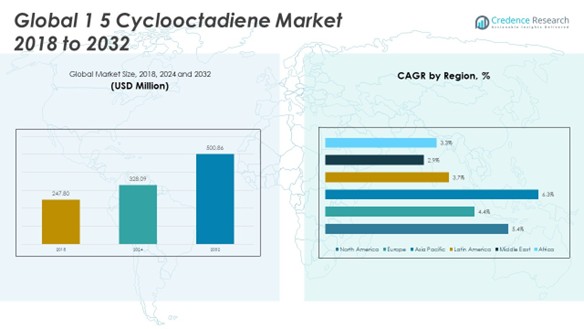
The Global 1,5-Cyclooctadiene Market size was valued at USD 247.80 million in 2018 to USD 328.09 million in 2024 and is anticipated to reach USD 500.86 million by 2032, at a CAGR of 5.43% during the forecast period.
Key drivers fueling this market growth include the rising demand for 1,5-Cyclooctadiene in the production of agrochemicals, cosmetics, and construction materials. In agriculture, the compound is utilized in synthesizing pesticides and fertilizers, supporting the sector's expansion in emerging economies. The cosmetics industry leverages 1,5-Cyclooctadiene for its role in manufacturing personal care products, while the construction sector benefits from its application in producing polystyrene, an insulating material. Additionally, the compound's use as a ligand in coordination chemistry enhances its significance in various chemical synthesis processes. Its compatibility with multiple catalytic systems further increases its demand in advanced organic reactions. Growing research in developing novel organometallic compounds continues to expand its functional utility across industrial domains.
Regionally, the Asia-Pacific (APAC) region holds the largest market share, attributed to increasing disposable incomes and the growing demand for home and personal care products in countries like China, India, Thailand, and South Korea. North America follows, with the United States leading due to its advanced chemical industry and emphasis on sustainable production practices. Europe also presents significant opportunities, driven by its robust chemical manufacturing base and stringent regulatory standards that necessitate high-purity chemical intermediates. Latin America and the Middle East are witnessing gradual adoption due to rising investments in the specialty chemicals sector. Continuous infrastructure development in these regions also supports the growth of related application industries, indirectly influencing demand for 1,5-Cyclooctadiene.
Market Insights:
- The Global 1,5-Cyclooctadiene Market is projected to grow at a CAGR of 5.43%, reaching USD 500.86 million by 2032.
- Demand is rising due to COD’s critical role in agrochemical synthesis, especially in pesticide and fertilizer production.
- Growth in personal care formulations is fueling the use of COD-based intermediates in cosmetics and dermatology products.
- Its application in homogeneous catalysis and coordination chemistry strengthens its value in specialty chemical manufacturing.
- Increasing use in polymer and construction sectors supports production of lightweight, energy-efficient building materials.
- Regulatory pressures and health risks associated with chemical handling pose operational challenges for manufacturers.
- Asia Pacific holds the largest market share, driven by strong demand in China, India, and South Korea’s personal care and chemical industries.
Market Drivers:
Expanding Use in Organometallic Chemistry and Homogeneous Catalysis
One of the primary drivers of the Global 1,5-Cyclooctadiene Market is its expanding use in organometallic chemistry, particularly in the synthesis of metal complexes for homogeneous catalysis. Its ability to act as a stable diene ligand supports a wide range of catalytic processes, including hydrogenation and polymerization. Chemical manufacturers increasingly depend on COD to enhance reaction efficiency and catalyst selectivity in complex synthesis pathways. It plays a crucial role in stabilizing transition metal centers, making it essential in producing highly active and tunable catalytic systems. Researchers continue to explore its coordination behavior to develop next-generation catalytic platforms. This growing utility in both academic and industrial research sectors reinforces its position as a valuable chemical intermediate.
- For instance, the in-situ preparation of (1,5-cyclooctadiene) palladium dichloride has been adopted for industrial-scale production of homogeneous catalysts, as described in a patented method that emphasizes low toxicity, reduced ligand consumption, and suitability for large-scale pharmaceutical and fine chemical synthesis.
Rising Demand from the Polymer and Construction Industries
The Global 1,5-Cyclooctadiene Market benefits from the growing demand for advanced polymers in the construction industry, particularly for insulation and structural materials. COD-based intermediates support the development of lightweight, thermally efficient polystyrene products widely used in modern building systems. Governments and private developers seek to improve energy performance in buildings, creating steady demand for materials that offer enhanced insulation and durability. COD’s compatibility with polymerization processes makes it a preferred feedstock for manufacturers producing high-performance plastics. It supports cost-effective formulations while meeting performance criteria in large-scale construction projects. The expansion of urban infrastructure and sustainable housing further accelerates this demand.
Increased Utilization in Agrochemical Production for Crop Efficiency
The agrochemical industry continues to adopt 1,5-Cyclooctadiene in the synthesis of key intermediates for pesticides and fertilizers. Countries facing food security challenges rely on high-yield crop protection solutions that incorporate COD-based compounds. Chemical producers value COD’s reactivity and stability in creating effective agricultural formulations. It plays a role in supporting sustainable farming practices by enabling the development of advanced agrochemicals with lower environmental impact. Research and development efforts in crop science drive continuous evaluation of COD’s effectiveness in delivering targeted agricultural outcomes. The steady rise in global agricultural production directly influences its demand in this application sector.
- For example, the global 1,5-cyclooctadiene market share from agrochemicals was estimated at $15.57 million in 2019, reflecting its widespread use in crop protection products.
Growing Use in High-Purity Intermediates for Personal Care Formulations
The cosmetics and personal care industry represents another significant driver for the Global 1,5-Cyclooctadiene Market. It supports the synthesis of specialty chemicals used in skin care, hair care, and beauty products requiring high purity and chemical stability. Manufacturers prioritize ingredients that enable safe and effective formulations, making COD a reliable choice for various active intermediates. It contributes to the structural integrity and performance of compounds designed for sensitive applications. The rising demand for dermatologically tested and efficacy-driven products has encouraged deeper integration of COD in personal care R&D pipelines. This driver strengthens the compound’s role in premium product segments.
Market Trends:
Increasing Integration of 1,5-Cyclooctadiene in Catalyst and Ligand Systems for Specialty Applications
A notable trend in the Global 1,5-Cyclooctadiene Market is the growing integration of the compound in ligand systems for homogeneous catalysis. Its ability to stabilize low-valent metal complexes makes it an ideal choice in organometallic chemistry, especially in transition metal-catalyzed reactions. Researchers are increasingly exploring COD-metal complexes in applications ranging from olefin polymerization to asymmetric synthesis. This expanding use in high-value chemical transformations strengthens its relevance in specialty and fine chemical manufacturing. Industries focusing on sustainable and high-efficiency synthesis are incorporating 1,5-Cyclooctadiene to improve reaction specificity and minimize by-product generation. It continues to gain prominence in advanced chemical labs and commercial-scale catalyst systems worldwide.
- For instance, BASFutilizes 1,5-cyclooctadiene as a ligand in the synthesis of (1,5-cyclooctadiene) nickel (0) complexes, which are employed as catalysts for specialty polymerizations and fine chemical synthesis.
Rising Demand in Polystyrene-Based Construction and Insulation Materials
The Global 1,5-Cyclooctadiene Market is witnessing rising demand from the construction sector, particularly in polystyrene production. The compound serves as an intermediate in the synthesis of advanced polymers that are used in insulation materials, helping meet energy efficiency standards in building design. Construction companies are turning to materials that support thermal resistance and lightweight structural applications, increasing reliance on compounds like 1,5-Cyclooctadiene. Government initiatives promoting green construction practices further accelerate this shift toward durable, recyclable materials. The compound’s chemical stability and compatibility with polymer formulations make it a preferred choice for high-performance insulation applications. It supports manufacturers in achieving cost-efficiency without compromising quality.
- For instance, INEOS Styrolution, a global leader in styrenics, uses 1,5-cyclooctadiene as a key intermediate in the production of specialty polystyrene grades for insulation panels.
Expanding Application in Agrochemical Synthesis Amid Global Food Security Priorities
The agrochemical sector continues to drive new applications of 1,5-Cyclooctadiene in pesticide and fertilizer formulation. It is widely used as a precursor in synthesizing cyclic organic compounds that serve as intermediates in crop protection solutions. Countries facing agricultural productivity challenges are increasing investments in chemical synthesis platforms that include 1,5-Cyclooctadiene-based formulations. Research institutions are also evaluating its role in the development of next-generation agrochemicals with improved environmental compatibility. Regulatory compliance and demand for high-efficiency inputs push producers to adopt intermediates with proven reliability and scalability. The compound enables formulation flexibility while supporting the sector's evolving needs in food safety and yield enhancement.
Innovation in Personal Care Products Enhancing Demand from Cosmetics Manufacturers
The personal care industry is experiencing an uptick in demand for 1,5-Cyclooctadiene due to its role in producing stable chemical intermediates for cosmetics and skin care products. Manufacturers value its properties in synthesizing active compounds that improve product performance and shelf stability. With consumer preferences shifting toward scientifically backed formulations, companies are incorporating advanced intermediates like 1,5-Cyclooctadiene in their product pipelines. It is gaining traction in the development of premium-grade personal care items, including anti-aging creams and dermatological solutions. Innovations in formulation technology continue to drive experimentation with 1,5-Cyclooctadiene in emulsifiers and texturizers. This trend aligns with the broader market shift toward efficacy-driven cosmetic formulations.
Market Challenges Analysis:
Health and Environmental Concerns Related to Chemical Handling and Disposal
One of the key challenges facing the Global 1,5-Cyclooctadiene Market is the growing scrutiny over health and environmental safety during chemical production and handling. Exposure to 1,5-Cyclooctadiene can pose health risks, including skin and respiratory irritation, requiring strict compliance with occupational safety guidelines. Regulatory bodies are enforcing more stringent standards on chemical storage, transportation, and disposal to mitigate environmental hazards. These compliance obligations increase operational costs and limit flexibility in production environments. Small- and medium-scale manufacturers may find it difficult to meet evolving safety protocols without substantial capital investment. It remains critical for producers to upgrade infrastructure and adopt advanced safety technologies to ensure risk mitigation.
Volatility in Raw Material Prices and Supply Chain Disruptions
Fluctuating prices of raw materials used in 1,5-Cyclooctadiene synthesis present another persistent challenge for market players. The Global 1,5-Cyclooctadiene Market depends on a stable petrochemical supply chain, which remains vulnerable to geopolitical tensions and crude oil price volatility. Supply chain disruptions-such as shipping delays or raw material shortages-can lead to extended production downtimes and increased lead times for end users. These uncertainties affect pricing strategies and profit margins across the value chain. Manufacturers must develop contingency plans and diversify sourcing strategies to ensure consistent supply. It becomes essential to balance cost-efficiency with supply stability in a dynamic global environment.
- For instance, a German specialty chemical producer reported a 22% increase in operating expenses in 2023 due to natural gas costs exceeding €100/MWh, which directly impacted the cost of producing cyclooctene-a key precursor for 1,5-cyclooctadiene-leading to a 9% year-on-year price hike for cyclooctene contracts.
Market Opportunities:
The transition toward green chemistry presents a strong opportunity for the Global 1,5-Cyclooctadiene Market. Its role as a ligand in recyclable and less toxic catalytic systems aligns well with sustainable synthesis goals across multiple industries. Research institutions and manufacturers are investing in eco-friendly pathways that reduce waste and improve atom economy, driving demand for compounds like COD. It supports low-emission processes and enables more efficient reactions under milder conditions. Companies developing bio-based or renewable feedstock alternatives can integrate COD-based systems to enhance sustainability credentials. This shift toward cleaner production practices expands the market’s relevance in environmentally conscious sectors.
Emerging economies offer untapped growth potential due to increasing industrialization and demand for high-performance materials. The Global 1,5-Cyclooctadiene Market can benefit from rising consumption of engineered polymers in packaging, construction, and automotive applications. Advances in polymer chemistry enable manufacturers to develop customized COD-based intermediates for niche applications. As infrastructure and manufacturing capacities grow in Asia, Latin America, and Africa, regional players seek reliable chemical inputs to support expansion. It presents opportunities for strategic partnerships, localized production, and technology transfer. This global shift enhances COD’s utility in next-generation materials.
Market Segmentation Analysis:
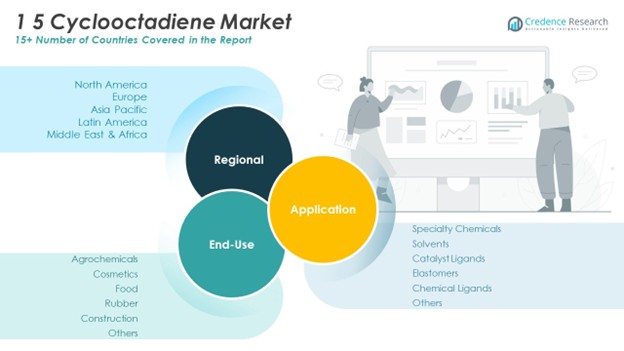
By End Use: The Global 1,5-Cyclooctadiene Market serves a wide range of end-use industries, with agrochemicals leading in consumption due to its utility in synthesizing pesticide and fertilizer intermediates. Cosmetics represent a growing segment, where the compound supports the formulation of active ingredients in skincare and haircare products. The food industry adopts it in limited but critical applications, often involving packaging or specialty additives. Rubber and construction segments utilize 1,5-Cyclooctadiene in producing high-performance materials like elastomers and insulating polymers. Demand from construction continues to rise with global infrastructure development. The "Others" category includes niche industrial uses that contribute to steady, diversified demand.
By application: specialty chemicals dominate the market, leveraging the compound’s reactivity and structural properties in producing customized intermediates. Solvents and catalyst ligands form essential segments, where 1,5-Cyclooctadiene plays a central role in coordination chemistry and reaction control. It also finds application in elastomers due to its ability to improve flexibility and thermal resistance in polymer blends. The chemical ligands segment benefits from ongoing research in organometallic and coordination chemistry. The "Others" application segment includes research and laboratory-scale uses that maintain demand across academic and industrial R&D. The market structure reflects strong integration into both commodity and advanced material production chains.
Segmentation:
By End-Use Segment:
- Agrochemicals
- Cosmetics
- Food
- Rubber
- Construction
- Others
By Application Segment:
- Specialty Chemicals
- Solvents
- Catalyst Ligands
- Elastomers
- Chemical Ligands
- Others
- North America
- U.S.
- Canada
- Mexico
- Europe
- Germany
- France
- U.K.
- Italy
- Spain
- Rest of Europe
- Asia Pacific
- China
- Japan
- India
- South Korea
- South-east Asia
- Rest of Asia Pacific
- Latin America
- Brazil
- Argentina
- Rest of Latin America
- Middle East & Africa
- GCC Countries
- South Africa
- Rest of the Middle East and Africa
Regional Analysis:
North America
The North America 1 5 Cyclooctadiene Market size was valued at USD 76.09 million in 2018 to USD 99.25 million in 2024 and is anticipated to reach USD 152.12 million by 2032, at a CAGR of 5.4% during the forecast period. North America holds 21.3% of the Global Chip Resistor Market, supported by its advanced electronics manufacturing infrastructure and strong demand from automotive and aerospace sectors. The United States leads regional consumption due to its robust semiconductor ecosystem and presence of leading OEMs. Growth in EV adoption and smart device production continues to drive demand for compact and reliable resistors. Government investments in defense and communication technologies further strengthen the market’s foundation. Technological innovation and integration of IoT in consumer electronics also support the expansion. The region maintains high standards in quality and performance, favoring suppliers with specialized, high-precision components.
Europe
The Europe 1 5 Cyclooctadiene Market size was valued at USD 59.98 million in 2018 to USD 76.06 million in 2024 and is anticipated to reach USD 108.09 million by 2032, at a CAGR of 4.4% during the forecast period. Europe accounts for 18.9% of the Global Chip Resistor Market, with significant contributions from Germany, France, and the UK. Strong automotive and industrial automation sectors stimulate continuous demand for chip resistors. Manufacturers in the region focus on sustainability and energy efficiency, prompting the use of advanced resistor technologies in EVs, renewable energy systems, and smart grids. Regulatory pressure on electronic waste management has led to a preference for longer-lasting and recyclable components. The European Union’s push for digital transformation and localized semiconductor production enhances market stability. High R&D intensity across EU countries ensures steady development in component miniaturization and functionality.
Asia Pacific
The Asia Pacific 1 5 Cyclooctadiene Market size was valued at USD 88.62 million in 2018 to USD 122.62 million in 2024 and is anticipated to reach USD 201.04 million by 2032, at a CAGR of 6.3% during the forecast period. Asia Pacific dominates the Global Chip Resistor Market with a 42.7% market share, driven by high-volume electronics production in China, South Korea, Japan, and Taiwan. The region serves as a global manufacturing hub for smartphones, laptops, wearables, and automotive electronics. Rapid industrialization and urbanization accelerate the demand for power management and communication components. Strong supply chain networks and cost-effective labor provide competitive advantages to regional manufacturers. Government-backed semiconductor initiatives in India and China support long-term market expansion. Asia Pacific continues to be the center for technological advancements in passive components.
Latin America
The Latin America 1 5 Cyclooctadiene Market size was valued at USD 11.14 million in 2018 to USD 14.56 million in 2024 and is anticipated to reach USD 19.54 million by 2032, at a CAGR of 3.7 % during the forecast period. Latin America contributes 6.1% to the Global Chip Resistor Market, with Brazil and Mexico serving as key markets. The region shows growing demand from automotive assembly lines and consumer electronics industries. Rising mobile penetration and the spread of digital technologies contribute to steady adoption. Investments in renewable energy and smart infrastructure projects provide new opportunities for resistor integration. Local manufacturers are slowly enhancing capabilities to meet international quality standards. Import dependence remains a challenge, although trade partnerships aim to improve supply chain resilience.
Middle East
The Middle East 1 5 Cyclooctadiene Market size was valued at USD 6.44 million in 2018 to USD 7.74 million in 2024 and is anticipated to reach USD 9.81 million by 2032, at a CAGR of 2.9 % during the forecast period. The Middle East holds 5.6% of the Global Chip Resistor Market, driven by infrastructure modernization and growth in industrial automation. Countries like the UAE and Saudi Arabia invest heavily in smart city and digital transformation initiatives. Demand for electronics in consumer goods, defense, and healthcare boosts market activity. The region emphasizes energy efficiency, encouraging adoption of advanced resistor technologies. Limited local manufacturing makes the market reliant on international suppliers. Strategic partnerships with global players are helping improve regional access to quality components.
Africa
The Africa 1 5 Cyclooctadiene Market size was valued at USD 5.53 million in 2018 to USD 7.86 million in 2024 and is anticipated to reach USD 10.25 million by 2032, at a CAGR of 3.3 % during the forecast period. Africa holds a 5.4% share of the Global Chip Resistor Market, supported by expanding telecommunications and consumer electronics adoption. Countries such as South Africa, Nigeria, and Kenya lead demand due to increasing smartphone penetration and internet connectivity. Electrification projects and solar energy programs create demand for basic resistor components. The region faces supply chain limitations due to infrastructure and regulatory barriers. Government incentives and global development programs are gradually improving access to modern electronic parts. Africa presents long-term potential as a developing electronics consumption hub.
Key Player Analysis:
- Sigma Aldrich
- TCI Chemicals
- Spex Certiprep
- Biosynth Carbosynth
- ABCR GmbH
- Kraton Corporation
- Shandong Yanggu Huatai Chemical
- Nanjing Kaiming Chemical
- Fushun Jinly Petrochemical
- Oakwood Chemical
- AK Scientific
- AA Blocks
- BroadPharm
- Evonik Industries AG
Competitive Analysis:
The Global 1,5-Cyclooctadiene Market features a competitive landscape shaped by both multinational chemical companies and specialized producers. Key players such as Sigma Aldrich, TCI Chemicals, and Biosynth Carbosynth maintain strong market positions through extensive product portfolios and high-purity synthesis capabilities. Companies like Kraton Corporation and Evonik Industries AG leverage advanced manufacturing infrastructure to supply bulk volumes for industrial applications. Regional manufacturers including Shandong Yanggu Huatai Chemical and Nanjing Kaiming Chemical offer cost-effective alternatives and focus on domestic demand in Asia. Firms compete on factors such as pricing, product consistency, regulatory compliance, and supply chain efficiency. The market favors companies that invest in R&D, technical support, and custom synthesis services. It continues to attract new entrants aiming to serve niche applications in catalyst systems, specialty chemicals, and high-performance materials.
Recent Developments:
- In March 2025, Sigma-Aldrich listed new and existing 1,5-cyclooctadiene-based compounds, such as Chloro(1,5-cyclooctadiene) rhodium(I) dimer and Bis(1,5-cyclooctadiene) rhodium(I) tetrakis[bis(3,5-trifluoromethyl) phenyl] borate, highlighting their availability and application in catalysis and advanced synthesis. These offerings underscore Sigma-Aldrich's active participation in meeting the evolving demands of the global 1,5-cyclooctadiene market.
Market Concentration & Characteristics:
The Global 1,5-Cyclooctadiene Market demonstrates a moderately concentrated structure, with a mix of global chemical manufacturers and regional suppliers contributing to its supply chain. It is characterized by high entry barriers due to stringent purity requirements, regulatory standards, and the need for specialized synthesis capabilities. Leading players maintain a competitive edge through advanced R&D, established distribution networks, and customized product offerings for niche applications. The market favors suppliers that can ensure consistent quality, reliable logistics, and compliance with safety regulations across diverse end-use industries. It supports a balance between large-volume industrial users and smaller segments requiring precision-grade materials.
Report Coverage:
The research report offers an in-depth analysis based on End Use and Application. It details leading market players, providing an overview of their business, product offerings, investments, revenue streams, and key applications. Additionally, the report includes insights into the competitive environment, SWOT analysis, current market trends, as well as the primary drivers and constraints. Furthermore, it discusses various factors that have driven market expansion in recent years. The report also explores market dynamics, regulatory scenarios, and technological advancements that are shaping the industry. It assesses the impact of external factors and global economic changes on market growth. Lastly, it provides strategic recommendations for new entrants and established companies to navigate the complexities of the market.
Future Outlook:
- Demand for 1,5-Cyclooctadiene will rise due to its expanding use in specialty and fine chemical synthesis.
- Advancements in homogeneous catalysis will drive adoption in industrial and academic research.
- The construction sector will support steady growth through increased use in polystyrene-based insulation materials.
- Agrochemical applications will expand with rising demand for high-efficiency crop protection solutions.
- The cosmetics industry will adopt more COD-based intermediates to meet consumer demand for performance-driven formulations.
- Asia Pacific will remain the dominant region due to large-scale electronics and chemical manufacturing.
- Manufacturers will invest in green chemistry processes to align with sustainability regulations.
- Technological innovations in catalyst ligand design will broaden its application base.
- Strategic partnerships and custom synthesis services will become key competitive differentiators.
- Market players will focus on expanding capacity and improving purity levels to meet global demand.

Request a Free Sample
Fill in your details and we'll send you a free sample report.
- Sample data tables & charts
- Research methodology
Market Dynamics
Expanding Use in Organometallic Chemistry and Homogeneous Catalysis
1,5-Cyclooctadiene is increasingly used as a ligand in the synthesis of metal complexes for homogeneous catalysis, supporting advanced chemical reactions in both industrial and academic research. Its ability to stabilize transition metal centers makes it essential for producing highly active and tunable catalytic systems.
Rising Demand from Polymer and Construction Industries
The compound is a key intermediate in the production of advanced polymers, particularly polystyrene used for insulation and lightweight construction materials. Growing infrastructure development and the push for energy-efficient buildings are driving steady demand in this sector.
Increased Utilization in Agrochemical Production
1,5-Cyclooctadiene is widely adopted in the synthesis of pesticide and fertilizer intermediates, supporting higher crop yields and sustainable farming practices. The need for efficient crop protection solutions in emerging economies is fueling its use in agrochemical formulations.
Growing Use in High-Purity Intermediates for Personal Care
The cosmetics and personal care industry leverages 1,5-Cyclooctadiene for synthesizing specialty chemicals used in skin and hair care products. Rising consumer demand for efficacy-driven and dermatologically tested formulations is boosting its integration into premium product lines.
Shift Toward Green Chemistry and Sustainable Synthesis
Manufacturers are investing in eco-friendly production pathways where 1,5-Cyclooctadiene serves as a ligand in recyclable and less toxic catalytic systems. This aligns with regulatory trends and industry goals for reducing environmental impact and improving process sustainability.
Need a Custom Version of This Report?
Tailor the scope, geography, or segments to your exact requirements.
- Custom geography or segment scope
- Direct access to our analyst team
Frequently Asked Questions
What is the current size of the Global 1,5-Cyclooctadiene Market?
What factors are driving the growth of the Global 1,5-Cyclooctadiene Market?
What are some challenges faced by the Global 1,5-Cyclooctadiene Market?
Who are the major players in the Global 1,5-Cyclooctadiene Market?
Table of Content
Chapter 1 Market Segmentation
- 1.1 Segmentation Framework
- 1.1.1 Product and Service Classification
- 1.1.2 Application and End-Use Classification
- 1.1.3 Technology and Solution Classification
- 1.1.4 Customer and Distribution Channel Classification
- 1.1.5 Geographic Segmentation
- 1.1.6 Market Segment Definitions and Boundaries
- 1.2 By End Use
- 1.2.1 Agrochemicals
- 1.2.2 Cosmetics
- 1.2.3 Food
- 1.2.4 Rubber
- 1.2.5 Construction
- 1.2.6 Others
- 1.3 By Application
- 1.3.1 Specialty Chemicals
- 1.3.2 Solvents
- 1.3.3 Catalyst Ligands
- 1.3.4 Elastomers
- 1.3.5 Chemical Ligands
- 1.3.6 Others
Chapter 2 Introduction
- 2.1 Report Objectives and Scope
- 2.2 Product Definition and Industry Terminology
- 2.3 Market Inclusions and Exclusions
- 2.4 Research Process
- 2.4.1 Primary Research and Expert Interviews
- 2.4.2 Secondary Research and Source Review
- 2.4.3 Top-Down and Bottom-Up Estimation
- 2.4.4 Data Triangulation and Verification
- 2.5 Market Size Measurement Basis
- 2.5.1 2024: USD 328.09 million → 2032: USD 500.86 million
- 2.6 Historical and Forecast Reference Periods
- 2.6.1 Base Year: 2024
- 2.6.2 Forecast Period: 2024-2032
- 2.7 Research Assumptions and Limitations
Chapter 3 Executive Summary
- 3.1 Market Snapshot and Key Findings
- 3.2 Base-Year Market Size, 2024
- 3.3 Forecast Market Size, 2032
- 3.4 Revenue and Volume Growth Outlook
- 3.5 Key Demand and Supply Indicators
- 3.6 Leading Market Segments
- 3.7 Fastest-Growing Market Opportunities
- 3.8 Regional Performance Highlights
- 3.9 Technology and Industry Transformation
- 3.10 Competitive Landscape Summary
- 3.11 Analyst View and Strategic Implications
Chapter 4 Global 1,5-Cyclooctadiene Market Trends and Developments
- 4.1 Historical Industry Development
- 4.2 Recent Market Trends and Developments
- 4.3 Demand and Customer Behavior Trends
- 4.4 Technology and Product Innovation
- 4.5 Artificial Intelligence, Automation and Digitalization
- 4.6 Local Manufacturing and Supply Chain Realignment
- 4.7 Industry Partnerships, Mergers and Acquisitions
- 4.8 Sustainability and Circular Economy Developments
- 4.9 Government and Private Sector Investment Trends
- 4.10 Emerging Business Models and Commercialization
- 4.11 Industry Developments and Announcements
Chapter 5 Global 1,5-Cyclooctadiene Market Production, Supply and Demand Analysis
- 5.1 Demand Trend and Consumption Analysis
- 5.2 Demand Forecast, 2024-2032
- 5.3 Production and Output Trend
- 5.4 Production and Output Forecast, 2024-2032
- 5.5 Installed Capacity and Capacity Utilization
- 5.6 Company-Wise Production Plants and Statistics
- 5.6.1 Installed Production Capacity
- 5.6.2 Actual Production
- 5.6.3 Planned Capacity and Expansion Targets
- 5.7 Supply Chain Structure and Procurement Trends
- 5.8 Supply-Demand Gap and Bottlenecks
- 5.9 Import Dependence and Sourcing Structure
- 5.10 Contract Manufacturing and Outsourcing
- 5.11 Regional Supply and Demand Concentration
Chapter 6 Global 1,5-Cyclooctadiene Market Pricing Analysis
- 6.1 Pricing Structure and Measurement
- 6.2 Historical Pricing Trends
- 6.3 Pricing Outlook, 2024-2032
- 6.4 Average Selling Price and Unit Economics
- 6.5 Pricing by Product and Market Segment
- 6.6 Geographic Pricing Differences
- 6.7 Key Input, Energy, Labor and Logistics Costs
- 6.8 Contract Pricing and Purchasing Models
- 6.9 Pricing Sensitivity and Competitive Positioning
- 6.10 Price, Margin and Profitability Implications
Chapter 7 Global 1,5-Cyclooctadiene Market Dynamics
- 7.1 Market Growth Drivers
- 7.1.1 Demand-Side Drivers
- 7.1.2 Technology and Innovation Drivers
- 7.1.3 Infrastructure and Investment Drivers
- 7.1.4 Regulatory and Policy Drivers
- 7.2 Market Restraints
- 7.2.1 Cost and Affordability Constraints
- 7.2.2 Technology and Adoption Barriers
- 7.2.3 Supply Chain and Operational Constraints
- 7.3 Market Challenges
- 7.3.1 Competitive Pressure and Margin Erosion
- 7.3.2 Skills, Infrastructure and Implementation Gaps
- 7.4 Emerging Market Opportunities
- 7.5 Market Dynamics Impact and Time-Horizon Assessment
Chapter 8 Global 1,5-Cyclooctadiene Value Chain Analysis
- 8.1 Industry Value Chain Overview
- 8.2 Upstream Suppliers and Critical Inputs
- 8.3 Technology and Component Providers
- 8.4 Manufacturing or Service Delivery
- 8.5 Distribution, Channel Partners and Integrators
- 8.6 Downstream Applications and End Users
- 8.7 Value Addition and Profit Pools
- 8.8 Vertical Integration and Outsourcing
- 8.9 Supplier Concentration and Risk
- 8.10 Supply Chain Localization and Resilience
Chapter 9 Global 1,5-Cyclooctadiene Market Regulations and Policies
- 9.1 Relevant Laws, Standards and Compliance Frameworks
- 9.2 Product, Service, Safety and Quality Requirements
- 9.3 Government Policies, Incentives and Subsidies
- 9.4 Imports, Exports and Trade Barriers
- 9.5 Public Procurement and Local Content Requirements
- 9.6 Environmental and Sustainability Compliance
- 9.7 Upcoming Policy Changes and Market Implications
Chapter 10 Global 1,5-Cyclooctadiene Market Hotspots and Opportunities
- 10.1 Market Opportunity Mapping and Growth Hotspots
- 10.2 High-Growth Applications and Customer Groups
- 10.3 Underserved Markets and White-Space Opportunities
- 10.4 Emerging Technology and Product Opportunities
- 10.5 New Capacity and Investment Hotspots
- 10.6 Market Entry and Expansion Opportunities
- 10.7 Distribution and Partnership Opportunities
- 10.8 Near-Term and Long-Term Commercial Potential
- 10.9 Opportunity Attractiveness and Execution Risks
Chapter 11 Global 1,5-Cyclooctadiene Market Outlook, 2024-2032
- 11.1 Market Size and Analysis
- 11.1.1 Revenue (Market Measurement: 2024: USD 328.09 million → 2032: USD 500.86 million)
- 11.1.2 Market Volume and Quantity Sold
- 11.1.3 Historical Market Size
- 11.1.4 Base-Year Market Size, 2024
- 11.2 Market Forecast, 2024-2032
- 11.2.1 Revenue Forecast to 2032
- 11.2.2 Volume Forecast to 2032
- 11.2.3 CAGR and Year-on-Year Growth
- 11.2.4 Incremental Revenue Opportunity
- 11.3 Forecast Assumptions and Scenario Analysis
- 11.3.1 Base-Case Forecast
- 11.3.2 Optimistic and Conservative Scenarios
- 11.3.3 Technology, Pricing and Policy Sensitivities
- 11.4 Market Attractiveness and Growth Outlook
Chapter 12 Global 1,5-Cyclooctadiene Market Segmentation and Outlook
- 12.1 Segmentation Summary and Market Shares, 2024
- 12.2 Largest and Fastest-Growing Segments
- 12.3 By End Use - Market Size and Forecast, 2024-2032
- 12.3.1 Segment Definition and Scope
- 12.3.2 Historical Market Size
- 12.3.3 Revenue Forecast, 2024-2032
- 12.3.4 Volume Forecast, 2024-2032
- 12.3.5 Base-Year Market Share, 2024
- 12.3.6 Segment CAGR and Growth Drivers
- 12.3.7 Subsegment Market Size and Forecast
- 12.3.7.1 Agrochemicals
- 12.3.7.2 Cosmetics
- 12.3.7.3 Food
- 12.3.7.4 Rubber
- 12.3.7.5 Construction
- 12.3.7.6 Others
- 12.3.8 Subsegment Pricing and Adoption Trends
- 12.3.9 Leading Suppliers and Competition
- 12.3.10 Regional Demand and Opportunities
- 12.4 By Application - Market Size and Forecast, 2024-2032
- 12.4.1 Segment Definition and Scope
- 12.4.2 Historical Market Size
- 12.4.3 Revenue Forecast, 2024-2032
- 12.4.4 Volume Forecast, 2024-2032
- 12.4.5 Base-Year Market Share, 2024
- 12.4.6 Segment CAGR and Growth Drivers
- 12.4.7 Subsegment Market Size and Forecast
- 12.4.7.1 Specialty Chemicals
- 12.4.7.2 Solvents
- 12.4.7.3 Catalyst Ligands
- 12.4.7.4 Elastomers
- 12.4.7.5 Chemical Ligands
- 12.4.7.6 Others
- 12.4.8 Subsegment Pricing and Adoption Trends
- 12.4.9 Leading Suppliers and Competition
- 12.4.10 Regional Demand and Opportunities
- 12.5 Segment Growth Comparison
- 12.6 Segment Attractiveness and Priority Matrix
Chapter 13 Global 1,5-Cyclooctadiene End-Use and Application Market Outlook
- 13.1 End-Use Industry and Customer Demand Structure
- 13.2 Leading Applications and Customer Groups
- 13.3 End-Use Market Size, Share and Forecast
- 13.4 Major End-Use Industry Deep Dives
- 13.4.1 Customer Requirements and Use Cases
- 13.4.2 Demand and Replacement Cycles
- 13.4.3 Technical and Regulatory Considerations
- 13.4.4 Purchasing and Procurement Models
- 13.4.5 Leading Vendors and Distribution Channels
- 13.4.6 Forecast and Commercial Opportunities
- 13.5 Emerging Applications and Cross-Segment Demand
- 13.6 End-Use Industry Investment Priorities
Chapter 14 Global 1,5-Cyclooctadiene Geographic Market Outlook, 2024-2032
- 14.1 Regional Market Size and Share, 2024
- 14.2 Regional Market Forecast, 2024-2032
- 14.3 Regional Pricing, Production and Demand Differences
- 14.4 North America
- 14.4.1 United States
- 14.4.2 Canada
- 14.4.3 Mexico
- 14.5 Europe
- 14.5.1 Germany
- 14.5.2 France
- 14.5.3 Italy
- 14.5.4 United Kingdom
- 14.5.5 Spain
- 14.5.6 Poland
- 14.5.7 Russia
- 14.5.8 Netherlands
- 14.5.9 Belgium
- 14.5.10 Sweden
- 14.5.11 Denmark
- 14.5.12 Norway
- 14.5.13 Rest of Europe
- 14.6 Asia Pacific
- 14.6.1 China
- 14.6.2 India
- 14.6.3 Japan
- 14.6.4 South Korea
- 14.6.5 Thailand
- 14.6.6 Indonesia
- 14.6.7 Vietnam
- 14.6.8 Malaysia
- 14.6.9 Australia
- 14.6.10 Rest of Asia Pacific
- 14.7 Latin America
- 14.7.1 Brazil
- 14.7.2 Argentina
- 14.7.3 Colombia
- 14.7.4 Chile
- 14.7.5 Rest of Latin America
- 14.8 Middle East
- 14.8.1 Saudi Arabia
- 14.8.2 United Arab Emirates
- 14.8.3 Turkey
- 14.8.4 Israel
- 14.8.5 Iran
- 14.8.6 Rest of the Middle East
- 14.9 Africa
- 14.9.1 South Africa
- 14.9.2 Egypt
- 14.9.3 Nigeria
- 14.9.4 Morocco
- 14.9.5 Rest of Africa
- 14.10 Regional Investment, Policy and Supply Chain Differences
- 14.11 Regional Competitive Landscape
- 14.12 Geographic Growth Hotspots
Chapter 15 Global 1,5-Cyclooctadiene Technology, Innovation and Sustainability Outlook
- 15.1 Technology Landscape and Maturity
- 15.2 Product, Process and Service Innovation
- 15.3 AI, Automation and Digital Tools in the Industry
- 15.4 Technology Adoption and Performance Benchmarking
- 15.5 Innovation Pipeline and R&D Investment
- 15.6 Patent and Intellectual Property Trends
- 15.7 Energy Efficiency and Resource Management
- 15.8 Sustainability, Recycling and Circularity
- 15.9 Technology Roadmap, 2024-2032
- 15.10 Risks of Obsolescence and Technology Substitution
Chapter 16 Global 1,5-Cyclooctadiene Market Key Strategic Imperatives
- 16.1 Growth and Market Entry Priorities
- 16.2 High-Return Products and Segments
- 16.3 Pricing, Profitability and Cost Optimization
- 16.4 Technology Investment and Product Differentiation
- 16.5 Supply Chain Localization and Resilience
- 16.6 Distribution and Customer Acquisition
- 16.7 Partnership, Acquisition and Capacity Strategy
- 16.8 Regional Expansion Priorities
- 16.9 Short-, Medium- and Long-Term Actions
Chapter 17 Competition Outlook
- 17.1 Industry Competition Characteristics
- 17.2 Market Structure and Concentration
- 17.3 Market Share and Competitive Positioning, 2024
- 17.4 Company-Wise Revenue and Product Benchmarking
- 17.5 Production and Service Capacity Benchmarking
- 17.6 Technology, Pricing and Differentiation
- 17.7 Regional Footprint and Distribution Strength
- 17.8 Mergers, Acquisitions and Strategic Alliances
- 17.9 New Entrants and Competitive Threats
- 17.10 Porter's Five Forces and Industry Attractiveness
- 17.11 Competitive Outlook, 2024-2032
Chapter 18 Company Profiles
- 18.1 Company Coverage and Selection Criteria
- 18.2 Sigma Aldrich
- 18.2.1 Business Description
- 18.2.2 Company Ownership and Geographic Presence
- 18.2.3 Product and Service Portfolio
- 18.2.4 Manufacturing and Operating Footprint
- 18.2.5 Production Capacity and Expansion Plans
- 18.2.6 Financial Performance and Investment
- 18.2.7 Market Share and Competitive Position
- 18.2.8 Technology and Innovation Capabilities
- 18.2.9 Strategic Alliances or Partnerships
- 18.2.10 Recent Developments
- 18.2.11 Growth Strategy and Outlook
- 18.3 TCI Chemicals
- 18.4 Biosynth Carbosynth
- 18.5 Kraton Corporation
- 18.6 Evonik Industries AG
- 18.7 Shandong Yanggu Huatai Chemical
- 18.8 Nanjing Kaiming Chemical
- 18.9 Oakwood Chemical
- 18.10 ABCR GmbH
- 18.11 Fushun Jinly Petrochemical
- 18.12 Other Relevant Market Participants
Note: Every listed company is profiled on the structure shown under the first company. The company list is preliminary and may change based on research findings, market developments, data availability and client requirements.
Chapter 19 Disclaimer
- 19.1 Research and Forecast Disclaimer
- 19.2 Data Source and Estimation Limitations
Note: The depth of individual sections depends on data availability for this market. Volume, capacity, trade and other unit-based metrics are included where applicable.

