
Market Overview:
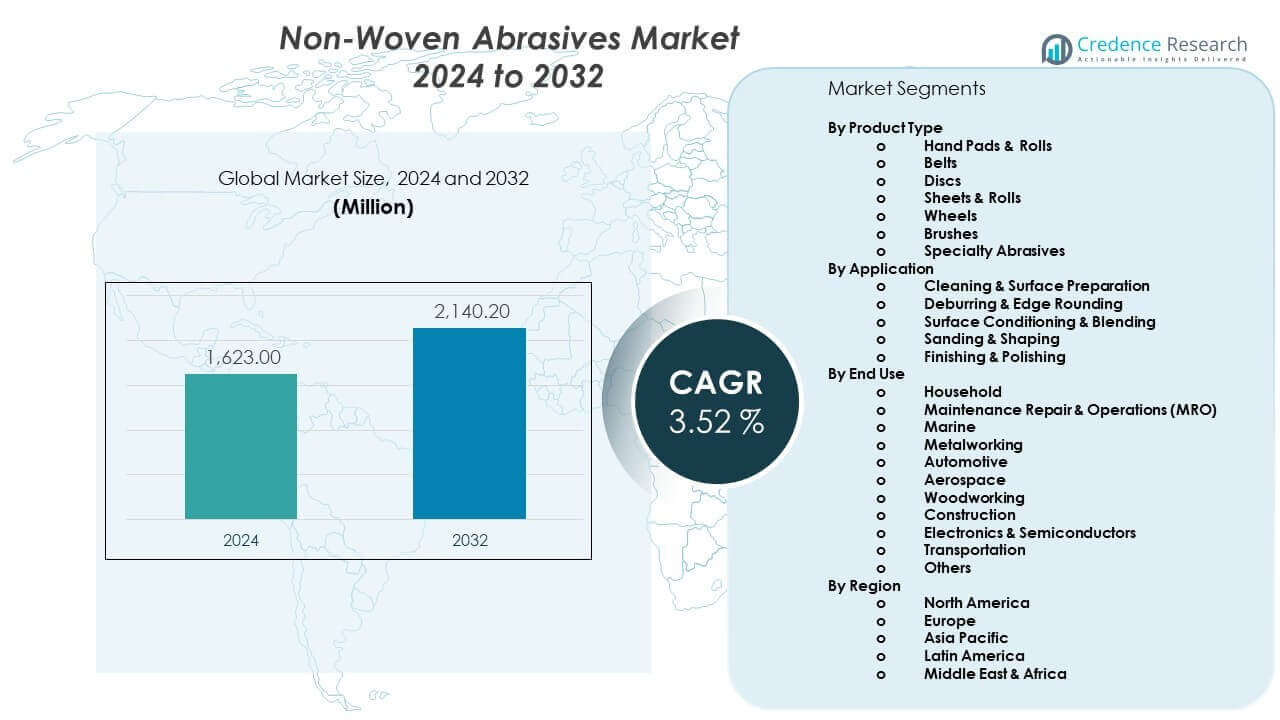
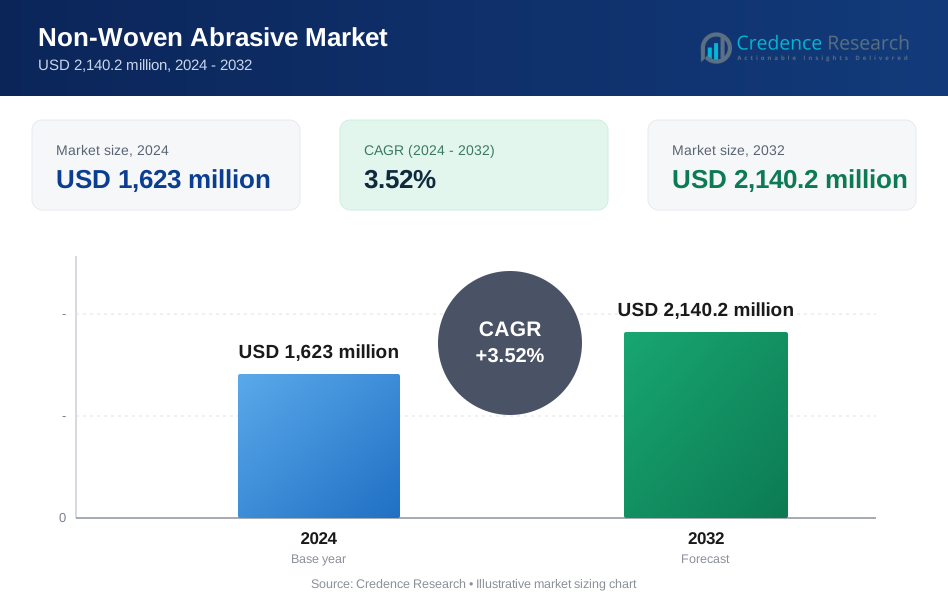
The Non-woven abrasives market is projected to grow from USD 1,623 million in 2024 to USD 2,140.2 million by 2032. The market is expected to register a CAGR of 3.52% from 2024 to 2032.
| REPORT ATTRIBUTE | DETAILS |
|---|---|
| Historical Period | 2020-2023 |
| Base Year | 2024 |
| Forecast Period | 2025-2032 |
| Non-Woven Abrasive Market Size 2024 | USD 1,623 Million |
| Non-Woven Abrasive Market, CAGR | 3.52% |
| Non-Woven Abrasive Market Size 2032 | USD 2,140.2 Million |
Market growth is driven by rising use in metal fabrication and automotive finishing operations. Manufacturers prefer non-woven abrasives for uniform surface quality and reduced rework rates. Growth in appliance and electronics production supports steady product consumption. Industrial maintenance activities also increase demand for cleaning and conditioning tools. Flexible product forms suit complex shapes and sensitive surfaces. Adoption rises due to lower heat generation during use. Improved durability extends product replacement cycles. These factors collectively sustain market expansion.
North America and Europe lead the market due to strong industrial bases and mature manufacturing sectors. The United States and Germany show high adoption across automotive and metalworking industries. Asia Pacific emerges as the fastest-growing region due to rapid industrialization. China and India benefit from expanding manufacturing and infrastructure projects. Rising electronics and consumer goods production supports regional demand. Southeast Asia gains traction due to cost-efficient manufacturing hubs. Regional growth reflects industrial output shifts toward emerging economies.
Market Insights:
- The market stood at USD 1,623 million in 2024 and is projected to reach USD 2,140.2 million by 2032, growing at a CAGR of 3.52%, supported by steady industrial and MRO demand.
- Asia Pacific led with about 38% share due to large-scale manufacturing in China, Japan, and India, while Europe held nearly 23% driven by automotive and metalworking strength, and North America accounted for around 22% supported by MRO and automotive aftermarket demand.
- Asia Pacific remains the fastest-growing region with roughly 38% share, driven by rapid industrialization, electronics production growth, and expanding infrastructure projects across emerging economies.
- By application, metalworking held the largest share at approximately 34% due to high usage in surface conditioning, deburring, and finishing operations across fabrication units.
- By end use, automotive accounted for nearly 27% share, supported by consistent demand from OEM production lines and expanding vehicle maintenance and refurbishment activities.
Market Drivers:
Rising Demand For Consistent Surface Finishing Across Manufacturing Industries
The Non-woven abrasives market benefits from strong demand for uniform surface finishes across manufacturing industries. Automotive plants require smooth finishes for visible and functional components to meet quality standards. Metal fabrication units rely on controlled abrasion to reduce surface defects and improve part reliability. Industrial buyers prefer predictable performance across repeated operations. The material structure supports even pressure distribution during use. This feature lowers rejection rates in finished products. Manufacturers aim to improve output quality through stable tools. Surface consistency remains a core purchase factor.
- For instance, 3M reports its Scotch-Brite™ non-woven abrasives deliver consistent Ra surface values across repeated production cycles, helping OEMs cut rework rates in automated body shops.
Expanding Use In Automotive Maintenance And Aftermarket Applications
The Non-woven abrasives market gains support from expanding automotive maintenance and aftermarket activities. Repair shops use these products for cleaning and blending tasks during routine servicing. Vehicle refurbishment increases tool demand across service centers. Workshops value low surface damage during component preparation to preserve part integrity. Flexible abrasive formats support curved and uneven parts. This benefit improves repair efficiency and finish quality. Rising vehicle ownership boosts maintenance cycles across regions. Aftermarket service growth sustains steady demand.
- For instance, Robert Bosch highlights that non-woven abrasive discs enable controlled paint blending and rust removal without aggressive metal loss in vehicle repair operations.
Growing Preference For Low Heat And Low Vibration Abrasive Solutions
The Non-woven abrasives market grows due to preference for safer operating characteristics. Operators prefer tools that reduce heat during surface treatment processes. Lower heat protects sensitive metals and coated parts from damage. Reduced vibration improves worker comfort and operational control. These features support longer operational shifts without fatigue. Industrial safety standards favor stable abrasive tools across facilities. Manufacturers align purchases with workplace safety goals. Comfort and control influence buying decisions across end-use industries.
Increasing Adoption In Electronics And Appliance Manufacturing
The Non-woven abrasives market benefits from growth in electronics and appliance manufacturing. Manufacturers require fine finishing on delicate components to avoid surface damage. The structure supports gentle material removal with controlled abrasion. Appliance makers use these products for cosmetic finishing of visible surfaces. Demand rises for scratch-free surface preparation. Production lines value consistent output quality for high volumes. Tool reliability supports efficient manufacturing operations. Electronics growth sustains long-term demand.
Market Trends:
Shift Toward Customized Abrasive Formats For Application-Specific Needs
The Non-woven abrasives market shows rising demand for tailored product designs. Manufacturers request formats suited to unique surface profiles and materials. Customization improves process efficiency and finish accuracy. Suppliers expand product portfolios with varied densities and structures. End users seek better task alignment from abrasives. Custom solutions reduce secondary finishing steps in production. Process optimization drives this trend across industries. Specialized use cases gain importance.
- For instance, Klingspor offers non-woven belts and discs in multiple densities, allowing customers to match abrasive aggressiveness with exact surface requirements.
Growing Focus On Ergonomic And Operator-Friendly Abrasive Products
The Non-woven abrasives market reflects a strong emphasis on operator comfort. Tool design now considers ease of handling and balance. Lightweight structures reduce worker fatigue during extended use. Better grip support improves task control and precision. Factories focus on productivity through ergonomic tools. Comfort supports longer operating durations on shop floors. User experience influences product selection decisions. Ergonomic design becomes a key differentiator.
- For instance, Mirka reports lightweight non-woven discs paired with low-vibration tools help operators work longer shifts with reduced fatigue.
Increased Integration Of Abrasives In Automated Finishing Systems
The Non-woven abrasives market aligns with broader automation trends in manufacturing. Manufacturers integrate these abrasives into robotic finishing lines. Consistent performance supports automated surface treatment processes. Predictable wear behavior aids system calibration and control. Automation reduces labor dependency in finishing operations. Industrial plants seek stable tool compatibility for machines. This trend supports higher throughput and repeatability. Automation adoption expands steadily.
Market Trends: Rising Demand For Multi-Functional Abrasive Products
The Non-woven abrasives market trends toward demand for versatile products. Users prefer tools that handle multiple finishing tasks efficiently. Multi-use products reduce inventory complexity for workshops. This approach lowers procurement and storage costs. Workshops value flexibility across diverse operations. Versatility improves overall operational efficiency. Suppliers promote broader application ranges. Multi-functionality gains market attention.
Market Challenges Analysis:
Price Sensitivity And Competition From Conventional Coated Abrasives
The Non-woven abrasives market faces pricing pressure from conventional coated abrasives. Coated abrasives often offer lower upfront costs to buyers. Customers compare performance benefits against price differences. Cost-focused industries delay premium product adoption decisions. Procurement teams emphasize short-term savings over lifecycle value. This behavior affects volume growth in some segments. Suppliers must justify value propositions through performance benefits. Price competition remains intense across regions.
Limited Awareness In Small And Medium Manufacturing Units
The Non-woven abrasives market encounters awareness gaps in smaller manufacturing units. Smaller firms rely on familiar abrasive solutions with known usage. Technical benefits remain under-communicated in these segments. Training access stays limited in smaller workshops. This slows product switching decisions and trials. Sales cycles extend due to knowledge gaps. Suppliers invest in education and demonstrations. Adoption barriers persist at smaller scales.
Market Opportunities:
Expansion Potential In Emerging Manufacturing Economies
The Non-woven abrasives market holds strong growth potential in emerging manufacturing economies. Industrial expansion increases surface finishing needs across sectors. New factories adopt modern production practices and standards. Quality requirements rise across developing markets. Manufacturers seek reliable finishing tools to meet specifications. Local production hubs increase product demand. Infrastructure projects support metal processing activities. Emerging economies offer long-term opportunities.
Product Innovation Aligned With Sustainability And Process Efficiency Goals
The Non-woven abrasives market can gain from a stronger innovation focus. Manufacturers develop longer-life abrasive solutions to enhance value. Extended durability improves cost efficiency for end users. Process efficiency becomes a buyer priority across industries. Innovation supports reduced material waste during operations. Producers align products with efficiency targets. R&D investments strengthen competitive positioning. Innovation-driven growth prospects remain strong.
Market Segmentation Analysis:
By Product Type
The Non-woven abrasives market shows diverse demand across product types based on task complexity. Hand pads and rolls see wide use in manual cleaning and light finishing. Belts support continuous surface treatment in industrial setups. Discs gain traction in precision grinding and controlled material removal. Sheets and rolls suit flexible surface preparation needs. Wheels serve heavy-duty conditioning and blending tasks. Brushes address rust removal and surface cleaning. Specialty abrasives meet niche industrial requirements.
- For instance, 3M notes Scotch-Brite™ hand pads remain widely used for controlled cleaning in maintenance operations.
By Application
Application demand varies with surface treatment objectives across industries. Cleaning and surface preparation remain core uses across maintenance tasks. Deburring and edge rounding support safety and part accuracy. Surface conditioning and blending address cosmetic and functional finishes. Sanding and shaping enable dimensional correction. Finishing and polishing focus on final appearance and surface smoothness. Industrial users prefer predictable abrasion control. Process-specific needs shape product selection. Application diversity supports stable demand.
- For instance, Norton Abrasives reports non-woven abrasives support consistent edge rounding and surface conditioning in industrial fabrication.
By End Use
End-use demand reflects industrial output and maintenance activity levels. Household use centers on light cleaning and refurbishment tasks. MRO drives steady demand across industrial facilities. Marine use supports corrosion control and surface upkeep. Metalworking remains a major consumer due to fabrication needs. Automotive and aerospace rely on precision finishing. Woodworking values smooth surface preparation. Construction supports material conditioning needs. Electronics and semiconductors require gentle abrasion. Transportation and other sectors contribute incremental demand.
Segmentation:
By Product Type
- Hand Pads & Rolls
- Belts
- Discs
- Sheets & Rolls
- Wheels
- Brushes
- Specialty Abrasives
By Application
- Cleaning & Surface Preparation
- Deburring & Edge Rounding
- Surface Conditioning & Blending
- Sanding & Shaping
- Finishing & Polishing
By End Use
- Household
- Maintenance Repair & Operations (MRO)
- Marine
- Metalworking
- Automotive
- Aerospace
- Woodworking
- Construction
- Electronics & Semiconductors
- Transportation
- Others
By Region
- North America
- U.S.
- Canada
- Mexico
- Europe
- Germany
- France
- U.K.
- Italy
- Spain
- Rest of Europe
- Asia Pacific
- China
- Japan
- India
- South Korea
- South-east Asia
- Rest of Asia Pacific
- Latin America
- Brazil
- Argentina
- Rest of Latin America
- Middle East & Africa
- GCC Countries
- South Africa
- Rest of the Middle East and Africa
Regional Analysis:
North America And Europe
The Non-woven abrasives market in North America and Europe holds a combined share of nearly 45%. North America accounts for around 22% due to strong automotive and metalworking industries. The United States leads demand through MRO and industrial finishing activities. Europe represents close to 23%, led by Germany, France, and Italy. Advanced manufacturing standards support consistent product adoption. Aerospace and automotive sectors drive precision finishing demand. Mature industrial infrastructure sustains stable consumption patterns.
Asia Pacific
The Non-woven abrasives market in Asia Pacific commands the largest share at approximately 38%. China leads regional demand due to large-scale manufacturing and metal fabrication output. Japan and South Korea support growth through electronics and automotive production. India shows rising demand from infrastructure and industrial expansion. Cost-efficient manufacturing encourages higher product usage. Local suppliers expand capacity to meet demand. Rapid industrialization supports long-term regional growth.
Latin America And Middle East & Africa
The Non-woven abrasives market across Latin America and Middle East & Africa accounts for nearly 17% combined. Latin America holds about 9%, led by Brazil and Argentina. Automotive assembly and construction activities support demand. Middle East & Africa contributes nearly 8% due to infrastructure and marine applications. Saudi Arabia and the UAE lead regional consumption. Industrial maintenance drives steady usage. Gradual manufacturing growth improves future demand outlook.
Key Player Analysis:
- 3M
- Saint-Gobain
- DEWALT
- Carborundum Universal Limited
- Sia Abrasives
- PFERD
- Mirka Ltd.
Competitive Analysis:
The Non-woven abrasives market features strong competition among global and regional manufacturers. Large players focus on product consistency, broad portfolios, and strong distribution networks. Brand reputation influences purchasing decisions in industrial and MRO segments. Companies invest in process control to ensure uniform abrasive performance. Product differentiation centers on durability, flexibility, and surface finish quality. Strategic pricing supports penetration in cost-sensitive regions. Smaller firms compete through niche applications and customized formats. The market shows moderate consolidation with stable competitive intensity. Long-term positioning depends on innovation and customer relationships.
Recent Developments:
- In September 2024, Carborundum Universal Limited expanded its strategic footprint by acquiring a 100% stake in Silicon Carbide Products, Inc. (SCP), a US-based manufacturer of high-performance industrial ceramics. This acquisition, while centered on ceramics, strengthens CUMI’s overall presence in the US industrial market, complementing its abrasive business. On the product front, CUMI’s subsidiary, Rhodius Abrasives, released its 2024/2025 Product Catalogue, creating a refreshed lineup of non-woven cleaning and finishing tools alongside its new ultra-thin cutting discs. Financial reports from late 2025 (Q2 FY26) indicated strong growth in their abrasives volume, driven by these expanded international operations.
- In August 2024, Saint-Gobain Abrasives announced a significant expansion in its non-woven manufacturing capabilities by initiating the construction of a new administration and operational building specifically for non-woven abrasives in Worcester, Massachusetts. This 47,000-square-foot facility is designed to support the company’s growing non-woven portfolio, which is critical for surface finishing applications in the automotive and aerospace sectors. Additionally, in March 2024, the company unveiled its new Norton RazorStar® technology, featuring precision-engineered shaped ceramic grains. While primarily applied to belts and fibre discs, this grain technology represents a major shift in their abrasive performance strategy, aiming to reduce thermal damage and waste in metal grinding operations.
Report Coverage:
The research report offers an in-depth analysis based on By Product Type, By Application, By End Use, and By Region. It details leading market players, providing an overview of their business, product offerings, investments, revenue streams, and key applications. Additionally, the report includes insights into the competitive environment, SWOT analysis, current market trends, as well as the primary drivers and constraints. Furthermore, it discusses various factors that have driven market expansion in recent years. The report also explores market dynamics, regulatory scenarios, and technological advancements that are shaping the industry. It assesses the impact of external factors and global economic changes on market growth. Lastly, it provides strategic recommendations for new entrants and established companies to navigate the complexities of the market.
Future Outlook:
- Industrial surface finishing demand will remain stable across core sectors.
- Automotive maintenance will continue supporting recurring product usage.
- Electronics manufacturing will drive demand for gentle finishing solutions.
- Custom abrasive formats will gain wider acceptance.
- Automation-compatible products will see higher adoption.
- Emerging economies will attract supplier capacity expansion.
- Product durability will become a key purchase factor.
- Sustainability considerations will influence product development.
- Distribution partnerships will strengthen regional reach.
- Brand reliability will shape long-term customer loyalty.
Request a Free Sample
Fill in your details and we'll send you a free sample report.
- Sample data tables & charts
- Research methodology
Need a Custom Version of This Report?
Tailor the scope, geography, or segments to your exact requirements.
- Custom geography or segment scope
- Direct access to our analyst team
Frequently Asked Questions
What is the current market size for Non-woven abrasives market, and what is its projected size in 2032?
At what Compound Annual Growth Rate is the Non-woven abrasives market projected to grow between 2025 and 2032?
Which Non-woven abrasives market segment held the largest share in 2024?
What are the primary factors fueling the growth of the Non-woven abrasives market?
Who are the leading companies in the Non-woven abrasives market?
Which region commanded the largest share of the Non-woven abrasives market in 2024?
Table of Content
Chapter 1. Report Introduction
- 1.1 Report Description & Purpose
- 1.1.1 Report Title & Market Definition
- 1.1.2 Unique Selling Propositions (USP) & Key Differentiators
- 1.1.3 Value Proposition for Stakeholders
- 1.2 Research Objectives
- 1.2.1 Market Sizing Objectives (Volume & Revenue)
- 1.2.2 Segmentation Objectives
- 1.2.3 Competitive Intelligence Objectives
- 1.2.4 Forecast & Scenario Objectives
- 1.3 Report Scope
- 1.3.1 Non-Woven Abrasive Scope – Types & Subtypes Covered
- 1.3.2 Geographic Scope – Regions & Countries Covered
- 1.3.3 Historical Period, Base Year & Forecast Period (2024; forecast to 2032)
- 1.3.4 Inclusions & Exclusions
- 1.4 HS Code & Classification Framework
- 1.5 Currency, Units & Pricing Basis
- 1.6 Target Stakeholders
- 1.7 Limitations & Assumptions
Chapter 2. Executive Summary
- 2.1 Global Non-Woven Abrasive Market Snapshot
- 2.1.1 Market Size – Historical (2024) & Forecast (2024-2032) (2024: USD 1,623 million → 2032: USD 2,140.2 million)
- 2.1.2 Volume & Revenue – Global Totals
- 2.1.3 Key Market Highlights – Top Five Facts
- 2.2 Non-Woven Abrasive Market Segmentation Snapshot
- 2.2.1 Market Split by Region – 2024 vs. 2032
- 2.3 Competitive Snapshot
- 2.3.1 Top 10 Players by Revenue Share – 2024
- 2.3.2 Top 10 Players by Volume Share – 2024
- 2.3.3 Recent Strategic Developments (18-Month Summary)
- 2.4 Key Investment Highlights & Strategic Conclusions
Chapter 3. Non-Woven Abrasive Market Dynamics & Industry Analysis
- 3.1 Market Overview & Context
- 3.1.1 Non-Woven Abrasive Market Position in the Broader Automotive Value Chain
- 3.1.2 OEM vs. Replacement Market Dynamics
- 3.1.3 Market Maturity & Development Stage by Region
- 3.2 Non-Woven Abrasive Market Drivers
- 3.3 Non-Woven Abrasive Market Restraints & Challenges
- 3.4 Non-Woven Abrasive Market Opportunities
- 3.5 Porter's Five Forces Analysis
- 3.5.1 Threat of New Entrants
- 3.5.2 Bargaining Power of Suppliers
- 3.5.3 Bargaining Power of Buyers
- 3.5.4 Threat of Substitutes
- 3.5.5 Competitive Rivalry – Intensity Assessment
- 3.6 Non-Woven Abrasive Value Chain Analysis
- 3.6.1 Upstream – Raw Material/Input Suppliers
- 3.6.1.1 Raw Material/Input 1
- 3.6.1.2 Raw Material/Input 2
- 3.6.1.3 Raw Material/Input 3
- 3.6.2 Midstream – Production/Manufacturing/Service Delivery
- 3.6.2.1 Production/Process Overview
- 3.6.2.2 Key Facility Locations & Capacity by Manufacturer
- 3.6.3 Downstream – Distribution & End Consumer
- 3.6.3.1 Primary Channel – B2B/OEM
- 3.6.3.2 Secondary Channels – Dealer, Retail, Online, Direct
- 3.6.4 Value Chain Profitability Analysis
- 3.6.1 Upstream – Raw Material/Input Suppliers
- 3.7 PESTEL Analysis
- 3.7.1 Political Factors
- 3.7.2 Economic Factors
- 3.7.3 Social Factors
- 3.7.4 Technological Factors
- 3.7.5 Environmental Factors
- 3.7.6 Legal Factors
- 3.8 Non-Woven Abrasive Supply Chain Analysis
- 3.8.1 Raw Material/Input Supply Risk Assessment
- 3.8.2 Manufacturing Concentration Risk (Geographic Exposure)
- 3.8.3 Trade Disruption Impact Analysis
- 3.9 Regulatory & Policy Landscape
Note: The regulatory and policy landscape section covers regulations based on their applicability to the market, Non-Woven Abrasive category, geography, and scope of the study. Only regulatory frameworks with a material impact on operations, compliance, trade, sustainability, or market access are analyzed in detail.
Chapter 4. Key Investment Pockets & Opportunity Analysis
- 4.1 Non-Woven Abrasive Market Attractiveness Analysis
- 4.1.1 By Region – Investment Attractiveness Matrix (Volume × CAGR)
- 4.2 Absolute Revenue Growth Opportunity
- 4.2.1 By Region – Absolute USD Growth Through 2032
- 4.3 Incremental Volume Opportunity
- 4.3.1 By Region – Incremental Volume Through 2032
- 4.3.2 Segment – Incremental Volume
- 4.4 Emerging Submarket Opportunity Deep Dive (Subject to Applicability)
- 4.5 Emerging Market Opportunity Scorecards
- 4.5.1 United States
- 4.5.2 Europe
- 4.5.3 Asia
- 4.5.4 Middle East & Africa
Note: Emerging Market Opportunity Scorecards will be included based on relevance and strategic importance. Regions listed are indicative and may vary depending on data availability and market dynamics.
Chapter 5. Non-Woven Abrasive Import-Export Analysis & Trade Flows
- 5.1 Global Trade Overview
- 5.1.1 Global Export Value by Country (2024)
- 5.1.2 Global Export Volume by Country (2024)
- 5.1.3 Global Import Value by Country (2024)
- 5.1.4 Global Import Volume by Country (2024)
- 5.1.5 Net Trade Balance by Country (2024)
- 5.2 Export Analysis – Segment
- 5.2.1 Type 1 (HS Code)
- 5.2.2 Type 2 (HS Code)
- 5.2.3 Type 3 (HS Code)
- 5.2.4 Type 4 (HS Code)
- 5.2.5 Type 5 (HS Code)
- 5.3 Import Analysis – Segment
- 5.3.1 Type 1 (HS Code)
- 5.3.2 Type 2 (HS Code)
- 5.3.3 Type 3 (HS Code)
- 5.3.4 Type 4 (HS Code)
- 5.3.5 Type 5 (HS Code)
- 5.4 Average Unit Trade Prices
- 5.4.1 Average Export Price – Segment & Country
- 5.4.2 Average Import Price – Segment & Source Country
- 5.4.3 Price Trends (2024)
- 5.5 Key Trade Route Analysis
- 5.5.1 Trade Route 1
- 5.5.2 Trade Route 2
- 5.5.3 Trade Route 3
- 5.5.4 Trade Route 4
- 5.5.5 Trade Route 5
- 5.6 Trade Policy Impact Assessment
- 5.6.1 US Anti-Dumping & Section 301 Tariffs
- 5.6.2 EU Customs Union Impact
- 5.6.3 Major Free Trade Agreements
- 5.6.4 USMCA Rules of Origin
Note: Trade policy analysis will be included only where relevant to the Non-Woven Abrasive market.
Chapter 6. Competitive Landscape & Company Benchmarking
- 6.1 Non-Woven Abrasive Market Concentration & Structure
- 6.1.1 Herfindahl-Hirschman Index (HHI) – vs. 2024
- 6.1.2 Tier 1, Tier 2 & Tier 3 Market Structure
- 6.1.3 Global, Regional & Local Player Dynamics
- 6.2 Non-Woven Abrasive Market Share Analysis – 2024
- 6.2.1 Global Revenue Share by Company
- 6.2.2 Global Volume Share by Company
- 6.2.3 Regional Revenue Share
- 6.2.4 Market Share Evolution ( vs. 2024)
- 6.2.5 OEM Segment Share by Company
- 6.2.6 Replacement Segment Share by Company
- 6.3 Production/Delivery Capacity & Facility Analysis
- 6.3.1 Global Installed Capacity
- 6.3.2 Capacity Utilization Rates
- 6.3.3 Production/Output Volume
- 6.3.4 Facility Locations & Capacity Map
- 6.3.5 Planned Capacity Additions
- 6.4 Non-Woven Abrasive Competitive Benchmarking Matrix
- 6.4.1 Revenue, Volume, CAGR & Profitability Comparison
- 6.4.2 Channel Revenue Mix
- 6.4.3 Geographic Revenue Exposure
- 6.4.4 R&D Intensity
- 6.4.5 Sustainability Maturity
- 6.5 Strategic Developments in Non-Woven Abrasive (Last 24 Months)
- 6.5.1 Mergers, Acquisitions & Divestments
- 6.5.2 New Non-Woven Abrasive Launches
- 6.5.3 Facility Expansions
- 6.5.4 Strategic Alliances, Joint Ventures & Partnerships
- 6.5.5 Distribution Expansion & Market Entry
- 6.5.6 Sustainability & ESG Initiatives
- 6.6 Competitive Strategy Mapping
- 6.6.1 Leader, Challenger, Follower & Niche Classification
- 6.6.2 Pricing Strategy Comparison
- 6.6.3 Channel Strategy Matrix
Note: Strategic developments are included based on their materiality and the availability of reliable information.
Chapter 7. Global Non-Woven Abrasive Market – By Distribution Channel
- 7.1 Segment Overview
- 7.1.1 Volume & Revenue Split by Channel (2024 & 2032)
- 7.1.2 Channel Mix Evolution (2024-2032)
Chapter 8. Regional Market Analysis – Global Overview
- 8.1 Global Regional Overview
- 8.1.1 Regional Volume Share
- 8.1.2 Regional Revenue Share
- 8.1.3 Regional Volume by Region
- 8.1.4 Regional Revenue by Region
- 8.1.5 Regional Forecast Through 2032
- 8.2 Cross-Regional Segment Analysis
- 8.2.1 By Distribution Channel
- 8.2.2 By Brand/Price Tier
Chapter 9. North America Non-Woven Abrasive Market
- 9.1 United States
- 9.2 Canada
- 9.3 Mexico
Chapter 10. Europe Non-Woven Abrasive Market
- 10.1 Germany
- 10.2 France
- 10.3 Italy
- 10.4 United Kingdom
- 10.5 Spain
- 10.6 Poland
- 10.7 Russia
- 10.8 Netherlands
- 10.9 Belgium
- 10.10 Sweden
- 10.11 Denmark
- 10.12 Norway
- 10.13 Rest of Europe
Chapter 11. Asia Pacific Non-Woven Abrasive Market
- 11.1 China
- 11.2 India
- 11.3 Japan
- 11.4 South Korea
- 11.5 Thailand
- 11.6 Indonesia
- 11.7 Vietnam
- 11.8 Malaysia
- 11.9 Australia
- 11.10 Rest of Asia Pacific
Chapter 12. Latin America Non-Woven Abrasive Market
- 12.1 Brazil
- 12.2 Argentina
- 12.3 Colombia
- 12.4 Chile
- 12.5 Rest of Latin America
Chapter 13. Middle East Non-Woven Abrasive Market
- 13.1 Saudi Arabia
- 13.2 United Arab Emirates
- 13.3 Turkey
- 13.4 Israel
- 13.5 Iran
- 13.6 Rest of the Middle East
Chapter 14. Africa Non-Woven Abrasive Market
- 14.1 South Africa
- 14.2 Egypt
- 14.3 Nigeria
- 14.4 Morocco
- 14.5 Rest of Africa
Chapter 15. Non-Woven Abrasive Company Profiles
- 15.1 [Company 01]
- 15.1.1 Company Overview
- 15.1.2 Key Management Personnel
- 15.1.3 Products & Services Portfolio
- 15.1.4 Financial Performance
- 15.1.5 Key Market Focus & Geographic Presence
- 15.1.6 Recent Developments & Strategic Initiatives
Note: The company profile list is preliminary and may change based on research findings, market developments, data availability, and client requirements.
Chapter 16. Appendices
- Appendix A – List of Abbreviations & Acronyms
- Appendix B – Industry Classification Code Reference – Full Series
- Appendix C – Production & Capacity Data Tables
- Appendix D – End-Use & Demand Base Tables
- Appendix E – Consumption & Replacement Rate Assumptions
- Appendix F – ASP Reference Tables
- Appendix G – Manufacturing & Facility Database
- Appendix H – Import-Export Data Tables
- Appendix I – Regulatory Summary Tables
- Appendix J – Primary Research Participant List (Anonymized)
- Appendix K – Primary Research Questionnaire Framework
- Appendix L – Data Sources & Bibliography
- Appendix M – Market Size Divergence & Source Comparison
Chapter 17. Research Methodology
- 17.1 Research Framework & Philosophy
- 17.2 Secondary Research – Sources, Hierarchy & Data Extraction
- 17.3 Data Modeling – Bottom-Up & Top-Down Market Sizing
- 17.4 Primary Research – Stakeholder Framework, LOI & Sample Sizes
- 17.5 Forecast Methodology – Regression, Scenario & Sensitivity Analysis
- 17.6 Quality Control – Four-Layer Validation Framework
- 17.7 Limitations & Standard Assumptions
- 17.8 Disclaimer
