Home » Consumer Goods » Africa Fat Filled Milk Powders (FFMP) Market

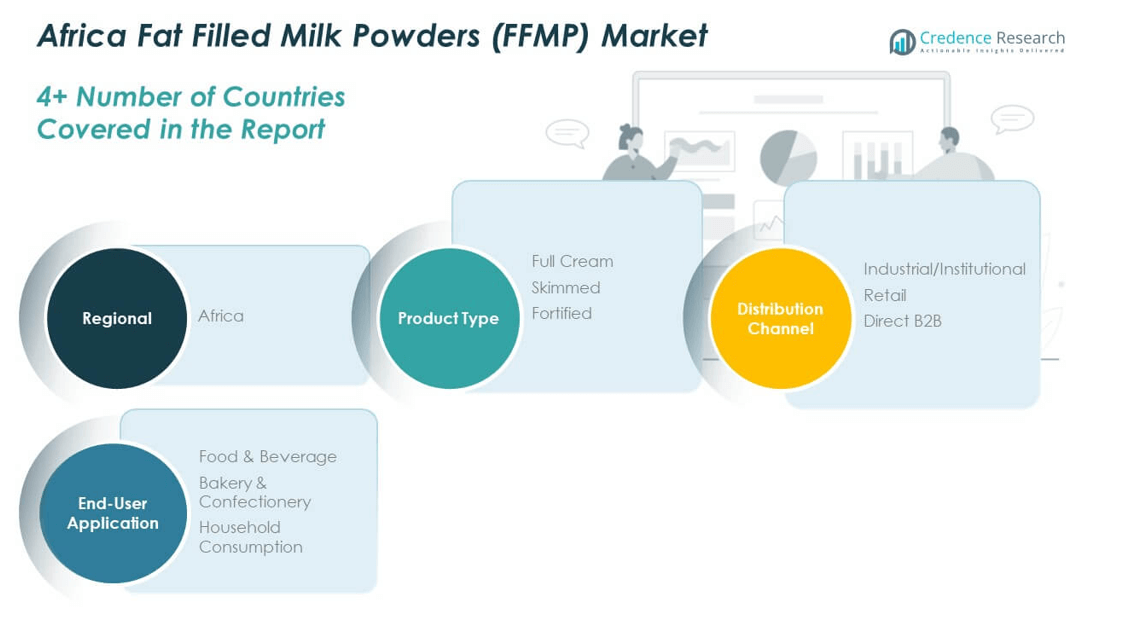
Africa Fat Filled Milk Powder (FFMP) Market By Product Type (Dairy-Based FFMP, Non-Dairy Fat Filled Milk Powder); By Distribution Channel (Direct Sales, Distributors & Wholesalers, Modern Retail, Traditional Trade); By End-User Application (Bakery & Confectionery, Dairy Recombination, Beverages, Infant & Institutional Nutrition, Household Consumption) – Growth, Share, Opportunities & Competitive Analysis, 2024 – 2032

Report ID: 177659 | Report Format : Excel, PDF

Market Overview:

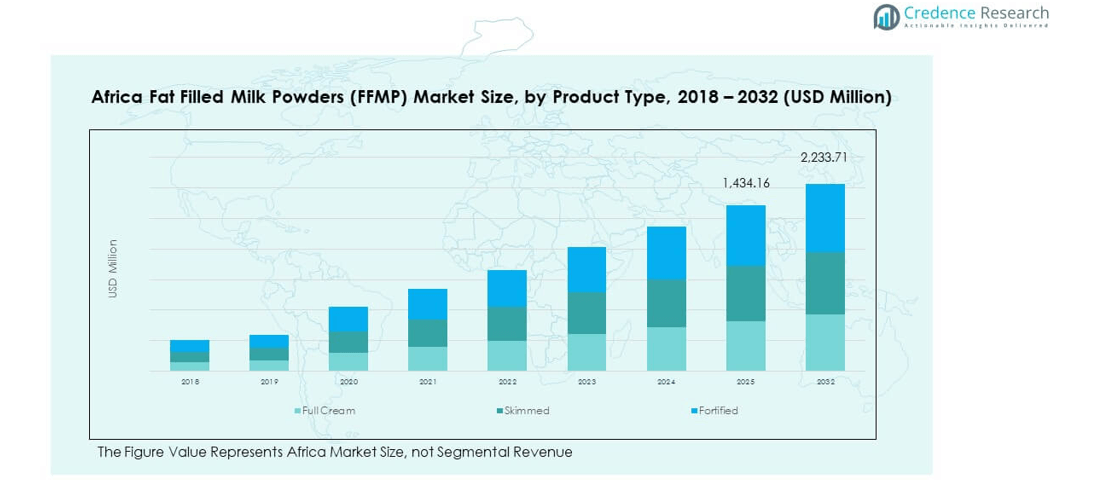
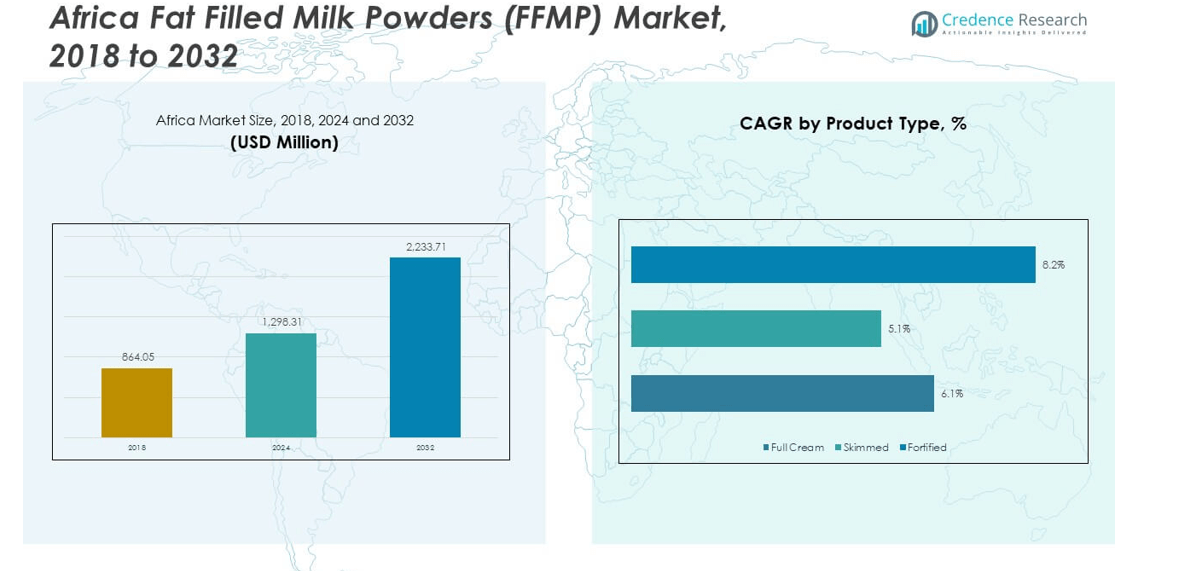
The Africa Fat Filled Milk Powders (FFMP) Market size was valued at USD 864.05 million in 2018 to USD 1,298.31 million in 2024. The market is anticipated to reach USD 2,233.71 million by 2032. The market is projected to expand at a CAGR of 6.53% during the forecast period.

REPORT ATTRIBUTE DETAILS
Historical Period 2020-2023
Base Year 2024
Forecast Period 2025-2032
Africa Fat Filled Milk Powder (FFMP) Market Size 2024 USD 1,298.31 million
Africa Fat Filled Milk Powder (FFMP) Market, CAGR 6.53%
Africa Fat Filled Milk Powder (FFMP) MarketSize 2032 USD 2,233.71 million


Demand rises from affordability and long shelf life advantages. Food processors prefer FFMP for stable pricing and functional performance. Bakery, confectionery, and beverage makers use FFMP for consistent fat content. Urbanization boosts packaged food consumption across African cities. Import reliance supports steady inflows for local blending. Government feeding programs favor cost-efficient dairy alternatives. Cold chain gaps increase preference for shelf-stable powders. Household income growth supports higher dairy intake. Manufacturers improve formulations to match taste expectations. Distribution expansion improves product reach across retail formats.

North Africa leads due to strong food processing bases. Egypt and Morocco drive volumes through bakery and recombination uses. West Africa emerges with fast urban growth and imports. Nigeria and Ghana show rising packaged food demand. East Africa grows through institutional and aid-driven consumption. Kenya and Ethiopia expand blending and distribution networks. Southern Africa remains stable with established dairy alternatives. Coastal ports ease imports and regional trade flows. Inland markets expand as logistics improve. Regional diversity shapes varied demand patterns.

Africa Fat Filled Milk Powders (FFMP) Market size

Market Insights:

  • The Africa Fat Filled Milk Powders (FFMP) Market reached USD 864.05 million in 2018, rose to USD 1,298.31 million in 2024, and is projected to hit USD 2,233.71 million by 2032, growing at a CAGR of 6.53%.
  • North Africa leads with about 38% share due to strong food processing bases, West Africa follows with nearly 27% driven by urban demand, and East Africa holds around 18% supported by institutional nutrition programs.
  • East Africa stands as the fastest-growing region with an estimated 18% share, supported by limited cold chain access, aid programs, and rising urban food consumption.
  • By product type, Full Cream FFMP accounts for roughly 45% share due to broad use in recombined dairy and household consumption, while Skimmed FFMP holds about 35% supported by bakery and beverage applications.
  • Fortified FFMP represents close to 20% share, driven by demand from infant nutrition and institutional feeding programs seeking enhanced nutritional profiles.

Access crucial information at unmatched prices!

Request your sample report today & start making informed decisions powered by Credence Research Inc.!

Download Sample

Market Drivers:

Rising Demand For Affordable Dairy Alternatives Across Mass Consumer Segments

The Africa Fat Filled Milk Powders (FFMP) Market benefits from strong demand for cost-effective dairy substitutes. Price-sensitive consumers prefer products with stable pricing. FFMP offers lower production and procurement costs. Food manufacturers use it to manage input expenses. Retail pricing remains accessible for low- and middle-income households. Shelf stability supports bulk purchasing behavior. Public nutrition programs favor affordable dairy formats.

  • For instance, Nestlé uses fat filled milk powder in recombined dairy formulations across several African markets, where shelf-stable powders enable distribution beyond cold chain reach and support large-volume institutional supply.

Expansion Of Processed Food And Beverage Manufacturing Capacity In Africa

Food processing growth supports higher FFMP consumption. Bakeries rely on consistent fat functionality. Confectionery producers value uniform texture and taste. Beverage blenders use it for recombined milk products. Industrial users prefer predictable performance in recipes. Capacity expansion increases bulk procurement volumes. Regional processors strengthen long-term supply contracts.

Urbanization And Shifting Dietary Patterns Toward Packaged Foods

Urban growth changes food consumption habits. Busy lifestyles increase demand for packaged products. FFMP supports instant mixes and ready foods. Modern retail formats expand shelf presence. Import channels supply urban distribution hubs. Private labels use it for value offerings. Urban households drive repeat consumption cycles.

Limited Cold Chain Infrastructure Favoring Shelf-Stable Dairy Inputs

Cold storage gaps restrict fresh dairy distribution. FFMP solves storage and transport constraints. Long shelf life reduces spoilage risks. Distributors manage inventory with lower losses. Remote markets gain steady dairy access. Institutional buyers value storage flexibility. Supply reliability strengthens market penetration.

Market Trends:

Growing Use Of Customized Fat Blends For Application-Specific Performance

Manufacturers refine fat profiles for end uses. Bakeries demand controlled melting behavior. Beverage applications need stable emulsification. Customized blends improve mouthfeel outcomes. Product differentiation gains importance. Suppliers invest in formulation expertise. It supports premium positioning within value segments.

  • For instance, FrieslandCampina Ingredients develops application-specific fat systems for bakery and recombined dairy uses, supported by pilot plants that test melting behavior and solubility under industrial processing conditions.

Increasing Role Of Local Blending And Repacking Operations

Local players expand blending facilities near ports. Importers reduce logistics lead times. Repacking improves regional distribution efficiency. Smaller pack sizes meet retail needs. Local operations create supply agility. Employment growth supports policy alignment. The Africa Fat Filled Milk Powders (FFMP) Market adapts to decentralized models.

  • For instance, FrieslandCampina WAMCO operates blending and repacking facilities in West Africa to support faster distribution of fat filled milk powders across Nigeria and neighboring markets.

Shift Toward Fortified And Nutrient-Enhanced FFMP Products

Producers add vitamins and minerals to blends. Nutrition-focused variants support public programs. Urban consumers seek functional benefits. Label transparency gains relevance. Fortification supports child nutrition initiatives. Brands highlight nutritional parity with milk powder. Product portfolios diversify across income tiers.

Rising Participation Of Private Labels And Regional Brands

Retailers expand private label dairy ranges. Competitive pricing drives shelf space allocation. Regional brands gain trust through consistency. Packaging upgrades improve brand perception. Marketing focuses on value and reliability. Distribution partnerships widen market reach. Brand competition reshapes pricing strategies.

Africa Fat Filled Milk Powders (FFMP) Market share

Market Challenges Analysis:

Exposure To Volatile Global Vegetable Oil And Dairy Input Prices

The Africa Fat Filled Milk Powders (FFMP) Market faces raw material cost volatility. Vegetable oil prices fluctuate due to global supply shifts. Dairy solids prices affect blend economics. Cost swings challenge margin planning. Import dependence increases exposure risks. Price transmission affects downstream buyers. Contract renegotiations strain supplier relationships. Cost management remains a core operational challenge.

Regulatory Scrutiny And Consumer Perception Issues Around Dairy Substitutes

Some markets impose strict labeling rules. Consumer awareness affects product acceptance. Misunderstanding of FFMP composition creates hesitation. Regulatory differences complicate cross-border trade. Compliance costs rise for exporters. Education gaps limit demand growth. Brands invest in communication to build trust. Policy changes require constant monitoring.

Market Opportunities:

Expansion Of Institutional Feeding And Public Nutrition Programs

Governments support large-scale nutrition initiatives. FFMP offers cost-efficient dairy nutrition. Shelf stability suits remote distribution. Aid agencies prefer bulk powdered formats. It aligns with school and relief programs. Procurement volumes support long-term demand. Policy backing strengthens market visibility.

Growth Potential In Underserved Inland And Secondary Urban Markets

Infrastructure upgrades improve inland access. Distributors expand secondary city networks. Retail penetration increases packaged food sales. FFMP suits long-distance transport needs. Local wholesalers widen product availability. Consumption rises beyond coastal hubs. The Africa Fat Filled Milk Powders (FFMP) Market gains from geographic expansion.

Market Segmentation Analysis:

By Product Type

Dairy-Based FFMP
Dairy-based variants hold strong demand due to familiarity with milk taste and texture. Food processors prefer this type for bakery and confectionery use. Fat consistency supports reliable performance in recipes. Institutional buyers trust dairy-based formulations for nutrition programs. Shelf stability improves storage efficiency. Importers rely on established global supply chains. The Africa Fat Filled Milk Powders (FFMP) Market sees steady uptake within this segment.

  • For instance, Nestlé sources dairy-based fat filled milk powder from standardized global plants that meet strict quality and microbiological benchmarks for institutional nutrition programs.

Non-Dairy Fat Filled Milk Powder
Non-dairy variants gain attention for lower cost structures. Manufacturers use vegetable fats to manage input volatility. This type suits mass-market food applications. Long shelf life supports distribution in remote areas. Taste customization improves consumer acceptance. Price-sensitive buyers favor this segment. Volume growth remains strong across urban markets.

By Distribution Channel

Direct Sales
Direct sales serve large food processors and institutions. Buyers value consistent supply contracts. This channel supports bulk volumes and stable pricing.

  • For instance, multinational dairy processors procure FFMP through long-term direct agreements with global ingredient suppliers to secure uninterrupted production schedules.

Distributors & Wholesalers
Distributors extend reach across regional markets. Wholesalers support smaller manufacturers and retailers. Logistics networks improve inland availability.

Modern Retail
Modern retail expands household consumption. Branded packs gain shelf visibility. Organized stores support repeat purchases.

Traditional Trade
Traditional trade dominates rural and semi-urban areas. Small pack sizes suit daily buying habits. Local retailers sustain steady turnover.

By End-User Application

Bakery & Confectionery
This segment drives consistent industrial demand. FFMP ensures texture and flavor control.

Dairy Recombination
Recombination supports affordable milk alternatives. It meets urban consumption needs.

Beverages
Beverage makers use FFMP for creamers and mixes. Solubility supports processing efficiency.

Infant & Institutional Nutrition
Institutional programs prefer cost-effective nutrition sources. Product stability ensures safe distribution.

Household Consumption
Households use FFMP for daily cooking needs. Value pricing supports repeat use.

Africa Fat Filled Milk Powders (FFMP) Market segmentation

Segmentation:

By Product Type

  • Dairy-Based FFMP
  • Non-Dairy Fat Filled Milk Powder

By Distribution Channel

  • Direct Sales
  • Distributors & Wholesalers
  • Modern Retail
  • Traditional Trade

By End-User Application

  • Bakery & Confectionery
  • Dairy Recombination
  • Beverages
  • Infant & Institutional Nutrition
  • Household Consumption

By Region

  • North Africa
  • West Africa
  • East Africa
  • Southern Africa
  • Central Africa

Regional Analysis:

North Africa

North Africa holds the largest share of the Africa Fat Filled Milk Powders (FFMP) Market at nearly 38%. Egypt, Morocco, and Algeria lead consumption through strong food processing activity. Large bakery and dairy recombination industries support stable demand. Import infrastructure remains well developed across major ports. Institutional nutrition programs support steady offtake volumes. Urban consumers prefer affordable dairy substitutes. It benefits from organized distribution and established supplier presence.

West and East Africa

West Africa accounts for around 27% market share, led by Nigeria and Ghana. Rapid urban population growth supports packaged food demand. Import dependence drives steady FFMP inflows. Local blending and repacking activities expand market access. East Africa represents close to 18% share, with Kenya and Ethiopia as key contributors. Institutional feeding programs and aid channels support volumes. It gains traction due to limited cold chain coverage.

Southern and Central Africa

Southern Africa contributes nearly 12% of regional demand, led by South Africa. Established retail networks support household consumption. Food manufacturers use FFMP for cost control. Central Africa holds about 5% share, driven by basic food applications. Import logistics remain a constraint in landlocked areas. Consumption stays focused on low-cost nutrition sources. It shows gradual growth with improving trade corridors.

Shape Your Report to Specific Countries or Regions & Enjoy 30% Off!

Key Player Analysis:

Competitive Analysis:

The Africa Fat Filled Milk Powders (FFMP) Market features a mix of multinational dairy groups and regional suppliers. Global players leverage scale, sourcing networks, and formulation expertise. Regional companies focus on local blending, repacking, and distribution strength. Competition centers on price stability, fat quality, and supply reliability. Companies invest in application-specific blends for bakeries and recombination users. Brand presence remains stronger in urban retail channels. Institutional contracts shape volume leadership. Import partnerships support consistent raw material access. It remains moderately consolidated with room for regional expansion.

Recent Developments:

  • In September 2025, Nestlé announced a significant expansion of its research and development operations across Sub-Saharan Africa, strengthening its commitment to addressing regional nutrition challenges and food security concerns. The expansion includes strategic partnerships with key agricultural institutions including the National Agronomic Research Centre in Ivory Coast and the International Institute of Tropical Agriculture (IITA) in Nigeria, focusing on enhancing crop yields and resilience in maize, cocoa, and coffee production vital to local food systems. Concurrently, Nestlé emphasized its infant nutrition focus through exclusive breastfeeding advocacy and addressing critical nutrition challenges such as stunting and anemia across the African continent.
  • In August 2025, FrieslandCampina signed a strategic partnership framework agreement with Côte d’Ivoire’s Ministry of Technical Education, Vocational Training and Apprenticeship (METFPA). The agreement aims to strengthen practical skills development in agri-food and dairy processing sectors through joint internship programs, trainer development, and co-construction of study modules on dairy farming. Furthermore, FrieslandCampina WAMCO continued its commitment to strengthening Nigeria’s dairy sector through the Centre for Nigerian Dutch Dairy Development (CNDDD) in 2024, launching collaborative initiatives focused on innovation and sustainable dairy production advancement.
  • On July 1, 2025, Danone successfully completed its acquisition of a majority stake in Kate Farms, a leading U.S.-based plant-based, organic nutrition company recognized as the #1 doctor-recommended plant-based brand in the United States. The acquisition combines Kate Farms with Danone’s existing specialized nutrition portfolio, including brands such as Nutricia, Real Food Blends, and Functional Formularies, creating an integrated medical nutrition business capable of serving patients and consumers across hospitals, retail, and online channels. Under the new structure, Kate Farms’ former CEO and Chairman Brett Matthews assumed leadership of the combined business entity.

Report Coverage:

The research report offers an in-depth analysis based on product type, distribution channel, end-user application, and region. It details leading market players, providing an overview of their business, product offerings, investments, revenue streams, and key applications. Additionally, the report includes insights into the competitive environment, SWOT analysis, current market trends, as well as the primary drivers and constraints. Furthermore, it discusses various factors that have driven market expansion in recent years. The report also explores market dynamics, regulatory scenarios, and technological advancements that are shaping the industry. It assesses the impact of external factors and global economic changes on market growth. Lastly, it provides strategic recommendations for new entrants and established companies to navigate the complexities of the market.

Future Outlook:

  • Expansion of local blending facilities will improve supply responsiveness across regions.
  • Bakery and confectionery demand will remain a key consumption pillar.
  • Institutional nutrition programs will sustain bulk volume demand.
  • Retail penetration will expand household usage in urban centers.
  • Product customization will support application-specific growth.
  • Distribution reach will deepen into inland and secondary cities.
  • Cost management will shape supplier competitiveness.
  • Regulatory clarity will influence cross-border trade flows.
  • Private label participation will increase competitive pressure.
  • Strategic partnerships will strengthen regional market access.

CHAPTER NO. 1 : INTRODUCTION 21

1.1. Report Description 21

Purpose of the Report 21

USP & Key Offerings 21

1.2. Key Benefits for Stakeholders 22

1.3. Target Audience 22

CHAPTER NO. 2 : EXECUTIVE SUMMARY 23

CHAPTER NO. 3 : FAT FILLED MILK POWDERS (FFMP) MARKET FORCES & INDUSTRY PULSE 25

3.1. Foundations of Change – Market Overview 25

3.2. Catalysts of Expansion – Key Market Drivers 27

3.3. Momentum Boosters – Growth Triggers 28

3.4. Innovation Fuel – Disruptive Technologies 28

3.5. Headwinds & Crosswinds – Market Restraints 29

3.6. Regulatory Tides – Compliance Challenges 30

3.7. Economic Frictions – Inflationary Pressures 30

3.8. Untapped Horizons – Growth Potential & Opportunities and Strategic Navigation – Industry Frameworks 31

3.9. Market Equilibrium – Porter’s Five Forces 32

3.10. Ecosystem Dynamics – Value Chain Analysis 34

3.11. Macro Forces – PESTEL Breakdown 36

3.12. Price Trend Analysis 38

3.12.1. Regional Price Trend 39

3.12.2. Price Trend by Product 39

3.13. Buying Criteria 40

CHAPTER NO. 4 : COMPETITION ANALYSIS 41

4.1. Company Market Share Analysis 41

4.1.1. Africa Fat Filled Milk Powders (FFMP) Market Company Volume Market Share 41

4.1.2. Africa Fat Filled Milk Powders (FFMP) Market Company Revenue Market Share 43

4.2. Strategic Developments 45

4.2.1. Acquisitions & Mergers 45

4.2.2. New Product Launch 46

4.2.3. Agreements & Collaborations 47

4.3. Competitive Dashboard 48

4.4. Company Assessment Metrics, 2024 49

CHAPTER NO. 5 : AFRICA MARKET ANALYSIS, INSIGHTS & FORECAST, BY PRODUCT TYPE 50

CHAPTER NO. 6 : AFRICA MARKET ANALYSIS, INSIGHTS & FORECAST, BY DISTRIBUTION CHANNEL 55

CHAPTER NO. 7 : AFRICA MARKET ANALYSIS, INSIGHTS & FORECAST, BY END-USER APPLICATION 60

CHAPTER NO. 8 : AFRICA MARKET ANALYSIS, INSIGHTS & FORECAST, BY REGION 65

CHAPTER NO. 9 : COMPANY PROFILE 72

9.1. FrieslandCampina WAMCO 72

9.2. Clover Industries 75

9.3. Danone 75

9.4. Parmalat 75

9.5. Nestlé 75

9.6. Company 6 75

9.7. Company 7 75

9.8. Company 8 75

9.9. Company 9 75

9.10. Company 10 75

9.11. Company 11 75

9.12. Company 12 75

9.13. Company 13 75

9.14. Company 14 75


List of Figures

FIG NO. 1. Fat Filled Milk Powders (FFMP) Market Revenue Share, By Product Type, 2024 & 2032 50

FIG NO. 2. Market Attractiveness Analysis, By Product Type 51

FIG NO. 3. Incremental Revenue Growth Opportunity by Product Type, 2024 – 2032 52

FIG NO. 4. Fat Filled Milk Powders (FFMP) Market Revenue Share, By Distribution Channel, 2024 & 2032 55

FIG NO. 5. Incremental Revenue Growth Opportunity by Distribution Channel, 2024 – 2032 56

FIG NO. 6. Incremental Revenue Growth Opportunity by Distribution Channel, 2024 – 2032 57

FIG NO. 7. Fat Filled Milk Powders (FFMP) Market Revenue Share, By End-User Application, 2024 & 2032 60

FIG NO. 8. Market Attractiveness Analysis, By End-User Application 61

FIG NO. 9. Incremental Revenue Growth Opportunity by End-User Application, 2024 – 2032 62

FIG NO. 10. Fat Filled Milk Powders (FFMP) Market Revenue Share, By Region, 2024 & 2032 65

FIG NO. 11. Market Attractiveness Analysis, By Region 66

FIG NO. 12. Incremental Revenue Growth Opportunity by Region, 2024 – 2032 67


List of Tables

TABLE NO. 1. : Africa Fat Filled Milk Powders (FFMP) Market Revenue, By Product Type, 2018 – 2024 (USD Million) 53

TABLE NO. 2. : Africa Fat Filled Milk Powders (FFMP) Market Revenue, By Product Type, 2025 – 2032 (USD Million) 53

TABLE NO. 3. : Africa Fat Filled Milk Powders (FFMP) Market Volume, By Product Type, 2018 – 2024 (Metric Tons) 54

TABLE NO. 4. : Africa Fat Filled Milk Powders (FFMP) Market Volume, By Product Type, 2025 – 2032 (Metric Tons) 54

TABLE NO. 5. : Africa Fat Filled Milk Powders (FFMP) Market Revenue, By Distribution Channel, 2018 – 2024 (USD Million) 58

TABLE NO. 6. : Africa Fat Filled Milk Powders (FFMP) Market Revenue, By Distribution Channel, 2025 – 2032 (USD Million) 58

TABLE NO. 7. : Africa Fat Filled Milk Powders (FFMP) Market Volume, By Distribution Channel, 2018 – 2024 (Metric Tons) 59

TABLE NO. 8. : Africa Fat Filled Milk Powders (FFMP) Market Volume, By Distribution Channel, 2025 – 2032 (Metric Tons) 59

TABLE NO. 9. : Africa Fat Filled Milk Powders (FFMP) Market Revenue, By End-User Application, 2018 – 2024 (USD Million) 63

TABLE NO. 10. : Africa Fat Filled Milk Powders (FFMP) Market Revenue, By End-User Application, 2025 – 2032 (USD Million) 63

TABLE NO. 11. : Africa Fat Filled Milk Powders (FFMP) Market Volume, By End-User Application, 2018 – 2024 (Metric Tons) 64

TABLE NO. 12. : Africa Fat Filled Milk Powders (FFMP) Market Volume, By End-User Application, 2025 – 2032 (Metric Tons) 64

TABLE NO. 13. : Africa Fat Filled Milk Powders (FFMP) Market Revenue, By Region, 2018 – 2024 (USD Million) 68

TABLE NO. 14. : Africa Fat Filled Milk Powders (FFMP) Market Revenue, By Region, 2025– 2032 (USD Million) 69

TABLE NO. 15. : Africa Fat Filled Milk Powders (FFMP) Market Volume, By Region, 2018 – 2024 (Metric Tons) 70


TABLE NO. 16. : Africa Fat Filled Milk Powders (FFMP) Market Volume, By Region, 2025– 2032 (Metric Tons) 71

Request Free Sample

We prioritize the confidentiality and security of your data. Our promise: your information remains private.

Ready to Transform Data into Decisions?

Request Your Sample Report and Start Your Journey of Informed Choices


Providing the strategic compass for industry titans.

cr-clients-logos

Frequently Asked Questions

What is the current market size for Africa Fat Filled Milk Powders (FFMP) Market, and what is its projected size in 2032?

The Africa Fat Filled Milk Powders (FFMP) Market was valued at USD 1,298.31 million in 2024 and is projected to reach USD 2,233.71 million by 2032.

At what Compound Annual Growth Rate is the Africa Fat Filled Milk Powders (FFMP) Market projected to grow between 2024 and 2032?

The Africa Fat Filled Milk Powders (FFMP) Market is projected to grow at a CAGR of 6.53% during the forecast period.

Which Africa Fat Filled Milk Powders (FFMP) Market segment held the largest share in 2024?

Dairy-based FFMP held the largest share due to strong demand from bakeries and dairy recombination applications within the Africa Fat Filled Milk Powders (FFMP) Market.

What are the primary factors fueling the growth of the Africa Fat Filled Milk Powders (FFMP) Market?

Key drivers include affordability, long shelf life, limited cold chain infrastructure, and rising processed food demand in the Africa Fat Filled Milk Powders (FFMP) Market.

Who are the leading companies in the Africa Fat Filled Milk Powders (FFMP) Market?

Major players include Nestlé, FrieslandCampina WAMCO, Danone, Parmalat, and Clover Industries in the Africa Fat Filled Milk Powders (FFMP) Market.

About Author

Rajdeep Kumar Deb

Rajdeep Kumar Deb

Lead Analyst – Consumer & Finance

Rajdeep brings a decade of consumer goods and financial services insight to strategic market analysis.

View Profile

Related Reports

Touchscreen Gloves Market

The Touchscreen Gloves Market size was valued at USD 1,489.6 million in 2024 and is anticipated to reach USD 2,860.93 million by 2032, growing at a CAGR of 8.5% during the forecast period.

Philippines Sponge and Scouring Pads Market

The Philippines Sponge and Scouring Pads Market size was valued at USD 96.35 million in 2018 and increased to USD 139.19 million in 2024. The market is anticipated to reach USD 225.57 million by 2032.

Global and Europe Football Club Merchandising Market

The Global and Europe Football Club Merchandising Market size was valued at USD 12,611.00 million in 2018 to USD 18,696.13 million in 2024 and is anticipated to reach USD 31,507.89 million by 2032, at a CAGR of 6.28% during the forecast period.

Africa Beauty and Personal Care Market

The Africa Beauty & Personal Care Market size was valued at USD 7,100.00 million in 2018 to USD 8,860.27 million in 2024 and is anticipated to reach USD 15,709.85 million by 2032, at a CAGR of 7.52% during the forecast period.

U.S. Footwear Market

The U.S. Footwear Market size was valued at USD 69.53 billion in 2018 to USD 95.23 billion in 2024 and is anticipated to reach USD 142.77 billion by 2032, at a CAGR of 4.83% during the forecast period.

Potato Fiber Market

The Potato Fiber Market is projected to grow from USD 504.21 million in 2024 to an estimated USD 722.54 million by 2032, with a CAGR of 4.6% from 2024 to 2032.

Topical Pet Sprays Market

Topical Pet Sprays Market size was valued at USD 864.5 million in 2024 and is anticipated to reach USD 1,296.85 million by 2032, growing at a CAGR of 5.2% during the forecast period.

Toilet Bowl Cleaner Tablets Market

Toilet Bowl Cleaner Tablets Market size was valued at USD 1,379.79 million in 2024 and is anticipated to reach USD 1,720.91 million by 2032, at a CAGR of 2.8% during the forecast period.

Toilet Bowl Brush Market

The Toilet Bowl Brush Market size was valued at USD 7,589.6 million in 2024 and is anticipated to reach USD 11,230.39 million by 2032, growing at a CAGR of 5.02% during the forecast period.

Toddler Wear Market

Toddler Wear Market size was valued at USD 266,369.6 million in 2024 and is anticipated to reach USD 424,552.67 million by 2032, at a CAGR of 6% during the forecast period.

Italy Women Apparel Market

The Italy Women Apparel Market size was valued at USD 25,300.00 million in 2018 to USD 26,617.31 million in 2024 and is anticipated to reach USD 31,469.76 million by 2032, at a CAGR of 2.14% during the forecast period.

Smart Dishwasher Market

Smart Dishwasher Market size was valued at USD 3,718 Million in 2024 and is anticipated to reach USD 6,680.12 Million by 2032, growing at a CAGR of 7.6% during the forecast period.

Licence Option

The report comes as a view-only PDF document, optimized for individual clients. This version is recommended for personal digital use and does not allow printing. Use restricted to one purchaser only.
$3999

To meet the needs of modern corporate teams, our report comes in two formats: a printable PDF and a data-rich Excel sheet. This package is optimized for internal analysis. Unlimited users allowed within one corporate location (e.g., regional office).
$5999

The report will be delivered in printable PDF format along with the report’s data Excel sheet. This license offers 100 Free Analyst hours where the client can utilize Credence Research Inc. research team. Permitted for unlimited global use by all users within the purchasing corporation, such as all employees of a single company.
$10999

Report delivery within 24 to 48 hours

Europe

North America

Email

Smallform of Sample request
User Review

Thank you for the data! The numbers are exactly what we asked for and what we need to build our business case.

Materials Scientist
(privacy requested)

User Review

The report was an excellent overview of the Industrial Burners market. This report does a great job of breaking everything down into manageable chunks.

Imre Hof
Management Assistant, Bekaert

cr-clients-logos

Request Sample