Market overview
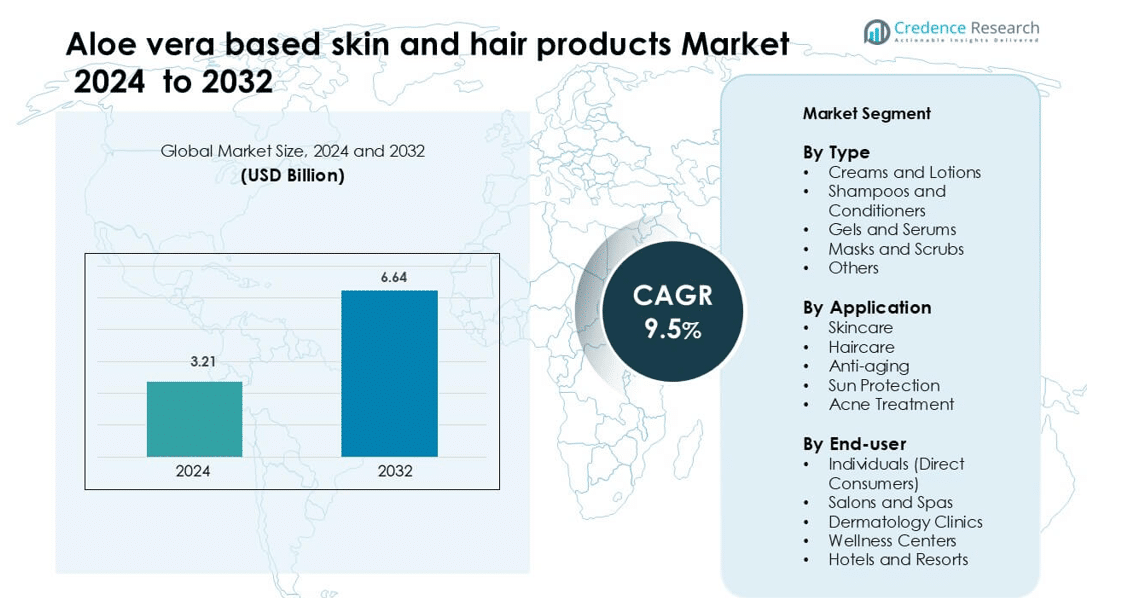
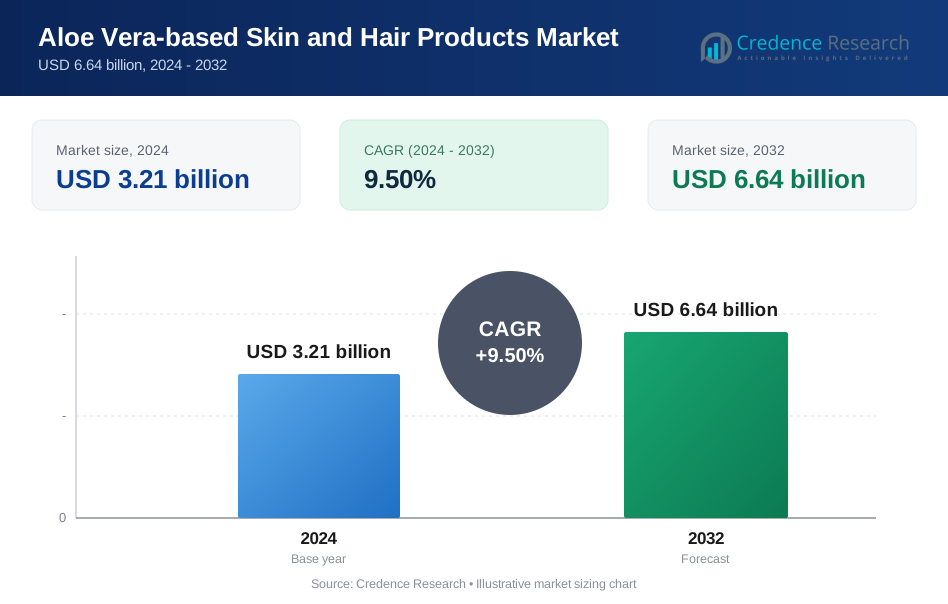
Aloe vera based skin and hair products Market was valued at USD 3.21 billion in 2024 and is anticipated to reach USD 6.64 billion by 2032, growing at a CAGR of 9.5% during the forecast period.
| REPORT ATTRIBUTE | DETAILS |
|---|---|
| Historical Period | 2020-2023 |
| Base Year | 2024 |
| Forecast Period | 2025-2032 |
| Aloe Vera Based Skin and Hair Products Market Size 2024 | USD 3.21 billion |
| Aloe Vera Based Skin and Hair Products Market, CAGR | 9.5% |
| Aloe Vera Based Skin and Hair Products Market Size 2032 | USD 6.64 billion |
Top players in the Aloe vera-based skin and hair products market include leading personal care manufacturers known for strong botanical formulations, wide product lines, and established global distribution. These companies focus on creams, gels, shampoos, and serums that highlight Aloe’s soothing, hydrating, and repair benefits. Many brands invest in clean-label development, organic Aloe sourcing, and dermatologist-approved blends to enhance consumer trust. Expanding online visibility and premium wellness ranges further strengthen competitive positioning. North America leads the global market with a 32% share, supported by high adoption of natural beauty, strong retail penetration, and rising demand for gentle, plant-based skincare and haircare solutions.
Market Insights
- The Aloe vera-based skin and hair products market is valued at USD 3.21 billion in 2024 and is projected to reach USD 6.64 billion by 2032, growing at a 9.5% CAGR.
- Strong demand for natural skincare drives growth as consumers choose Aloe-rich creams and lotions, which hold the 37% share as the dominant product segment due to high use in hydration and soothing routines.
- Hybrid formulations, clean-label claims, and sustainable packaging shape market trends, with rising adoption of Aloe-based gels, serums, and scalp-care solutions across retail and online channels.
- Competition intensifies as global beauty brands, wellness companies, and regional manufacturers expand organic sourcing and dermatologist-tested formulas, increasing pressure on price, innovation, and transparency.
- North America leads with a 32% share, followed by Asia-Pacific at 29%; skincare remains the top application segment with a 44% share, supported by high demand for gentle, plant-derived daily-use formulations across key markets.
Market Segmentation Analysis:
By Type
Creams and lotions lead the Aloe vera-based products market with a 37% share due to their wide daily-use appeal and high moisture retention. These formulas suit diverse skin types and support hydration, repair, and soothing benefits. Growing demand for plant-derived skincare boosts adoption across retail and online channels. Shampoos and conditioners grow as consumers shift to gentle, sulfate-free formulas. Gels and serums expand with rising interest in lightweight textures, while masks and scrubs gain traction in weekly routines. Other formats, such as wipes and cleansers, support niche demand and broaden category reach.
- For instance, The Body Shop enhanced its Aloe Soothing Day Cream line with Community Fair Trade-sourced organic aloe vera from the Campeche Farmers in the Yucatán Peninsula of Mexico, using cold-press extraction to retain maximum freshness and quality.
By Application
Skincare dominates the market with a 44% share, driven by strong demand for soothing, hydrating, and barrier-repair benefits from Aloe vera. Rising cases of dryness and sensitivity increase adoption of natural actives in cleansers, moisturizers, and serums. Haircare gains momentum as consumers seek scalp-calming and strengthening solutions. Anti-aging use rises with interest in antioxidant-rich botanical formulas. Sun protection products benefit from Aloe’s cooling and recovery properties, while acne treatment grows due to antibacterial activity that supports gentle everyday use.
- For instance, Clinique incorporated Aloe bio-ferment and hyaluronic acid in its Moisture Surge 100H Auto-Replenishing Hydrator, clinically proven to double skin hydration for 100 hours.
By End User
Individuals hold the dominant position with a 62% share, supported by strong retail presence and frequent purchase cycles across mass and premium categories. The rise of online beauty platforms expands access to natural Aloe-based formulations for daily routines. Salons and spas increase usage in professional treatments focused on hydration and skin calming. Dermatology clinics use Aloe-infused products for post-procedure care and irritation relief. Wellness centers and hospitality chains adopt Aloe products to enhance guest experience through natural, soothing amenities.
Key Growth Drivers
Rising Preference for Natural and Plant-Based Formulations
Consumers now choose natural solutions over synthetic products, which increases the use of Aloe vera in skin and hair care. Buyers want gentle formulas that support hydration, repair, and soothing benefits without harsh chemicals. This shift boosts demand for creams, gels, and shampoos that rely on Aloe vera’s strong moisturizing and calming properties. Brands promote clean labels and botanical sourcing to meet safety expectations. The growth of vegan and cruelty-free beauty also strengthens this trend. Retailers expand natural beauty shelves, while online platforms highlight ingredient transparency. These factors build steady adoption across daily-use categories.
- For instance, L'Oréal’s Garnier Green Labs Aloe Renew Serum Cream uses 96% naturally derived ingredients and is certified cruelty-free by Leaping Bunny.
Expanding Dermatology and Clinical Use Cases
Dermatology clinics and specialists recommend Aloe vera products for irritation control, wound healing, and post-procedure comfort. This clinical support increases trust in Aloe-based formulas across wider consumer groups. Aloe’s soothing and anti-inflammatory actions help reduce redness and dryness, which makes the ingredient suitable for sensitive skin. Rising cases of eczema, sun damage, and pollution-linked irritation push more people toward calming products. Clinics also use Aloe-infused gels during treatments and recovery routines. The link between dermatology and natural actives strengthens long-term market growth and drives premium demand in targeted skincare segments.
- For instance, dermatology brand The Body Shop uses aloe gel formulated at 98% natural-origin ingredients, establishing its product as suitable for sensitive skin.
Growth of Online Beauty Retail and Direct-to-Consumer Brands
Online platforms help Aloe vera products reach a broad audience through strong visibility and clear ingredient-based targeting. Digital-native brands use simple formulas and transparent sourcing to appeal to health-focused buyers. Social media boosts product awareness through tutorials, reviews, and influencer-led campaigns. Direct-to-consumer brands offer customized solutions for dryness, acne, and scalp issues, which increases customer loyalty. Many companies use subscription models to raise repeat sales in essential categories like lotions and hair gels. The convenience of quick delivery, wide assortment, and easy comparison strengthens the online demand curve.
Key Trend & Opportunity
Growth of Multi-Benefit and Hybrid Formulations
Brands now develop multi-use products that combine Aloe vera with vitamins, ceramides, peptides, and herbal extracts. These hybrids offer hydration, repair, brightening, and anti-aging benefits in a single item. Buyers prefer fewer steps in their routines, which increases demand for lightweight gels and all-in-one creams. The shift supports innovation in treatment serums, scalp-soothing conditioners, and sun recovery products. Companies that use clean emulsifiers and advanced stabilization methods can deliver long-lasting Aloe activity. This creates space for premium launches and supports expansion in both retail and professional channels.
- For instance, Nature Republic Soothing & Moisture Aloe Vera Gel contains 92% Aloe leaf extract, which allows the gel to serve as a hydrator, calming treatment, and brightening base in a single formula.
Rise of Sustainable Packaging and Ethical Sourcing
More consumers value eco-friendly packaging and traceable ingredient sources. This interest drives companies to use recyclable bottles, biodegradable tubes, and verified Aloe plantations. Ethical sourcing supports community farming and long-term crop stability. Many brands promote organic certification to build trust among health-focused buyers. Sustainable actions also improve brand image in competitive categories like lotions and shampoos. As buyers reward responsible companies, firms that invest in green packaging and transparent supply chains gain market leverage. This trend opens new opportunities in premium and export-driven product lines.
- For instance, The Body Shop reports using 100% recycled PET for all core skincare bottles, reducing virgin plastic use by over 600 tons per year, and runs community trade programs that source Aloe from certified organic farms in Mexico.
Key Challenge
Risk of Product Adulteration and Quality Variability
Aloe vera quality varies widely based on plant maturity, extraction methods, and storage conditions. Low-grade or diluted extracts reduce performance and create trust issues among consumers. Adulteration with synthetic polymers or artificial colors also threatens brand credibility. Smaller producers often lack strong testing systems, which increases inconsistency across batches. Regulatory oversight differs across regions, making quality control more complex for global brands. Companies must invest in certified extracts, strong documentation, and stability-tested formulas to maintain reliability. This challenge raises costs and slows market entry for new players.
High Competition from Alternative Natural Ingredients
The market faces strong competition from ingredients such as hyaluronic acid, centella asiatica, niacinamide, tea tree, and coconut derivatives. These actives deliver hydration, soothing, anti-acne, or brightening benefits similar to Aloe vera. Many of these ingredients also gain stronger scientific support, which shifts consumer interest toward trend-driven formulations. Brands must differentiate Aloe products through advanced blends, clinical backing, or targeted claims to stay relevant. Failure to innovate reduces visibility in crowded retail and online shelves. This pressure forces companies to adapt quickly to changing buyer expectations.
Regional Analysis
North America
North America leads the Aloe vera-based skin and hair products market with a 32% share, driven by strong adoption of natural and clean-label beauty. Consumers prioritize soothing, hydrating, and anti-inflammatory benefits, which increases demand for Aloe-rich creams, gels, and shampoos. Retailers highlight plant-based formulas, while dermatology clinics use Aloe-based products for post-treatment care. The U.S. market grows through online beauty platforms and premium wellness brands. Rising cases of skin sensitivity and sun exposure support sales of Aloe-focused moisturizers and after-sun products, strengthening the region’s leadership.
Europe
Europe holds a 27% share, supported by strong regulatory standards, high interest in botanical skincare, and growing demand for sustainable packaging. Countries such as Germany, France, and the UK show steady use of Aloe-based moisturizers, serums, and scalp-care products. Consumers prefer gentle, eco-friendly formulations with certified ingredients. The rise of vegan and cruelty-free beauty boosts Aloe-focused product lines across retail chains. Wellness tourism in Mediterranean countries also fuels demand for Aloe-infused spa treatments. Strong awareness of ingredient transparency keeps Aloe products firmly positioned across mid-range and premium categories.
Asia-Pacific
Asia-Pacific accounts for a 29% share, driven by fast growth in skincare usage, large youth demographics, and strong cultural acceptance of herbal ingredients. South Korea, Japan, India, and China lead demand for Aloe-based gels, toners, sunscreens, and hair-strengthening formulas. K-beauty trends promote lightweight hydrating products, which increases Aloe gel adoption. Hot and humid climates support moisture-repair and soothing formulations, especially after sun exposure. Expanding e-commerce and rising disposable incomes push premium Aloe skincare. Local manufacturers scale production with wide Aloe cultivation, strengthening supply availability.
Latin America
Latin America captures an 8% share, supported by growing interest in plant-based beauty and rising skin sensitivity concerns tied to heat and pollution. Brazil and Mexico lead consumption of Aloe-based creams, shampoos, and multipurpose gels. The region’s strong sun exposure drives demand for soothing after-sun and hydration products. Local wellness brands highlight botanical ingredients to attract young buyers. Expansion of pharmacy chains and online platforms improves product access. Although price sensitivity limits premium uptake, Aloe products gain stable traction across mass-market categories.
Middle East & Africa
The Middle East & Africa region holds a 4% share, shaped by rising skincare awareness, harsh climatic conditions, and increasing demand for hydration-focused formulas. High temperatures and frequent sun exposure boost the need for calming Aloe-based moisturizers, gels, and after-sun products. Gulf countries show strong interest in herbal and halal-certified beauty. Growing tourism and spa facilities in the UAE fuel professional use of Aloe-based treatments. Africa’s adoption rises gradually as urban buyers seek natural and affordable skincare. Retail expansion and social media education support long-term growth.
Market Segmentations:
By Type
- Creams and Lotions
- Shampoos and Conditioners
- Gels and Serums
- Masks and Scrubs
- Others
By Application
- Skincare
- Haircare
- Anti-aging
- Sun Protection
- Acne Treatment
By End-user
- Individuals (Direct Consumers)
- Salons and Spas
- Dermatology Clinics
- Wellness Centers
- Hotels and Resorts
By Geography
- North America
- U.S.
- Canada
- Mexico
- Europe
- Germany
- France
- U.K.
- Italy
- Spain
- Rest of Europe
- Asia Pacific
- China
- Japan
- India
- South Korea
- South-east Asia
- Rest of Asia Pacific
- Latin America
- Brazil
- Argentina
- Rest of Latin America
- Middle East & Africa
- GCC Countries
- South Africa
- Rest of the Middle East and Africa
Competitive Landscape
The competitive landscape of the Aloe vera-based skin and hair products market features a mix of global beauty brands, natural-focused companies, and regional manufacturers that compete through innovation, clean formulations, and strong distribution reach. Major players expand product lines across creams, gels, shampoos, and serums to capture rising demand for plant-based care. Many companies highlight organic Aloe sourcing, paraben-free blends, and dermatologically tested formulas to strengthen brand trust. Firms also invest in lightweight textures, multi-benefit hybrids, and sensitive-skin solutions to appeal to broader consumer groups. Online platforms drive intense competition, as direct-to-consumer brands use targeted marketing and subscription models to increase retention. Partnerships with dermatology clinics, spas, and wellness centers help brands widen professional use. Retail chains introduce private-label Aloe ranges, adding further price pressure. This mix of premium, mid-range, and mass-market offerings creates a dynamic environment where innovation, transparency, and sustainability shape long-term competitive strength.
Key Player Analysis
- The Body Shop
- Nature Republic
- Forever Living Products
- Jason Natural (The Hain Celestial Group)
- Amara Organics
- Aubrey Organics
- L'Biotica
- Earth's Daughter
- Green Leaf Naturals
- Herbal Essences (Procter & Gamble)
Recent Developments
- In February 2024, Herbal Essences (Procter & Gamble) Launched a new line of shampoos & conditioners featuring Pure Plants of Aloe and Camellia Oil focused on nourishment without heaviness.
- In July 2022, Organic Harvest, an organic beauty and personal care brand, certified by ECOCERT launched an all-new range of organic Aloe Vera Gel. Available in 4 different variants, the new Organic Aloe Vera Gel is gender neutral and ideal for varying skin and hair types for all age groups
Report Coverage
The research report offers an in-depth analysis based on Type, Application, End-User and Geography. It details leading market players, providing an overview of their business, product offerings, investments, revenue streams, and key applications. Additionally, the report includes insights into the competitive environment, SWOT analysis, current market trends, as well as the primary drivers and constraints. Furthermore, it discusses various factors that have driven market expansion in recent years. The report also explores market dynamics, regulatory scenarios, and technological advancements that are shaping the industry. It assesses the impact of external factors and global economic changes on market growth. Lastly, it provides strategic recommendations for new entrants and established companies to navigate the complexities of the market.
Future Outlook
- Demand for natural and plant-derived formulations will rise across skincare and haircare.
- Brands will expand Aloe-based hybrid products that combine hydration, repair, and brightening benefits.
- Advanced extraction methods will improve purity, stability, and active content in Aloe formulas.
- Dermatology-backed Aloe products will gain higher adoption for sensitive and irritation-prone skin.
- Online and direct-to-consumer channels will drive stronger visibility and repeat purchases.
- Sustainable packaging and ethical Aloe sourcing will influence buyer preferences.
- Professional segments such as spas and clinics will expand use of Aloe recovery treatments.
- Brands will introduce more lightweight gels and serums suited for humid and warm climates.
- Competition will intensify as new entrants launch clean-label Aloe product lines.
- Growth in wellness tourism will boost demand for Aloe-based amenities and spa formulations.
Request a Free Sample
Fill in your details and we'll send you a free sample report.
- Sample data tables & charts
- Research methodology
Market Dynamics
Rising Preference for Natural and Plant-Based Formulations
Consumers are increasingly seeking gentle, plant-derived alternatives to synthetic personal care products, driving demand for Aloe vera-based creams, gels, and shampoos that offer hydration, repair, and soothing benefits. This trend is reinforced by the popularity of vegan, cruelty-free, and clean-label beauty products.
Expanding Dermatology and Clinical Use Cases
Aloe vera’s proven soothing and anti-inflammatory properties have led to its growing use in dermatology clinics for irritation control, wound healing, and post-procedure care, boosting consumer trust and expanding its adoption in sensitive-skin and recovery-focused products.
Growth of Online Beauty Retail and Direct-to-Consumer Brands
The rise of e-commerce and direct-to-consumer channels has made Aloe vera-based products more accessible, with digital-native brands leveraging ingredient transparency, influencer marketing, and subscription models to reach health-conscious buyers and drive repeat purchases.
Innovation in Multi-Benefit and Hybrid Formulations
Brands are developing hybrid products that combine Aloe vera with other actives like vitamins and peptides, offering multiple benefits such as hydration, repair, and brightening in a single product. This appeals to consumers seeking simplified routines and supports premium product launches.
Sustainable Packaging and Ethical Sourcing
Growing consumer concern for environmental impact and ethical sourcing is pushing brands to adopt recyclable packaging and source Aloe from certified organic farms, enhancing brand reputation and attracting eco-conscious buyers in a competitive market.
Need a Custom Version of This Report?
Tailor the scope, geography, or segments to your exact requirements.
- Custom geography or segment scope
- Direct access to our analyst team
Frequently Asked Questions
What is the current market size for Aloe vera based skin and hair products Market, and what is its projected size in 2032?
At what Compound Annual Growth Rate is Aloe vera based skin and hair products Market projected to grow between 2025 and 2032?
Which types segment will post the highest CAGR during the forecast period?
Who are the major players in the global aloe vera-based skin and hair products market?
What are the major market drivers of the aloe vera-based skin and hair products industry?
What are the major market restraints of the aloe vera-based skin and hair products industry?
What are the major market opportunities of the aloe vera-based skin and hair products industry?
Table of Content
Chapter 1 Market Segmentation
- 1.1 Segmentation Framework
- 1.1.1 Product and Service Classification
- 1.1.2 Application and End-Use Classification
- 1.1.3 Technology and Solution Classification
- 1.1.4 Customer and Distribution Channel Classification
- 1.1.5 Geographic Segmentation
- 1.1.6 Market Segment Definitions and Boundaries
- 1.2 By Type
- 1.2.1 Creams and Lotions
- 1.2.2 Shampoos and Conditioners
- 1.2.3 Gels and Serums
- 1.2.4 Masks and Scrubs
- 1.2.5 Others
- 1.3 By End-user
- 1.3.1 Individuals (Direct Consumers)
- 1.3.2 Salons and Spas
- 1.3.3 Dermatology Clinics
- 1.3.4 Wellness Centers
- 1.3.5 Hotels and Resorts
- 1.4 By Application
- 1.4.1 Skincare
- 1.4.2 Haircare
- 1.4.3 Anti-aging
- 1.4.4 Sun Protection
- 1.4.5 Acne Treatment
Chapter 2 Introduction
- 2.1 Report Objectives and Scope
- 2.2 Product Definition and Industry Terminology
- 2.3 Market Inclusions and Exclusions
- 2.4 Research Process
- 2.4.1 Primary Research and Expert Interviews
- 2.4.2 Secondary Research and Source Review
- 2.4.3 Top-Down and Bottom-Up Estimation
- 2.4.4 Data Triangulation and Verification
- 2.5 Market Size Measurement Basis
- 2.5.1 2024: USD 3.21 billion → 2032: USD 6.64 billion
- 2.6 Historical and Forecast Reference Periods
- 2.6.1 Base Year: 2024
- 2.6.2 Forecast Period: 2024-2032
- 2.7 Research Assumptions and Limitations
Chapter 3 Executive Summary
- 3.1 Market Snapshot and Key Findings
- 3.2 Base-Year Market Size, 2024
- 3.3 Forecast Market Size, 2032
- 3.4 Revenue and Volume Growth Outlook
- 3.5 Key Demand and Supply Indicators
- 3.6 Leading Market Segments
- 3.7 Fastest-Growing Market Opportunities
- 3.8 Regional Performance Highlights
- 3.9 Technology and Industry Transformation
- 3.10 Competitive Landscape Summary
- 3.11 Analyst View and Strategic Implications
Chapter 4 Global Aloe Vera-based Skin and Hair Products Market Trends and Developments
- 4.1 Historical Industry Development
- 4.2 Recent Market Trends and Developments
- 4.3 Demand and Customer Behavior Trends
- 4.4 Technology and Product Innovation
- 4.5 Artificial Intelligence, Automation and Digitalization
- 4.6 Local Manufacturing and Supply Chain Realignment
- 4.7 Industry Partnerships, Mergers and Acquisitions
- 4.8 Sustainability and Circular Economy Developments
- 4.9 Government and Private Sector Investment Trends
- 4.10 Emerging Business Models and Commercialization
- 4.11 Industry Developments and Announcements
Chapter 5 Global Aloe Vera-based Skin and Hair Products Market Production, Supply and Demand Analysis
- 5.1 Demand Trend and Consumption Analysis
- 5.2 Demand Forecast, 2024-2032
- 5.3 Production and Output Trend
- 5.4 Production and Output Forecast, 2024-2032
- 5.5 Installed Capacity and Capacity Utilization
- 5.6 Company-Wise Production Plants and Statistics
- 5.6.1 Installed Production Capacity
- 5.6.2 Actual Production
- 5.6.3 Planned Capacity and Expansion Targets
- 5.7 Supply Chain Structure and Procurement Trends
- 5.8 Supply-Demand Gap and Bottlenecks
- 5.9 Import Dependence and Sourcing Structure
- 5.10 Contract Manufacturing and Outsourcing
- 5.11 Regional Supply and Demand Concentration
Chapter 6 Global Aloe Vera-based Skin and Hair Products Market Pricing Analysis
- 6.1 Pricing Structure and Measurement
- 6.2 Historical Pricing Trends
- 6.3 Pricing Outlook, 2024-2032
- 6.4 Average Selling Price and Unit Economics
- 6.5 Pricing by Product and Market Segment
- 6.6 Geographic Pricing Differences
- 6.7 Key Input, Energy, Labor and Logistics Costs
- 6.8 Contract Pricing and Purchasing Models
- 6.9 Pricing Sensitivity and Competitive Positioning
- 6.10 Price, Margin and Profitability Implications
Chapter 7 Global Aloe Vera-based Skin and Hair Products Market Dynamics
- 7.1 Market Growth Drivers
- 7.1.1 Demand-Side Drivers
- 7.1.2 Technology and Innovation Drivers
- 7.1.3 Infrastructure and Investment Drivers
- 7.1.4 Regulatory and Policy Drivers
- 7.2 Market Restraints
- 7.2.1 Cost and Affordability Constraints
- 7.2.2 Technology and Adoption Barriers
- 7.2.3 Supply Chain and Operational Constraints
- 7.3 Market Challenges
- 7.3.1 Competitive Pressure and Margin Erosion
- 7.3.2 Skills, Infrastructure and Implementation Gaps
- 7.4 Emerging Market Opportunities
- 7.5 Market Dynamics Impact and Time-Horizon Assessment
Chapter 8 Global Aloe Vera-based Skin and Hair Products Value Chain Analysis
- 8.1 Industry Value Chain Overview
- 8.2 Upstream Suppliers and Critical Inputs
- 8.3 Technology and Component Providers
- 8.4 Manufacturing or Service Delivery
- 8.5 Distribution, Channel Partners and Integrators
- 8.6 Downstream Applications and End Users
- 8.7 Value Addition and Profit Pools
- 8.8 Vertical Integration and Outsourcing
- 8.9 Supplier Concentration and Risk
- 8.10 Supply Chain Localization and Resilience
Chapter 9 Global Aloe Vera-based Skin and Hair Products Market Regulations and Policies
- 9.1 Relevant Laws, Standards and Compliance Frameworks
- 9.2 Product, Service, Safety and Quality Requirements
- 9.3 Government Policies, Incentives and Subsidies
- 9.4 Imports, Exports and Trade Barriers
- 9.5 Public Procurement and Local Content Requirements
- 9.6 Environmental and Sustainability Compliance
- 9.7 Upcoming Policy Changes and Market Implications
Chapter 10 Global Aloe Vera-based Skin and Hair Products Market Hotspots and Opportunities
- 10.1 Market Opportunity Mapping and Growth Hotspots
- 10.2 High-Growth Applications and Customer Groups
- 10.3 Underserved Markets and White-Space Opportunities
- 10.4 Emerging Technology and Product Opportunities
- 10.5 New Capacity and Investment Hotspots
- 10.6 Market Entry and Expansion Opportunities
- 10.7 Distribution and Partnership Opportunities
- 10.8 Near-Term and Long-Term Commercial Potential
- 10.9 Opportunity Attractiveness and Execution Risks
Chapter 11 Global Aloe Vera-based Skin and Hair Products Market Outlook, 2024-2032
- 11.1 Market Size and Analysis
- 11.1.1 Revenue (Market Measurement: 2024: USD 3.21 billion → 2032: USD 6.64 billion)
- 11.1.2 Market Volume and Quantity Sold
- 11.1.3 Historical Market Size
- 11.1.4 Base-Year Market Size, 2024
- 11.2 Market Forecast, 2024-2032
- 11.2.1 Revenue Forecast to 2032
- 11.2.2 Volume Forecast to 2032
- 11.2.3 CAGR and Year-on-Year Growth
- 11.2.4 Incremental Revenue Opportunity
- 11.3 Forecast Assumptions and Scenario Analysis
- 11.3.1 Base-Case Forecast
- 11.3.2 Optimistic and Conservative Scenarios
- 11.3.3 Technology, Pricing and Policy Sensitivities
- 11.4 Market Attractiveness and Growth Outlook
Chapter 12 Global Aloe Vera-based Skin and Hair Products Market Segmentation and Outlook
- 12.1 Segmentation Summary and Market Shares, 2024
- 12.2 Largest and Fastest-Growing Segments
- 12.3 By Type - Market Size and Forecast, 2024-2032
- 12.3.1 Segment Definition and Scope
- 12.3.2 Historical Market Size
- 12.3.3 Revenue Forecast, 2024-2032
- 12.3.4 Volume Forecast, 2024-2032
- 12.3.5 Base-Year Market Share, 2024
- 12.3.6 Segment CAGR and Growth Drivers
- 12.3.7 Subsegment Market Size and Forecast
- 12.3.7.1 Creams and Lotions
- 12.3.7.2 Shampoos and Conditioners
- 12.3.7.3 Gels and Serums
- 12.3.7.4 Masks and Scrubs
- 12.3.7.5 Others
- 12.3.8 Subsegment Pricing and Adoption Trends
- 12.3.9 Leading Suppliers and Competition
- 12.3.10 Regional Demand and Opportunities
- 12.4 By End-user - Market Size and Forecast, 2024-2032
- 12.4.1 Segment Definition and Scope
- 12.4.2 Historical Market Size
- 12.4.3 Revenue Forecast, 2024-2032
- 12.4.4 Volume Forecast, 2024-2032
- 12.4.5 Base-Year Market Share, 2024
- 12.4.6 Segment CAGR and Growth Drivers
- 12.4.7 Subsegment Market Size and Forecast
- 12.4.7.1 Individuals (Direct Consumers)
- 12.4.7.2 Salons and Spas
- 12.4.7.3 Dermatology Clinics
- 12.4.7.4 Wellness Centers
- 12.4.7.5 Hotels and Resorts
- 12.4.8 Subsegment Pricing and Adoption Trends
- 12.4.9 Leading Suppliers and Competition
- 12.4.10 Regional Demand and Opportunities
- 12.5 By Application - Market Size and Forecast, 2024-2032
- 12.5.1 Segment Definition and Scope
- 12.5.2 Historical Market Size
- 12.5.3 Revenue Forecast, 2024-2032
- 12.5.4 Volume Forecast, 2024-2032
- 12.5.5 Base-Year Market Share, 2024
- 12.5.6 Segment CAGR and Growth Drivers
- 12.5.7 Subsegment Market Size and Forecast
- 12.5.7.1 Skincare
- 12.5.7.2 Haircare
- 12.5.7.3 Anti-aging
- 12.5.7.4 Sun Protection
- 12.5.7.5 Acne Treatment
- 12.5.8 Subsegment Pricing and Adoption Trends
- 12.5.9 Leading Suppliers and Competition
- 12.5.10 Regional Demand and Opportunities
- 12.6 Segment Growth Comparison
- 12.7 Segment Attractiveness and Priority Matrix
Chapter 13 Global Aloe Vera-based Skin and Hair Products End-Use and Application Market Outlook
- 13.1 End-Use Industry and Customer Demand Structure
- 13.2 Leading Applications and Customer Groups
- 13.3 End-Use Market Size, Share and Forecast
- 13.4 Major End-Use Industry Deep Dives
- 13.4.1 Customer Requirements and Use Cases
- 13.4.2 Demand and Replacement Cycles
- 13.4.3 Technical and Regulatory Considerations
- 13.4.4 Purchasing and Procurement Models
- 13.4.5 Leading Vendors and Distribution Channels
- 13.4.6 Forecast and Commercial Opportunities
- 13.5 Emerging Applications and Cross-Segment Demand
- 13.6 End-Use Industry Investment Priorities
Chapter 14 Global Aloe Vera-based Skin and Hair Products Geographic Market Outlook, 2024-2032
- 14.1 Regional Market Size and Share, 2024
- 14.2 Regional Market Forecast, 2024-2032
- 14.3 Regional Pricing, Production and Demand Differences
- 14.4 North America
- 14.4.1 United States
- 14.4.2 Canada
- 14.4.3 Mexico
- 14.5 Europe
- 14.5.1 Germany
- 14.5.2 France
- 14.5.3 Italy
- 14.5.4 United Kingdom
- 14.5.5 Spain
- 14.5.6 Poland
- 14.5.7 Russia
- 14.5.8 Netherlands
- 14.5.9 Belgium
- 14.5.10 Sweden
- 14.5.11 Denmark
- 14.5.12 Norway
- 14.5.13 Rest of Europe
- 14.6 Asia Pacific
- 14.6.1 China
- 14.6.2 India
- 14.6.3 Japan
- 14.6.4 South Korea
- 14.6.5 Thailand
- 14.6.6 Indonesia
- 14.6.7 Vietnam
- 14.6.8 Malaysia
- 14.6.9 Australia
- 14.6.10 Rest of Asia Pacific
- 14.7 Latin America
- 14.7.1 Brazil
- 14.7.2 Argentina
- 14.7.3 Colombia
- 14.7.4 Chile
- 14.7.5 Rest of Latin America
- 14.8 Middle East
- 14.8.1 Saudi Arabia
- 14.8.2 United Arab Emirates
- 14.8.3 Turkey
- 14.8.4 Israel
- 14.8.5 Iran
- 14.8.6 Rest of the Middle East
- 14.9 Africa
- 14.9.1 South Africa
- 14.9.2 Egypt
- 14.9.3 Nigeria
- 14.9.4 Morocco
- 14.9.5 Rest of Africa
- 14.10 Regional Investment, Policy and Supply Chain Differences
- 14.11 Regional Competitive Landscape
- 14.12 Geographic Growth Hotspots
Chapter 15 Global Aloe Vera-based Skin and Hair Products Technology, Innovation and Sustainability Outlook
- 15.1 Technology Landscape and Maturity
- 15.2 Product, Process and Service Innovation
- 15.3 AI, Automation and Digital Tools in the Industry
- 15.4 Technology Adoption and Performance Benchmarking
- 15.5 Innovation Pipeline and R&D Investment
- 15.6 Patent and Intellectual Property Trends
- 15.7 Energy Efficiency and Resource Management
- 15.8 Sustainability, Recycling and Circularity
- 15.9 Technology Roadmap, 2024-2032
- 15.10 Risks of Obsolescence and Technology Substitution
Chapter 16 Global Aloe Vera-based Skin and Hair Products Market Key Strategic Imperatives
- 16.1 Growth and Market Entry Priorities
- 16.2 High-Return Products and Segments
- 16.3 Pricing, Profitability and Cost Optimization
- 16.4 Technology Investment and Product Differentiation
- 16.5 Supply Chain Localization and Resilience
- 16.6 Distribution and Customer Acquisition
- 16.7 Partnership, Acquisition and Capacity Strategy
- 16.8 Regional Expansion Priorities
- 16.9 Short-, Medium- and Long-Term Actions
Chapter 17 Competition Outlook
- 17.1 Industry Competition Characteristics
- 17.2 Market Structure and Concentration
- 17.3 Market Share and Competitive Positioning, 2024
- 17.4 Company-Wise Revenue and Product Benchmarking
- 17.5 Production and Service Capacity Benchmarking
- 17.6 Technology, Pricing and Differentiation
- 17.7 Regional Footprint and Distribution Strength
- 17.8 Mergers, Acquisitions and Strategic Alliances
- 17.9 New Entrants and Competitive Threats
- 17.10 Porter's Five Forces and Industry Attractiveness
- 17.11 Competitive Outlook, 2024-2032
Chapter 18 Company Profiles
- 18.1 Company Coverage and Selection Criteria
- 18.2 The Body Shop
- 18.2.1 Business Description
- 18.2.2 Company Ownership and Geographic Presence
- 18.2.3 Product and Service Portfolio
- 18.2.4 Manufacturing and Operating Footprint
- 18.2.5 Production Capacity and Expansion Plans
- 18.2.6 Financial Performance and Investment
- 18.2.7 Market Share and Competitive Position
- 18.2.8 Technology and Innovation Capabilities
- 18.2.9 Strategic Alliances or Partnerships
- 18.2.10 Recent Developments
- 18.2.11 Growth Strategy and Outlook
- 18.3 Nature Republic
- 18.4 Forever Living Products
- 18.5 Jason Natural (The Hain Celestial Group)
- 18.6 Amara Organics
- 18.7 Aubrey Organics
- 18.8 L'Biotica
- 18.9 Earth's Daughter
- 18.10 Green Leaf Naturals
- 18.11 Herbal Essences (Procter & Gamble)
- 18.12 Other Relevant Market Participants
Note: Every listed company is profiled on the structure shown under the first company. The company list is preliminary and may change based on research findings, market developments, data availability and client requirements.
Chapter 19 Disclaimer
- 19.1 Research and Forecast Disclaimer
- 19.2 Data Source and Estimation Limitations
Note: The depth of individual sections depends on data availability for this market. Volume, capacity, trade and other unit-based metrics are included where applicable.