Market Overview
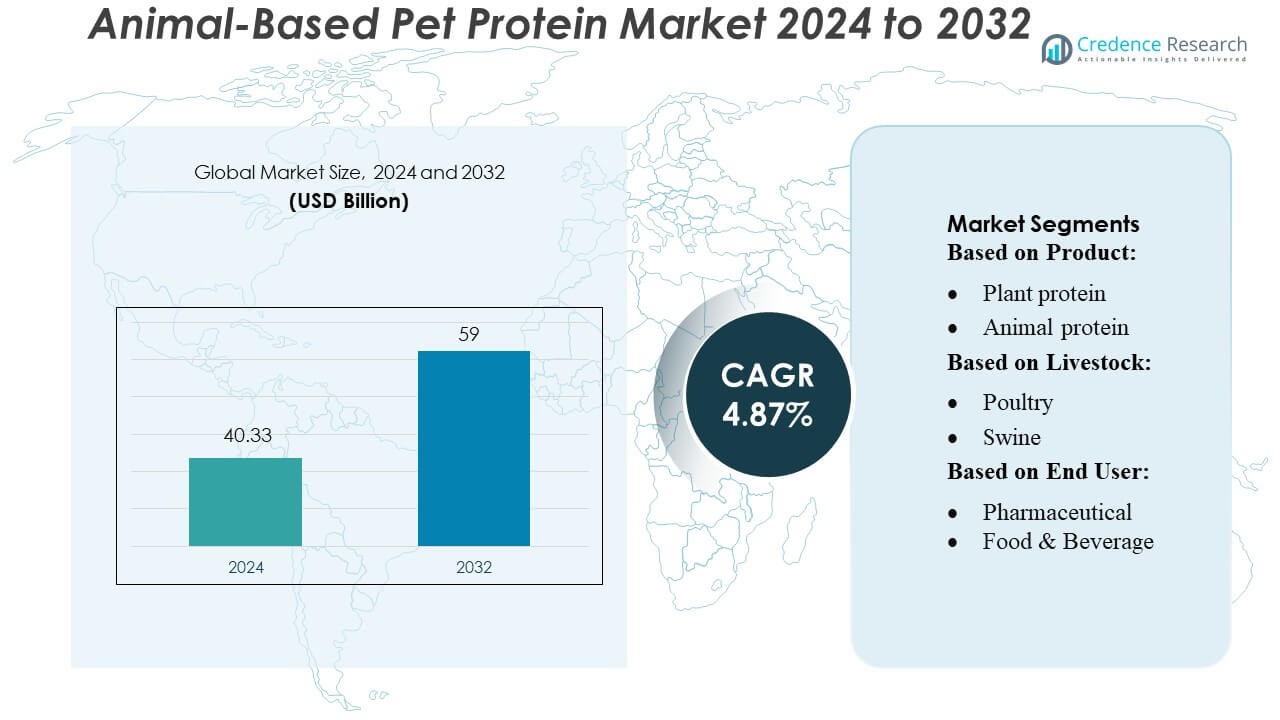
Animal-Based Pet Protein Market size was valued USD 40.33 billion in 2024 and is anticipated to reach USD 59 billion by 2032, at a CAGR of 4.87% during the forecast period.
| REPORT ATTRIBUTE | DETAILS |
|---|---|
| Historical Period | 2020-2023 |
| Base Year | 2024 |
| Forecast Period | 2025-2032 |
| Animal-Based Pet Protein Market Size 2024 | USD 40.33 Billion |
| Animal-Based Pet Protein Market, CAGR | 4.87% |
| Animal-Based Pet Protein Market Size 2032 | USD 59 Billion |
The Animal-Based Pet Protein Market is highly competitive, with top players such as Nutri-Pea, DuPont, COSUCRA, Roquette Frères, SOTEXPRO, Burcon, Ingredion, Shandong Jianyuan Group, Axiom Foods, Inc., and The Scoular Company driving innovation and expansion. These companies focus on developing high-quality, sustainable, and ethically sourced animal proteins to meet the growing demand for premium pet foods. Strategic initiatives, including product innovation, capacity expansion, and regional partnerships, are enabling these players to strengthen their market presence and enhance distribution networks. North America emerges as the leading region in the market, accounting for approximately 39% of the global share, supported by high pet ownership rates, strong consumer spending, and well-established regulatory frameworks that ensure quality and safety. The combination of established market leaders and a dominant regional presence underscores the robust growth trajectory of the global animal-based pet protein market.
 Market Insights
- The Animal-Based Pet Protein Market was valued at USD 40.33 billion in 2024 and is projected to reach USD 59 billion by 2032, growing at a CAGR of 4.87% during the forecast period.
- Market growth is driven by rising pet ownership, increasing demand for premium and high-protein pet foods, and consumer preference for sustainable and ethically sourced animal proteins.
- Key trends include the development of novel protein formulations, focus on functional and health-enhancing pet foods, and adoption of eco-friendly production practices across the industry.
- The market is highly competitive, led by companies such as Nutri-Pea, DuPont, COSUCRA, Roquette Frères, SOTEXPRO, Burcon, Ingredion, Shandong Jianyuan Group, Axiom Foods, Inc., and The Scoular Company, focusing on innovation, capacity expansion, and strategic regional partnerships.
- North America is the leading region with approximately 39% market share, followed by Europe and Asia Pacific; dry and wet pet food segments dominate the product share, reflecting strong consumer preference for high-protein formulations.
Market Segmentation Analysis:
By Product
The animal protein segment dominates the market, capturing a significant share due to its high bioavailability, essential amino acid content, and proven efficacy in promoting pet health and growth. Animal protein sources such as fish, poultry, and meat by-products are increasingly preferred in premium pet formulations. The plant protein and alternative protein segments are witnessing gradual adoption driven by consumer demand for sustainable and hypoallergenic options. Market growth is propelled by rising pet humanization trends and increased awareness of nutritional requirements, encouraging pet owners to opt for protein-rich diets that enhance immunity and overall vitality.
- For instance, Diamond Pet Foods operates 6 advanced production facilities across the United States (with a seventh under construction), utilizing precision extrusion systems to produce high-quality dry pet food, ensuring rigorous quality-control processes and high volume output.
By Livestock
Among livestock, poultry-based protein leads with the largest market share, owing to its cost-effectiveness, digestibility, and broad availability for inclusion in pet food formulations. Swine and cattle proteins are also significant, supplying functional nutrients and supporting large-scale production. Aquaculture-based proteins are emerging due to high-quality omega-3 content, while equine protein remains niche but specialized for performance-oriented pet feeds. Growth in this segment is driven by rising pet adoption, expanding premium pet food offerings, and increasing demand for species-specific formulations that cater to digestive health, energy, and weight management.
- For instance, General Mills, Inc. reported that its team of data scientists has scaled from running roughly 2,000 analytic models per month to running over 6 million models per month that generate in excess of 500 million individual predictions, enabling optimized supply-chain alignment for its dog-food brand Blue Buffalo.
By End-User
The animal feed end-user segment commands the highest share, reflecting the widespread integration of pet protein in commercial feed production for companion animals and livestock. Pharmaceutical and food & beverage applications are expanding, with proteins used in nutraceuticals and functional treats to support immunity and joint health. Cosmetic applications remain niche but are gaining traction in pet grooming and skin-care products. Drivers include the growing pet care industry, rising awareness of protein’s role in disease prevention, and the development of fortified pet products that align with human-grade nutrition standards and premium positioning in competitive markets.
Key Growth Drivers
Rising Pet Humanization
The growing trend of pet humanization is a primary driver, as owners increasingly seek high-quality, nutrient-rich diets for their pets. Animal-based proteins provide essential amino acids, vitamins, and minerals critical for pet health, supporting immunity, muscle development, and overall wellness. Premium pet food brands leverage this demand by offering meat, poultry, and fish-based formulations tailored to specific health needs. As consumers treat pets as family members, willingness to invest in superior nutrition is fueling consistent market growth across developed and emerging regions.
- For instance, Freshpet reports that its in-house R&D team now comprises 16 full-time professionals and operates over 6,000 sq ft of laboratory and testing facilities, including a dedicated pilot plant to enable new product development without disrupting main production lines.
Expansion of Premium Pet Food Market
The surge in premium and specialized pet food products is driving demand for animal-based proteins. Manufacturers are incorporating high-quality proteins such as chicken, salmon, and beef to create targeted formulations for weight management, digestive health, and active lifestyles. This trend is reinforced by increasing disposable income and urban lifestyles that prioritize convenience and quality nutrition. Investments in research and development to improve protein digestibility and bioavailability further strengthen market adoption, positioning animal-based protein as the preferred ingredient in premium pet food portfolios globally.
- For instance, Hill’s Pet Nutrition, Inc. reports that its newest manufacturing facility in Tonganoxie, Kansas spans 365,000 square-feet on more than 80 acres and integrates AI-driven food-safety vigilance, full automation and robotics, and end-to-end digital monitoring to enhance global production capabilities.
Increasing Awareness of Nutritional Benefits
Awareness of protein’s role in maintaining pets’ health is accelerating market growth. Animal-based proteins are recognized for their superior amino acid profile, enhanced palatability, and functional benefits like improved coat quality and joint health. Pet owners and veterinarians increasingly advocate diets enriched with animal proteins to address specific health concerns, including obesity, aging, and immune support. Educational campaigns, veterinary endorsements, and social media influence contribute to informed purchasing decisions, encouraging widespread adoption of high-protein formulations across diverse pet categories.
Key Trends & Opportunities
Sustainable Protein Sourcing
Sustainability is emerging as a key opportunity, with companies exploring responsibly sourced animal proteins, including by-products and aquaculture-based ingredients. Brands are adopting eco-friendly sourcing and traceable supply chains to reduce environmental impact while maintaining nutritional quality. This trend appeals to environmentally conscious consumers and opens avenues for innovative products that balance premium nutrition with sustainability. Companies investing in this approach differentiate their offerings, creating competitive advantage while meeting regulatory and consumer demands for transparency and ethical sourcing practices in the pet protein market.
- For instance, Mars Petcare, in collaboration with partners including Big Idea Ventures, AAK, and the Bühler Group, launched the "Next Generation Pet Food Program". The program received a total of 165 applications from 39 countries for its 2025 cohort.
Functional and Fortified Pet Foods
Functional pet foods fortified with animal-based proteins are gaining traction, addressing specific health needs such as digestive wellness, immunity, and joint support. Innovations include hydrolyzed proteins, collagen-enriched formulations, and omega-3-rich fish proteins that enhance overall pet health. This trend is driven by growing awareness of preventive healthcare for pets, mirroring human nutrition trends. Companies focusing on research-backed functional products can capture premium segments, while partnerships with veterinarians and nutritionists help build credibility and consumer trust, expanding market penetration globally.
- For instance, Purina’s manufacturing automation efforts in its Clinton, Iowa, dry-food facility achieved approximately a 90% reduction in system-failure incidents during a machine-learning pilot, with the technology now rolled out across other dry-food plants achieving about 70% of that improvement so far.
Diversification Across Pet Categories
Manufacturers are exploring opportunities by diversifying protein formulations across different pet types, including cats, dogs, equine, and exotic pets. Tailored formulations for life stage, breed, and activity level create niche markets, allowing companies to capture higher margins. Emerging markets offer growth potential as pet ownership rises and consumer preferences shift towards specialized nutrition. Diversification enhances brand visibility, encourages product loyalty, and addresses gaps in the market for species-specific and health-oriented diets, positioning animal-based protein as a versatile ingredient across the pet care ecosystem.
Key Challenges
Supply Chain Constraints
Fluctuations in raw material availability, rising costs of meat and fish proteins, and regulatory restrictions on animal sourcing pose significant challenges. Supply chain disruptions can impact production schedules, pricing strategies, and product consistency. Companies must navigate complex logistics, maintain sustainable sourcing, and optimize inventory management to mitigate risks. Ensuring high-quality, traceable animal proteins while managing cost pressures remains a critical concern, particularly as demand for premium and functional products continues to rise globally.
Health and Safety Concerns
Concerns around contamination, allergens, and antibiotic residues in animal-based proteins present a challenge for manufacturers. Regulatory compliance, rigorous quality control, and adherence to safety standards are essential to maintain consumer trust. Product recalls or negative publicity can significantly impact brand reputation. Companies are investing in advanced testing, certifications, and traceable sourcing to ensure safe, high-quality protein ingredients, but ongoing vigilance is required to address consumer health concerns while sustaining market growth in an increasingly quality-conscious pet nutrition landscape.
Regional Analysis
North America
North America leads the animal-based pet protein market with a 38–40% share, driven by high pet ownership and strong demand for premium pet foods. Consumers in the U.S. and Canada prefer high-quality, minimally processed animal proteins, encouraging manufacturers to focus on ethically sourced ingredients. The region benefits from established retail networks, advanced distribution channels, and strict food safety regulations, ensuring product quality and consumer confidence. Innovations in protein formulations and new product launches continue to strengthen market growth, making North America the largest and most mature market globally.
Europe
Europe holds about 28–29% of the global market. Countries like Germany, the UK, and France show high demand for premium animal-based pet proteins due to strong consumer awareness of pet health and nutrition. Strict regulations ensure product quality and safety, reinforcing trust among pet owners. Sustainability and transparency in sourcing are increasingly important, driving manufacturers to adopt eco-friendly practices. Although growth is slower than in emerging regions, Europe remains a key market, with stable demand for high-quality proteins and steady innovation in pet food formulations.
Asia Pacific
Asia Pacific accounts for roughly 22–23% of the market and is growing rapidly. Rising urbanization, increasing disposable incomes, and greater pet adoption in countries like China, India, and Japan fuel demand for premium pet foods. Consumers prefer fresh, high-quality animal proteins, and manufacturers are expanding production and imports to meet needs. Improving regulations and food safety standards support market expansion. The region offers strong growth potential as more middle-class households prioritize pet nutrition and are willing to pay for high-protein, quality pet food products.
Latin America
Latin America contributes around 8–8.5% of the global market. Brazil is the largest market, supported by growing pet ownership and rising interest in premium pet foods. The region benefits from abundant livestock supply, making animal-based proteins more accessible. Increasing disposable income and urbanization are encouraging consumers to choose higher-quality pet nutrition. While the market is smaller than North America or Europe, it shows steady growth as awareness of pet health increases and manufacturers introduce more premium protein options.
Middle East & Africa
Middle East & Africa holds 6–7% of the market. Pet adoption is increasing, especially in urban areas, along with demand for high-quality animal proteins. While infrastructure and regulatory frameworks are still developing, imports of premium pet food are rising. Growing disposable incomes and awareness of pet nutrition are supporting market growth. The region offers opportunities for manufacturers to expand, particularly by providing ethically sourced and high-protein pet foods, as consumers gradually prioritize pet health and quality nutrition.
Market Segmentations:
By Product:
- Plant protein
- Animal protein
By Livestock:
- Poultry
- Swine
By End User:
- Pharmaceutical
- Food & Beverage
By Geography
- North America
- U.S.
- Canada
- Mexico
- Europe
- Germany
- France
- U.K.
- Italy
- Spain
- Rest of Europe
- Asia Pacific
- China
- Japan
- India
- South Korea
- South-east Asia
- Rest of Asia Pacific
- Latin America
- Brazil
- Argentina
- Rest of Latin America
- Middle East & Africa
- GCC Countries
- South Africa
- Rest of the Middle East and Africa
Competitive Landscape
The animal-based pet protein market, including Nutri-Pea, DuPont, COSUCRA, Roquette Frères, SOTEXPRO, Burcon, Ingredion, Shandong Jianyuan Group, Axiom Foods, Inc., and The Scoular Company. The animal-based pet protein market is highly competitive, driven by innovation, product differentiation, and strategic expansions. Companies focus on developing high-quality, sustainable, and ethically sourced animal proteins to cater to growing consumer demand for premium pet foods. Investment in research and development enables the introduction of novel protein formulations with enhanced nutritional profiles and functional benefits. Market participants are also leveraging mergers, partnerships, and regional expansions to strengthen their distribution networks and enhance market presence. Competitive advantage is increasingly shaped by product quality, traceability, regulatory compliance, and sustainability practices. Firms that prioritize transparency, innovation, and premium offerings are better positioned to capture market share and respond effectively to evolving consumer preferences in the global pet protein industry.
Key Player Analysis
- Nutri-Pea
- DuPont
- COSUCRA
- Roquette Frères
- SOTEXPRO
- Burcon
- Ingredion
- Shandong Jianyuan Group
- Axiom Foods, Inc.
- The Scoular Company
Recent Developments
- In February 2025, Marsapet and Calysta launched MicroBell, the first dog food featuring FeedKind Pet protein-an innovative, land-free cultured protein. This vegan, grain-free, and gluten-free kibble supports dogs with allergies and is now available in Europe. It offers a high nutrient profile as a sustainable alternative to traditional animal protein, marking a major step in eco-friendly pet nutrition.
- In July 2024, Ingredion Incorporated announced the launch of Vitessence Pea 100 HD, a new pea protein enhanced for cold-pressed bars for the Canada and U.S. markets. It delivers softness throughout the shelf life of cold-pressed bars.
- In February 2024, Cargill announced its expansion in Brazil by partnering with Bom Negócio to boost mineral supplement production for cattle and acquiring the Anhambi factory in Minas Gerais. This move is intended to increase production for pasture-raised cattle in Brazil's large beef cattle market.
- In March 2023, Nepra Foods and Scoular announced a manufacturing and distribution partnership for specialized plant-based products. The agreement specifies that Nepra will lead product development through its R&D team, utilizing specialty ingredients from both companies. This collaboration will also leverage Scoular's global supply chain to distribute the new products.
Report Coverage
The research report offers an in-depth analysis based on Product, Livestock, End-User and Geography. It details leading market players, providing an overview of their business, product offerings, investments, revenue streams, and key applications. Additionally, the report includes insights into the competitive environment, SWOT analysis, current market trends, as well as the primary drivers and constraints. Furthermore, it discusses various factors that have driven market expansion in recent years. The report also explores market dynamics, regulatory scenarios, and technological advancements that are shaping the industry. It assesses the impact of external factors and global economic changes on market growth. Lastly, it provides strategic recommendations for new entrants and established companies to navigate the complexities of the market.
Future Outlook
- Demand for high-quality animal proteins in pet foods will continue to rise globally.
- Innovation in protein formulations will drive the development of premium and functional pet foods.
- Sustainable and ethically sourced animal proteins will gain greater consumer preference.
- Expanding pet ownership in emerging regions will create new market opportunities.
- Investments in research and development will lead to novel protein products with enhanced nutritional benefits.
- Regulatory standards will increasingly shape product quality and safety requirements.
- Companies will focus on improving supply chain efficiency and distribution networks.
- Mergers, acquisitions, and strategic partnerships will intensify market competition.
- Consumer awareness of pet health and wellness will continue to influence product trends.
- Digital marketing and e-commerce channels will play a growing role in market expansion.

Request a Free Sample
Fill in your details and we'll send you a free sample report.
- Sample data tables & charts
- Research methodology
Market Dynamics
Rising Pet Humanization
Pet owners increasingly treat pets as family members, driving demand for high-quality, nutrient-rich animal-based proteins that support immunity, muscle development, and overall wellness. This trend encourages premiumization and willingness to invest in superior pet nutrition.
Expansion of Premium Pet Food Market
The surge in premium and specialized pet food products is boosting demand for animal-based proteins, as manufacturers incorporate high-quality ingredients like chicken, salmon, and beef to create targeted formulations for health, weight management, and active lifestyles.
Increasing Awareness of Nutritional Benefits
Greater awareness among pet owners and veterinarians about the superior amino acid profile and functional benefits of animal-based proteins is accelerating adoption, especially for addressing specific health concerns such as obesity, aging, and immune support.
Sustainable and Ethical Protein Sourcing
Consumer preference for sustainably and ethically sourced animal proteins is prompting companies to adopt eco-friendly sourcing, traceable supply chains, and responsible production practices, which differentiates brands and meets regulatory and consumer expectations.
Innovation in Functional and Fortified Pet Foods
The development of functional pet foods fortified with animal-based proteins - such as hydrolyzed proteins, collagen, and omega-3-rich fish proteins - addresses specific health needs and mirrors human nutrition trends, expanding premium market segments.
Need a Custom Version of This Report?
Tailor the scope, geography, or segments to your exact requirements.
- Custom geography or segment scope
- Direct access to our analyst team
Frequently Asked Questions
What is the current market size for Animal-Based Pet Protein Market, and what is its projected size in 2032?
At what Compound Annual Growth Rate is the Animal-Based Pet Protein Market projected to grow between 2025 and 2032?
Which Animal-Based Pet Protein Market segment held the largest share in 2024?
What are the primary factors fueling the growth of the Animal-Based Pet Protein Market?
Who are the leading companies in the Animal-Based Pet Protein Market?
Which region commanded the largest share of the Animal-Based Pet Protein Market in 2024?
Table of Content
Chapter 1 Market Segmentation
- 1.1 Segmentation Framework
- 1.1.1 Product and Service Classification
- 1.1.2 Application and End-Use Classification
- 1.1.3 Technology and Solution Classification
- 1.1.4 Customer and Distribution Channel Classification
- 1.1.5 Geographic Segmentation
- 1.1.6 Market Segment Definitions and Boundaries
- 1.2 By Product
- 1.2.1 Animal protein
- 1.2.2 Plant protein
- 1.2.3 Alternative protein
- 1.3 By End User
- 1.3.1 Animal feed
- 1.3.2 Pharmaceutical
- 1.3.3 Food & Beverage
- 1.3.4 Cosmetic
- 1.4 By Livestock
- 1.4.1 Poultry
- 1.4.2 Swine
- 1.4.3 Cattle
- 1.4.4 Aquaculture
- 1.4.5 Equine
Chapter 2 Introduction
- 2.1 Report Objectives and Scope
- 2.2 Product Definition and Industry Terminology
- 2.3 Market Inclusions and Exclusions
- 2.4 Research Process
- 2.4.1 Primary Research and Expert Interviews
- 2.4.2 Secondary Research and Source Review
- 2.4.3 Top-Down and Bottom-Up Estimation
- 2.4.4 Data Triangulation and Verification
- 2.5 Market Size Measurement Basis
- 2.5.1 2024: USD 40.33 billion → 2032: USD 59 billion
- 2.6 Historical and Forecast Reference Periods
- 2.6.1 Base Year: 2024
- 2.6.2 Forecast Period: 2024-2032
- 2.7 Research Assumptions and Limitations
Chapter 3 Executive Summary
- 3.1 Market Snapshot and Key Findings
- 3.2 Base-Year Market Size, 2024
- 3.3 Forecast Market Size, 2032
- 3.4 Revenue and Volume Growth Outlook
- 3.5 Key Demand and Supply Indicators
- 3.6 Leading Market Segments
- 3.7 Fastest-Growing Market Opportunities
- 3.8 Regional Performance Highlights
- 3.9 Technology and Industry Transformation
- 3.10 Competitive Landscape Summary
- 3.11 Analyst View and Strategic Implications
Chapter 4 Global Animal-Based Pet Protein Market Trends and Developments
- 4.1 Historical Industry Development
- 4.2 Recent Market Trends and Developments
- 4.3 Demand and Customer Behavior Trends
- 4.4 Technology and Product Innovation
- 4.5 Artificial Intelligence, Automation and Digitalization
- 4.6 Local Manufacturing and Supply Chain Realignment
- 4.7 Industry Partnerships, Mergers and Acquisitions
- 4.8 Sustainability and Circular Economy Developments
- 4.9 Government and Private Sector Investment Trends
- 4.10 Emerging Business Models and Commercialization
- 4.11 Industry Developments and Announcements
Chapter 5 Global Animal-Based Pet Protein Market Production, Supply and Demand Analysis
- 5.1 Demand Trend and Consumption Analysis
- 5.2 Demand Forecast, 2024-2032
- 5.3 Production and Output Trend
- 5.4 Production and Output Forecast, 2024-2032
- 5.5 Installed Capacity and Capacity Utilization
- 5.6 Company-Wise Production Plants and Statistics
- 5.6.1 Installed Production Capacity
- 5.6.2 Actual Production
- 5.6.3 Planned Capacity and Expansion Targets
- 5.7 Supply Chain Structure and Procurement Trends
- 5.8 Supply-Demand Gap and Bottlenecks
- 5.9 Import Dependence and Sourcing Structure
- 5.10 Contract Manufacturing and Outsourcing
- 5.11 Regional Supply and Demand Concentration
Chapter 6 Global Animal-Based Pet Protein Market Pricing Analysis
- 6.1 Pricing Structure and Measurement
- 6.2 Historical Pricing Trends
- 6.3 Pricing Outlook, 2024-2032
- 6.4 Average Selling Price and Unit Economics
- 6.5 Pricing by Product and Market Segment
- 6.6 Geographic Pricing Differences
- 6.7 Key Input, Energy, Labor and Logistics Costs
- 6.8 Contract Pricing and Purchasing Models
- 6.9 Pricing Sensitivity and Competitive Positioning
- 6.10 Price, Margin and Profitability Implications
Chapter 7 Global Animal-Based Pet Protein Market Dynamics
- 7.1 Market Growth Drivers
- 7.1.1 Demand-Side Drivers
- 7.1.2 Technology and Innovation Drivers
- 7.1.3 Infrastructure and Investment Drivers
- 7.1.4 Regulatory and Policy Drivers
- 7.2 Market Restraints
- 7.2.1 Cost and Affordability Constraints
- 7.2.2 Technology and Adoption Barriers
- 7.2.3 Supply Chain and Operational Constraints
- 7.3 Market Challenges
- 7.3.1 Competitive Pressure and Margin Erosion
- 7.3.2 Skills, Infrastructure and Implementation Gaps
- 7.4 Emerging Market Opportunities
- 7.5 Market Dynamics Impact and Time-Horizon Assessment
Chapter 8 Global Animal-Based Pet Protein Value Chain Analysis
- 8.1 Industry Value Chain Overview
- 8.2 Upstream Suppliers and Critical Inputs
- 8.3 Technology and Component Providers
- 8.4 Manufacturing or Service Delivery
- 8.5 Distribution, Channel Partners and Integrators
- 8.6 Downstream Applications and End Users
- 8.7 Value Addition and Profit Pools
- 8.8 Vertical Integration and Outsourcing
- 8.9 Supplier Concentration and Risk
- 8.10 Supply Chain Localization and Resilience
Chapter 9 Global Animal-Based Pet Protein Market Regulations and Policies
- 9.1 Relevant Laws, Standards and Compliance Frameworks
- 9.2 Product, Service, Safety and Quality Requirements
- 9.3 Government Policies, Incentives and Subsidies
- 9.4 Imports, Exports and Trade Barriers
- 9.5 Public Procurement and Local Content Requirements
- 9.6 Environmental and Sustainability Compliance
- 9.7 Upcoming Policy Changes and Market Implications
Chapter 10 Global Animal-Based Pet Protein Market Hotspots and Opportunities
- 10.1 Market Opportunity Mapping and Growth Hotspots
- 10.2 High-Growth Applications and Customer Groups
- 10.3 Underserved Markets and White-Space Opportunities
- 10.4 Emerging Technology and Product Opportunities
- 10.5 New Capacity and Investment Hotspots
- 10.6 Market Entry and Expansion Opportunities
- 10.7 Distribution and Partnership Opportunities
- 10.8 Near-Term and Long-Term Commercial Potential
- 10.9 Opportunity Attractiveness and Execution Risks
Chapter 11 Global Animal-Based Pet Protein Market Outlook, 2024-2032
- 11.1 Market Size and Analysis
- 11.1.1 Revenue (Market Measurement: 2024: USD 40.33 billion → 2032: USD 59 billion)
- 11.1.2 Market Volume and Quantity Sold
- 11.1.3 Historical Market Size
- 11.1.4 Base-Year Market Size, 2024
- 11.2 Market Forecast, 2024-2032
- 11.2.1 Revenue Forecast to 2032
- 11.2.2 Volume Forecast to 2032
- 11.2.3 CAGR and Year-on-Year Growth
- 11.2.4 Incremental Revenue Opportunity
- 11.3 Forecast Assumptions and Scenario Analysis
- 11.3.1 Base-Case Forecast
- 11.3.2 Optimistic and Conservative Scenarios
- 11.3.3 Technology, Pricing and Policy Sensitivities
- 11.4 Market Attractiveness and Growth Outlook
Chapter 12 Global Animal-Based Pet Protein Market Segmentation and Outlook
- 12.1 Segmentation Summary and Market Shares, 2024
- 12.2 Largest and Fastest-Growing Segments
- 12.3 By Product - Market Size and Forecast, 2024-2032
- 12.3.1 Segment Definition and Scope
- 12.3.2 Historical Market Size
- 12.3.3 Revenue Forecast, 2024-2032
- 12.3.4 Volume Forecast, 2024-2032
- 12.3.5 Base-Year Market Share, 2024
- 12.3.6 Segment CAGR and Growth Drivers
- 12.3.7 Subsegment Market Size and Forecast
- 12.3.7.1 Animal protein
- 12.3.7.2 Plant protein
- 12.3.7.3 Alternative protein
- 12.3.8 Subsegment Pricing and Adoption Trends
- 12.3.9 Leading Suppliers and Competition
- 12.3.10 Regional Demand and Opportunities
- 12.4 By End User - Market Size and Forecast, 2024-2032
- 12.4.1 Segment Definition and Scope
- 12.4.2 Historical Market Size
- 12.4.3 Revenue Forecast, 2024-2032
- 12.4.4 Volume Forecast, 2024-2032
- 12.4.5 Base-Year Market Share, 2024
- 12.4.6 Segment CAGR and Growth Drivers
- 12.4.7 Subsegment Market Size and Forecast
- 12.4.7.1 Animal feed
- 12.4.7.2 Pharmaceutical
- 12.4.7.3 Food & Beverage
- 12.4.7.4 Cosmetic
- 12.4.8 Subsegment Pricing and Adoption Trends
- 12.4.9 Leading Suppliers and Competition
- 12.4.10 Regional Demand and Opportunities
- 12.5 By Livestock - Market Size and Forecast, 2024-2032
- 12.5.1 Segment Definition and Scope
- 12.5.2 Historical Market Size
- 12.5.3 Revenue Forecast, 2024-2032
- 12.5.4 Volume Forecast, 2024-2032
- 12.5.5 Base-Year Market Share, 2024
- 12.5.6 Segment CAGR and Growth Drivers
- 12.5.7 Subsegment Market Size and Forecast
- 12.5.7.1 Poultry
- 12.5.7.2 Swine
- 12.5.7.3 Cattle
- 12.5.7.4 Aquaculture
- 12.5.7.5 Equine
- 12.5.8 Subsegment Pricing and Adoption Trends
- 12.5.9 Leading Suppliers and Competition
- 12.5.10 Regional Demand and Opportunities
- 12.6 Segment Growth Comparison
- 12.7 Segment Attractiveness and Priority Matrix
Chapter 13 Global Animal-Based Pet Protein End-Use and Application Market Outlook
- 13.1 End-Use Industry and Customer Demand Structure
- 13.2 Leading Applications and Customer Groups
- 13.3 End-Use Market Size, Share and Forecast
- 13.4 Major End-Use Industry Deep Dives
- 13.4.1 Customer Requirements and Use Cases
- 13.4.2 Demand and Replacement Cycles
- 13.4.3 Technical and Regulatory Considerations
- 13.4.4 Purchasing and Procurement Models
- 13.4.5 Leading Vendors and Distribution Channels
- 13.4.6 Forecast and Commercial Opportunities
- 13.5 Emerging Applications and Cross-Segment Demand
- 13.6 End-Use Industry Investment Priorities
Chapter 14 Global Animal-Based Pet Protein Geographic Market Outlook, 2024-2032
- 14.1 Regional Market Size and Share, 2024
- 14.2 Regional Market Forecast, 2024-2032
- 14.3 Regional Pricing, Production and Demand Differences
- 14.4 North America
- 14.4.1 United States
- 14.4.2 Canada
- 14.4.3 Mexico
- 14.5 Europe
- 14.5.1 Germany
- 14.5.2 France
- 14.5.3 Italy
- 14.5.4 United Kingdom
- 14.5.5 Spain
- 14.5.6 Poland
- 14.5.7 Russia
- 14.5.8 Netherlands
- 14.5.9 Belgium
- 14.5.10 Sweden
- 14.5.11 Denmark
- 14.5.12 Norway
- 14.5.13 Rest of Europe
- 14.6 Asia Pacific
- 14.6.1 China
- 14.6.2 India
- 14.6.3 Japan
- 14.6.4 South Korea
- 14.6.5 Thailand
- 14.6.6 Indonesia
- 14.6.7 Vietnam
- 14.6.8 Malaysia
- 14.6.9 Australia
- 14.6.10 Rest of Asia Pacific
- 14.7 Latin America
- 14.7.1 Brazil
- 14.7.2 Argentina
- 14.7.3 Colombia
- 14.7.4 Chile
- 14.7.5 Rest of Latin America
- 14.8 Middle East
- 14.8.1 Saudi Arabia
- 14.8.2 United Arab Emirates
- 14.8.3 Turkey
- 14.8.4 Israel
- 14.8.5 Iran
- 14.8.6 Rest of the Middle East
- 14.9 Africa
- 14.9.1 South Africa
- 14.9.2 Egypt
- 14.9.3 Nigeria
- 14.9.4 Morocco
- 14.9.5 Rest of Africa
- 14.10 Regional Investment, Policy and Supply Chain Differences
- 14.11 Regional Competitive Landscape
- 14.12 Geographic Growth Hotspots
Chapter 15 Global Animal-Based Pet Protein Technology, Innovation and Sustainability Outlook
- 15.1 Technology Landscape and Maturity
- 15.2 Product, Process and Service Innovation
- 15.3 AI, Automation and Digital Tools in the Industry
- 15.4 Technology Adoption and Performance Benchmarking
- 15.5 Innovation Pipeline and R&D Investment
- 15.6 Patent and Intellectual Property Trends
- 15.7 Energy Efficiency and Resource Management
- 15.8 Sustainability, Recycling and Circularity
- 15.9 Technology Roadmap, 2024-2032
- 15.10 Risks of Obsolescence and Technology Substitution
Chapter 16 Global Animal-Based Pet Protein Market Key Strategic Imperatives
- 16.1 Growth and Market Entry Priorities
- 16.2 High-Return Products and Segments
- 16.3 Pricing, Profitability and Cost Optimization
- 16.4 Technology Investment and Product Differentiation
- 16.5 Supply Chain Localization and Resilience
- 16.6 Distribution and Customer Acquisition
- 16.7 Partnership, Acquisition and Capacity Strategy
- 16.8 Regional Expansion Priorities
- 16.9 Short-, Medium- and Long-Term Actions
Chapter 17 Competition Outlook
- 17.1 Industry Competition Characteristics
- 17.2 Market Structure and Concentration
- 17.3 Market Share and Competitive Positioning, 2024
- 17.4 Company-Wise Revenue and Product Benchmarking
- 17.5 Production and Service Capacity Benchmarking
- 17.6 Technology, Pricing and Differentiation
- 17.7 Regional Footprint and Distribution Strength
- 17.8 Mergers, Acquisitions and Strategic Alliances
- 17.9 New Entrants and Competitive Threats
- 17.10 Porter's Five Forces and Industry Attractiveness
- 17.11 Competitive Outlook, 2024-2032
Chapter 18 Company Profiles
- 18.1 Company Coverage and Selection Criteria
- 18.2 Nutri-Pea
- 18.2.1 Business Description
- 18.2.2 Company Ownership and Geographic Presence
- 18.2.3 Product and Service Portfolio
- 18.2.4 Manufacturing and Operating Footprint
- 18.2.5 Production Capacity and Expansion Plans
- 18.2.6 Financial Performance and Investment
- 18.2.7 Market Share and Competitive Position
- 18.2.8 Technology and Innovation Capabilities
- 18.2.9 Strategic Alliances or Partnerships
- 18.2.10 Recent Developments
- 18.2.11 Growth Strategy and Outlook
- 18.3 DuPont
- 18.4 COSUCRA
- 18.5 Roquette Frères
- 18.6 SOTEXPRO
- 18.7 Burcon
- 18.8 Ingredion
- 18.9 Shandong Jianyuan Group
- 18.10 Axiom Foods, Inc.
- 18.11 The Scoular Company
- 18.12 Other Relevant Market Participants
Note: Every listed company is profiled on the structure shown under the first company. The company list is preliminary and may change based on research findings, market developments, data availability and client requirements.
Chapter 19 Disclaimer
- 19.1 Research and Forecast Disclaimer
- 19.2 Data Source and Estimation Limitations
Note: The depth of individual sections depends on data availability for this market. Volume, capacity, trade and other unit-based metrics are included where applicable.