| REPORT ATTRIBUTE | DETAILS |
|---|---|
| Historical Period | 2020-2023 |
| Base Year | 2024 |
| Forecast Period | 2025-2032 |
| Asia Pacific Off The Road Tire Market Size 2023 | USD 5,358.97 Million |
| Asia Pacific Off The Road Tire Market, CAGR | 5.7% |
| Asia Pacific Off The Road Tire Market Size 2032 | USD 8,829.71 Million |
Market Overview:
Asia Pacific Off The Road Tire Market size was valued at USD 5,358.97 million in 2023 and is anticipated to reach USD 8,829.71 million by 2032, at a CAGR of 5.7% during the forecast period (2023-2032).
The Asia Pacific OTR tire market is primarily driven by several key factors. Rapid infrastructure development across the region, particularly in emerging economies like India and China, is fueling demand for heavy machinery and construction vehicles, which require durable OTR tires. The growing industrial sector, which includes mining, construction, and agriculture, further accelerates the demand for these tires. Additionally, the region is experiencing significant agricultural mechanization, leading to increased adoption of machinery that relies on OTR tires. Technological advancements in tire performance, such as improved durability, reduced wear, and better fuel efficiency, are also key drivers, making OTR tires more attractive to end-users. Moreover, the increasing focus on environmental sustainability is encouraging innovations in tire design, with companies producing eco-friendlier and efficient options.
Regionally, the Asia Pacific market dominates the global OTR tire landscape. China, as the largest economy in the region, plays a central role due to its massive infrastructure projects and booming industrial sector. India follows closely, with rapid urbanization, industrial growth, and ongoing construction projects driving tire demand. Other key contributors include Japan, South Korea, and Australia, where industrial activities are robust, and infrastructure development continues to thrive. The region's diverse economic activities, ranging from mining and construction to agriculture, create a steady demand for OTR tires, ensuring continued market growth and innovation across multiple industries.
Market Insights:
- The Asia Pacific OTR tire market was valued at USD 5,358.97 million in 2023 and is projected to reach USD 8,829.71 million by 2032, growing at a CAGR of 5.7% during the forecast period.
- The Global OTR tire market was valued at USD 18,234 million in 2023 and is expected to grow to USD 27,097.46 million by 2032, at a CAGR of 4.5%.
- Key growth drivers include rapid infrastructure development, particularly in emerging economies like India and China, which are fueling the demand for heavy machinery and construction vehicles requiring durable OTR tires.
- The region’s industrial sector, especially mining, construction, and agriculture, is experiencing significant growth, further accelerating the demand for specialized OTR tires for machinery.
- Technological advancements in OTR tire design, such as improved durability, wear resistance, and fuel efficiency, are making tires more attractive to end-users and contributing to market growth.
- Environmental regulations and sustainability initiatives are pushing for eco-friendly and energy-efficient OTR tire solutions, driving innovation in tire materials and recycling technologies.
- Despite growth, the market faces challenges, including the high cost of premium OTR tires, which may limit adoption in price-sensitive markets or for smaller enterprises.
- The Asia Pacific market is regionally dominated by China, India, Japan, South Korea, and Australia, with each country’s industrial activities, such as mining and construction, driving steady demand for OTR tires.
Market Drivers:
Infrastructure Development and Urbanization
The rapid pace of infrastructure development in the Asia Pacific region is one of the primary drivers of the Off-the-Road (OTR) tire market. Countries such as China, India, and Southeast Asian nations are heavily investing in infrastructure projects, including the construction of roads, highways, bridges, and industrial facilities. These projects require the use of heavy machinery, such as bulldozers, graders, and cranes, which are all equipped with OTR tires. For instance, JK Tyre recently launched an OTR tire range with 11 models tailored for different heavy machinery, directly supporting the surge in construction and industrial activity. With urbanization on the rise, particularly in India and China, the demand for construction equipment has surged, consequently driving the need for durable, high-performance tires capable of enduring challenging off-road conditions. As infrastructure development continues to expand across the region, OTR tire demand is expected to grow proportionally.
Industrial Growth and Mechanization
Industrialization is another key factor propelling the growth of the OTR tire market in Asia Pacific. The region has witnessed significant industrial expansion, especially in countries like China, India, and Japan. The increasing demand for mining, construction, and agricultural equipment has directly impacted the need for OTR tires, as these sectors require specialized tires for their vehicles and machinery. For instance, Bridgestone Corporation, for example, has expanded its OTR tire offerings to support the growing demand in mining and construction, emphasizing durability and load-carrying capacity. The mining industry, in particular, requires robust and durable tires to withstand harsh terrain and heavy loads. As industries continue to expand and modernize their machinery, the demand for high-quality OTR tires is expected to rise, driving the market's growth further.
Technological Advancements in Tire Design
Technological advancements in OTR tire design and manufacturing are playing a significant role in driving market growth in the region. Manufacturers are continuously innovating to develop tires that offer improved durability, performance, and fuel efficiency, catering to the specific needs of heavy machinery operators. The introduction of advanced materials, such as synthetic rubbers and specialized compounds, has enhanced the overall performance of OTR tires, making them more resistant to wear and tear in harsh environments. Additionally, the integration of smart tire technology that monitors tire pressure, wear, and temperature in real time is gaining traction. These innovations are attracting end-users who seek enhanced operational efficiency and lower maintenance costs, thus accelerating the adoption of OTR tires in the region.
Government Regulations and Sustainability Initiatives
Government regulations and sustainability initiatives in the Asia Pacific region are driving the adoption of eco-friendly and energy-efficient OTR tires. Many countries in the region are tightening environmental regulations, particularly in the mining and construction industries, where OTR tires are heavily utilized. To comply with these regulations, companies are turning to tires that offer better fuel efficiency, lower emissions, and longer lifespan. Additionally, there is a growing emphasis on the recycling of tires, with governments encouraging the use of sustainable materials and the proper disposal of used tires. This trend is contributing to the demand for advanced OTR tire solutions that meet environmental standards while maintaining high performance. As companies align with sustainability goals, they are increasingly investing in eco-friendly OTR tire technologies, further propelling market growth.
Market Trends:
Rise of Radial Tires
In the Asia Pacific Off-the-Road (OTR) tire market, there is a growing preference for radial tires over traditional bias-ply tires. Radial tires offer several advantages, including enhanced fuel efficiency, better durability, and superior performance under heavy loads. These benefits make them particularly suitable for the mining, construction, and agriculture sectors, where machinery operates under demanding conditions. The shift towards radial tires is driven by advancements in tire technology, which has made radial tires more cost-effective over their lifespan compared to bias-ply alternatives. As these tires continue to offer better value, their adoption is expected to grow across the region.
Emergence of Smart Tire Technology
Another significant trend in the Asia Pacific OTR tire market is the increasing adoption of smart tire technology. With the integration of sensors and IoT (Internet of Things) capabilities, smart tires allow operators to monitor tire pressure, temperature, wear, and overall performance in real time. Bridgestone, for example, has developed the Smart Strain Sensor, a technology capable of estimating wheel axle load and tire wear condition by using sensors inside the tire to measure strain during motion. This technology helps prevent tire-related failures and ensures optimal vehicle performance, reducing downtime and maintenance costs. As the region’s industries seek more efficient and reliable equipment, the demand for smart tire solutions is increasing. This trend is particularly strong in sectors such as mining and construction, where operational efficiency is crucial.
Focus on Sustainable Tire Solutions
Sustainability has become a key concern in the Asia Pacific OTR tire market, with growing demand for eco-friendly solutions. The rising awareness of environmental issues and the push for stricter regulations on carbon emissions have driven tire manufacturers to explore more sustainable options. This includes the use of bio-based and recycled materials in tire production, as well as innovations aimed at improving the overall sustainability of tire disposal. Goodyear has launched the ElectricDrive Sustainable-Material (EDS) tire, built using recycled polyester and carbon black sourced from end-of-life tires, and aims to deliver the industry's first fully sustainable-material tire by 2030. As governments and industries place more emphasis on reducing environmental impact, there is a noticeable shift towards tires that are more energy-efficient and have a lower carbon footprint. This trend aligns with global efforts to adopt more sustainable practices across all sectors.
Growth of the Used Tire Market
The used tire market is gaining traction in the Asia Pacific region, particularly in countries with well-established mining and construction industries. As the demand for OTR tires grows, so does the availability of used tires, which provide a cost-effective alternative to new tires. These used tires, when refurbished and inspected for quality, offer businesses a more affordable solution, especially in regions with tight budgets or those involved in large-scale projects with high tire consumption. The increasing acceptance of used and retreaded OTR tires, combined with advancements in tire refurbishment technology, is contributing to the expansion of this market segment. As businesses seek to reduce costs without compromising on quality, the used tire market is expected to continue growing.
Market Challenges Analysis:
High Cost of OTR Tires
One of the key restraints in the Asia Pacific Off-the-Road (OTR) tire market is the high cost associated with premium quality OTR tires. These tires are designed to withstand extreme conditions in industries such as mining, construction, and agriculture, leading to higher production costs. The advanced materials and technology incorporated into these tires, including radial designs, smart sensors, and durable compounds, contribute to the overall expense. For companies operating on tight budgets or in regions with limited access to financing, the high initial investment for OTR tires can be a significant barrier. Although the benefits of improved efficiency and longer tire life often justify the cost, it remains a challenge for smaller enterprises in the region.
Fluctuating Raw Material Prices
Fluctuations in the prices of raw materials, such as rubber, steel, and synthetic compounds, present another challenge to the growth of the OTR tire market in Asia Pacific. The global nature of raw material supply chains means that prices can be volatile, influenced by factors such as geopolitical tensions, trade tariffs, and climate conditions affecting rubber production. These price fluctuations can lead to increased production costs for OTR tires, which may be passed on to consumers. Manufacturers face the challenge of managing these costs while maintaining competitive pricing, particularly in a market where price sensitivity is high in certain regions.
Limited Recycling and Disposal Infrastructure
The lack of adequate recycling and disposal infrastructure for OTR tires is another significant challenge in the Asia Pacific market. End-of-life tires, especially those used in heavy-duty applications, often pose environmental concerns. For instance, in 2024, Asia produced over 2.3 million vehicles in January alone, contributing to the mounting tire waste problem. Many regions in Asia Pacific lack sufficient facilities for the proper disposal and recycling of large OTR tires, leading to improper disposal practices that contribute to environmental degradation. The absence of a robust recycling system limits the ability to reuse valuable materials from old tires, thereby hindering sustainability efforts in the region.
Market Opportunities:
The ongoing and future infrastructure development across the Asia Pacific region presents a significant opportunity for the Off-the-Road (OTR) tire market. Governments in countries such as China, India, and Southeast Asian nations are making substantial investments in infrastructure, including highways, roads, bridges, and industrial projects. These infrastructure initiatives require heavy machinery that relies on durable OTR tires. As these projects expand, the demand for OTR tires is expected to rise, creating opportunities for manufacturers to supply a growing market. Additionally, urbanization in emerging economies is driving the need for modernized construction equipment, further boosting tire demand. Companies that can provide high-performance tires designed for such large-scale projects stand to benefit from this expansion.
The rapid mechanization of agriculture and the growth of the mining sector also offer significant opportunities for the Asia Pacific OTR tire market. With an increasing number of agricultural enterprises shifting to mechanized equipment to enhance productivity, there is a growing need for tires that can withstand the rigors of farming machinery. Additionally, the mining industry in countries like Australia, China, and India continues to expand, driven by demand for minerals and resources. This growth in mining operations requires OTR tires capable of performing in harsh, off-road environments. Manufacturers that focus on creating durable, high-performance tires tailored for these industries are positioned to capture a large share of the market, especially as demand for specialized tires rises in both the agricultural and mining sectors.
Market Segmentation Analysis:
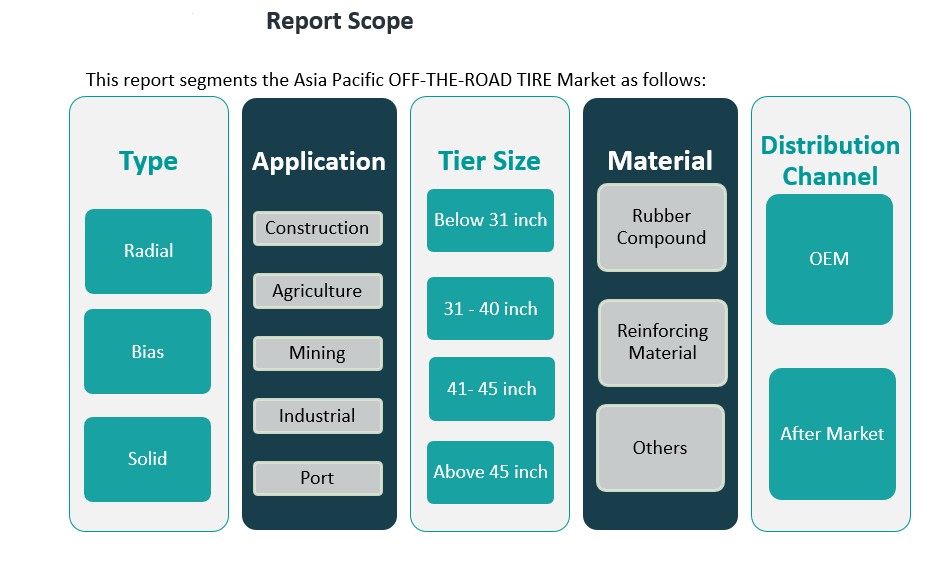
The Asia Pacific Off-the-Road (OTR) tire market is segmented into several categories, each addressing the unique needs of industries using heavy-duty machinery.
By Type Segment
The OTR tire market is primarily divided into radial, bias, and solid tire types. Radial tires dominate the market due to their superior performance in terms of durability and fuel efficiency, especially in construction and mining sectors. Bias tires, while offering a lower upfront cost, are typically used in specific applications requiring heavy load-bearing capacity. Solid tires, which are airless and durable, are preferred in industries like port handling, where puncture resistance is critical.
By Application Segment
The market is categorized by application into construction, agriculture, mining, industrial, and port sectors. The construction segment holds the largest share, driven by large infrastructure projects across the region. The agriculture sector is seeing increased demand due to mechanization, while the mining sector requires OTR tires for heavy-duty machinery used in harsh environments. Industrial and port sectors also contribute significantly to the market, particularly in regions with extensive logistical operations.
By Tire Size Segment
Tire sizes are segmented into below 31 inches, 31-40 inches, 41-45 inches, and above 45 inches. Larger tires (above 45 inches) are commonly used in mining and heavy construction equipment, while smaller tires are more common in agricultural machinery and port operations.
By Material Segment
The material segment includes rubber compounds, reinforcing materials, and others. Rubber compounds are the most widely used due to their flexibility and durability. Reinforcing materials such as steel cords are crucial for improving the strength and lifespan of OTR tires.
By Distribution Channel Segment
The distribution channel is divided into OEM (Original Equipment Manufacturer) and aftermarket segments. The OEM segment holds a significant share as OTR tires are frequently purchased as part of new equipment sales, while the aftermarket segment is growing as companies replace tires in existing machinery.
Segmentation:
By Type Segment
- Radial
- Bias
- Solid
By Application Segment
- Construction
- Agriculture
- Mining
- Industrial
- Port
By Tire Size Segment
- Below 31 inch
- 31 - 40 inch
- 41 - 45 inch
- Above 45 inch
By Material Segment
- Rubber Compound
- Reinforcing Material
- Others
By Distribution Channel Segment
- OEM
- After Market
Regional Analysis:
The Asia Pacific Off-the-Road (OTR) tire market is witnessing significant growth, driven by the region’s expanding infrastructure projects, industrial activities, and agricultural mechanization. The market is divided into several key regions, each contributing to the overall market dynamics in distinct ways.
China
China dominates the Asia Pacific OTR tire market, holding the largest market share due to its massive infrastructure projects, rapid industrialization, and large-scale mining operations. The country’s extensive demand for construction and mining equipment, including excavators, loaders, and bulldozers, directly drives the need for durable OTR tires. China’s ongoing development of its transport infrastructure and increasing mechanization in agriculture are key factors contributing to the high demand for these tires. The region is projected to maintain a dominant position in the market, accounting for approximately 40-45% of the total share.
India
India follows China closely, with significant growth in the OTR tire market. The country’s infrastructure development, industrial growth, and agricultural mechanization are major contributors to this demand. India’s mining sector is also expanding, with an increased focus on coal and mineral extraction, which drives the need for OTR tires capable of handling harsh off-road conditions. India is expected to hold a market share of around 25-30%, benefiting from government initiatives such as the National Infrastructure Pipeline, which aims to boost construction and industrial projects.
Japan and South Korea
Japan and South Korea are established players in the OTR tire market, with a focus on high-quality, durable tire solutions. Japan’s industrial sector, including mining, construction, and heavy manufacturing, drives OTR tire demand, while South Korea’s advanced infrastructure projects contribute to growth in the sector. These countries account for approximately 15-18% of the market share. The demand in these regions is supported by technological advancements and a focus on sustainability in tire manufacturing, leading to an increasing adoption of eco-friendly and efficient tire solutions.
Southeast Asia and Australia
Southeast Asia, including countries such as Indonesia, Thailand, and Malaysia, is experiencing significant growth in the OTR tire market due to rising industrialization, mining, and agricultural mechanization. The region is projected to account for around 10-12% of the market share, with demand driven by infrastructure expansion and increased agricultural activity. Australia also plays a key role in the OTR tire market, driven by its strong mining sector. Australia’s market share is expected to be around 7-10%, primarily driven by the mining industry's requirements for high-performance tires.
Key Player Analysis:
- Bridgestone
- Michelin
- Goodyear
- Yokohama Tire
- China National Tire & Rubber
- MRF
- Continental AG
- Belshina
- Cheng-Shin Rubber
- Eurotire
Competitive Analysis:
The Asia Pacific Off-the-Road (OTR) tire market is highly competitive, with several key players vying for market share through innovation, pricing strategies, and regional expansion. Major global manufacturers such as Michelin, Bridgestone, Goodyear, and Continental dominate the market due to their established brand presence, advanced technology, and extensive distribution networks. These companies continuously invest in research and development to introduce new tire solutions that meet the demanding conditions of construction, mining, and agriculture sectors. Additionally, regional players like China’s Double Coin and India’s Apollo Tyres are gaining traction by offering cost-effective solutions tailored to local market needs. Competitive strategies focus on product differentiation, with companies increasingly offering specialized tires that improve performance, fuel efficiency, and durability. Strategic partnerships, mergers, and acquisitions further strengthen the position of key players. As demand grows across the region, competition will intensify, driving continuous innovation and improvement in tire technologies.
Recent Developments:
- In November 2024, Bridgestone India Private Ltd., a subsidiary of Bridgestone Corporation, announced a strategic investment of approximately US$85 million to expand its production capacity and capability in India. This investment will enhance the Pune and Indore plants, aiming to increase the Pune plant’s annual output by about 1.1 million tires by 2029 and improve premium tire manufacturing at Indore. Additionally, a satellite technology center will be established at Pune in 2025 to support advanced tire development.
- In January 2025, China National Tire & Rubber Co. announced plans to expand its operations in Egypt by doubling heavy-duty tire production at its Alexandria factory and establishing a new passenger car tire plant on an adjacent site. While this expansion is focused on Egypt, the company continues to export a significant portion of its output to Asia-Pacific markets, reinforcing its regional presence.
- In December 2024, JK Tyre & Industries announced the launch of its latest range of Off-the-Road (OTR) tires, specifically engineered to excel in challenging terrains and boost productivity for heavy-duty machinery in the mining sector. According to Anuj Kathuria, President (India) of JK Tyre & Industries, these new OTR tires are designed to deliver robust performance, enhanced durability, and improved efficiency, setting new standards in tire technology for the industry.
Market Concentration & Characteristics:
The Asia Pacific Off-the-Road (OTR) tire market exhibits a moderate to high level of concentration, with several leading global tire manufacturers controlling a significant share. Major players such as Michelin, Bridgestone, Goodyear, and Continental dominate the market, owing to their extensive product portfolios, advanced manufacturing capabilities, and strong brand recognition. These companies have established a solid presence through wide distribution networks and strategic partnerships with key industries like construction, mining, and agriculture. Despite the dominance of these global giants, regional players such as Double Coin and Apollo Tyres are gaining ground by offering cost-effective solutions tailored to the local market. The market is characterized by intense competition, with players continually focusing on product innovation, especially in terms of tire durability, fuel efficiency, and technology integration. Furthermore, there is a growing emphasis on sustainability, with manufacturers investing in eco-friendly tire materials and recycling technologies to meet rising environmental concerns in the region.
Report Coverage:
The research report offers an in-depth analysis based on Type, Application, Tire Size, Material and Distribution Channel It details leading market players, providing an overview of their business, product offerings, investments, revenue streams, and key applications. Additionally, the report includes insights into the competitive environment, SWOT analysis, current market trends, as well as the primary drivers and constraints. Furthermore, it discusses various factors that have driven market expansion in recent years. The report also explores market dynamics, regulatory scenarios, and technological advancements that are shaping the industry. It assesses the impact of external factors and global economic changes on market growth. Lastly, it provides strategic recommendations for new entrants and established companies to navigate the complexities of the market.
Future Outlook:
- The Asia Pacific OTR tire market is expected to experience steady growth, driven by ongoing infrastructure development in key regions.
- Industrialization, particularly in emerging economies like India and China, will increase demand for heavy-duty machinery and tires.
- Agricultural mechanization will drive the adoption of OTR tires, especially in developing countries across Southeast Asia.
- The mining sector’s expansion will continue to fuel the demand for durable tires capable of handling extreme off-road conditions.
- Technological advancements in tire design, including smart tires and eco-friendly solutions, will shape future market trends.
- Radial tires are projected to dominate the market due to their superior performance and efficiency.
- Rising environmental concerns will push manufacturers to focus on sustainable production and recycling technologies.
- The aftermarket segment will grow as businesses seek cost-effective tire replacements for existing machinery.
- Regional players will gain market share by offering more affordable and region-specific tire solutions.
- Increased investment in the Asia Pacific OTR tire market will lead to heightened competition, driving innovation and improved product offerings.

Request a Free Sample
Fill in your details and we'll send you a free sample report.
- Sample data tables & charts
- Research methodology
Market Dynamics
Infrastructure Development and Urbanization
Rapid infrastructure expansion in countries like China and India is driving demand for heavy machinery, which in turn increases the need for durable OTR tires capable of handling challenging construction and industrial environments.
Industrial Growth and Mechanization
The ongoing industrialization and mechanization in sectors such as mining, construction, and agriculture across Asia Pacific are boosting the requirement for specialized OTR tires to equip new and modernized machinery.
Technological Advancements in Tire Design
Innovations such as improved durability, smart tire technology, and enhanced fuel efficiency are making OTR tires more attractive to end-users, supporting operational efficiency and reducing maintenance costs.
Government Regulations and Sustainability Initiatives
Stricter environmental regulations and a growing focus on sustainability are pushing manufacturers to develop eco-friendly and energy-efficient OTR tires, driving market growth through compliance and innovation.
Expansion of Mining and Agricultural Sectors
Growth in mining operations and increased agricultural mechanization, particularly in Australia, China, and Southeast Asia, are fueling demand for robust OTR tires that can withstand harsh off-road conditions.
Need a Custom Version of This Report?
Tailor the scope, geography, or segments to your exact requirements.
- Custom geography or segment scope
- Direct access to our analyst team
Frequently Asked Questions
What is the current size of the Asia Pacific Off the Road Tire market?
What factors are driving the growth of the Asia Pacific Off the Road Tire market?
What are the key segments within the Asia Pacific Off the Road Tire market?
What are some challenges faced by the Asia Pacific Off the Road Tire market?
Who are the major players in the Asia Pacific Off the Road Tire market?
Table of Content
Chapter 1 Market Segmentation
- 1.1 Segmentation Framework
- 1.1.1 Product and Service Classification
- 1.1.2 Application and End-Use Classification
- 1.1.3 Technology and Solution Classification
- 1.1.4 Customer and Distribution Channel Classification
- 1.1.5 Geographic Segmentation
- 1.1.6 Market Segment Definitions and Boundaries
- 1.2 By Type
- 1.2.1 Radial
- 1.2.2 Bias
- 1.2.3 Solid
- 1.3 By Tire Size
- 1.3.1 Below 31 inch
- 1.3.2 31 - 40 inch
- 1.3.3 41 - 45 inch
- 1.3.4 Above 45 inch
- 1.4 By Application
- 1.4.1 Construction
- 1.4.2 Agriculture
- 1.4.3 Mining
- 1.4.4 Industrial
- 1.4.5 Port
Chapter 2 Introduction
- 2.1 Report Objectives and Scope
- 2.2 Product Definition and Industry Terminology
- 2.3 Market Inclusions and Exclusions
- 2.4 Research Process
- 2.4.1 Primary Research and Expert Interviews
- 2.4.2 Secondary Research and Source Review
- 2.4.3 Top-Down and Bottom-Up Estimation
- 2.4.4 Data Triangulation and Verification
- 2.5 Market Size Measurement Basis
- 2.5.1 2023: USD 5,358.97 million → 2032: USD 8,829.71 million
- 2.6 Historical and Forecast Reference Periods
- 2.6.1 Base Year: 2023
- 2.6.2 Forecast Period: 2023-2032
- 2.7 Research Assumptions and Limitations
Chapter 3 Executive Summary
- 3.1 Market Snapshot and Key Findings
- 3.2 Base-Year Market Size, 2023
- 3.3 Forecast Market Size, 2032
- 3.4 Revenue and Volume Growth Outlook
- 3.5 Key Demand and Supply Indicators
- 3.6 Leading Market Segments
- 3.7 Fastest-Growing Market Opportunities
- 3.8 Regional Performance Highlights
- 3.9 Technology and Industry Transformation
- 3.10 Competitive Landscape Summary
- 3.11 Analyst View and Strategic Implications
Chapter 4 Asia Pacific Off-the-Road Tire Market Trends and Developments
- 4.1 Historical Industry Development
- 4.2 Recent Market Trends and Developments
- 4.3 Demand and Customer Behavior Trends
- 4.4 Technology and Product Innovation
- 4.5 Artificial Intelligence, Automation and Digitalization
- 4.6 Local Manufacturing and Supply Chain Realignment
- 4.7 Industry Partnerships, Mergers and Acquisitions
- 4.8 Sustainability and Circular Economy Developments
- 4.9 Government and Private Sector Investment Trends
- 4.10 Emerging Business Models and Commercialization
- 4.11 Industry Developments and Announcements
Chapter 5 Asia Pacific Off-the-Road Tire Market Production, Supply and Demand Analysis
- 5.1 Demand Trend and Consumption Analysis
- 5.2 Demand Forecast, 2023-2032
- 5.3 Production and Output Trend
- 5.4 Production and Output Forecast, 2023-2032
- 5.5 Installed Capacity and Capacity Utilization
- 5.6 Company-Wise Production Plants and Statistics
- 5.6.1 Installed Production Capacity
- 5.6.2 Actual Production
- 5.6.3 Planned Capacity and Expansion Targets
- 5.7 Supply Chain Structure and Procurement Trends
- 5.8 Supply-Demand Gap and Bottlenecks
- 5.9 Import Dependence and Sourcing Structure
- 5.10 Contract Manufacturing and Outsourcing
- 5.11 Regional Supply and Demand Concentration
Chapter 6 Asia Pacific Off-the-Road Tire Market Pricing Analysis
- 6.1 Pricing Structure and Measurement
- 6.2 Historical Pricing Trends
- 6.3 Pricing Outlook, 2023-2032
- 6.4 Average Selling Price and Unit Economics
- 6.5 Pricing by Product and Market Segment
- 6.6 Geographic Pricing Differences
- 6.7 Key Input, Energy, Labor and Logistics Costs
- 6.8 Contract Pricing and Purchasing Models
- 6.9 Pricing Sensitivity and Competitive Positioning
- 6.10 Price, Margin and Profitability Implications
Chapter 7 Asia Pacific Off-the-Road Tire Market Dynamics
- 7.1 Market Growth Drivers
- 7.1.1 Demand-Side Drivers
- 7.1.2 Technology and Innovation Drivers
- 7.1.3 Infrastructure and Investment Drivers
- 7.1.4 Regulatory and Policy Drivers
- 7.2 Market Restraints
- 7.2.1 Cost and Affordability Constraints
- 7.2.2 Technology and Adoption Barriers
- 7.2.3 Supply Chain and Operational Constraints
- 7.3 Market Challenges
- 7.3.1 Competitive Pressure and Margin Erosion
- 7.3.2 Skills, Infrastructure and Implementation Gaps
- 7.4 Emerging Market Opportunities
- 7.5 Market Dynamics Impact and Time-Horizon Assessment
Chapter 8 Asia Pacific Off-the-Road Tire Value Chain Analysis
- 8.1 Industry Value Chain Overview
- 8.2 Upstream Suppliers and Critical Inputs
- 8.3 Technology and Component Providers
- 8.4 Manufacturing or Service Delivery
- 8.5 Distribution, Channel Partners and Integrators
- 8.6 Downstream Applications and End Users
- 8.7 Value Addition and Profit Pools
- 8.8 Vertical Integration and Outsourcing
- 8.9 Supplier Concentration and Risk
- 8.10 Supply Chain Localization and Resilience
Chapter 9 Asia Pacific Off-the-Road Tire Market Regulations and Policies
- 9.1 Relevant Laws, Standards and Compliance Frameworks
- 9.2 Product, Service, Safety and Quality Requirements
- 9.3 Government Policies, Incentives and Subsidies
- 9.4 Imports, Exports and Trade Barriers
- 9.5 Public Procurement and Local Content Requirements
- 9.6 Environmental and Sustainability Compliance
- 9.7 Upcoming Policy Changes and Market Implications
Chapter 10 Asia Pacific Off-the-Road Tire Market Hotspots and Opportunities
- 10.1 Market Opportunity Mapping and Growth Hotspots
- 10.2 High-Growth Applications and Customer Groups
- 10.3 Underserved Markets and White-Space Opportunities
- 10.4 Emerging Technology and Product Opportunities
- 10.5 New Capacity and Investment Hotspots
- 10.6 Market Entry and Expansion Opportunities
- 10.7 Distribution and Partnership Opportunities
- 10.8 Near-Term and Long-Term Commercial Potential
- 10.9 Opportunity Attractiveness and Execution Risks
Chapter 11 Asia Pacific Off-the-Road Tire Market Outlook, 2023-2032
- 11.1 Market Size and Analysis
- 11.1.1 Revenue (Market Measurement: 2023: USD 5,358.97 million → 2032: USD 8,829.71 million)
- 11.1.2 Market Volume and Quantity Sold
- 11.1.3 Historical Market Size
- 11.1.4 Base-Year Market Size, 2023
- 11.2 Market Forecast, 2023-2032
- 11.2.1 Revenue Forecast to 2032
- 11.2.2 Volume Forecast to 2032
- 11.2.3 CAGR and Year-on-Year Growth
- 11.2.4 Incremental Revenue Opportunity
- 11.3 Forecast Assumptions and Scenario Analysis
- 11.3.1 Base-Case Forecast
- 11.3.2 Optimistic and Conservative Scenarios
- 11.3.3 Technology, Pricing and Policy Sensitivities
- 11.4 Market Attractiveness and Growth Outlook
Chapter 12 Asia Pacific Off-the-Road Tire Market Segmentation and Outlook
- 12.1 Segmentation Summary and Market Shares, 2023
- 12.2 Largest and Fastest-Growing Segments
- 12.3 By Type - Market Size and Forecast, 2023-2032
- 12.3.1 Segment Definition and Scope
- 12.3.2 Historical Market Size
- 12.3.3 Revenue Forecast, 2023-2032
- 12.3.4 Volume Forecast, 2023-2032
- 12.3.5 Base-Year Market Share, 2023
- 12.3.6 Segment CAGR and Growth Drivers
- 12.3.7 Subsegment Market Size and Forecast
- 12.3.7.1 Radial
- 12.3.7.2 Bias
- 12.3.7.3 Solid
- 12.3.8 Subsegment Pricing and Adoption Trends
- 12.3.9 Leading Suppliers and Competition
- 12.3.10 Regional Demand and Opportunities
- 12.4 By Tire Size - Market Size and Forecast, 2023-2032
- 12.4.1 Segment Definition and Scope
- 12.4.2 Historical Market Size
- 12.4.3 Revenue Forecast, 2023-2032
- 12.4.4 Volume Forecast, 2023-2032
- 12.4.5 Base-Year Market Share, 2023
- 12.4.6 Segment CAGR and Growth Drivers
- 12.4.7 Subsegment Market Size and Forecast
- 12.4.7.1 Below 31 inch
- 12.4.7.2 31 - 40 inch
- 12.4.7.3 41 - 45 inch
- 12.4.7.4 Above 45 inch
- 12.4.8 Subsegment Pricing and Adoption Trends
- 12.4.9 Leading Suppliers and Competition
- 12.4.10 Regional Demand and Opportunities
- 12.5 By Application - Market Size and Forecast, 2023-2032
- 12.5.1 Segment Definition and Scope
- 12.5.2 Historical Market Size
- 12.5.3 Revenue Forecast, 2023-2032
- 12.5.4 Volume Forecast, 2023-2032
- 12.5.5 Base-Year Market Share, 2023
- 12.5.6 Segment CAGR and Growth Drivers
- 12.5.7 Subsegment Market Size and Forecast
- 12.5.7.1 Construction
- 12.5.7.2 Agriculture
- 12.5.7.3 Mining
- 12.5.7.4 Industrial
- 12.5.7.5 Port
- 12.5.8 Subsegment Pricing and Adoption Trends
- 12.5.9 Leading Suppliers and Competition
- 12.5.10 Regional Demand and Opportunities
- 12.6 Segment Growth Comparison
- 12.7 Segment Attractiveness and Priority Matrix
Chapter 13 Asia Pacific Off-the-Road Tire End-Use and Application Market Outlook
- 13.1 End-Use Industry and Customer Demand Structure
- 13.2 Leading Applications and Customer Groups
- 13.3 End-Use Market Size, Share and Forecast
- 13.4 Major End-Use Industry Deep Dives
- 13.4.1 Customer Requirements and Use Cases
- 13.4.2 Demand and Replacement Cycles
- 13.4.3 Technical and Regulatory Considerations
- 13.4.4 Purchasing and Procurement Models
- 13.4.5 Leading Vendors and Distribution Channels
- 13.4.6 Forecast and Commercial Opportunities
- 13.5 Emerging Applications and Cross-Segment Demand
- 13.6 End-Use Industry Investment Priorities
Chapter 14 Asia Pacific Off-the-Road Tire Geographic Market Outlook, 2023-2032
- 14.1 Regional Market Size and Country-Level Shares, 2023
- 14.2 Country Market Size Comparison, 2023
- 14.3 Country Market Forecasts, 2023-2032
- 14.4 Subregional Industrial and Demand Clusters
- 14.5 Intra-Regional Pricing and Cost Differences
- 14.6 Cross-Border Trade and Supply Networks
- 14.7 Regional Supply and Demand Balances
- 14.8 Country Opportunity Comparison and Prioritization
Note: Every listed country is covered on the structure shown under the first country.
Chapter 15 Asia Pacific Off-the-Road Tire Technology, Innovation and Sustainability Outlook
- 15.1 Technology Landscape and Maturity
- 15.2 Product, Process and Service Innovation
- 15.3 AI, Automation and Digital Tools in the Industry
- 15.4 Technology Adoption and Performance Benchmarking
- 15.5 Innovation Pipeline and R&D Investment
- 15.6 Patent and Intellectual Property Trends
- 15.7 Energy Efficiency and Resource Management
- 15.8 Sustainability, Recycling and Circularity
- 15.9 Technology Roadmap, 2023-2032
- 15.10 Risks of Obsolescence and Technology Substitution
Chapter 16 Asia Pacific Off-the-Road Tire Market Key Strategic Imperatives
- 16.1 Growth and Market Entry Priorities
- 16.2 High-Return Products and Segments
- 16.3 Pricing, Profitability and Cost Optimization
- 16.4 Technology Investment and Product Differentiation
- 16.5 Supply Chain Localization and Resilience
- 16.6 Distribution and Customer Acquisition
- 16.7 Partnership, Acquisition and Capacity Strategy
- 16.8 Regional Expansion Priorities
- 16.9 Short-, Medium- and Long-Term Actions
Chapter 17 Competition Outlook
- 17.1 Industry Competition Characteristics
- 17.2 Market Structure and Concentration
- 17.3 Market Share and Competitive Positioning, 2023
- 17.4 Company-Wise Revenue and Product Benchmarking
- 17.5 Production and Service Capacity Benchmarking
- 17.6 Technology, Pricing and Differentiation
- 17.7 Regional Footprint and Distribution Strength
- 17.8 Mergers, Acquisitions and Strategic Alliances
- 17.9 New Entrants and Competitive Threats
- 17.10 Porter's Five Forces and Industry Attractiveness
- 17.11 Competitive Outlook, 2023-2032
Chapter 18 Company Profiles
- 18.1 Company Coverage and Selection Criteria
- 18.2 Bridgestone
- 18.2.1 Business Description
- 18.2.2 Company Ownership and Geographic Presence
- 18.2.3 Product and Service Portfolio
- 18.2.4 Manufacturing and Operating Footprint
- 18.2.5 Production Capacity and Expansion Plans
- 18.2.6 Financial Performance and Investment
- 18.2.7 Market Share and Competitive Position
- 18.2.8 Technology and Innovation Capabilities
- 18.2.9 Strategic Alliances or Partnerships
- 18.2.10 Recent Developments
- 18.2.11 Growth Strategy and Outlook
- 18.3 Michelin
- 18.4 Goodyear
- 18.5 Yokohama Tire
- 18.6 China National Tire & Rubber
- 18.7 MRF
- 18.8 Continental AG
- 18.9 Belshina
- 18.10 Cheng-Shin Rubber
- 18.11 Eurotire
- 18.12 Other Relevant Market Participants
Note: Every listed company is profiled on the structure shown under the first company. The company list is preliminary and may change based on research findings, market developments, data availability and client requirements.
Chapter 19 Disclaimer
- 19.1 Research and Forecast Disclaimer
- 19.2 Data Source and Estimation Limitations
Note: The depth of individual sections depends on data availability for this market. Volume, capacity, trade and other unit-based metrics are included where applicable.