Market Overview
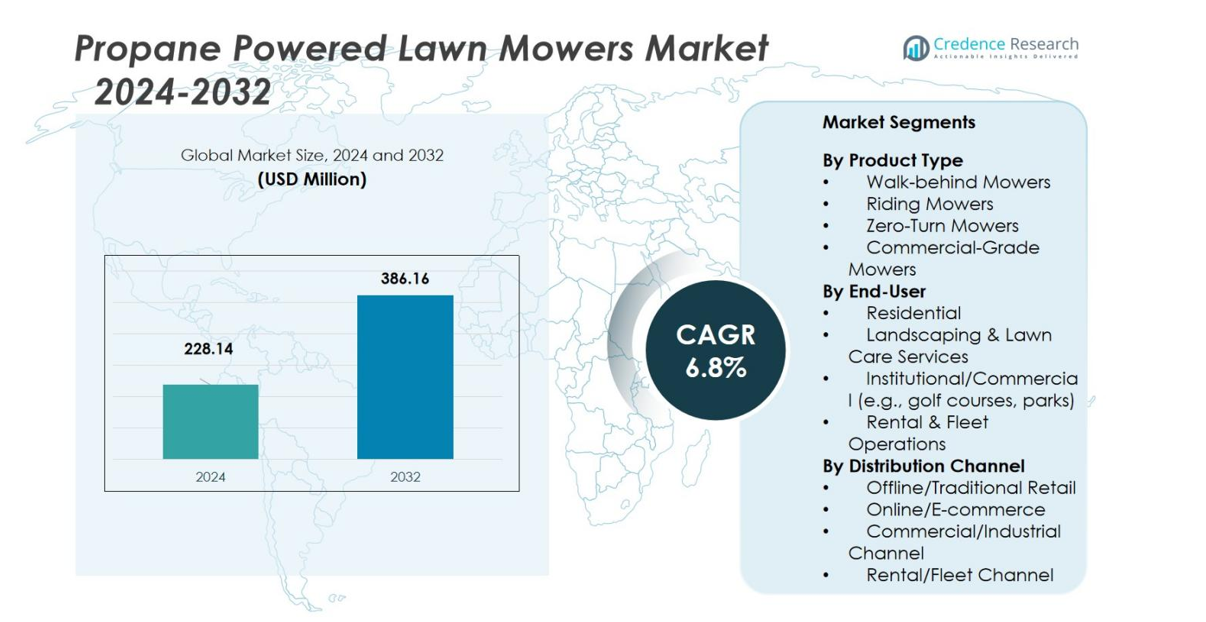
The Propane Powered Lawn Mowers Market size was valued at USD 228.14 Million in 2024 and is anticipated to reach USD 386.16 Million by 2032, at a CAGR of 6.8% during the forecast period.
| REPORT ATTRIBUTE |
DETAILS |
| Historical Period |
2020-2023 |
| Base Year |
2024 |
| Forecast Period |
2025-2032 |
| Propane Powered Lawn Mowers Market Size 2024 |
USD 228.14 Million |
| Propane Powered Lawn Mowers Market, CAGR |
6.8% |
| Propane Powered Lawn Mowers Market Size 2032 |
USD 386.16 Million |
The Propane Powered Lawn Mowers Market is dominated by key players such as Honda Motor Co., Toro Company, Briggs & Stratton Corporation, MTD Products, and Husqvarna Group, who drive the market with their innovative product offerings and strong brand presence. These companies lead the market through continuous advancements in engine efficiency, fuel consumption, and emission reductions, aligning with the increasing demand for eco-friendly lawn care solutions. North America holds the largest share of the market at 55% in 2024, driven by stringent environmental regulations and a high preference for sustainable lawn care solutions. Europe follows with a market share of 25%, supported by similar regulatory trends and consumer demand for low-emission equipment. The market is further expanding in regions like Asia-Pacific, where growing urbanization and environmental consciousness are fostering adoption of propane-powered mowers.
Market Insights
- The Propane Powered Lawn Mowers Market was valued at USD 228.14 Million in 2024 and is anticipated to reach USD 386.16 Million by 2032, growing at a CAGR of 6.8% during the forecast period.
- The increasing consumer awareness of environmental sustainability and stricter emission regulations are driving the market’s growth, particularly in residential and commercial sectors.
- A key trend is the growing adoption of propane-powered mowers due to their lower emissions and eco-friendly appeal, which is gaining traction in both developed and emerging markets.
- The market faces challenges from the high initial cost of propane mowers compared to gasoline models and limited propane refueling infrastructure in certain regions.
- North America leads the market with 55% share, followed by Europe at 25%. The Asia-Pacific region is expected to experience rapid growth, accounting for 12% of the market share in 2024.
Access crucial information at unmatched prices!
Request your sample report today & start making informed decisions powered by Credence Research Inc.!
Download Sample
Market Segmentation Analysis:
By Product Type
The Propane Powered Lawn Mowers Market is primarily segmented into Walk-behind Mowers, Riding Mowers, Zero-Turn Mowers, and Commercial-Grade Mowers. Riding Mowers dominate this segment with a significant share, accounting for 45% of the market in 2024. This sub-segment’s growth is driven by the increasing demand for efficient lawn care solutions, especially for larger residential properties and commercial use. Riding mowers offer high productivity and comfort, making them popular among homeowners with larger lawns and landscaping services. The adoption of propane-powered models in this category is also fueled by eco-conscious consumer preferences.
- For instance, Exmark Manufacturing developed propane-powered commercial riding mowers featuring a propane-dedicated EFI engine by Kohler, delivering improved fuel efficiency and reliable start-up performance favored by large commercial landscapers.
By End-User
The End-User segment includes Residential, Landscaping & Lawn Care Services, Institutional/Commercial (e.g., golf courses, parks), and Rental & Fleet Operations. The Residential segment holds the largest share, representing 40% of the market in 2024. This dominance is driven by a growing number of eco-conscious homeowners seeking environmentally friendly alternatives to gasoline-powered mowers. The trend toward propane adoption in residential areas is bolstered by the ease of use, lower emissions, and cost-effectiveness of propane-fueled mowers, making them a preferred choice for homeowners maintaining medium to large lawns.
- For instance, AmeriGas, the largest propane supplier in the U.S., which supports landscaping businesses nationwide with propane tank refill, exchange, and installation services.
By Distribution Channel
The Distribution Channel segment includes Offline/Traditional Retail, Online/E-commerce, Commercial/Industrial Channel, and Rental/Fleet Channel. Offline/Traditional Retail dominates with a market share of 50% in 2024. This dominance is attributed to the established presence of brick-and-mortar stores where customers can physically inspect products and receive expert advice. However, Online/E-commerce is rapidly growing, driven by the convenience of shopping from home and the increased adoption of digital platforms, projected to capture a larger market share as consumer buying habits shift toward e-commerce channels.
Key Growth Drivers
Environmental Awareness and Emission Regulations
A significant driver of growth in the propane-powered lawn mowers market is the increasing consumer awareness of environmental sustainability. Propane mowers are seen as a cleaner alternative to gasoline-powered models due to their lower emissions and reduced environmental impact. As governments globally tighten emissions regulations, particularly in North America and Europe, propane mowers gain traction. This trend is driving residential and commercial lawn care services to adopt propane-powered models to comply with stringent environmental standards, fueling market expansion.
- For instance, Exmark’s propane mowers with EFI engines achieve up to a 25% reduction in greenhouse gas emissions compared to gasoline mowers, enhancing both performance and environmental benefits.
Increased Demand for Eco-Friendly Lawn Care Solutions
The growing demand for eco-friendly lawn care solutions is another key growth driver. Consumers are increasingly prioritizing products that reduce their carbon footprint, and propane-powered mowers fit this demand by offering lower greenhouse gas emissions compared to traditional gasoline mowers. This shift is supported by the rising awareness of the environmental impact of gasoline-powered equipment, especially in suburban and residential areas. Additionally, the appeal of propane’s clean-burning properties drives adoption among environmentally-conscious homeowners and commercial landscaping services alike.
- For instance, the AmeriGas Partners, L.P. notes that propane burns cleaner than gasoline or diesel its lower carbon content reduces engine stress and yields cleaner operation with fewer maintenance demands.
Technological Advancements in Propane Engines
Technological advancements in propane engine design and efficiency are boosting the growth of propane-powered lawn mowers. Modern propane engines are more efficient, reliable, and cost-effective, making them increasingly attractive to both residential and commercial consumers. Innovations such as quieter operation, enhanced fuel efficiency, and improved power output contribute to the appeal of propane mowers. As engine technology continues to improve, the performance gap between propane and gasoline mowers narrows, resulting in broader market adoption and increased sales.
Key Trends & Opportunities
Rise of Smart and Connected Lawn Mowers
One of the emerging trends in the propane-powered lawn mowers market is the rise of smart and connected mowers. These mowers are equipped with GPS technology, Bluetooth, and app-based controls that allow users to monitor and control their lawn care equipment remotely. The integration of smart technology with propane mowers presents opportunities for growth, particularly in the residential and commercial sectors. These features improve efficiency, convenience, and user experience, which could lead to higher adoption rates among tech-savvy consumers and service providers looking to optimize their lawn maintenance operations.
- For instance, the Sunseeker X7 Series robotic mower integrates AONavi™ positioning technology, combining RTK-GNSS satellite navigation with Visual SLAM mapping.
Expanding Landscaping and Lawn Care Services
As the landscaping and lawn care services market continues to grow, it presents significant opportunities for the propane-powered lawn mowers market. Professional landscapers and lawn care providers are increasingly turning to propane mowers to meet the rising demand for sustainable services. The growth of urban green spaces, golf courses, parks, and other public spaces drives the demand for commercial-grade lawn mowers. Propane mowers’ advantages in terms of cost-effectiveness, lower emissions, and performance make them an attractive option for service providers seeking eco-friendly alternatives.
- For instance, Exmark Manufacturing Inc. partnered with Kohler to create propane-dedicated EFI engines integrated into their commercial mowers, offering improved fuel efficiency and reliability that appeal to municipal and large property landscapers.
Key Challenges
High Initial Cost and Maintenance
One of the primary challenges facing the propane-powered lawn mowers market is the higher initial cost compared to traditional gasoline-powered models. Propane mowers often have a premium price due to the specialized engine technology and infrastructure required for fueling. This cost barrier may deter budget-conscious consumers, especially in regions where gasoline mowers dominate. Furthermore, maintenance and refueling infrastructure can add to the overall operating costs, posing a challenge for widespread adoption, particularly in price-sensitive residential and commercial sectors.
Limited Availability of Propane Infrastructure
Another challenge for the propane-powered lawn mowers market is the limited availability of propane fueling stations, especially in rural and remote areas. While propane is widely used in other industries, the infrastructure required to easily access and refill propane tanks is not as widespread as gasoline refueling stations. This limits the convenience and accessibility of propane-powered mowers, particularly for users in areas without established propane infrastructure. Expanding this infrastructure is essential to overcoming this challenge and fostering greater market growth.
Regional Analysis
North America
North America dominates the Propane Powered Lawn Mowers Market, holding a market share of 55% in 2024. The growth in this region is primarily driven by stringent environmental regulations and increasing consumer demand for eco-friendly lawn care solutions. Propane-powered mowers offer a cleaner, more sustainable alternative to gasoline-powered equipment, aligning with the region’s growing environmental consciousness. Additionally, the vast number of residential lawns and the well-established landscaping services sector further fuel market demand. The U.S. remains the key market in this region, with strong support from government incentives for using low-emission equipment.
Europe
Europe holds a significant share of the Propane Powered Lawn Mowers Market, accounting for 25% in 2024. The market is expanding due to stringent emissions regulations, which are pushing both residential and commercial users to adopt greener alternatives. Propane mowers are increasingly being adopted in countries like Germany, the UK, and France, where environmental awareness is high. Additionally, the demand for sustainable solutions in urban green spaces and public parks contributes to market growth. The region’s focus on reducing carbon footprints further boosts the adoption of propane-powered mowers among consumers and businesses alike.
Asia-Pacific
The Propane Powered Lawn Mowers Market in the Asia-Pacific region is expected to grow rapidly, with a market share of 12% in 2024. The region’s expanding residential and commercial landscaping sectors, coupled with growing awareness of environmental issues, are driving demand for propane-powered lawn mowers. Countries like Japan, Australia, and South Korea lead in adoption due to their well-established lawn care culture and increasing focus on reducing carbon emissions. As urbanization increases, the demand for sustainable lawn care solutions is expected to grow, presenting significant opportunities for propane-powered equipment in the region.
Latin America & Middle East & Africa
The Propane Powered Lawn Mowers Market in Latin America and the Middle East & Africa accounts for 8% of the global market in 2024. While still emerging, the market in these regions is poised for growth due to increasing urbanization and expansion of green spaces, particularly in large cities and commercial developments. The rising focus on eco-friendly products, supported by regulatory shifts and a growing interest in sustainable landscaping, is encouraging the adoption of propane-powered mowers. However, limited infrastructure for propane refueling remains a challenge to widespread adoption in these regions.
Market Segmentations:
By Product Type
- Walk-behind Mowers
- Riding Mowers
- Zero-Turn Mowers
- Commercial-Grade Mowers
By End-User
- Residential
- Landscaping & Lawn Care Services
- Institutional/Commercial (e.g., golf courses, parks)
- Rental & Fleet Operations
By Distribution Channel
- Offline/Traditional Retail
- Online/E-commerce
- Commercial/Industrial Channel
- Rental/Fleet Channel
By Region
- North America
- Europe
- Germany
- France
- U.K.
- Italy
- Spain
- Rest of Europe
- Asia Pacific
- China
- Japan
- India
- South Korea
- South-east Asia
- Rest of Asia Pacific
- Latin America
- Brazil
- Argentina
- Rest of Latin America
- Middle East & Africa
- GCC Countries
- South Africa
- Rest of the Middle East and Africa
Competitive Landscape
The Propane Powered Lawn Mowers Market is characterized by the presence of key players such as Honda Motor Co., Toro Company, Briggs & Stratton Corporation, MTD Products, and Husqvarna Group. These companies dominate the market through their innovative product offerings, strong brand recognition, and commitment to sustainability. The competitive landscape is highly influenced by the growing consumer demand for eco-friendly lawn care solutions. Companies are focusing on technological advancements in engine efficiency, fuel consumption, and emissions reduction to stay ahead of the competition. In addition to product innovation, strategic partnerships, acquisitions, and the expansion of distribution networks are vital for market growth. The increasing emphasis on sustainable practices has led these players to invest in propane-powered mowers, capitalizing on the shift towards cleaner energy solutions in residential and commercial landscaping. Additionally, the development of hybrid models and smart technology integration is creating new growth avenues for companies in this competitive market.
Shape Your Report to Specific Countries or Regions & Enjoy 30% Off!
Key Player Analysis
- MTD Products
- Husqvarna Group
- Briggs & Stratton Corporation
- The Toro Company
- Honda Motor Co.
- Deere & Company
- Kubota Corporation
- Stanley Black & Decker, Inc.
- Robert Bosch GmbH
- AGCO Corporation
Recent Developments
- In April 2025, Stanadyne (with Katech & PERC) debuted a propane direct‑injection fuel system (up to ~200‑bar) highlighting potential use in medium‑duty engines and off‑road applications, an enabling technology for propane‑fuelled equipment including potential lawn‑care fleets.
- In September 2023, Propane Education & Research Council (PERC) entered into a partnership with Stanadyne and Katech to introduce a new direct‑injection propane engine technology for off‑road equipment, including commercial mowers
Report Coverage
The research report offers an in-depth analysis based on Product Type, End User, Distribution Channel and Region. It details leading market players, providing an overview of their business, product offerings, investments, revenue streams, and key applications. Additionally, the report includes insights into the competitive environment, SWOT analysis, current market trends, as well as the primary drivers and constraints. Furthermore, it discusses various factors that have driven market expansion in recent years. The report also explores market dynamics, regulatory scenarios, and technological advancements that are shaping the industry. It assesses the impact of external factors and global economic changes on market growth. Lastly, it provides strategic recommendations for new entrants and established companies to navigate the complexities of the market.
Future Outlook
- The adoption of propane-powered lawn mowers is expected to rise as environmental regulations tighten globally, pushing for cleaner and more sustainable lawn care solutions.
- Consumer preference for eco-friendly alternatives to gasoline-powered mowers will continue to drive market growth, especially in residential and commercial sectors.
- Technological advancements in propane engine efficiency, performance, and emission reduction will make these mowers more appealing to a wider customer base.
- The growing popularity of smart and connected lawn mowers, integrating GPS and remote control features, will open new opportunities for propane-powered models.
- Rising demand for professional landscaping services, including sustainable lawn care solutions, will increase the adoption of propane mowers in commercial settings.
- Expanding propane refueling infrastructure will enhance the convenience and accessibility of propane-powered mowers, supporting market growth in urban and suburban areas.
- Increased focus on reducing carbon footprints in both residential and institutional landscapes will contribute to stronger market penetration.
- Propane mowers will continue to gain traction in regions with well-established green spaces, such as golf courses and public parks, as eco-conscious choices become more prevalent.
- The cost of propane-powered mowers may decline over time as manufacturers optimize production processes, making them more competitive with traditional gasoline models.
- With the rise of sustainable landscaping trends, propane-powered mowers will likely become the preferred choice in markets focused on reducing emissions from lawn care equipment.



