Market Overview
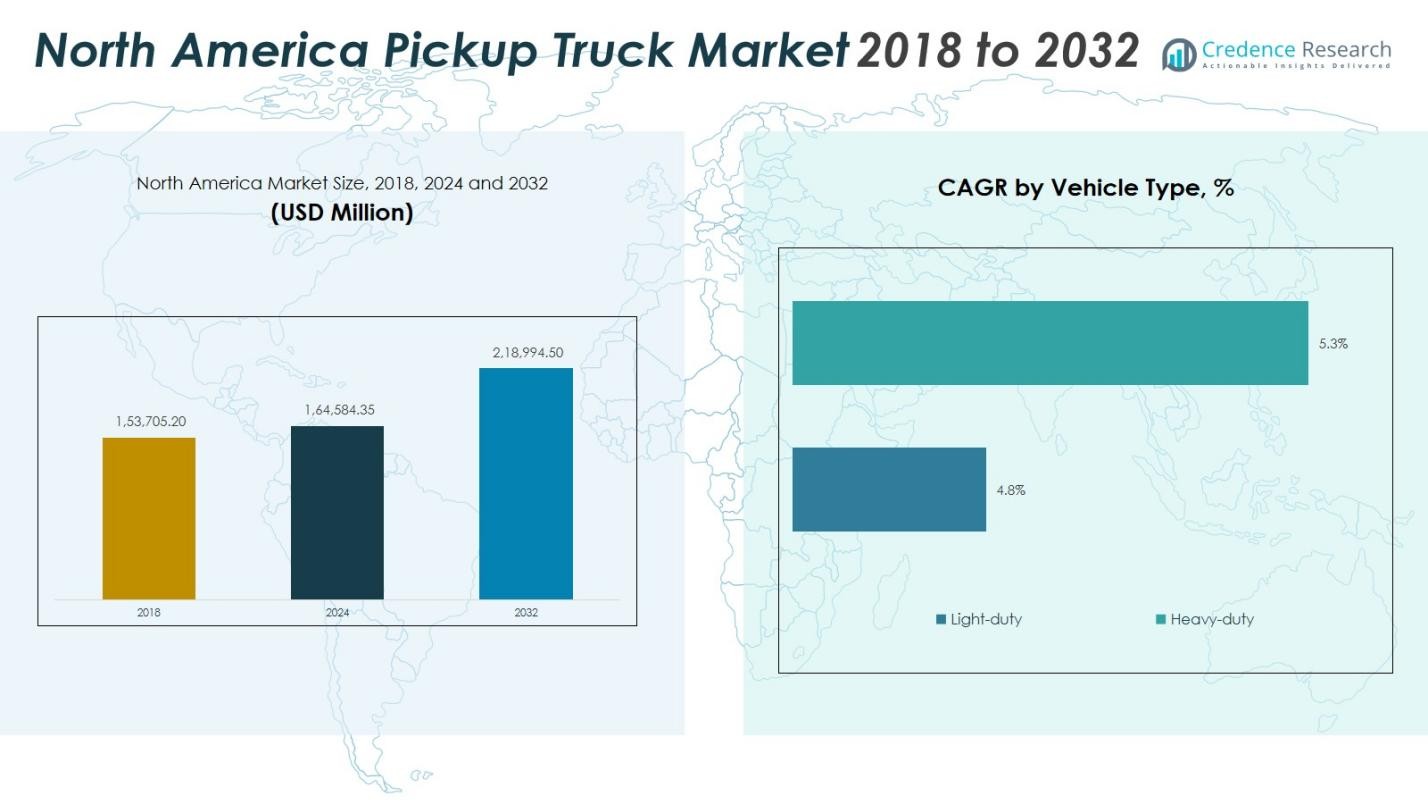
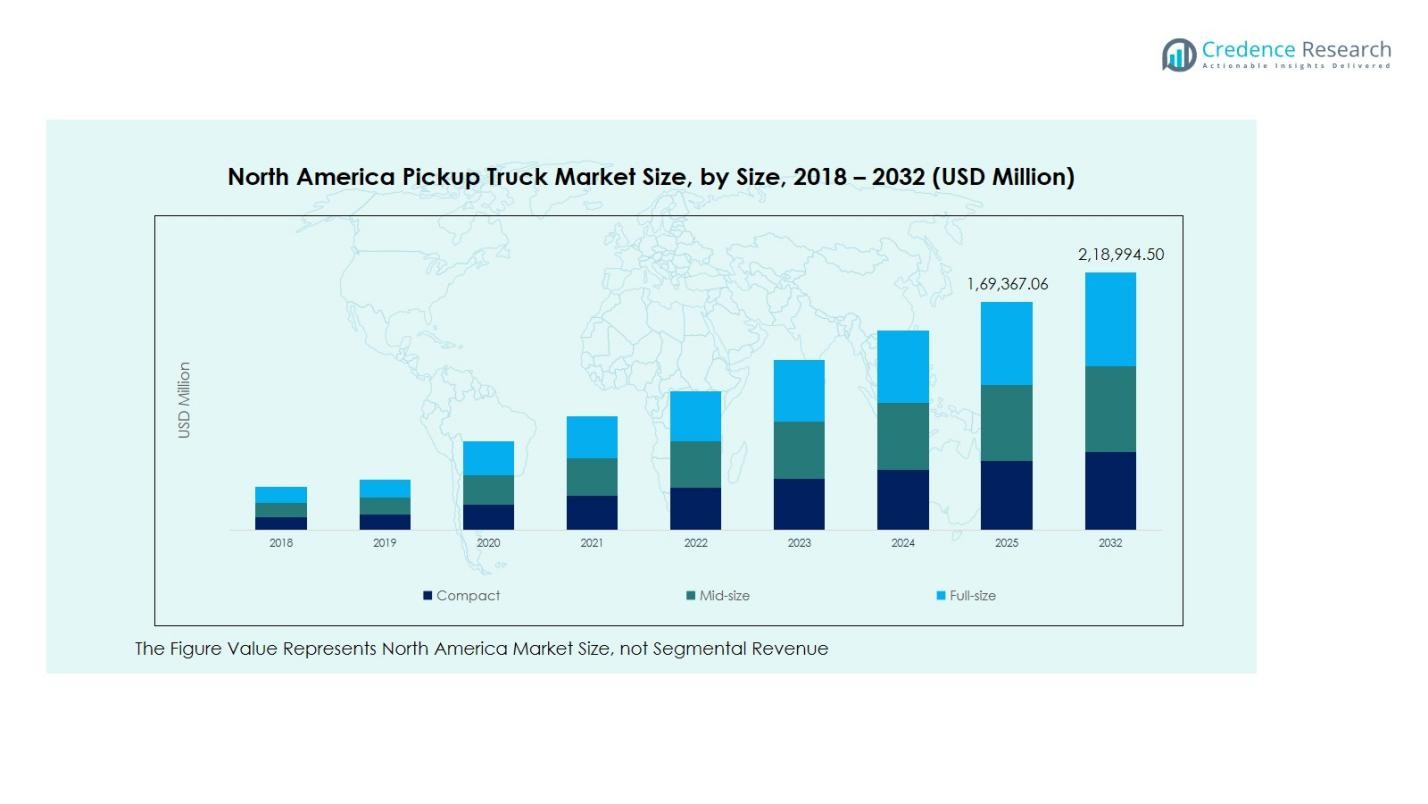
North America Pickup Truck Market size was valued at USD 153,068.30 Million in 2018 and reached USD 160,922.43 Million in 2024. It is anticipated to reach USD 213,523.81 Million by 2032, at a CAGR of 3.50% during the forecast period.
| REPORT ATTRIBUTE | DETAILS |
|---|---|
| Historical Period | 2020-2023 |
| Base Year | 2024 |
| Forecast Period | 2025-2032 |
| North America Pickup Truck Market Size 2024 | USD 160,922.43 Million |
| North America Pickup Truck Market, CAGR | 3.50% |
| North America Pickup Truck Market Size 2032 | USD 213,523.81 Million |
North America Pickup Truck Market is led by prominent manufacturers including Ford Motor Company, General Motors, Stellantis N.V. (Ram Trucks), Toyota Motor Corporation, Nissan Motor Co., Ltd., Tesla, Inc., and Rivian Automotive, Inc., who continue to set industry benchmarks through innovation and brand loyalty. Ford’s F-Series maintains a strong lead, while GM’s Chevrolet Silverado and Ram 1500 models hold substantial market positions across both commercial and personal segments. The U.S. remains the dominant region with a 78.4% market share in 2024, reflecting strong consumer demand for full-size and light-duty models. Advancements in electrification, hybrid powertrains, and connectivity are propelling market growth, with companies like Tesla and Rivian accelerating the shift toward electric pickups. Ongoing infrastructure development and fleet electrification initiatives are further enhancing market penetration across urban and suburban areas, reinforcing the region’s technological and economic leadership in the pickup truck sector.
Market Insights
- The North America Pickup Truck Market is valued USD 160,922.43 Million in 2024 and is projected to grow at a CAGR of 3.50% through 2032.
- Growing consumer and commercial demand for light-duty pickups, holding 62.5% segment share, is driven by versatility, fuel efficiency, and expanding use in urban and suburban logistics.
- Electric pickup adoption is rising, supported by models like the Ford F-150 Lightning and Rivian R1T, with the electric segment gaining momentum and expected to significantly expand over the forecast period.
- Leading players such as Ford, General Motors, and Stellantis maintain strong market positions through product innovation, brand dominance, and expanding EV offerings, while new entrants like Tesla challenge traditional leaders.
- The United States dominates the regional landscape with a 78.4% share in 2024, followed by Canada at 13.8% and Mexico at 7.8%, reflecting differences in infrastructure, vehicle preferences, and industrial activity.
 Market Segmentation Analysis:
By Vehicle Type
The light-duty segment dominates the North America Pickup Truck Market, accounting for 62.5% of the market share in 2024. This segment’s growth is driven by rising consumer demand for versatile and fuel-efficient vehicles suitable for both personal and small-business use. Additionally, advancements in comfort features and safety technologies have increased adoption among urban consumers. The heavy-duty sub-segment, while smaller, is gaining traction due to expansion in construction, logistics, and oil & gas operations, but currently holds a 37.5% share.
- For instance, the Ram1500 features a multifunction tailgate, adaptive cruise control, and available air suspension, enhancing both comfort and versatility for urban and suburban users. These innovations have contributed to its popularity, especially among buyers seeking a blend of utility and luxury in a light-duty platform.
By Application
The commercial application segment leads the market with a 48.7% share in 2024, driven by strong demand from industries like logistics, construction, and utility services. The need for high payload capacities and towing strength supports its dominance. The personal segment, with a 30.2% share, is steadily growing due to lifestyle preferences and the popularity of premium pickup models for leisure. The industrial application accounts for 15.6% share, primarily driven by mining and energy sectors, while the ‘others’ category holds 5.5%.
- For instance, Mahindra Logistics operates a fleet of over 15,000 vehicles optimized for full truck load transportation, supporting efficient logistics and construction supply chains.
By Fuel Type
The diesel segment remains the dominant fuel type, commanding 57.8% of the market share in 2024, largely due to superior torque, fuel efficiency, and towing capacity critical for commercial and industrial operations. The petrol segment accounts for 32.4% share, sustained by lower initial vehicle costs and broader adoption in the personal-use segment. The electric sub-segment, though currently representing only 9.8%, is rapidly emerging, driven by rising environmental mandates, tax incentives, and launches of models like the Ford F-150 Lightning and Rivian R1T.
Key Growth Drivers
Rising Demand for Versatile Utility Vehicles
The increasing need for vehicles that balance commercial utility with personal convenience is a major growth driver in the North America Pickup Truck Market. Light-duty models are particularly popular among small businesses and individual consumers, offering strong payload capacity and towing capabilities. This flexibility, combined with improved comfort and safety features, has expanded the market beyond traditional work-use scenarios. The trend is supported by rising urban and suburban lifestyles, allowing pickups to serve dual purposes for work and leisure.
- For instance, the 2025 Ford F-150 with its 3.5L PowerBoost Full Hybrid V6 delivers an impressive towing capacity of up to 11,200 lbs and a payload capacity of 1,750 lbs, integrating electrification with strong torque and efficiency.
Expansion of E-Commerce and Logistics Sector
The growth of e-commerce and logistics is fueling significant demand for pickup trucks, particularly in last-mile delivery and field service operations. Fleet operators prefer pickups for their cargo capacity, durability, and adaptability to varied terrains. This rising demand is especially prominent in sectors such as construction, utilities, and maintenance, where trucks play an essential role. Companies are increasingly investing in customized pickup fleets, boosting sales across both light-duty and heavy-duty categories and enhancing demand for fleet management services.
- For instance, Ford partnered with delivery company Hermes in London to pilot a last-mile delivery system using Ford electric Transit vans, achieving three times the efficiency compared to traditional methods.
Technological Advancements and Electrification
Automakers are integrating next-generation technologies into pickup designs, including advanced driver-assistance systems, connectivity features, and electrified powertrains. Electric pickup models like the Tesla Cybertruck and Ford F-150 Lightning are reshaping buyer expectations and addressing sustainability goals. Enhanced fuel efficiency, lower emissions, and innovative payload management systems are further accelerating adoption. Investments in battery technology and charging infrastructure are making electric pickups more viable for both commercial and personal usage, driving long-term market growth.
 Key Trends & Opportunities
Shift Toward Electric and Hybrid Pickups
One of the most prominent trends in the North America Pickup Truck Market is the surge in electric and hybrid truck development. Major manufacturers are not only introducing all-electric models but also offering hybrid variants to build consumer trust. This opens opportunities for growth in environmentally conscious fleet operations and government-backed projects. The shift toward electric pickups aligns with emissions regulations and increasing fuel prices, creating a sizeable opportunity for new entrants and technology innovators in the market.
- For instance, Volvo Trucks North America has delivered 70 Volvo VNR Electric trucks to various fleets under a $21.5 million EPA-backed initiative, advancing zero-emission options in medium and heavy-duty truck segments.
Customization and Aftermarket Growth
There is a rising trend toward highly customized pickups to meet diverse consumer and business needs. From performance upgrades to enhanced interior features, customers are spending more on personalization, which drives the growth of the aftermarket ecosystem. Companies are expanding accessory lines, offering value-added services, and targeting niche segments such as off-road enthusiasts and luxury buyers. This trend creates opportunities for specialized parts manufacturers and service providers, enhancing profitability beyond initial vehicle sales.
- For instance, the electric pickup Slate offers over 100 accessories that allow owners to transform the vehicle from a 2-seat pickup into a 5-seat SUV or even an open-air roadster, with options for custom wraps and 3D printed parts, promoting a unique DIY personalization experience.
Key Challenges
Stringent Emissions Regulations and Costs
Increasingly stringent emissions standards across North America pose a significant challenge to traditional internal combustion pickup trucks. These regulations demand costly upgrades in engine technologies and emissions control systems, raising production costs. Compliance increases pressure on manufacturers, especially for diesel-powered models that dominate the commercial segment. Failure to comply risks fines and restricted sales, prompting companies to accelerate investments in alternative powertrains that may not yet offer comparable capabilities or margins.
High Ownership and Maintenance Costs
The overall cost of owning pickup trucks, including maintenance, fuel, insurance, and repairs, remains a barrier to wider adoption, especially among individual consumers and small businesses. Larger models, while capable, require more expensive servicing and consume more fuel. Electric models, while potentially reducing operating costs, involve high upfront prices and depend on a growing but still limited charging network. These factors can hinder adoption in budget-sensitive markets and slow down replacement cycles for existing fleet owners.
Regional Analysis
United States
The United States dominates the North America Pickup Truck Market with a market share of 78.4% in 2024, driven by strong cultural affinity for pickups and extensive use across commercial, industrial, and recreational applications. High demand for full-size and light-duty pickups from brands like Ford, Chevrolet, and Ram fuels this growth. The U.S. market also leads in the adoption of electric pickups, supported by incentives and a growing EV charging network. Expanding construction and e-commerce sectors further boost fleet demand, while consumer preference for upgraded comfort and technology features supports the trend toward premium and hybrid models.
Canada
Canada holds a significant share of 13.8% in the North America Pickup Truck Market, supported by rising demand in both urban and rural regions. The market is driven by the need for robust vehicles capable of handling challenging terrains and harsh winter conditions, making mid-size and heavy-duty pickups particularly popular. Fleet expansion in mining, energy, and forestry sectors contributes to strong commercial demand. Additionally, consumer interest in lifestyle-oriented models and off-road capabilities is increasing, with brands like Toyota and GMC gaining traction. Government EV incentives are gradually promoting electric pickup adoption in urban centers.
Mexico
Mexico represents 7.8% of the North America Pickup Truck Market in 2024, impacted by growing industrialization and increased infrastructure spending. The country serves as a major production hub for global OEMs, with models manufactured locally for both domestic and export markets. Light-duty pickups dominate consumer and commercial preferences, especially in logistics and agriculture. Demand for diesel variants remains high due to efficiency in long-distance and heavy-load operations. While electric vehicle penetration is low, improving road infrastructure and rising adoption in urban areas offer long-term potential for EV and hybrid pickups across the country.
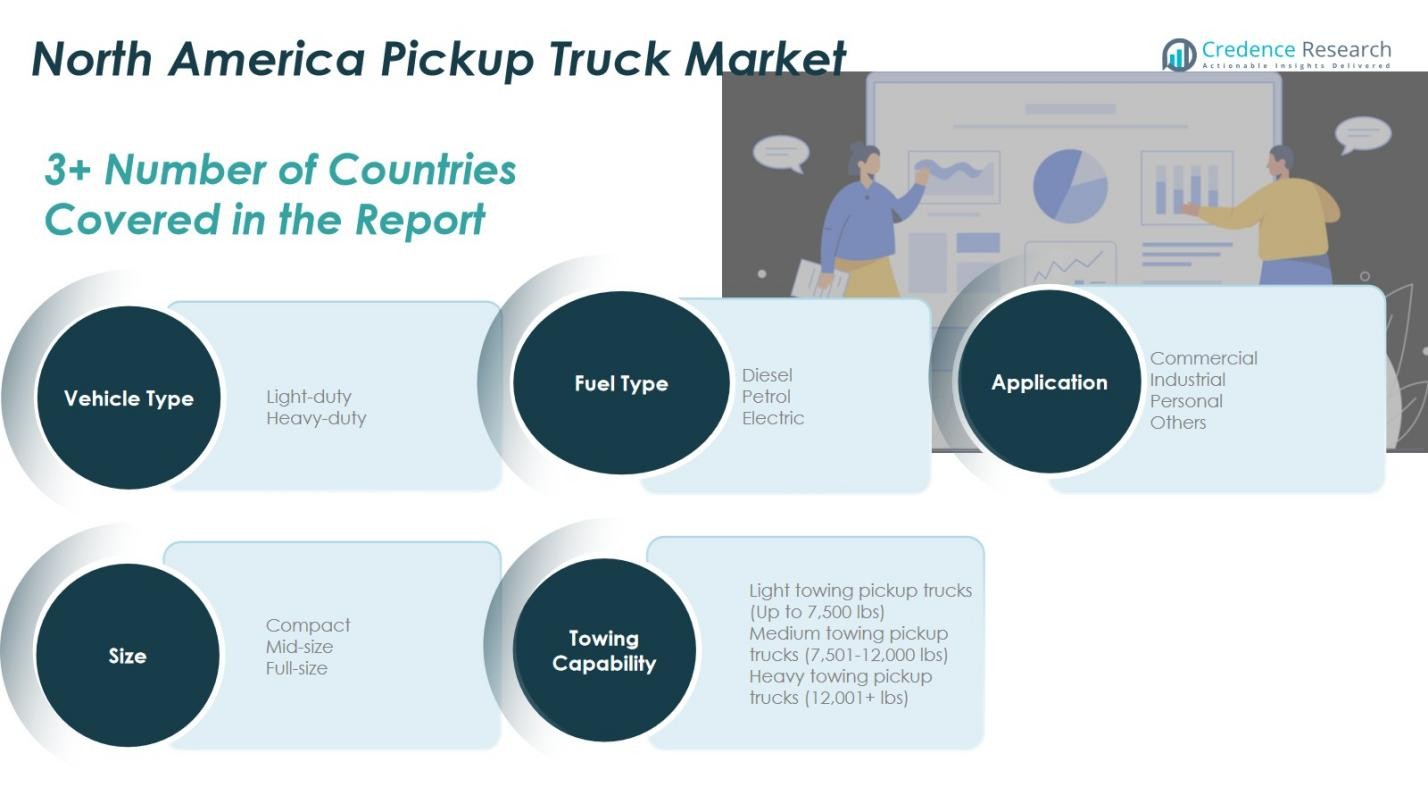
Market Segmentations:
By Vehicle Type:
- Light-duty
- Heavy-duty
By Application:
- Commercial
- Industrial
- Personal
- Others
By Fuel Type:
- Diesel
- Petrol
- Electric
By Size:
- Compact
- Mid-size
- Full-size
By Towing Capability:
- Light towing pickup trucks (Up to 7,500 lbs)
- Medium towing pickup trucks (7,501–12,000 lbs)
- Heavy towing pickup trucks (12,001+ lbs)
By Region:
- U.S.
- Canada
- Mexico
 Competitive Landscape
Competitive landscape in the North America Pickup Truck Market is shaped by major key players including Ford Motor
Company, General Motors, Stellantis N.V. (Ram Trucks), Toyota Motor Corporation, Nissan Motor Co., Ltd., Tesla, Inc., Rivian Automotive, Inc., and Honda Motor Co., Ltd. These companies collectively dominate market dynamics through a mix of legacy leadership, product innovation, and strategic expansion. Ford and GM continue to lead with strong brand loyalty, extensive dealer networks, and robust product lineups. Stellantis (Ram) remains competitive with high-performance models, while Toyota and Nissan maintain steady market positions in mid-size pickups. Emerging players like Tesla and Rivian are reshaping the landscape with electric models and advanced technologies, appealing to eco-conscious consumers and commercial fleets transitioning to zero-emission vehicles. Innovation in towing capacity, safety features, and driver assistance systems continues to define competitive strategies, with companies adopting electrification, connectivity integration, and hybrid powertrains to secure long-term market share.
Key Player Analysis
- Ford Motor Company
- General Motors (Chevrolet, GMC)
- Stellantis N.V. (Ram Trucks)
- Toyota Motor Corporation
- Nissan Motor Co., Ltd.
- Tesla, Inc.
- Rivian Automotive, Inc.
- Honda Motor Co., Ltd.
- Hyundai Motor Company
- Lordstown Motors Corp.
- Canoo Inc.
- Bollinger Motors
Recent Developments
- In March 2025, Hyundai Motor Company and General Motors Company announced that they were in negotiations to share pickup-truck platforms and electric-van technology for North America, including GM potentially supplying Hyundai with midsize pickup trucks.
- In September 2025, Ram (a brand of Stellantis N.V.) officially decided to discontinue development of its fully electric full-size pickup, citing weak demand in North America, and instead shift focus to a range-extended hybrid version.
- In September 2025, Hyundai Motor Company confirmed plans to launch a body-on-frame mid-size pickup truck in North America before 2030, targeting models such as the Toyota Tacoma and Ford Ranger.
Report Coverage
The research report offers an in-depth analysis based on Vehicle Type, Application, Fuel Type, Size, Towing Capability and Region. It details leading market players, providing an overview of their business, product offerings, investments, revenue streams, and key applications. Additionally, the report includes insights into the competitive environment, SWOT analysis, current market trends, as well as the primary drivers and constraints. Furthermore, it discusses various factors that have driven market expansion in recent years. The report also explores market dynamics, regulatory scenarios, and technological advancements that are shaping the industry. It assesses the impact of external factors and global economic changes on market growth. Lastly, it provides strategic recommendations for new entrants and established companies to navigate the complexities of the market.
Future Outlook
- Electric pickup trucks will gain significant traction as major automakers expand EV product portfolios and charging infrastructure improves.
- Hybrid powertrains will become increasingly common as a transitional step toward full electrification in commercial and personal fleets.
- Advanced connectivity and autonomous driving features will become standard, enhancing safety, navigation, and fleet management.
- Light-duty segments will continue to dominate due to versatility and growing demand from both commercial and personal users.
- Rising fuel efficiency standards will drive innovation in lightweight materials and powertrain technologies.
- Demand for customized and aftermarket upgrades will grow, particularly in off-road and lifestyle-oriented vehicles.
- Fleet electrification initiatives from government and private sectors will accelerate adoption of electric models.
- Increased competition from new entrants in the EV segment will pressure traditional manufacturers to innovate faster.
- Commercial and industrial applications will continue to expand with infrastructure investments and economic growth.
- Environmental regulations will reshape product strategies, driving development of cleaner and more efficient models.

Request a Free Sample
Fill in your details and we'll send you a free sample report.
- Sample data tables & charts
- Research methodology
Need a Custom Version of This Report?
Tailor the scope, geography, or segments to your exact requirements.
- Custom geography or segment scope
- Direct access to our analyst team
Frequently Asked Questions
What is the current market size for North America Pickup Truck Market, and what is its projected size in 2032?
At what Compound Annual Growth Rate is the North America Pickup Truck Market projected to grow between 2025 and 2032?
Which North America Pickup Truck Market segment held the largest share in 2024?
What are the primary factors fueling the growth of the North America Pickup Truck Market?
Who are the leading companies in the North America Pickup Truck Market?
Which region commanded the largest share of the North America Pickup Truck Market in 2024?
Table of Content
Chapter 1 Market Segmentation
- 1.1 Segmentation Framework
- 1.1.1 Product and Service Classification
- 1.1.2 Application and End-Use Classification
- 1.1.3 Technology and Solution Classification
- 1.1.4 Customer and Distribution Channel Classification
- 1.1.5 Geographic Segmentation
- 1.1.6 Market Segment Definitions and Boundaries
Chapter 2 Introduction
- 2.1 Report Objectives and Scope
- 2.2 Product Definition and Industry Terminology
- 2.3 Market Inclusions and Exclusions
- 2.4 Research Process
- 2.4.1 Primary Research and Expert Interviews
- 2.4.2 Secondary Research and Source Review
- 2.4.3 Top-Down and Bottom-Up Estimation
- 2.4.4 Data Triangulation and Verification
- 2.5 Market Size Measurement Basis
- 2.5.1 2024: USD 160,922.43 Million → 2032: USD 213,523.81 Million
- 2.6 Historical and Forecast Reference Periods
- 2.6.1 Base Year: 2024
- 2.6.2 Forecast Period: 2024-2032
- 2.7 Research Assumptions and Limitations
Chapter 3 Executive Summary
- 3.1 Market Snapshot and Key Findings
- 3.2 Base-Year Market Size, 2024
- 3.3 Forecast Market Size, 2032
- 3.4 Revenue and Volume Growth Outlook
- 3.5 Key Demand and Supply Indicators
- 3.6 Leading Market Segments
- 3.7 Fastest-Growing Market Opportunities
- 3.8 Regional Performance Highlights
- 3.9 Technology and Industry Transformation
- 3.10 Competitive Landscape Summary
- 3.11 Analyst View and Strategic Implications
Chapter 4 North America Pickup Truck Market Trends and Developments
- 4.1 Historical Industry Development
- 4.2 Recent Market Trends and Developments
- 4.3 Demand and Customer Behavior Trends
- 4.4 Technology and Product Innovation
- 4.5 Artificial Intelligence, Automation and Digitalization
- 4.6 Local Manufacturing and Supply Chain Realignment
- 4.7 Industry Partnerships, Mergers and Acquisitions
- 4.8 Sustainability and Circular Economy Developments
- 4.9 Government and Private Sector Investment Trends
- 4.10 Emerging Business Models and Commercialization
- 4.11 Industry Developments and Announcements
Chapter 5 North America Pickup Truck Market Production, Supply and Demand Analysis
- 5.1 Demand Trend and Consumption Analysis
- 5.2 Demand Forecast, 2024-2032
- 5.3 Production and Output Trend
- 5.4 Production and Output Forecast, 2024-2032
- 5.5 Installed Capacity and Capacity Utilization
- 5.6 Company-Wise Production Plants and Statistics
- 5.6.1 Installed Production Capacity
- 5.6.2 Actual Production
- 5.6.3 Planned Capacity and Expansion Targets
- 5.7 Supply Chain Structure and Procurement Trends
- 5.8 Supply-Demand Gap and Bottlenecks
- 5.9 Import Dependence and Sourcing Structure
- 5.10 Contract Manufacturing and Outsourcing
- 5.11 Regional Supply and Demand Concentration
Chapter 6 North America Pickup Truck Market Pricing Analysis
- 6.1 Pricing Structure and Measurement
- 6.2 Historical Pricing Trends
- 6.3 Pricing Outlook, 2024-2032
- 6.4 Average Selling Price and Unit Economics
- 6.5 Pricing by Product and Market Segment
- 6.6 Geographic Pricing Differences
- 6.7 Key Input, Energy, Labor and Logistics Costs
- 6.8 Contract Pricing and Purchasing Models
- 6.9 Pricing Sensitivity and Competitive Positioning
- 6.10 Price, Margin and Profitability Implications
Chapter 7 North America Pickup Truck Market Dynamics
- 7.1 Market Growth Drivers
- 7.1.1 Demand-Side Drivers
- 7.1.2 Technology and Innovation Drivers
- 7.1.3 Infrastructure and Investment Drivers
- 7.1.4 Regulatory and Policy Drivers
- 7.2 Market Restraints
- 7.2.1 Cost and Affordability Constraints
- 7.2.2 Technology and Adoption Barriers
- 7.2.3 Supply Chain and Operational Constraints
- 7.3 Market Challenges
- 7.3.1 Competitive Pressure and Margin Erosion
- 7.3.2 Skills, Infrastructure and Implementation Gaps
- 7.4 Emerging Market Opportunities
- 7.5 Market Dynamics Impact and Time-Horizon Assessment
Chapter 8 North America Pickup Truck Value Chain Analysis
- 8.1 Industry Value Chain Overview
- 8.2 Upstream Suppliers and Critical Inputs
- 8.3 Technology and Component Providers
- 8.4 Manufacturing or Service Delivery
- 8.5 Distribution, Channel Partners and Integrators
- 8.6 Downstream Applications and End Users
- 8.7 Value Addition and Profit Pools
- 8.8 Vertical Integration and Outsourcing
- 8.9 Supplier Concentration and Risk
- 8.10 Supply Chain Localization and Resilience
Chapter 9 North America Pickup Truck Market Regulations and Policies
- 9.1 Relevant Laws, Standards and Compliance Frameworks
- 9.2 Product, Service, Safety and Quality Requirements
- 9.3 Government Policies, Incentives and Subsidies
- 9.4 Imports, Exports and Trade Barriers
- 9.5 Public Procurement and Local Content Requirements
- 9.6 Environmental and Sustainability Compliance
- 9.7 Upcoming Policy Changes and Market Implications
Chapter 10 North America Pickup Truck Market Hotspots and Opportunities
- 10.1 Market Opportunity Mapping and Growth Hotspots
- 10.2 High-Growth Applications and Customer Groups
- 10.3 Underserved Markets and White-Space Opportunities
- 10.4 Emerging Technology and Product Opportunities
- 10.5 New Capacity and Investment Hotspots
- 10.6 Market Entry and Expansion Opportunities
- 10.7 Distribution and Partnership Opportunities
- 10.8 Near-Term and Long-Term Commercial Potential
- 10.9 Opportunity Attractiveness and Execution Risks
Chapter 11 North America Pickup Truck Market Outlook, 2024-2032
- 11.1 Market Size and Analysis
- 11.1.1 Revenue (Market Measurement: 2024: USD 160,922.43 Million → 2032: USD 213,523.81 Million)
- 11.1.2 Market Volume and Quantity Sold
- 11.1.3 Historical Market Size
- 11.1.4 Base-Year Market Size, 2024
- 11.2 Market Forecast, 2024-2032
- 11.2.1 Revenue Forecast to 2032
- 11.2.2 Volume Forecast to 2032
- 11.2.3 CAGR and Year-on-Year Growth
- 11.2.4 Incremental Revenue Opportunity
- 11.3 Forecast Assumptions and Scenario Analysis
- 11.3.1 Base-Case Forecast
- 11.3.2 Optimistic and Conservative Scenarios
- 11.3.3 Technology, Pricing and Policy Sensitivities
- 11.4 Market Attractiveness and Growth Outlook
Chapter 12 North America Pickup Truck Market Segmentation and Outlook
- 12.1 Segmentation Summary and Market Shares, 2024
- 12.2 Largest and Fastest-Growing Segments
- 12.3 Segment Growth Comparison
- 12.4 Segment Attractiveness and Priority Matrix
Chapter 13 North America Pickup Truck Geographic Market Outlook, 2024-2032
- 13.1 Regional Market Size and Country-Level Shares, 2024
- 13.2 Country Market Size Comparison, 2024
- 13.3 Country Market Forecasts, 2024-2032
- 13.4 Subregional Industrial and Demand Clusters
- 13.5 Intra-Regional Pricing and Cost Differences
- 13.6 Cross-Border Trade and Supply Networks
- 13.7 Regional Supply and Demand Balances
- 13.8 Country Opportunity Comparison and Prioritization
Note: Every listed country is covered on the structure shown under the first country.
Chapter 14 North America Pickup Truck Technology, Innovation and Sustainability Outlook
- 14.1 Technology Landscape and Maturity
- 14.2 Product, Process and Service Innovation
- 14.3 AI, Automation and Digital Tools in the Industry
- 14.4 Technology Adoption and Performance Benchmarking
- 14.5 Innovation Pipeline and R&D Investment
- 14.6 Patent and Intellectual Property Trends
- 14.7 Energy Efficiency and Resource Management
- 14.8 Sustainability, Recycling and Circularity
- 14.9 Technology Roadmap, 2024-2032
- 14.10 Risks of Obsolescence and Technology Substitution
Chapter 15 North America Pickup Truck Market Key Strategic Imperatives
- 15.1 Growth and Market Entry Priorities
- 15.2 High-Return Products and Segments
- 15.3 Pricing, Profitability and Cost Optimization
- 15.4 Technology Investment and Product Differentiation
- 15.5 Supply Chain Localization and Resilience
- 15.6 Distribution and Customer Acquisition
- 15.7 Partnership, Acquisition and Capacity Strategy
- 15.8 Regional Expansion Priorities
- 15.9 Short-, Medium- and Long-Term Actions
Chapter 16 Competition Outlook
- 16.1 Industry Competition Characteristics
- 16.2 Market Structure and Concentration
- 16.3 Market Share and Competitive Positioning, 2024
- 16.4 Company-Wise Revenue and Product Benchmarking
- 16.5 Production and Service Capacity Benchmarking
- 16.6 Technology, Pricing and Differentiation
- 16.7 Regional Footprint and Distribution Strength
- 16.8 Mergers, Acquisitions and Strategic Alliances
- 16.9 New Entrants and Competitive Threats
- 16.10 Porter's Five Forces and Industry Attractiveness
- 16.11 Competitive Outlook, 2024-2032
Chapter 17 Company Profiles
- 17.1 Company Coverage and Selection Criteria
- 17.2 Leading Market Participants – Standard Profile Structure
- 17.2.1 Business Description
- 17.2.2 Company Ownership and Geographic Presence
- 17.2.3 Product and Service Portfolio
- 17.2.4 Manufacturing and Operating Footprint
- 17.2.5 Production Capacity and Expansion Plans
- 17.2.6 Financial Performance and Investment
- 17.2.7 Market Share and Competitive Position
- 17.2.8 Technology and Innovation Capabilities
- 17.2.9 Strategic Alliances or Partnerships
- 17.2.10 Recent Developments
- 17.2.11 Growth Strategy and Outlook
- 17.3 Other Relevant Market Participants
Note: Every listed company is profiled on the structure shown under the first company. The company list is preliminary and may change based on research findings, market developments, data availability and client requirements.
Chapter 18 Disclaimer
- 18.1 Research and Forecast Disclaimer
- 18.2 Data Source and Estimation Limitations
Note: The depth of individual sections depends on data availability for this market. Volume, capacity, trade and other unit-based metrics are included where applicable.