
Market Overview:
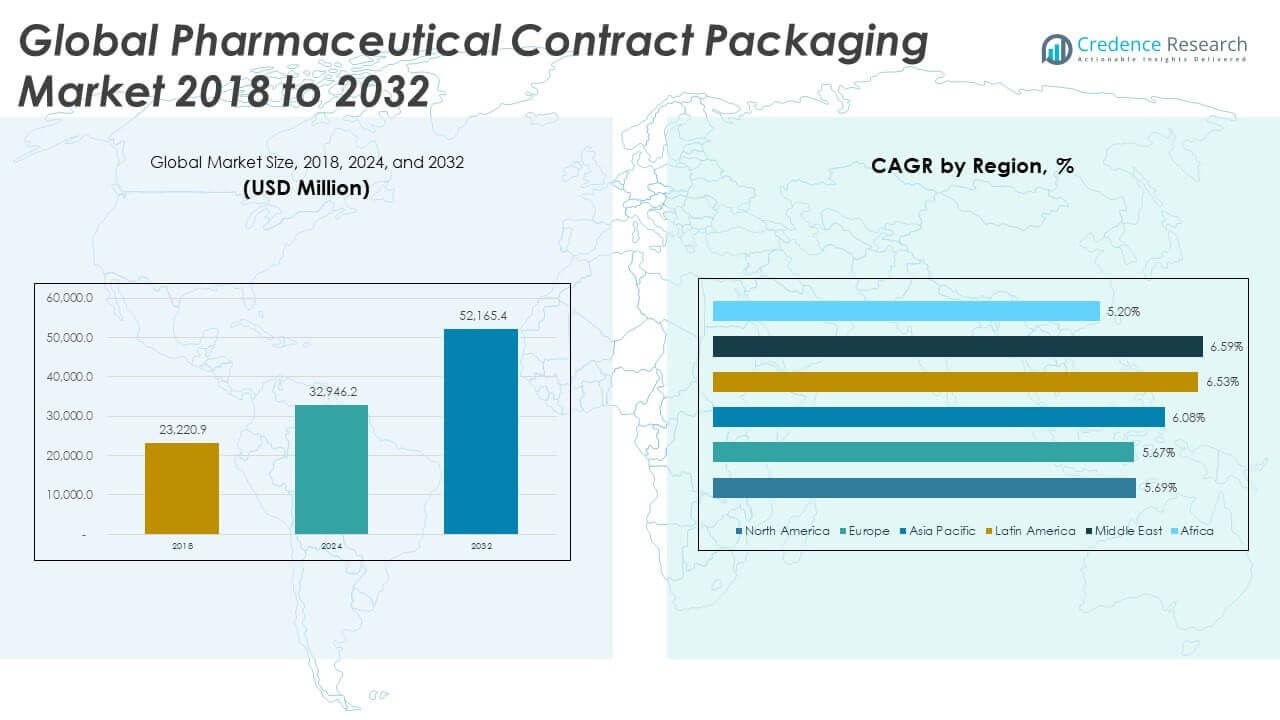
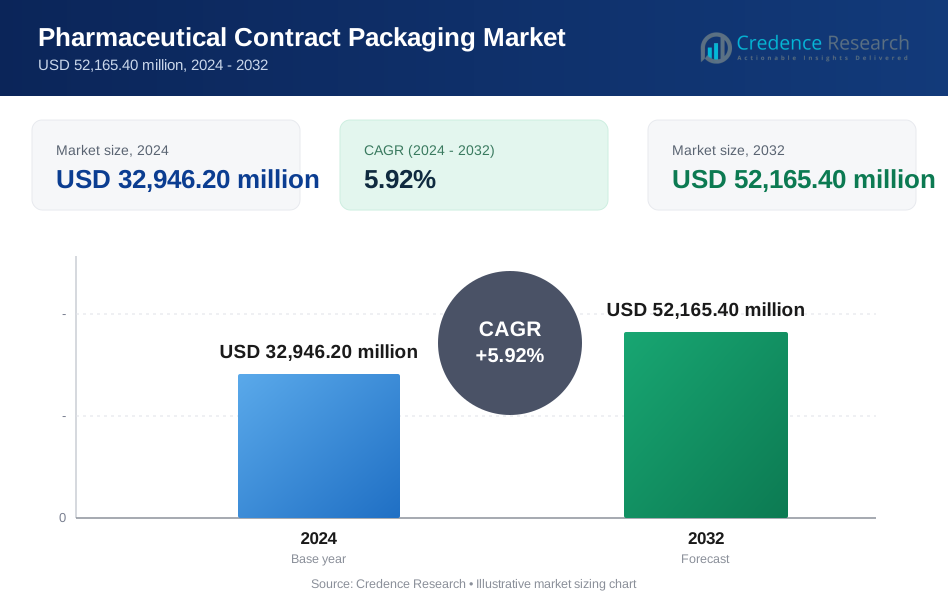
The Global Pharmaceutical Contract Packaging Market size was valued at USD 23,220.90 million in 2018 to USD 32,946.20 million in 2024 and is anticipated to reach USD 52,165.40 million by 2032, at a CAGR of 5.92% during the forecast period.
| REPORT ATTRIBUTE | DETAILS |
|---|---|
| Historical Period | 2020-2023 |
| Base Year | 2024 |
| Forecast Period | 2025-2032 |
| Pharmaceutical Contract Packaging Market Size 2024 | USD 32,946.20 million |
| Pharmaceutical Contract Packaging Market, CAGR | 5.92% |
| Pharmaceutical Contract Packaging Market Size 2032 | USD 52,165.40 million |
The market grows due to rising outsourcing by pharmaceutical manufacturers. Drug companies focus more on core research activities. Packaging partners offer speed, scale, and regulatory expertise. Complex dosage forms increase packaging needs. Demand for blister, vial, and syringe packaging continues to rise. Strict safety and labeling rules support professional packaging services. Biologics and specialty drugs need advanced handling solutions. Contract packagers invest in automation and compliance systems. These factors strengthen long-term demand across branded and generic drugs.
North America leads due to strong pharmaceutical production and strict compliance standards. The United States shows high outsourcing adoption among large drug makers. Europe follows with strong presence of contract packaging specialists. Countries like Germany and the United Kingdom drive regional demand. Asia Pacific emerges as a fast-growing region. India and China expand due to cost advantages and manufacturing scale. Latin America and the Middle East show gradual growth. Expanding healthcare access supports future regional demand.
Market Insights:
- The market was valued at USD 23,220.90 million in 2018, reached USD 32,946.20 million in 2024, and is projected to hit USD 52,165.40 million by 2032, growing at a CAGR of 5.92%.
- Asia Pacific led with about 33% share, followed by Europe at nearly 27% and North America at around 24%, driven by strong pharma manufacturing, outsourcing depth, and regulatory maturity.
- Asia Pacific remains the fastest-growing region with roughly 33% share, supported by cost advantages, high generic drug output, and expanding export-focused production.
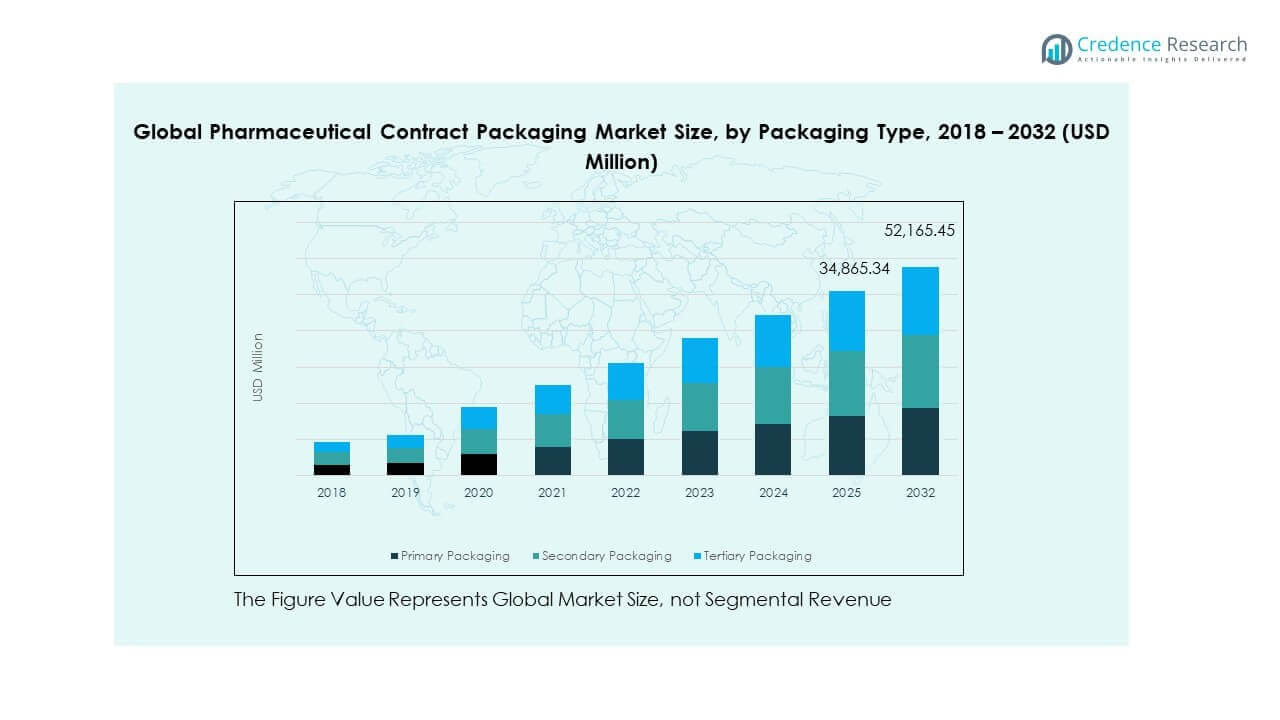
- By packaging type, secondary packaging accounted for about 42% share, while primary packaging held close to 38%, reflecting strong demand for compliance, labeling, and product protection.
- Tertiary packaging contributed nearly 20% share, supported by rising bulk distribution, logistics efficiency needs, and global pharmaceutical trade growth.
Market Drivers:
Rising Outsourcing Demand From Pharmaceutical Manufacturers
The Global Pharmaceutical Contract Packaging Market benefits from higher outsourcing across drug manufacturers. Companies aim to reduce fixed operational costs. External partners provide flexible capacity during demand shifts. It supports faster product launches across markets. Regulatory complexity pushes firms toward specialized packaging providers. These providers ensure compliance with global quality standards. Growing generic drug volumes increase packaging workloads. Contract partners help manage peak production cycles efficiently.
- For instance, Catalent operates 50+ global facilities and runs hundreds of packaging lines for oral and injectable products. Contract partners manage peak cycles efficiently. Compliance support strengthens outsourcing decisions.
Increasing Complexity Of Drug Delivery Formats And Packaging Needs
Advanced drug delivery formats raise packaging requirements. Injectables, biologics, and combination products need precision handling. It supports demand for sterile and controlled packaging services. Unit-dose and patient-centric formats gain priority. Packaging accuracy protects product stability and safety. Pharmaceutical firms prefer partners with validated processes. This driver supports steady service adoption. Technical expertise strengthens long-term outsourcing decisions.
- For instance, Lonza supports biologics with validated aseptic filling lines across multiple sites. Unit-dose formats improve patient safety. Pharmaceutical firms prefer partners with proven validation records. Technical expertise drives long-term contracts.
Stringent Regulatory And Safety Compliance Requirements
Regulatory authorities enforce strict packaging standards worldwide. Serialization and traceability rules raise compliance costs. It benefits firms with proven regulatory systems. Drug safety concerns increase scrutiny on labeling accuracy. Tamper-evident packaging becomes a standard requirement. Contract packagers invest in audit-ready facilities. Pharmaceutical companies reduce compliance risk through outsourcing. This factor drives sustained market reliance.
Growth In Global Pharmaceutical Production And Distribution Networks
Pharmaceutical production expands across multiple regions. Cross-border drug distribution raises packaging complexity. It supports demand for standardized global packaging solutions. Contract packagers manage multilingual labeling needs. They support rapid scaling across geographies. Pharmaceutical exports depend on compliant packaging formats. Supply chain efficiency improves through specialized partners. This growth supports long-term service demand.
Market Trends:
Adoption Of Serialization And Track And Trace Technologies
The Global Pharmaceutical Contract Packaging Market shows strong adoption of serialization systems. Governments mandate product traceability across supply chains. It drives investment in digital packaging infrastructure. Contract packagers deploy integrated coding systems. Data capture improves recall response capabilities. Pharmaceutical firms value real-time tracking support. This trend improves transparency across distribution networks. Technology adoption enhances partner selection criteria.
- For instance, Sharp Packaging Services confirms full compliance with EU Falsified Medicines Directive requirements, supporting end-to-end serialization across large-scale prescription packaging lines.
Shift Toward Patient-Centric And Unit-Dose Packaging Formats
Patient-centric packaging gains strong attention across markets. Unit-dose packs improve adherence and dosing accuracy. It supports blister and sachet packaging demand. Elderly and chronic patients prefer easy-use formats. Pharmaceutical brands enhance user experience through packaging design. Contract packagers offer customization capabilities. This trend supports premium service differentiation. Packaging design becomes a competitive factor.
- For instance, Catalent expanded its unit-dose blister packaging operations to support adherence-focused therapies for chronic disease management.
Increased Automation And Digital Integration In Packaging Operations
Automation expands across contract packaging facilities. Robotics improve speed and consistency in operations. It reduces error rates and manual handling risks. Digital systems support batch tracking and reporting. Pharmaceutical clients demand high process visibility. Automated inspection systems ensure quality assurance. This trend improves operational efficiency. Investment in smart packaging lines continues.
Growing Focus On Sustainable And Eco-Friendly Packaging Materials
Sustainability gains importance in pharmaceutical packaging strategies. Clients prefer reduced plastic and recyclable materials. It supports innovation in material selection. Contract packagers align with corporate sustainability goals. Lightweight packaging reduces logistics impact. Regulatory pressure supports eco-friendly practices. This trend reshapes supplier qualification standards. Environmental compliance influences long-term contracts.
Market Challenges Analysis:
Regulatory Variability And Compliance Management Across Regions
The Global Pharmaceutical Contract Packaging Market faces complex regulatory variation. Each region applies different packaging rules. It increases compliance management costs. Frequent regulatory updates require process adjustments. Smaller providers face resource limitations. Audit readiness demands constant documentation control. Pharmaceutical clients expect zero compliance gaps. This challenge affects operational scalability.
Cost Pressures And Capacity Constraints During Demand Surges
Contract packagers face rising operational costs. Labor, energy, and compliance expenses increase steadily. It pressures profit margins across services. Sudden demand surges strain available capacity. Facility expansion requires high capital investment. Skilled workforce shortages limit output growth. Clients demand short turnaround times. These factors challenge service consistency.
Market Opportunities:
Expansion Of Biologics, Specialty Drugs, And Clinical Trial Packaging
The Global Pharmaceutical Contract Packaging Market gains opportunity from biologics growth. Specialty drugs require advanced packaging expertise. It supports demand for sterile and cold-chain services. Clinical trial volumes increase across regions. Small batch packaging needs specialized handling. Contract packagers offer flexible production models. Pharmaceutical innovators prefer experienced partners. This segment supports high-value service growth.
Rising Pharmaceutical Manufacturing In Emerging Economies
Emerging markets expand pharmaceutical manufacturing capacity. India, China, and Southeast Asia show strong momentum. It creates demand for local contract packaging services. Export-oriented production increases compliance needs. Global firms seek regional packaging partners. Infrastructure investment improves service quality. Market entry barriers reduce gradually. This opportunity supports geographic expansion.
Market Segmentation Analysis:
Packaging Type
Primary packaging holds a critical role due to direct drug contact and safety needs. It supports integrity, stability, and contamination control. Secondary packaging strengthens protection, branding, and regulatory labeling. It enables efficient handling across supply chains. Tertiary packaging supports bulk movement and logistics efficiency. It improves storage safety during large-scale distribution. Demand across all three types remains steady due to compliance and scale needs.
- For instance, Amcor supplies pharmaceutical blister films with certified moisture and oxygen barrier performance for regulated drug packaging.
Packaging Format
Blister packaging leads due to dose accuracy and patient convenience. Bottles and containers support high-volume solid and liquid drugs. Sachets and pouches gain use in unit-dose and trial packs. Vials and ampoules serve injectables with strict sterility needs. Prefilled syringes grow with self-administration trends. Combination and specialty packaging supports complex therapies. Format choice depends on drug type and distribution channel.
- For instance, West Pharmaceutical Services manufactures billions of elastomer closures annually, supporting sterile injectable packaging for global pharmaceutical producers.
Dosage Form
Solid oral dosage dominates due to high prescription volumes. Liquid forms require precise sealing and leakage control. Semi-solid packaging supports topical and dermatology drugs. Injectables demand aseptic and validated packaging lines. Biologics and biosimilars require cold-chain compatible solutions. It drives demand for advanced handling expertise. Dosage diversity expands service scope for contract packagers.
End User
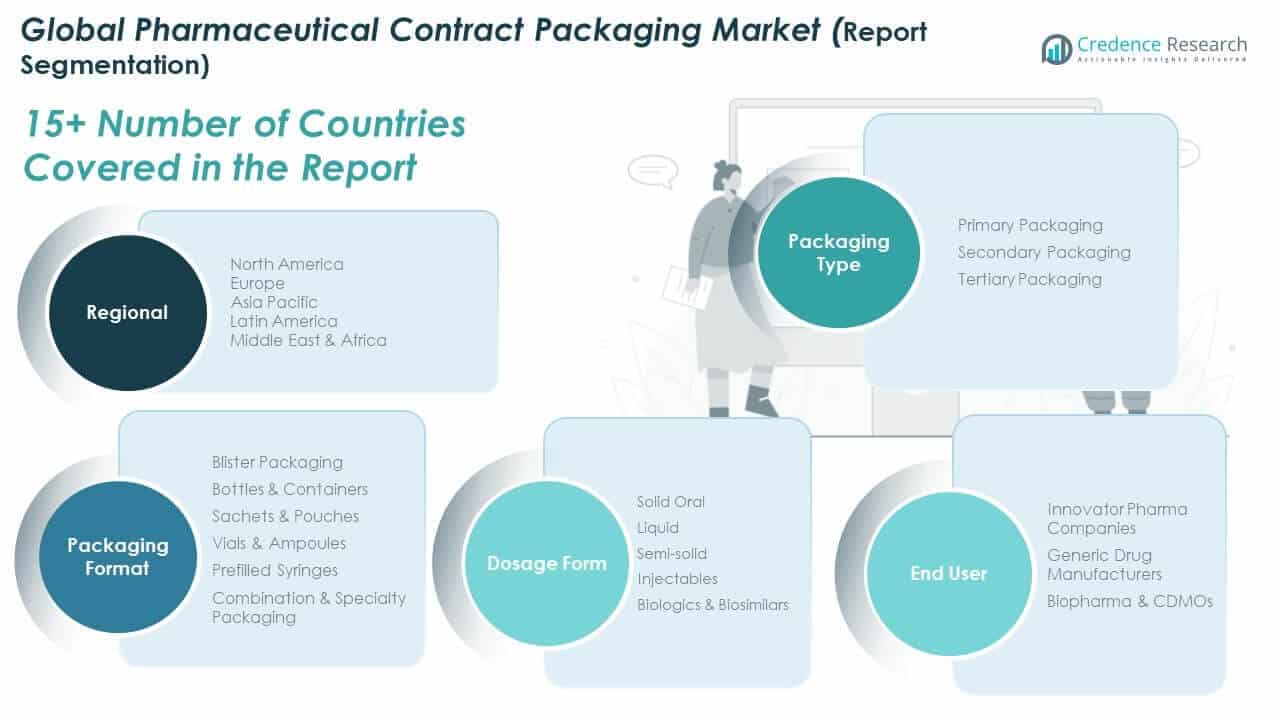
Innovator pharma companies outsource to speed launches and manage compliance. Generic drug manufacturers seek cost efficiency and scale support. Biopharma and CDMOs rely on specialized packaging partners. It supports clinical, commercial, and lifecycle needs. The Global Pharmaceutical Contract Packaging Market benefits from demand across all end users. Each group values reliability, flexibility, and regulatory strength.
Segmentation:
By Packaging Type
- Primary Packaging
- Secondary Packaging
- Tertiary Packaging
- Blister Packaging
- Bottles & Containers
- Sachets & Pouches
- Vials & Ampoules
- Prefilled Syringes
- Combination & Specialty Packaging
- Solid Oral
- Liquid
- Semi-solid
- Injectables
- Biologics & Biosimilars
- Innovator Pharma Companies
- Generic Drug Manufacturers
- Biopharma & CDMOs
- North America
- U.S.
- Canada
- Mexico
- Europe
- Germany
- France
- U.K.
- Italy
- Spain
- Rest of Europe
- Asia Pacific
- China
- Japan
- India
- South Korea
- South-east Asia
- Rest of Asia Pacific
- Latin America
- Brazil
- Argentina
- Rest of Latin America
- Middle East & Africa
- GCC Countries
- South Africa
- Rest of the Middle East and Africa
Regional Analysis:
North America
The North America Global Pharmaceutical Contract Packaging Market size was valued at USD 5,598.55 million in 2018 to USD 7,841.67 million in 2024 and is anticipated to reach USD 12,201.50 million by 2032, at a CAGR of 5.69% during the forecast period. North America held nearly 24% market share in 2024. The region benefits from advanced pharmaceutical manufacturing capacity. The United States leads due to strong outsourcing adoption. Strict regulatory frameworks increase reliance on compliant packaging partners. High biologics production supports demand for sterile packaging. Contract packagers invest in automation and traceability. Mature healthcare infrastructure supports steady service demand. Strong R&D activity sustains long-term growth.
Europe
The Europe Global Pharmaceutical Contract Packaging Market size was valued at USD 6,269.63 million in 2018 to USD 8,768.40 million in 2024 and is anticipated to reach USD 13,615.18 million by 2032, at a CAGR of 5.67% during the forecast period. Europe accounted for about 27% market share in 2024. Germany, France, and the UK lead regional demand. Strong regulatory oversight drives outsourcing preference. The region shows high adoption of serialization standards. Contract packagers support cross-border drug distribution. Biopharma activity supports specialty packaging demand. Sustainability initiatives influence material choices. Stable pharmaceutical exports support market continuity.
Asia Pacific
The Asia Pacific Global Pharmaceutical Contract Packaging Market size was valued at USD 7,586.26 million in 2018 to USD 10,858.13 million in 2024 and is anticipated to reach USD 17,391.96 million by 2032, at a CAGR of 6.08% during the forecast period. Asia Pacific held nearly 33% market share in 2024. China and India drive regional expansion. Cost advantages support outsourcing growth. Expanding generic drug production boosts packaging volumes. Regional governments invest in healthcare manufacturing. Contract packagers scale capacity rapidly. Export-focused production raises compliance needs. The region shows strong long-term momentum.
Latin America
The Latin America Global Pharmaceutical Contract Packaging Market size was valued at USD 2,034.15 million in 2018 to USD 2,990.58 million in 2024 and is anticipated to reach USD 4,955.72 million by 2032, at a CAGR of 6.53% during the forecast period. Latin America represented around 9% market share in 2024. Brazil and Mexico lead regional demand. Growing local drug manufacturing supports outsourcing. Regulatory alignment improves service adoption. Multinational firms expand regional operations. Contract packagers strengthen compliance capabilities. Healthcare access expansion supports packaging needs. The region shows rising investment interest.
Middle East
The Middle East Global Pharmaceutical Contract Packaging Market size was valued at USD 1,109.96 million in 2018 to USD 1,638.37 million in 2024 and is anticipated to reach USD 2,728.25 million by 2032, at a CAGR of 6.59% during the forecast period. The region held about 5% market share in 2024. GCC countries drive pharmaceutical investments. Local production reduces import dependence. Governments support healthcare localization programs. Contract packaging demand grows steadily. Compliance standards continue to improve. Regional hubs attract multinational partnerships. Growth remains structurally positive.
Africa
The Africa Global Pharmaceutical Contract Packaging Market size was valued at USD 622.32 million in 2018 to USD 849.07 million in 2024 and is anticipated to reach USD 1,272.84 million by 2032, at a CAGR of 5.20% during the forecast period. Africa accounted for nearly 3% market share in 2024. South Africa leads regional activity. Healthcare infrastructure development supports demand. Local manufacturing initiatives gain traction. Contract packagers focus on basic compliance services. Import substitution policies drive packaging needs. International aid supports medicine access programs. The region shows gradual but stable growth.
Key Player Analysis:
- Catalent Pharma Solutions
- Sharp Packaging Services
- PCI Pharma Services
- Thermo Fisher Scientific
- Amcor
- North East Pharma Pack
- Aptar Group
- West Pharmaceutical Services
- Berry Global
Competitive Analysis:
The Global Pharmaceutical Contract Packaging Market shows moderate consolidation with global and regional players. Leading companies compete on compliance strength, capacity scale, and service breadth. It favors firms with validated sterile and high-speed packaging lines. Strategic focus remains on reliability and turnaround speed. Players invest in automation and digital traceability tools. Strong client retention depends on audit readiness and regulatory history. Global operators leverage multi-region footprints for large pharma clients. Mid-sized firms compete through niche capabilities and flexibility. Competitive intensity remains steady across major regions.
Recent Developments:
- In October 2025, Sharp Packaging Services announced a comprehensive $100 million global investment program spanning its North American and European pharmaceutical packaging facility network. The investment demonstrates the company's confidence in sustained demand growth for injectable and oral solid dose pharmaceutical packaging services. In the United States, the investment adds sterile fill-finish capacity at the Lee, Massachusetts location, while the Allentown, Pennsylvania campus will receive new state-of-the-art pre-filled syringe assembly and labeling lines, high-speed bottling equipment for oral solid dose products, and automated pouch filling systems. The Macungie, Pennsylvania facility is doubling in size through this investment program, with new production suites for assembly, labeling, and packaging of injectables, supported by ambient warehouse space and enhanced cold storage. The Bethlehem, Pennsylvania location, which offers clinical services from preclinical through commercial stages, is being outfitted with new cold-chain storage, capsule filling machines, and additional blister packaging lines for oral solid dose products, with these capabilities anticipated to be operational by the end of 2025. In Europe, Sharp's Netherlands facility is enhancing GMP production capacity for vial labeling and injectables packaging, scheduled to come online in 2026, while Belgium is undertaking a significant warehouse expansion incorporating additional cold-chain and ambient storage alongside a new syringe blistering production suite. Additionally, Sharp established a preferred partnership with Berkshire Sterile Manufacturing (BSM) to augment its clinical manufacturing services, leveraging BSM's proprietary 100% isolator-based sterile filling technology for syringes, vials, and cartridges. With nine GMP facilities globally and over 2,500 employees, Sharp positions itself as a comprehensive partner supporting pharmaceutical clients across the entire product lifecycle.
- Thermo Fisher Scientific aggressively expanded its pharmaceutical services capabilities through strategic acquisitions in 2025. In July 2025, the company announced an agreement to acquire Sanofi's state-of-the-art sterile manufacturing facility in Ridgefield, New Jersey, with expected completion targeted for the second half of 2025. The Ridgefield facility represents a strategically valuable asset featuring world-class sterile fill-finish and pharmaceutical packaging capabilities and employing over 200 specialized personnel who will transition to Thermo Fisher's pharmaceutical services division. Under the expanded partnership arrangement, Thermo Fisher committed to continuing manufacturing of Sanofi's therapeutic portfolio while simultaneously expanding facility capacity to serve the broader pharmaceutical and biotechnology customer base seeking U.S.-based manufacturing capacity. Complementing this acquisition, Thermo Fisher completed the acquisition of Solventum's purification and filtration business in September 2025, further consolidating its laboratory and biopharma services infrastructure. These strategic acquisitions position Thermo Fisher as a comprehensive solutions provider capable of delivering integrated development, manufacturing, and analytical services to pharmaceutical customers.
- Aptar Group has pursued an aggressive acquisition and partnership strategy throughout 2025 to expand its pharmaceutical services and digital health capabilities. In July 2025, Aptar Pharma announced the acquisition of Mod3 Pharma's clinical trial materials manufacturing capabilities from SWK Holdings. This strategic acquisition significantly enhanced Aptar's early-stage drug development services, providing formulation, fill-and-finish capabilities for Phase I and Phase II clinical trials with comprehensive cGMP compliance and an FDA-inspected facility in New Jersey. The acquisition built upon an existing partnership focused on cGMP fill-and-finish services for orally inhaled and nasal drug products (OINDPs), enabling Aptar to offer accelerated pathways for new drug delivery technologies across dermal, ophthalmic, injectable, and secondary packaging applications leveraging Aptar's proprietary Active Material Science Solutions.
Report Coverage:
The research report offers an in-depth analysis based on Packaging Type and Packaging Format segments. It details leading market players, providing an overview of their business, product offerings, investments, revenue streams, and key applications. Additionally, the report includes insights into the competitive environment, SWOT analysis, current market trends, as well as the primary drivers and constraints. Furthermore, it discusses various factors that have driven market expansion in recent years. The report also explores market dynamics, regulatory scenarios, and technological advancements that are shaping the industry. It assesses the impact of external factors and global economic changes on market growth. Lastly, it provides strategic recommendations for new entrants and established companies to navigate the complexities of the market.
Future Outlook:
- Outsourcing adoption will rise among branded and generic drug manufacturers.
- Demand for sterile and biologics packaging will expand steadily.
- Automation will improve speed, accuracy, and compliance control.
- Serialization requirements will shape service selection criteria.
- Asia Pacific will attract new capacity investments.
- Sustainability goals will influence packaging material choices.
- Clinical trial packaging demand will remain strong.
- Regional contract packagers will expand service depth.
- Digital traceability will support supply chain transparency.
- Long-term contracts will favor compliant and scalable providers.
Request a Free Sample
Fill in your details and we'll send you a free sample report.
- Sample data tables & charts
- Research methodology
Need a Custom Version of This Report?
Tailor the scope, geography, or segments to your exact requirements.
- Custom geography or segment scope
- Direct access to our analyst team
Frequently Asked Questions
What is the current market size for Global Pharmaceutical Contract Packaging Market, and what is its projected size in 2032?
At what Compound Annual Growth Rate is the Global Pharmaceutical Contract Packaging Market projected to grow between 2025 and 2032?
Which Global Pharmaceutical Contract Packaging Market segment held the largest share in 2024?
What are the primary factors fueling the growth of the Global Pharmaceutical Contract Packaging Market?
Who are the leading companies in the Global Pharmaceutical Contract Packaging Market?
Which region commanded the largest share of the Global Pharmaceutical Contract Packaging Market in 2024?
Table of Content
Chapter 1. Report Introduction
- 1.1 Report Description & Purpose
- 1.1.1 Report Title & Market Definition
- 1.1.2 Unique Selling Propositions (USP) & Key Differentiators
- 1.1.3 Value Proposition for Stakeholders
- 1.2 Research Objectives
- 1.2.1 Market Sizing Objectives (Volume & Revenue)
- 1.2.2 Segmentation Objectives
- 1.2.3 Competitive Intelligence Objectives
- 1.2.4 Forecast & Scenario Objectives
- 1.3 Report Scope
- 1.3.1 Pharmaceutical Contract Packaging Scope – Types & Subtypes Covered
- 1.3.2 Geographic Scope – Regions & Countries Covered
- 1.3.3 Historical Period, Base Year & Forecast Period (2024; forecast to 2032)
- 1.3.4 Inclusions & Exclusions
- 1.4 HS Code & Classification Framework
- 1.5 Currency, Units & Pricing Basis
- 1.6 Target Stakeholders
- 1.7 Limitations & Assumptions
Chapter 2. Executive Summary
- 2.1 Global Pharmaceutical Contract Packaging Market Snapshot
- 2.1.1 Market Size – Historical (2024) & Forecast (2024-2032) (2024: USD 32,946.20 million → 2032: USD 52,165.40 million)
- 2.1.2 Volume & Revenue – Global Totals
- 2.1.3 Key Market Highlights – Top Five Facts
- 2.2 Pharmaceutical Contract Packaging Market Segmentation Snapshot
- 2.2.1 Market Split by Region – 2024 vs. 2032
- 2.3 Competitive Snapshot
- 2.3.1 Top 10 Players by Revenue Share – 2024
- 2.3.2 Top 10 Players by Volume Share – 2024
- 2.3.3 Recent Strategic Developments (18-Month Summary)
- 2.4 Key Investment Highlights & Strategic Conclusions
Chapter 3. Pharmaceutical Contract Packaging Market Dynamics & Industry Analysis
- 3.1 Market Overview & Context
- 3.1.1 Pharmaceutical Contract Packaging Market Position in the Broader Automotive Value Chain
- 3.1.2 OEM vs. Replacement Market Dynamics
- 3.1.3 Market Maturity & Development Stage by Region
- 3.2 Pharmaceutical Contract Packaging Market Drivers
- 3.3 Pharmaceutical Contract Packaging Market Restraints & Challenges
- 3.4 Pharmaceutical Contract Packaging Market Opportunities
- 3.5 Porter's Five Forces Analysis
- 3.5.1 Threat of New Entrants
- 3.5.2 Bargaining Power of Suppliers
- 3.5.3 Bargaining Power of Buyers
- 3.5.4 Threat of Substitutes
- 3.5.5 Competitive Rivalry – Intensity Assessment
- 3.6 Pharmaceutical Contract Packaging Value Chain Analysis
- 3.6.1 Upstream – Raw Material/Input Suppliers
- 3.6.1.1 Raw Material/Input 1
- 3.6.1.2 Raw Material/Input 2
- 3.6.1.3 Raw Material/Input 3
- 3.6.2 Midstream – Production/Manufacturing/Service Delivery
- 3.6.2.1 Production/Process Overview
- 3.6.2.2 Key Facility Locations & Capacity by Manufacturer
- 3.6.3 Downstream – Distribution & End Consumer
- 3.6.3.1 Primary Channel – B2B/OEM
- 3.6.3.2 Secondary Channels – Dealer, Retail, Online, Direct
- 3.6.4 Value Chain Profitability Analysis
- 3.6.1 Upstream – Raw Material/Input Suppliers
- 3.7 PESTEL Analysis
- 3.7.1 Political Factors
- 3.7.2 Economic Factors
- 3.7.3 Social Factors
- 3.7.4 Technological Factors
- 3.7.5 Environmental Factors
- 3.7.6 Legal Factors
- 3.8 Pharmaceutical Contract Packaging Supply Chain Analysis
- 3.8.1 Raw Material/Input Supply Risk Assessment
- 3.8.2 Manufacturing Concentration Risk (Geographic Exposure)
- 3.8.3 Trade Disruption Impact Analysis
- 3.9 Regulatory & Policy Landscape
Note: The regulatory and policy landscape section covers regulations based on their applicability to the market, Pharmaceutical Contract Packaging category, geography, and scope of the study. Only regulatory frameworks with a material impact on operations, compliance, trade, sustainability, or market access are analyzed in detail.
Chapter 4. Key Investment Pockets & Opportunity Analysis
- 4.1 Pharmaceutical Contract Packaging Market Attractiveness Analysis
- 4.1.1 By Region – Investment Attractiveness Matrix (Volume × CAGR)
- 4.2 Absolute Revenue Growth Opportunity
- 4.2.1 By Region – Absolute USD Growth Through 2032
- 4.3 Incremental Volume Opportunity
- 4.3.1 By Region – Incremental Volume Through 2032
- 4.3.2 Segment – Incremental Volume
- 4.4 Emerging Submarket Opportunity Deep Dive (Subject to Applicability)
- 4.5 Emerging Market Opportunity Scorecards
- 4.5.1 United States
- 4.5.2 Europe
- 4.5.3 Asia
- 4.5.4 Middle East & Africa
Note: Emerging Market Opportunity Scorecards will be included based on relevance and strategic importance. Regions listed are indicative and may vary depending on data availability and market dynamics.
Chapter 5. Pharmaceutical Contract Packaging Import-Export Analysis & Trade Flows
- 5.1 Global Trade Overview
- 5.1.1 Global Export Value by Country (2024)
- 5.1.2 Global Export Volume by Country (2024)
- 5.1.3 Global Import Value by Country (2024)
- 5.1.4 Global Import Volume by Country (2024)
- 5.1.5 Net Trade Balance by Country (2024)
- 5.2 Export Analysis – Segment
- 5.2.1 Type 1 (HS Code)
- 5.2.2 Type 2 (HS Code)
- 5.2.3 Type 3 (HS Code)
- 5.2.4 Type 4 (HS Code)
- 5.2.5 Type 5 (HS Code)
- 5.3 Import Analysis – Segment
- 5.3.1 Type 1 (HS Code)
- 5.3.2 Type 2 (HS Code)
- 5.3.3 Type 3 (HS Code)
- 5.3.4 Type 4 (HS Code)
- 5.3.5 Type 5 (HS Code)
- 5.4 Average Unit Trade Prices
- 5.4.1 Average Export Price – Segment & Country
- 5.4.2 Average Import Price – Segment & Source Country
- 5.4.3 Price Trends (2024)
- 5.5 Key Trade Route Analysis
- 5.5.1 Trade Route 1
- 5.5.2 Trade Route 2
- 5.5.3 Trade Route 3
- 5.5.4 Trade Route 4
- 5.5.5 Trade Route 5
- 5.6 Trade Policy Impact Assessment
- 5.6.1 US Anti-Dumping & Section 301 Tariffs
- 5.6.2 EU Customs Union Impact
- 5.6.3 Major Free Trade Agreements
- 5.6.4 USMCA Rules of Origin
Note: Trade policy analysis will be included only where relevant to the Pharmaceutical Contract Packaging market.
Chapter 6. Competitive Landscape & Company Benchmarking
- 6.1 Pharmaceutical Contract Packaging Market Concentration & Structure
- 6.1.1 Herfindahl-Hirschman Index (HHI) – vs. 2024
- 6.1.2 Tier 1, Tier 2 & Tier 3 Market Structure
- 6.1.3 Global, Regional & Local Player Dynamics
- 6.2 Pharmaceutical Contract Packaging Market Share Analysis – 2024
- 6.2.1 Global Revenue Share by Company
- 6.2.2 Global Volume Share by Company
- 6.2.3 Regional Revenue Share
- 6.2.4 Market Share Evolution ( vs. 2024)
- 6.2.5 OEM Segment Share by Company
- 6.2.6 Replacement Segment Share by Company
- 6.3 Production/Delivery Capacity & Facility Analysis
- 6.3.1 Global Installed Capacity
- 6.3.2 Capacity Utilization Rates
- 6.3.3 Production/Output Volume
- 6.3.4 Facility Locations & Capacity Map
- 6.3.5 Planned Capacity Additions
- 6.4 Pharmaceutical Contract Packaging Competitive Benchmarking Matrix
- 6.4.1 Revenue, Volume, CAGR & Profitability Comparison
- 6.4.2 Channel Revenue Mix
- 6.4.3 Geographic Revenue Exposure
- 6.4.4 R&D Intensity
- 6.4.5 Sustainability Maturity
- 6.5 Strategic Developments in Pharmaceutical Contract Packaging (Last 24 Months)
- 6.5.1 Mergers, Acquisitions & Divestments
- 6.5.2 New Pharmaceutical Contract Packaging Launches
- 6.5.3 Facility Expansions
- 6.5.4 Strategic Alliances, Joint Ventures & Partnerships
- 6.5.5 Distribution Expansion & Market Entry
- 6.5.6 Sustainability & ESG Initiatives
- 6.6 Competitive Strategy Mapping
- 6.6.1 Leader, Challenger, Follower & Niche Classification
- 6.6.2 Pricing Strategy Comparison
- 6.6.3 Channel Strategy Matrix
Note: Strategic developments are included based on their materiality and the availability of reliable information.
Chapter 7. Global Pharmaceutical Contract Packaging Market – By Distribution Channel
- 7.1 Segment Overview
- 7.1.1 Volume & Revenue Split by Channel (2024 & 2032)
- 7.1.2 Channel Mix Evolution (2024-2032)
Chapter 8. Regional Market Analysis – Global Overview
- 8.1 Global Regional Overview
- 8.1.1 Regional Volume Share
- 8.1.2 Regional Revenue Share
- 8.1.3 Regional Volume by Region
- 8.1.4 Regional Revenue by Region
- 8.1.5 Regional Forecast Through 2032
- 8.2 Cross-Regional Segment Analysis
- 8.2.1 By Distribution Channel
- 8.2.2 By Brand/Price Tier
Chapter 9. North America Pharmaceutical Contract Packaging Market
- 9.1 United States
- 9.2 Canada
- 9.3 Mexico
Chapter 10. Europe Pharmaceutical Contract Packaging Market
- 10.1 Germany
- 10.2 France
- 10.3 Italy
- 10.4 United Kingdom
- 10.5 Spain
- 10.6 Poland
- 10.7 Russia
- 10.8 Netherlands
- 10.9 Belgium
- 10.10 Sweden
- 10.11 Denmark
- 10.12 Norway
- 10.13 Rest of Europe
Chapter 11. Asia Pacific Pharmaceutical Contract Packaging Market
- 11.1 China
- 11.2 India
- 11.3 Japan
- 11.4 South Korea
- 11.5 Thailand
- 11.6 Indonesia
- 11.7 Vietnam
- 11.8 Malaysia
- 11.9 Australia
- 11.10 Rest of Asia Pacific
Chapter 12. Latin America Pharmaceutical Contract Packaging Market
- 12.1 Brazil
- 12.2 Argentina
- 12.3 Colombia
- 12.4 Chile
- 12.5 Rest of Latin America
Chapter 13. Middle East Pharmaceutical Contract Packaging Market
- 13.1 Saudi Arabia
- 13.2 United Arab Emirates
- 13.3 Turkey
- 13.4 Israel
- 13.5 Iran
- 13.6 Rest of the Middle East
Chapter 14. Africa Pharmaceutical Contract Packaging Market
- 14.1 South Africa
- 14.2 Egypt
- 14.3 Nigeria
- 14.4 Morocco
- 14.5 Rest of Africa
Chapter 15. Pharmaceutical Contract Packaging Company Profiles
- 15.1 [Company 01]
- 15.1.1 Company Overview
- 15.1.2 Key Management Personnel
- 15.1.3 Products & Services Portfolio
- 15.1.4 Financial Performance
- 15.1.5 Key Market Focus & Geographic Presence
- 15.1.6 Recent Developments & Strategic Initiatives
Note: The company profile list is preliminary and may change based on research findings, market developments, data availability, and client requirements.
Chapter 16. Appendices
- Appendix A – List of Abbreviations & Acronyms
- Appendix B – Industry Classification Code Reference – Full Series
- Appendix C – Production & Capacity Data Tables
- Appendix D – End-Use & Demand Base Tables
- Appendix E – Consumption & Replacement Rate Assumptions
- Appendix F – ASP Reference Tables
- Appendix G – Manufacturing & Facility Database
- Appendix H – Import-Export Data Tables
- Appendix I – Regulatory Summary Tables
- Appendix J – Primary Research Participant List (Anonymized)
- Appendix K – Primary Research Questionnaire Framework
- Appendix L – Data Sources & Bibliography
- Appendix M – Market Size Divergence & Source Comparison
Chapter 17. Research Methodology
- 17.1 Research Framework & Philosophy
- 17.2 Secondary Research – Sources, Hierarchy & Data Extraction
- 17.3 Data Modeling – Bottom-Up & Top-Down Market Sizing
- 17.4 Primary Research – Stakeholder Framework, LOI & Sample Sizes
- 17.5 Forecast Methodology – Regression, Scenario & Sensitivity Analysis
- 17.6 Quality Control – Four-Layer Validation Framework
- 17.7 Limitations & Standard Assumptions
- 17.8 Disclaimer
