
Market Overview:
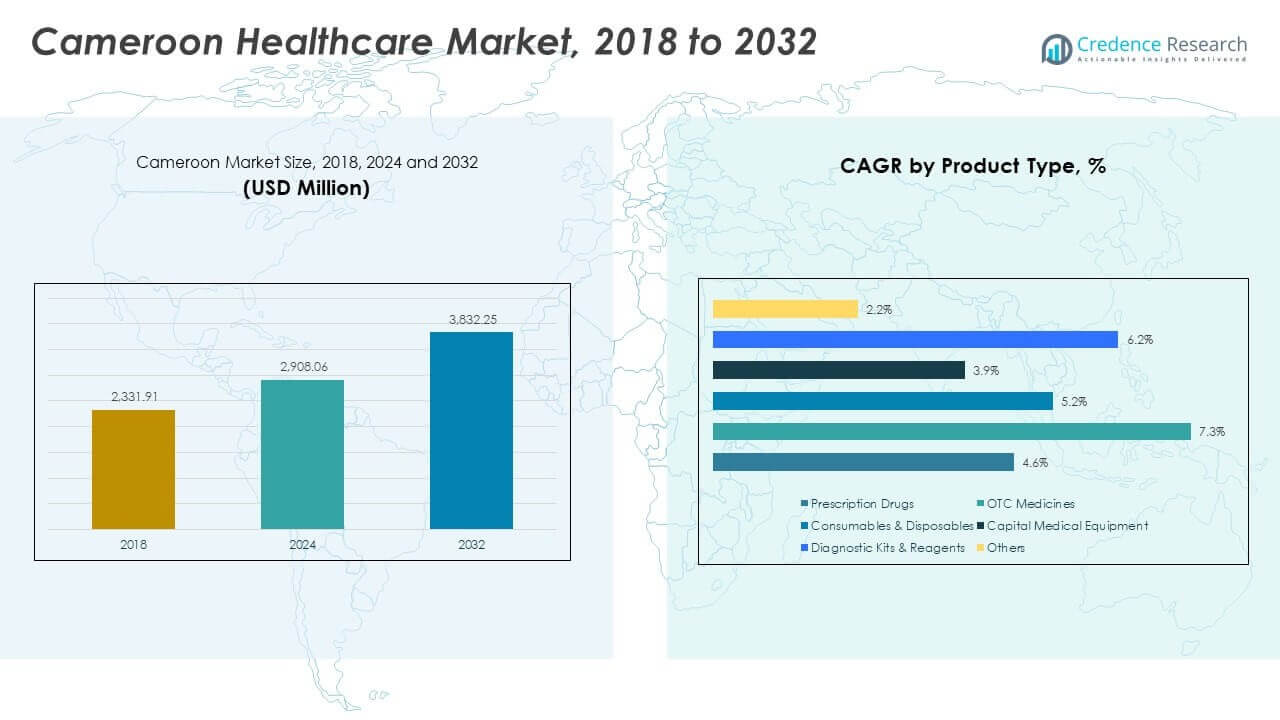
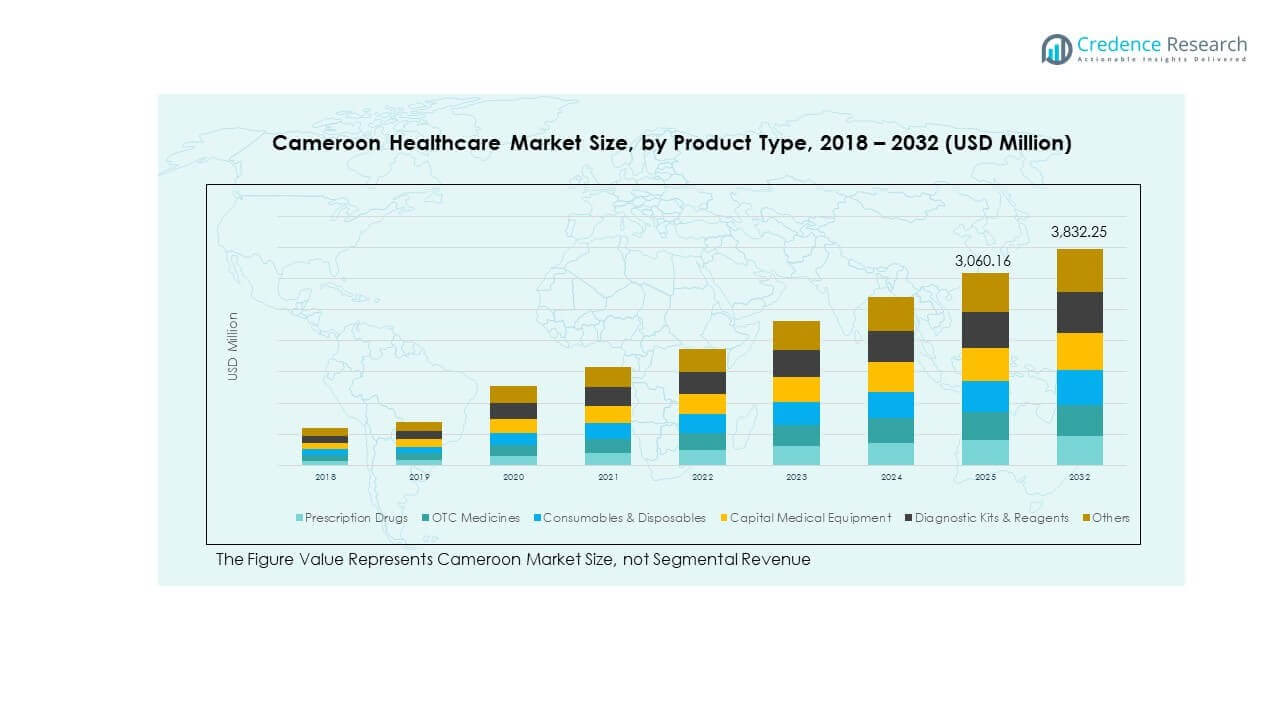
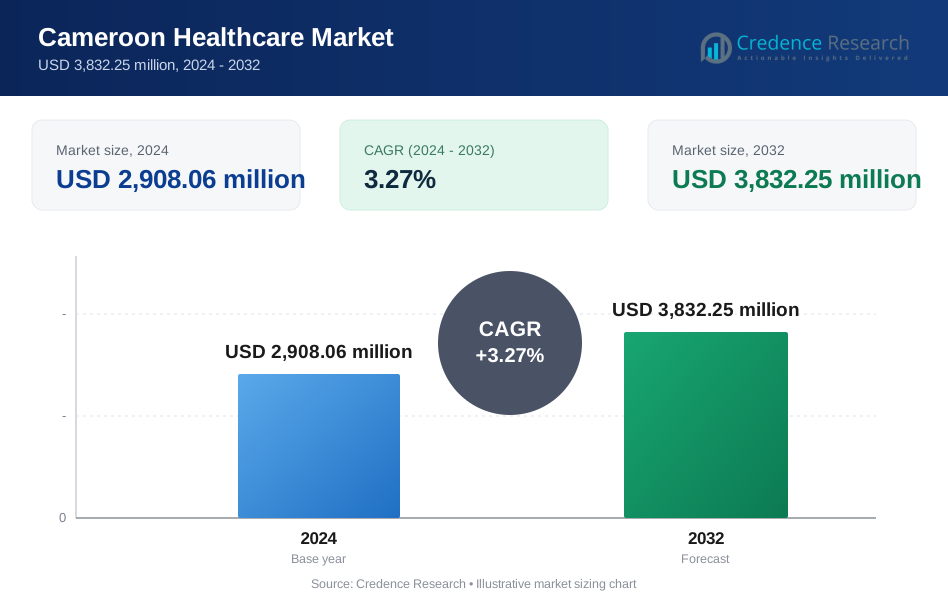
The Cameroon Healthcare Market size was valued at USD 2,331.91 million in 2018 to USD 2,908.06 million in 2024 and is anticipated to reach USD 3,832.25 million by 2032, at a CAGR of 3.27% during the forecast period.
| REPORT ATTRIBUTE | DETAILS |
|---|---|
| Historical Period | 2020-2023 |
| Base Year | 2024 |
| Forecast Period | 2025-2032 |
| Cameroon Healthcare Market Size 2024 | USD 2,908.06 million |
| Cameroon Healthcare Market , CAGR | 3.27% |
| Cameroon Healthcare Market Size 2032 | USD 3,832.25 million |
Healthcare demand in Cameroon continues to grow due to demographic expansion, increased public health spending, and international development assistance. Government reforms in universal health coverage and access to essential services improve patient outreach in underserved areas. Rising cases of communicable and non-communicable diseases drive demand for diagnostics, pharmaceuticals, and chronic care services. Private sector participation expands through new clinic networks and diagnostic centers in cities. National policies supporting local drug manufacturing and mobile health technologies also strengthen system capacity. Digital health platforms and donor-backed health programs improve efficiency and delivery in rural and peri-urban zones.
The Centre region, led by Yaoundé, holds the largest share due to institutional infrastructure, better access to hospitals, and strong health program administration. Littoral region, including Douala, follows with robust private sector engagement and growing outpatient demand. The West and North-West regions show emerging growth backed by local investment in diagnostics and primary care. The North and East face challenges due to lower facility density and fewer healthcare workers. However, outreach services, donor-funded maternal programs, and mobile clinics help bridge service delivery gaps across those areas. Market expansion across regions will depend on ongoing infrastructure upgrades and workforce development.
Market Insights
- The Cameroon Healthcare Market was valued at USD 2,331.91 million in 2018, USD 2,908.06 million in 2024, and is projected to reach USD 3,832.25 million by 2032, growing at a CAGR of 3.27%.
- Urbanization, rising disease burden, and healthcare investments are key drivers expanding access and quality of care.
- Infrastructure gaps, workforce shortages, and limited rural coverage continue to restrain the market’s full growth potential.
- The Centre region holds 32% share, driven by administrative concentration and strong institutional infrastructure in Yaoundé.
- Littoral holds 27%, supported by Douala’s commercial strength, private hospitals, and import-led supply chains.
Market Drivers
Rising Government Spending on Health Infrastructure and Universal Coverage Programs
The Cameroon Healthcare Market is driven by increased public investment in hospital infrastructure, insurance coverage, and essential health services. The government allocates higher budget shares toward modernizing public hospitals and expanding regional health centers. The Universal Health Coverage (UHC) program aims to improve access to primary and preventive care, especially in low-income communities. This effort boosts demand for diagnostics, pharmaceuticals, and equipment. Cameroon’s Ministry of Public Health collaborates with development agencies to deploy mobile clinics and maternal health units. These initiatives reduce regional disparities in healthcare access. Urban populations benefit from better-equipped tertiary care hospitals. Meanwhile, rural populations gain from community-based care models. Together, these structural shifts support sustained market growth.
- For instance, Cameroon's Ministry of Public Health launched Phase 1 of the Universal Health Coverage (UHC) program in Bertoua on April 12, 2023, enrolling 7,000 people that day to receive free essential health services.
Increased Burden of Non-Communicable Diseases and Need for Long-Term Care
The country’s disease profile is shifting toward non-communicable diseases (NCDs), such as diabetes, hypertension, and cancer. This shift increases demand for specialized medical services, chronic disease management, and continuous care. Patients now require diagnostics, follow-up treatment, and home-based services, strengthening demand across healthcare segments. The Cameroon Healthcare Market responds with expanded services in cardiology, oncology, and dialysis. Rising urbanization and lifestyle changes contribute to higher incidence rates of NCDs. Patients in middle-income groups are seeking preventive health screenings and disease monitoring. These changes create growth in private diagnostic centers and outpatient clinics. Pharmaceutical sales also increase due to long-term medication needs. The overall burden of NCDs drives systemic changes in service delivery.
- For instance, under PEPFAR's Pediatric Surge initiative, Cameroon aimed to increase pediatric ART coverage from 11,508 children (48%) in March 2023 to 22,954 (95%) by December 2024 through district hospital upgrades to Pediatric Treatment Centers of Excellence (PTCE) hubs.
Growth in Private Sector Investments and Health PPP Initiatives
Private health operators are investing in clinics, pharmacies, and specialty hospitals across major cities. Investors see strong growth potential due to rising healthcare awareness and an expanding middle class. The Cameroon Healthcare Market benefits from public-private partnerships (PPPs) that enable infrastructure upgrades, equipment procurement, and telemedicine platforms. These collaborations enhance quality of care and reduce dependency on public budgets. Diagnostic labs and outpatient chains now operate under regulated models to improve service delivery. Some investors focus on building medical tourism capacity in urban regions. The private sector brings technology adoption and operational efficiency into mainstream care. These initiatives make healthcare more accessible, reliable, and sustainable for various segments.
International Donor Support and Focus on Preventive Health Programs
Multilateral organizations support Cameroon’s health system through grants, vaccine campaigns, and disease control programs. The country benefits from WHO-backed immunization drives, HIV treatment programs, and maternal health projects. These externally funded programs reduce mortality and improve preventive care coverage. The Cameroon Healthcare Market gains momentum from such international partnerships, particularly in underfunded rural areas. Donor support also enables workforce training, mobile outreach services, and essential drug availability. These efforts strengthen primary care systems and create more consistent service delivery. Public health awareness campaigns improve patient behavior and early detection rates. Preventive interventions reduce pressure on emergency services and support overall system resilience.
Market Trends
Digital Transformation Across Public Hospitals and Private Health Networks
Digital health tools are reshaping service delivery across urban and semi-urban hospitals. Government and private operators deploy hospital information systems (HIS), electronic medical records (EMR), and appointment scheduling platforms. These tools reduce wait times, improve recordkeeping, and enable faster diagnosis. The Cameroon Healthcare Market is adopting digital systems to modernize legacy operations and improve efficiency. Teleconsultation platforms help bridge urban-rural healthcare gaps by connecting patients to city-based specialists. Mobile apps support chronic disease monitoring, especially for diabetic and hypertensive patients. Startups focus on digital pharmacy solutions and remote diagnostics. Public hospitals are piloting e-health portals for outpatient appointments. The digitalization trend enables more coordinated and patient-centric care.
Expansion of Diagnostic and Imaging Services in Urban and Peri-Urban Areas
Demand for advanced imaging and pathology services is growing rapidly in Cameroon's cities. Diagnostic labs are expanding operations to offer CT, MRI, and ultrasound services. Patients increasingly seek preventive screenings and specialized diagnostics. The Cameroon Healthcare Market responds with upgraded lab chains and public diagnostic centers. Imaging centers offer bundled diagnostic packages for chronic disease monitoring. Demand also rises from outpatient clinics and maternity centers for real-time diagnostics. Public-private ventures expand laboratory testing in semi-urban communities. Growth in diagnostics improves disease detection and patient compliance. Quality diagnostics also support clinical research and drug trials in urban regions.
- For instance, CDC-supported efforts achieved ISO 15189 accreditation for 5 laboratories by 2024, enhancing diagnostic quality for HIV and TB testing nationwide.
Growing Demand for Maternity and Childcare Facilities Among Urban Households
Urban fertility rates remain high, creating steady demand for maternity services and neonatal care. Women seek safer childbirth environments and specialized obstetric care. The Cameroon Healthcare Market shows increased investment in maternity hospitals, gynecology clinics, and pediatric care. Private providers offer prenatal packages and neonatal ICUs in metropolitan regions. These facilities meet demand for high-risk pregnancy management. Government maternal health initiatives also improve outcomes through midwife training and free checkups. Patients prefer facilities offering ultrasound, lab tests, and postnatal support. Maternal healthcare continues to drive outpatient volumes in peri-urban centers. The trend boosts demand for trained nurses, midwives, and child health specialists.
- For instance, CDC Cameroon initiatives tested over 840,000 pregnant women for HIV by 2024, with 97% of positives receiving treatment to support maternal and child health.
Rising Focus on Locally Manufactured Pharmaceuticals and Generic Drug Penetration
Cameroon’s reliance on imported drugs has prompted a policy push for domestic manufacturing. Regulatory bodies promote local production of essential medicines, especially generics. The Cameroon Healthcare Market witnesses new investments in pharma plants and packaging units. Local firms produce antibiotics, antimalarials, and over-the-counter drugs. Affordable generics improve access for low-income households. These shifts reduce costs and increase availability of critical medications. Government tenders favor locally produced drugs to secure supply chains. This trend aligns with regional integration efforts under the African Continental Free Trade Area. Local pharma capacity also enables faster pandemic response and stock management.
Market Challenges Analysis
Inadequate Rural Healthcare Infrastructure and Uneven Access to Essential Services
Rural communities face limited access to healthcare due to poor infrastructure and resource constraints. Many facilities lack trained personnel, diagnostic equipment, and essential drugs. The Cameroon Healthcare Market remains heavily concentrated in urban zones, leaving gaps in rural outreach. Geographic barriers and poor road connectivity delay emergency care access. Mobile health programs remain underfunded and inconsistent. Rural patients often rely on traditional medicine due to facility shortages. Referral systems are weak, reducing continuity of care. These challenges strain the public system and widen health inequities. Addressing these barriers requires stronger policy implementation and regional funding support.
Workforce Shortages, Skill Gaps, and Brain Drain in Medical Professions Cameroon faces a shortage of healthcare professionals, especially in specialties and rural deployment. Trained doctors, nurses, and lab technicians often migrate to better-paying international markets. The Cameroon Healthcare Market struggles with uneven distribution of skilled staff across public and private sectors. Skill gaps affect quality of care in surgical, maternity, and emergency services. Rural hospitals operate below capacity due to staffing deficits. High patient-to-doctor ratios increase burnout and reduce service quality. Training institutions face infrastructure and funding limitations. These constraints hamper expansion plans and quality improvements. The sector requires long-term workforce development policies and retention incentives.
Market Opportunities
Telemedicine Adoption and Mobile Health Service Expansion Across Underserved Regions
The growing mobile penetration and telecom access in rural Cameroon present new delivery models for care. Telemedicine platforms can connect district health units to urban hospitals for consultations and diagnostics. The Cameroon Healthcare Market can leverage mobile apps and SMS services for chronic disease monitoring, health education, and remote diagnostics. These solutions reduce geographic barriers and improve early intervention outcomes. Telecom-health partnerships could expand basic care delivery in low-resource zones.
Private Investment Opportunities in Specialty Clinics, Pharmacies, and Diagnostic Chains
Rising demand for quality outpatient care creates opportunities for mid-size investors in healthcare services. Entrepreneurs can develop specialty clinics focused on dental, eye, orthopedic, and dialysis care. The Cameroon Healthcare Market also offers scope for expanding pharmacy chains in semi-urban regions. Diagnostic service providers can tap unmet demand in imaging and lab testing. Franchise and PPP models can improve reach and operational scalability across regions.
Market Segmentation Analysis
By Healthcare Segment
Pharmaceuticals dominate the Cameroon Healthcare Market, driven by high demand for essential drugs and generics. Medical devices and equipment see consistent growth due to infrastructure upgrades in urban hospitals. The diagnostics segment expands as private labs invest in imaging and pathology tools. Healthcare services attract investments in hospitals and specialty clinics. Digital health and telemedicine gain traction in remote regions. Others include traditional care and public health interventions.
By Product Type
Prescription drugs account for the largest share due to their role in managing both chronic and infectious diseases. OTC medicines grow with rising self-medication habits and pharmacy expansions. Consumables and disposables maintain steady demand from hospitals and labs. Capital medical equipment drives procurement projects in public health centers. Diagnostic kits and reagents support disease detection and maternal care programs. Others include supplements and herbal formulations.
- For instance, CBC Central Pharmacy serves CBCHS facilities with over 450,000 IV bags annually. OTC medicines grow with rising self-medication habits and pharmacy expansions.
By End User
Public hospitals lead due to broad service coverage and government programs. Private hospitals show rapid growth in urban zones. Clinics and primary healthcare centers provide key access in rural areas. Diagnostic laboratories expand in cities with growing health check-up volumes. Others include NGOs and mobile medical units.
- For instance, bioMérieux partnered via IFC to expand diagnostic equipment access in African facilities including Cameroon.
By Therapy Area
Communicable diseases remain a priority in the Cameroon Healthcare Market due to malaria, HIV, and TB. Non-communicable diseases see rising demand for cardiac and diabetes care. Maternal and child health programs support nationwide interventions. Infectious diseases continue to strain resources in border and conflict-prone areas. Others include mental health and rare conditions.
By Distribution Channel
Direct sales to hospitals remain vital for bulk procurement. Distributors and importers manage most international supply chains. Retail pharmacies expand in cities and town centers. Others include mobile vendors and humanitarian supply channels.
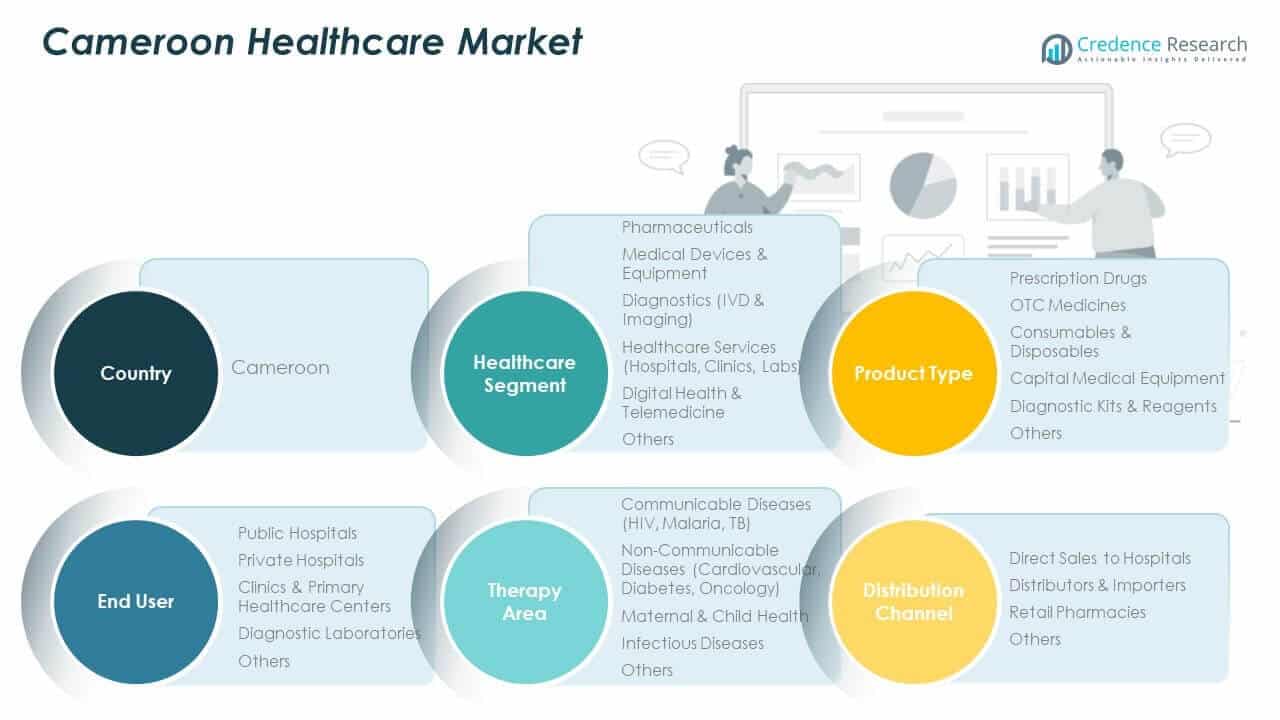
Segmentation
By Healthcare Segment
- Pharmaceuticals
- Medical Devices & Equipment
- Diagnostics (IVD & Imaging)
- Healthcare Services (Hospitals, Clinics, Labs)
- Digital Health & Telemedicine
- Others
By Product Type
- Prescription Drugs
- OTC Medicines
- Consumables & Disposables
- Capital Medical Equipment
- Diagnostic Kits & Reagents
- Others
By End User
- Public Hospitals
- Private Hospitals
- Clinics & Primary Healthcare Centers
- Diagnostic Laboratories
- Others
By Therapy Area
- Communicable Diseases (HIV, Malaria, TB)
- Non-Communicable Diseases (Cardiovascular, Diabetes, Oncology)
- Maternal & Child Health
- Infectious Diseases
- Others
By Distribution Channel
- Direct Sales to Hospitals
- Distributors & Importers
- Retail Pharmacies
- Others
- North America
- U.S.
- Canada
- Mexico
- Europe
- Germany
- France
- U.K.
- Italy
- Spain
- Rest of Europe
- Asia Pacific
- China
- Japan
- India
- South Korea
- South-east Asia
- Rest of Asia Pacific
- Latin America
- Brazil
- Argentina
- Rest of Latin America
- Middle East & Africa
- GCC Countries
- South Africa
- Rest of the Middle East and Africa
Regional Analysis
The Centre region, home to Yaoundé, holds the largest share of the Cameroon Healthcare Market at approximately 32%. It benefits from a dense network of tertiary hospitals, teaching institutions, and specialist clinics. Government ministries and major public health initiatives operate from this region, making it a central hub for policy and program execution. Private hospitals and diagnostics centers are expanding to serve a growing urban population. The presence of pharmaceutical distributors and training centers supports service quality. The Centre region continues to attract investment from both international donors and private operators.
The Littoral region, anchored by Douala, accounts for around 27% of the market. It is the country’s main economic hub, with strong private-sector participation in healthcare delivery. The region hosts a wide range of clinics, corporate hospitals, and medical equipment providers. Port access makes it a key entry point for imported pharmaceuticals and devices. Population density and industrial growth sustain high demand for occupational health services and emergency care. The Littoral region also leads in retail pharmacy expansion and outpatient diagnostics.
The West, North-West, South-West, and Northern regions collectively account for the remaining 41% of the Cameroon Healthcare Market. The West region shows growing potential due to rising investments in clinics and diagnostic labs. The South-West and North-West regions face operational disruptions due to socio-political tensions, but mobile clinics and donor programs continue to function. Northern regions remain underserved, with limited access to hospitals and essential care. Mobile health units and telemedicine pilots aim to reduce service gaps in these zones. Donor-funded maternal health and disease control programs sustain outreach across these areas.
Key Player Analysis
Competitive Analysis
The Cameroon Healthcare Market features a mix of public institutions, local private providers, and international healthcare players. Public hospitals dominate essential services in urban and rural areas, backed by Ministry of Public Health programs. Local firms like Cinpharm and CBC Health Services play a major role in pharmaceutical production and private care delivery. Diagnostic service providers and retail pharmacy chains expand their urban footprints. Private hospitals such as Polyclinique Idimed and Centre Médical la Cathédrale focus on specialist care and diagnostics. Multinational pharmaceutical companies like Sanofi and Novartis maintain presence through distributors, especially in infectious disease treatment. Medical device suppliers operate primarily through local importers based in Douala and Yaoundé. NGOs and international health organizations such as MSF and WHO influence preventive health delivery in underserved regions. The market sees increasing partnerships between local providers and global equipment firms to expand diagnostic and imaging capabilities. Competition centers around pricing, service availability, and regional coverage.
Recent Developments
- In December 2025, Cameroon and the United States signed a five-year Global Health Memorandum of Understanding to strengthen the national health system, emphasizing access to essential services, workforce capacity, and HIV management under the America First Global Health Strategy.
- In December 2025, Allianz Partners expanded its Allianz Health & Benefits Network in partnership with SanlamAllianz, creating an integrated employee health benefits network that includes Cameroon among its current markets.
- In September 2025, UbiPharm Cameroon partnered with PharmaExpo 2025, a major pharmaceutical exhibition held in Douala, bringing together manufacturers, distributors, and healthcare professionals. This engagement enhanced collaboration among stakeholders in Cameroon’s pharmaceutical supply chain and showcased the company’s commitment to expanding access to healthcare solutions
Report Coverage
The research report offers an in-depth analysis based on Healthcare Segment, Product Type, End User, Therapy Area and Distribution Channel. It details leading market players, providing an overview of their business, product offerings, investments, revenue streams, and key applications. Additionally, the report includes insights into the competitive environment, SWOT analysis, current market trends, as well as the primary drivers and constraints. Furthermore, it discusses various factors that have driven market expansion in recent years. The report also explores market dynamics, regulatory scenarios, and technological advancements that are shaping the industry. It assesses the impact of external factors and global economic changes on market growth. Lastly, it provides strategic recommendations for new entrants and established companies to navigate the complexities of the market.
Future Outlook
- Public healthcare spending will increase to support infrastructure upgrades and universal health coverage.
- Private investment in diagnostic labs, specialty clinics, and pharmacy chains will expand in urban areas.
- Growth in local pharmaceutical manufacturing will reduce import dependence and improve drug availability.
- Telemedicine and mobile health platforms will scale across rural zones to close access gaps.
- Rising cases of lifestyle-related diseases will boost demand for chronic care and specialist services.
- Maternal and child health programs will receive expanded donor support to lower mortality rates.
- Health insurance adoption will grow across formal and informal sectors, widening patient coverage.
- Retail pharmacies and diagnostics networks will expand beyond Douala and Yaoundé into secondary cities.
- New public-private partnerships will emerge to build and operate mid-size hospitals and care centers.
- Digitization of hospital workflows and health records will improve patient tracking and clinical efficiency.
Request a Free Sample
Fill in your details and we'll send you a free sample report.
- Sample data tables & charts
- Research methodology
Need a Custom Version of This Report?
Tailor the scope, geography, or segments to your exact requirements.
- Custom geography or segment scope
- Direct access to our analyst team
Frequently Asked Questions
What is the current market size for Cameroon Healthcare Market, and what is its projected size in 2032?
At what Compound Annual Growth Rate is the Cameroon Healthcare Market projected to grow between 2024 and 2032?
Which Cameroon Healthcare Market segment held the largest share in 2024?
What are the primary factors fueling the growth of the Cameroon Healthcare Market?
Who are the leading companies in the Cameroon Healthcare Market?
Which region commanded the largest share of the Cameroon Healthcare Market in 2024?
Table of Content
Chapter 1. Report Introduction
- 1.1 Report Description & Purpose
- 1.1.1 Report Title & Market Definition
- 1.1.2 Unique Selling Propositions (USP) & Key Differentiators
- 1.1.3 Value Proposition for Stakeholders
- 1.2 Research Objectives
- 1.2.1 Market Sizing Objectives (Volume & Revenue)
- 1.2.2 Segmentation Objectives
- 1.2.3 Competitive Intelligence Objectives
- 1.2.4 Forecast & Scenario Objectives
- 1.3 Report Scope
- 1.3.1 Cameroon Healthcare Scope – Types & Subtypes Covered
- 1.3.2 Geographic Scope – Regions & Countries Covered
- 1.3.3 Historical Period, Base Year & Forecast Period (2024; forecast to 2032)
- 1.3.4 Inclusions & Exclusions
- 1.4 HS Code & Classification Framework
- 1.5 Currency, Units & Pricing Basis
- 1.6 Target Stakeholders
- 1.7 Limitations & Assumptions
Chapter 2. Executive Summary
- 2.1 Global Cameroon Healthcare Market Snapshot
- 2.1.1 Market Size – Historical (2024) & Forecast (2024-2032) (2024: USD 2,908.06 million → 2032: USD 3,832.25 million)
- 2.1.2 Volume & Revenue – Global Totals
- 2.1.3 Key Market Highlights – Top Five Facts
- 2.2 Cameroon Healthcare Market Segmentation Snapshot
- 2.2.1 Market Split by Region – 2024 vs. 2032
- 2.3 Competitive Snapshot
- 2.3.1 Top 10 Players by Revenue Share – 2024
- 2.3.2 Top 10 Players by Volume Share – 2024
- 2.3.3 Recent Strategic Developments (18-Month Summary)
- 2.4 Key Investment Highlights & Strategic Conclusions
Chapter 3. Cameroon Healthcare Market Dynamics & Industry Analysis
- 3.1 Market Overview & Context
- 3.1.1 Cameroon Healthcare Market Position in the Broader Automotive Value Chain
- 3.1.2 OEM vs. Replacement Market Dynamics
- 3.1.3 Market Maturity & Development Stage by Region
- 3.2 Cameroon Healthcare Market Drivers
- 3.3 Cameroon Healthcare Market Restraints & Challenges
- 3.4 Cameroon Healthcare Market Opportunities
- 3.5 Porter's Five Forces Analysis
- 3.5.1 Threat of New Entrants
- 3.5.2 Bargaining Power of Suppliers
- 3.5.3 Bargaining Power of Buyers
- 3.5.4 Threat of Substitutes
- 3.5.5 Competitive Rivalry – Intensity Assessment
- 3.6 Cameroon Healthcare Value Chain Analysis
- 3.6.1 Upstream – Raw Material/Input Suppliers
- 3.6.1.1 Raw Material/Input 1
- 3.6.1.2 Raw Material/Input 2
- 3.6.1.3 Raw Material/Input 3
- 3.6.2 Midstream – Production/Manufacturing/Service Delivery
- 3.6.2.1 Production/Process Overview
- 3.6.2.2 Key Facility Locations & Capacity by Manufacturer
- 3.6.3 Downstream – Distribution & End Consumer
- 3.6.3.1 Primary Channel – B2B/OEM
- 3.6.3.2 Secondary Channels – Dealer, Retail, Online, Direct
- 3.6.4 Value Chain Profitability Analysis
- 3.6.1 Upstream – Raw Material/Input Suppliers
- 3.7 PESTEL Analysis
- 3.7.1 Political Factors
- 3.7.2 Economic Factors
- 3.7.3 Social Factors
- 3.7.4 Technological Factors
- 3.7.5 Environmental Factors
- 3.7.6 Legal Factors
- 3.8 Cameroon Healthcare Supply Chain Analysis
- 3.8.1 Raw Material/Input Supply Risk Assessment
- 3.8.2 Manufacturing Concentration Risk (Geographic Exposure)
- 3.8.3 Trade Disruption Impact Analysis
- 3.9 Regulatory & Policy Landscape
Note: The regulatory and policy landscape section covers regulations based on their applicability to the market, Cameroon Healthcare category, geography, and scope of the study. Only regulatory frameworks with a material impact on operations, compliance, trade, sustainability, or market access are analyzed in detail.
Chapter 4. Key Investment Pockets & Opportunity Analysis
- 4.1 Cameroon Healthcare Market Attractiveness Analysis
- 4.1.1 By Region – Investment Attractiveness Matrix (Volume × CAGR)
- 4.2 Absolute Revenue Growth Opportunity
- 4.2.1 By Region – Absolute USD Growth Through 2032
- 4.3 Incremental Volume Opportunity
- 4.3.1 By Region – Incremental Volume Through 2032
- 4.3.2 Segment – Incremental Volume
- 4.4 Emerging Submarket Opportunity Deep Dive (Subject to Applicability)
- 4.5 Emerging Market Opportunity Scorecards
- 4.5.1 United States
- 4.5.2 Europe
- 4.5.3 Asia
- 4.5.4 Middle East & Africa
Note: Emerging Market Opportunity Scorecards will be included based on relevance and strategic importance. Regions listed are indicative and may vary depending on data availability and market dynamics.
Chapter 5. Cameroon Healthcare Import-Export Analysis & Trade Flows
- 5.1 Global Trade Overview
- 5.1.1 Global Export Value by Country (2024)
- 5.1.2 Global Export Volume by Country (2024)
- 5.1.3 Global Import Value by Country (2024)
- 5.1.4 Global Import Volume by Country (2024)
- 5.1.5 Net Trade Balance by Country (2024)
- 5.2 Export Analysis – Segment
- 5.2.1 Type 1 (HS Code)
- 5.2.2 Type 2 (HS Code)
- 5.2.3 Type 3 (HS Code)
- 5.2.4 Type 4 (HS Code)
- 5.2.5 Type 5 (HS Code)
- 5.3 Import Analysis – Segment
- 5.3.1 Type 1 (HS Code)
- 5.3.2 Type 2 (HS Code)
- 5.3.3 Type 3 (HS Code)
- 5.3.4 Type 4 (HS Code)
- 5.3.5 Type 5 (HS Code)
- 5.4 Average Unit Trade Prices
- 5.4.1 Average Export Price – Segment & Country
- 5.4.2 Average Import Price – Segment & Source Country
- 5.4.3 Price Trends (2024)
- 5.5 Key Trade Route Analysis
- 5.5.1 Trade Route 1
- 5.5.2 Trade Route 2
- 5.5.3 Trade Route 3
- 5.5.4 Trade Route 4
- 5.5.5 Trade Route 5
- 5.6 Trade Policy Impact Assessment
- 5.6.1 US Anti-Dumping & Section 301 Tariffs
- 5.6.2 EU Customs Union Impact
- 5.6.3 Major Free Trade Agreements
- 5.6.4 USMCA Rules of Origin
Note: Trade policy analysis will be included only where relevant to the Cameroon Healthcare market.
Chapter 6. Competitive Landscape & Company Benchmarking
- 6.1 Cameroon Healthcare Market Concentration & Structure
- 6.1.1 Herfindahl-Hirschman Index (HHI) – vs. 2024
- 6.1.2 Tier 1, Tier 2 & Tier 3 Market Structure
- 6.1.3 Global, Regional & Local Player Dynamics
- 6.2 Cameroon Healthcare Market Share Analysis – 2024
- 6.2.1 Global Revenue Share by Company
- 6.2.2 Global Volume Share by Company
- 6.2.3 Regional Revenue Share
- 6.2.4 Market Share Evolution ( vs. 2024)
- 6.2.5 OEM Segment Share by Company
- 6.2.6 Replacement Segment Share by Company
- 6.3 Production/Delivery Capacity & Facility Analysis
- 6.3.1 Global Installed Capacity
- 6.3.2 Capacity Utilization Rates
- 6.3.3 Production/Output Volume
- 6.3.4 Facility Locations & Capacity Map
- 6.3.5 Planned Capacity Additions
- 6.4 Cameroon Healthcare Competitive Benchmarking Matrix
- 6.4.1 Revenue, Volume, CAGR & Profitability Comparison
- 6.4.2 Channel Revenue Mix
- 6.4.3 Geographic Revenue Exposure
- 6.4.4 R&D Intensity
- 6.4.5 Sustainability Maturity
- 6.5 Strategic Developments in Cameroon Healthcare (Last 24 Months)
- 6.5.1 Mergers, Acquisitions & Divestments
- 6.5.2 New Cameroon Healthcare Launches
- 6.5.3 Facility Expansions
- 6.5.4 Strategic Alliances, Joint Ventures & Partnerships
- 6.5.5 Distribution Expansion & Market Entry
- 6.5.6 Sustainability & ESG Initiatives
- 6.6 Competitive Strategy Mapping
- 6.6.1 Leader, Challenger, Follower & Niche Classification
- 6.6.2 Pricing Strategy Comparison
- 6.6.3 Channel Strategy Matrix
Note: Strategic developments are included based on their materiality and the availability of reliable information.
Chapter 7. Global Cameroon Healthcare Market – By Distribution Channel
- 7.1 Segment Overview
- 7.1.1 Volume & Revenue Split by Channel (2024 & 2032)
- 7.1.2 Channel Mix Evolution (2024-2032)
Chapter 8. Regional Market Analysis – Global Overview
- 8.1 Global Regional Overview
- 8.1.1 Regional Volume Share
- 8.1.2 Regional Revenue Share
- 8.1.3 Regional Volume by Region
- 8.1.4 Regional Revenue by Region
- 8.1.5 Regional Forecast Through 2032
- 8.2 Cross-Regional Segment Analysis
- 8.2.1 By Distribution Channel
- 8.2.2 By Brand/Price Tier
Chapter 9. North America Cameroon Healthcare Market
- 9.1 United States
- 9.2 Canada
- 9.3 Mexico
Chapter 10. Europe Cameroon Healthcare Market
- 10.1 Germany
- 10.2 France
- 10.3 Italy
- 10.4 United Kingdom
- 10.5 Spain
- 10.6 Poland
- 10.7 Russia
- 10.8 Netherlands
- 10.9 Belgium
- 10.10 Sweden
- 10.11 Denmark
- 10.12 Norway
- 10.13 Rest of Europe
Chapter 11. Asia Pacific Cameroon Healthcare Market
- 11.1 China
- 11.2 India
- 11.3 Japan
- 11.4 South Korea
- 11.5 Thailand
- 11.6 Indonesia
- 11.7 Vietnam
- 11.8 Malaysia
- 11.9 Australia
- 11.10 Rest of Asia Pacific
Chapter 12. Latin America Cameroon Healthcare Market
- 12.1 Brazil
- 12.2 Argentina
- 12.3 Colombia
- 12.4 Chile
- 12.5 Rest of Latin America
Chapter 13. Middle East Cameroon Healthcare Market
- 13.1 Saudi Arabia
- 13.2 United Arab Emirates
- 13.3 Turkey
- 13.4 Israel
- 13.5 Iran
- 13.6 Rest of the Middle East
Chapter 14. Africa Cameroon Healthcare Market
- 14.1 South Africa
- 14.2 Egypt
- 14.3 Nigeria
- 14.4 Morocco
- 14.5 Rest of Africa
Chapter 15. Cameroon Healthcare Company Profiles
- 15.1 [Company 01]
- 15.1.1 Company Overview
- 15.1.2 Key Management Personnel
- 15.1.3 Products & Services Portfolio
- 15.1.4 Financial Performance
- 15.1.5 Key Market Focus & Geographic Presence
- 15.1.6 Recent Developments & Strategic Initiatives
Note: The company profile list is preliminary and may change based on research findings, market developments, data availability, and client requirements.
Chapter 16. Appendices
- Appendix A – List of Abbreviations & Acronyms
- Appendix B – Industry Classification Code Reference – Full Series
- Appendix C – Production & Capacity Data Tables
- Appendix D – End-Use & Demand Base Tables
- Appendix E – Consumption & Replacement Rate Assumptions
- Appendix F – ASP Reference Tables
- Appendix G – Manufacturing & Facility Database
- Appendix H – Import-Export Data Tables
- Appendix I – Regulatory Summary Tables
- Appendix J – Primary Research Participant List (Anonymized)
- Appendix K – Primary Research Questionnaire Framework
- Appendix L – Data Sources & Bibliography
- Appendix M – Market Size Divergence & Source Comparison
Chapter 17. Research Methodology
- 17.1 Research Framework & Philosophy
- 17.2 Secondary Research – Sources, Hierarchy & Data Extraction
- 17.3 Data Modeling – Bottom-Up & Top-Down Market Sizing
- 17.4 Primary Research – Stakeholder Framework, LOI & Sample Sizes
- 17.5 Forecast Methodology – Regression, Scenario & Sensitivity Analysis
- 17.6 Quality Control – Four-Layer Validation Framework
- 17.7 Limitations & Standard Assumptions
- 17.8 Disclaimer
