Market Overview:
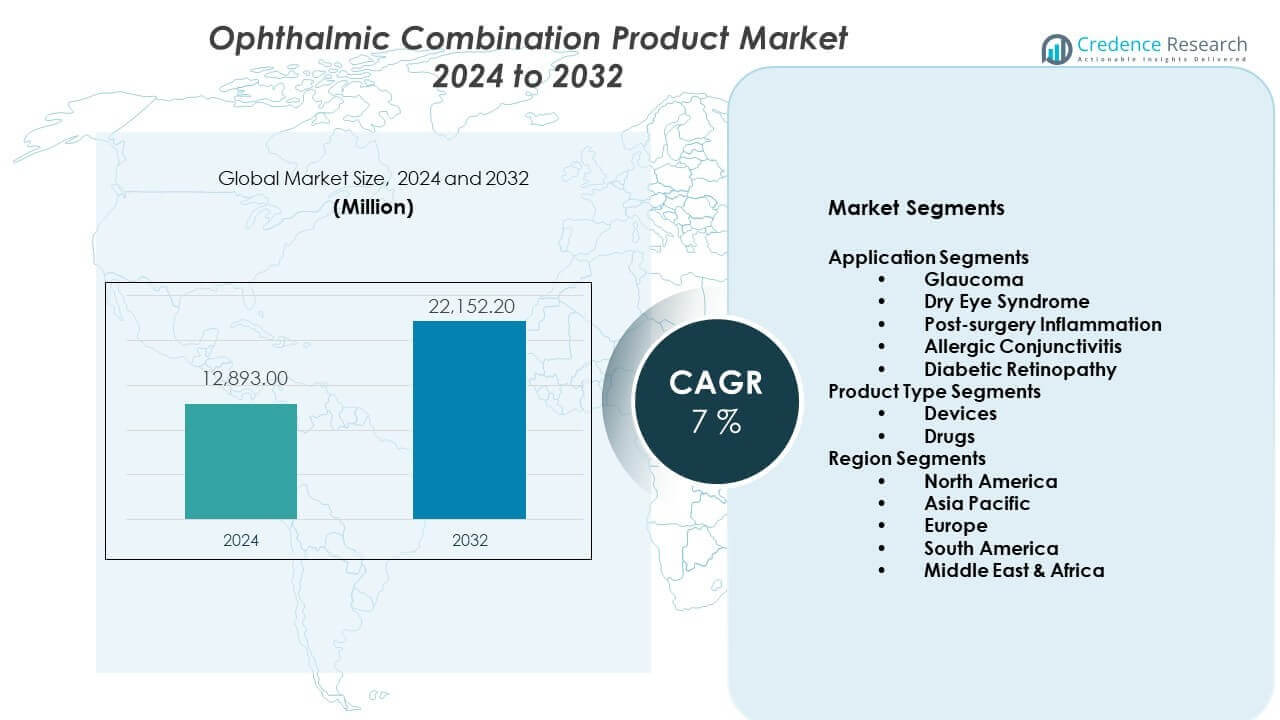
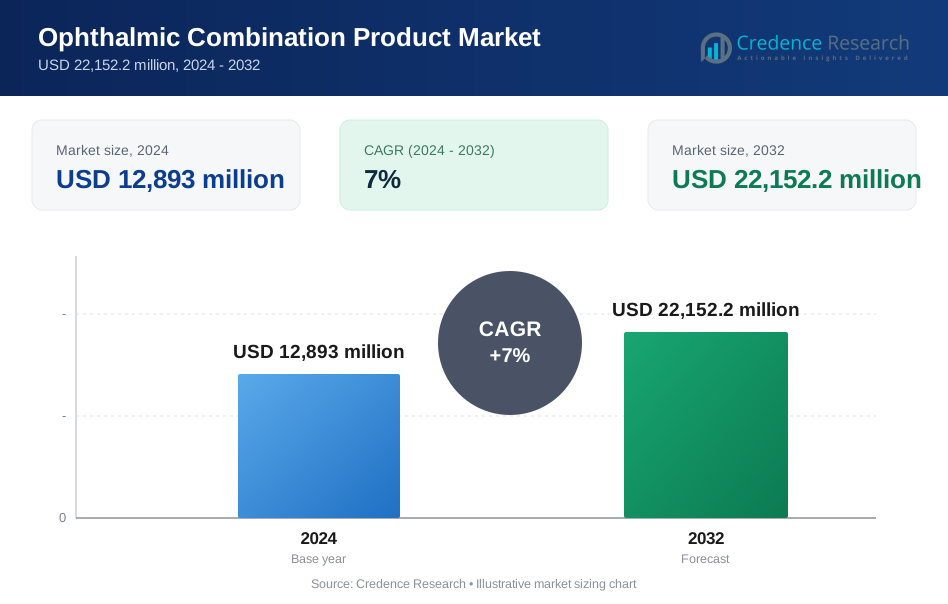
The Ophthalmic combination product market is projected to grow from USD 12,893 million in 2024 to USD 22,152.2 million by 2032. The market is expected to expand at a CAGR of 7% from 2024 to 2032.
| REPORT ATTRIBUTE | DETAILS |
|---|---|
| Historical Period | 2020-2023 |
| Base Year | 2024 |
| Forecast Period | 2025-2032 |
| Ophthalmic Combination Product Market Size 2024 | USD 12,893 million |
| Solid Bleached Board Market, CAGR | 7% |
| Solid Bleached Board Market Size 2032 | USD 22,152.2 million |
Market growth is driven by rising prevalence of glaucoma, dry eye disease, and ocular infections. Physicians prefer combination therapies to reduce dosing frequency and improve patient adherence. Aging populations increase long-term demand for advanced ophthalmic treatments. Improved drug delivery systems enhance safety and therapeutic effectiveness. Pharmaceutical companies invest in fixed-dose combinations to extend product lifecycles. Regulatory support for proven combinations accelerates approvals. Hospital and retail pharmacy channels support wide product availability across care settings.
North America leads the market due to strong healthcare access and early adoption of combination therapies. Europe follows, supported by high diagnosis rates and structured ophthalmic care systems. Asia Pacific emerges as a fast-growing region due to expanding patient pools. Countries such as China and India benefit from rising eye disease awareness. Improving healthcare infrastructure supports adoption. Latin America and the Middle East show gradual growth as access improves.
Market Insights:
- The market was valued at USD 12,893 million in 2024 and is projected to reach USD 22,152.2 million by 2032, growing at a CAGR of 7% during the forecast period.
- North America leads with about 40% share due to advanced eye care systems, followed by Europe at 30% with strong clinical protocols, and Asia Pacific at 20% driven by large patient pools.
- Asia Pacific is the fastest-growing region, holding nearly 20% share, supported by rising disease awareness, urban healthcare expansion, and improving access in China and India.
- By product type, drugs dominate the market with roughly 75% share due to strong physician preference and established prescription use.
- By application, glaucoma and dry eye syndrome together account for over 55% share, supported by chronic treatment needs and high diagnosis rates.
Market Drivers:
Rising Burden Of Chronic And Multifactorial Eye Disorders Across Age Groups
The Ophthalmic combination product market benefits from rising cases of glaucoma, dry eye disease, and ocular inflammation. Patients often face multiple eye conditions at the same time. Combination therapies address more than one condition with a single product. This approach improves treatment efficiency in routine clinical practice. Physicians prefer such products for better symptom control. Reduced prescription complexity supports wider acceptance. Hospitals and clinics adopt combination products for standardized care. The growing elderly population strengthens long-term demand.
- For instance, AbbVie’s Combigan showed mean intraocular pressure reduction of about 7–9 mmHg in Phase III trials.
Need For Improved Patient Adherence Through Simplified Treatment Regimens
Complex dosing schedules often reduce compliance in eye care treatments. Fixed-dose combinations lower the number of daily applications. This simplification improves patient adherence across chronic therapies. The Ophthalmic combination product market gains from this shift in prescribing behavior. Ophthalmologists seek options that reduce missed doses. Better adherence supports improved clinical outcomes. Caregivers favor simpler regimens for elderly patients. This driver supports steady prescription volumes.
- For instance, Novartis’ Simbrinza demonstrated comparable efficacy with two fewer daily administrations versus separate drops.
Advancements In Ophthalmic Drug Delivery And Formulation Science
Modern formulations enhance drug stability and ocular absorption. Controlled-release technologies improve therapeutic consistency. Combination products benefit from improved bioavailability profiles. The Ophthalmic combination product market gains credibility through safer formulations. Reduced irritation supports patient comfort during long-term use. Manufacturers focus on preservative-safe combinations. Innovation strengthens physician confidence in combined therapies. Regulatory approvals increase with stronger clinical data.
Strong Support From Healthcare Infrastructure And Prescription Channels
Hospitals remain primary centers for eye disease management. Retail pharmacies support easy access to prescribed therapies. The Ophthalmic combination product market benefits from strong distribution networks. Insurance coverage improves affordability for long-term treatments. Specialist clinics drive early adoption of advanced combinations. Electronic prescriptions support accurate dispensing. Healthcare systems favor therapies that reduce follow-up visits. These factors reinforce consistent market demand.
Market Trends:
Shift Toward Fixed-Dose Combinations For Standardized Clinical Protocols
Physicians increasingly follow protocol-driven treatment approaches. Fixed-dose combinations fit well within standard care pathways. The Ophthalmic combination product market reflects this structural shift. Standardization improves treatment consistency across facilities. Hospitals favor products with predictable outcomes. Combination therapies reduce prescription variability. Training programs emphasize protocol-based drug selection. This trend supports sustained market penetration.
- For instance, Bausch + Lomb’s Lotemax SM clinical trials showed that nearly 30% of patients achieved complete inflammation resolution and over 70% were pain-free by day 8 post-surgery.
Growing Focus On Preservative-Free And Patient-Friendly Formulations
Concerns around long-term preservative exposure continue to rise. Manufacturers develop gentler combination products for sensitive eyes. The Ophthalmic combination product market aligns with patient safety priorities. Preservative-free options reduce irritation risk. This feature supports chronic use across age groups. Clinicians recommend safer profiles for extended therapy. Patient satisfaction improves with better tolerability. This trend reshapes product development strategies.
- For instance, Alcon’s preservative-free formulations reduced reported ocular irritation by over 40% in post-market studies.
Expansion Of Combination Therapies In Post-Surgical Eye Care
Post-operative eye care requires infection and inflammation control. Combination products address multiple recovery needs together. The Ophthalmic combination product market sees wider surgical adoption. Surgeons prefer fewer products during recovery phases. Reduced dosing simplifies patient instructions after surgery. Compliance improves during critical healing periods. Clinics standardize post-surgical medication kits. This trend boosts short-term therapy demand.
Increased Role Of Branded Generics In Market Expansion
Branded generics gain trust among physicians and pharmacists. These products balance cost control with clinical reliability. The Ophthalmic combination product market benefits from this shift. Price-sensitive healthcare systems favor branded alternatives. Wider access supports treatment continuity. Local manufacturers strengthen regional supply chains. Competitive pricing expands patient reach. This trend supports volume-driven growth.
Market Challenges Analysis:
Complex Regulatory Requirements For Multi-Component Ophthalmic Products
Combination products face strict regulatory scrutiny during approval. Each active component requires safety validation. The Ophthalmic combination product market encounters longer development timelines. Clinical trials demand robust comparative evidence. Approval delays increase development costs. Smaller firms face entry barriers due to compliance demands. Regulatory variations across regions add complexity. These factors limit rapid product launches.
Formulation Stability And Compatibility Constraints
Combining multiple active ingredients presents technical challenges. Chemical incompatibility affects shelf stability. The Ophthalmic combination product market must manage formulation risks carefully. Manufacturing errors can impact therapeutic performance. Quality control standards remain high. Stability testing extends production timelines. Reformulation increases research expenses. These challenges affect profit margins.
Market Opportunities:
Rising Demand In Emerging Economies With Improving Eye Care Access
Emerging markets show rising awareness of eye health. Urbanization improves access to ophthalmic services. The Ophthalmic combination product market gains new patient bases. Hospitals expand specialty eye care units. Government programs support vision screening initiatives. Combination therapies suit resource-limited settings. Reduced product count lowers treatment burden. These factors create strong growth potential.
Pipeline Expansion Through Novel Therapeutic Combinations
Manufacturers explore new drug pairings for unmet needs. Combination therapies target inflammation and infection together. The Ophthalmic combination product market benefits from innovation pipelines. Clinical research supports differentiated products. Intellectual property protection strengthens market positioning. Physicians welcome new options for resistant cases. Product differentiation supports premium positioning. This opportunity drives future innovation.
Market Segmentation Analysis:
Application Segments
Glaucoma represents a core application due to long-term therapy needs and strict adherence requirements. Combination products support pressure control with fewer daily doses. Dry Eye Syndrome shows strong adoption due to chronic symptoms and high patient volumes. Combined anti-inflammatory and lubricating therapies improve comfort and consistency. Post-surgery inflammation drives short-term demand in hospital and clinic settings. Combination products simplify recovery protocols after cataract and refractive procedures. Allergic conjunctivitis benefits from dual-action relief against itching and redness. Diabetic retinopathy remains a smaller segment, but it gains relevance through adjunct therapies. The Ophthalmic combination product market supports varied clinical needs across acute and chronic eye conditions.
- For instance, Allergan’s Combigan has demonstrated significant efficacy in managing intraocular pressure (IOP), with clinical trials showing it can achieve a mean daytime IOP of less than 18 mmHg in approximately 40% of patients and provide a mean IOP reduction of up to 33% from baseline.
Product Type Segments
Drugs dominate usage due to established prescription habits and broad clinical acceptance. Fixed-dose eye drops address multiple symptoms with a single formulation. Physicians prefer drug combinations for predictable dosing and monitoring. Devices hold a niche but strategic role within advanced care pathways. Sustained release implants support long-acting therapy in controlled settings. Punctal plugs gain use in dry eye management with combination benefits. Devices suit patients requiring reduced dosing frequency. Adoption remains limited to specialty centers. Both segments reflect different care priorities across patient profiles and treatment durations.
- For instance, Allergan’s Durysta implant maintained intraocular pressure reduction for up to six months in controlled clinical studies.
Segmentation:
Application Segments
- Glaucoma
- Dry Eye Syndrome
- Post-surgery Inflammation
- Allergic Conjunctivitis
- Diabetic Retinopathy
Product Type Segments
- Devices
- Drugs
Region Segments
- North America
- U.S.
- Canada
- Mexico
- Europe
- Germany
- France
- U.K.
- Italy
- Spain
- Rest of Europe
- Asia Pacific
- China
- Japan
- India
- South Korea
- South-east Asia
- Rest of Asia Pacific
- Latin America
- Brazil
- Argentina
- Rest of Latin America
- Middle East & Africa
- GCC Countries
- South Africa
- Rest of the Middle East and Africa
Regional Analysis:
North America
North America accounts for nearly 40% of the global market share. The region benefits from advanced ophthalmic care systems and high diagnosis rates. Strong prescription uptake supports wide use of combination therapies. The Ophthalmic combination product market gains from early adoption of fixed-dose treatments. Presence of major pharmaceutical companies strengthens product availability. Favorable reimbursement policies support long-term therapy use. High patient awareness sustains consistent demand across chronic eye disorders.
Europe
Europe holds around 30% of the global market share. The region shows strong demand across hospital and specialty clinic settings. Structured healthcare systems support standardized ophthalmic treatment protocols. The Ophthalmic combination product market benefits from high compliance with clinical guidelines. Aging populations increase demand for multi-action eye therapies. Western Europe leads due to higher healthcare spending. Eastern Europe shows steady growth with improving access to eye care services.
Asia Pacific, South America, And Middle East & Africa
Asia Pacific represents close to 20% of the market share and remains the fastest-growing region. Rising disease awareness supports higher diagnosis rates. Expanding urban healthcare infrastructure improves access to combination products. The Ophthalmic combination product market benefits from large patient pools in China and India. South America contributes nearly 6% of global share, supported by improving clinical capacity. Middle East & Africa account for about 4%, driven by gradual healthcare investments. These regions offer long-term expansion opportunities.
Key Player Analysis:
Competitive Analysis:
The Ophthalmic combination product market shows moderate to high competitive intensity. Large pharmaceutical firms hold strong positions through broad ophthalmology portfolios. These companies focus on fixed-dose combinations to strengthen prescription loyalty. Brand strength supports sustained physician preference across chronic therapies. It benefits from continuous formulation upgrades and lifecycle extensions. Mid-sized players compete through branded generics and regional reach. Product differentiation relies on safety profiles and dosing convenience. Strategic partnerships support faster market access. Competition centers on clinical trust, regulatory approvals, and distribution strength.
Recent Developments:
- In May 2025, Alcon received FDA approval for TRYPTYR, marking a transformational advancement in dry eye disease management. Launched commercially across the United States in July 2025, TRYPTYR represents the first-in-class TRPM8 receptor agonist neuromodulator that stimulates corneal sensory nerves to rapidly increase natural tear production. In pivotal Phase 3 clinical trials (COMET-2 and COMET-3), TRYPTYR demonstrated remarkable efficacy with 42.6% of patients in COMET-2 and 53.2% in COMET-3 experiencing at least a 10mm increase in natural tear production at Day 14, compared to only 8.2% and 14.4% respectively in vehicle controls (both p<0.0001). The treatment demonstrates statistically significant tear production as early as Day 1, with consistent results observed through Day 90. Patients administer one drop per eye twice daily using convenient single-dose vials, targeting the estimated 38 million individuals in the U.S. living with dry eye disease.
- Alcon introduced the Clareon PanOptix Pro intraocular lens (IOL) in February 2025, representing the next generation of the world's leading trifocal IOL technology. The lens leverages proprietary ENLIGHTEN NXT Optical technology to deliver unprecedented 94% light utilization the highest reported among any trifocal IOL with only 6% scatter light compared to 88% utilization in the original Clareon PanOptix. This 16% increase in optical image contrast between distance and intermediate zones provides more uninterrupted light distribution across the full visual range. Initially introduced to select U.S. practices in February, broad commercial availability commenced in May 2025, with additional international markets beginning rollout in late 2025. The lens is available in a comprehensive range of powers from +6.0 through +34.0 diopters with various increments and features blue light and ultraviolet filtering across all variants.
- In February 2025, Alcon launched SYSTANE PRO Preservative-Free, the longest-lasting dry eye drop in the SYSTANE portfolio. This multi-dose preservative-free formula features a unique triple-action system combining hyaluronate, nano-sized lipids, and HP-Guar to hydrate, restore tear film stability, and protect against further eye irritation. Clinical evidence demonstrates the formulation provides up to 12 hours of dry eye symptom relief, addressing the needs of the estimated 45.5 million Americans living with dry eye disease. The U.S. launch began in February 2025, with expansion to additional markets planned for 2026.
- In January 2025, Bausch + Lomb entered into a strategic collaboration with City Therapeutics to develop a novel RNA interference (RNAi)-based treatment for geographic atrophy (GA), an advanced form of age-related macular degeneration causing irreversible vision loss. This partnership represents City Therapeutics' first major corporate collaboration and brings together Bausch + Lomb's ophthalmology expertise with City Therapeutics' integrated patient data platform and AI-powered analytical engine for novel drug discovery. Under the collaboration terms, City Therapeutics receives upfront cash payment and is eligible for contingent milestone payments totaling up to $485 million tied to development, regulatory, commercial, and sales achievements, plus tiered royalty payments on net product sales. Additionally, Bausch + Lomb issued a convertible note representing a minority equity interest in City Therapeutics if converted. This collaboration targets over one million people in the U.S. living with GA.
- Bausch + Lomb partnered with Character Biosciences in a multi-target drug discovery collaboration initiated in 2024 and announced in January 2025, leveraging both companies' complementary expertise to develop treatments for age-related macular degeneration (AMD). Under the agreement, Character Biosciences receives upfront payment, annual research funding, development and sales-related milestone payments, and tiered royalties on potential future product sales. Bausch + Lomb will make a strategic equity investment in Character Biosciences subject to certain closing conditions. The partnership applies artificial intelligence-driven approaches to uncover novel disease mechanisms and accelerate development of targeted AMD therapies.
Report Coverage:
The research report offers an in-depth analysis based on Application Segments and Product Type Segments. It details leading market players, providing an overview of their business, product offerings, investments, revenue streams, and key applications. Additionally, the report includes insights into the competitive environment, SWOT analysis, current market trends, as well as the primary drivers and constraints. Furthermore, it discusses various factors that have driven market expansion in recent years. The report also explores market dynamics, regulatory scenarios, and technological advancements that are shaping the industry. It assesses the impact of external factors and global economic changes on market growth. Lastly, it provides strategic recommendations for new entrants and established companies to navigate the complexities of the market.
Future Outlook:
- Fixed-dose combinations will gain stronger acceptance in chronic eye care.
- Preservative-safe formulations will shape future product development.
- Emerging markets will offer higher volume growth opportunities.
- Post-surgical combination therapies will expand in hospital use.
- Branded generics will improve affordability and access.
- Drug-device integration will remain limited but strategic.
- Regulatory clarity will support faster approvals for proven combinations.
- Physician preference will favor simplified dosing regimens.
- Distribution partnerships will strengthen regional penetration.
Request a Free Sample
Fill in your details and we'll send you a free sample report.
- Sample data tables & charts
- Research methodology
Need a Custom Version of This Report?
Tailor the scope, geography, or segments to your exact requirements.
- Custom geography or segment scope
- Direct access to our analyst team
Frequently Asked Questions
What is the current market size for Ophthalmic combination product market, and what is its projected size in 2032?
At what Compound Annual Growth Rate is the Ophthalmic combination product market projected to grow between 2025 and 2032?
Which Ophthalmic combination product market segment held the largest share in 2024?
What are the primary factors fueling the growth of the Ophthalmic combination product market?
Who are the leading companies in the Ophthalmic combination product market?
Which region commanded the largest share of the Ophthalmic combination product market in 2024?
Table of Content
Chapter 1 Market Segmentation
- 1.1 Segmentation Framework
- 1.1.1 Product and Service Classification
- 1.1.2 Application and End-Use Classification
- 1.1.3 Technology and Solution Classification
- 1.1.4 Customer and Distribution Channel Classification
- 1.1.5 Geographic Segmentation
- 1.1.6 Market Segment Definitions and Boundaries
Chapter 2 Introduction
- 2.1 Report Objectives and Scope
- 2.2 Product Definition and Industry Terminology
- 2.3 Market Inclusions and Exclusions
- 2.4 Research Process
- 2.4.1 Primary Research and Expert Interviews
- 2.4.2 Secondary Research and Source Review
- 2.4.3 Top-Down and Bottom-Up Estimation
- 2.4.4 Data Triangulation and Verification
- 2.5 Market Size Measurement Basis
- 2.5.1 2024: USD 12,893 million → 2032: USD 22,152.2 million
- 2.6 Historical and Forecast Reference Periods
- 2.6.1 Base Year: 2024
- 2.6.2 Forecast Period: 2024-2032
- 2.7 Research Assumptions and Limitations
Chapter 3 Executive Summary
- 3.1 Market Snapshot and Key Findings
- 3.2 Base-Year Market Size, 2024
- 3.3 Forecast Market Size, 2032
- 3.4 Revenue and Volume Growth Outlook
- 3.5 Key Demand and Supply Indicators
- 3.6 Leading Market Segments
- 3.7 Fastest-Growing Market Opportunities
- 3.8 Regional Performance Highlights
- 3.9 Technology and Industry Transformation
- 3.10 Competitive Landscape Summary
- 3.11 Analyst View and Strategic Implications
Chapter 4 Global Ophthalmic Combination Product Market Trends and Developments
- 4.1 Historical Industry Development
- 4.2 Recent Market Trends and Developments
- 4.3 Demand and Customer Behavior Trends
- 4.4 Technology and Product Innovation
- 4.5 Artificial Intelligence, Automation and Digitalization
- 4.6 Local Manufacturing and Supply Chain Realignment
- 4.7 Industry Partnerships, Mergers and Acquisitions
- 4.8 Sustainability and Circular Economy Developments
- 4.9 Government and Private Sector Investment Trends
- 4.10 Emerging Business Models and Commercialization
- 4.11 Industry Developments and Announcements
Chapter 5 Global Ophthalmic Combination Product Market Production, Supply and Demand Analysis
- 5.1 Demand Trend and Consumption Analysis
- 5.2 Demand Forecast, 2024-2032
- 5.3 Production and Output Trend
- 5.4 Production and Output Forecast, 2024-2032
- 5.5 Installed Capacity and Capacity Utilization
- 5.6 Company-Wise Production Plants and Statistics
- 5.6.1 Installed Production Capacity
- 5.6.2 Actual Production
- 5.6.3 Planned Capacity and Expansion Targets
- 5.7 Supply Chain Structure and Procurement Trends
- 5.8 Supply-Demand Gap and Bottlenecks
- 5.9 Import Dependence and Sourcing Structure
- 5.10 Contract Manufacturing and Outsourcing
- 5.11 Regional Supply and Demand Concentration
Chapter 6 Global Ophthalmic Combination Product Market Pricing Analysis
- 6.1 Pricing Structure and Measurement
- 6.2 Historical Pricing Trends
- 6.3 Pricing Outlook, 2024-2032
- 6.4 Average Selling Price and Unit Economics
- 6.5 Pricing by Product and Market Segment
- 6.6 Geographic Pricing Differences
- 6.7 Key Input, Energy, Labor and Logistics Costs
- 6.8 Contract Pricing and Purchasing Models
- 6.9 Pricing Sensitivity and Competitive Positioning
- 6.10 Price, Margin and Profitability Implications
Chapter 7 Global Ophthalmic Combination Product Market Dynamics
- 7.1 Market Growth Drivers
- 7.1.1 Demand-Side Drivers
- 7.1.2 Technology and Innovation Drivers
- 7.1.3 Infrastructure and Investment Drivers
- 7.1.4 Regulatory and Policy Drivers
- 7.2 Market Restraints
- 7.2.1 Cost and Affordability Constraints
- 7.2.2 Technology and Adoption Barriers
- 7.2.3 Supply Chain and Operational Constraints
- 7.3 Market Challenges
- 7.3.1 Competitive Pressure and Margin Erosion
- 7.3.2 Skills, Infrastructure and Implementation Gaps
- 7.4 Emerging Market Opportunities
- 7.5 Market Dynamics Impact and Time-Horizon Assessment
Chapter 8 Global Ophthalmic Combination Product Value Chain Analysis
- 8.1 Industry Value Chain Overview
- 8.2 Upstream Suppliers and Critical Inputs
- 8.3 Technology and Component Providers
- 8.4 Manufacturing or Service Delivery
- 8.5 Distribution, Channel Partners and Integrators
- 8.6 Downstream Applications and End Users
- 8.7 Value Addition and Profit Pools
- 8.8 Vertical Integration and Outsourcing
- 8.9 Supplier Concentration and Risk
- 8.10 Supply Chain Localization and Resilience
Chapter 9 Global Ophthalmic Combination Product Market Regulations and Policies
- 9.1 Relevant Laws, Standards and Compliance Frameworks
- 9.2 Product, Service, Safety and Quality Requirements
- 9.3 Government Policies, Incentives and Subsidies
- 9.4 Imports, Exports and Trade Barriers
- 9.5 Public Procurement and Local Content Requirements
- 9.6 Environmental and Sustainability Compliance
- 9.7 Upcoming Policy Changes and Market Implications
Chapter 10 Global Ophthalmic Combination Product Market Hotspots and Opportunities
- 10.1 Market Opportunity Mapping and Growth Hotspots
- 10.2 High-Growth Applications and Customer Groups
- 10.3 Underserved Markets and White-Space Opportunities
- 10.4 Emerging Technology and Product Opportunities
- 10.5 New Capacity and Investment Hotspots
- 10.6 Market Entry and Expansion Opportunities
- 10.7 Distribution and Partnership Opportunities
- 10.8 Near-Term and Long-Term Commercial Potential
- 10.9 Opportunity Attractiveness and Execution Risks
Chapter 11 Global Ophthalmic Combination Product Market Outlook, 2024-2032
- 11.1 Market Size and Analysis
- 11.1.1 Revenue (Market Measurement: 2024: USD 12,893 million → 2032: USD 22,152.2 million)
- 11.1.2 Market Volume and Quantity Sold
- 11.1.3 Historical Market Size
- 11.1.4 Base-Year Market Size, 2024
- 11.2 Market Forecast, 2024-2032
- 11.2.1 Revenue Forecast to 2032
- 11.2.2 Volume Forecast to 2032
- 11.2.3 CAGR and Year-on-Year Growth
- 11.2.4 Incremental Revenue Opportunity
- 11.3 Forecast Assumptions and Scenario Analysis
- 11.3.1 Base-Case Forecast
- 11.3.2 Optimistic and Conservative Scenarios
- 11.3.3 Technology, Pricing and Policy Sensitivities
- 11.4 Market Attractiveness and Growth Outlook
Chapter 12 Global Ophthalmic Combination Product Market Segmentation and Outlook
- 12.1 Segmentation Summary and Market Shares, 2024
- 12.2 Largest and Fastest-Growing Segments
- 12.3 Segment Growth Comparison
- 12.4 Segment Attractiveness and Priority Matrix
Chapter 13 Global Ophthalmic Combination Product Geographic Market Outlook, 2024-2032
- 13.1 Regional Market Size and Share, 2024
- 13.2 Regional Market Forecast, 2024-2032
- 13.3 Regional Pricing, Production and Demand Differences
- 13.4 North America
- 13.4.1 United States
- 13.4.2 Canada
- 13.4.3 Mexico
- 13.5 Europe
- 13.5.1 Germany
- 13.5.2 France
- 13.5.3 Italy
- 13.5.4 United Kingdom
- 13.5.5 Spain
- 13.5.6 Poland
- 13.5.7 Russia
- 13.5.8 Netherlands
- 13.5.9 Belgium
- 13.5.10 Sweden
- 13.5.11 Denmark
- 13.5.12 Norway
- 13.5.13 Rest of Europe
- 13.6 Asia Pacific
- 13.6.1 China
- 13.6.2 India
- 13.6.3 Japan
- 13.6.4 South Korea
- 13.6.5 Thailand
- 13.6.6 Indonesia
- 13.6.7 Vietnam
- 13.6.8 Malaysia
- 13.6.9 Australia
- 13.6.10 Rest of Asia Pacific
- 13.7 Latin America
- 13.7.1 Brazil
- 13.7.2 Argentina
- 13.7.3 Colombia
- 13.7.4 Chile
- 13.7.5 Rest of Latin America
- 13.8 Middle East
- 13.8.1 Saudi Arabia
- 13.8.2 United Arab Emirates
- 13.8.3 Turkey
- 13.8.4 Israel
- 13.8.5 Iran
- 13.8.6 Rest of the Middle East
- 13.9 Africa
- 13.9.1 South Africa
- 13.9.2 Egypt
- 13.9.3 Nigeria
- 13.9.4 Morocco
- 13.9.5 Rest of Africa
- 13.10 Regional Investment, Policy and Supply Chain Differences
- 13.11 Regional Competitive Landscape
- 13.12 Geographic Growth Hotspots
Chapter 14 Global Ophthalmic Combination Product Technology, Innovation and Sustainability Outlook
- 14.1 Technology Landscape and Maturity
- 14.2 Product, Process and Service Innovation
- 14.3 AI, Automation and Digital Tools in the Industry
- 14.4 Technology Adoption and Performance Benchmarking
- 14.5 Innovation Pipeline and R&D Investment
- 14.6 Patent and Intellectual Property Trends
- 14.7 Energy Efficiency and Resource Management
- 14.8 Sustainability, Recycling and Circularity
- 14.9 Technology Roadmap, 2024-2032
- 14.10 Risks of Obsolescence and Technology Substitution
Chapter 15 Global Ophthalmic Combination Product Market Key Strategic Imperatives
- 15.1 Growth and Market Entry Priorities
- 15.2 High-Return Products and Segments
- 15.3 Pricing, Profitability and Cost Optimization
- 15.4 Technology Investment and Product Differentiation
- 15.5 Supply Chain Localization and Resilience
- 15.6 Distribution and Customer Acquisition
- 15.7 Partnership, Acquisition and Capacity Strategy
- 15.8 Regional Expansion Priorities
- 15.9 Short-, Medium- and Long-Term Actions
Chapter 16 Competition Outlook
- 16.1 Industry Competition Characteristics
- 16.2 Market Structure and Concentration
- 16.3 Market Share and Competitive Positioning, 2024
- 16.4 Company-Wise Revenue and Product Benchmarking
- 16.5 Production and Service Capacity Benchmarking
- 16.6 Technology, Pricing and Differentiation
- 16.7 Regional Footprint and Distribution Strength
- 16.8 Mergers, Acquisitions and Strategic Alliances
- 16.9 New Entrants and Competitive Threats
- 16.10 Porter's Five Forces and Industry Attractiveness
- 16.11 Competitive Outlook, 2024-2032
Chapter 17 Company Profiles
- 17.1 Company Coverage and Selection Criteria
- 17.2 Leading Market Participants – Standard Profile Structure
- 17.2.1 Business Description
- 17.2.2 Company Ownership and Geographic Presence
- 17.2.3 Product and Service Portfolio
- 17.2.4 Manufacturing and Operating Footprint
- 17.2.5 Production Capacity and Expansion Plans
- 17.2.6 Financial Performance and Investment
- 17.2.7 Market Share and Competitive Position
- 17.2.8 Technology and Innovation Capabilities
- 17.2.9 Strategic Alliances or Partnerships
- 17.2.10 Recent Developments
- 17.2.11 Growth Strategy and Outlook
- 17.3 Other Relevant Market Participants
Note: Every listed company is profiled on the structure shown under the first company. The company list is preliminary and may change based on research findings, market developments, data availability and client requirements.
Chapter 18 Disclaimer
- 18.1 Research and Forecast Disclaimer
- 18.2 Data Source and Estimation Limitations
Note: The depth of individual sections depends on data availability for this market. Volume, capacity, trade and other unit-based metrics are included where applicable.