
Market Overview:
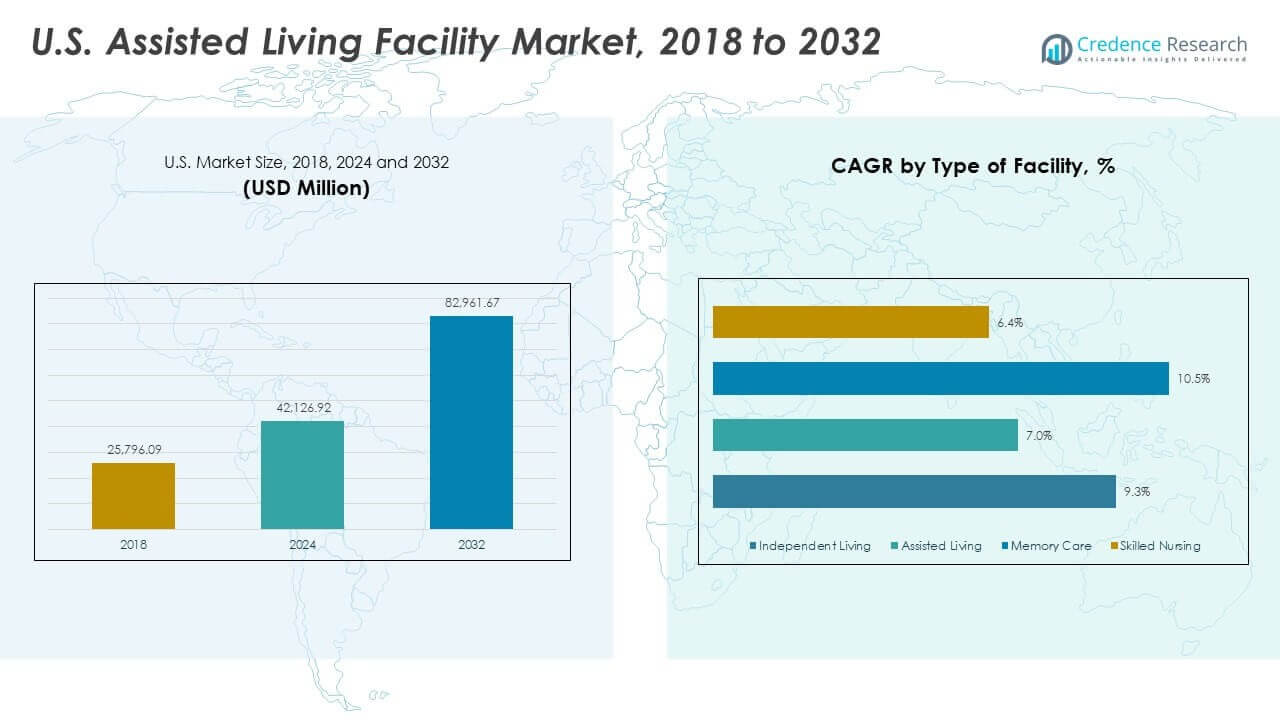
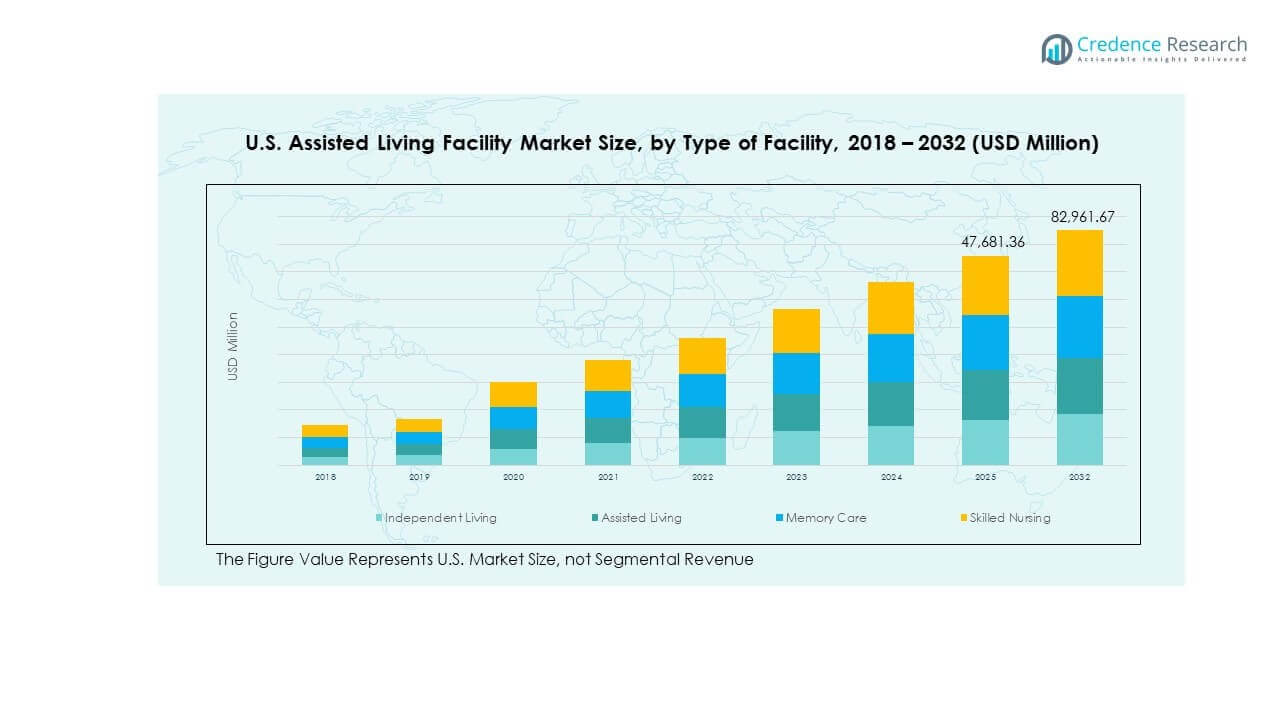
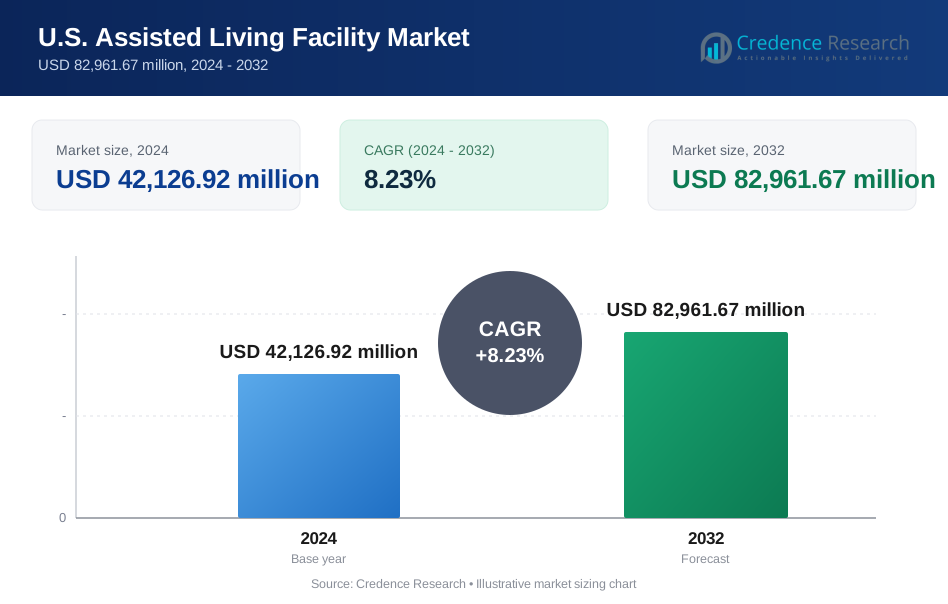
The U.S. Assisted Living Facility Market size was valued at USD 25,796.09 million in 2018, reached USD 42,126.92 million in 2024, and is anticipated to reach USD 82,961.67 million by 2032, growing at a CAGR of 8.23% during the forecast period.
| REPORT ATTRIBUTE | DETAILS |
|---|---|
| Historical Period | 2020-2023 |
| Base Year | 2024 |
| Forecast Period | 2025-2032 |
| U.S. Assisted Living Facility Market Size 2024 | USD 42,126.92 Million |
| U.S. Assisted Living Facility Market, CAGR | 8.23% |
| U.S. Assisted Living Facility Market Size 2032 | USD 82,961.67 Million |
Growth in this market is driven by rising demand for structured care among the aging population. Seniors increasingly seek safe, medically supported environments offering independence with assistance. Changing family structures, longer life expectancy, and higher rates of chronic illness contribute to this trend. Facilities offer services such as daily living support, medication management, and wellness programs. Demand spans across independent living, assisted living, memory care, and skilled nursing models. Technology adoption and improved regulatory frameworks also support facility expansion.
Regionally, the Western U.S. leads the market due to a strong concentration of retirees, favorable climate, and well-established infrastructure. The Southern region follows closely, driven by population growth, lower operating costs, and strong private investment. The Midwest and Northeast regions show steady development, supported by aging populations and expanding healthcare networks. Each region responds to local demographic trends, facility saturation, and policy frameworks. Urban centers support higher-value service models, while suburban and rural areas attract mid-range facility investments.
Market Insights
- The U.S. Assisted Living Facility Market expanded from USD 25,796.09 million in 2018 to USD 42,126.92 million in 2024 and is projected to reach USD 82,961.67 million by 2032, reflecting sustained expansion supported by an 8.23% CAGR.
- The Western region led the market with a 31% share, driven by strong retiree inflows, advanced healthcare systems, and high facility density, while the South followed with 29% due to favorable demographics and investment conditions, and the Midwest held 21% supported by affordability and stable senior populations.
- The South emerged as the fastest-growing region with a 29% share, supported by population migration, lower operating costs, and expanding private-sector assisted living developments.
- Assisted living accounted for the dominant segment share, supported by a 10.5% CAGR, while skilled nursing followed closely with a 9.3% CAGR, reflecting rising demand for higher-acuity care services.
- Memory care and independent living segments showed steady growth, with CAGRs of 7.0% and 6.4% respectively, supported by increasing cognitive care needs and sustained demand for independent senior living environments.
Market Drivers
Aging Demographics and Longer Life Expectancy Fueling Demand for Residential Senior Care
The growing population of Americans aged 65 and older directly drives the U.S. Assisted Living Facility Market. Advances in healthcare have extended life expectancy, increasing the need for long-term care options. Many seniors live alone or experience chronic illnesses that limit daily independence. Families look for supervised settings where safety, social interaction, and medical support are available. Demand rises as traditional multigenerational caregiving models decline. Assisted living facilities offer a middle ground between home care and nursing homes. These setups support aging individuals with tailored services, improving comfort and security. This demographic trend strengthens the long-term demand outlook.
Changing Family Structures and Urbanization Supporting Facility-Based Living Models
Smaller households and dual-income families limit time available for at-home elder care. Urban lifestyles reduce space and caregiving capacity in many homes. These social changes push families toward structured senior living options. The U.S. Assisted Living Facility Market benefits from this shift as it meets both personal care and lifestyle needs. Facilities provide 24/7 staffing, scheduled routines, and accessible amenities. This arrangement appeals to families seeking reliable care with minimal disruption. The market aligns with new living patterns that prioritize autonomy with safety. Institutional care is increasingly seen as a practical solution for modern families.
- For example, Brookdale Senior Living offers technology‑driven resident engagement programs such as ConnectedLiving®, which provide seniors with access to digital communication tools and support to stay connected with family and online resources. These programs aim to improve social interaction and resident quality of life within its communities.
Rising Incidence of Chronic Conditions Requiring Daily Support Services
Seniors often face multiple chronic illnesses that require consistent medication and monitoring. Conditions such as dementia, diabetes, and arthritis affect mobility and daily activity. Assisted living facilities help manage these conditions through trained staff and on-site services. The U.S. Assisted Living Facility Market gains from demand for stable, supervised environments. Health-related needs make at-home care complex and costly. Structured facilities offer medication management, physical therapy, and nutritional planning. These services lower emergency risks and enhance quality of life. Rising chronic illness prevalence ensures steady demand across aging populations.
- For example, SafelyYou’s AI‑enabled fall detection system in senior living communities has been shown to reduce overall resident falls by up to 40% and cut fall‑related emergency department visits by around 80%, based on industry case studies and research outcomes.
Increased Awareness of Assisted Living Benefits Through Healthcare Outreach and Referrals
Healthcare providers, insurers, and advocacy groups increasingly promote assisted living as a care model. Public campaigns and discharge planners introduce families to structured facility-based care. The U.S. Assisted Living Facility Market grows as families gain clarity on options beyond nursing homes. Patients leaving hospitals often transition to assisted living for post-acute support. This pathway supports faster hospital turnover and lower readmission rates. Payers and providers benefit from cost-effective care continuity. As awareness spreads, more families proactively explore assisted living before health crises occur. Early planning supports stable occupancy growth across the country.
Market Trends
Integration of Smart Monitoring Technologies to Improve Resident Safety and Facility Efficiency
Assisted living providers are adopting smart monitoring systems to track resident health and movement. Wearable devices and sensors detect falls, medication compliance, and sleep patterns. This trend enhances safety while reducing staff strain. The U.S. Assisted Living Facility Market sees growing demand for such systems from both families and operators. Smart alerts reduce emergency response times and help monitor chronic conditions. Facilities use analytics to plan interventions and customize care. Technology allows remote oversight by medical professionals when needed. These tools support leaner staffing without compromising care. Adoption is rising across both new and retrofit facilities.
Personalized Wellness Programs Becoming Standard Across Premium and Mid-Tier Facilities
Residents increasingly expect holistic wellness experiences beyond basic care. Facilities now offer physical therapy, mental health sessions, and social programming tailored to individual needs. This personalization improves resident satisfaction and outcomes. The U.S. Assisted Living Facility Market responds by integrating activity coordinators, fitness trainers, and mental health support. Facilities with diverse programming attract more residents and see lower churn. Wellness tracking tools and lifestyle coaches also add value. Custom plans create a community feel while promoting health. This trend supports differentiation in a competitive market.
- For example, Atria Senior Living's Life Guidance® program delivers personalized dementia care through the Best Friends™ approach. It includes staff training focused on building trust, connection, and emotional engagement in memory care settings.
Hospital Partnerships and Step-Down Care Models Expanding Transitional Care Role
Hospitals seek cost-effective post-discharge destinations for elderly patients. Assisted living centers increasingly fill this role as transitional or step-down care hubs. These partnerships reduce hospital burden while boosting facility occupancy. The U.S. Assisted Living Facility Market benefits from formal ties to healthcare systems. Operators invest in rehabilitation services and temporary care suites. This allows smoother patient handoffs and revenue from short-term stays. Facilities also gain clinical credibility and insurer recognition. As healthcare networks expand, these ties become a strategic growth lever.
Rise of Boutique and Thematic Facilities Targeting Lifestyle-Oriented Seniors
Developers are launching facilities focused on specific cultural, dietary, or lifestyle needs. These include faith-based homes, LGBTQ+-friendly communities, and luxury resort-style campuses. Such niche offerings target well-informed seniors seeking identity-aligned care. The U.S. Assisted Living Facility Market sees rising investment in these high-appeal formats. They offer specialized staff, cuisine, and activities matching resident preferences. Boutique facilities support brand loyalty and word-of-mouth referrals. Occupancy tends to be strong in these concept-driven centers. This trend supports market segmentation and targeted marketing strategies.
- For example, Maplewood Senior Living promotes inclusive senior care and has publicly supported LGBTQ+-friendly initiatives. It emphasizes dignity, respect, and tailored programming across its communities, aligning with broader diversity and inclusion goals.
Market Challenges Analysis
Workforce Shortages and High Turnover Rates Impacting Service Quality and Cost Control
The sector struggles with chronic labor shortages, especially in caregiving and nursing roles. Staff burnout, limited advancement, and low wages contribute to high turnover. The U.S. Assisted Living Facility Market faces mounting pressure to attract and retain qualified workers. Operators increase wages and incentives, raising operational costs. Frequent staff changes affect resident satisfaction and care continuity. Training new employees requires time and investment. Quality metrics drop when teams lack experience or consistency. Staffing challenges limit expansion plans, especially in rural or high-cost labor regions. Workforce development remains a critical barrier to long-term stability.
Complex Regulatory Landscape and Rising Compliance Costs Restricting Operational Agility
Facilities must comply with a patchwork of federal, state, and local regulations. These cover safety, staffing, medication handling, and resident rights. The U.S. Assisted Living Facility Market contends with evolving rules that often differ by state. Meeting inspection standards requires constant documentation and administrative oversight. Noncompliance risks license suspension or financial penalties. Smaller operators struggle with compliance burdens and may exit the market. This limits competition and raises entry barriers. Regulatory uncertainty delays innovation and infrastructure investment. Operators must allocate resources to legal and compliance functions, diverting funds from resident services.
Market Opportunities
Rising Demand in Middle-Income Senior Segment Enables Scaled Facility Development
Many seniors require affordable care options with moderate comfort and access. This group remains underserved by luxury facilities and underfunded public care. The U.S. Assisted Living Facility Market can expand through mid-priced communities offering essential services with reliable quality. Developers can use standardized models, regional clustering, and technology to manage costs. Public-private partnerships and tax incentives can support these builds. This segment supports long-term occupancy and generates stable cash flow. Scaling this model meets growing demand and promotes regional equity.
Technology-Driven Remote Care Integration Unlocks New Service Formats and Revenue Models
Advancements in telehealth, mobile health platforms, and remote diagnostics enable hybrid care models. Assisted living facilities can offer remote specialist consults and virtual family check-ins. The U.S. Assisted Living Facility Market gains by extending service reach without large staff increases. Technology allows smaller facilities to compete by offering premium monitoring and engagement. Subscription-based digital services open new revenue streams. This approach supports flexibility in care delivery and appeals to tech-savvy residents and caregivers.
Market Segmentation Analysis
By Type of Facility
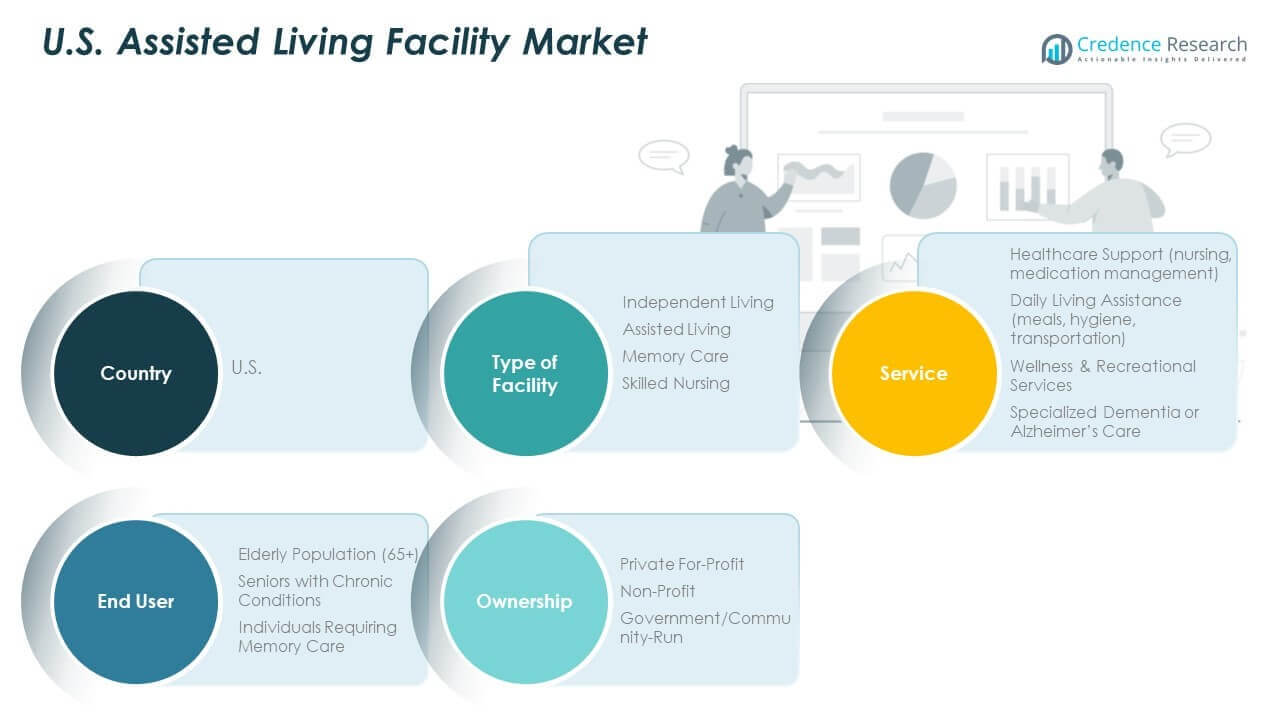
Independent living facilities attract seniors seeking autonomy with minimal support. These communities focus on lifestyle, offering private residences, amenities, and social engagement. Assisted living remains the most in-demand type, supporting individuals who require help with activities like bathing or medication. Memory care units serve residents with cognitive impairments, offering secure environments and trained staff. Skilled nursing provides high-level medical care and daily supervision, often regulated under clinical guidelines. The U.S. Assisted Living Facility Market sees diversified growth across these types due to varying levels of dependency among aging individuals.
- For example, Atria Senior Living has explored digital engagement tools to support resident communication and care coordination. Its focus on technology aims to enhance the resident experience and improve staff responsiveness in memory care and assisted living communities.
By Service
Healthcare support services remain central to facility operations, driven by chronic illness prevalence among seniors. Nursing staff and medication management ensure clinical compliance and safety. Daily living assistance is essential for mobility-restricted or low-functioning residents. Meals, hygiene, and transport services improve quality of life. Wellness and recreational services promote mental and emotional well-being. Facilities use tailored activity programs to increase resident engagement. Specialized dementia or Alzheimer’s care includes sensory programs, memory therapies, and secure living arrangements. Service integration supports retention and brand reputation.
By End User
The elderly population aged 65+ drives the majority of facility demand. This group requires varying levels of care, creating demand across multiple service tiers. Seniors with chronic conditions need regular monitoring, which facilities deliver through routine health checks and managed care plans. Individuals with memory care needs require structured environments with trained professionals. The U.S. Assisted Living Facility Market adapts service models to these user groups to ensure care continuity and safety.
- For example, Life Care Centers of America has adopted advanced monitoring technologies to support resident safety and clinical oversight in its communities. These systems help staff identify changes in resident health patterns and respond more quickly to care needs.
By Ownership
Private for-profit operators dominate the market with scalable models and investor backing. These firms expand aggressively in high-demand regions. Non-profit facilities focus on community health missions and often serve low- to middle-income groups. Government or community-run centers fill care gaps in underserved areas. Ownership models influence service quality, pricing, and operational strategy across the U.S. Assisted Living Facility Market.
Segmentation
By Type of Facility
- Independent Living
- Assisted Living
- Memory Care
- Skilled Nursing
By Service
- Healthcare Support (nursing, medication management)
- Daily Living Assistance (meals, hygiene, transportation)
- Wellness & Recreational Services
- Specialized Dementia or Alzheimer’s Care
By End User
- Elderly Population (65+)
- Seniors with Chronic Conditions
- Individuals Requiring Memory Care
By Ownership
- Private For-Profit
- Non-Profit
- Government/Community-Run
By Country
- United States (U.S.)
Regional Analysis
The Western region leads the U.S. Assisted Living Facility Market, accounting for around 31% of total market share. States like California, Washington, and Arizona contribute significantly due to large elderly populations and a strong preference for climate-friendly retirement destinations. California alone drives considerable demand, supported by a high concentration of private operators and advanced healthcare infrastructure. Urban centers continue to expand assisted living capacity to meet growing local needs. Regulatory support and active retirement migration from colder states strengthen market positioning in this region. Demand remains strong across both coastal metros and smaller suburban cities.
The Southern region holds approximately 29% market share, led by states like Florida, Texas, and Georgia. Florida remains a key growth driver due to its reputation as a top retirement destination and large 65+ demographic. Texas supports strong expansion through both urban and rural developments, driven by rising chronic condition cases and growing middle-income aging populations. The region benefits from favorable tax policies, lower operating costs, and strong investor interest in new developments. The U.S. Assisted Living Facility Market sees consistent facility openings across this region, targeting both full-service and memory care offerings. Localized service models help operators address cultural and community needs.
The Midwestern and Northeastern regions collectively hold around 40% of the market share. The Midwest contributes about 21%, supported by stable senior populations in states like Illinois, Ohio, and Michigan. These states benefit from lower construction costs and strong Medicaid-linked occupancy. The Northeast, with an estimated 19% share, includes high-density states such as New York, Pennsylvania, and Massachusetts. High service demand offsets the impact of stricter regulations and higher facility costs. Urban cores and aging industrial towns offer significant opportunities for memory care and skilled nursing developments. Both regions see steady growth through public-private partnerships and non-profit providers.
Key Player Analysis
- Brookdale Senior Living
- Sunrise Senior Living
- Life Care Services
- Atria Senior Living
- Holiday Retirement
- Five Star Senior Living
- Enlivant
- Capital Senior Living
- Senior Lifestyle Corporation
- Benchmark Senior Living
Competitive Analysis
The U.S. Assisted Living Facility Market remains moderately consolidated, with several national chains and a large number of regional players. Brookdale Senior Living holds a leading position, offering wide geographic coverage and a full range of care services. Sunrise Senior Living and Atria Senior Living follow closely, focusing on upscale communities with strong customer engagement and wellness programs. Life Care Services and Five Star Senior Living maintain notable market presence through tailored care models and established brands across multiple regions. Competition centers around service differentiation, geographic expansion, staff quality, and integration of digital technologies. Larger operators leverage scale to invest in facility upgrades, resident monitoring systems, and personalized care platforms. Private equity investment continues to support market consolidation, driving acquisitions of smaller chains in high-demand areas. Operators prioritize occupancy growth, resident satisfaction, and regulatory compliance to stay competitive. In highly saturated states like Florida, California, and Texas, market leaders emphasize innovation in wellness, memory care, and hybrid living models. As demand rises, strategic partnerships, targeted marketing, and workforce development will remain critical to maintaining a strong competitive edge across all regions.
Recent Developments
- In May 2025, Sunrise Senior Living announced a strategic partnership with Griffin Living adding two premium boutique-style communities in California Varenita of Simi Valley and Varenita of Westlake to its portfolio of over 240 U.S. and Canadian communities focused on assisted living and memory care.
Report Coverage
The research report offers an in-depth analysis based on Type of Facility, Service, End User and Ownership. It details leading market players, providing an overview of their business, product offerings, investments, revenue streams, and key applications. Additionally, the report includes insights into the competitive environment, SWOT analysis, current market trends, as well as the primary drivers and constraints. Furthermore, it discusses various factors that have driven market expansion in recent years. The report also explores market dynamics, regulatory scenarios, and technological advancements that are shaping the industry. It assesses the impact of external factors and global economic changes on market growth. Lastly, it provides strategic recommendations for new entrants and established companies to navigate the complexities of the market.
Future Outlook
- Demand will rise steadily due to a growing elderly population requiring structured residential care.
- Memory care and chronic illness services will gain traction as core facility offerings.
- Mid-income facility models will expand to address affordability gaps in underserved regions.
- Urban and suburban developments will remain strong, driven by proximity to hospitals and families.
- Technology adoption in monitoring, emergency alerts, and virtual consultations will improve care delivery.
- Partnerships between hospitals and assisted living operators will increase for transitional care support.
- Staffing models will shift toward efficiency with continued workforce training and retention programs.
- Private for-profit operators will lead expansion, while non-profits will target community-driven growth.
- Regional diversification will strengthen, with more investment in the Midwest and Southern states.
- Wellness and lifestyle-based amenities will drive occupancy rates in competitive urban markets.
Request a Free Sample
Fill in your details and we'll send you a free sample report.
- Sample data tables & charts
- Research methodology
Need a Custom Version of This Report?
Tailor the scope, geography, or segments to your exact requirements.
- Custom geography or segment scope
- Direct access to our analyst team
Frequently Asked Questions
What is the current market size for U.S. Assisted Living Facility Market, and what is its projected size in 2032?
At what Compound Annual Growth Rate is the U.S. Assisted Living Facility Market projected to grow between 2024 and 2032?
Which U.S. Assisted Living Facility Market segment held the largest share in 2024?
What are the primary factors fueling the growth of the U.S. Assisted Living Facility Market?
Who are the leading companies in the U.S. Assisted Living Facility Market?
Which region commanded the largest share of the U.S. Assisted Living Facility Market in 2024?
Table of Content
Chapter 1. Report Introduction
- 1.1 Report Description & Purpose
- 1.1.1 Report Title & Market Definition
- 1.1.2 Unique Selling Propositions (USP) & Key Differentiators
- 1.1.3 Value Proposition for Stakeholders
- 1.2 Research Objectives
- 1.2.1 Market Sizing Objectives (Volume & Revenue)
- 1.2.2 Segmentation Objectives
- 1.2.3 Competitive Intelligence Objectives
- 1.2.4 Forecast & Scenario Objectives
- 1.3 Report Scope
- 1.3.1 U.S. Assisted Living Facility Scope – Types & Subtypes Covered
- 1.3.2 Geographic Scope – Regions & Countries Covered
- 1.3.3 Historical Period, Base Year & Forecast Period (2024; forecast to 2032)
- 1.3.4 Inclusions & Exclusions
- 1.4 HS Code & Classification Framework
- 1.5 Currency, Units & Pricing Basis
- 1.6 Target Stakeholders
- 1.7 Limitations & Assumptions
Chapter 2. Executive Summary
- 2.1 Global U.S. Assisted Living Facility Market Snapshot
- 2.1.1 Market Size – Historical (2024) & Forecast (2024-2032) (2024: USD 42,126.92 million → 2032: USD 82,961.67 million)
- 2.1.2 Volume & Revenue – Global Totals
- 2.1.3 Key Market Highlights – Top Five Facts
- 2.2 U.S. Assisted Living Facility Market Segmentation Snapshot
- 2.2.1 Market Split by Region – 2024 vs. 2032
- 2.3 Competitive Snapshot
- 2.3.1 Top 10 Players by Revenue Share – 2024
- 2.3.2 Top 10 Players by Volume Share – 2024
- 2.3.3 Recent Strategic Developments (18-Month Summary)
- 2.4 Key Investment Highlights & Strategic Conclusions
Chapter 3. U.S. Assisted Living Facility Market Dynamics & Industry Analysis
- 3.1 Market Overview & Context
- 3.1.1 U.S. Assisted Living Facility Market Position in the Broader Automotive Value Chain
- 3.1.2 OEM vs. Replacement Market Dynamics
- 3.1.3 Market Maturity & Development Stage by Region
- 3.2 U.S. Assisted Living Facility Market Drivers
- 3.3 U.S. Assisted Living Facility Market Restraints & Challenges
- 3.4 U.S. Assisted Living Facility Market Opportunities
- 3.5 Porter's Five Forces Analysis
- 3.5.1 Threat of New Entrants
- 3.5.2 Bargaining Power of Suppliers
- 3.5.3 Bargaining Power of Buyers
- 3.5.4 Threat of Substitutes
- 3.5.5 Competitive Rivalry – Intensity Assessment
- 3.6 U.S. Assisted Living Facility Value Chain Analysis
- 3.6.1 Upstream – Raw Material/Input Suppliers
- 3.6.1.1 Raw Material/Input 1
- 3.6.1.2 Raw Material/Input 2
- 3.6.1.3 Raw Material/Input 3
- 3.6.2 Midstream – Production/Manufacturing/Service Delivery
- 3.6.2.1 Production/Process Overview
- 3.6.2.2 Key Facility Locations & Capacity by Manufacturer
- 3.6.3 Downstream – Distribution & End Consumer
- 3.6.3.1 Primary Channel – B2B/OEM
- 3.6.3.2 Secondary Channels – Dealer, Retail, Online, Direct
- 3.6.4 Value Chain Profitability Analysis
- 3.6.1 Upstream – Raw Material/Input Suppliers
- 3.7 PESTEL Analysis
- 3.7.1 Political Factors
- 3.7.2 Economic Factors
- 3.7.3 Social Factors
- 3.7.4 Technological Factors
- 3.7.5 Environmental Factors
- 3.7.6 Legal Factors
- 3.8 U.S. Assisted Living Facility Supply Chain Analysis
- 3.8.1 Raw Material/Input Supply Risk Assessment
- 3.8.2 Manufacturing Concentration Risk (Geographic Exposure)
- 3.8.3 Trade Disruption Impact Analysis
- 3.9 Regulatory & Policy Landscape
Note: The regulatory and policy landscape section covers regulations based on their applicability to the market, U.S. Assisted Living Facility category, geography, and scope of the study. Only regulatory frameworks with a material impact on operations, compliance, trade, sustainability, or market access are analyzed in detail.
Chapter 4. Key Investment Pockets & Opportunity Analysis
- 4.1 U.S. Assisted Living Facility Market Attractiveness Analysis
- 4.1.1 By Region – Investment Attractiveness Matrix (Volume × CAGR)
- 4.2 Absolute Revenue Growth Opportunity
- 4.2.1 By Region – Absolute USD Growth Through 2032
- 4.3 Incremental Volume Opportunity
- 4.3.1 By Region – Incremental Volume Through 2032
- 4.3.2 Segment – Incremental Volume
- 4.4 Emerging Submarket Opportunity Deep Dive (Subject to Applicability)
- 4.5 Emerging Market Opportunity Scorecards
- 4.5.1 United States
- 4.5.2 Europe
- 4.5.3 Asia
- 4.5.4 Middle East & Africa
Note: Emerging Market Opportunity Scorecards will be included based on relevance and strategic importance. Regions listed are indicative and may vary depending on data availability and market dynamics.
Chapter 5. U.S. Assisted Living Facility Import-Export Analysis & Trade Flows
- 5.1 Global Trade Overview
- 5.1.1 Global Export Value by Country (2024)
- 5.1.2 Global Export Volume by Country (2024)
- 5.1.3 Global Import Value by Country (2024)
- 5.1.4 Global Import Volume by Country (2024)
- 5.1.5 Net Trade Balance by Country (2024)
- 5.2 Export Analysis – Segment
- 5.2.1 Type 1 (HS Code)
- 5.2.2 Type 2 (HS Code)
- 5.2.3 Type 3 (HS Code)
- 5.2.4 Type 4 (HS Code)
- 5.2.5 Type 5 (HS Code)
- 5.3 Import Analysis – Segment
- 5.3.1 Type 1 (HS Code)
- 5.3.2 Type 2 (HS Code)
- 5.3.3 Type 3 (HS Code)
- 5.3.4 Type 4 (HS Code)
- 5.3.5 Type 5 (HS Code)
- 5.4 Average Unit Trade Prices
- 5.4.1 Average Export Price – Segment & Country
- 5.4.2 Average Import Price – Segment & Source Country
- 5.4.3 Price Trends (2024)
- 5.5 Key Trade Route Analysis
- 5.5.1 Trade Route 1
- 5.5.2 Trade Route 2
- 5.5.3 Trade Route 3
- 5.5.4 Trade Route 4
- 5.5.5 Trade Route 5
- 5.6 Trade Policy Impact Assessment
- 5.6.1 US Anti-Dumping & Section 301 Tariffs
- 5.6.2 EU Customs Union Impact
- 5.6.3 Major Free Trade Agreements
- 5.6.4 USMCA Rules of Origin
Note: Trade policy analysis will be included only where relevant to the U.S. Assisted Living Facility market.
Chapter 6. Competitive Landscape & Company Benchmarking
- 6.1 U.S. Assisted Living Facility Market Concentration & Structure
- 6.1.1 Herfindahl-Hirschman Index (HHI) – vs. 2024
- 6.1.2 Tier 1, Tier 2 & Tier 3 Market Structure
- 6.1.3 Global, Regional & Local Player Dynamics
- 6.2 U.S. Assisted Living Facility Market Share Analysis – 2024
- 6.2.1 Global Revenue Share by Company
- 6.2.2 Global Volume Share by Company
- 6.2.3 Regional Revenue Share
- 6.2.4 Market Share Evolution ( vs. 2024)
- 6.2.5 OEM Segment Share by Company
- 6.2.6 Replacement Segment Share by Company
- 6.3 Production/Delivery Capacity & Facility Analysis
- 6.3.1 Global Installed Capacity
- 6.3.2 Capacity Utilization Rates
- 6.3.3 Production/Output Volume
- 6.3.4 Facility Locations & Capacity Map
- 6.3.5 Planned Capacity Additions
- 6.4 U.S. Assisted Living Facility Competitive Benchmarking Matrix
- 6.4.1 Revenue, Volume, CAGR & Profitability Comparison
- 6.4.2 Channel Revenue Mix
- 6.4.3 Geographic Revenue Exposure
- 6.4.4 R&D Intensity
- 6.4.5 Sustainability Maturity
- 6.5 Strategic Developments in U.S. Assisted Living Facility (Last 24 Months)
- 6.5.1 Mergers, Acquisitions & Divestments
- 6.5.2 New U.S. Assisted Living Facility Launches
- 6.5.3 Facility Expansions
- 6.5.4 Strategic Alliances, Joint Ventures & Partnerships
- 6.5.5 Distribution Expansion & Market Entry
- 6.5.6 Sustainability & ESG Initiatives
- 6.6 Competitive Strategy Mapping
- 6.6.1 Leader, Challenger, Follower & Niche Classification
- 6.6.2 Pricing Strategy Comparison
- 6.6.3 Channel Strategy Matrix
Note: Strategic developments are included based on their materiality and the availability of reliable information.
Chapter 7. Global U.S. Assisted Living Facility Market – By Distribution Channel
- 7.1 Segment Overview
- 7.1.1 Volume & Revenue Split by Channel (2024 & 2032)
- 7.1.2 Channel Mix Evolution (2024-2032)
Chapter 8. Regional Market Analysis – Global Overview
- 8.1 Global Regional Overview
- 8.1.1 Regional Volume Share
- 8.1.2 Regional Revenue Share
- 8.1.3 Regional Volume by Region
- 8.1.4 Regional Revenue by Region
- 8.1.5 Regional Forecast Through 2032
- 8.2 Cross-Regional Segment Analysis
- 8.2.1 By Distribution Channel
- 8.2.2 By Brand/Price Tier
Chapter 9. North America U.S. Assisted Living Facility Market
- 9.1 United States
- 9.2 Canada
- 9.3 Mexico
Chapter 10. Europe U.S. Assisted Living Facility Market
- 10.1 Germany
- 10.2 France
- 10.3 Italy
- 10.4 United Kingdom
- 10.5 Spain
- 10.6 Poland
- 10.7 Russia
- 10.8 Netherlands
- 10.9 Belgium
- 10.10 Sweden
- 10.11 Denmark
- 10.12 Norway
- 10.13 Rest of Europe
Chapter 11. Asia Pacific U.S. Assisted Living Facility Market
- 11.1 China
- 11.2 India
- 11.3 Japan
- 11.4 South Korea
- 11.5 Thailand
- 11.6 Indonesia
- 11.7 Vietnam
- 11.8 Malaysia
- 11.9 Australia
- 11.10 Rest of Asia Pacific
Chapter 12. Latin America U.S. Assisted Living Facility Market
- 12.1 Brazil
- 12.2 Argentina
- 12.3 Colombia
- 12.4 Chile
- 12.5 Rest of Latin America
Chapter 13. Middle East U.S. Assisted Living Facility Market
- 13.1 Saudi Arabia
- 13.2 United Arab Emirates
- 13.3 Turkey
- 13.4 Israel
- 13.5 Iran
- 13.6 Rest of the Middle East
Chapter 14. Africa U.S. Assisted Living Facility Market
- 14.1 South Africa
- 14.2 Egypt
- 14.3 Nigeria
- 14.4 Morocco
- 14.5 Rest of Africa
Chapter 15. U.S. Assisted Living Facility Company Profiles
- 15.1 [Company 01]
- 15.1.1 Company Overview
- 15.1.2 Key Management Personnel
- 15.1.3 Products & Services Portfolio
- 15.1.4 Financial Performance
- 15.1.5 Key Market Focus & Geographic Presence
- 15.1.6 Recent Developments & Strategic Initiatives
Note: The company profile list is preliminary and may change based on research findings, market developments, data availability, and client requirements.
Chapter 16. Appendices
- Appendix A – List of Abbreviations & Acronyms
- Appendix B – Industry Classification Code Reference – Full Series
- Appendix C – Production & Capacity Data Tables
- Appendix D – End-Use & Demand Base Tables
- Appendix E – Consumption & Replacement Rate Assumptions
- Appendix F – ASP Reference Tables
- Appendix G – Manufacturing & Facility Database
- Appendix H – Import-Export Data Tables
- Appendix I – Regulatory Summary Tables
- Appendix J – Primary Research Participant List (Anonymized)
- Appendix K – Primary Research Questionnaire Framework
- Appendix L – Data Sources & Bibliography
- Appendix M – Market Size Divergence & Source Comparison
Chapter 17. Research Methodology
- 17.1 Research Framework & Philosophy
- 17.2 Secondary Research – Sources, Hierarchy & Data Extraction
- 17.3 Data Modeling – Bottom-Up & Top-Down Market Sizing
- 17.4 Primary Research – Stakeholder Framework, LOI & Sample Sizes
- 17.5 Forecast Methodology – Regression, Scenario & Sensitivity Analysis
- 17.6 Quality Control – Four-Layer Validation Framework
- 17.7 Limitations & Standard Assumptions
- 17.8 Disclaimer
