
Market Overview:
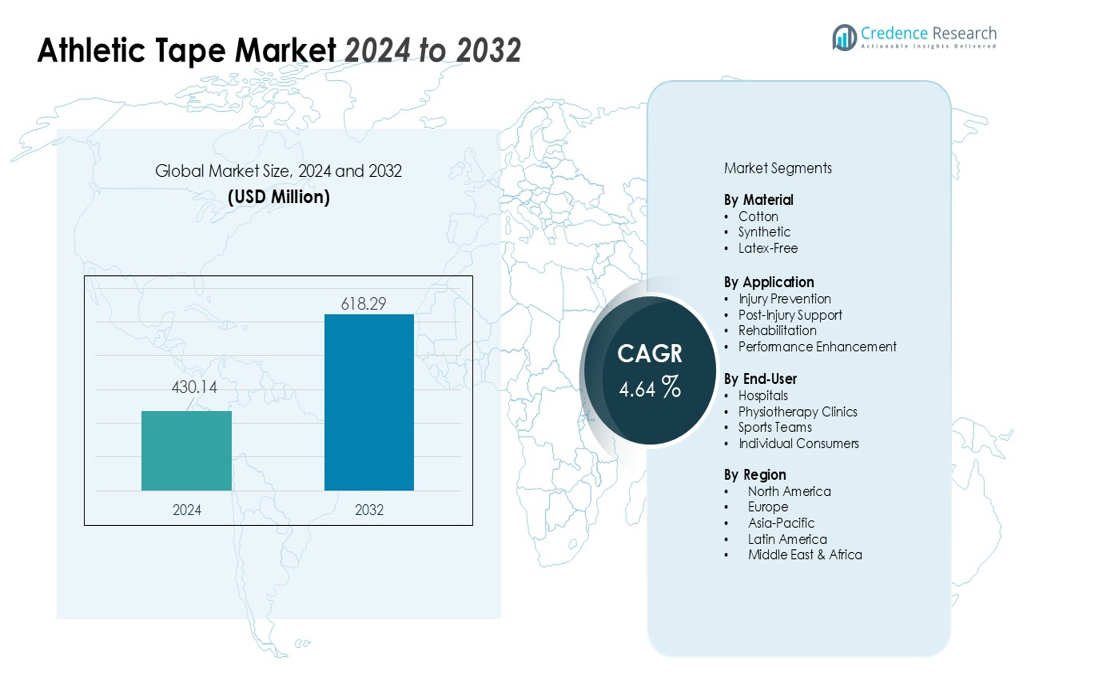
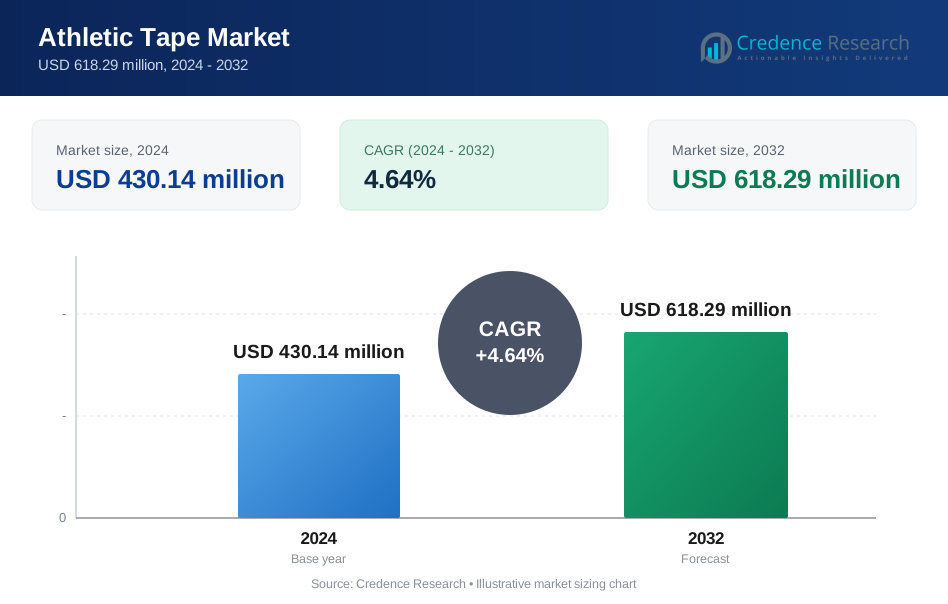
The athletic tape market size was valued at USD 430.14 million in 2024 and is anticipated to reach USD 618.29 million by 2032, at a CAGR of 4.64 % during the forecast period.
| REPORT ATTRIBUTE | DETAILS |
|---|---|
| Historical Period | 2020-2023 |
| Base Year | 2024 |
| Forecast Period | 2025-2032 |
| Athletic Tape Market Size 2024 | USD 430.14 million |
| Athletic Tape Market, CAGR | 4.64% |
| Athletic Tape Market Size 2032 | USD 618.29 million |
Key market drivers include the surge in sports participation, expanding physiotherapy and sports medicine services, and growing awareness of injury-prevention practices. Increasing incidences of sprains, strains, and repetitive-use injuries heighten reliance on kinesiology and rigid athletic tapes for enhanced performance and recovery. Manufacturers introduce breathable, latex-free, water-resistant, and hypoallergenic variants to meet user expectations for comfort and durability. Growing e-commerce availability, athlete endorsements, and rising adoption of sports training programs further strengthen market momentum.
Regionally, North America leads due to widespread participation in organized sports, advanced sports medicine infrastructure, and premium product adoption. Europe follows with strong demand from professional leagues and physiotherapy centers emphasizing preventive care. Asia-Pacific is the fastest-growing region, driven by increasing fitness awareness, expanding youth sports participation, and rising investments in athletic facilities across China, India, Japan, and Southeast Asia.
Market Insights:
- The athletic tape market is projected to grow from USD 430.14 million (2024) to USD 618.29 million (2032), supported by a CAGR of 4.64% during the forecast period.
- Rising sports injuries, including sprains and strains, are driving increased use of kinesiology and rigid tapes for joint stability and injury prevention.
- Expansion of physiotherapy, rehabilitation, and sports medicine facilities boosts product adoption for recovery support, swelling reduction, and movement correction.
- Growing fitness participation, youth sports involvement, and structured training programs accelerate demand across schools, gyms, and community sports setups.
- Product innovation in breathable, latex-free, water-resistant, and hypoallergenic materials strengthens consumer preference for high-performance athletic tapes.
- Market challenges include skin sensitivity issues, adhesive inconsistency under intense activity, and rising concerns over counterfeit low-quality products.
- Regionally, North America leads due to advanced sports infrastructure, while Asia-Pacific emerges as the fastest-growing market driven by expanding fitness culture and youth sports participation.
Market Drivers:
Rising Incidence of Sports Injuries and Growing Focus on Preventive Support
The athletic tape market benefits from increasing cases of sprains, strains, and joint instabilities across professional and recreational sports. Athletes rely on rigid and elastic tapes to stabilize joints and reduce re-injury risk during training and competition. Sports medicine professionals recommend taping techniques to enhance neuromuscular control and support weakened structures. The trend strengthens market demand as injury-prevention programs gain wider acceptance.
- For instance, Kinesio's Kinesio Tex Gold FP adhesive tape features enhanced breathability and can be worn continuously for 3-5 days in high-sweat conditions, widely used by athletes and medical professionals for injury prevention and support.
Expansion of Physiotherapy, Rehabilitation, and Sports Medicine Services
The athletic tape market gains strong traction from the growth of physiotherapy clinics, rehabilitation centers, and sports medicine facilities. Practitioners use taping applications to improve functional recovery, reduce swelling, and support targeted movement correction. It aligns with clinical protocols that emphasize non-invasive treatment pathways for joint and muscle conditions. Rising investments in outpatient rehabilitation strengthen product usage across diverse patient groups.
- For Instance, The field of sports medicine and rehabilitation is experiencing increased demand due to an aging population and a rise in chronic conditions, leading to widespread adoption of new technologies and therapeutic products, including advanced kinesiology tapes and other clinical supplies
Increasing Fitness Participation and Rapid Growth of Organized Sports
The athletic tape market accelerates with rising participation in fitness programs, gym activities, and competitive sports across all age groups. Youth and amateur athletes use tapes to improve endurance, reduce fatigue, and maintain proper biomechanics. It supports performance enhancement goals that drive higher demand across schools, universities, and community sports structures. Growing emphasis on active lifestyles directly contributes to continuous market expansion.
Product Innovation and Growing Preference for High-Performance Materials
The athletic tape market advances through continuous innovation in breathable, hypoallergenic, and water-resistant materials. Manufacturers develop enhanced adhesive technologies that maintain stability during intense physical activity. It meets consumer expectations for comfort, durability, and skin-friendly performance. Wider acceptance of premium and kinesiology tapes encourages brands to expand portfolios and strengthen their competitive positioning.
Market Trends:
Rising Shift Toward Kinesiology Tapes, Advanced Materials, and Performance-Enhancing Designs
The athletic tape market witnesses strong movement toward kinesiology tapes that support muscle function and reduce strain without restricting mobility. Consumers prefer elastic, breathable, and latex-free materials that improve comfort during extended physical activity. It aligns with the growing demand for skin-friendly, moisture-resistant, and durable tapes suited for high-intensity sports. Brands introduce upgraded adhesive formulations that maintain grip under sweat and water exposure. Digital content from physiotherapists and sports trainers increases awareness of taping techniques and therapeutic benefits. Influencer-led endorsements on fitness platforms encourage wider adoption across amateur and professional athletes.
- For Instance, StrengthTape features an exclusive AllSport™ Adhesive designed to maintain adherence for up to 7 days through exposure to water, sweat, and mud.
Expansion of Customization, Eco-Friendly Offerings, and Smart Taping Solutions
The athletic tape market experiences rising demand for customizable patterns, team-specific colors, and branded variants that enhance user engagement. It pushes companies to diversify portfolios with premium textures, pre-cut strips, and sport-specific formats. Interest in sustainable materials grows as consumers seek tapes made from recycled fibers, organic cotton, and low-impact adhesives. Manufacturers explore biodegradable packaging and eco-certified production processes to strengthen brand positioning. Integration of smart taping concepts, including sensor-compatible tapes for movement analysis, gains traction among high-performance athletes. Wider e-commerce penetration supports rapid product discovery and strengthens the shift toward personalized and performance-driven formulations.
- For instance, PhysioTaping is a manufacturer of customizable wholesale sports tapes that offers private label options and various colors for wholesalers. The company produces standard kinesiology tape widths, typically around 2 inches (5cm), and other common sizes like 1 inch or 3 inches.
Market Challenges Analysis:
Concerns Around Skin Irritation, Adhesive Limitations, and Product Performance Variability
The athletic tape market faces challenges linked to skin sensitivity, inconsistent adhesion, and performance variations across different sports conditions. Some users experience irritation or allergic reactions due to adhesives or synthetic materials. It creates hesitation among athletes who require long-wear stability during intense activity. Adhesive failure under sweat, humidity, or prolonged use reduces tape effectiveness and impacts user confidence. Variability in stretch, durability, and breathability across brands complicates product selection. Rising expectations for premium comfort and reliability pressure manufacturers to improve material quality.
Intense Price Competition, Counterfeit Products, and Limited Consumer Awareness of Proper Use
The athletic tape market encounters strong price pressure from low-cost brands and generic imports that undercut premium offerings. It becomes difficult for established players to differentiate when consumers prioritize affordability over performance. Counterfeit products with weak adhesives and poor-quality materials create safety concerns and damage brand trust. Limited knowledge of proper taping techniques among amateur users restricts optimal product outcomes. Dependence on trained professionals for accurate application can slow adoption in certain regions. Supply chain fluctuations in cotton, polymers, and adhesives further add operational challenges for manufacturers.
Market Opportunities:
Growing Adoption in Preventive Sports Medicine, Fitness Programs, and Rehabilitation Care
The athletic tape market gains opportunities from rising participation in fitness activities, youth sports, and structured training programs. Preventive care attracts strong interest as athletes seek non-invasive support for joints and muscles. It aligns with the expansion of physiotherapy centers that integrate taping into treatment plans for mobility improvement and injury recovery. Demand grows as consumers show higher willingness to use tapes for posture correction, muscle activation, and movement stability. Sports academies and university programs increase product usage to support performance readiness. Wider acceptance in routine fitness lifestyles strengthens long-term market potential.
Innovation in Eco-Friendly Materials, Smart Wearables, and Customized Product Formats
The athletic tape market benefits from technological advancements that enable breathable, hypoallergenic, and eco-conscious material development. It supports consumer preference for sustainable products made from organic fibers and low-impact adhesives. Smart wearable integration creates new avenues for motion tracking and injury-risk analysis. Customizable pre-cut designs, sport-specific variants, and premium adhesive technologies expand application versatility. Digital training platforms help users learn taping methods, improving outcomes and satisfaction. Brands that invest in R&D and tailored product bundles capture growth in both retail and professional sports channels.
Market Segmentation Analysis:
By Material
The athletic tape market divides into cotton, synthetic, and latex-free materials, each serving distinct performance needs. Cotton tapes dominate due to strong breathability, comfort, and ease of tearing during application. Synthetic variants gain traction for their superior elasticity, moisture resistance, and durability during high-intensity sports. It appeals to athletes who require long-wear stability in humid or sweat-heavy conditions. Latex-free options expand steadily as users seek hypoallergenic solutions that reduce skin irritation risks. Rising preference for advanced adhesive technologies strengthens demand for premium material blends.
- For Instance, KT Tape Original Cotton, made from natural cotton fibers, provides breathable and flexible support that lasts for 1 to 3 days through intense physical activity, maintaining comfort and skin ventilation for athletes.
By Application
The athletic tape market covers applications for injury prevention, post-injury support, rehabilitation, and performance enhancement. Injury prevention holds the largest share, driven by widespread use in joint stabilization and muscle alignment. Rehabilitation emerges as a fast-growing segment due to rising physiotherapy visits for sprains, strains, and overuse injuries. It supports controlled movement and accelerates functional recovery across diverse patient groups. Performance enhancement gains visibility as athletes adopt taping to improve posture, reduce fatigue, and increase muscle activation. Growing awareness of kinesiology taping expands usage across professional and amateur sports.
- For Instance, Kinesiology tape, offered by various brands such as KT Tape, RockTape, and Kinesio Tex Tape, is used by athletes and physical therapists to provide support while allowing a full range of motion.
By End-User
The athletic tape market serves hospitals, physiotherapy clinics, sports teams, and individual consumers. Physiotherapy clinics lead usage due to frequent taping interventions for mobility improvement and injury management. Sports teams remain strong adopters as trainers use tapes for daily practice and competition support. It expands within home-use segments as fitness enthusiasts seek accessible taping solutions for stability and muscle support. Hospitals use medical-grade tapes for acute injury care and postoperative recovery. Rising consumer access through e-commerce strengthens demand across all end-user categories.
Segmentations:
By Material
- Cotton
- Synthetic
- Latex-Free
By Application
- Injury Prevention
- Post-Injury Support
- Rehabilitation
- Performance Enhancement
By End-User
- Hospitals
- Physiotherapy Clinics
- Sports Teams
- Individual Consumers
By Region
- North America
- U.S.
- Canada
- Mexico
- Europe
- Germany
- France
- U.K.
- Italy
- Spain
- Rest of Europe
- Asia Pacific
- China
- Japan
- India
- South Korea
- South-east Asia
- Rest of Asia Pacific
- Latin America
- Brazil
- Argentina
- Rest of Latin America
- Middle East & Africa
- GCC Countries
- South Africa
- Rest of the Middle East and Africa
Regional Analysis:
Strong Market Penetration in North America Backed by Advanced Sports Infrastructure
The athletic tape market holds a dominant position in North America due to widespread participation in organized sports and a mature sports medicine ecosystem. Professional leagues, school athletics, and recreational fitness programs generate consistent demand for premium taping products. It benefits from strong adoption of kinesiology and rigid tapes across physiotherapy clinics, sports rehabilitation centers, and home-use settings. Manufacturers introduce advanced adhesive technologies that meet performance expectations under intense physical activity. High consumer spending power supports rapid uptake of high-quality, skin-friendly materials. E-commerce platforms and specialty retailers strengthen regional accessibility and product visibility.
Steady Demand Growth in Europe Supported by Preventive Care Culture and Clinical Integration
The athletic tape market records steady expansion in Europe, where injury-prevention practices and physiotherapy-based recovery protocols hold significant importance. Sports clubs, rehabilitation facilities, and national health systems integrate taping techniques into routine care. It aligns with increased interest in premium, breathable, and hypoallergenic materials that suit diverse athletic and clinical needs. Strong participation in football, rugby, cycling, and indoor sports contributes to continuous product usage. Regulatory emphasis on high-quality medical supplies supports market credibility. Rising awareness of kinesiology taping through professional trainers and digital tutorials broadens consumer adoption.
Fastest Growth in Asia-Pacific Driven by Fitness Expansion and Rising Youth Sports Participation
The athletic tape market experiences the fastest growth in Asia-Pacific due to rising fitness engagement, expanding gym networks, and growing youth involvement in competitive sports. Countries such as China, India, Japan, and South Korea invest heavily in sports development programs and athletic training facilities. It benefits from increasing demand for joint stabilization, performance enhancement, and preventive care solutions. Physiotherapy services expand rapidly across urban centers, where taping becomes a common part of injury management. Consumer interest in cost-effective yet high-performance tapes supports regional volume growth. E-commerce penetration accelerates product availability across developing markets.
Key Player Analysis:
- 3M
- Johnson & Johnson
- Mueller Sports Medicine
- KT Tape
- Nitto Denko Corporation
- SpiderTech
- RockTape
- Kinesio Taping
- Jaybird & Mais
- Cramer Products
- BSN Medical
Competitive Analysis:
The athletic tape market features a competitive landscape shaped by global brands and specialized sports medicine companies that focus on performance, material quality, and product innovation. Leading players such as 3M, Johnson & Johnson, Mueller Sports Medicine, KT Tape, and Nitto Denko Corporation strengthen their positions through continuous advancements in adhesive technology, breathable fabrics, and hypoallergenic formulations. It benefits from diversified portfolios that address both clinical and athletic applications. Companies invest in research to improve elasticity, water resistance, and skin compatibility to meet the expectations of professional and amateur users. Strategic partnerships with sports teams, physiotherapists, and training academies help brands enhance visibility and credibility. Expansion through e-commerce, global distribution networks, and targeted marketing supports stronger penetration across developed and emerging markets.
Recent Developments:
- In August 2025, RockTape introduced a new medical line offering more tape per box at a lower price, aimed at improving pain relief and mobility options for medical professionals.
- In January 2025, KT Tape was acquired by Bridges Consumer Healthcare, as announced in January 2025, this acquisition expands Bridges’ portfolio with KT Tape’s leading kinesiology tape and aims to drive innovation and growth.
Report Coverage:
The research report offers an in-depth analysis based on Material, Application, End-User and Region. It details leading Market players, providing an overview of their business, product offerings, investments, revenue streams, and key applications. Additionally, the report includes insights into the competitive environment, SWOT analysis, current Market trends, as well as the primary drivers and constraints. Furthermore, it discusses various factors that have driven Market expansion in recent years. The report also explores Market dynamics, regulatory scenarios, and technological advancements that are shaping the industry. It assesses the impact of external factors and global economic changes on Market growth. Lastly, it provides strategic recommendations for new entrants and established companies to navigate the complexities of the Market.
Future Outlook:
- Demand for kinesiology and performance-enhancing tapes will rise as athletes seek flexible support that improves mobility and reduces muscle fatigue.
- Growing awareness of preventive injury management will push wider adoption across schools, fitness clubs, and community sports programs.
- Innovation in breathable, hypoallergenic, and eco-conscious materials will shape product development strategies for leading brands.
- Digital training platforms and physiotherapy content will strengthen user confidence in taping techniques and expand home-use adoption.
- Physiotherapy clinics and sports rehabilitation centers will increase tape usage to support structured recovery and mobility correction.
- Premium adhesive technologies with stronger sweat and water resistance will gain preference among high-intensity athletes.
- Smart taping concepts with sensor compatibility will emerge as niche opportunities in professional sports performance analysis.
- E-commerce growth will accelerate product accessibility, helping manufacturers reach new consumer segments across developing markets.
- Customization trends, including pre-cut formats and sport-specific designs, will drive brand differentiation and consumer engagement.
- Collaborations between manufacturers, sports teams, and healthcare providers will reinforce product credibility and strengthen long-term demand.
Request a Free Sample
Fill in your details and we'll send you a free sample report.
- Sample data tables & charts
- Research methodology
Need a Custom Version of This Report?
Tailor the scope, geography, or segments to your exact requirements.
- Custom geography or segment scope
- Direct access to our analyst team
Frequently Asked Questions
What is the current market size for the athletic tape market, and what is its projected size in 2032?
At what Compound Annual Growth Rate is the athletic tape market projected to grow between 2024 and 2032?
Which is the leading region of the market for Athletic Tape?
What are the key drivers for the growth of the Athletic Tape market?
Which is the major segment in the Athletic Tape market by Tape Width?
Who are the leading companies in the athletic tape market?
Table of Content
Chapter 1. Report Introduction
- 1.1 Report Description & Purpose
- 1.1.1 Report Title & Market Definition
- 1.1.2 Unique Selling Propositions (USP) & Key Differentiators
- 1.1.3 Value Proposition for Stakeholders
- 1.2 Research Objectives
- 1.2.1 Market Sizing Objectives (Volume & Revenue)
- 1.2.2 Segmentation Objectives
- 1.2.3 Competitive Intelligence Objectives
- 1.2.4 Forecast & Scenario Objectives
- 1.3 Report Scope
- 1.3.1 Athletic Tape Scope – Types & Subtypes Covered
- 1.3.2 Geographic Scope – Regions & Countries Covered
- 1.3.3 Historical Period, Base Year & Forecast Period (2024; forecast to 2032)
- 1.3.4 Inclusions & Exclusions
- 1.4 HS Code & Classification Framework
- 1.5 Currency, Units & Pricing Basis
- 1.6 Target Stakeholders
- 1.7 Limitations & Assumptions
Chapter 2. Executive Summary
- 2.1 Global Athletic Tape Market Snapshot
- 2.1.1 Market Size – Historical (2024) & Forecast (2024-2032) (2024: USD 430.14 million → 2032: USD 618.29 million)
- 2.1.2 Volume & Revenue – Global Totals
- 2.1.3 Key Market Highlights – Top Five Facts
- 2.2 Athletic Tape Market Segmentation Snapshot
- 2.2.1 Market Split by Region – 2024 vs. 2032
- 2.3 Competitive Snapshot
- 2.3.1 Top 10 Players by Revenue Share – 2024
- 2.3.2 Top 10 Players by Volume Share – 2024
- 2.3.3 Recent Strategic Developments (18-Month Summary)
- 2.4 Key Investment Highlights & Strategic Conclusions
Chapter 3. Athletic Tape Market Dynamics & Industry Analysis
- 3.1 Market Overview & Context
- 3.1.1 Athletic Tape Market Position in the Broader Automotive Value Chain
- 3.1.2 OEM vs. Replacement Market Dynamics
- 3.1.3 Market Maturity & Development Stage by Region
- 3.2 Athletic Tape Market Drivers
- 3.3 Athletic Tape Market Restraints & Challenges
- 3.4 Athletic Tape Market Opportunities
- 3.5 Porter's Five Forces Analysis
- 3.5.1 Threat of New Entrants
- 3.5.2 Bargaining Power of Suppliers
- 3.5.3 Bargaining Power of Buyers
- 3.5.4 Threat of Substitutes
- 3.5.5 Competitive Rivalry – Intensity Assessment
- 3.6 Athletic Tape Value Chain Analysis
- 3.6.1 Upstream – Raw Material/Input Suppliers
- 3.6.1.1 Raw Material/Input 1
- 3.6.1.2 Raw Material/Input 2
- 3.6.1.3 Raw Material/Input 3
- 3.6.2 Midstream – Production/Manufacturing/Service Delivery
- 3.6.2.1 Production/Process Overview
- 3.6.2.2 Key Facility Locations & Capacity by Manufacturer
- 3.6.3 Downstream – Distribution & End Consumer
- 3.6.3.1 Primary Channel – B2B/OEM
- 3.6.3.2 Secondary Channels – Dealer, Retail, Online, Direct
- 3.6.4 Value Chain Profitability Analysis
- 3.6.1 Upstream – Raw Material/Input Suppliers
- 3.7 PESTEL Analysis
- 3.7.1 Political Factors
- 3.7.2 Economic Factors
- 3.7.3 Social Factors
- 3.7.4 Technological Factors
- 3.7.5 Environmental Factors
- 3.7.6 Legal Factors
- 3.8 Athletic Tape Supply Chain Analysis
- 3.8.1 Raw Material/Input Supply Risk Assessment
- 3.8.2 Manufacturing Concentration Risk (Geographic Exposure)
- 3.8.3 Trade Disruption Impact Analysis
- 3.9 Regulatory & Policy Landscape
Note: The regulatory and policy landscape section covers regulations based on their applicability to the market, Athletic Tape category, geography, and scope of the study. Only regulatory frameworks with a material impact on operations, compliance, trade, sustainability, or market access are analyzed in detail.
Chapter 4. Key Investment Pockets & Opportunity Analysis
- 4.1 Athletic Tape Market Attractiveness Analysis
- 4.1.1 By Region – Investment Attractiveness Matrix (Volume × CAGR)
- 4.2 Absolute Revenue Growth Opportunity
- 4.2.1 By Region – Absolute USD Growth Through 2032
- 4.3 Incremental Volume Opportunity
- 4.3.1 By Region – Incremental Volume Through 2032
- 4.3.2 Segment – Incremental Volume
- 4.4 Emerging Submarket Opportunity Deep Dive (Subject to Applicability)
- 4.5 Emerging Market Opportunity Scorecards
- 4.5.1 United States
- 4.5.2 Europe
- 4.5.3 Asia
- 4.5.4 Middle East & Africa
Note: Emerging Market Opportunity Scorecards will be included based on relevance and strategic importance. Regions listed are indicative and may vary depending on data availability and market dynamics.
Chapter 5. Athletic Tape Import-Export Analysis & Trade Flows
- 5.1 Global Trade Overview
- 5.1.1 Global Export Value by Country (2024)
- 5.1.2 Global Export Volume by Country (2024)
- 5.1.3 Global Import Value by Country (2024)
- 5.1.4 Global Import Volume by Country (2024)
- 5.1.5 Net Trade Balance by Country (2024)
- 5.2 Export Analysis – Segment
- 5.2.1 Type 1 (HS Code)
- 5.2.2 Type 2 (HS Code)
- 5.2.3 Type 3 (HS Code)
- 5.2.4 Type 4 (HS Code)
- 5.2.5 Type 5 (HS Code)
- 5.3 Import Analysis – Segment
- 5.3.1 Type 1 (HS Code)
- 5.3.2 Type 2 (HS Code)
- 5.3.3 Type 3 (HS Code)
- 5.3.4 Type 4 (HS Code)
- 5.3.5 Type 5 (HS Code)
- 5.4 Average Unit Trade Prices
- 5.4.1 Average Export Price – Segment & Country
- 5.4.2 Average Import Price – Segment & Source Country
- 5.4.3 Price Trends (2024)
- 5.5 Key Trade Route Analysis
- 5.5.1 Trade Route 1
- 5.5.2 Trade Route 2
- 5.5.3 Trade Route 3
- 5.5.4 Trade Route 4
- 5.5.5 Trade Route 5
- 5.6 Trade Policy Impact Assessment
- 5.6.1 US Anti-Dumping & Section 301 Tariffs
- 5.6.2 EU Customs Union Impact
- 5.6.3 Major Free Trade Agreements
- 5.6.4 USMCA Rules of Origin
Note: Trade policy analysis will be included only where relevant to the Athletic Tape market.
Chapter 6. Competitive Landscape & Company Benchmarking
- 6.1 Athletic Tape Market Concentration & Structure
- 6.1.1 Herfindahl-Hirschman Index (HHI) – vs. 2024
- 6.1.2 Tier 1, Tier 2 & Tier 3 Market Structure
- 6.1.3 Global, Regional & Local Player Dynamics
- 6.2 Athletic Tape Market Share Analysis – 2024
- 6.2.1 Global Revenue Share by Company
- 6.2.2 Global Volume Share by Company
- 6.2.3 Regional Revenue Share
- 6.2.4 Market Share Evolution ( vs. 2024)
- 6.2.5 OEM Segment Share by Company
- 6.2.6 Replacement Segment Share by Company
- 6.3 Production/Delivery Capacity & Facility Analysis
- 6.3.1 Global Installed Capacity
- 6.3.2 Capacity Utilization Rates
- 6.3.3 Production/Output Volume
- 6.3.4 Facility Locations & Capacity Map
- 6.3.5 Planned Capacity Additions
- 6.4 Athletic Tape Competitive Benchmarking Matrix
- 6.4.1 Revenue, Volume, CAGR & Profitability Comparison
- 6.4.2 Channel Revenue Mix
- 6.4.3 Geographic Revenue Exposure
- 6.4.4 R&D Intensity
- 6.4.5 Sustainability Maturity
- 6.5 Strategic Developments in Athletic Tape (Last 24 Months)
- 6.5.1 Mergers, Acquisitions & Divestments
- 6.5.2 New Athletic Tape Launches
- 6.5.3 Facility Expansions
- 6.5.4 Strategic Alliances, Joint Ventures & Partnerships
- 6.5.5 Distribution Expansion & Market Entry
- 6.5.6 Sustainability & ESG Initiatives
- 6.6 Competitive Strategy Mapping
- 6.6.1 Leader, Challenger, Follower & Niche Classification
- 6.6.2 Pricing Strategy Comparison
- 6.6.3 Channel Strategy Matrix
Note: Strategic developments are included based on their materiality and the availability of reliable information.
Chapter 7. Global Athletic Tape Market – By Distribution Channel
- 7.1 Segment Overview
- 7.1.1 Volume & Revenue Split by Channel (2024 & 2032)
- 7.1.2 Channel Mix Evolution (2024-2032)
Chapter 8. Regional Market Analysis – Global Overview
- 8.1 Global Regional Overview
- 8.1.1 Regional Volume Share
- 8.1.2 Regional Revenue Share
- 8.1.3 Regional Volume by Region
- 8.1.4 Regional Revenue by Region
- 8.1.5 Regional Forecast Through 2032
- 8.2 Cross-Regional Segment Analysis
- 8.2.1 By Distribution Channel
- 8.2.2 By Brand/Price Tier
Chapter 9. North America Athletic Tape Market
- 9.1 United States
- 9.2 Canada
- 9.3 Mexico
Chapter 10. Europe Athletic Tape Market
- 10.1 Germany
- 10.2 France
- 10.3 Italy
- 10.4 United Kingdom
- 10.5 Spain
- 10.6 Poland
- 10.7 Russia
- 10.8 Netherlands
- 10.9 Belgium
- 10.10 Sweden
- 10.11 Denmark
- 10.12 Norway
- 10.13 Rest of Europe
Chapter 11. Asia Pacific Athletic Tape Market
- 11.1 China
- 11.2 India
- 11.3 Japan
- 11.4 South Korea
- 11.5 Thailand
- 11.6 Indonesia
- 11.7 Vietnam
- 11.8 Malaysia
- 11.9 Australia
- 11.10 Rest of Asia Pacific
Chapter 12. Latin America Athletic Tape Market
- 12.1 Brazil
- 12.2 Argentina
- 12.3 Colombia
- 12.4 Chile
- 12.5 Rest of Latin America
Chapter 13. Middle East Athletic Tape Market
- 13.1 Saudi Arabia
- 13.2 United Arab Emirates
- 13.3 Turkey
- 13.4 Israel
- 13.5 Iran
- 13.6 Rest of the Middle East
Chapter 14. Africa Athletic Tape Market
- 14.1 South Africa
- 14.2 Egypt
- 14.3 Nigeria
- 14.4 Morocco
- 14.5 Rest of Africa
Chapter 15. Athletic Tape Company Profiles
- 15.1 [Company 01]
- 15.1.1 Company Overview
- 15.1.2 Key Management Personnel
- 15.1.3 Products & Services Portfolio
- 15.1.4 Financial Performance
- 15.1.5 Key Market Focus & Geographic Presence
- 15.1.6 Recent Developments & Strategic Initiatives
Note: The company profile list is preliminary and may change based on research findings, market developments, data availability, and client requirements.
Chapter 16. Appendices
- Appendix A – List of Abbreviations & Acronyms
- Appendix B – Industry Classification Code Reference – Full Series
- Appendix C – Production & Capacity Data Tables
- Appendix D – End-Use & Demand Base Tables
- Appendix E – Consumption & Replacement Rate Assumptions
- Appendix F – ASP Reference Tables
- Appendix G – Manufacturing & Facility Database
- Appendix H – Import-Export Data Tables
- Appendix I – Regulatory Summary Tables
- Appendix J – Primary Research Participant List (Anonymized)
- Appendix K – Primary Research Questionnaire Framework
- Appendix L – Data Sources & Bibliography
- Appendix M – Market Size Divergence & Source Comparison
Chapter 17. Research Methodology
- 17.1 Research Framework & Philosophy
- 17.2 Secondary Research – Sources, Hierarchy & Data Extraction
- 17.3 Data Modeling – Bottom-Up & Top-Down Market Sizing
- 17.4 Primary Research – Stakeholder Framework, LOI & Sample Sizes
- 17.5 Forecast Methodology – Regression, Scenario & Sensitivity Analysis
- 17.6 Quality Control – Four-Layer Validation Framework
- 17.7 Limitations & Standard Assumptions
- 17.8 Disclaimer
